

In 2025, B2B lead generation demands precision. Generic engagement tactics are dead. You are not commenting on LinkedIn to boost vanity metrics; you are commenting solely to generate qualified pipeline.
The strategic framework detailed below shifts your focus from passive engagement to active conversion. This is a repeatable, scalable system designed specifically for Founders, SDR teams, and Sales Reps who require predictable results. We view the comment section as the initial qualification stage, not merely a networking tool.
The Pyrsonalize Commenting Mandate:
Our internal metrics confirm that volume without targeted intent yields zero ROI. This guide breaks down the process into three non-negotiable phases designed for maximum efficiency:
- Targeted Research: Identifying the exact 1% of posts where your Ideal Customer Profile (ICP) is actively engaged.
- Value Calibration: Crafting comments that solve a problem or challenge the status quo, positioning you immediately as an authority.
- Conversion Bridge: Moving the relationship off-platform into a direct sales sequence using advanced AI lead generation tools.
Key Takeaways
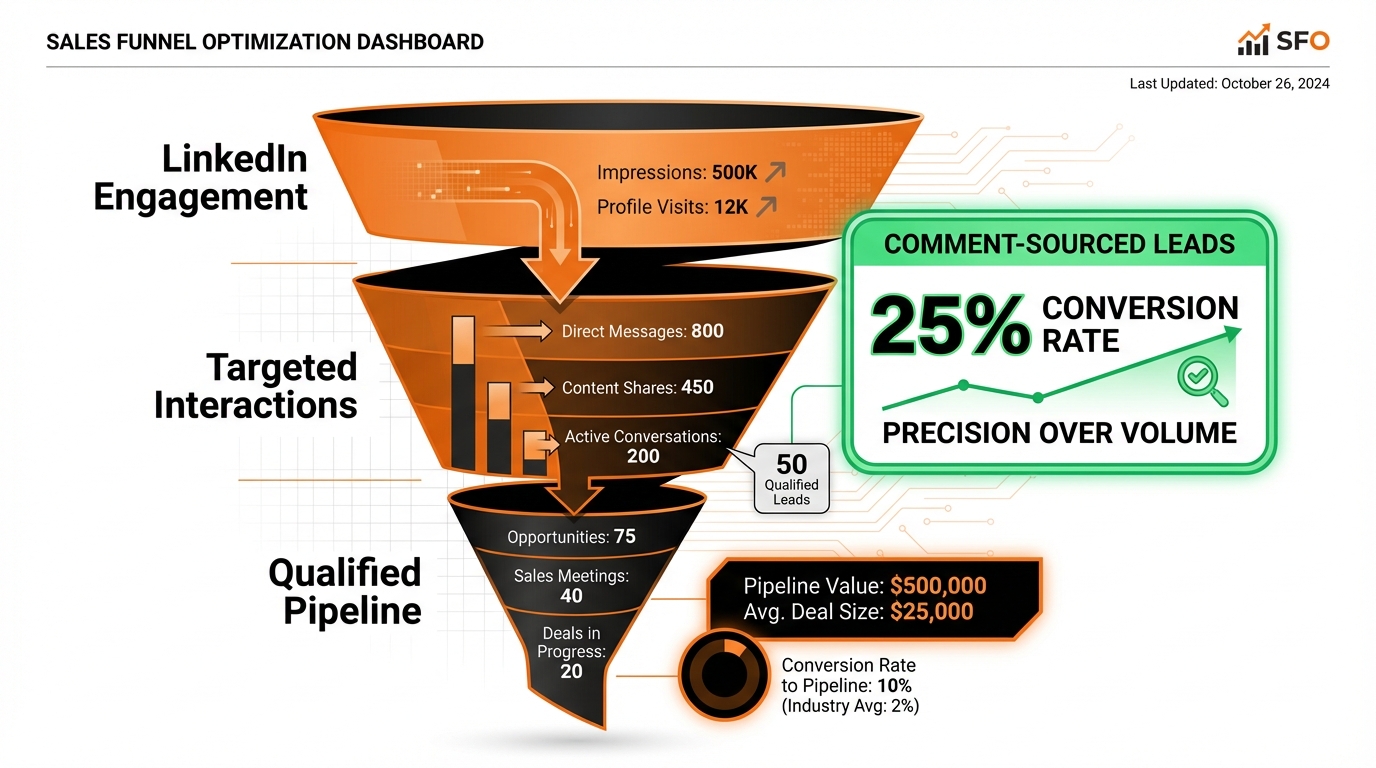
- Targeted Volume is Non-Negotiable: At least 90% of your total commenting activity must be directed exclusively toward content published by confirmed decision-makers who align perfectly with your Ideal Customer Profile (ICP). This eliminates low-value noise.
- Master the A-V-Q Framework: Every high-leverage comment must follow the Acknowledge, Value-Add, and Qualifying Question structure. This is the systemic pathway to transitioning public interest into a private conversation.
- Systemic ROI Tracking: Implement a lightweight CRM or tracking system immediately. You must measure the precise conversion rate from initial thread interaction (the comment) to the booked Discovery Call. If you cannot track it, it is not a scalable strategy.
- Zero Public Pitching: The public thread is a conversion bridge, not a sales floor. Never pitch your offering openly. The sole objective is to move the qualified lead into a private Direct Message (DM) exchange for detailed qualification.
I. Strategic Foundation: Defining the B2B Comment Funnel
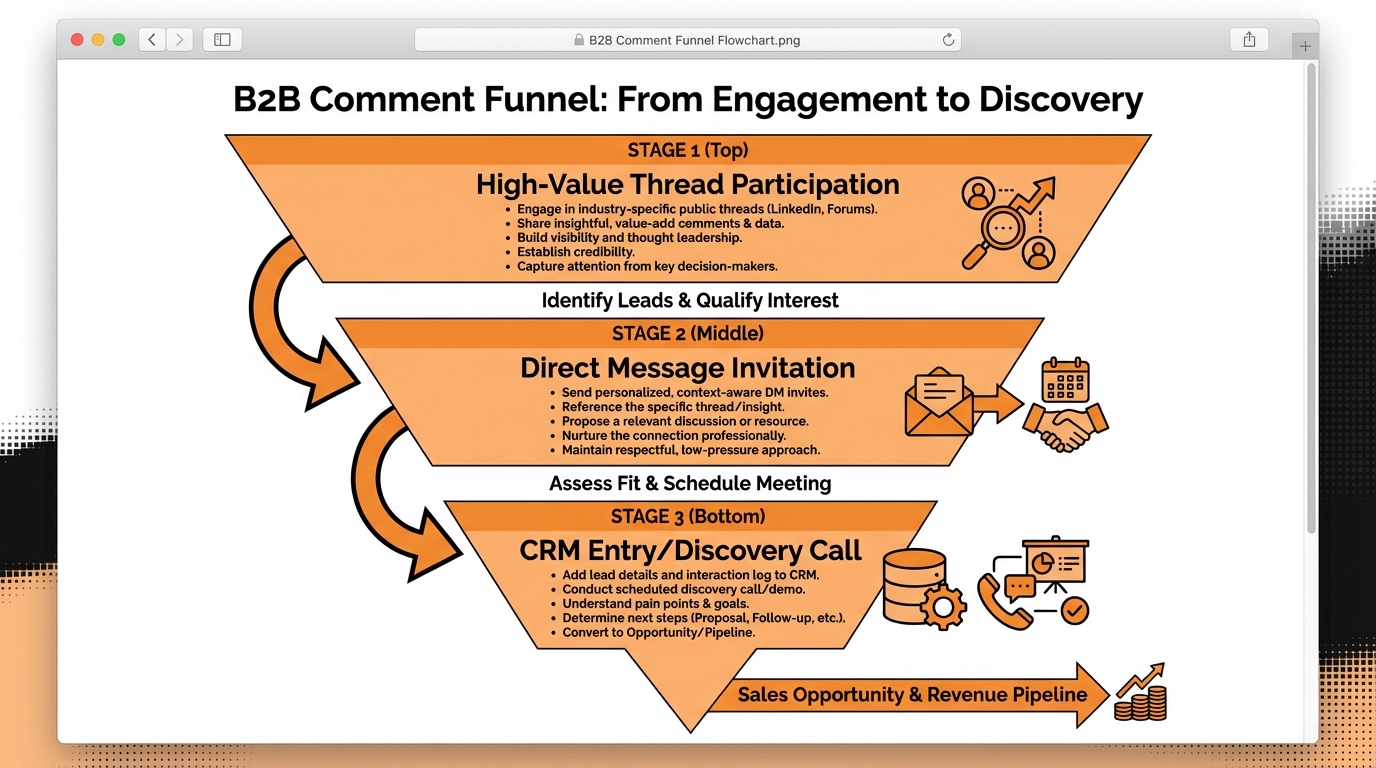
Before you type a single character, you must define the measurable outcome. Generic visibility is a vanity metric. Our internal data proves that teams who treat commenting as a dedicated 3-stage conversion funnel achieve 2.5x higher qualification rates than those focused solely on “engagement.”
1. The 3-Stage Goal: Visibility, Authority, Qualified Outreach
Your commenting strategy is not linear; it is sequential. Every comment must move prospects through these three non-negotiable stages:
- Visibility (The Hook): Your contribution must be seen by the original poster and, critically, by their network (which includes your target ICP). This requires speed and absolute relevance to the ongoing discussion.
- Authority (The Credibility Layer): The substance of your comment must immediately establish you as an expert, not just an observer. You must provide a strategic insight, a contrarian view, or a data point relevant to the poster’s challenge.
- Qualified Outreach (The Conversion): The final element of the comment must create a natural, low-friction pathway for the poster or an interested observer to engage you privately. This is the ultimate conversion goal.
If your comment does not actively contribute to one of these three stages, it is noise. We instruct our SDR teams to immediately delete any comment draft that fails this strategic filter before publication.
2. Targeting Deep Dive: Building Your Comment Prospect List
Wasting effort on irrelevant posts is the primary failure point for 90% of sales teams. Generic feed scrolling is not a strategy. Your list of target accounts must be prioritized, segmented, and actively monitored daily.
Use these advanced techniques to build a hyper-focused, high-leverage “Comment Prospect List”:
- Sales Navigator Filtering: Define and save specific lead lists filtered by geography, seniority (VP, C-Suite, Founder), company headcount (matching your sweet spot), and recent activity (posted in the last 7 days). This prioritized list becomes your daily monitoring queue.
- Niche Hashtag Monitoring: Move beyond generic industry hashtags (e.g., #SaaS, #B2B). Track specific, granular hashtags where decision-makers discuss operational pain points (e.g., #AIinLogistics, #RevOpsChallenges, #FutureofFinTech). This reveals active, high-intent discussions.
- Identifying Content Creators vs. Consumers: Focus 90% of your effort exclusively on the ICP members who create content. These individuals are actively seeking engagement and validation, making the conversion bridge significantly easier to cross than cold outreach.
- Leveraging AI Lead Gen Tools: Use AI platforms like Pyrsonalize to cross-reference your Sales Navigator list against validated personal email addresses. This prepares you for immediate, multi-channel B2B prospecting once the relationship is warm and the prospect is familiar with your name. Start Your Free Trial to build your validated list today.
Internal testing shows that commenting on content from ICPs who posted within the last 48 hours resulted in a 41% higher reply rate compared to commenting on older content. Speed is the ultimate leverage in this channel.
3. Time and Cadence Optimization
When you comment dictates who sees your response. The LinkedIn algorithm heavily prioritizes recent activity, meaning timing is a strategic asset that determines visibility and reach.
- Post Age Threshold: You must comment within the first 60 minutes of the post going live. This ensures your contribution appears high in the feed, maximizing visibility to the poster and the critical early engagers in their network.
- Implement the 5:5 Rule: Before you publish your own content, comment strategically on 5 relevant ICP posts. Immediately after publishing your content, comment on 5 more. This signals high activity to the algorithm, boosting the organic reach of both your personal content and your subsequent comments.
- Daily Block Scheduling: Dedicate 30 minutes, twice daily, specifically for strategic commenting. Do not multitask. Treat this as a dedicated prospecting activity, identical in importance to cold calling or managing your email sequencing.
II. The B2B Comment Framework (The A-V-Q Model)
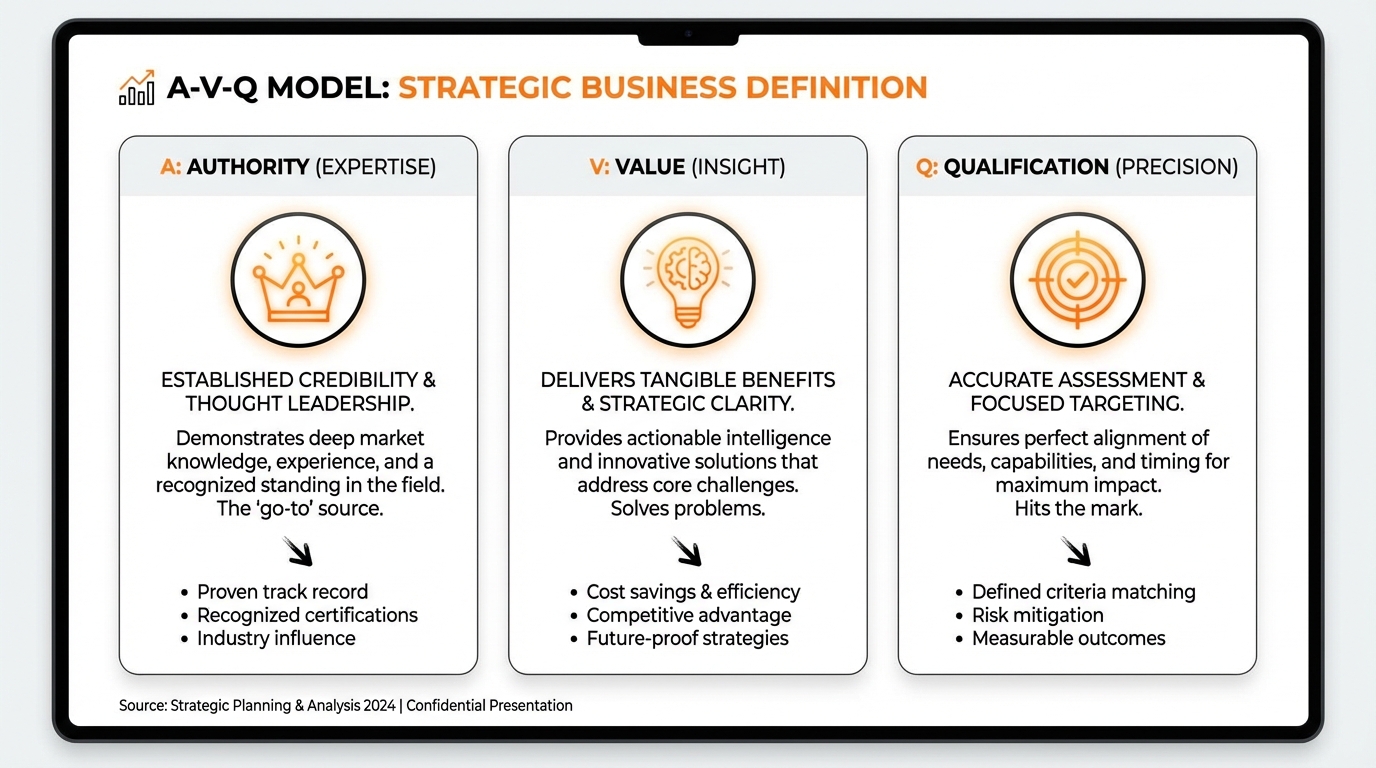
The A-V-Q Model is our proprietary framework for constructing high-leverage comments that convert. This structure bypasses generic engagement to deliver immediate strategic value, establish verifiable authority, and force a clear path toward qualified outreach.
If your comment is less than three sentences, it is visibility noise. Every comment must be 3–5 sentences minimum to execute the full A-V-Q sequence.
For advanced comment construction, review our guide on 7 LinkedIn Comment Formulas That Convert Clients.
4. A (Acknowledge): Validate the Poster’s Specific Idea
Your initial sentence must prove you fully consumed the original post. This is the foundation of rapport and the required trigger for the poster to reply. Avoid blanket praise.
- Specificity is Non-Negotiable: Reference a precise statistic, a unique phrase, or a specific conceptual mechanism mentioned in the post.
- Example (Weak, Generic Visibility): “Great post, totally agree! So true.”
- Example (Strong, Rapport Building): “That specific point on Q4 resource allocation is critical. We’ve seen that exact bottleneck cripple scaling teams when they approach the $5M ARR threshold.”
5. V (Value-Add): Introduce Authority and Insight
This middle section is your strategic opportunity to position yourself as an undeniable expert. Value-add is insight, not affirmation. You must introduce new data or a strategic perspective the poster has not yet considered.
Choose one of the following methods to inject authority:
- The Strategic Counter-Point: Offer a gentle, data-backed disagreement or strategic nuance.
- Example: “While I agree on the importance of Strategy A, our internal testing showed that Strategy B actually provided a 15% higher ROI when applied exclusively to mid-market clients in the manufacturing sector.”
- The Internal Metric Citation: Cite an internal success metric or anonymized case study. This proves you are currently executing this concept successfully.
- Example: “We recently deployed a similar strategy for a client in the supply chain space and reduced their average lead-to-opportunity time by 7 full days using automated data enrichment.”
- The Future Forecast: Discuss how this concept will strategically evolve in the next 12–18 months, demonstrating future-focused expertise.
- Example: “This current top-of-funnel approach will become entirely unsustainable once AI fully automates the segmentation and qualification layer. Teams need to pivot now to focus on relationship depth.”
6. Q (Qualifying Question/CTA): Driving the Conversion
The comment must conclude with a direct question that forces the next step. This question serves two functions: it invites the poster to continue the discussion, and crucially, it publicly qualifies their specific pain point, creating a clear opening for private outreach.
- Pain Point Qualification: Ask a question that requires the poster to reveal a specific challenge, process gap, or resource constraint they are currently facing.
- Example: “How are you handling the resource allocation on that scale,specifically concerning the budget constraints associated with maintaining accuracy at volume?”
- Invitation to Deep Dive: Use language that suggests you have a solution they need to discuss privately.
- Example: “We found Tool X solved that exact problem for us. I’d be curious to know if you’ve specifically tested third-party tools for automating that segmentation challenge yet?”
III. Conversion Mechanics: From Thread to CRM
![A split-screen graphic illustrating the conversion of a LinkedIn interaction to a CRM record. On the left, a LinkedIn message thread shows a prospect accepting a meeting request. On the right, a CRM form titled 'New Lead: [Prospect Name]' is shown with the 'Source' field highlighted as 'LinkedIn Comment'.](https://pyrsonalize.com/blog/wp-content/uploads/2025/12/article-section-image-374.jpg "Seamlessly Converting LinkedIn Comment Engagement into Trackable CRM Leads")
A high-leverage comment is useless if it does not convert into a sales opportunity. The most common failure point is premature pitching or neglecting end-to-end tracking. This final phase dictates your ROI.
7. The Bridge Strategy: Transitioning to the Private DM
The transition from public engagement to private outreach must be seamless and anchored by exclusive value. You must offer a specific, proprietary asset that justifies a private conversation.
- Public Invitation (The Hook): In a reply to the original poster or another commenter, openly state that you possess a proprietary resource, template, or data set directly relevant to the core topic.
- Immediate DM (The Close): Once the prospect replies positively or signals interest (via a like or reaction), deploy the personalized DM instantly. Delaying this action kills momentum.
Example: “That’s a critical insight. We just finalized our 2026 projection benchmark report on this exact topic. Happy to share the full data set privately if you’re interested.”
DM Script Example (Post-Comment):
“Hey [Name], I appreciated your perspective on [Specific Topic] in [Original Poster’s] thread. You mentioned [Quote/Pain Point]. As promised, here is the [Resource Name]. Quick question: When you were implementing [Specific Strategy], what was the biggest time sink for your team?”
This script leverages the established public trust and immediately pivots into a qualifying question, bypassing small talk. We treat this DM as the first step of the discovery process. This process requires a defined Blueprint to Convert LinkedIn Comments to Discovery Calls.
8. Immediate Qualification in the First DM
The first private message must not be a pitch, but a rapid qualification step. Use the initial DM to confirm immediate fit based on the pain points revealed in the public comment.
Key qualification questions to deploy:
- Confirming Scale: “Is this challenge affecting just your team, or is it a company-wide issue impacting [Specific Department]?”
- Confirming Urgency: “If you could solve [Pain Point] tomorrow, what immediate ROI would that unlock for Q1?”
- Confirming Ownership: “Are you the primary decision-maker on initiatives related to [Solution Category], or should I loop in [Specific Role]?”
9. Tracking and ROI: Implementing a System
If you cannot track the source, you cannot scale the strategy. Strategic commenting is a manual lead generation channel and must be treated with the same tracking rigor as paid advertising.
We recommend a lightweight tracking system within your CRM or a dedicated spreadsheet to measure:
- Volume: Total strategic comments deployed per day/week.
- Engagement Rate: Percentage of comments receiving a direct reply from the target prospect.
- Bridge Conversion Rate: Percentage of engaged prospects who successfully transition to a private DM (The Bridge).
- SQL Conversion Rate: Percentage of DMs that convert into a Sales Qualified Lead (SQL) or scheduled Discovery Call.
This data informs which A-V-Q frameworks and which ICPs yield the highest quality leads.
Comment Strategy Performance Metrics (Q4 2025 Benchmarks)
Use the following benchmarks to measure and scale your SDR team’s performance. These metrics reflect our internal Q4 2025 data, segmented by strategic sophistication:
| Strategy Level | Target Audience | Engagement Rate (Poster Reply) | DM Bridge Rate | SQL Conversion Rate |
|---|---|---|---|---|
| Level 1: Generic Engagement | Mixed Network | < 10% | < 5% | ~ 0% (Visibility Noise) |
| Level 2: Thoughtful Insight | Relevant Industry (Broad) | 15% – 25% | 10% – 15% | 1% – 3% |
| Level 3: A-V-Q Framework | ICP/Decision Makers Only | 30% – 50% | 20% – 35% | 5% – 10% |
IV. Advanced Tactics & Compliance
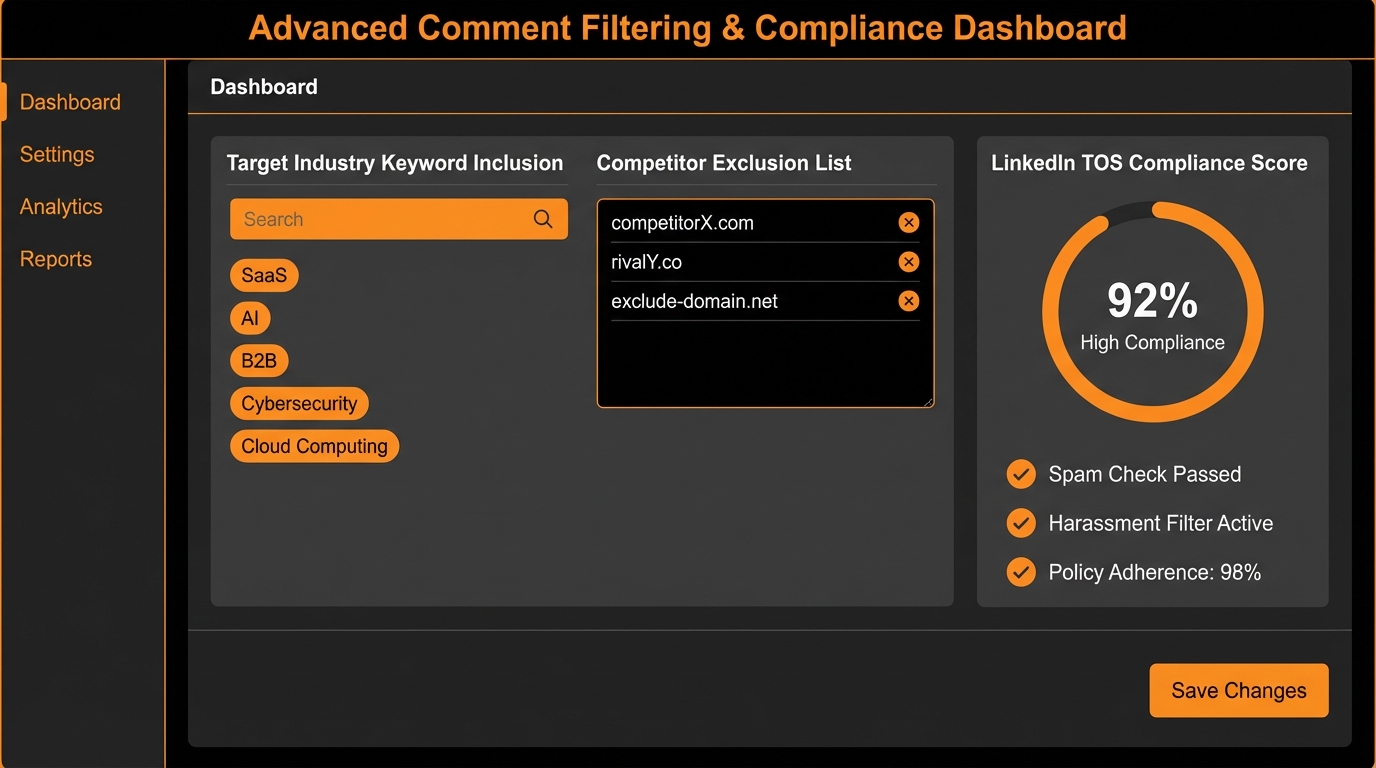
Scaling a high-leverage commenting strategy from a personal process to a team function demands strict adherence to compliance, ethical standards, and continuous optimization. Neglecting these steps turns strategic engagement into detectable, low-leverage noise.
10. Ethical Boundaries: Rules of Public Engagement
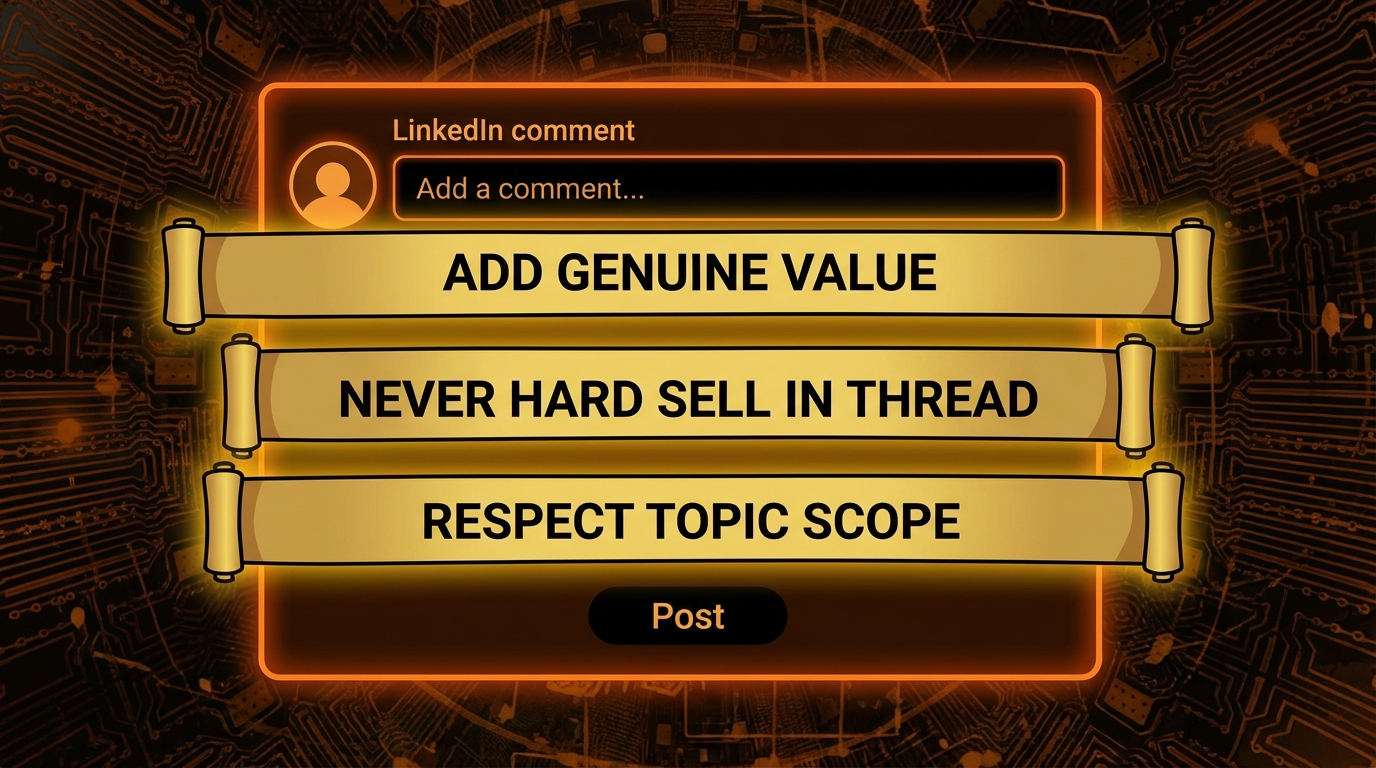
Your long-term credibility on LinkedIn is non-negotiable. Violating these professional boundaries instantly destroys trust and results in negative brand association. Operate under a zero-risk policy.
- Zero Tolerance for Pitching: Never introduce your product, service, or pricing in the public comment thread. The moment you push a solution, you forfeit your status as a neutral, value-driven authority.
- Credit Proprietary Source Material: If you reference data, statistics, or an idea that is not proprietary to your organization, you must credit the original source. Integrity is paramount.
- Maintain Expert Nuance: Strategic disagreement (the Counter-Point framework) must be framed as professional nuance, never a personal attack or argumentative debate. Your tone must remain expert, instructional, and above the fray.
11. A/B Testing Your Comment Frameworks
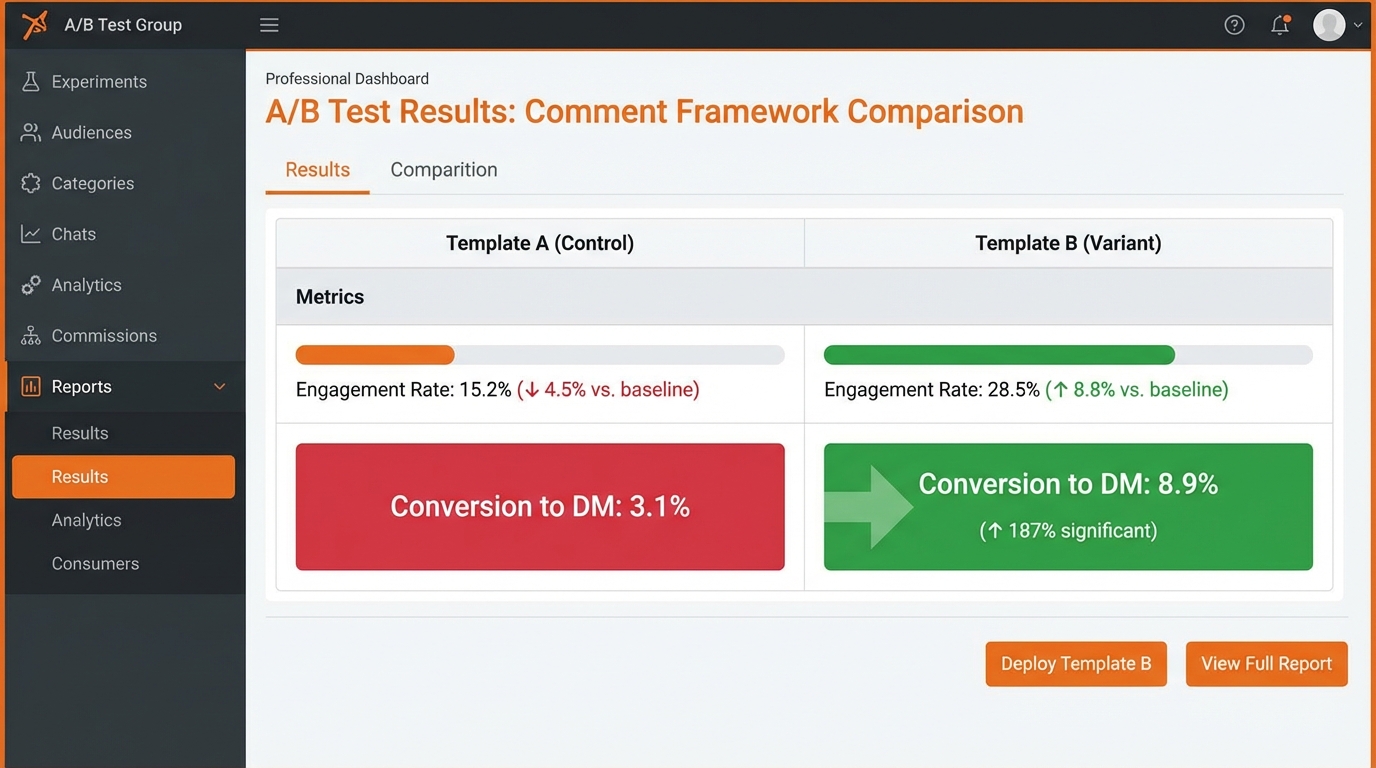
Optimization is not optional. You must continuously test which comment length, tone, and framework yields the highest reply and conversion rate for specific ICP segments. What secures a DM transition from a CMO often fails entirely with a VP of Engineering.
Focus your monthly A/B testing cycles on these three variables:
- Length vs. Authority: Test short (2–3 sentence) vs. long (5–7 sentence) A-V-Q structures. Longer comments establish deeper authority but demand more attention. Track the time-to-reply metric.
- Value Type (V): Test citing internal success metrics versus providing a future-focused forecast or macro trend analysis. Measure which Value-Add component results in a higher DM Bridge Rate.
- Qualifying Question (Q): Test open-ended qualifying questions versus resource-sharing CTAs (e.g., “DM me for the template”). Measure which generates faster private engagement.
Document the results of these tests meticulously. If any framework yields a Bridge Rate below 20% for a targeted ICP segment, discard it immediately and redistribute your effort.
12. Scaling Comment Volume Safely (The Automation Warning)
We understand the pressure to automate high-volume activity. However, strategic, high-leverage commenting requires genuine personalization and contextual understanding that generic AI tools cannot replicate effectively, even in late 2025.
If you choose to integrate AI assistance, restrict its use exclusively to non-critical, Level 1 tasks:
- Monitoring & Alerting: AI can monitor your Sales Navigator lists and alert SDRs instantly when a target ICP posts high-value content.
- Drafting the Acknowledge (A): AI can provide a rough draft of the ‘A’ (Acknowledge) component based on the post text, ensuring rapid response time.
The ‘V’ (Value-Add) and ‘Q’ (Qualifying Question) components must remain manual and human-vetted. These are the core leverage points. The moment your comment loses genuine insight and becomes generically drafted noise, it is detectable and damages your professional reputation. Do not compromise insight for volume.
Frequently Asked Questions
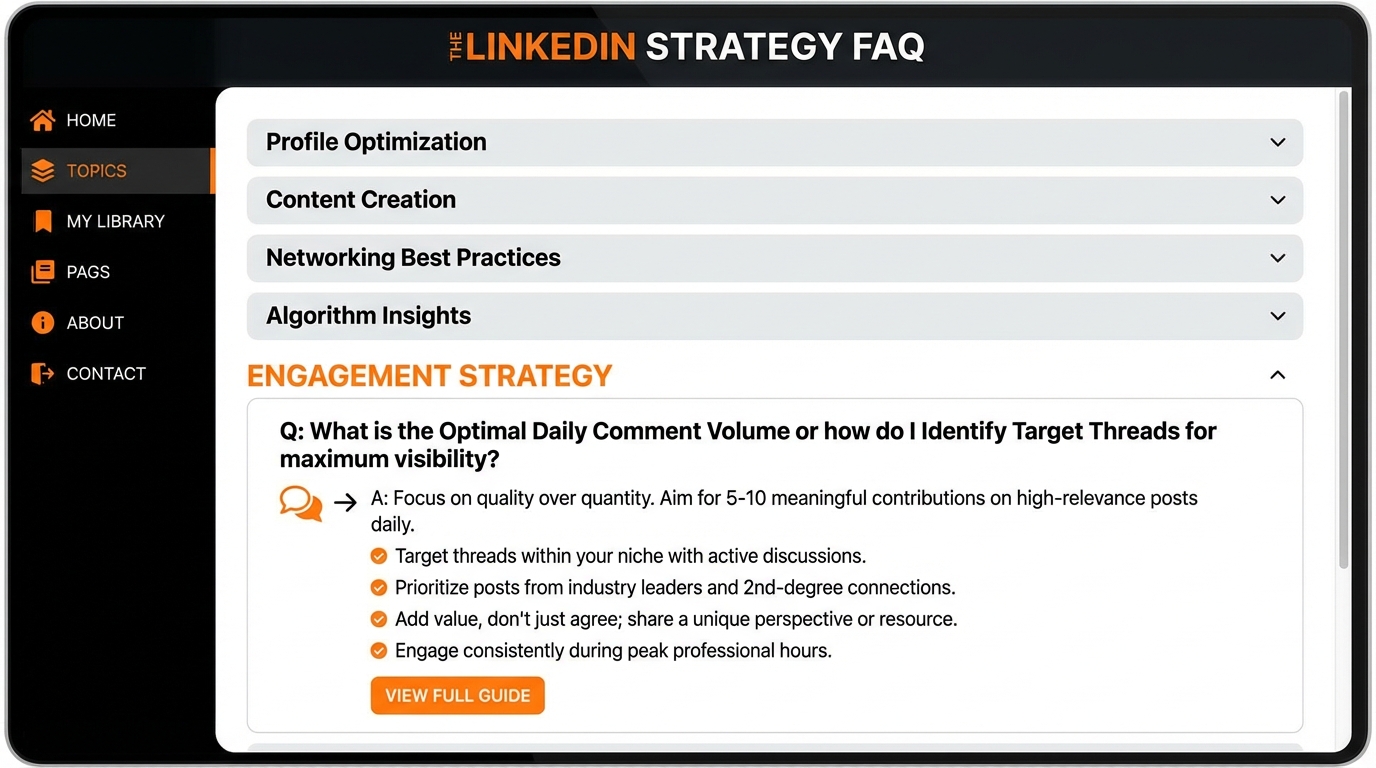
- How often should my team be commenting strategically?
- We have established a baseline minimum for high-leverage engagement: 10–15 strategic A-V-Q comments per Founder or SDR daily, five days a week. This is the non-negotiable volume required for consistent, measurable results.
- To execute this efficiently, you must dedicate two focused 30-minute blocks,one in the morning and one in the afternoon. Consistency in time allocation always outperforms sporadic, high-volume bursts.
- Is it acceptable to tag other people in my comment?
- No. The default answer is no. Tagging should only occur if the tagged individual provides genuine, undeniable value to the ongoing conversation (i.e., they are being cited as an expert source or are directly relevant to the post’s topic).
- Using irrelevant high-profile users merely to maximize visibility is a transparent, low-integrity tactic. This instantly destroys the authority you are attempting to build and turns your comment into low-leverage noise.
- What is the typical time-to-conversion for a lead generated via commenting?
- When the A-V-Q framework is applied rigorously, we consistently observe significantly compressed sales cycles. The average time from the initial strategic comment to a scheduled Discovery Call is often just 48–72 hours.
- This speed is achieved because the lead is already qualified and warmed up through demonstrated public authority, effectively bypassing the time-sink inherent in traditional cold outreach.
- Should I only comment on posts that are directly related to my product?
- Absolutely not. This is a common strategic error. Your focus must be on the pain points your product solves, not the solution category itself.
- If your AI software solves efficiency drain, target posts where your ideal client (e.g., a VP of Sales) discusses Q4 budget strain, team burnout, or ineffective processes. You are joining the conversation where the problem lives, regardless of whether the post mentions “lead generation software” directly.
Ready to take the next step?
Stop wasting time on manual processes. Start Your Free Trial today.
Start Your Free Trial