
You need leads right now. Speed defines success.
For SaaS founders and small business owners, efficiency is mandatory in 2025.
Facebook Lead Ads remain one of the most powerful, low-friction tools for high-volume lead capture.
Forget complex landing pages. Ignore high bounce rates.
The modern approach captures intent directly inside the Meta ecosystem.
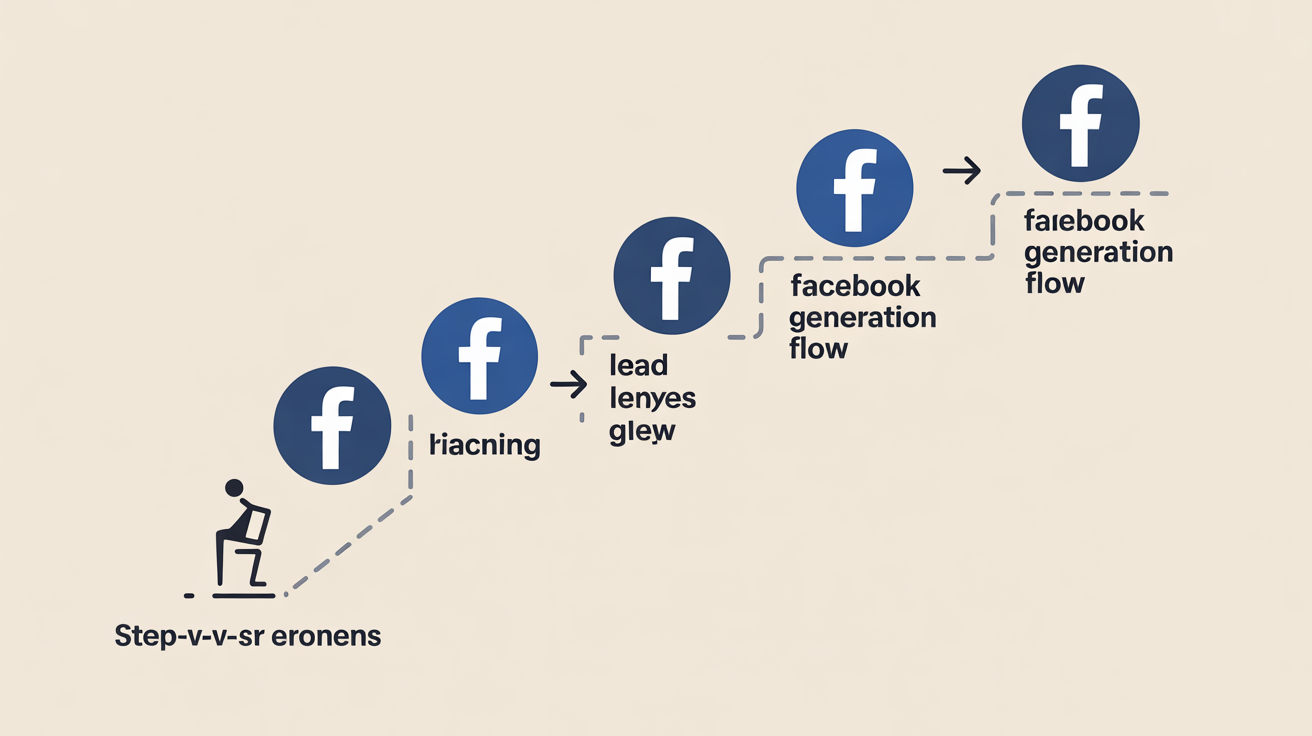
This comprehensive, step-by-step guide breaks down the manual Facebook lead generation flow.
We move beyond just setting up an ad. We focus on strategic execution.
We cover the creative, the crucial automation, and the scaling methods that ensure you acquire quality leads, not just volume.
Are you ready to build a predictable lead machine?
Phase 1: Pre-Campaign Strategy and Setup (The Foundation)

Generating leads is not about throwing money at Meta’s algorithm. It is about precision engineering.
Before you touch the Ads Manager, you must establish a solid foundation.
This strategic groundwork dictates two metrics: your Cost Per Result (CPR) and your lead quality.
Defining Your Irresistible Offer and Angle
Your offer must be highly specific. Why?
Generic offers only generate generic, low-quality leads.
What specific, acute pain point are you solving right now?
In 2025, your creative is your primary targeting filter, but your offer remains the essential bait.
Use these psychological angles to craft your initial ad concepts:
- Desire-Driven: Focus on the ultimate dream outcome. How fast can they achieve success using your SaaS platform?
- Pain-Driven: Agitate the current problem. What painful inefficiency is keeping them up at 3 AM?
- Proof/Case Study: Show undeniable evidence. Use a testimonial screenshot as the primary creative asset.
- Objection-Flipping: Address common skepticism head-on. Turn their “yeah, but…” into “oh, wow.”
Your offer needs to be clear, fast, and simple to attain.
If your service costs thousands of dollars, offer a free, personalized audit or a high-value checklist. Deliver immediate value.
The Critical Role of E-E-A-T and Reputation
Leads are inherently skeptical. Why should they give you their contact information?
Trust is the currency of conversion in digital marketing.
Even if the user never leaves Facebook, they will often check your Page reviews or search your company name.
A poor online reputation will actively sabotage your lead generation efforts and raise your CPR.
Before you scale your ad spend, ensure your digital storefront looks impeccable.
If you need help optimizing how prospects view your brand, review strategies on maximizing landing page conversion through Trust Signals: Maximize Landing Page Conversion.
Focus on integrating these E-E-A-T elements directly within your ad flow:
- Expertise: Clearly state your unique methodology or proprietary system in the ad copy headline.
- Experience: Use genuine UGC (User-Generated Content) or raw, selfie-style video concepts that show real results.
- Authoritativeness: Display client logos or media mentions (e.g., “As seen in…”) in your ad creatives.
- Trustworthiness: Ensure your Instant Form links directly to a clear, easily accessible Privacy Policy. This is mandatory compliance.
Once trust is established, move immediately to campaign execution.
Phase 2: Building the High-Converting Lead Ad (The Execution)
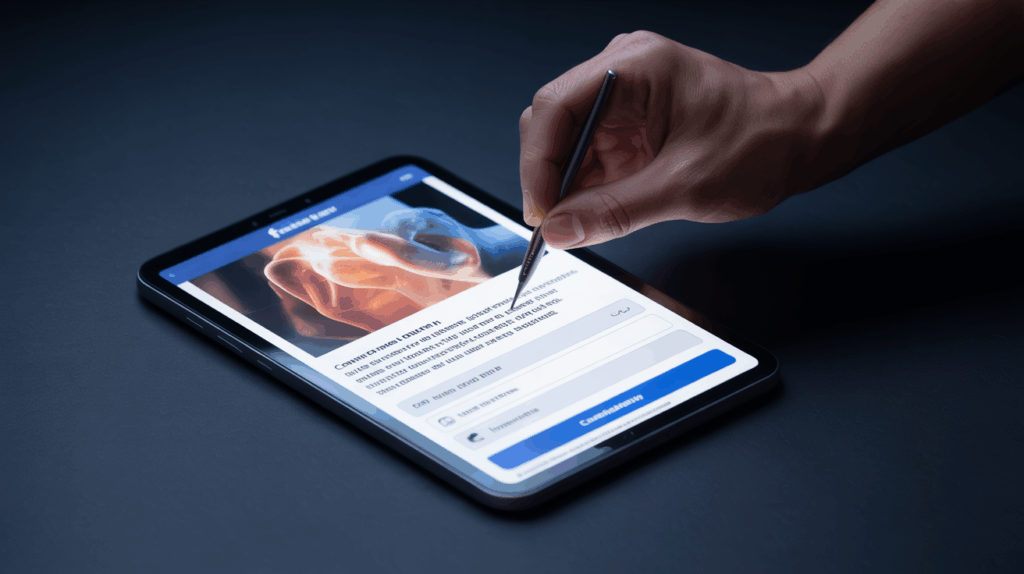
We are now moving into the Meta Ads Manager environment.
This is the core implementation of your step-by-step guide to manual Facebook lead generation flow.
The overriding goal is minimizing friction while simultaneously maximizing lead quality.
Setting Up the Campaign Objective and Budget
Start by selecting the correct objective. This is non-negotiable.
You must choose “Lead generation” when creating a new campaign.
This action tells Meta’s AI exactly what event you want it to optimize delivery for.
- Create Campaign: Go to Ads Manager and click “Create.”
- Select Objective: Choose “Lead generation” and click “Continue.”
- Naming Convention: Name your campaign clearly (e.g., “P-TEST-Q4-Audit-Broad”).
- Budget Strategy: Start with Campaign Budget Optimization (CBO) turned on for stability. CBO is essential for efficient budget allocation across multiple Ad Sets, especially when scaling.
Initial testing budgets should be sufficient to gather 50-100 conversion events quickly. Aim for $20-$50 per Ad Set per day. This allows the algorithm to exit the learning phase efficiently without burning excessive cash on unproven creative concepts.
Creative is the New Targeting (2025 Mandate)
Micro-managing detailed interests is obsolete. Do not waste time here.
Meta’s AI is powerful enough to find your ideal audience, provided your creative acts as the precise magnet.
If your creative only stops the right person, the targeting is already accomplished.
Use a diverse concept roster for initial testing:
- UGC Concepts: Raw, unpolished videos where a ‘real person’ talks directly to the camera about the problem and solution. These often yield the lowest CPR.
- Before/After: Visual transformation or quantifiable results presented clearly (e.g., 30 days, 3x revenue).
- Static Image with Bold Text: Single image creative utilizing a pattern interrupt or a shocking industry statistic overlaid.
- Review Screenshot Ad: Use a real customer review or testimonial as the primary visual and headline.
Structure your ad copy using this proven, high-conversion formula:
[Acute Pain or Driving Desire] + [Big Promise/Result] + [Proof or Curiosity Hook] + [Simple, Low-Friction CTA]
Designing the Instant Form for Quality Leads
The Instant Form is where the conversion happens. It opens instantly inside Facebook, offering pre-populated user data.
Warning: Too much ease often results in low-intent leads. You must strategically balance volume and intent.
| Form Type | Goal | Question Structure |
|---|---|---|
| More Volume (Lower Intent) | Maximize lead count quickly (often cheaper CPR). | Pre-filled name, email, phone. Minimal custom questions. |
| Higher Intent (Qualified Leads) | Generate leads ready to buy (higher CPR but better closing rate). | Use conditional logic or short-answer questions (e.g., “What is your current monthly revenue, $5K, $20K, or $100K+?” or “Do you have a dedicated sales team?”). |
Always select the “Higher Intent” form type if your service has a high average contract value (ACV) or requires immediate sales follow-up.
The “Higher Intent” form includes a mandatory review step, forcing the user to consciously confirm their details, filtering out accidental clicks.
Steps for Form Creation:
- Intro: Use a compelling headline and a background image that matches your ad creative for continuity.
- Questions: Customize fields. Always ask 2-3 qualifying questions beyond just contact details to establish need and budget.
- Privacy: Link your Privacy Policy. This step is critical for compliance and trust.
- Completion: The ‘Thank You’ screen. Provide a clear next step, such as a direct link to book a call or download the resource immediately.
A submitted form is only the first step. The true ROI is determined by rapid follow-up.
Phase 3: Automation, Attribution, and Follow-Up (The Conversion Engine)
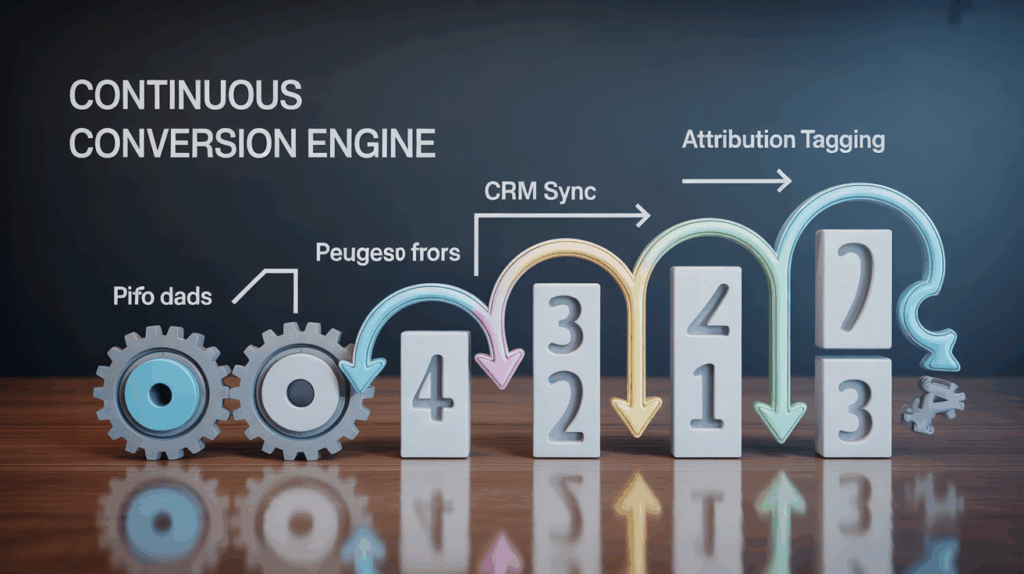
You have successfully captured a lead. What happens in the next five minutes determines your ROI.
The 5-Minute Rule is critical: studies show contacting a lead within five minutes of submission increases conversion rates by up to 900%.
Manual downloading of CSV files is a death sentence for scaling sales teams.
Automation is non-negotiable for a scalable step-by-step guide to manual Facebook lead generation flow.
Connecting Lead Ads to Your CRM (The Speed Advantage)
Leads must flow instantly and synchronously from Meta to your Customer Relationship Management (CRM) system.
This requires a robust, zero-lag integration solution.
Tools like Pyrsonalize.com specialize in connecting these disparate data points, ensuring zero lead lag time.
Our AI Lead Generation SaaS helps you instantly process, qualify, and initiate the outreach sequence the moment a prospect hits “Submit.”
This level of automated speed is the true competitive edge in 2025.
A high-performance lead workflow looks like this:
- Facebook Lead Ad Instant Form is submitted.
- Data instantly syncs to the CRM/Sales Platform (e.g., using Pyrsonalize.com or a tool like Zapier). Reviewing Essential Zapier Lead Generation Workflow Templates can provide structure here.
- Immediate multi-channel follow-up is triggered (Automated Call, SMS, Email).
- Lead is automatically scored and assigned to the correct sales representative.
- Sales rep receives a notification and initiates the human call attempt within the 5-minute window.
Mastering Conversion API and Tracking Parameters
Accurate attribution is the bedrock of profitable scaling.
Due to privacy updates (iOS, browser restrictions), relying solely on the Facebook Pixel is highly risky and inaccurate.
You must implement the Conversions API (CAPI) immediately.
CAPI sends conversion data directly from your server to Meta, bypassing browser limitations. This ensures your optimization data is clean and accurate, reducing your effective CPA by improving delivery quality.
This allows Meta to optimize delivery based on higher-quality downstream events, such as “Qualified Lead” or “Booked Demo,” rather than just “Form Submission.”
Furthermore, use Tracking Parameters to gain granular visibility inside your CRM.
Tracking parameters are hidden fields within the Instant Form that identify the specific ad, ad set, or campaign that generated the lead.
How to configure Instant Form Tracking Parameters:
- Go to your Instant Form settings in Ads Manager.
- Select “Tracking Parameters.”
- Add dynamic parameters like
utm_source(Value: Facebook),utm_campaign(Value: {{campaign.name}}), andad_id(Value: {{ad.id}}).
This data is pushed directly into your CRM, allowing your sales team to know exactly which creative generated the lead. This informs your scaling decisions.
The Multi-Channel Follow-Up Attack
One touchpoint is insufficient. If you rely only on email, your show-up rates will suffer drastically.
Effective lead nurturing requires a coordinated, automated, and personalized sequence.
Modern sales teams leverage sophisticated Top AI Tools for High-Volume Cold Outreach 2025 to personalize and automate these sequences at scale.
Your initial 15-minute sequence should include:
- Immediate Call Attempt: Human interaction is still paramount. Attempt the call immediately.
- Immediate SMS Text: Confirmation of submission and a brief, personalized message (“Saw you requested the SaaS Audit. Checking if you’re free for a quick chat now?”).
- Immediate Value Email: Deliver the promised asset (if applicable) and reinforce the next step (booking a call or demo).
If they do not convert immediately, drop them into a 7-14 day nurture list. Remember, you paid for that lead; maximize its lifetime value.
Phase 4: Scaling and Optimization Discipline (The Growth Mandate)

You have tested your creative and validated your automation flow. Now, it is time to scale.
Scaling aggressively without discipline is the quickest way to destroy profitability and spike your CPA.
We use a controlled, systematic approach for predictable growth.
The 3-Campaign Structure
Never mix testing with scaling. Volatility kills profit.
Adopt a three-tiered campaign structure for maximum control and efficiency in budget management.
We recommend organizing your budget and goals like this:
- Prospecting Campaign (Testing): Goal is to find new winning creatives. Use broad targeting, CBO enabled, high creative velocity (5-8 fresh ads weekly). Budget allocation: 20-30%.
- Remarketing Campaign (Trust Building): Goal is to convert warm traffic. Targets site visitors, video viewers, and form openers (30-90 days). Ads focus exclusively on testimonials and objection handling. Budget allocation: 10-20%.
- Scaling Campaign (Profit Mode): Goal is to pour fuel on proven winners only. Move top-performing Ad Sets from Prospecting here. Use controlled, incremental budget increases. Budget allocation: 50-70%.
This structure ensures your core profit engine (Scaling) is protected from the inherent volatility of creative testing.
Calculating Breakeven CPR and Scaling Safely
You cannot scale what you do not accurately measure.
The single most important metric is your Breakeven Cost Per Result (CPR).
This is the maximum threshold you can pay for a lead or booked call before you start losing money.
Breakeven CPR Formula:
Breakeven CPR = (Profit Margin Per Client) x (Lead-to-Client Closing Rate)
Example: Your SaaS subscription generates $5,000 in lifetime value (LTV), and your profit margin is 50% ($2,500). Your closing rate is 5% (1 in 20 leads converts).
Revenue per Lead = $2,500 x 0.05 = $125
Your Breakeven CPR is $125. If you pay $130 per lead, you are operating at a net loss.
Use your Breakeven CPR to manage your ads ruthlessly:
- Kill Ads: Any ad running 25-50% above your breakeven CPR after three days of sufficient spend must be immediately paused.
- Scale Winners: If an ad is performing well under breakeven (e.g., $80 CPR), move it to your protected Scaling Campaign.
When scaling, increase budgets gradually. Rapid doubling of budget often spikes costs and throws the campaign back into the destructive learning phase.
Stick to a maximum 5-10% daily increase on winning Ad Sets, or use fixed dollar increases ($250-$500 every three days) if you are spending over $1,000 daily.
For high-volume spenders, consider implementing bid caps to force Meta to stay within your profitable CPR range. Maintain disciplined control.
This systematic, data-driven approach transforms your Facebook efforts from a gamble into a predictable, high-yield asset.