


The SDR role is not a destination. It is a launchpad.
You know the goal: The Account Executive (AE) seat. It means higher earnings. It means real autonomy. Crucially, it means full ownership of the sales cycle.
But the transition is harder than industry blogs suggest. The market is competitive; mobility is not guaranteed. Internal promotion is rarely handed out based purely on quota attainment. Quota is table stakes.
Moving from SDR to AE requires a fundamental strategic shift: Stop acting like a prospector. Start thinking like a closer.
We consistently observe SDRs making a critical error: They focus only on weekly KPIs. This misses the point entirely. Getting promoted is a sales cycle. In this cycle, you are the product.
This is the exact 12-month blueprint our top-performing clients utilize. It is designed to force internal promotion (or secure a high-ticket external AE role) in the competitive 2025 market.
We break the promotion path into three non-negotiable phases:
- Phase 1: Internal Leverage. Stop focusing solely on volume. Start managing perception and building influence with managers and VPs.
- Phase 2: AE Skill Mastery. You need to run demos, forecast accurately, and negotiate pricing,before you get the title.
- Phase 3: The Promotion Pitch. Promotion is a sale. You must document your value and present a compelling case, backed by data (not just bookings).
Follow this framework. Your timeline shrinks from 24 months to 12.
Key Takeaways: The AE Transition Strategy
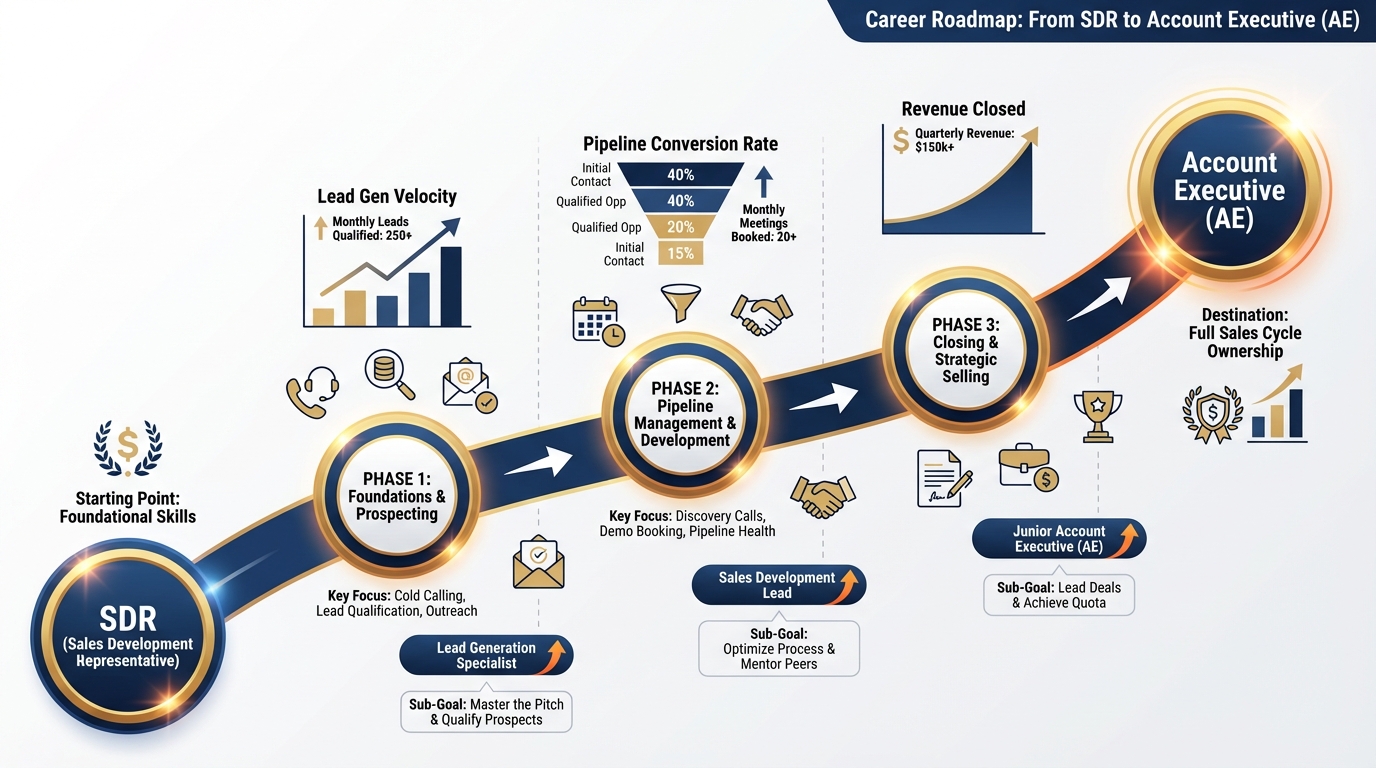
Promotion is not a lottery ticket. It is a structured, measurable sales campaign.
We broke this transition blueprint down into three non-negotiable phases,each designed to secure the role and guarantee Q1 success:
- Phase 1 (0-6 Months): Mastery. Exceeding quota is the baseline. You must consistently overachieve (120%+). This builds the financial leverage required for salary negotiation,before you even submit the application.
- Phase 2 (6-12 Months): Readiness. Stop relying on basic qualification frameworks (BANT, GPCT). Shift your methodology entirely to complex closing strategies (MEDDIC, Command of the Message). This proves AE-level strategic thinking and deal control.
- Phase 3 (12+ Months): Execution. Treat the promotion itself as a multi-threaded, high-value sales cycle. Your target accounts are internal VPs and Directors. Secure these internal champions *before* the role is officially posted.
The objective is tactical: We are not aiming just to get the job. We are aiming to demonstrate immediate ROI. The goal is to hit the ground running and close deals immediately,driving measurable revenue in your first quarter as an AE.
Phase 1 (0–6 Months): Mastering the SDR Engine

Your first six months define your reputation. This period is strictly about proving reliability and establishing yourself as a high-quality pipeline generator.
But foundational work must be strategic. You must build a system that runs itself,that is the only way to free up the time necessary for AE shadowing and advanced skill development.
Step #1: Achieve & Sustain Quota Consistency
Quota attainment is the price of admission. Without it, the AE conversation ends immediately.
Hitting the number once is insufficient. Our internal standard requires six consecutive months of 100%+ attainment,minimum. Why this rigidity? The AE role demands consistency across long, complex sales cycles. If you cannot maintain predictable activity as an SDR, you will fail to maintain pipeline predictability as an AE.
- Track the Right Metrics: Move beyond basic activity volume. Focus intensely on the quality of the meetings booked (SQL conversion rate) and the total pipeline generated (ARR sourced). These are the metrics AEs use to measure their own success.
- Build a System, Not a Habit: Implement a strict workflow (reference SDR Agent KPIs: The 2025 Blueprint for Predictable Revenue) that allows you to hit 80% of your quota by the 15th of the month. This buffer time is crucial for the AE preparation steps that follow.
- Document Your Wins: Start a “Brag Document” immediately. Log every successful sequence, every key discovery question you asked, and every time an AE praised the quality of your lead. This document is your resume for promotion.
The biggest mistake SDRs make is believing that high volume equals high value. A top SDR focuses relentlessly on quality of qualification because that directly translates to AE trust and future success.
Step #2: The Methodology Shift: From BANT to MEDDIC
SDRs rely on BANT (Budget, Authority, Need, Timeline) to set appointments. This is the entry-level framework.
AEs operate on closing frameworks: MEDDIC or MEDDPICC. This is necessary to manage complex, multi-threaded deals and secure revenue.
This methodology gap is precisely where 90% of SDR transitions fail. You must bridge it now.
Understanding the AE Mindset
You must start applying AE concepts to every SDR call:
- Economic Buyer Identification (E): Stop just finding the decision-maker. Identify the Economic Buyer,the person who signs the contract and controls the budget. Can you get their name? Can you articulate the specific financial pain their company is facing?
- Decision Criteria (D): Understand how the prospect will formally evaluate your solution against internal alternatives and competitors. If you book a meeting, you must tell the AE exactly what criteria the prospect will use to judge success.
- Pain Deep Dive (Quantification): Use advanced discovery to uncover the *financial impact* of the pain point. Instead of asking, “Do you have a need?” ask, “If you don’t solve this in the next quarter, what is the estimated cost to the business?” (If you are still struggling with basic qualification, reference How To Qualify Leads Using Bant Framework Sdr.)
Practice this methodology shift today. Every time your AE praises your “Great qualification,” log it in your Brag Document. If they complain, “I wish I knew who the economic buyer was,” you have an immediate, measurable area for improvement. This is how you build the trust required to earn the AE seat.
Phase 2 (6–12 Months): Strategic Readiness

You proved you can hit the number. Now, you must prove you can manage the complexity of the Account Executive role.
This phase is strategic: it demands exposure, networking, and skill acquisition that sits deliberately outside your formal job description.
Step #3: Internal Sales Cycle Mastery and Forecasting
AEs are judged by accurate revenue forecasting. SDRs are judged solely by activity volume.
You must bridge this gap. Shadow the entire sales process,specifically focusing on the stages after the initial demo. This is where deals die (or thrive).
- Shadow Everything: Stop only sitting in on discovery. Shadow negotiation, legal review, and implementation handoffs. Ask the AE directly: “What is the single biggest risk factor in this deal?”
- Master CRM Forecasting: Your CRM is not a logging tool. It is a strategic pipeline management engine. Ask your manager to demonstrate precisely how they move opportunities, calculate win rates, and project future revenue.
- Run a Micro-Deal (Mandatory): Proactively secure permission to manage a small, low-risk deal (e.g., a short-cycle SMB account) from discovery to close. Closing one deal independently provides massive, undeniable leverage in your promotion interview.
Step #4: AE Tech Stack Integration and Proficiency
The AE tech stack is fundamentally different,and far more complex,than the SDR stack.
SDRs optimize for outreach velocity (Outreach, Salesloft) and data acquisition (using Pyrsonalize AI to find critical contacts). AEs optimize for deal management, negotiation leverage, and risk analysis.
You need immediate familiarity with these platforms. If you lack access, demand dedicated training or temporary learning licenses.
| AE Tech Category | Platform Examples | SDR Action Required |
|---|---|---|
| Conversation Intelligence | Gong, Chorus | Analyze top-performing AE calls (deal structure, negotiation language, talk tracks). Identify the key decision-making moments. |
| CRM Forecasting | Salesforce, HubSpot Pipeline | Understand stage definitions, exit criteria, and reporting dashboards. Learn how to justify a deal’s probability percentage. |
| Contract Management (CPQ) | DealHub, Conga, DocuSign | Understand how quotes are generated, how redlining works, and common legal objections that delay close. |
| Sales Engagement (Advanced) | Outreach, Salesloft (Advanced reporting) | Learn how The Essential SDR Sales Tech Stack Blueprint for 2025 integrates with forecasting,not just initial contact. |
Step #5: The Financial Reality Check (Comp Structure)
The AE role is a massive financial pivot. You must understand the inherent risk.
SDR compensation relies heavily on base salary (60–70% base). AE compensation flips that model entirely.
The Shift: You are trading guaranteed stability for massive financial leverage.
- Variable Compensation Dominates: AE OTE (On-Target Earnings) is typically 50/50 or even 40/60 base/variable split. Your income is tied directly to closed revenue, not just activity logs.
- Quota Multiplier Shock: Expect your AE quota to be 5x to 10x your SDR pipeline quota. If you sourced $100K in pipeline monthly, prepare to close $40K in monthly ARR as the AE.
Negotiation Insight (Critical): When negotiating your first AE role internally, prioritize the base/variable split and the ramp period.
Demand a 90-day or 120-day ramp. During this period, you must be paid 100% of your expected OTE. This is non-negotiable protection against the initial learning curve.
Phase 3 (12+ Months): Execution and Transition

The preparation phase is over. This is pure execution. We are securing the role,and we are defining your long-term earnings trajectory immediately.
Step #6: Segment Strategy: Choosing Your First AE Role
Not all AE roles deliver the same ROI. Your first closing seat dictates your next decade of income. Choose wisely.
You have a critical decision point: Small-to-Midsize Business (SMB) or Mid-Market (MM).
SMB Account Executive
- Pros: Shorter sales cycles (30–60 days). Lower Average Contract Value (ACV),faster conversion. High volume of transactional deals. Excellent for rapidly developing core closing instincts.
- Cons: Lower overall deal size. High burnout potential due to volume targets. Minimal exposure to multi-threaded Enterprise negotiations.
Mid-Market Account Executive
- Pros: Significantly higher ACV. Better On-Target Earnings (OTE) potential long-term. Exposure to complex stakeholder maps and procurement processes. Builds the foundational skills necessary for future Enterprise sales.
- Cons: Longer sales cycles (90–180 days). Higher pressure to manage pipeline risk. Requires disciplined forecasting accuracy.
Strategic Mandate: If the internal promotion path leads to SMB, take it immediately. Secure the AE title. Spend 12–18 months dominating that segment.
Then, leverage that proven closing record to jump externally: Target a Mid-Market role at a higher-paying organization. The title is leverage. Get the title first,then optimize the compensation.
Step #7: Negotiating the Offer (Internal vs. External)
You are a top performer (120%+ quota attainment for 6+ months). You have maximum leverage. Use it.
Internal Promotion: Risk is minimal; you know the product and the cultural landscape. The downside? Compensation packages are often standardized (and non-negotiable).
- The Tactic: If base salary is fixed, negotiate for operational advantages: Better territory assignment, prioritized inbound lead flow, or a longer, more structured ramp period.
External Jump: This is high-risk, high-reward. You gain the ability to completely reset your compensation floor. We often see top SDRs secure a 20%+ increase in base salary this way.
- Positioning Strategy: Market the AE activities you executed in Phase 2. Use quantified results: “Managed a micro-pipeline of 5 SMB opportunities; closed 2 deals for $X ARR in Q4 2025.”
Do not wait for internal bureaucracy to catch up. If you hit the 12-month mark,and the AE path is still undefined or delayed,start applying externally immediately. Momentum is currency.
Handling Setbacks: Rejection and Imposter Syndrome

The path to the closing seat is rarely clean. We know this. Expect turbulence: Rejection is guaranteed. You may fail the internal interview. You will absolutely battle imposter syndrome during your first AE ramp. This is not a failure state; it is a test of your strategic resolve.
Navigating Promotion Rejection
If the internal promotion is denied, your immediate, strategic response defines your future earnings trajectory.
- Demand Specific, Actionable Feedback: Do not accept HR pleasantries. Schedule the follow-up immediately. Ask the hiring manager directly: “What specific, measurable gap prevented this hire? Was it pipeline forecasting? Command of the pricing conversation?”
- Codify the Improvement Plan: Draft a 90-day plan based *only* on that feedback. Send it to both your direct manager and the hiring manager. This documents your commitment, professionalism, and coachability (a critical AE trait).
- Establish the Hard Deadline: If the company cannot provide a guaranteed, written promotion timeline (e.g., “Review in Q3 2026, assuming X metrics are met”), they are actively stalling your career. Execute the external jump plan immediately. Your time is too valuable to waste on vague promises.
Managing Imposter Syndrome in Q1 AE
The first 90 days as a closing AE are a foundational period. You moved from SDR mastery to AE rookie status. Missing quota during the ramp is standard,it is not a reflection of your long-term ability.
The skills that generated high SDR activity (speed, volume) often fail in complex, multi-stakeholder deal management. You must rewire your focus.
- Focus on Process Velocity, Not Immediate Revenue: For 90 days, your metric is perfect execution of the AE playbook. This means multi-threading every deal, conducting thorough mutual action plans, accurate stage forecasting, and maintaining ruthless follow-up cadences.
- Weaponize Conversation Intelligence: Do not guess where you failed. Listen to your own loss calls. Use tools like Gong or Chorus to benchmark your negotiation talk tracks against the top 10% of the team. Identify the precise moment you lost control of the narrative.
- Never Abandon Proactive Prospecting: Relying solely on inbound leads is a rookie mistake that creates future pipeline instability. Dedicate 3-5 hours weekly to highly personalized outbound. This stabilizes your pipeline and reduces the acute pressure of relying on others (SDRs/Marketing).
The SDR role taught you volume and rejection tolerance. The AE role requires strategic patience and mastery of complexity. Master the process, and the revenue follows.
Secure Your Pipeline. Secure Your Promotion.

Your transition to the closing seat demands efficiency. Your promotion relies on closing deals. Closing deals relies entirely on pipeline quality.
This is the AE mandate: A high-performing Account Executive minimizes friction points. They eliminate low-value tasks. They do not spend hours manually searching for contact data.
We engineered Pyrsonalize to solve the data bottleneck. We automate the acquisition of accurate contact information (personal emails, verified direct dials). This provides non-negotiable leverage for any AE focused on achieving quota and securing future growth.
Great AEs eliminate manual list building. They prioritize conversion strategy. We provide the fuel.
- Focus 100% on Strategy: Remove manual data acquisition from your workflow entirely.
- Target Decision-Makers: Feed your pipeline exclusively with verified SaaS founders and high-ticket service business owners.
- Accelerate Ramp Time: Stop wasting crucial early ramp hours on low-value, time-sucking data entry.
- Build Trust Systems: Leverage highly accurate, personal data to initiate organic, trust-based outreach campaigns.
If you want to transition from SDR to AE,and succeed in that closing seat,you must prioritize pipeline efficiency over manual effort.
Frequently Asked Questions
- How long does it typically take to transition from SDR to AE?
- The standard path takes 12 to 18 months. High-velocity SDRs,those demonstrating immediate AE competency,can secure the title in 9 to 12 months.
- If you are approaching 24 months, your internal mobility path is broken. This signals a systemic issue: you need to execute an external jump immediately.
- Is it better to get promoted internally or jump to an external AE role?
- Internal promotion is lower risk; you already know the product and the internal team structure. However, external negotiation yields significantly higher compensation packages.
- We advise the external jump if:
- Your internal timeline exceeds 18 months.
- You want to negotiate based purely on market rate, not internal promotion standards.
- Always prioritize the title and the compensation ceiling.
- What is the most critical skill an SDR must develop for the AE role?
- The single most critical shift is moving from Activity Management to Deal Risk Management.
- As an SDR, you manage volume. As an AE, you manage revenue forecasting and pipeline integrity. This requires disciplined time allocation and mastery of a closing methodology (specifically MEDDIC).
- If you cannot forecast your pipeline accurately, you cannot be an effective Account Executive.
Ready to take the next step?
Stop wasting time on manual data entry. Secure your pipeline today.
Try AI Lead Generation TodayReferences
- SDR Career Progression to AE: The Ultimate Guide – Kaspr
- How did you go from SDR to AE in this market without getting …
- SaaS SDR Career Path: How to Grow to AE in 18 Months | Zohort
- How to Make the Leap from SDR to AE: Your Personal Game Plan
- The SDR to AE Transition: Why It’s Harder Than You Think – YouTube