


The strategic decision is immediate: Should you outsource your lead generation to a specialized agency, or commit to building a dedicated, expensive in-house team?
Forget simple answers. The choice hinges entirely on three variables: your current growth stage, your tolerance for fixed costs, and your immediate required velocity.
Here is the reality for 2025: The complexity of B2B prospecting—requiring multi-channel outreach, advanced AI tools (like our platform for finding personal emails), and strict compliance—means the old models are broken. You need predictable pipeline, not peak-and-valley results.
Our team has scaled lead generation systems for high-growth SaaS companies for years. We know the financial traps and the scalability ceilings of each model. This guide is your definitive blueprint for choosing the right path—focusing on true cost, brand control, and long-term scalability.
Key Takeaways for Decision Makers
- In-House = Control + High Fixed Cost: Provides maximum brand alignment and proprietary product knowledge. However, expect 6 to 10 months to reach full productivity (this is a high opportunity cost).
- Agency = Speed + Variable Cost: Offers instant expertise and a massively faster ramp-up (often weeks, not months). But strict vendor vetting is non-negotiable to maintain quality and protect your brand voice.
- The Hybrid Model Wins for Growth: The most successful SaaS companies in 2025 use a Hybrid approach. They keep strategic, high-touch functions (Inbound, Customer Expansion, proprietary data management) in-house while outsourcing volume-based, specialized tasks (Cold Outbound execution, SDR function scaling) to vetted agencies.
- Focus on Fully Loaded CAC: When comparing costs, ignore salaries alone. You must calculate the Fully Loaded Customer Acquisition Cost (CAC), which includes benefits, management overhead, licensing for your entire tech stack, and ongoing training. This is the only metric that matters.
The Core Comparison: In-House vs. Outsourced Lead Generation
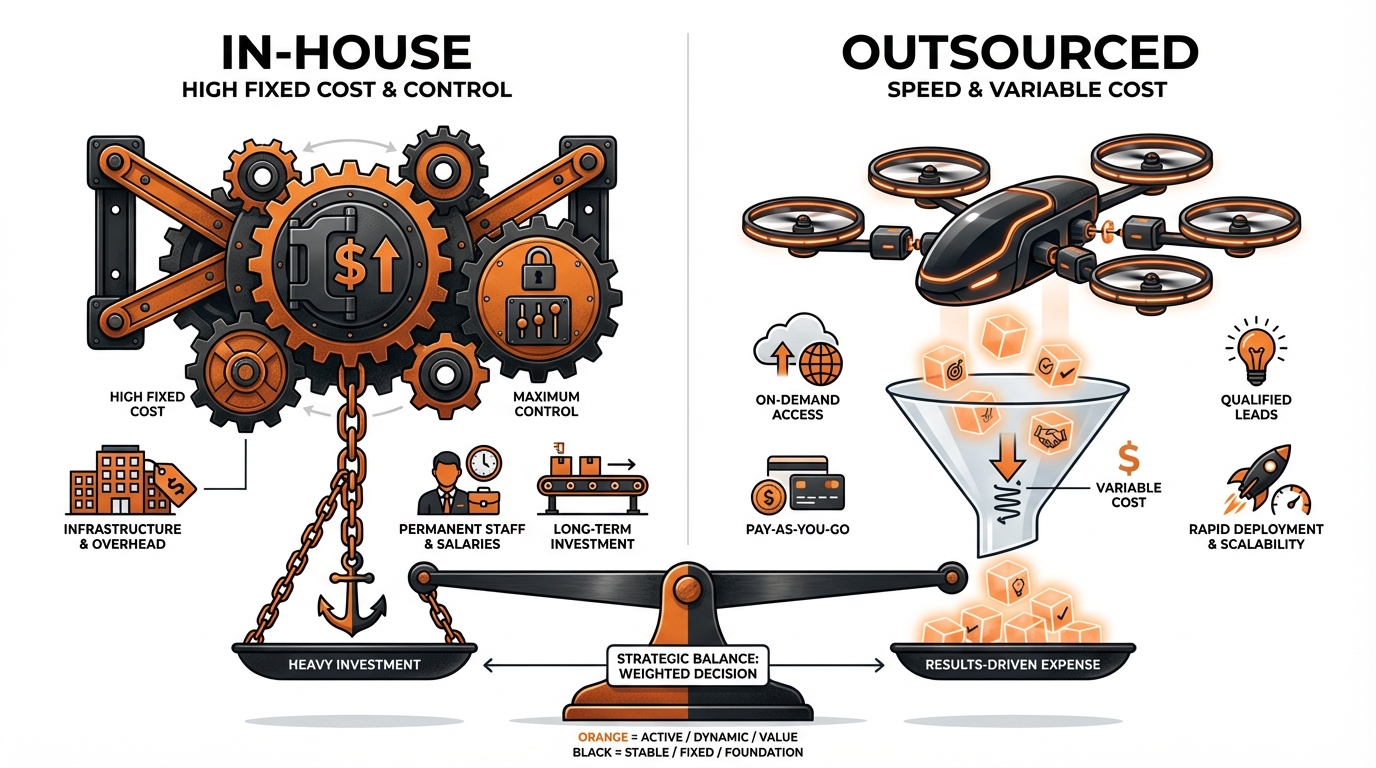
Every strategic decision in lead generation hinges on five core metrics: Cost, Control, Speed, Expertise, and Scalability. We know the truth: You can optimize for three, but you will never nail all five simultaneously. That’s the strategic trade-off.
1. Cost-Effectiveness and Fixed Overhead
Most founders see an agency retainer and immediately think: “That’s expensive.” They then compare it to a single SDR salary and assume, incorrectly, that “That’s cheaper.”
This is where the fundamental financial math fails.
Hiring an in-house team means you are committing to massive, non-negotiable fixed overhead. We are talking about true costs that extend far beyond the base salary:
- Salary, comprehensive benefits, and payroll taxes.
- Recruitment fees and time (This is critical management overhead).
- Training and ramp-up periods (Count on 7–10 months of non-productive salary burn).
- The full, high-end tech stack cost (CRM, AI prospecting tools,like ours,dialers, intent data subscriptions).
Conversely, an agency retainer is a variable operational cost. You are paying for immediate access to a complete, optimized infrastructure. You scale up or down based on market demand, without the debilitating HR headache of hiring, training, or firing.
We find that outsourced efforts consistently yield higher ROI because they distribute the cost of specialized infrastructure across multiple clients. You gain optimized infrastructure without the fixed liability.
2. Control and Brand Alignment
This category is non-negotiable: In-house wins. Period.
Your internal team is naturally steeped in your company culture. They understand the granular product nuances better than any external partner ever could, and they can pivot messaging instantly based on internal feedback.
If your product is highly technical, deeply niche, or requires extremely sensitive, high-touch communication, the in-house model is mandatory.
The inherent challenge with agencies is maintaining brand voice and quality assurance at scale. If you choose outsourcing, you must enforce rigorous Service Level Agreements (SLAs). Without comprehensive guidelines, you risk generic, low-quality outreach,the kind that actively damages your hard-won reputation.
3. Speed and Time-to-Value
Speed is the definitive value proposition of outsourcing.
We’ve tracked the timeline: Hiring a senior SDR takes three months of searching, three months of onboarding, and four months to reach target output. Total Time-to-Value: 7 to 10 months. That’s nearly a year of missed pipeline opportunity.
An agency is already operational. They possess established playbooks, fully trained staff, and a pre-purchased, optimized tool stack. They launch campaigns and deliver MQLs/SQLs within 4 to 6 weeks.
If you need pipeline right now, outsourcing delivers immediate, necessary acceleration.
4. Expertise and Tool Stack Access
A small internal team,even a team of four,cannot realistically achieve mastery across the full spectrum of modern lead generation. They cannot be experts in SEO, high-converting content, hyper-personalized cold email, LinkedIn systematic outreach, intent data analysis, and compliance simultaneously.
An agency provides instant access to a specialized talent pool: copywriters, data analysts, and high-performing SDRs. Crucially, they leverage advanced, expensive tools,like the best AI prospecting platforms,that are often cost-prohibitive for a small internal operation. (If you want to know which tools they use, check our list: Best AI Lead Generation Tools For B2B Prospecting 2026).
This immediate access to diverse, high-level expertise is the single greatest ROI driver for the outsourced model.
5. Scalability and Flexibility
Scalability is often overlooked until you need it immediately.
In-house teams scale linearly (1 new hire = 1 unit of growth, plus 10 months of ramp-up). If you hit a sudden market surge or need to pivot strategy, your internal capacity will bottleneck your growth instantly.
Agencies offer exponential scalability. They can often double or triple your outreach volume in weeks, not months, by reallocating existing, trained resources. This flexibility is key when chasing aggressive growth targets or entering new geographic markets quickly.
Strategic Fit Matrix: Matching Model to SaaS Growth Stage
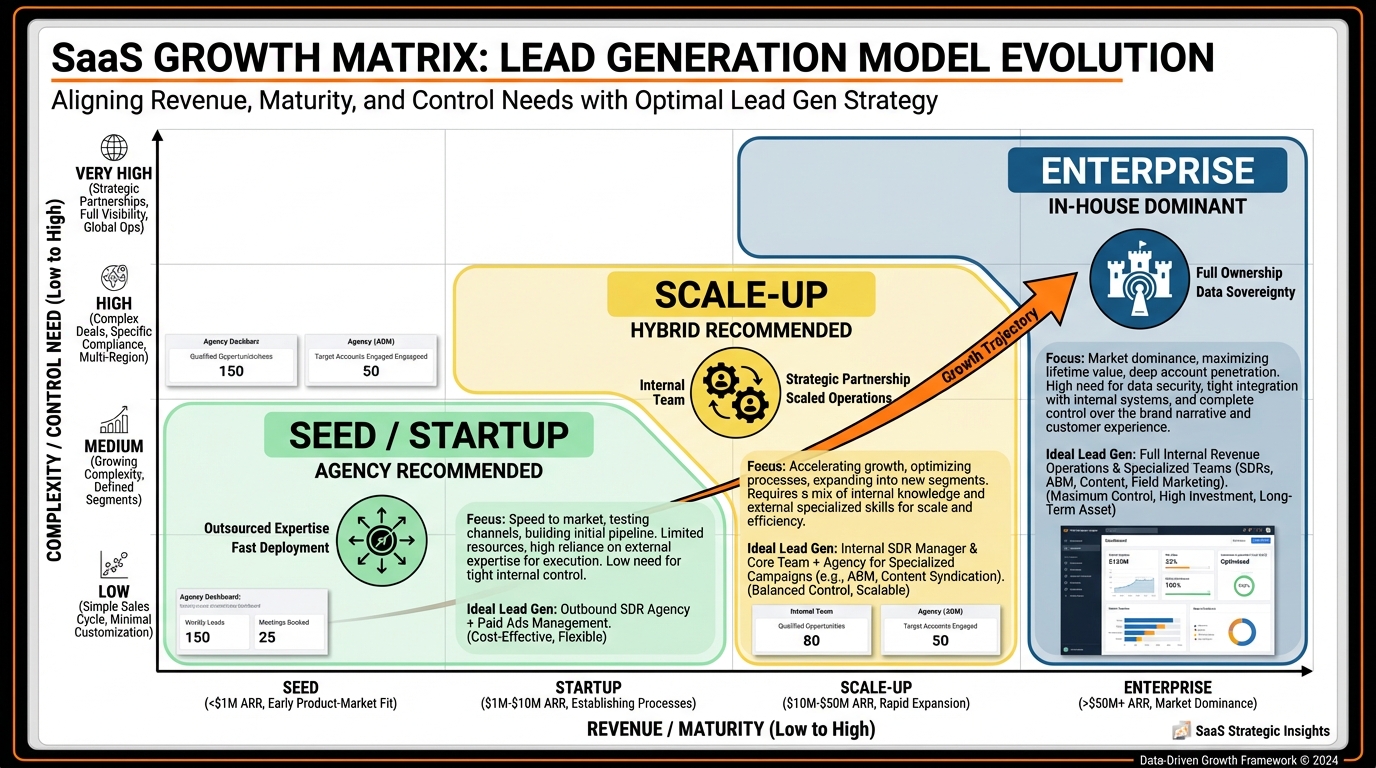
The optimal choice is not static. It evolves as your company matures and your needs shift from validation to massive scale. You must match the model to the objective.
We call this the Strategic Fit Matrix. Here is how our team maps the decision based on your current stage:
| Growth Stage | Primary Strategic Goal | Recommended Model | Justification (The Why) |
|---|---|---|---|
| Seed / Series A (Pre-PMF) | Validate ICP, rapid pipeline build, maintain low fixed cost. | Outsourced Agency | Speed and flexibility are paramount. Avoid the catastrophic fixed salary risk while testing multiple market segments and messaging frameworks. |
| Growth Stage (Series B/C) | Scalable, predictable volume, establishing internal IP, maintaining quality control. | Hybrid Model | Build internal core knowledge (Inbound/Conversion Systems) while utilizing an agency for volume outbound execution, testing, and SDR capacity overflow. |
| Enterprise/Mature | Maximum control, deep account-based focus, brand integrity, complex compliance. | In-House (with specialized contractors) | The fixed cost is justified by the sheer scale and the absolute need for brand control, security, and integration across large, complex deal cycles. |
If you are a Seed-stage founder, stop budgeting for an in-house SDR. You simply cannot afford the 10-month ramp-up time required to see results,you need validated data and meetings yesterday.
Outsourcing is the only viable path to immediate pipeline velocity in the early stages.
For Series B and C founders, the goal shifts to predictability and efficiency. The Hybrid model is not optional,it is the only proven path to predictable, scaled growth without losing core IP or sacrificing quality control.
We will break down exactly how to implement that hybrid structure in the following sections.
Financial Deep Dive: Calculating True Lead Generation Costs
Stop comparing a $70,000 SDR salary to a $10,000 monthly agency retainer. That’s an apples-to-oranges comparison that guarantees poor financial planning.
To make a strategic decision, you must calculate the Fully Loaded Customer Acquisition Cost (CAC). We analyze this down to the dollar.
Step #1: Determine the In-House Fully Loaded Cost (The True Multiplier)
The standard HR multiplier (1.4x to 1.6x base salary) is insufficient for lead generation roles. You must aggressively factor in the operational stack, management overhead, and the cost of failure.
Let’s analyze a single, high-performing SDR with a $65,000 base salary:
- Salary & Statutory Benefits: $65,000 (Base) + $15,000 (Taxes/Health/401k Match) = $80,000.
- Tech Stack (Annualized): CRM seats, email verification, intent data, and critical AI lead generation tools (like ours). This runs $5,000 to $15,000 per SDR, minimally. (We budget $10,000).
- Management & Training Overhead: The Sales Manager’s dedicated time, ongoing training, and professional development. Estimate 20% of the SDR’s salary: $13,000. (This is time your leadership *cannot* spend selling.)
- Ramp-Up Opportunity Cost (The Hidden Killer): If the SDR takes 8 months to hit full quota, you have paid $53,333 in salary for limited, trial-phase output. This cost is rarely accounted for, but it crushes early-stage ROI.
Total Annual Fixed Cost (Excluding Ramp-Up): $80,000 + $10,000 + $13,000 = $103,000+.
If that SDR produces 120 qualified leads (SQLs) per year, your Cost Per SQL (CPQL) is $858. Now, we compare this cold, hard number to the agency model.
Step #2: Determine the Agency Cost Per SQL (Variable Cost Model)
An expert agency typically charges a fixed monthly retainer (e.g., $8,000) tied to a defined, measurable scope (e.g., 15 SQLs per month, totaling 180 per year).
Total Annual Variable Cost: $8,000 retainer x 12 months = $96,000.
If the agency delivers the agreed-upon 180 SQLs, your Cost Per SQL is $533.
The Strategic Conclusion: In this common, real-world scenario, the agency model is 38% more cost-effective on a per-lead basis.
Crucially, that agency delivers faster results, requires zero management time from your leadership team, and minimizes the risk associated with personnel failure.
This is why high-growth founders treat lead generation as a variable operational expense, not a fixed overhead liability.
The Strategic Solution: Mastering the Hybrid Model for 10x Growth

If your SaaS company is past Series A, the Hybrid model is not optional,it is the most robust path to scale. It solves the core problem: maximizing in-house control over strategic functions while leveraging agency specialization for high-volume execution.
The key to making this work is defining an iron-clad division of labor. If your in-house SDRs and the agency reps are chasing the same leads, you aren’t scaling,you’re duplicating effort and crushing morale. We eliminate that friction immediately.
The Optimal Division of Labor: Our Allocation Blueprint
Our team recommends splitting responsibilities based on three factors: channel, function, and required product depth. This strategic division ensures the agency handles high-volume, repeatable tasks, freeing your in-house experts for high-value, strategic interactions (i.e., closing deals).
| Function | Best Allocated To | Why? (Key Benefit) |
|---|---|---|
| Cold Outbound Prospecting (SDR) | Agency | Volume, speed, expertise in multi-channel execution, and dedicated focus on manual lead generation. |
| Inbound Lead Qualification (BDR) | In-House | Requires deep product knowledge and immediate, high-quality response time for high-intent traffic. |
| Content/SEO Strategy | In-House | Essential for long-term brand equity, authority, and controlling the brand narrative. |
| Customer Expansion/Upsell | In-House | Requires account history, existing trust, and deep product usage context (Account Management). |
| Ad Operations (PPC/Paid Social) | Agency/Contractor | Specialized, constantly changing environment requiring deep technical skill and budget optimization expertise. |
Eliminating Friction: The Three Pillars of Hybrid Integration
A Hybrid model fails instantly if the handoff point is messy. We implement tight integration across three non-negotiable pillars to ensure zero friction:
1. Shared Technology Stack (The Single Source of Truth)
Both teams must operate within the exact same CRM instance (HubSpot, Salesforce, Pipedrive). Period.
If the agency uses its own separate database and tries to dump CSV files on you weekly, you are sacrificing data integrity and pipeline visibility. This scenario is a guaranteed failure point.
Ensure they integrate directly into your existing reporting infrastructure. This is non-negotiable for tracking performance metrics and optimizing the AI Lead Funnel.
2. Defined Lead Qualification Criteria (Iron-Clad SLA)
The single biggest cause of hybrid failure is internal friction: your in-house Sales team rejecting leads delivered by the Agency. You must eliminate subjective judgment by defining an iron-clad Service Level Agreement (SLA) for what constitutes a Sales Qualified Lead (SQL).
The SLA must specify the following non-negotiable data points:
- ICP Fit: Exact minimum company size, specific industry vertical, and required tech stack used.
- Intent Signal: Clear identification of the pain point and stated interest in booking a demo or trial.
- Qualification Framework: Which data points (BANT or MEDDIC status) must the agency confirm before the meeting is booked?
If the agency delivers a lead that meets 100% of the SLA criteria, the in-house Sales team must accept it. Accountability flows both ways.
3. Mandatory Feedback Loop (Rapid Calibration)
Forget lengthy monthly reviews. You need a weekly, mandatory 30-minute sync meeting. This meeting is not a performance review; it is a rapid calibration session.
The in-house Sales team provides immediate, tactical feedback on lead quality. Example: “Leads from the mid-market financial vertical are failing discovery due to low budget.”
The Agency uses this feedback to immediately adjust targeting parameters, refine messaging sequences, and pivot focus within 48 hours.
This level of focused agility is the core differentiator between a successful Hybrid model and an expensive, stalled experiment.
Scaling Securely: Compliance, Vetting, and the Non-Negotiable Exit Strategy

Forget volume if you haven’t mastered compliance. In the 2025 regulatory landscape, lead generation is fundamentally a data security issue.
When you onboard an agency, you are immediately outsourcing access to highly sensitive Personal Identifiable Information (PII). This is not just a risk; it is a direct liability shield breach.
Data Compliance and Regulatory Risk
Agencies that rely on aggressive, non-compliant data scraping or outdated mass cold outreach methodologies are exposing your company to crippling GDPR or CCPA fines. Understand this: You are the ultimate responsible party for every single contact made in your name.
We mandate that every partner adheres to strict, ethical prospecting standards. Our team only works with verified, compliant data sources,and we require immediate, documented respect for all opt-out requests.
If an agency cannot detail its data sourcing methods thoroughly and transparently, they are disqualified. This is where strategic, ethical prospecting tools become crucial.
See our guide on The 2025 AI Prospecting Ethics Blueprint for more on this.
Actionable Vendor Vetting Checklist
Before you sign the Statement of Work, use this iron-clad vendor vetting checklist. It is designed to mitigate risk and ensure absolute strategic alignment.
- Compliance Audit: Can they provide documented, verifiable proof of GDPR/CCPA compliance (for both data sourcing and outreach sequences)?
- Asset Ownership: Who legally owns the generated copy, sequence templates, and prospect lists? (The answer must be: Your company.)
- Vertical Experience: Have they scaled lead generation for a SaaS company within your specific vertical and Average Contract Value (ACV) range? (Demand three recent, verifiable references.)
- Real-Time Transparency: Do they provide direct, real-time access to performance dashboards,or are they hiding behind monthly summary reports?
- Defined Exit Strategy: What is the formalized process for smoothly transitioning knowledge, data, and processes back in-house? (If they don’t have one, you are building a dependency trap.)
- Critical SLA: What is the guaranteed Service Level Agreement (SLA) response time for critical issues (e.g., legal or prospect complaints)?
If an agency hesitates, balks, or tries to obfuscate transparency on any of these six points, terminate the discussion immediately. The regulatory and reputational risk is simply not worth the potential gain.
The Non-Negotiable Exit Strategy: Transitioning Lead Gen Back In-House
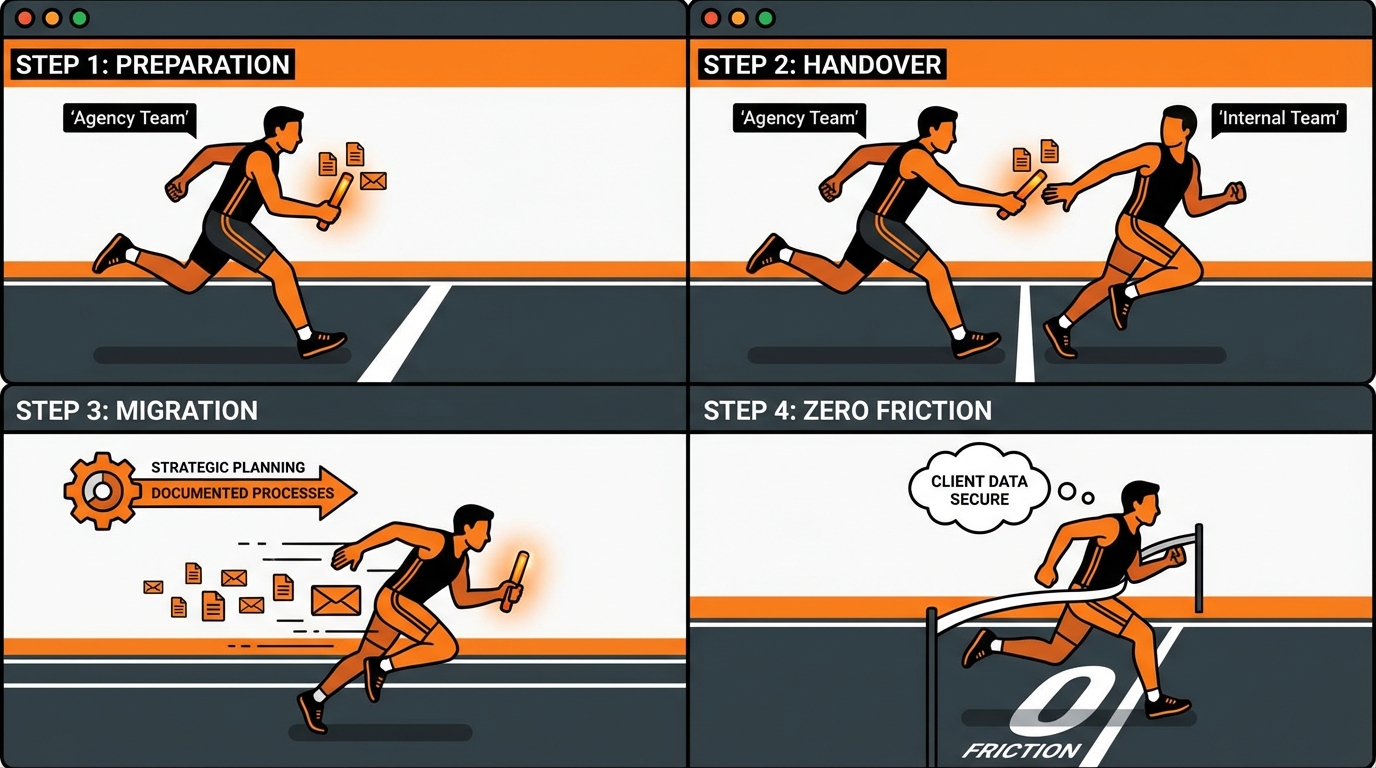
A strategic founder never builds dependencies. They build systems.
If you utilize an agency for speed and validation, your immediate goal is clear: migrate core competencies in-house the moment scaling is proven and funding is secured. This protects your margins, retains institutional knowledge, and minimizes future compliance risk.
We view the agency as a high-speed, outsourced training module,not a permanent fixture. This transition plan must be locked down and contractually obligated on Day 1.
Phase 1: IP Acquisition and Knowledge Transfer (Months 1-6)
We call this the IP Acquisition Phase. During the initial engagement, your designated in-house manager (Marketing or Sales) must be actively shadowing,and documenting,the agency’s successful playbooks. This is a non-negotiable contractual requirement.
Mandate the following deliverables:
- Capture and replicate the top-performing email sequences and scripts (word-for-word, down to the subject line structure).
- Pinpoint the exact profitable audience segments (the ICP that converts at scale) and the specific list-building methodologies used.
- Demand access to recordings of qualification calls, or mandate shadowing (ensure compliance is handled first).
- Acquire their specific tech stack configuration, automation recipes, and reporting templates.
Phase 2: Strategic Internal Pilot (Months 7-12)
Do not cut the agency loose the moment you hire your first in-house SDR. That is a guaranteed revenue dip and a rookie mistake.
We implement a strategic Internal Pilot phase instead. The agency now acts as your guaranteed volume buffer and performance control group.
Your new SDR runs small, controlled campaigns using the playbooks acquired in Phase 1. You then run a direct, ruthless metric comparison:
- Cost Per SQL vs. Agency Cost Per SQL.
- Time to Conversion vs. Agency Time to Conversion.
- Overall Conversion Rate (SDR to Demo) vs. Agency Rate.
This minimizes revenue risk while ensuring your internal hire ramps up successfully, validated against a proven external benchmark.
Phase 3: Full In-Housing (Month 12+)
This is the final termination point. Once your internal machine consistently meets,or, ideally, exceeds,the agency’s performance benchmarks for two consecutive quarters, the contract is terminated.
Congratulations. You have successfully leveraged the agency’s speed and expertise (and budget) to build a validated, high-performing internal system. This strategy saved you 12 months of costly trial-and-error, and you now own the entire lead generation system.
Frequently Asked Questions
What is the biggest hidden cost of an In-House team?
The single biggest hidden cost is opportunity cost due to ramp-up time.
You are paying a full salary for 6–10 months while an SDR struggles to learn the system and fails to hit quota. This delay costs you lost revenue from deals that never entered the pipeline.
The cost of delay routinely exceeds the entire annual agency retainer. That is a strategic failure we cannot afford.
How do I ensure an Agency maintains my Brand Voice?
This requires non-negotiable oversight. We demand high standards, and you should too.
You must furnish the agency with exhaustive brand guidelines covering:
- Tone and specific vocabulary (what terms are used vs. avoided).
- Detailed customer success narratives and case studies.
- Clear definitions of your ideal customer profile (ICP).
Critically: Demand approval on all initial outreach scripts and sequences before they go live. Ongoing quality control requires weekly, adversarial spot-checks of their communications,always.
When should a SaaS company shift from Outsourced to Hybrid?
The transition is purely strategic.
It should happen the moment scaling is validated, which typically aligns with securing a Series A or Series B funding round. This gives you the capital needed to invest in long-term infrastructure.
Alternatively, shift when the agency retainer cost exceeds the fully loaded cost of two high-performing, proven SDRs. This signals you are ready to invest in building long-term, strategic internal assets (like proprietary inbound content and scalable software).
Stop Wasting Time on Manual List Building.
Whether you hire in-house or outsource, your team needs the best tools to find verified client emails and build targeted lists instantly. This is how we boost pipeline speed and hit those aggressive quotas.
Start Your Free Trial