


You already know the generic market rates. You’ve seen the charts: $0.50 per word. $100 per hour. $500 for a basic landing page.
Ignore that data. It is irrelevant to strategic growth.
If you charge based on time or word count in 2025, you are actively leaving 60% of potential revenue unsecured. We track this closely. Our internal agency data confirms the shift: revenue increased by 77% the moment we eliminated hourly billing and started selling outcomes.
High-ticket copywriting is not about volume. It is purely about leverage and strategic positioning.
This guide is for the expert: the copywriter targeting $5,000 to $25,000 per project. We are not discussing how to justify $800 blog posts here. We are discussing precisely how to structure, anchor, and defend multi-five-figure deals against sophisticated buyers.
This is the strategic blueprint you need to execute now.
Key Takeaways: The High-Ticket Strategy Shift
- Stop Selling Hours: Hourly and per-word rates cap your potential earnings. Transition immediately to Value-Based Project Pricing (VBP).
- Anchor High: Utilize tiered proposals (Good, Better, Best). Use the middle option to anchor the client to your desired high-ticket rate.
- Negotiate Non-Monetary Value: If the rate stalls, negotiate scope reduction, faster payment terms, or IP rights. Do not immediately drop the dollar amount.
- The Walk-Away Rate: Define your professional minimum viable fee (MVF). If they cannot meet it, walk away cleanly. This preserves your authority and brand equity.
Step #1: Mandate Value-Based Pricing (VBP) in 2025

High-ticket negotiation starts by eliminating the anchors that prevent scale. Hourly rates are anchors. Per-word rates are anchors.
They cap your income potential immediately.
High-ticket projects,defined internally as any engagement exceeding $5,000,demand a fundamentally different financial structure. This is non-negotiable.
You are not selling 5,000 words of input labor. You are selling a system designed to increase traceable revenue. You sell the measurable outcome: the conversion rate spike, the 3% lift. This is the only acceptable metric.
The Two Mandatory Pricing Models
For high-ticket work, only two models apply. We rely exclusively on these structures because they maximize our leverage:
- Value-Based Project Pricing (VBP): You must calculate the potential Return on Investment (ROI) for the client before you quote. If your copy generates $100,000 in traceable Q4 revenue, a $10,000 fee delivers a 10x ROI. This justification is mathematically undeniable.
- Performance Bonuses and Royalties: This structure signals extreme confidence and unlocks maximum upside. Attach a percentage of traceable revenue (typically 0.5% to 5%) to your flat VBP fee. This aligns your financial success directly with the client’s bottom line, protecting your high base rate while maximizing profit.
Use this internal Pyrsonalize framework to assess project profitability and negotiation leverage in real-time:
| Pricing Model | High-Ticket Suitability | Primary Risk Factor | Negotiation Leverage |
|---|---|---|---|
| Per-Word / Hourly | Low (Caps income) | Scope Creep | None |
| Flat Project Fee (Low-Ticket) | Medium (Requires tight scope) | Over-delivery / Under-valuing | Minimal |
| Value-Based Project Pricing (VBP) | High (Mandatory) | Justification Failure | High (Based on ROI data) |
| VBP + Performance Bonus | Extreme (Maximum Upside) | Complex Tracking | Extreme (Confidence signal) |
Step #2: Building the High-Ticket Justification Stack
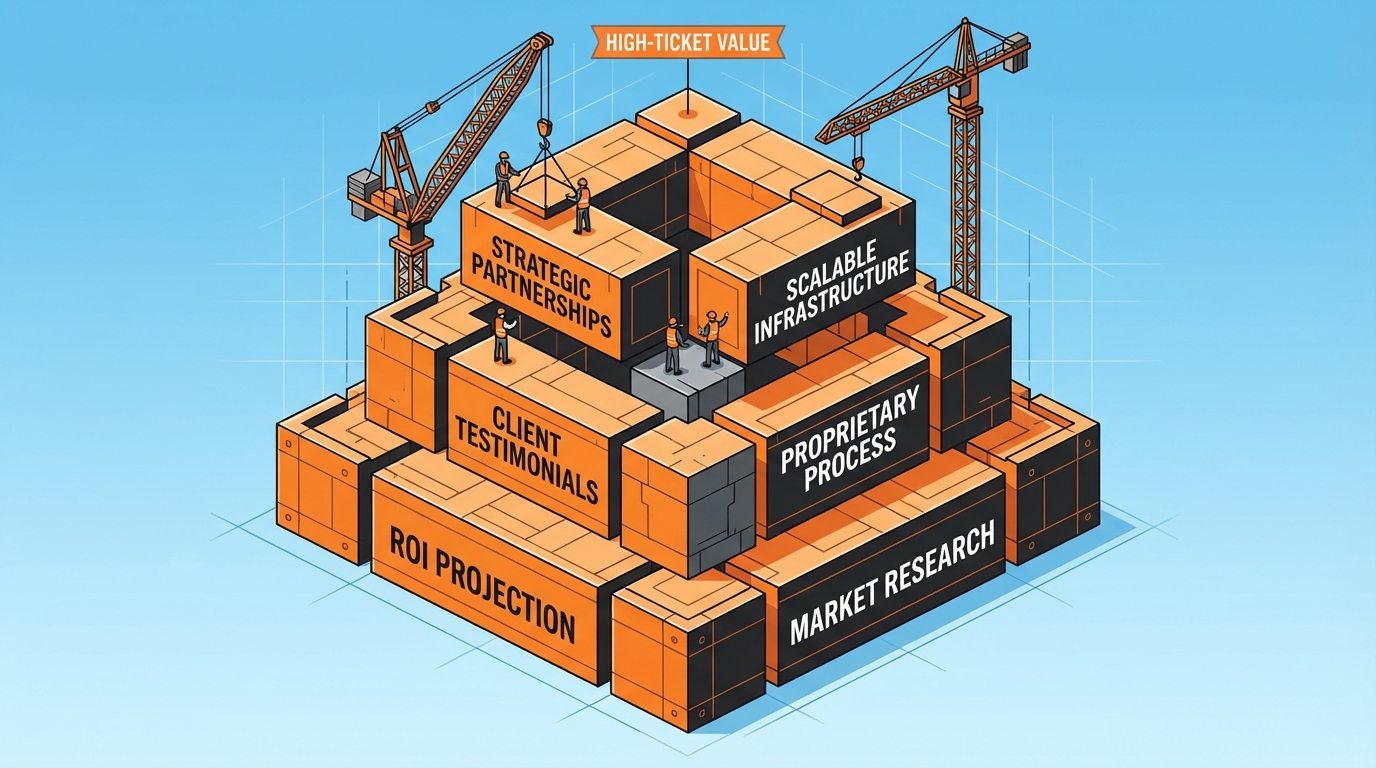
A high rate is just a claim. Claims require immediate, concrete evidence to back them up.
This evidence is your High-Ticket Justification Stack. It consists of three non-negotiable pillars. These pillars must be deployed before you present the final price.
Pillar 1: Deep Niche Authority
Generalists do not command high-ticket fees. Period.
You must position yourself as the recognized, strategic expert. This requires focusing on a narrow, high-value vertical (e.g., Enterprise B2B SaaS, specialized FinTech, or High-End E-commerce).
The client must believe you understand their customer,their market dynamics and revenue bottlenecks,better than their internal team does.
- Showcase three case studies exclusively within their industry.
- Use their specific industry jargon naturally during the discovery call to establish immediate, undeniable credibility.
- Reference competitor campaigns you have analyzed or worked directly against.
Authority eliminates negotiation friction. If you are the only expert who can solve their $100,000 revenue problem, your $15,000 fee is simply the cost of doing necessary business.
Pillar 2: Quantifiable ROI and Measurable Results
High-ticket clients do not care about subjective creativity. They care about conversion rates, lead quality, and tangible revenue lift.
You must shift the entire conversation from focusing on cost to focusing on investment potential.
“We do not charge $8,000 for a sequence of emails. We charge $8,000 to implement a proven, pre-tested sequence that, based on prior client data, has generated an average of $45,000 in traceable Q3 revenue. Your investment is protected because it’s based on our proven framework.”
If you lack direct client data, leverage current market data and modeling. Show them the projected returns of a systemized approach. This is the definition of a strategic consultant, not just a writer.
We leverage specialized AI tools internally to model these returns effectively,maximizing our own high-ticket potential. For specific implementation models, reference our guide: Monetizing ChatGPT: High-Ticket Income Without Coding.
Pillar 3: Optimized Onboarding (Discovery Call Strategy)
Negotiation starts the moment the call is booked.
This structured call is designed to establish strategic dominance and immediately disqualify low-budget leads.
Do not spend time explaining what copywriting is. Spend time diagnosing their specific revenue problem and defining their measurable outcome.
- Control the Agenda: Send a structured, time-boxed agenda beforehand. You lead the call. Always.
- Focus on Pain: Ask diagnosis questions only: “What is the precise cost of your current conversion bottleneck?” or “If this project fails, what is the measurable impact on your Q4 revenue goals?”
- Pre-Anchor the Budget: Near the end, ask about their allocated budget range. If their range falls below your minimum viable fee (MVF), professionally disqualify them immediately.
We use these same principles for lead qualification. Read our guide on how to Convert LinkedIn Comments to Discovery Calls: The 2025 Blueprint for the full process.
Step #3: Pre-Negotiation Anchoring & Proposal Strategy

The Good, Better, Best Framework
- The Anchor (The “Best” Option):
This is the intentional high-water mark. Price this 50% to 100% above your true target rate. It justifies the extreme price by defining the upper limit of value.
- Include every premium add-on: Ongoing consulting, unlimited revisions, 12 months of testing support, full launch strategy guidance.
- *Goal:* Define the maximum possible investment, even if they never purchase it.
- The Target (The “Better” Option):
This is your actual desired high-ticket rate. It includes the core deliverable plus the essential Value-Based Pricing (VBP) elements.
- Includes the core deliverable (e.g., the 5-page funnel build).
- Includes VBP elements: ROI modeling, limited revisions, and post-launch check-ins.
- It looks reasonable. Crucially, it looks high-value compared to the Anchor.
- The Decoy (The “Good” Option):
Aggressively strip this package down. Price it just above what a mediocre competitor might charge.
- It must lack strategy, include fewer pages, and offer zero post-launch support.
- *Purpose:* Its only job is to make the Target option appear like the necessary, superior investment.
The strategic result is predictable:
Clients avoid the cheap option (it screams risk). They are anchored by the highest option (the massive investment). They logically gravitate toward the middle,your target rate,which now appears discounted and safe by comparison. This is how we drive high-value decisions.
Step #4: Advanced Objection Handling & Negotiation Tactics

The proposal is submitted. Negotiation begins.
High-ticket clients are strategic buyers,they are testing your resolve. They will attack your pricing model. We must anticipate these strikes and neutralize them instantly.
Neutralizing Common High-Ticket Objections
Never apologize for your rate. Your pricing is based on measurable past results and proprietary systems.
Be ready with precise, value-focused counter-arguments. This is how we maintain authority and eliminate the price debate:
- Objection: “Agency X is cheaper. They quoted us $5k.”
Counter: “That is expected. Agency X sells word count. We sell a proprietary conversion system designed specifically for your $30M market. If you need cheap words, hire them. If you need guaranteed ROI lift, our investment is structured to be the lowest available over the long term.” - Objection: “We only pay hourly for contractors.”
Counter: “We appreciate the policy. However, our high-leverage work relies on proprietary frameworks,not time spent. Paying hourly penalizes our efficiency. We operate strictly on Value-Based Pricing (VBP) because you are buying results, not clock hours. We deliver a tested funnel in 40 hours that might take an internal hire 120 hours. We charge for the 80-hour saving we provide.” - Objection: “Prove the ROI upfront.”
Counter: “The ROI is proven by our past results (reference Pillar 2 data). We do not guarantee future results, but we guarantee our strategic commitment. If you require shared risk, we can adjust the fee structure: 20% of the payment can be tied to a specific, measurable metric achieved within 90 days. The base rate remains firm. We trade certainty for shared performance.”
Leveraging Non-Monetary Value (The Strategic Trade)
A client might genuinely hit a budget ceiling. Do not drop your price. If you drop the price, you drop your authority.
We negotiate using non-monetary levers instead. Price is only one variable in the equation.
Use these three alternatives to maintain your profit margin and strategic positioning:
- Reduced Scope: “I cannot lower the $12,000 fee. However, I can remove the two supporting email sequences and focus exclusively on the core landing page conversion mechanism. That reduces the investment to $9,500.” You cut the required work. You maintain your effective hourly rate (your return on time).
- Faster Payment Terms: Demand 75% upfront instead of the standard 50%. Always negotiate Net 15 instead of Net 30. Immediate cash flow reduces collection risk and provides instant leverage.
- IP Rights/Case Study Use: Offer a small, controlled concession (e.g., a 5% discount) in exchange for the absolute, non-revocable right to use their results, data, and logo in your future marketing materials. This social proof is the highest leverage asset for securing your next high-ticket client.
Advanced negotiation is never just about the words. It is about reading the room.
If you handle these high-stakes negotiations virtually, you must understand the subtle signals. We use AI tools to capture and analyze engagement metrics in real-time. This is how we gain the edge in virtual sales.
Ready to automate the client acquisition process entirely? Stop negotiating and start converting.
Step #5: Securing Long-Term High-Ticket Value
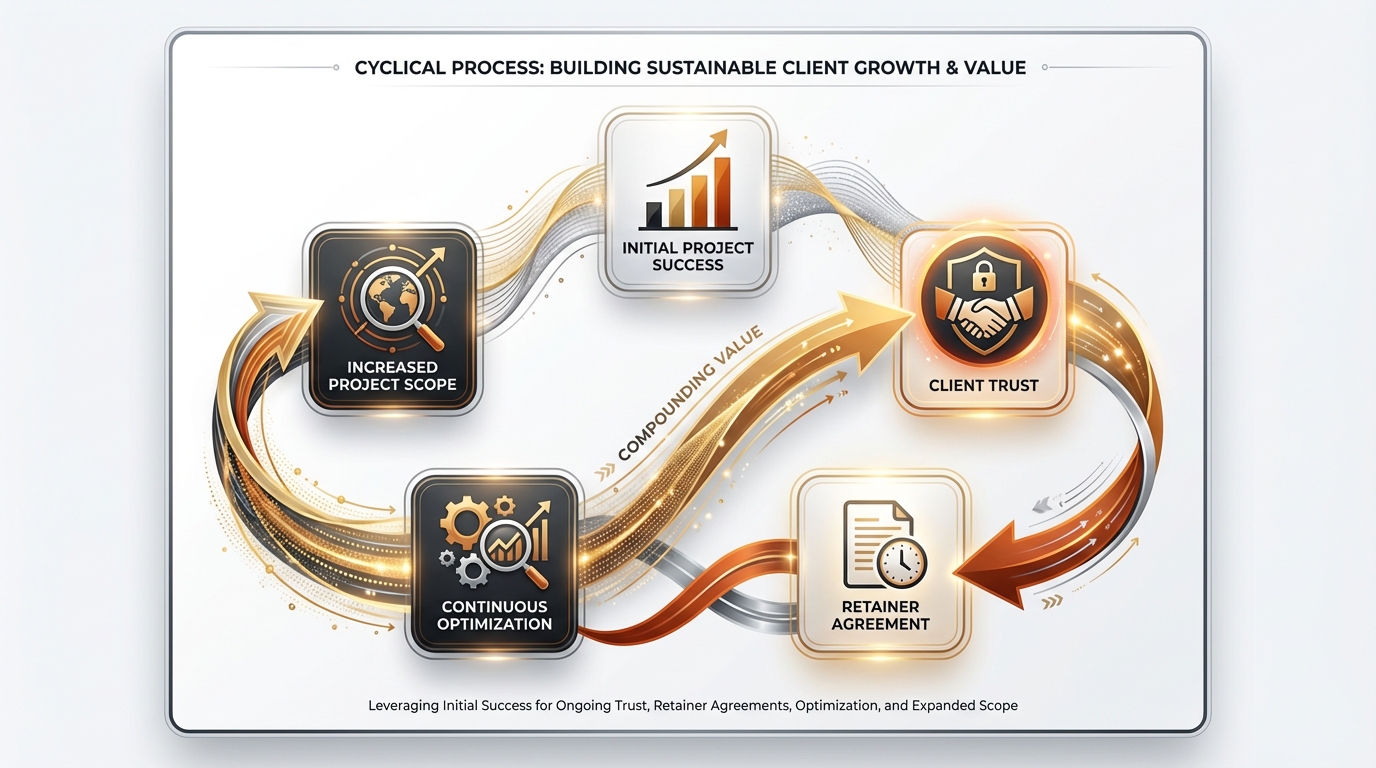
The single project is profitable. But the retainer is strategic wealth creation.
Our focus is maximizing Client Lifetime Value (CLV). We target converting 50% of initial projects into long-term bundled agreements or retainers. This stabilizes revenue. It maximizes CLV. And it dramatically reduces the friction of manual lead generation.
Negotiating Retainers and Bundling
You must frame the retainer as the mandatory next step.
It is not optional. It is essential for maximizing the ROI of the core project. Clients pay high-ticket rates for results, not just deliverables.
Bundling for Immediate Upsell
Always offer a discounted rate only when services are purchased together.
Example: A $10,000 Sales Page + a $5,000 Email Sequence equals $15,000 total. Bundle them instantly for $13,500 (a 10% discount).
The client perceives a significant deal. You secured $3,500 more than the initial core project alone. This strategy boosts our average deal size by 20% consistently.
The Mandatory Optimization Retainer
Copywriting is a high-stakes hypothesis until proven by live data.
After the initial project delivery, propose a mandatory three-month optimization retainer. This is non-negotiable for high-ticket deliverables.
This retainer must cover four critical elements:
- A/B Testing Management and Setup (essential technical oversight).
- Conversion Data Analysis and Reporting (measuring results against revenue goals).
- Minor Iterations (e.g., headline swaps, minor flow adjustments based on live feedback).
- Monthly Strategy Calls (maintaining executive presence and strategic alignment).
Price this retainer at 20-30% of the initial project fee. It guarantees a recurring, predictable revenue stream,the foundation of scale.
Protecting Your Margin: Scope Negotiation
Scope creep is the silent killer of profitability. When a client pays $15,000, they feel entitled to ask for “one quick change” or “just a draft of the FAQ page.”
These small, unpaid requests instantly erode your margin. Your contract must be airtight and non-ambiguous. We eliminate ambiguity using rigid definitions:
- Define Deliverables: List every specific item (e.g., 1x Landing Page, 5x Email Drafts, 3x Draft Revision Rounds). If it’s not listed, it doesn’t exist.
- Define Revisions: State the exact number of revision rounds (usually two) and the submission timeline (e.g., Two rounds of revisions, client feedback submitted within 7 days of delivery).
- Define Strategy vs. Execution: Clarify that strategy and consulting time exceeding the allocated retainer hours are billed separately at your premium consulting rate.
If a client requests work outside the scope, respond instantly. You must professionalize the process of attaching a price tag:
“That is a highly valuable idea for the new funnel. Since that falls outside the defined scope of Project X, I can quote that as a separate, smaller project, or we can roll it into the Q1 retainer. Which option works best for you?”
You never say no. You simply attach a price tag to the new request. This protects your time, your margin, and your authority.
Step #6: The Professional Walk-Away

The final, most powerful negotiation tactic is the sincere willingness to walk away. If you cannot walk away, you are not negotiating: you are complying.
We treat the walk-away as a strategic filter.
Accepting low rates is a systemic failure. It immediately signals desperation and destroys your brand equity in the market.
Worse: it attracts more low-quality leads (the time-wasters) and consumes the strategic time required to close truly high-ticket clients.
Establishing Your Minimum Viable Fee (MVF)
The Minimum Viable Fee (MVF) is your non-negotiable floor for any project. You must define this number and adhere to it religiously.
Our calculation for the MVF is based on three specific metrics:
- Your true time cost (The operational hours required).
- The required strategic input (The expertise level demanded).
- The measurable ROI delivered (The revenue increase potential).
If the client pushes past this MVF,if they attempt to commoditize your expertise,you must decline the project. Immediately. Do this professionally, but do it with absolute authority.
The Authority Exit Script
Use an exit script that maintains authority, reinforces your premium positioning, and strategically leaves the door open for future, better-funded work:
“Thank you for the detailed feedback on the proposal. Based on our VBP model (Value-Based Pricing) and the level of strategic input required for this engagement, we are unable to proceed at the current budget. We specialize exclusively in engagements where our strategic rates are met, ensuring maximum, measurable ROI for our clients. If your budget allocation increases in Q1, please reach out. We would be happy to revisit this project scope.”
This communication strategy achieves three critical goals:
- It reinforces your premium positioning.
- It protects your time equity (The most valuable asset).
- It filters your pipeline (Removing low-value friction).
Focus exclusively on the high-ticket clients who understand that specialized expertise is a strategic investment,never a replaceable commodity expense.
Strategic Q&A: Negotiating The Top Tier

- How do I transition existing low-rate clients to Value-Based Pricing (VBP)?
-
You do not transition the project; you execute a strategic transition of the relationship.
When their current contract approaches termination, announce a fundamental shift in your service model. Frame this change exclusively around guaranteed future ROI:- “To deliver the measurable revenue increase you require in 2026, we are moving exclusively to strategic project pricing.”
- “Our new VBP model requires an investment of X, but guarantees Y measurable outcome (e.g., 15% conversion lift).”
- Is it acceptable to charge a retainer for A/B testing and optimization?
-
It is mandatory.
In high-ticket copywriting, the copy is merely a hypothesis until validated by hard data. We require a mandatory optimization retainer for two reasons:- It covers the critical post-launch phase required to hit the promised KPIs.
- If you are responsible for results (revenue lift), you must control the testing environment.
- What is the biggest strategic mistake copywriters make when negotiating high-ticket rates?
-
They negotiate against themselves.
This is a fatal strategic error. They submit a justified proposal and immediately preempt the client by offering a discount before any objection is even raised.- Submit your justified rate.
- Wait.
- Let the client make the first move.
Ready to secure high-ticket clients consistently?
Negotiating high rates requires targeting the right decision-makers,founders and high-level sales leadership. Pyrsonalize helps you find the direct personal emails of these individuals so you can bypass SDR teams and qualify high-ticket clients effectively.
Start Your Free Trial