


Key Takeaways: The Strategic Contract Stack
- The MSA is Non-Negotiable: The Master Service Agreement (MSA) establishes the legal ground rules, protecting your agency from liability and setting foundational terms for termination and IP ownership.
- SOW Prevents Scope Creep: The Statement of Work (SOW) is the operational document. It must be hyper-specific, detailing deliverables, timelines, and revision limits to protect profitability.
- Protect Internal IP: Use dedicated Independent Contractor Agreements (ICAs) and Employment Agreements to secure ownership of all work product (Work-for-Hire clauses are mandatory).
- Mandatory 2025 Clauses: Every client contract must include specific provisions for Data Compliance (e.g., GDPR/CCPA) and clear limitations of liability to manage risk exposure.
- Contracts Drive Pricing: A robust, professionally managed contract system justifies premium pricing. It signals authority and professionalism to high-ticket clients, increasing your perceived value.
Why Your Contract System Is a Strategic Asset

- Mitigates Financial Risk: It rigorously defines payment schedules, late fees, and immediate service suspension for non-payment. This is the primary defense protecting your agency’s cash flow.
- Controls Scope Creep: It establishes a rigid, mandatory change order process. Any deviation from the defined Statement of Work (SOW) triggers a new fee structure and formal, written approval.
- Secures Intellectual Property (IP): It ensures that all proprietary strategies, client data, and creative assets are owned or licensed correctly from Day One. This clarity is absolutely vital for agency valuation and future sale potential.
Core Document #1: The Master Service Agreement (MSA)
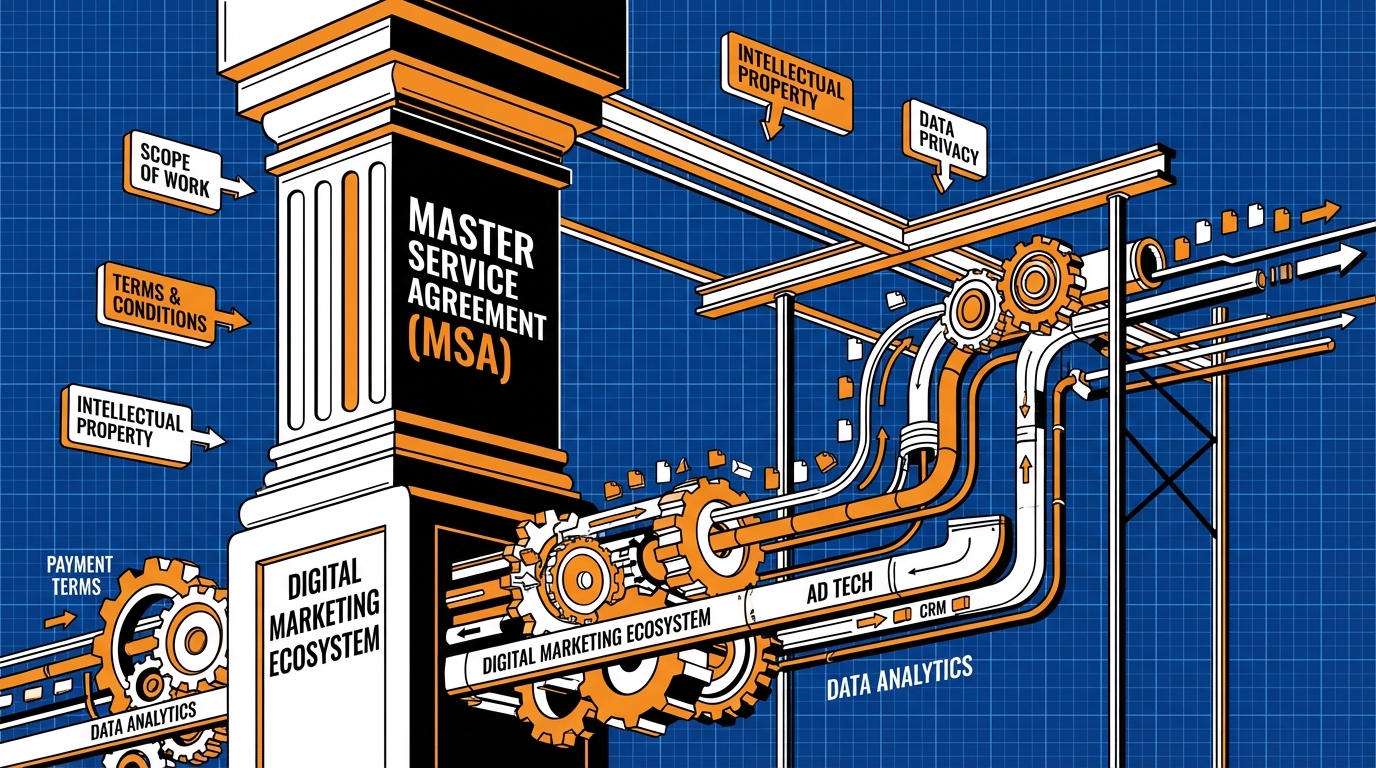
The Five High-Leverage Components We Require
1. Definitions and Parties
Precision is paramount. State precisely who the parties are, using the full legal business names and addresses. Define core terms like “Client,” “Agency,” “Services,” and “Work Product.” Ambiguity in definitions creates legal loopholes; loopholes void protection.
Download the Visual Guide
Get the slide-by-slide visual summary of this article (PDF) for free.
2. Indemnification and Limitation of Liability (L.O.L.)
This is the single most critical protective clause in the entire agreement. It dictates who pays when something inevitably goes wrong.
We must strictly limit our financial liability. Our MSA language restricts agency liability to the total fees paid by the client in the preceding three to six months. This prevents a minor scope error from escalating into a catastrophic, business-ending lawsuit.
“Our standard practice includes a strict indemnification clause: The client agrees to hold us harmless from any claims arising from the content, data, or intellectual property they provide us. This legally shifts the risk back to the source of the materials.”
3. Confidentiality and Non-Disclosure (NDA)
Confidentiality is a two-way street, protecting both parties equally. For us, it shields our proprietary systems, pricing models, and internal methodologies. For the client, it safeguards their trade secrets, customer lists, and financial data.
Crucially, ensure the NDA section explicitly survives the termination of the MSA. Confidentiality regarding sensitive data must be permanent, not bound by the active service period.
4. Dispute Resolution Mechanism
We must control the path for resolving conflicts. Litigation is slow, expensive, and public—the opposite of operational discipline. We recommend mandatory, non-binding mediation, followed by binding arbitration if necessary.
This approach forces a fast, private resolution, protecting our brand reputation and minimizing legal spend.
5. Termination and Exit Strategy
Define the precise conditions under which either party can exit the agreement. We require a fast, clean, and profitable exit strategy for non-performing or unprofitable clients. This protects our time and resources.
Key elements to mandate:
- Required Notice: Specify the mandatory written notice period (typically 30 or 60 days).
- Financial Obligation: The client must pay for all services rendered, expenses incurred, and deliverables completed up to the termination date. No exceptions.
- Breach of Contract: Include language allowing the Agency immediate termination rights if the client breaches payment terms, acts in bad faith, or engages in illegal activity.
Core Document #2: The Statement of Work (SOW)

Structuring a Bulletproof SOW
1. Hyper-Specific Deliverables (The “What”)
If you cannot measure it, you cannot bill for it. Avoid ambiguous statements like “We will manage social media.” Instead, quantify every action and outcome:
- Four (4) LinkedIn posts per week, delivered as final draft copy and associated graphics (Agency provides graphics).
- One (1) 1,500-word SEO-optimized blog post per month, requiring client sign-off on the outline before drafting begins.
- One (1) monthly performance report delivered via Google Data Studio link by the 5th business day of the following month.
Specificity removes ambiguity. Ambiguity leads to lost revenue.
2. Defined Timelines and Milestones (The Cash Flow Anchor)
Define the entire project schedule upfront. Critically, tie your agency’s payments directly to the completion of measurable milestones, not just calendar dates.
Example: “Payment 1 (25%) is due upon SOW execution. Payment 2 (25%) is due upon approval of the Q1 Content Strategy Document.” This structure ensures swift cash flow and client accountability.
3. Revision Limits (Protecting Your Margin)
Unlimited revisions are the fastest way to bankrupt a profitable project. Clients often assume free, endless adjustments.
Your SOW must explicitly cap this time sink: “The Agency permits a maximum of two (2) consolidated rounds of revision per major deliverable. Additional revisions requested by the Client will be billed at an hourly rate of $X, subject to a formal Change Order (CO) executed prior to work commencement.”
4. Client Obligations (The Partnership Requirement)
Agency success is a partnership. If the client fails to provide necessary assets or approvals, your project stalls, but your internal costs continue to accrue. The SOW must detail the client’s mandatory contributions:
- Timely access to required platforms (e.g., HubSpot, GA4, ad accounts) within 72 hours of SOW execution.
- Approval of drafts and strategies within 48 business hours.
- Failure to approve within this window shifts the project timeline, and the Agency is held harmless for any resulting delays or missed deadlines.
- Provision of necessary brand assets, intellectual property, and subject matter expertise (SMEs) required for content creation.
This level of detail transforms your SOW from a simple checklist into a legally enforceable roadmap. It justifies the Value-Based Pricing strategy you are deploying.
The Internal Agency Stack: Protecting Your IP and Trade Secrets
Independent Contractor Agreement (ICA)
Critical Warning:Key ICA Requirements for IP Capture:
- Work-for-Hire Clause: This is mandatory for an agency. It states that all work created by the contractor within the scope of the project is immediately owned entirely by the Agency. The contractor retains zero rights or licenses to the deliverables.
- Contractor Independence: Explicitly states that the contractor is responsible for their own taxes, insurance, tools, and hours. Crucially, they are not directed by the Agency on *how* to complete the work, only what the final deliverable must be (the *result*).
- Non-Solicitation: Prevents the contractor from soliciting your clients or employees during the engagement and for a defined period (e.g., 12–24 months) after the contract terminates.
Employment Agreement (W-2 Staff)
- Assignment of Inventions: This clause is vital. It ensures that any IP developed by the employee during their employment—even if potentially created on their own time—is immediately assigned to the Agency. This captures proprietary systems or tools developed by key staff.
- Confidentiality and Trade Secrets: Reinforces the protection of sensitive data, including client lists, pricing structures, marketing strategies, and internal software tools or proprietary processes (e.g., your unique SEO methodology).
- Non-Compete/Non-Solicit: These clauses prevent former employees from immediately leveraging your trade secrets to start a competing business or poaching your team. These must be drafted with extreme care to comply with specific state laws regarding duration, geography, and scope.
Mandatory Clauses for 2025 Digital Agencies
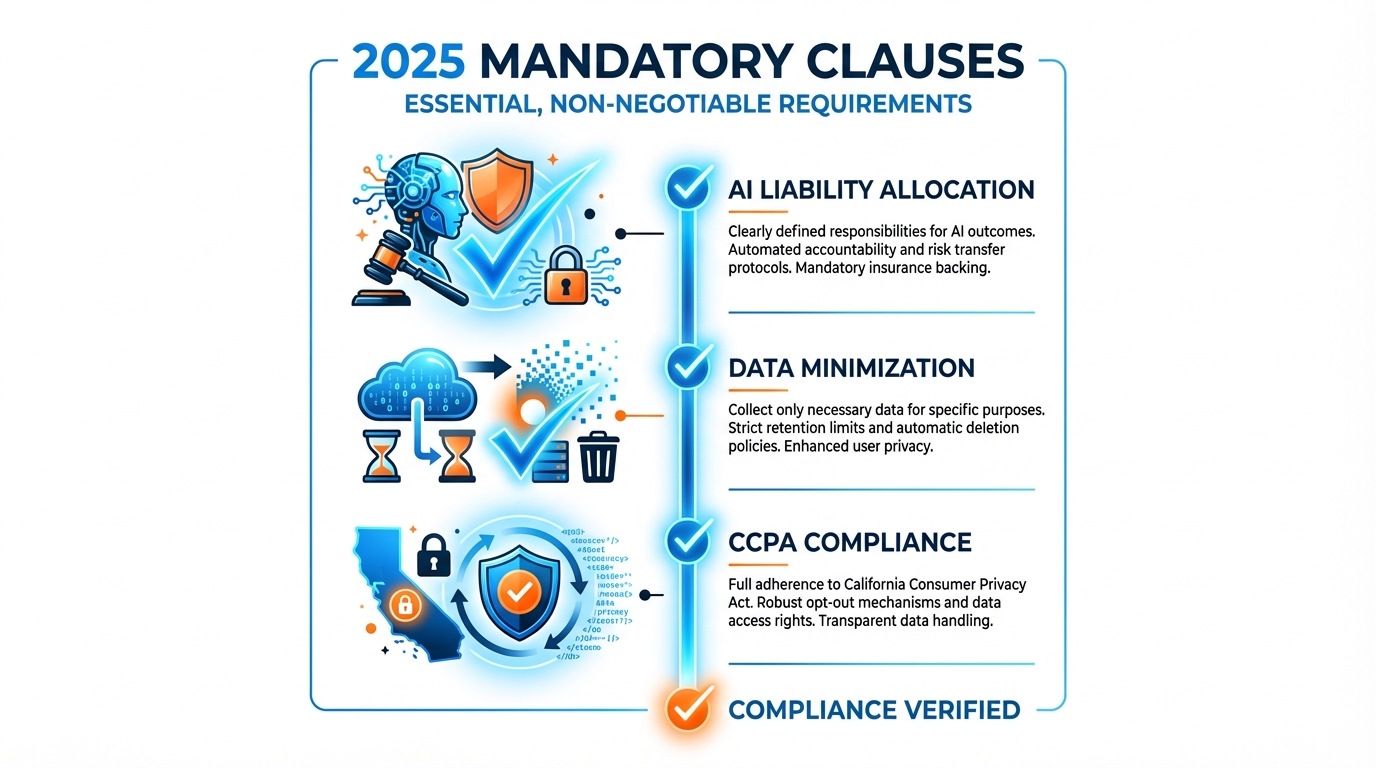
1. Data Compliance and Privacy (GDPR/CCPA)
Explicitly defining the Client as the Data Controller significantly reduces your exposure to liability stemming from data breaches or misuse, placing the ultimate compliance burden where it belongs: with the data owner.
2. IP Ownership and Licensing Clarity
| Asset Category | Ownership Status | Strategic Rationale |
|---|---|---|
| Client-Provided Materials (Logos, existing data, brand guidelines) | Client retains 100% ownership. Agency receives a limited, non-exclusive license to use only for the purpose of the engagement. | Protects the Agency from liability regarding the origin or rights clearance of client assets. |
| Custom Work Product (Blog posts, specific ad copy, final design files) | Transferred to Client upon full payment (Work-for-Hire). | Ensures the client has full usage rights, but only if they fulfill all financial obligations under the contract. |
| Agency Tools/Templates (Internal checklists, proprietary lead funnels, reporting scripts, underlying code) | Agency retains 100% ownership. Client receives a non-exclusive license to use only during the engagement term. | Protects your core methodology. Prevents clients from reusing your trade secrets or proprietary processes with a competitor post-engagement. |
3. FTC and Regulatory Compliance
We execute the strategy; the Client certifies its legality. This separation of duties protects your agency from massive regulatory fines and compliance headaches.
How to Deploy Your Contract Stack for High-Ticket Leads

Step #1: Initial Proposal (Pre-Contract)
Step #2: The Contract Presentation
- The MSA (Master Service Agreement): This defines the legal rules and liability boundaries.
- The SOW (Statement of Work): This details the exact deliverables and timelines for the initial phase.
- An Invoice: The setup fee or initial retainer is non-negotiable. Strategic Lead Generation for Small Agencies requires a financial commitment upfront; securing this payment validates the client’s intent.
Step #3: Handling Negotiation
Frequently Asked Questions
What is the difference between an MSA and an SOW?
The MSA (Master Service Agreement) is the strategic, long-term foundation. It governs the entire relationship: liability, termination clauses, and confidentiality. The SOW (Statement of Work) is the tactical execution document. It details specific project deliverables, timelines, and pricing structures. The SOW is always attached to the MSA. This structure allows us to update or replace project scopes (SOWs) without rewriting the core legal framework (MSA).
Should I hire a lawyer or use a contract template?
We mandate both paths. Start with a robust, attorney-drafted template specifically tailored for digital marketing agencies. This provides the necessary structure. You must then hire an attorney specializing in small business or intellectual property (IP) law within your jurisdiction. They will review and customize the document. Customization is non-negotiable—it ensures the contract protects you under local law and accurately reflects your unique business model (e.g., retainer structures, specific automation services, or proprietary lead generation methods).
What is a “Work-for-Hire” clause and why is it important?
A “Work-for-Hire” clause is how we secure intellectual property (IP) ownership. It legally dictates that the party commissioning the work—either our agency or our client—immediately owns the copyright and all IP rights to the material created. This clause is critical in Independent Contractor Agreements (ICAs) and SOWs. It ensures that when we pay a contractor or employee to create content, ownership transfers automatically and immediately, eliminating future usage rights disputes.
How often should I update my agency contracts?
Our standard operating procedure requires legal counsel review annually. We update immediately if there are significant changes to our business model (e.g., transitioning from project-based work to high-value retainer models). Immediate updates are also required following major regulatory shifts (e.g., state, federal, or international data privacy laws like CCPA or GDPR). Operating with outdated legal protection is not just risk—it is negligence that directly impacts our revenue security.
Ready to take the next step?
Try AI Lead Generation Today
Click Here