


You operate a high-ticket service agency. You build complex, custom systems that drive significant client revenue. Despite this high level of expertise, 80% of agencies still rely on boilerplate contracts—documents that expose them to massive, unnecessary financial risk.
This is not a legal lecture. This is a strategic guide focused purely on revenue defense and profit maximization.
A weak contract is an immediate invitation for scope creep. It guarantees late payments. It systematically dissolves your profit margins—especially when dealing with sophisticated B2B clients who inherently understand how to exploit legal ambiguity.
We view the contract not as a mere formality, but as the final, non-negotiable step in The Strategic Agency Client Onboarding Blueprint.
Before we even discuss the Master Service Agreement (MSA), you must have already used The Strategic Checklist: 40 Questions to Vet Agency Clients. Now, we move to legal fortification.
To secure maximum profitability and enforce accountability, your agency needs five core documents. They must be airtight. This is how we structure every client relationship.
Key Takeaways: Fortifying Your Agency Revenue
- MSA vs. SOW: Never combine your Master Service Agreement (MSA) and Statement of Work (SOW). The MSA defines the long-term relationship. The SOW defines the short-term engagement.
- IP Protection is Non-Negotiable: Clearly define who owns the raw data, the proprietary strategy, and the final creative assets. Assume nothing.
- Liability Cap: Your Limitation of Liability clause must cap damages at the fees paid over the last 3-6 months. Protect your agency’s entire existence from one bad client.
- Enforce Payment: Use the contract to explicitly define late fees, interest, and the right to immediately pause services for non-payment. Stop treating non-payment like a negotiation.
- Governing Law: Always mandate that disputes be resolved in your jurisdiction, minimizing travel and legal costs.
Why Your Generic Contract Is Killing Your Agency Profit

If your primary legal document is a free template downloaded five years ago, it is already obsolete. The digital landscape—encompassing data privacy laws, AI usage policies, and platform shifts—changes fundamentally every 90 days. Your contract must adapt to this volatility.
Generic contracts fail in three critical areas that directly impact your bottom line:
- They Encourage Scope Creep: Vague language surrounding “deliverables” or “revision cycles” invites clients to demand endless, uncompensated changes. This lack of definition directly erodes your project profitability and team bandwidth.
- They Lack Financial Teeth: Generic documents treat late payment as an inconvenience, not a contractual breach. They fail to establish immediate, enforced penalties or, crucially, the explicit right to cease all work until payment is received.
- They Fail to Protect Agency IP: They often rely on broad “work-for-hire” clauses without delineating ownership of proprietary assets. This risks giving away your core value: internal software, strategic frameworks, and pre-existing agency methodologies.
We track this closely: our agency saw a measurable 3% increase in net profit margins simply by tightening our scope definition language and rigorously enforcing late payment penalties. This is not about being aggressive; it is about establishing pragmatic, enforceable boundaries.
The 5 Non-Negotiable Contracts Required for Scale
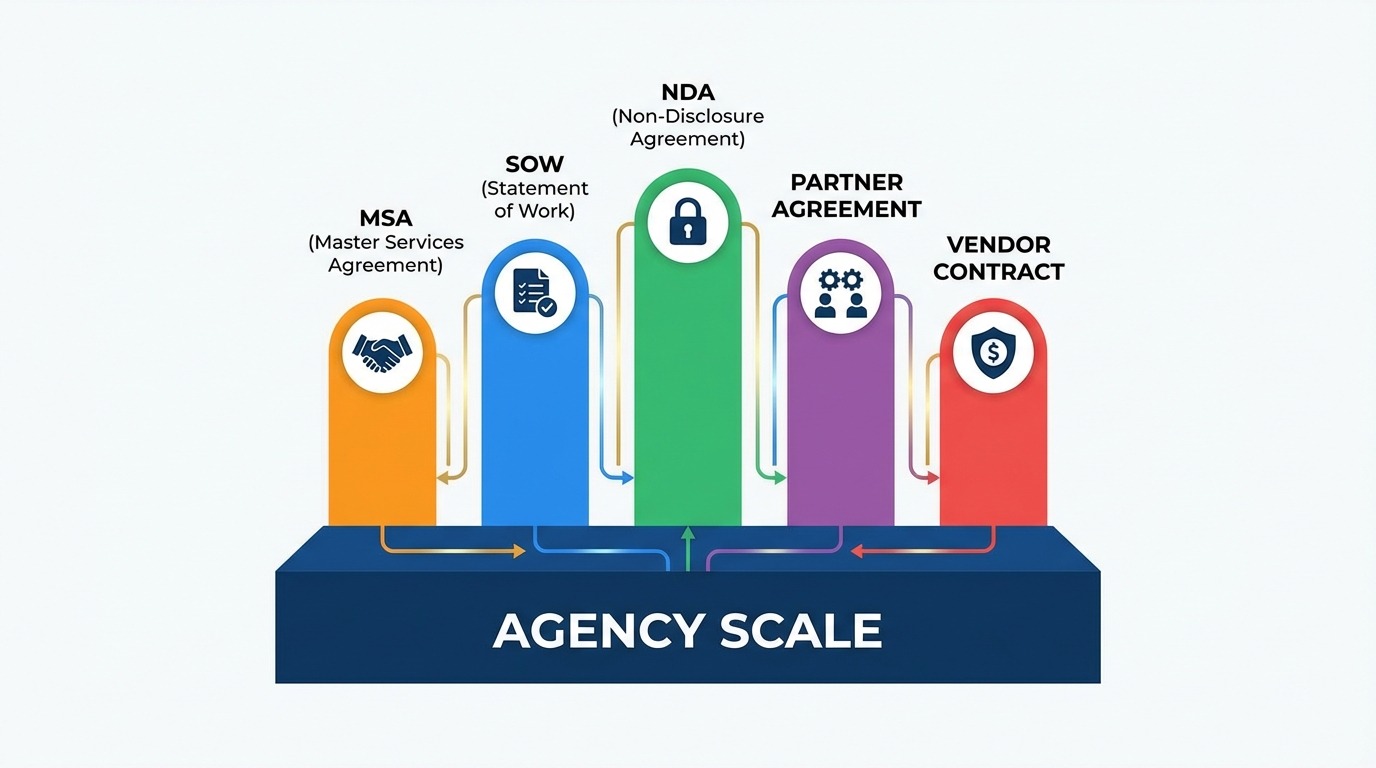
Scaling agencies—those hitting and exceeding $50k MRR—do not rely on a single, monolithic document. We use a modular system of agreements. This structured approach allows you to rapidly adapt to diverse service offerings (SEO, Paid Media, Creative Production) without needing to renegotiate foundational terms every quarter.
Step #1: The Master Service Agreement (MSA)
The MSA is the bedrock of the entire client relationship. It defines the rules of engagement, not the project specifics.
This boilerplate document remains consistent across all engagements, often spanning years. It must be signed once, establishing the permanent legal framework.
Key MSA Components:
- Term and Termination: How long the relationship lasts and the required notice (usually 30–60 days written notice) necessary to exit.
- Payment Terms: General structure (retainer, project, hourly), late fee policy, and interest calculations for overdue invoices.
- Confidentiality/NDA: A reciprocal clause protecting both your agency’s proprietary methods and the client’s sensitive business data.
- Indemnification & Liability: The clauses that protect you from being sued due to client actions (e.g., the client providing illegal or copyrighted content).
- Governing Law: Specifies the state or jurisdiction where any legal dispute must be settled. Always mandate your agency’s location.
The MSA sets the rules of engagement. Do not clutter it with project specifics; that is the job of the SOW.
Step #2: The Statement of Work (SOW)
The SOW is the project execution document. It must be signed every time you initiate a new campaign, project phase, or retainer renewal.
This document defines the boundaries—and critically, protects your agency margins.
Key SOW Components:
- Specific Scope of Work: Exact services, platforms, and channels covered. Zero ambiguity is required.
- Deliverables and Metrics: Specific, quantifiable outputs (e.g., “12 blog posts of 1,500 words,” not merely “content creation”). Define the KPIs used to measure success.
- Timeline and Milestones: Start dates, completion targets, and check-in cadence for accountability.
- Fees and Billing Schedule: The exact dollar amount for this specific scope, tied to the MSA’s payment terms.
- Revision Limits: State the maximum number of revision rounds per deliverable (e.g., “Two rounds of revisions included. Additional revisions billed at $XXX/hour”).
If the client asks for something outside the SOW, you immediately initiate a Change Order. This process is clearly defined in the SOW itself.
Step #3: Non-Disclosure Agreement (NDA)
While often integrated into the MSA, a separate, robust NDA is essential. We use this primarily for pre-contract discussions, especially when proprietary client data or trade secrets are involved.
Pragmatic NDA Focus:
- Definition of Confidential Information: Be broad. Include pricing models, customer lists, internal SOPs, and marketing strategies.
- Exclusions: What information is not confidential (e.g., information already public, or legally required to be disclosed).
- Duration: Confidentiality obligations must survive the termination of the MSA. We typically mandate 3–5 years post-termination.
If your scope involves handling sensitive B2B data—like customer personal emails or proprietary AI models—the NDA is your primary shield against future data breach liability. Do not skip this step.
Step #4: Intellectual Property (IP) & Work-for-Hire Agreement
This is the single most common failure point for scaling agencies. If you fail here, you risk giving away your business model.
The default legal rule is simple: the creator owns the IP. You must explicitly transfer ownership of the deliverables to the client, contingent upon final payment.
Clarifying IP Ownership:
- Work-for-Hire Clause: States that all new creative material (copy, graphics, video) created specifically under the SOW is owned by the client upon full payment.
- Agency IP Retention: Crucially, this clause must exclude your proprietary tools, processes, methodologies, templates, and internal code. You must retain ownership of your system.
- Client License: Grant the client a perpetual, worldwide license to use your retained IP (e.g., the template you used to build their report) solely for their internal business operations.
“If you don’t define what you own, you risk giving away the very systems that make your agency scalable. We never transfer ownership of our strategic methodology; we only transfer the output.”
Step #5: Limitation of Liability (LoL) & Indemnification
These two clauses are non-negotiable insurance policies. They actively protect your balance sheet from catastrophic failure and prevent a single lawsuit from bankrupting your agency.
Limitation of Liability (LoL): This caps the maximum amount of financial damages the client can seek from your agency if you mess up.
- The Cap: Set the maximum liability at the total fees paid by the client in the three or six months immediately preceding the claim.
- Exclusions: Exclude liability for consequential damages, lost profits, or third-party claims. This prevents a client from suing you for millions because they claim your campaign failure cost them a major contract.
Indemnification: This is a promise to hold the other party harmless against third-party lawsuits stemming from their actions.
- Client Indemnification: The client indemnifies you against claims arising from their provided content (e.g., copyright infringement) or their failure to comply with laws (e.g., data privacy violations).
- Agency Indemnification: You indemnify the client against claims arising from your gross negligence or your use of materials that infringe on a third party’s IP.
This is the difference between managing a minor legal issue and facing bankruptcy.
Critical Clauses That Protect Your Agency’s Profit Margin
The Master Service Agreement (MSA) provides the foundation, but sustainable scaling requires tactical clauses designed to protect your most sensitive assets: cash flow and team time. High-performance agencies drill down into these specific operational clauses to safeguard profitability and ensure predictable 2025 revenue.
Enforcing Payment and Late Fees
Cash flow is the oxygen that fuels growth. Your contract must prioritize prompt payment above all else. Treat non-payment not as a customer service issue, but as a legal breach of the MSA.
We use the contract to enforce prompt payment behavior. These are the critical payment clauses we mandate:
- Due Dates: Payment is due net 7 or net 15 from the invoice date. We recommend net 7 for new clients or high-value retainers.
- Late Penalties: Implement a fixed late fee (e.g., $250) PLUS accrued interest (e.g., 1.5% per month or the maximum legal rate permitted by law).
- Right to Suspend Service: Explicitly state that if payment is 5–10 days past due, the agency reserves the right to immediately suspend all services—including ad management, hosting, and campaign execution—without penalty or liability. This is your primary leverage.
- Collection Costs: The client must be responsible for all costs incurred by the agency to collect past-due amounts, including attorney fees and court costs.
When the legal consequences of delay are clear, clients pay faster.
Managing Scope Creep: The Mandatory Change Order System
Scope creep is the single largest killer of agency profitability. It occurs when a client introduces a new requirement that falls outside the defined Statement of Work (SOW). If not managed legally, these unbilled hours erode 10–20% of your gross margin.
Your contract must pre-define the solution using a mandatory Change Order Process:
- The client submits a formal request for new work outside the SOW.
- The agency provides a Change Order Document (COD) detailing the new scope, the revised timeline, and the new associated fee.
- The client must formally sign the COD before the agency commences any related work.
This system shifts the financial risk back to the client. We use this table format to illustrate the protective power of the clause:
| Scenario | Contract Definition | Revenue Impact (Without Clause) | Revenue Impact (With Clause) |
|---|---|---|---|
| Vague Revisions | “Unlimited revisions” or “Revisions included.” | Unpaid labor, 10-15% margin erosion. | Revisions capped at 2 rounds; additional work requires COD. |
| Platform Change | Client demands migration to a new CRM mid-project. | Unbudgeted staff time, project delay, high risk. | New CRM integration defined as out-of-scope; billed via COD at premium rates. |
| Client Delays | Client fails to provide feedback/assets on time. | Agency team sits idle, project stalls, blame shifts to agency. | Defined client response window (e.g., 48 hours). Delays beyond this extend the project timeline and may incur idle time fees. |
Data Compliance and Privacy Clauses (Non-Negotiable Risk Mitigation)
If your agency handles any client data—especially PII (Personally Identifiable Information)—you must legally address compliance. In 2025, this is mandatory for agencies utilizing AI lead generation, advanced analytics, or cross-border data transfers. Failure to comply exposes your agency to fines that can exceed the entire contract value.
We require these core compliance documents:
- Data Processing Agreement (DPA): This is often required under GDPR and defines your agency as the “Data Processor” and the client as the “Data Controller.” It legally clarifies liability.
- Security Standards: Mandate that your agency will follow commercially reasonable security standards for data storage and transmission.
- Breach Notification Protocol: Define the precise process, timeline (e.g., 72 hours), and method for notifying the client in the event of a suspected or confirmed data breach.
- Client Guarantee (Warranties): Crucially, require the client to warrant that they have the legal right to share the data with your agency for the stated marketing purposes. This shifts the initial burden of legality back to the Data Controller.
Exclusivity and Non-Solicitation
These two clauses protect the agency’s market bandwidth and its most valuable asset: its people.
1. Exclusivity Clause (The Revenue Limiter)
High-value clients may request exclusivity, prohibiting your agency from working with their direct competitors. Granting this limits your future market potential and requires careful negotiation.
- Narrow Definition: If you grant exclusivity, ensure it is narrowly defined (e.g., restricted to specific services, specific platforms, or a defined geographical market).
- Mandatory Premium: Exclusivity costs you future revenue. Charge a mandatory 20–30% premium on the baseline retainer fee to offset this lost opportunity cost.
2. Non-Solicitation Clause (The Talent Protector)
A non-solicitation clause prevents the client from poaching your key employees or contractors during the engagement and for a defined period (typically 12–24 months) afterward. Your team is your competitive advantage; protect it legally with this clause.
Governing Law and Dispute Resolution

When client relationships collapse—and they sometimes do—the legal fallout can instantly vaporize your profit margins. Litigation is a time sink and a massive revenue drain. Your contract must dictate a fast, predictable path forward that protects your capital.
Defining the Legal Playing Field
Governing Law: Define Your Home Field. Always specify that the laws of your state (or jurisdiction) govern the contract. This is non-negotiable. Allowing litigation in a client’s distant state introduces exponential costs, delays, and complexity. Protect your team and your budget by keeping the legal fight local.
The Mandatory Dispute Resolution Ladder
Litigation is the last resort because it is expensive, unpredictable, and public. We implement a mandatory, multi-tiered escalation ladder designed to force rapid resolution before court involvement:
- Tier 1: Informal Negotiation. Key decision-makers (stakeholders) from both parties must meet to resolve the issue within a defined, short timeline (e.g., 10 business days). This keeps the resolution internal and low-cost.
- Tier 2: Mandatory Mediation. If negotiation fails, parties must engage a neutral, third-party mediator (whose selection process is defined in the MSA). Mediation is non-binding but acts as a critical, final pressure point before formal legal action.
- Tier 3: Binding Arbitration (Preferred) or Litigation. If mandatory mediation fails, the contract must define the final legal path. We strongly recommend Binding Arbitration—it is faster, cheaper, private, and less disruptive to ongoing business operations than traditional court litigation.
By rigorously defining this escalation path, you save significant operational time, protect your reputation from public court records, and safeguard your agency’s cash flow.
The Final Step: The Contract Execution Checklist
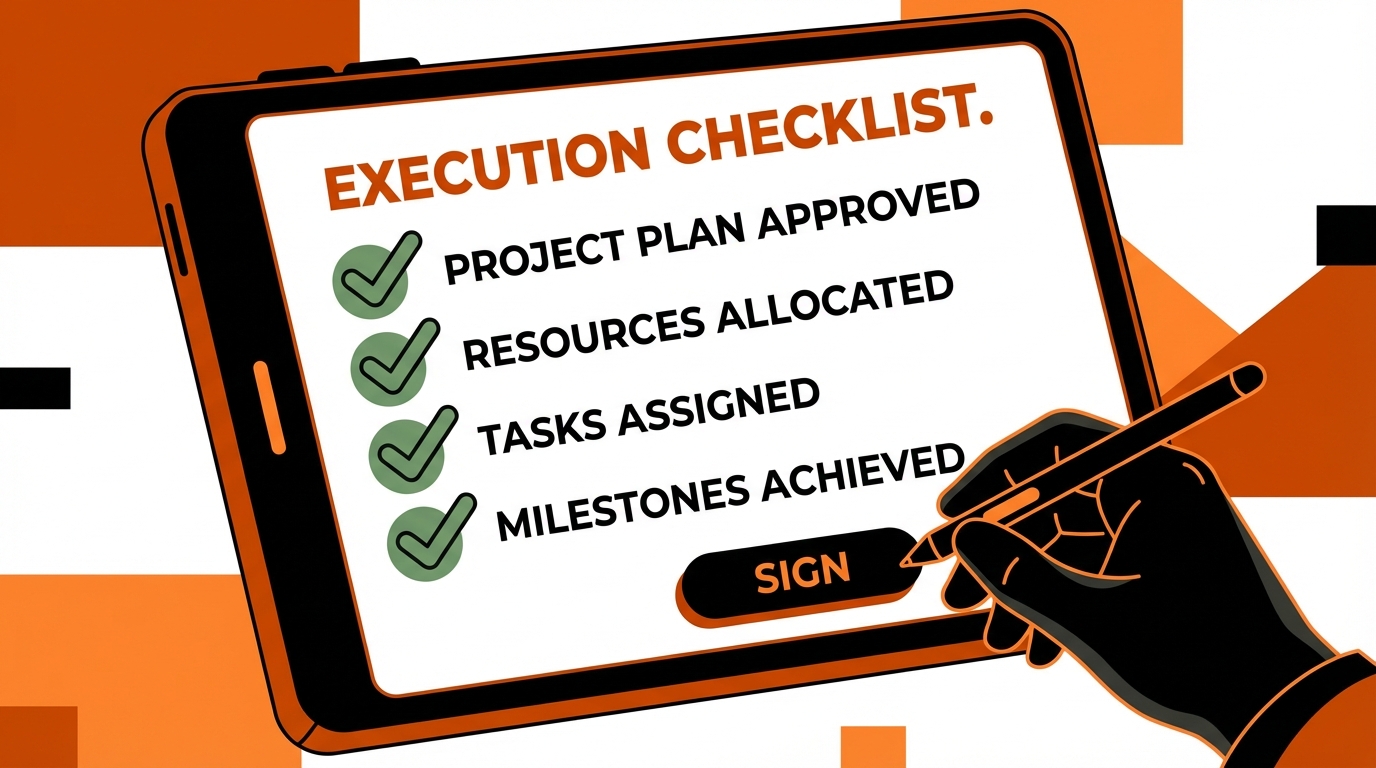
Before the contract leaves your desk—before that client relationship officially begins—you must run a final quality assurance check. This checklist ensures execution is flawless and legally sound, protecting your agency from immediate vulnerabilities.
- Legal Audit (The 12-Month Rule): Has a specialized attorney (not generic counsel) reviewed this specific document within the last 12 months? Digital law evolves too fast for outdated templates.
- Unambiguous Language: Can a non-lawyer client read and understand every expectation in five minutes? Complexity invites misinterpretation; clarity prevents devastating scope creep.
- SOW vs. Proposal Alignment: Does the Statement of Work (SOW) match the initial proposal *exactly*? Inconsistencies between sales documents and legal documents create immediate legal vulnerabilities.
- Auditable E-Signature: Are you using a reliable platform (e.g., DocuSign, Adobe Sign) that provides a robust, court-admissible audit trail? Digital execution must be legally provable.
- Mandatory Client Deliverables & Failure Clause: Is there a crystal-clear list of deliverables the client *must* provide (access, content, timely approvals)? Crucially, does the contract define the specific consequence (e.g., project pause, fee accrual) if they fail?
A truly strong contract is not designed to help you *win* a lawsuit. It is designed to prevent the lawsuit entirely. By establishing crystal-clear expectations and enforcing mutual accountability from day one, we protect our revenue and secure predictable client success.
Frequently Asked Questions

Can we use a single contract for all our different marketing services?
Yes, but only as a framework. Use a single MSA (Master Service Agreement) for the overarching legal terms. However, you must use distinct SOWs (Statements of Work) for every service offering (e.g., SEO, Paid Media, Creative Production). Mixing scopes in a single document guarantees confusion, scope creep, and ultimately, project failure. The MSA dictates the rules; the SOW dictates the action.
How often should we update our agency contracts?
Your MSA must be reviewed by specialized legal counsel annually, minimum. The pace of change in data privacy (GDPR, CCPA) and platform terms of service (TOS) makes this mandatory risk mitigation. SOWs are tactical documents and must be updated for every new project, scope change, or renewal period.
What is the difference between Indemnification and Limitation of Liability?
This distinction is critical. Limitation of Liability (LoL) protects your agency from direct claims initiated by the client—typically seeking recovery for alleged lost revenue or massive damages. Indemnification, conversely, shields you from lawsuits brought by a third party (e.g., a copyright holder suing over content usage) stemming from the client’s actions or provided assets. Both clauses are non-negotiable requirements for robust protection.
Should we include a clause about AI content usage?
Yes. As of 2025, this is not optional—it is mandatory risk management. Your contract must explicitly define responsibility for vetting AI-generated content. This includes checking for accuracy, factual errors, and, most critically, potential copyright infringement. You must explicitly state that the client assumes all legal risk for any AI content they approve or request.
Ready to take the next step?
Try AI Lead Generation Today
Click HereReferences
- Digital Marketing Agreement Templates – LegalZoom
- The ultimate guide to crafting a powerful digital marketing contract
- How to create a contract template for your marketing agency – Ignition
- Marketing Agreement Guide: Types, Templates & Tips | HyperStart
- Is there a contract that you use for digital agency clients? – Reddit