
You are launching a B2B product in 2025. This is not a drill. This is your definitive window of opportunity to capture market share, but only if you reject the catastrophic failure formula that plagues 90% of B2B product launches.
The brutal truth? Most launches fail not because the product is bad, but because the lead generation strategy is fundamentally flawed. They focus on volume, not intent. They chase noise instead of nurturing trust. They treat the launch as a one-time event, not a continuous, high-leverage system.
If you rely on generic press releases, un-targeted Product Hunt blasts, or static PDFs as your primary lead magnets, you are already behind. Your competitors are swimming in low-quality MQLs (Marketing Qualified Leads) that will never convert. Your mandate is to generate SQLs (Sales Qualified Leads) from day one. This 2025 Blueprint details the mandatory, high-intent strategies required to hit critical mass immediately.
The Catastrophic Failure of Generic B2B Launches

We need to address the common mistakes head-on. Competitor data shows that the number one reason startups fail is a lack of market need or poor go-to-market execution. What does that translate to in practical lead generation terms?
- The “Launch and Pray” Mentality: Being active only during the launch week is a guaranteed way to spike attention and then flatline. Marketing is a marathon, and lead generation must be operational 90 days before your product hits the market.
- Chasing Vanity Metrics: You accumulate 5,000 email signups, but 95% are students, researchers, or tire-kickers who have zero budget authority. This wastes your sales team’s time and destroys pipeline predictability.
- Generic Messaging: If your landing page doesn’t instantly articulate the specific pain point you solve for a specific persona, you have failed the 5-second test. B2B buyers don’t care about features; they care about quantifiable relief from existing pain.
In 2025, your launch strategy must be engineered backward from the closed deal. Every lead generation idea must serve the ultimate goal: identifying individuals who have the budget, authority, need, and timeline (BANT) to buy now.
2025 B2B Launch Lead Generation Blueprint: The Three Phases
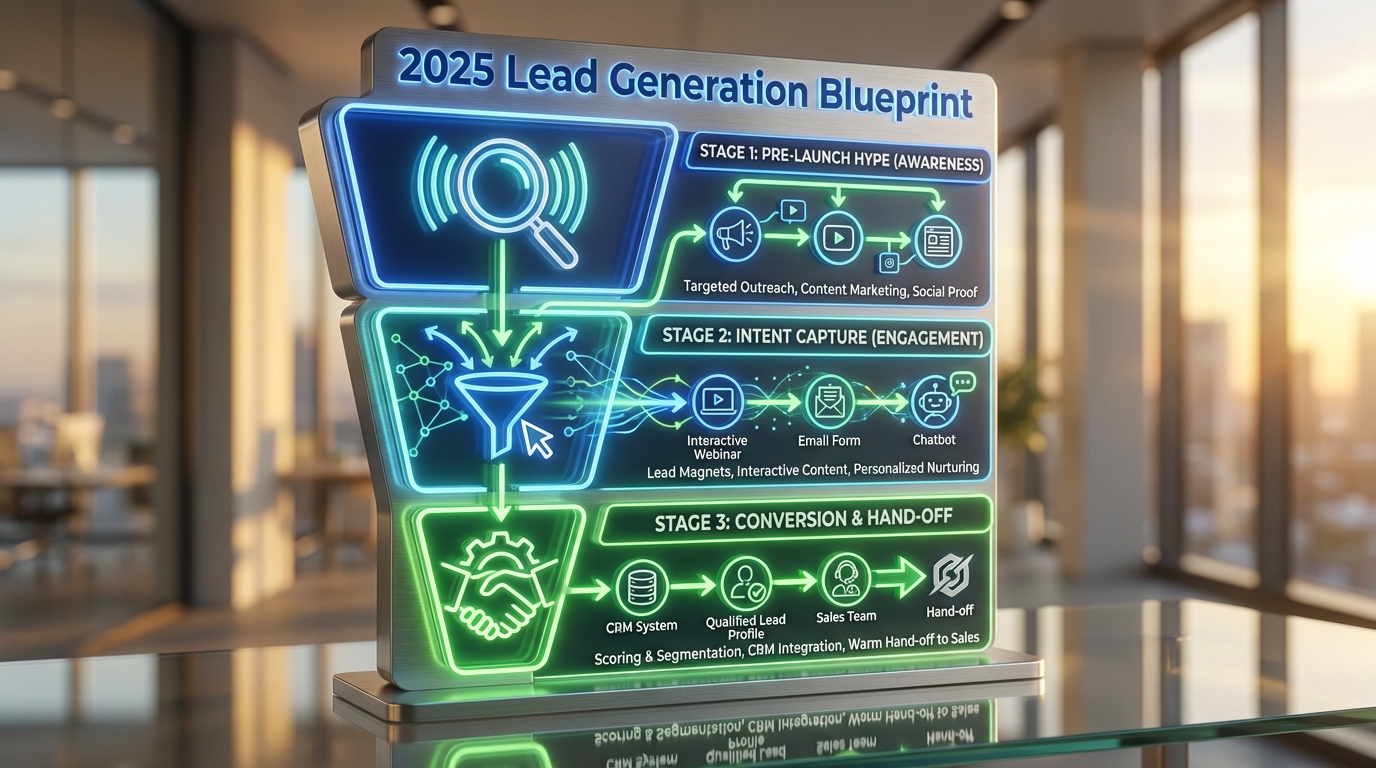
Effective B2B product launch lead generation is broken into three distinct, mandatory phases. Skipping any of these phases guarantees an anemic pipeline.
Phase 1: Pre-Launch Lead Generation (Building the Waiting List)
This phase begins 60 to 90 days out. Your goal is not signups; your goal is dialogue. You are seeking out your Ideal Customer Profile (ICP) and starting conversations based on their current pain points, not your future product features.
Tactic 1: Deep Dive ICP Identification and Direct Outreach
Stop relying on inbound SEO for the initial push. You need to manually identify the exact decision-makers (VPs, Directors, Founders) in the companies you serve. This requires precision data.
Use AI lead generation software to scrape LinkedIn profiles and find validated, personal email addresses for these specific titles at your target companies. Why personal emails? Because info@ and contact@ addresses are black holes. You need a direct line to the person who feels the pain you solve.
Once you have this high-quality, verified list of 500 Tier 1 prospects, you initiate personalized outreach. Your message must be 95% about their problem and 5% about your solution.
Tactic 2: Trust-Based Social Selling & Dialogue Incubation
LinkedIn remains the mandatory platform for B2B trust-building. During pre-launch, your team should be focusing on hyper-relevant, non-promotional content that positions you as the expert solving the current market challenge your product addresses.
You must shift from mass posting to targeted engagement. Find the high-value groups and posts where your ICP congregates. Provide definitive, strategic answers to their questions. When they respond, the conversation moves to the direct message (DM). This manual process creates high-intent leads that are already warmed up before the launch date even arrives.
If you want the definitive guide on how to operationalize this system, you need to review our Mandatory LinkedIn Lead Gen: The 2025 Trust Blueprint. It details exactly how to transition from content consumer to trusted advisor.
Tactic 3: High-Value, Gated Assets (The Anti-Generic Lead Magnet)
Your lead magnet cannot be a generic eBook titled “The Future of X.” That is low-intent fluff. Your lead magnet must be an actionable, strategic tool that requires immediate commitment from the user, signaling high intent.
Mandatory High-Intent Lead Magnet Examples:
- The Proprietary Benchmark Report: A data report you commissioned that details exactly why the current system fails, providing proprietary statistics that only you possess.
- The Interactive ROI Calculator: A tool that allows the prospect to input their current spending/inefficiency metrics and instantly calculates the cost of their current pain. Gated access to the full report requires contact information.
- The 2025 Implementation Checklist: A definitive, step-by-step guide (e.g., “The 7 Mandatory Steps to Cut SaaS Spend by 30%”). This attracts decision-makers currently tackling the problem.
Phase 2: The Launch Window (Conversion Amplification)
The launch window (typically 7-14 days) is where you convert the trust and attention you built in Phase 1 into qualified sales meetings and demos.
Tactic 4: Mandatory Webinar Funnels for High-Ticket B2B
For high-ticket SaaS or services, the webinar is non-negotiable. It is the single most effective structure for delivering high-value education, demonstrating expertise, and qualifying leads in a group setting. Unlike static content, webinars demand an hour of the prospect’s time-a massive indicator of intent.
Your webinar must not be a sales pitch. It must be a 45-minute masterclass on solving the core problem, followed by a 15-minute product introduction that frames your solution as the inevitable next step. The conversion mechanism is the immediate booking of a 1:1 demo call.
Need the precise funnel structure? Read our guide on the topic: Webinar Lead Gen: The 2025 High-Intent Conversion Blueprint.
Comparison Table: Webinar vs. Static Lead Generation
| Metric | High-Volume (Static Ebook) | High-Intent (Live Webinar/Demo) |
|---|---|---|
| Cost Per Lead (CPL) | Low | Moderate to High |
| Qualification Depth | Minimal (Email only) | Deep (Attendance, Q&A engagement) |
| Time to SQL | 30 – 90 Days | Immediate (Post-event booking) |
| Trust Built | Transactional | Relational & Expert Status |
Tactic 5: Partner-Powered Lead Magnet Bundles
You cannot launch in isolation. Strategic partnerships amplify trust and reach exponentially. Identify 2-3 non-competing businesses that serve your exact ICP (e.g., if you sell sales enablement software, partner with a CRM consultant and a B2B data provider).
Collaboratively create a high-value “Launch Bundle” that combines assets from all partners. The lead registers once to receive all three resources. This immediately triples your reach and leverages the existing trust equity of your partners. This tactic is powerful because it aggregates highly qualified, overlapping audiences.
Tactic 6: Interactive Qualification Quizzes and Assessments
In 2025, passive forms are dead. Interactive content is mandatory for high-intent qualification. A quiz or assessment asks the prospect a series of strategic questions related to their business pain before offering the “result” (e.g., “Find out your 2025 Readiness Score for X”).
This does two things:
- It forces the prospect to self-identify their pain points, increasing their awareness of the problem.
- It provides your sales team with crucial BANT qualification data (e.g., “What is your current team size?” or “What is your budget allocated for this solution?”).
The result page then offers a tailored solution, which is usually a direct, personalized demo request. This is how you generate leads that are already 80% qualified before the first sales touchpoint. If you want to master this structure, review the 2025 Quiz Blueprint: High-Intent Leads for Service Busine….
Phase 3: Post-Launch Lead Nurturing (The Mandatory Marathon)
The launch spike fades. The difference between survival and scaling is what you do in the 60 days post-launch.
Tactic 7: Case Study Acceleration and Social Proof
During the pre-launch phase, you should have secured 3-5 beta clients. Immediately post-launch, you must convert these beta successes into definitive, data-driven case studies. B2B buyers operate on proof and ROI.
Mandatory Case Study Components:
- The specific, painful problem before your product.
- The exact implementation timeline.
- Quantifiable metrics (e.g., “Reduced time-to-conversion by 40%,” “Saved $50k annually”).
- Direct quote from the decision-maker (authority proof).
These case studies become the foundation of your post-launch outreach, replacing generic sales collateral. They are the undeniable proof that your product is a painkiller, not a vitamin.
Tactic 8: Account-Based Marketing (ABM) for Tier 1 Accounts
Your initial outreach list of 500 Tier 1 prospects (Tactic 1) now becomes your ABM target. These are the leads who didn’t convert during the launch window but showed engagement (opened emails, attended the webinar, visited the pricing page).
ABM means treating these high-value prospects like a market of one. This requires hyper-personalized sequences:
- Send a direct, personalized video message referencing their specific company pain.
- Deliver a physical gift (corporate gifting) to their office, timed with a follow-up email.
- Run highly targeted display ads only visible to employees at that specific company domain, referencing the case study that aligns closest with their industry.
This high-effort approach demonstrates serious intent and resourcefulness, breaking through the noise that generic email automation cannot penetrate.
The Brutal Truth About Lead Quality

We need to talk about lead scoring. If your system still scores a whitepaper download the same as a demo request, your entire sales pipeline is compromised. In 2025, lead quality dictates success.
Key Highlights: High-Intent Lead Strategy Metrics
A high-intent B2B launch requires ruthless prioritization. Focus on these measurable outcomes:
- Conversion Rate from Demo Request to Meeting Held: Mandatory target: 75%+. If your rate is lower, your qualification process (quizzes, webinars) is failing.
- Lead-to-SQL Velocity: How quickly does a prospect move from first contact to sales-ready? High-intent strategies should reduce this timeline by 50% compared to typical inbound funnels.
- Cost Per Qualified Acquisition (CPQA): Shift your focus from CPL (Cost Per Lead) to the CPQA. A higher CPL for a guaranteed SQL is always preferable to a low CPL for thousands of useless contacts.
Text-Based Infographic: The Cost of Low-Intent Leads
The market has shifted. You must adapt, or you will burn resources.
- 78% of B2B buyers now conduct their own research before engaging a salesperson. Your content must anticipate their questions.
- 42% of sales reps report that lack of quality data is their biggest barrier to hitting quota. (This is why AI lead generation for verified emails is mandatory.)
- Only 13% of leads who download a generic whitepaper are ever considered sales-ready. Stop wasting energy on low-value assets.
High-Intent Lead Strategy Checklist (Mandatory Actions)
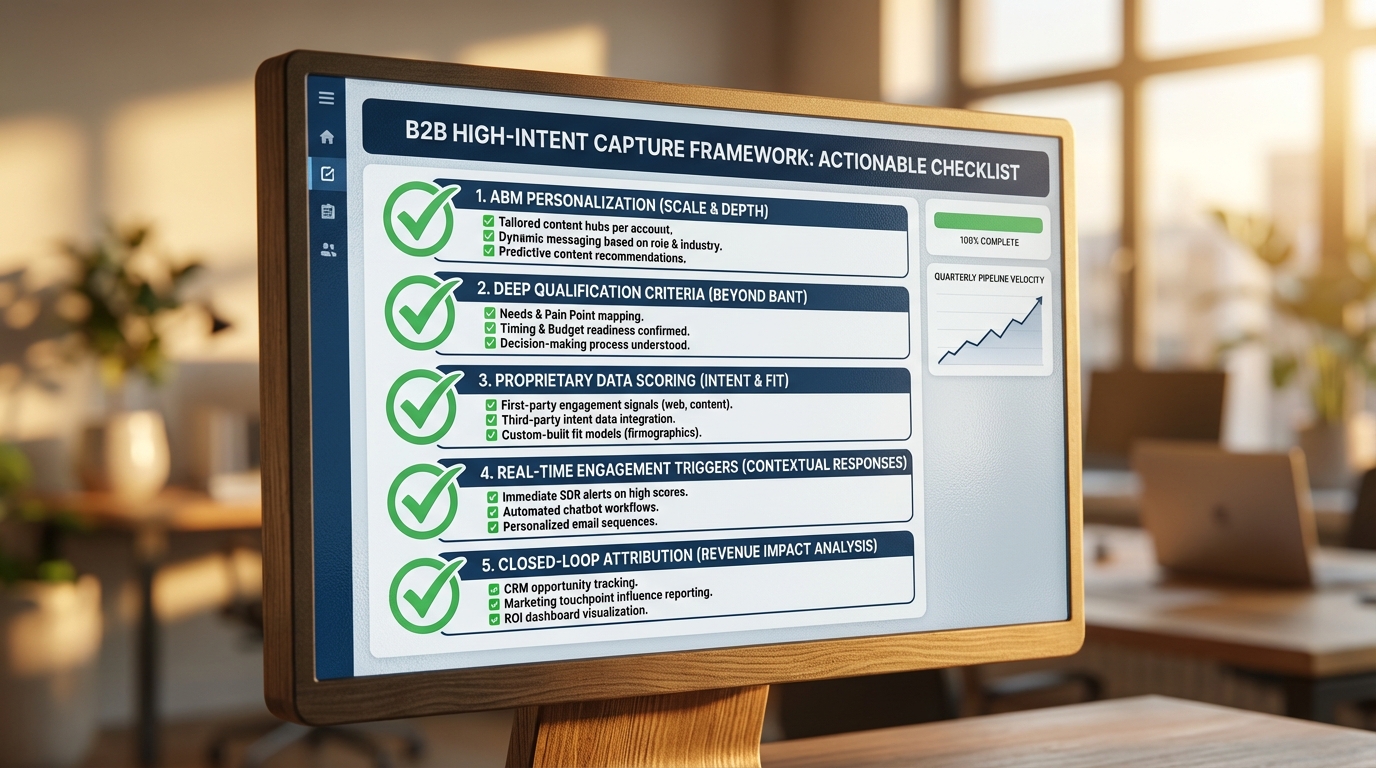
Use this checklist to audit your B2B product launch strategy today. If you cannot check off every item, your launch is at risk.
- ✅ Define the ICP using job titles, company size, and specific pain points, not broad industry categories.
- ✅ Utilize AI lead generation tools to find direct, verified contact information for Tier 1 decision-makers.
- ✅ Begin personalized, trust-based outreach (LinkedIn/Email) 90 days before launch.
- ✅ Replace generic lead magnets with an interactive ROI calculator or proprietary benchmark report.
- ✅ Implement a mandatory, high-value webinar funnel focused on education and immediate demo booking.
- ✅ Use a qualification quiz or assessment on the website to gather BANT data before allowing demo requests.
- ✅ Secure 3-5 quantifiable case studies from beta clients immediately post-launch.
- ✅ Establish a dedicated ABM strategy for the top 100 non-converting, highly engaged prospects.
Pros and Cons: High-Intent vs. High-Volume Launches
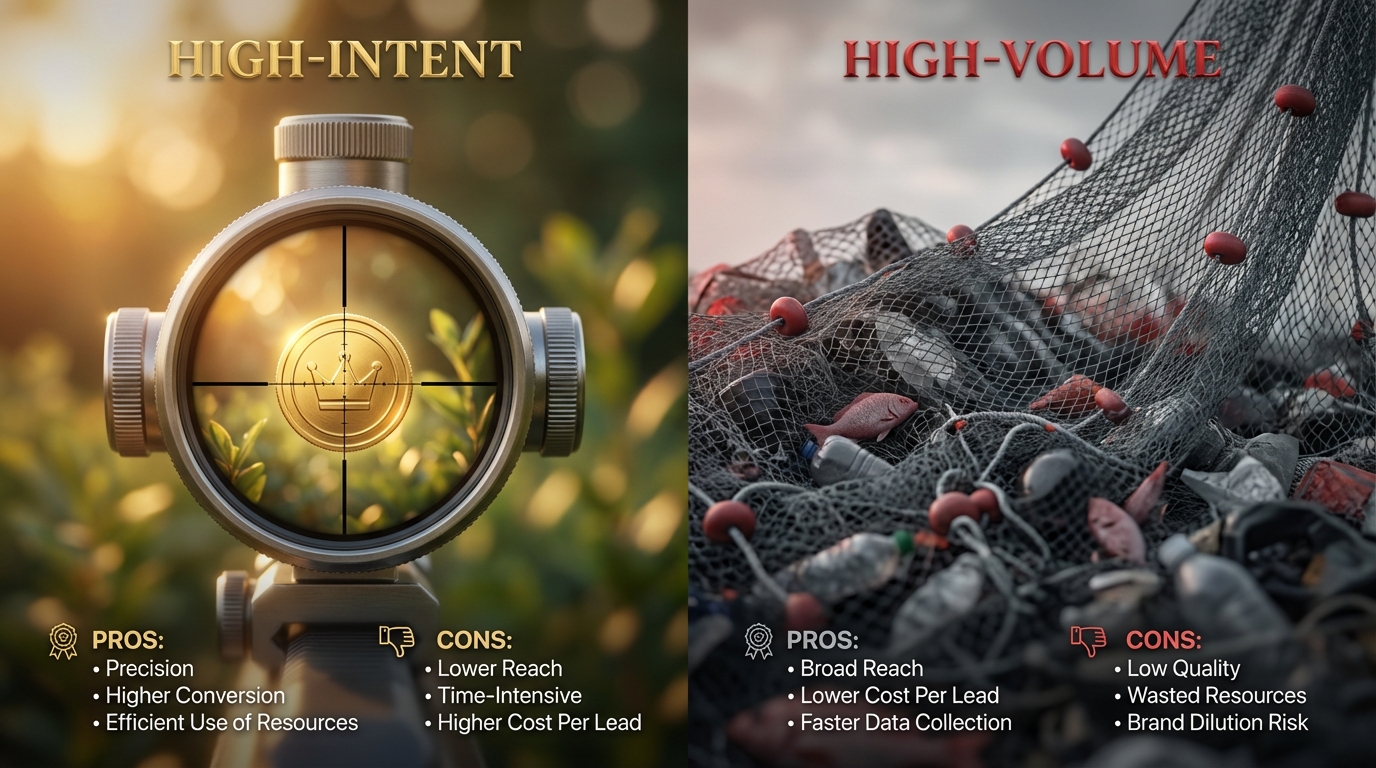
You must understand the trade-offs of choosing a strategic, high-intent approach over the outdated, volume-based model.
Pros of High-Intent Strategy
- Significantly higher conversion rates (Lead to Customer).
- Shorter sales cycle due to pre-qualification.
- Higher average contract value (ACV) because you attract decision-makers.
- Sales team time is leveraged efficiently (less time chasing dead ends).
- Stronger market positioning as a definitive expert.
Cons of High-Intent Strategy
- Higher initial Cost Per Lead (CPL).
- Requires more time for manual, personalized outreach.
- Lower total lead volume (fewer names in the database).
- Dependency on high-quality data and specialized tools (like AI lead generation).
- Requires tight alignment between marketing and sales teams.
The choice is clear: Do you want a massive list of names that yields 2% conversions, or a highly curated list that yields 15-20% conversions? The 2025 market rewards precision, not volume.
Final Mandate: Operationalize Trust

Your B2B product launch is not a marketing problem; it is a trust problem. Every lead generation idea listed above is designed to operationalize trust before the transaction even begins. You must demonstrate expertise, solve immediate problems, and reach the decision-maker directly.
Stop launching generic campaigns into the void. Start building a system that identifies, qualifies, and nurtures high-intent prospects who are ready to buy your solution right now. The technology exists to find these people; your job is to execute the strategy with confidence and urgency.
Frequently Asked Questions

How early should I start lead generation before a B2B launch?
Answer: You must start lead generation, particularly the trust-building and ICP identification phase, a minimum of 60 to 90 days before the official launch date. This time is used for manual outreach, content seeding, and securing beta users whose success stories will fuel the launch window.
Is cold email still effective for B2B product launches in 2025?
Answer: Generic, high-volume cold email is dead. However, hyper-personalized, low-volume outreach to verified decision-makers-using personal email addresses found via AI tools-is highly effective. The key is personalization and focusing the message entirely on their pain points, not your product features.
What is the single biggest mistake B2B companies make during a product launch?
Answer: The single biggest mistake is neglecting the post-launch phase. Most companies exhaust their resources during the launch week and fail to implement a structured, long-term follow-up and ABM strategy. Lead generation is a continuous process; the launch is merely the starting line for converting high-intent leads.
Should I prioritize LinkedIn or SEO for B2B launch leads?
Answer: For the immediate, high-intent leads required for a launch, prioritize targeted LinkedIn outreach and social selling. SEO is critical for long-term, scalable inbound traffic, but it is not fast enough to generate the initial, qualified pipeline needed to validate a new B2B product.
Ready to take the next step?
Try AI Lead Generation Today
Click Here