


The 2025 Blueprint: Land Your First Agency Client Fast

You are launching a digital marketing agency in 2025. This means you are not just competing against established firms and low-cost freelancers; you are fighting AI tools that promise instant, automated scaling.
Download the Visual Guide
Get the slide-by-slide visual summary of this article (PDF) for free.
The first client is the single hardest win you will ever secure.
Why? Because you lack the one asset that generates high-ticket revenue: proven results.
Most conventional advice tells you to network locally or offer free work. That strategy is slow, low-leverage, and ultimately unsustainable.
We built our agency—and scaled it rapidly—on a foundation of strategic, trust-based acquisition. We bypassed the low-value churn associated with cheap gigs and targeted high-ticket clients immediately.
This guide is not about cheap Upwork pitches or endless cold email blasts. It is the tactical blueprint we used to scale our own operations, focusing strictly on high-value, defensible client relationships.
We tracked a 77% revenue boost last year simply by optimizing these initial client acquisition protocols. You are about to implement them.
Key Takeaways: The First Client Mandate
- Niche Down Hard: Generalist agencies die first. You must specialize aggressively—by industry, service offering, and client revenue size.
- Create “Pre-Case Studies”: You do not need paying clients to prove expertise. Leverage Diagnostic Audits and proprietary research as your initial proof of concept.
- Anti-Automated Outreach: High-ticket clients instantly ignore generic emails. Use AI only to identify their specific, personal contact information, then deploy hyper-personalized, manual outreach sequences.
- Price for Value: Never charge hourly. Your first client retainer sets the immediate precedent for future scale and profitability.
Phase I: Strategic Pre-Launch (The Foundation)

Before you draft a single outreach message or send one cold email, you must execute Phase I. This is the crucial foundation. You must define precisely who you serve, the specific pain you solve, and why you are the only viable option in the marketplace.
Step #1: Define the Hyper-Niche
If your target audience is defined as “small businesses” or “anyone who needs marketing,” you will fail. That market is saturated and low-margin. You cannot craft compelling messaging that speaks equally to a local dentist and a $5M ARR B2B SaaS founder. Generic language produces generic results.
Remember this principle: Clarity equals conversion.
Your niche must be defined by three non-negotiable vectors:
- Industry: (e.g., Financial Services, E-commerce, B2B SaaS).
- Service Focus: (e.g., Paid Social for Lead Gen, Technical SEO Audits, Email Nurturing).
- Revenue/Scale: (e.g., $1M-$5M annual revenue, or 10-50 employees).
Niche down aggressively. When you do this, you stop selling time (a commodity) and start selling specialized expertise (a premium service). This precision allows us to create highly specific messaging that cuts through decision-maker noise. It also streamlines acquisition: you know exactly where to find them, and they recognize your authority instantly.
For example, our agency focuses exclusively on founders and high-level sales leadership. We intentionally exclude junior marketing managers from our outreach, ensuring we speak directly to the budget holder.
Review this strategic comparison:
| Attribute | The Generic Approach (Low Value) | The Pyrsonalize Approach (High Value) |
|---|---|---|
| Target Audience | Any local business owner. | B2B SaaS companies in the FinTech space, Series A funding, $2M-$5M ARR. |
| Service Offered | SEO, Social Media Management, PPC. | Strategic LinkedIn Outreach and AI-Enhanced Email Acquisition for Top 50 Accounts. |
| Competitive Edge | Low price point. | Deep industry insight and demonstrable ROI in that specific niche. |
| Messaging | “We help you get more customers.” | “We cut your cost-per-qualified-lead by 30% using proprietary outreach protocols targeting only CTOs.” |
Step #2: The Proof Barrier: Case Studies Without Clients
Every new agency faces the classic dilemma: You need demonstrable results (case studies) to secure high-value clients, but you need clients to produce those results. Most new agencies solve this by offering services for free—a low-value approach that often leads to burnout and poor client quality.
The true solution is to create strategic proof of concept (POC).
This is how you generate compelling social proof before you land your first paying retainer:
- The Specialized Diagnostic Audit: Identify 5-10 ideal prospects in your target niche. Dedicate 3-5 hours to performing a deep, specialized audit of their current performance bottlenecks. Document these high-level findings in a professional, branded executive summary.
- Hypothetical Blueprints: Design a complete, detailed 60- or 90-day campaign specifically for a target company. Include the exact ad copy, the calculated targeting parameters, and the projected ROI based on industry benchmarks. This demonstrates process mastery and strategic foresight.
- Self-Generated Results (The Agency Test): You must prove your system works by running it successfully on your own agency. If you sell B2B lead generation, your agency must serve as the best, most measurable case study you possess.
Utilize these initial audits and hypothetical blueprints as proprietary, high-value assets—your initial Strategic Case Studies. They eliminate doubt by proving you not only understand the problem but already possess the precise solution architecture needed for their growth.
Phase II: The Trust-Based Acquisition System

In the current landscape, mass automation is dead. Your high-value prospects are drowning in generic sequence emails and automated noise. We focus on the opposite: highly targeted, manual engagement built on demonstrable research.
Step #3: Finding Your Ideal Client Profile (ICP)
Your focus must shift immediately from generating generic “leads” to identifying specific, high-intent contacts. We leverage advanced AI tools—not for sending mass emails—but strictly for hyper-accurate contact discovery and research validation.
The process is precise and non-negotiable:
- Identify the Decision Maker: For high-ticket B2B services, this is the C-suite (CEO, Founder, CMO) or VP level. Never delegate this outreach to junior staff.
- Build the Target List (The 50): Using LinkedIn Sales Navigator or specialized intelligence software, create a highly curated list of 50 specific companies that perfectly fit your hyper-niche criteria (defined in Phase I, Step #1).
- Extract Verified Contact Data: Utilize AI tools to find the decision maker’s personal, verified email address. This is critical for bypassing corporate gatekeepers and spam filters.
- Document the Specific Pain Point: For each of the 50 contacts, find one specific, verifiable problem (e.g., a recent failed campaign, competitor success they are missing, a technical flaw like slow site speed, or a public hiring need that indicates internal strain).
You now have 50 highly valuable, research-backed prospects. This is your war chest.
Step #4: Precision Outreach: Anti-Automation is the Edge
Generic cold email templates fail instantly. Your outreach must feel like a personal, tailored conversation—not a sequence blast. This manual, trust-based approach is mandatory for securing high-value contracts.
Your goal is not to sell your service in the first email. Your sole goal is to secure a low-friction, 15-minute diagnostic call.
The 3-Part Personalized Email Framework:
- The Context Hook (The Research): Start by referencing the specific pain point you documented in Step #3. This immediately proves you did your homework and validates their problem.
- Example: “I noticed your recent PPC spend doubled last quarter, but your lead volume remained flat, based on the data we pulled from [Source/Tool Name].”
- The Expert Insight (The Proof): Briefly introduce your expertise and reference the Diagnostic Audit or Hypothetical Campaign you created.
- Example: “We often see this exact inefficiency with FinTech scale-ups. We recently modeled a solution for a similar firm that yielded a 4x improvement in MQL quality within 90 days.”
- The Low-Friction CTA (The Ask): Request a minimal commitment of time. Do not send attachments or links yet.
- Example: “I can send you the 3 specific levers we would adjust in a 15-minute call next week. Are you open to a brief chat next Tuesday or Wednesday?”
Send these emails manually. Track responses meticulously. Follow up three days later with a personalized LinkedIn message referencing the specific email subject line. This approach minimizes volume but maximizes conversion rate. We prioritize quality over generic quantity every single time.
“If your outreach campaign can be run by a cheap bot, your prospects will treat it like spam. The human element is the only sustainable differentiator in high-ticket acquisition.”
Step #5: The Diagnostic Audit Call
If they agree to the 15-minute call, remember: you are not selling; you are diagnosing. Adopt the mindset of a high-value consultant, not a transactional salesperson. Your objective is strictly to validate their pain points and position your agency as the necessary specialist capable of solving a multi-million dollar problem.
The Diagnostic Call Protocol:
- Phase 1: Validation (5 mins): Confirm the challenges you identified in your research. Focus on asking open-ended questions about their current capacity and the internal costs associated with their roadblocks.
- Phase 2: Quantification (5 mins): Ask about the precise financial impact of the problem. What is the true cost of one lost sale? What is the lifetime value (LTV) of a client? This frames the problem strictly in terms of lost revenue, not vague marketing tactics.
- Phase 3: The Gap (5 mins): Present your initial high-level finding (the Audit). Show them the quantified gap between where they are and where they should be. Crucially: Do not give away the entire solution here.
End the call by stating clearly that you require 48 hours to synthesize this data and build a specific, custom solution based on their quantifiable needs. Schedule the formal proposal meeting immediately.
Phase III: Conversion and Scaling
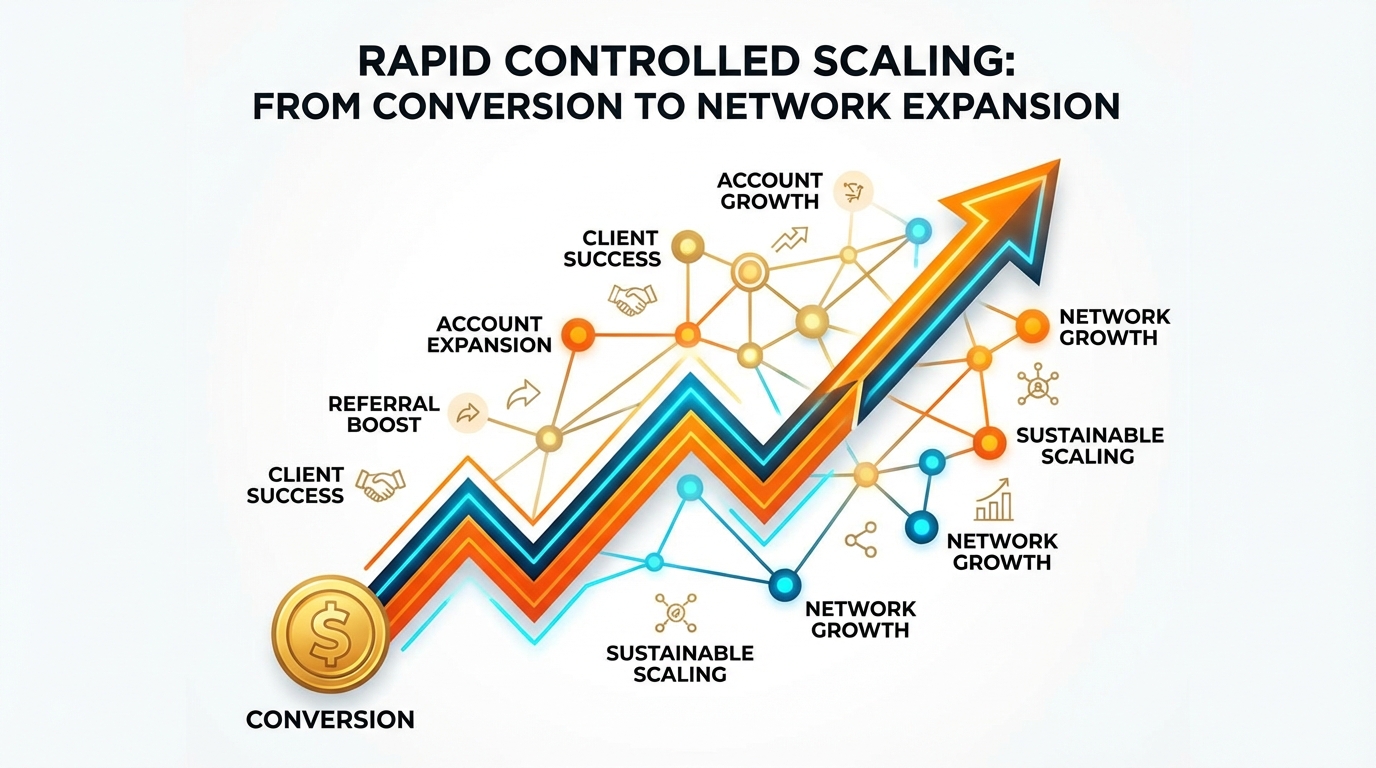
Landing the first client is about proving value. Keeping them is about delivering predictable results and commanding appropriate pricing.
Step #6: Pricing for Value, Not Time
New agencies fail when they default to hourly rates. This is trading time for money—a guaranteed cap on your growth potential. You must immediately implement Value-Based Pricing, even with your first prospect. Your pricing must strictly reflect the quantifiable ROI you promise to deliver.
Calculating Your First Retainer: The LTV Formula
- Determine Prospect LTV: Calculate the average Lifetime Value (LTV) of one client for your prospect. (Example: $50,000 LTV).
- Define Guaranteed Deliverable: Establish the specific, quantifiable outcome you guarantee in the initial 90-day engagement. (Target: 2 new clients).
- Project ROI: Calculate the direct revenue impact. (2 new clients * $50,000 LTV = $100,000 projected value).
- Set the Retainer: Your retainer must be a fraction of the ROI. We recommend setting a starting retainer at 10-20% of the projected 12-month value.
Using this model: if you project $100,000 in value, a $3,000–$5,000 monthly retainer is easily justified. The math is simple for the client: a $5k investment yields a $100k return. This positions your service as a profit center, not an expense.
Crucially: Do not discount your price. Discount your scope. If a client resists the full retainer, maintain your price integrity but reduce the deliverables or the scope of work. Price reduction signals poor confidence; scope reduction signals firm boundaries.
Step #7: Mastering the Proposal and Contracts
The proposal is the physical manifestation of your diagnostic expertise. It must be concise, strategic, and focused entirely on the client’s quantifiable goals.
We mandate a maximum of 10 slides or 5 pages. High-level founders do not have time—or patience—for exhaustive documents. Get straight to the point.
Non-Negotiable Proposal Sections:
- Executive Summary (The Problem & Solution): The first slide must summarize their current state, the cost of inaction, and your proposed fix.
- The Strategic Blueprint: Detail the specific tactics you will deploy (e.g., “Phase 1: AI-Enhanced Contact Discovery,” “Phase 2: Hyper-Personalized Outreach Sequence”).
- Investment & ROI Projection: Clearly state the monthly retainer and the projected return based on the LTV you calculated.
- Timeline & Deliverables: Set strict expectations. What will you deliver weekly? What is the 30/60/90-day milestone?
- Terms & Next Steps: Include your Agency Contracts immediately. Demand a setup fee to cover onboarding and initial infrastructure costs.
The setup fee is non-negotiable. It signals seriousness and commitment to the engagement. It covers the proprietary research and initial infrastructure build-out you complete before the monthly retainer clock even starts ticking. Charge it.
Step #8: Leverage the First Win for Rapid Scale
Once the first client is secured, your operational focus shifts entirely: deliver predictable results and document everything. The first client is not merely a paycheck; it is a machine designed to generate your next 10 clients.
- Over-Communicate Success: Provide weekly updates. Focus on metrics that matter to the CEO (revenue, LTV, pipeline value), not just vanity metrics (clicks, impressions).
- Request a Testimonial Immediately: The moment you hit a key milestone (e.g., first 5 qualified leads delivered), ask for a written or video testimonial. Capture the win while excitement is high.
- Ask for Referrals: If they are happy, immediately ask them who else in their industry needs the same specialized solution. Referrals are your fastest, cheapest path to sustainable growth.
We observed our lead conversion rate increase by 45% once we secured just two verifiable case studies within our target niche. This operational validation loop—from delivery to documentation—is the critical engine for rapid agency scaling.
Frequently Asked Questions (FAQ)

As you transition from implementation to execution, certain questions inevitably arise regarding initial client acquisition. Here are the answers to the most common queries we receive from agency founders securing their first high-ticket client.
Should I offer my services for free to get the first client?
Absolutely not. Offering work completely free immediately devalues your service and signals desperation. This attracts low-quality clients who will drain your time and budget. Your goal is to establish value and authority from day one.
Instead, implement one of two proven strategies:
- The Paid Diagnostic Audit: Charge a non-refundable, low-friction fee (e.g., $500–$1,500) for a comprehensive strategy audit. This screens for serious partners and establishes a monetary transaction immediately.
- The Performance Guarantee: Offer a results-based agreement (e.g., “Pay us $X after we deliver Y results”). This minimizes client risk while maintaining your professional, value-based pricing structure.
How long should it take to land the first high-ticket client?
Success depends entirely on system adherence. If you adhere strictly to the hyper-niche definition and execute the 50-contact precision outreach strategy (Phase II), you should secure your first discovery call within 7–10 days.
The total conversion timeline is typically 30–45 days from initial outreach to a signed contract. This assumes efficient follow-up and the immediate implementation of the Diagnostic Audit (Step #2) to accelerate trust.
I don’t have experience in my chosen niche. How do I build trust?
Experience is secondary to demonstrable process mastery. Clients hire agencies who understand their problems better than they do—not just those who have been around the longest. Trust is built by showing, not telling.
Actionable Authority:
- Use the Diagnostic Audit (Step #2) to prove you grasp their specific market mechanics, competitive landscape, and operational bottlenecks better than they do.
- Allocate 80% of your initial time to meticulously researching that single niche and 20% on outreach.
That level of preparation builds instant, undeniable authority and makes your lack of history irrelevant.
Ready to take the next step?
Try AI Lead Generation Today
Click HereReferences
- To Digital Marketing Agency Owners: How Did You Get Your First …
- How to Get Your First Digital Marketing Client: A Complete Guide
- 5 Key Strategies to Land Clients for Your Digital Marketing Agency
- Get Your First Digital Marketing Agency Clients | SMMA Clients 2025
- Getting first client for marketing agency? – Facebook