

You already know LinkedIn is the ultimate B2B lead source. That is not up for debate in 2025.
The problem is that 90% of the outreach happening there is noise. It is automated, generic, and immediately signals to the decision-maker: “I am trying to sell you something.”
Your target audience-SaaS founders, high-ticket service owners, and serious sales professionals-are drowning in spam. They ignore InMails. They reject connection requests that scream automation.
This is your critical advantage.
We are going to implement a trust-based, high-intent lead generation system on LinkedIn. This system prioritizes hyper-personalization and conversational engagement over sheer volume.
The result? You bypass the noise filter and get direct access to the people who actually sign the checks.
The 2025 Mandate: Why Your Old Strategy Fails

The game changed when LinkedIn became saturated. What worked in 2022-mass-sending generic templates-now gets you flagged, ignored, or blocked.
Your current approach fails if it relies on any of the following:
- Blasting InMails to cold prospects.
- Using automation tools to send 500+ connection requests per week.
- Failing to update your profile past a generic job title.
- Pitching your product in the very first DM.
We need to operate under the assumption that the prospect already knows you are selling something. Your goal is to prove you are a strategic resource first, not a vendor.
The Anti-InMail Protocol
InMails are expensive, low-response, and immediately associated with cold sales. Competitors are still pushing them because LinkedIn makes money off the feature.
Stop using InMails. Immediately.
Your priority must be establishing a first-degree connection. This opens up the DM channel, which is treated far more like a text message or WhatsApp chat than an email inbox. This is critical for high-intent conversion.
The Death of the Generic Connection Request
Should you send a note with your connection request?
The data is split, but our pragmatic approach favors blank connection requests in most cases, especially to high-level executives.
Why?
- A generic note (“I admire your work…”) is immediately recognizable as a sales tactic.
- A blank request forces the prospect to assess your profile. If your profile passes the “5-second trust test” (see Step 1), they accept.
- It saves you time. You reserve personalization for the DM, where it matters most.
If you absolutely must include a note, make it hyper-specific and reference a recent, verifiable action (e.g., “Saw your comment on the recent Series B funding for Acme-fascinating insight on market timing. Would love to connect.”).
Step 1: Optimize Your Profile (The 5-Second Trust Test)
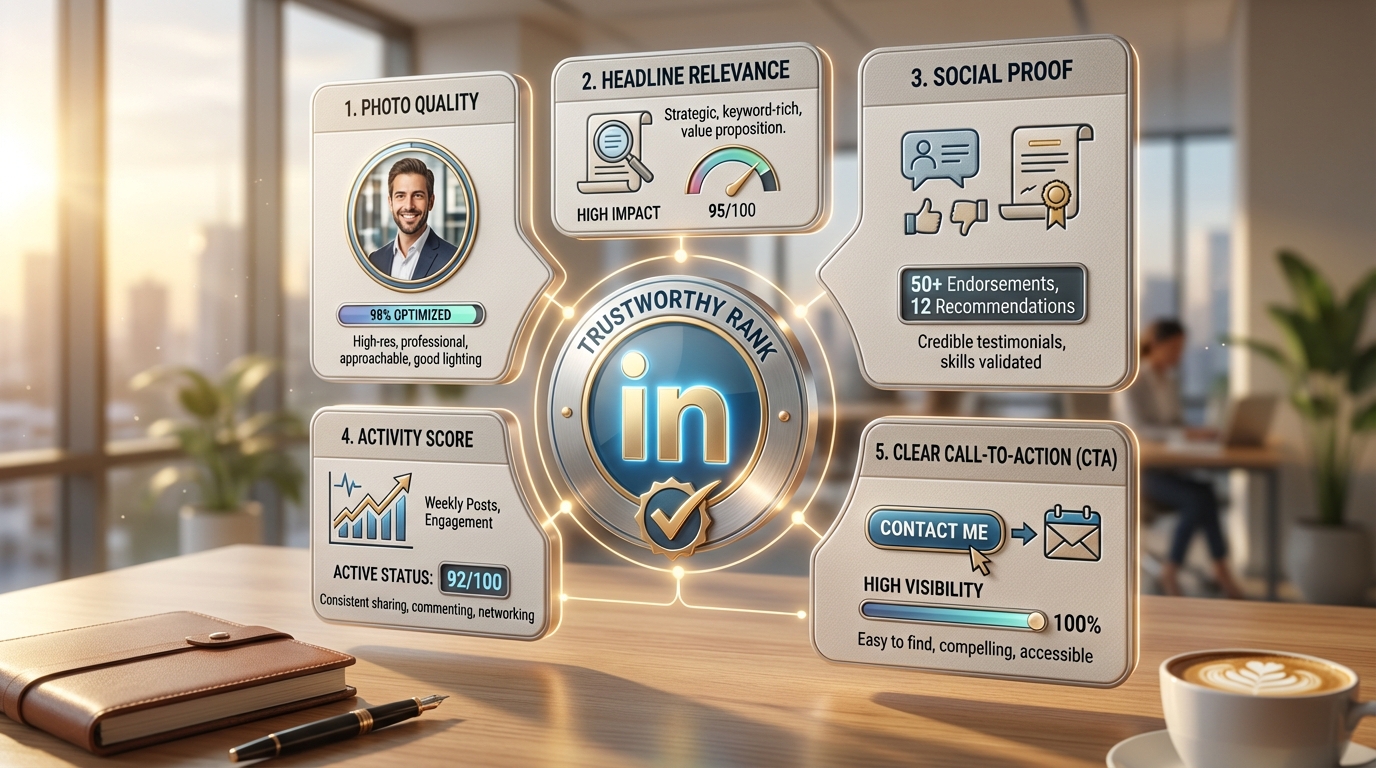
Your LinkedIn profile is not a resume. It is a landing page for high-intent leads.
If a prospect receives a connection request or sees your comment on a post, they spend approximately five seconds scanning your profile before deciding if you are a resource or a spammer. You must pass this test.
We call this the 5-Second Trust Test. If they cannot determine the value you provide in those five seconds, they hit ‘Ignore’.
Headline: Solution, Not Title
The biggest mistake? Your headline lists your job title and company.
Example of Failure: “Sales Director at Global SaaS Solutions.” (Red Flag. Pitch incoming.)
Your headline must focus on the outcome you deliver to your Ideal Client Profile (ICP). It should clearly state the pain point you solve.
Mandatory Headline Structure:
- [ICP]: We help SaaS Founders…
- [Pain]: …who are stuck at $5M ARR…
- [Solution/Outcome]: …scale to $10M using non-automated lead systems.
Example of Success: “Helping B2B Service Owners Implement Manual, Trust-Based Lead Generation Systems | Boosting Revenue by 77%.”
The Banner: Instant Value Proposition
The banner image is prime real estate. Do not use a generic landscape photo.
Your banner should visually reinforce your headline. It needs to contain a concise, high-impact statement or a testimonial statistic.
Banner Checklist:
- ✅ Clear, professional headshot (Smiling is mandatory-it disarms the prospect).
- ✅ Banner text that summarizes your core value (“Stop Cold Calling. Start Conversations.”).
- ✅ A clear, non-LinkedIn CTA (e.g., website URL or free resource link).
- ✅ No excessive company branding. This is about your personal authority.
The About Section: The Case Study
Structure your ‘About’ section not as a career history, but as a short case study proving you understand the buyer’s struggles.
- The Hook (The Pain): Start with the biggest problem your ICP faces right now in 2025.
- The Solution (Your Process): Briefly explain your unique, anti-generic methodology.
- The Proof (Metrics): Inject verifiable results (e.g., “Our clients typically see a 30% reduction in lead acquisition cost”).
- The Micro-CTA: End by inviting a specific type of conversation (“If you are a Series A founder looking to bypass automated spam, let’s connect.”).
Step 2: Precision Prospecting with Sales Navigator

Spray-and-pray lead generation is dead. You need to target buyers based on explicit intent and behavioral signals. This requires Sales Navigator.
If you are serious about high-ticket B2B sales, Sales Navigator is a mandatory investment. It allows for advanced filtering that the free version simply cannot match.
Intent Signals You Must Track
The highest converting leads are those who are actively signaling change or pain. Competitors often miss these nuanced signals.
Focus on these high-value filters in 2025:
- Job Change (Last 90 Days): Someone in a new leadership role has budget and mandates to make an impact. They are actively looking for solutions.
- Company Growth/Funding: A recent funding round (Seed, Series A/B) means new cash and new problems to solve quickly. They need vendors.
- Technology Changes: Use external tools (or internal AI systems) to see if they recently dropped a competitor’s software or adopted a new stack. This is an open door.
- Engaging with Competitor Content: If they are liking or commenting on posts from your competitors, they are in-market. Target them immediately.
Leveraging AI for Deep Personalization
True scale in manual outreach comes from making 10 high-quality connections feel like 100, without sacrificing personalization. This is where AI integration is non-negotiable.
You need to move beyond generic “I saw your post” openers.
Tools are now available that can scan a prospect’s public data-recent news, financial statements, job postings, and even their last three LinkedIn posts-and synthesize a unique, defensible conversation starter.
This allows you to open a DM with an observation that is so specific, the prospect immediately knows you did not automate the message.
For example, instead of “How are your conversions?” you can open with: “I noticed your team is hiring three specialized backend devs in Q4. Is that unexpected scaling effort putting pressure on your current lead volume targets?”
This level of data-driven insight is the difference between being ignored and booking a meeting.
If you want to understand how this data synthesis works, especially in the context of finding direct contact information, review our guide on Conversational AI Lead Generation: The 2025 High-Intent B…
Step 3: The Short-Form, High-Intent Outreach Framework
![A close-up of a person holding a smartphone displaying a LinkedIn direct message screen overlaid with a three-step framework for maximizing response rates. The steps shown are: 1. Personalized Hook (with example message: "Hi [Name], saw your post about [Topic]..."), 2. Value Proposition Statement (with example: "I have a unique [Solution] that could solve your [Problem] by [Benefit]..."), and 3. Clear Micro-Commitment CTA (with example: "Would you be open to a quick 10-min chat to share more?"). Arrows connect these steps leading to a final graphic labeled 'RESPONSE RATE MAXIMIZED'.](https://pyrsonalize.com/blog/wp-content/uploads/2025/11/step-3-the-short-form-high-intent-outreach-framework.jpg "The 3-Part LinkedIn DM Formula for Maximizing Response Rates in Lead Generation")
Once connected, the clock is ticking. You must initiate the conversation within 24 hours.
Remember the environment: LinkedIn DMs are fast, casual, and ruthless. Your message must be under 50 words.
The 3-Part DM Formula (Specific, Short, Conversational)
The goal of the first message is not to sell. The goal is to elicit a simple, conversational response-a “Yes,” “No,” or a brief clarification.
Part 1: The Specific Observation (The Hook)
Reference the personalized data point you found in Step 2. Keep it factual and brief.
Example: “Saw you just closed that Series A round. Congrats.”
Part 2: The Value Bridge (The Implication)
Connect their recent activity to a known pain point your solution addresses. This is the bridge between their world and yours.
Example: “In our experience, hyper-growth like that usually bottlenecks around manual lead capture.”
Part 3: The Low-Friction Question (The CTA)
Ask a question that requires minimal mental effort to answer, and that relates directly to the pain point.
Example: “Are you guys finding that manual outreach is still scalable at your new size?”
Full Example DM:
“Hey [Name], saw you just closed that Series A round. Congrats. In our experience, hyper-growth like that usually bottlenecks around manual lead capture. Are you guys finding that manual outreach is still scalable at your new size?”
This is 41 words. It is personal, relevant, and invites a simple, authentic reply.
Using Multimedia for Breakthrough Engagement
If you send a second or third follow-up, you must change the medium. Text-only follow-ups blend into the background.
Video and Voice Notes are your secret weapon in 2025.
They are hard to automate, which instantly signals authenticity. A 30-second video message recorded on your phone breaks down the digital barrier and puts a face to the name.
Voice Note Protocol:
- Keep it under 45 seconds.
- Reference the initial message (“Just following up on my quick question about scaling…”).
- Smile while recording (It changes your voice tone, making you sound more approachable).
- Offer a specific, helpful resource (“I actually just published a blueprint on that. Want me to send the PDF?”).
This demonstrates effort and commitment, separating you from 99% of sellers.
Step 4: Content Strategy: Becoming the Authority, Not the Seller

Lead generation is not just about outreach. It is about inbound authority. Your content strategy must position you as the definitive expert in your niche.
The content you publish serves three purposes:
- Validating your expertise when a prospect views your profile.
- Generating inbound leads (people commenting, reacting, or directly reaching out).
- Giving you context for personalized outreach (you can reference your own posts in a DM).
Content Pillars for High-Ticket B2B
Your content must be strategic. Avoid motivational fluff or generic business advice.
Focus on these high-intent content types:
- The Anti-Case Study: Detail a common failure point in your industry and explain, step-by-step, how to avoid it. (e.g., “The Three Reasons Your Lead Scoring Model Is Broken”).
- Definitive 2025 Blueprints: Publish tactical, actionable guides (like this one) that are specific to your ICP’s current challenges. Use numbered lists and bolding for maximum scannability.
- Contrarian Opinions: Take a strong, data-backed stance against conventional wisdom. (e.g., “Why Cold Calling Is Still Mandatory in 2025,” if you believe that, or “Why Automation Kills High-Ticket Sales.”)
- The “Help First” Post: Ask your audience what specific problem they are facing this week and offer a direct, free solution (a 15-minute call, a template, etc.). This generates massive goodwill and direct lead signals.
Crucial Tip: Post original text content with strategic line breaks. LinkedIn favors text posts that keep users on the platform. Avoid linking out in the main post body.
Leveraging Groups for Lead Capture
LinkedIn Groups are often overlooked, yet they are high-density hubs of your ICP.
You cannot spam groups. You must provide genuine, unsolicited value.
Group Strategy:
- Identify Active Groups: Filter for groups with high recent activity (not just high member count).
- Monitor Pain Points: Track the questions that come up repeatedly. These are your content ideas and your outreach triggers.
- Provide Definitive Answers: Do not just comment “I can help.” Provide a mini-tutorial or a detailed framework in the comment section itself.
- Manual Lead Extraction: When someone asks a question that aligns perfectly with your solution, offer a private connection. “I have a specific template for that, [Name]. I’ll send you a connection request so I can DM it over.”
This manual, conversational approach is how you convert group members into qualified leads, similar to how we structure conversions on other platforms. For deeper strategies on this manual extraction process, look at The 2025 Blueprint: Converting Facebook Group Members into High-Intent Leads Manually.
Step 5: Conversion and Systemization

The conversation is started. The trust is established. Now you need a definitive process to transition from “helpful connection” to “paying client.”
Do not waste time. Once they engage, your objective shifts to booking a discovery call or demo.
The Mandatory Follow-Up Cadence
Most prospects need 5 to 7 touches before they convert. LinkedIn outreach is rarely a one-hit wonder.
Your High-Intent Cadence (Post-Connection):
- Touch 1 (Day 0): The 3-Part DM Formula (Specific, Short, Question).
- Touch 2 (Day 3): Value-Add Follow-up. Send a relevant PDF, a quick article, or a voice note. No pitch. (“Thought this article on Q4 budgeting might be relevant based on our chat…”).
- Touch 3 (Day 7): Direct Booking Attempt. Frame the meeting as a high-value audit, not a sales pitch. (“Quick 15 minutes next week? I can audit your current lead system and show you where the bottleneck is, zero cost.”)
- Touch 4 (Day 14): Event/Content Invitation. Invite them to a webinar, a live event, or a new piece of definitive content you published.
The key here is variety and persistence. Each touch must provide value or change the medium.
Extracting High-Intent Data Points
You cannot manage a scalable lead system if you are tracking conversations in disparate spreadsheets or relying solely on LinkedIn’s limited interface.
Every response, every positive interaction, and every data point must be logged into your CRM or tracking sheet.
Mandatory Data Points to Log:
- Date of Connection Acceptance.
- Specific Pain Point Mentioned in DM.
- Content/Resource Sent (e.g., “Sent Q4 Budget PDF”).
- Next Follow-Up Date.
- Explicit Buyer Intent Signal (e.g., “Mentioned competitor X”).
This tracking allows you to calculate your real response rates and optimize your messaging framework. If you are serious about manual, trust-based systems, you need rigorous measurement. Learn the non-negotiable elements of tracking manual outreach effectively by reviewing The 2025 Guide to Tracking Manual Facebook Lead Generation Efforts.
Final Action Plan: Implementing the 2025 Blueprint

The window for easy, high-quality LinkedIn lead generation is closing. You must implement these strategic shifts now.
Do not attempt to scale volume until your process is proven effective on a small batch of 10 highly personalized leads.
Key Highlights: Your Next 7 Days
Focus on these TINY steps for a HUGE stress reducer:
- Day 1-2 (Audit): Redesign your LinkedIn profile headline and banner. Ensure it passes the 5-Second Trust Test.
- Day 3 (Targeting): Use Sales Navigator to pull a list of 25 ICPs based on “Job Change (Last 90 Days)” or “Recent Funding.”
- Day 4 (Connect): Send blank connection requests to those 25 targets.
- Day 5 (Content): Publish one definitive, anti-generic content piece that addresses a critical pain point in your niche.
- Day 6 (Outreach): Draft and send the 3-Part DM (under 50 words) to anyone who accepted your request.
- Day 7 (Track): Log all interactions and schedule your first follow-up touch (voice note).
This is how you generate quality leads on LinkedIn in 2025. This is how you build authority and trust, bypassing the spam filters that cripple your competitors.
The time for generic outreach is over. The time for strategic, high-intent conversion is now.
Ready to take the next step?
Try AI Lead Generation Today
Click Here