


Forget generalized Virtual Assistants (VAs). That market is saturated.
If you are still charging $20 per hour for calendar management or email sorting, you are already losing the race to the bottom.
That is a low-leverage, unsustainable model for serious income growth.
High-value remote work in 2025 is not about administrative support. It is about specialized implementation and measurable revenue impact. Period.
We see this trend constantly among our most successful founders: They are not hiring VAs. They are hiring Fractional Implementation Consultants.
The highest-paying niche right now is the freelance SaaS Onboarding Specialist.
This role bridges the gap between basic admin and complex technical setup. Its core function is critical: It directly impacts Customer Lifetime Value (LTV) and instantly reduces early-stage churn.
That measurable, bottom-line impact is precisely how we justify rates of $75 to $150 per hour,and often much higher.
ACTIONABLE SHIFT: Moving from VA to Consultant
- The Low-Leverage Model: Focuses on time spent ($20-$35/hr). Handles scheduling, admin, and non-critical tasks. This model caps your income.
- The High-Leverage Model (SaaS Consultant): Focuses exclusively on measurable business results (value-based pricing, $75-$150+/hr). The goal is implementation, churn reduction, and maximizing activation rates.
- The Core Requirement: You must master specific, high-demand SaaS tool stacks (e.g., advanced CRM configuration, API connections, Pendo implementation). General proficiency is irrelevant.
I. Defining the High-Value SaaS Onboarding VA

The traditional VA model is flawed: It positions you as a cost center.
The high-value specialist model flips the script. It positions you as a profit accelerator.
Founders pay high rates when those rates solve a measurable revenue problem. SaaS onboarding is precisely that problem.
Here’s the measurable impact:
- SaaS platforms lose 40% to 60% of new customers within the first 90 days. That’s revenue walking out the door.
- Poor onboarding drives this critical early churn. (It’s not about the product; it’s about activation.)
- An external specialist streamlines activation faster and more efficiently than an overwhelmed internal team.
You are not an administrative assistant. You are a retention consultant. This is a revenue role.
“We stopped hiring general VAs years ago. We need specialists who can execute technical setup without needing hand-holding. That expertise is worth triple the hourly rate.”
The Shift: From Task Execution to Strategic Ownership
Your goal is simple: Own the Activation phase of the customer journey.
This means moving your deliverables past low-leverage activities like scheduling.
Low-Value Deliverables (The Old VA Model):
- Managing the CEO’s calendar.
- Drafting basic correspondence.
- Data entry into a spreadsheet.
High-Value Deliverables (The New Specialist Model):
- Configuring the initial CRM setup (custom fields, reporting dashboards, integrations).
- Implementing product analytics tools (Pendo, Mixpanel, etc.) to track critical activation events.
- Building and testing low-touch automation flows (welcome sequences, failed login reminders, lifecycle emails).
This is specialized implementation work. It requires technical literacy, strategic oversight, and a direct focus on measurable ROI.
II. The Specialized Role: Measurable Deliverables That Drive Activation
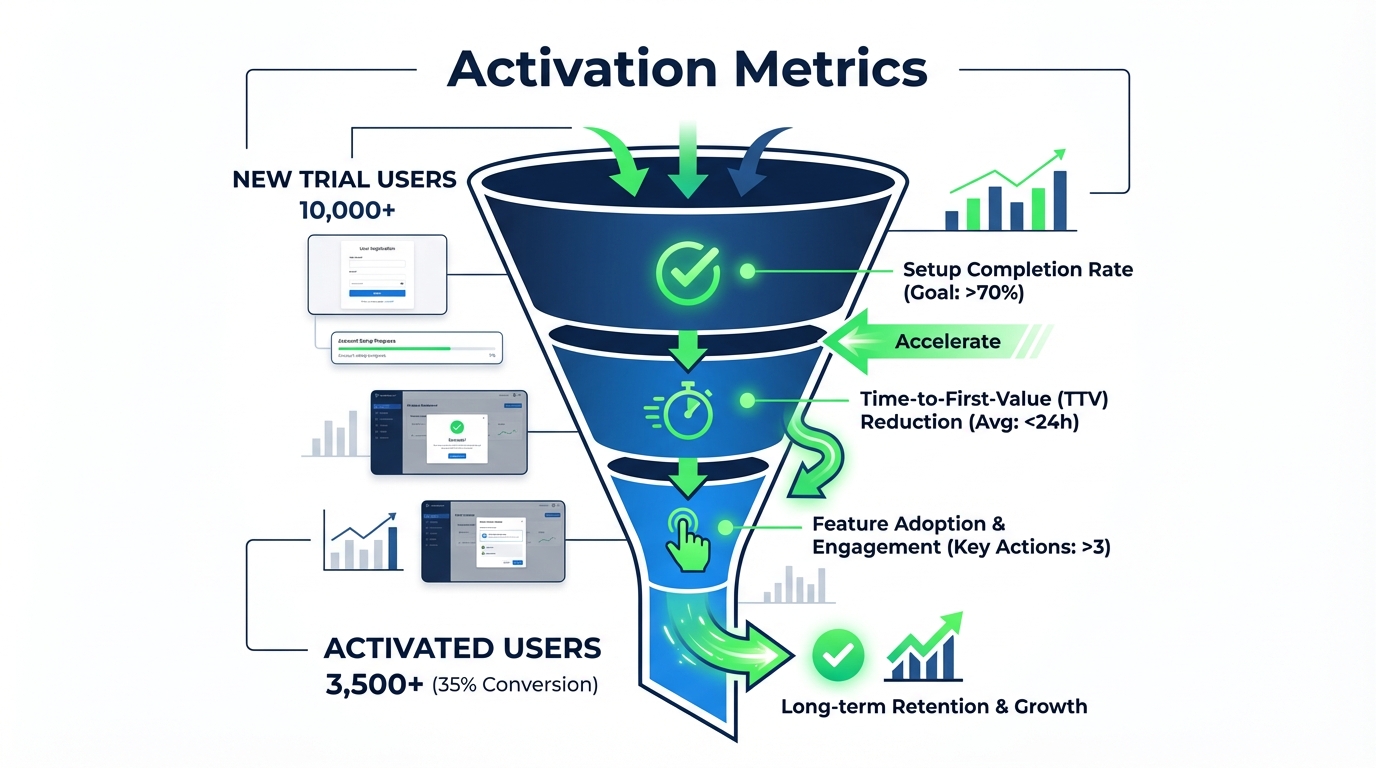
This isn’t administrative support. This is revenue protection.
The specialized SaaS Onboarding VA executes the critical, technical tasks needed to ensure rapid client activation. If the client isn’t active, they churn. Simple.
We break down these responsibilities into three profit-driving pillars:
Step #1: Technical Implementation: Zero-Downtime Activation
High earnings are justified here. Why? Because speed and precision directly impact Time-to-Value (TTV). We focus exclusively on configurations that minimize friction and lock in the contract.
- API/Integration Setup: Handling the initial, often complex connection between the client’s new SaaS product and their existing ecosystem (e.g., Slack, Salesforce, HRIS).
- Setting up Single Sign-On (SSO): Non-negotiable for enterprise contracts; failure to configure SSO correctly kills the deal and flags security risks.
- Secure Data Migration: Moving critical customer data from legacy systems (or spreadsheets) into the new platform,accurately and without loss.
Step #2: Building Scalable Systems (The Anti-Churn Layer)
Founders don’t hire VAs to put out fires forever. They hire them to build scalable, repeatable processes.
You don’t just fix the problem; you document the fix,and automate future success.
- Writing Standard Operating Procedures (SOPs): Creating internal guides for the CSM team to ensure standardized, repeatable post-onboarding handoffs.
- Help Center Content Generation: Drafting or updating knowledge base articles specific to the initial setup phase, drastically reducing future support tickets.
- Tailored Client Success Playbooks: Delivering customized guides that guarantee the new customer achieves continued value long after your contract concludes.
Step #3: Stakeholder Management: Driving Accountability
Onboarding projects stall when communication breaks down. Your role is managing expectations and driving accountability across all key stakeholders: the client, the sales team, and the Customer Success Manager.
- Project Mapping and Sequencing: Utilizing tools like Asana or ClickUp to define milestones and clear timelines for activation,no ambiguity allowed.
- Data-Driven Status Reports: Providing weekly updates focused strictly on activation metrics (e.g., usage volume, TTV reduction), not just task completion percentage.
- Proactive Risk Flagging: Identifying early bottlenecks (e.g., client non-responsiveness, integration failures) and escalating them immediately to prevent project derailment.
III. The High-Earning Toolkit: SaaS Implementation Mastery

High rates demand high leverage. You cannot generate revenue using basic, free tools.
Your expertise must be grounded in the specialized software stack that directly drives client activation and lifetime value (LTV).
Founders pay a premium for specialized knowledge they cannot afford to staff full-time. This is where you insert measurable value.
Focus your training on these three critical areas:
- 1. CRM Configuration Mastery: Forget basic contact management. We need VAs who understand sales pipelines, custom reporting, and advanced workflow automation within platforms like HubSpot or Salesforce. This is about process optimization, not data entry.
- 2. Product Adoption Platforms: Pendo, WalkMe, and Intercom are non-negotiable. Your job is to deploy targeted in-app messages that immediately drive feature adoption. If you master this, you directly reduce the time-to-value metric.
- 3. Customer Success (CS) Tools Integration: Gainsight or Catalyst track health scores and predict churn risk. The differentiating factor is your ability to integrate these platforms accurately,ensuring the data driving renewal decisions is flawless.
Understand the gap. Here is the definitive breakdown comparing the low-value administrative stack versus the high-leverage SaaS specialist toolkit:
| Category | Low-Value VA Tool Proficiency | High-Value SaaS Specialist Mastery |
|---|---|---|
| Project Management | Basic Trello or Asana task lists. | Advanced ClickUp/Jira workflow automation and complex dependency mapping. |
| Customer Data | Entering contacts into Google Sheets. | HubSpot/Salesforce API integration, custom property creation, lead routing setup. |
| Onboarding Tech | Sending welcome emails via Gmail. | Pendo/WalkMe deployment, segment creation, and activation flow analytics. |
| Communication | Scheduling Zoom meetings. | Configuring Intercom bots, managing automated support triggers, and documenting complex technical requirements. |
IV. 5 Steps to Transition & Command Premium Rates

The shift from generalized administrative support to specialized consulting requires a focused blueprint. Founders pay for certainty, measurable results, and high leverage. This is how you deliver it.
Step #1: Acquire Technical Certifications (Fast)
Your expertise needs validation beyond anecdotal experience. We require proof of work that instantly signals high value.
Target vendor-specific certifications. They are often free or low-cost, yet they immediately validate your skill set and reduce client risk.
- HubSpot Academy: Complete the ‘Customer Onboarding’ and ‘Service Hub Implementation’ tracks. This is non-negotiable for mid-market SaaS.
- Gainsight/Catalyst: Focus on foundational Customer Success management certifications. This speaks directly to retention and LTV.
- Pendo/WalkMe: Master product adoption training. This is the core of reducing Time-to-Value (TTV).
Future-Proofing Bonus: Integrate AI into every workflow. Learning advanced LLMs for rapid documentation, troubleshooting complex configurations, or generating user flows is a premium skill in 2025. This dramatically scales your output,and your rate. For a deeper dive into high-value AI roles, read our guide on the 2026 Remote Prompt Engineer Salary: Strategic Guide.
Step #2: Build a Specialized Portfolio (Case Studies)
Do not present screenshots of calendars or generic to-do lists. Show measurable, financial results.
Your portfolio must answer one question for the founder: How did you increase our activation rate or reduce Time-to-Value (TTV)?
If you lack client experience, secure a small, fast pro-bono project. Document the process with these three pillars:
- The Challenge: Client had a 50% drop-off rate post-signup. (This is a revenue leak.)
- Your Solution: Implemented a 3-step Intercom tour and streamlined the API connection process using Zapier.
- The Result: Reduced TTV by 4 full days and increased critical feature adoption by 22%. (Quantify the ROI.)
Step #3: Implement Value-Based Pricing
Stop selling time. Sell outcomes.
When you quote $100/hour, the founder focuses on the cost burden. When you quote a $2,000 fixed price for “SaaS Activation Flow Setup,” the focus shifts entirely to the value derived.
The Strategic Pricing Rule: Calculate the potential LTV increase or churn reduction your work will generate. Charge a strategic fraction of that documented gain.
Example: If your setup prevents two high-value clients from churning (worth $10,000 in Annual Recurring Revenue, or ARR), charging $3,000 for the project is not an expense,it is a mandatory investment for the founder.
Step #4: Refine Your Service Offering
Niche down further. Do not offer “general SaaS onboarding assistance.” This is a commodity role.
Offer highly specific, high-leverage solutions:
- “HubSpot-to-Gainsight Integration and Health Score Setup for Mid-Market B2B.”
- “Intercom Low-Touch Onboarding Automation for PLG Startups.”
- “Technical Data Migration and SSO Setup for Enterprise FinTech.”
Specificity commands instant authority and premium prices. Founders are looking for surgeons, not general practitioners.
Step #5: Target Founders Directly (Bypass HR)
HR departments look for VAs based on hourly cost. Founders look for consultants based on ROI.
If you want premium rates, you must position yourself directly in front of the decision-makers: the Head of Revenue, the VP of Sales, or the CEO.
How we approach this:
- LinkedIn Strategy: Use advanced search filters to find SaaS founders who have recently raised a Series A or B (they have budget) and are hiring Customer Success Managers (they have an onboarding problem).
- Cold Outreach: Focus your message solely on the measurable result you deliver. (Example: “I reduce TTV by 30% using Gainsight automation. Are you currently scaling your Customer Success team?”)
- The Goal: Land a 15-minute diagnostic call, not an interview. Treat the interaction as a consultation from the first email.
V. Finding Your SaaS Clients: Targeted Acquisition Strategies

High-value clients do not post on Indeed asking for a “Virtual Assistant.”
They pay for strategic expertise.
They look for solutions in specialized channels (not generic job boards). We focus our acquisition efforts exclusively on platforms where decision-makers congregate.
Strategy #1: Target Early-Stage SaaS Founders
Target Series A and B startups. They have significant capital but lack structured internal processes. Rapid scaling means their onboarding is already breaking (or about to).
They need rapid, specialized expertise,now.
Use Crunchbase or LinkedIn Sales Navigator to filter prospects. Look for two immediate signals:
- Recent funding rounds (Series A/B, within the last 6–12 months).
- Accelerated hiring growth in Customer Success or Sales Development (SDRs).
Your winning pitch must be direct: “I stabilize onboarding workflows during hyper-growth phases.”
Strategy #2: Leverage LinkedIn Strategic Engagement
Founders and Head of Revenue Operations (RevOps) leaders live on LinkedIn. You must maintain visibility where the actual buying conversations happen.
Find posts discussing churn, LTV decay, or technical debt in their current stack. Offer precise, high-value commentary. Demonstrate your expertise instantly.
This approach builds instant authority. It drives inbound traffic directly to your profile. We use this specific method constantly; it is how we attract our own ideal customers (Founders and SDR teams).
For a step-by-step blueprint on high-leverage engagement: Review our definitive guide on Strategic LinkedIn Commenting for B2B Lead Conversion.
Strategy #3: Direct Outreach to RevOps Teams
RevOps or Customer Success leaders own the onboarding function. They are the ideal contact,the budget holder.
Initiate targeted cold outreach. Your message must be hyper-personalized. Focus strictly on a specific pain point you can solve (e.g., referencing their current tool stack, recent funding news, or a known industry bottleneck).
Use a high-leverage hook:
“Congrats on the Series B scaling. Most companies at this stage see a 30% drop in activation speed due to integration friction. I specialize in streamlining HubSpot-to-Pendo flows to prevent that bottleneck. Interested in a 15-minute audit focused solely on activation speed?”
Precision is the only metric that matters in lead generation. You need high-quality data to execute this outreach effectively.
If finding the specific contacts (personal emails, direct lines) is your bottleneck, our AI lead generation software solves that problem instantly. We provide the targeted acquisition data required for this strategy.
Start Your Free Trial and Find Your Next SaaS Client NowVI. Salary Benchmarks: What Top SaaS Onboarding VAs Earn

Ignore the generic $20/hr VA rate. That benchmark is irrelevant.
We are not discussing general administrative support. We are discussing specialized consulting.
Transitioning from task execution to strategic implementation shifts your earning potential dramatically. This is a direct ROI play for the client; they pay for guaranteed outcomes.
Our internal research tracking successful fractional SaaS consultants in 2025 identifies three critical tiers:
Tier 1: Entry-Level Specialist ($50 – $75 USD/hr)
This is the entry point. You need 1-2 years of proven experience and 1-2 core technical certifications (e.g., HubSpot Onboarding, basic API interaction). You are proving competency.
- Focus: Execution of defined tasks, basic tool configuration, and documentation standardization.
- Client Profile: Small startups, high-volume transactional work, lower contract value (often project-based).
Tier 2: Experienced Consultant ($75 – $125 USD/hr)
You must demonstrate 3-5 years of results. This tier requires multiple certifications and a portfolio proving measurable churn reduction and increased activation rates.
- Focus: Full project ownership, integration troubleshooting (API basics are mandatory), and complex workflow design across multiple tools.
- Client Profile: Mid-market SaaS, Series A/B funded companies, demanding fixed-price project contracts.
Tier 3: Fractional Head of Onboarding ($125 – $200+ USD/hr)
This is the high-leverage tier. It requires a retainer model,you are selling strategic capacity, not just hours. You are providing process audits and executive-level guidance.
- Focus: Defining the entire onboarding strategy, optimizing systems for scale, and directly advising the executive team on activation KPIs.
- Client Profile: Enterprise clients, high-growth scale-ups, value-based contracts often exceeding $10,000 per month.
Your hourly rate is a direct reflection of two factors: the risk you mitigate and the revenue you accelerate. Focus relentlessly on the technical skills that prevent critical, early-stage churn. That is the only way to justify $200/hr.
Frequently Asked Questions

What is the most critical skill difference between a $20/hr VA and a $100/hr SaaS Specialist?
The difference is ownership: technical ownership.
A $20/hr VA handles communication about a task. They manage administrative friction.
The $100/hr specialist owns the system implementation. They are the strategic consultant.
Example: They don’t just ask about Salesforce custom fields. They configure the fields, ensuring they correctly trigger the automated welcome sequence in Intercom (or HubSpot, or Outreach).
They solve complex system friction. That is the premium skill.
Do I need a Computer Science degree to be a high-paying SaaS Onboarding VA?
Absolutely not. Deep coding knowledge is irrelevant here.
You need functional technical literacy. This means understanding the architecture:
- How APIs handshake between platforms.
- How SSO protocols function.
- How to configure settings across complex SaaS stacks (e.g., granular user permissions, workflow automation).
Founders prioritize measurable results and activation speed. Therefore, practical case studies and targeted certifications are exponentially more valuable than a general degree.
Should I charge hourly or project-based rates for SaaS Onboarding?
Always charge project-based or value-based rates. This is non-negotiable for high earners.
Hourly pricing is a cap. It forces the client to focus on your time spent, not the revenue generated from faster activation.
We recommend defined project rates.
Example: Charge $3,500 for a 4-week implementation sprint,not $100/hr for 35 hours.
This approach shifts the focus entirely to the delivered outcome (activation, reduced churn). Efficiency becomes highly profitable for you, and the client receives guaranteed value.
Ready to take the next step?
Stop wasting time on generic leads. Use our AI Lead Generation Software to find the exact contacts (Founders, RevOps) who need high-value onboarding specialists.
Start Your Free Trial