


The rise of AI has fundamentally changed how we generate revenue online. It is no longer a question of if you should adopt AI, but how quickly you can scale it.
This rapid scaling introduces massive ethical debt.
Large enterprises face multi-million dollar fines and catastrophic PR. For the solo founder or the small SDR team, ethical failure means instant reputational death.
Your ability to make money online (M.M.O.) relies entirely on trust. AI can destroy that trust faster than you built it.
We use AI extensively in our lead generation systems. Our focus is speed, accuracy, and compliance. We cannot afford to compromise on any of these pillars: Our growth depends on it.
You don’t need academic theory on AI ethics. You need a pragmatic framework: actionable steps that protect your revenue pipeline.
Key Takeaways for M.M.O. Founders
- Reputational Risk is Paramount: A single, AI-driven trust breach is fatal for small businesses (or SDR teams).
- The Black Box Problem: Institute mandatory human oversight for all AI outputs that directly impact revenue (lead scores, personalized emails, financial content).
- Transparency is Non-Negotiable: Disclose when content, reviews, or sales outreach is heavily automated. Avoid deceptive practices entirely.
- PII is Your Liability: If your AI tools handle Personal Identifiable Information (PII),especially client emails,strict data security protocols are non-negotiable.
I. Core Ethical Pillars: Ethical Strategy for Hyper-Scaling M.M.O.

Forget the Fortune 500 white papers. Those guides focus on HR bias and institutional finance,problems that do not apply to your six-figure agency or your niche lead generation funnel.
Our focus is monetization. We need ethical pillars redefined through the lens of digital revenue generation.
Step #1: Stop Algorithmic Bias from Killing Your Lead Scoring
Algorithmic bias is simple: unfair outcomes produced by flawed data. In M.M.O. lead generation, this manifests immediately:
- Lead Scoring Distortion: Your AI lead generation software (or your internal CRM model) is trained only on past wins. Result: The model ignores equally qualified prospects outside that historical norm. This restricts your market access. It reinforces existing biases.
- Ad Suppression/Amplification Risk: Using AI to optimize ad spend is dangerous. If the algorithm decides a demographic is “less profitable,” it may suppress visibility based on protected characteristics. That is a fast track to platform bans and immediate legal trouble.
The Actionable Fix: Audit Your Input Data Relentlessly
You must consistently test your lead scoring models. Use diverse, synthetic data sets. Run A/B tests on outreach campaigns. Prospects flagged as “low value” by the AI must still receive human review,always.
We discovered our initial AI model undervalued clients in non-Tier 1 countries. Why? Their historical average contract value was lower. We were sacrificing long-term, high-volume partnerships for short-term revenue spikes. Bias is not just a moral failure; it is objectively bad business strategy.
Precision is mandatory for strategic B2B lead generation. You need every edge, but excluding profitable segments based on flawed AI data is unacceptable.
Step #2: Data Privacy and PII Management (Your Core Liability)
For founders and sales teams, data privacy is not an IT department issue. It is a core liability. You handle PII (Personal Identifiable Information) every time you use a tool to find clients’ personal emails or scrape public data.
Your risk profile is fundamentally different from a large enterprise:
- Zero Redundancy: Large firms employ dedicated compliance officers. You likely use a single CRM or cloud sheet. A data breach hits you faster, harder, and often fatally.
- Consent and Purpose Clarity: Can you articulate precisely why you collected that personal email? GDPR and CCPA demand a legal basis (Legitimate Interest works for B2B, but requires a documented balancing test).
- Third-Party Vendor Risk: Most M.M.O. businesses integrate dozens of SaaS tools. If one AI vendor suffers a breach, your customer data is exposed. You remain responsible for the fallout.
The Actionable Fix: Minimize and Secure Everything
Do not hoard data you do not need. If a lead goes cold for 12 months, scrub their PII from your systems immediately. Ensure every AI lead generation tool you integrate is fully compliant with major regulations (GDPR, CCPA). Use robust encryption. This is non-negotiable.
Step #3: IP, Ownership, and the Commercial Liability Trap
Generative AI thrives on data ingestion. This creates an immediate legal minefield for anyone using AI to produce content, code, or creative assets for monetization.
The core question: If the AI was trained on copyrighted material, who owns the resulting asset?
The U.S. Copyright Office is clear: Raw AI outputs are not automatically protectable. Human authorship is the key requirement. This is the “Creativity and Ownership” gap that sinks commercial projects.
- Style Imitation Risk: Using AI to clone the writing style of a known brand or author risks claims of unfair competition or trademark infringement.
- Direct Infringement Liability: If your AI-generated asset (image, music, text) includes copyrighted source material, you,the commercial user,bear 100% of the liability. The AI developer is rarely held responsible.
The Actionable Fix: Transform, Don’t Generate
Never publish raw AI output. Use AI strictly as a drafting accelerator. Ensure significant human editing, transformation, and value-add occur. This strengthens your legal claim to authorship and drastically reduces the risk of infringing on source material. This step is crucial whether you are developing high-ticket services or learning how to monetize ChatGPT skills effectively.
II. M.M.O. Specific Ethical Gaps: The Competitive Edge

Institutional guides miss the mark. They ignore the specific ethical pitfalls of the digital economy,the gaps where real revenue is won or lost.
This is where the modern founder builds (or destroys) trust.
Step #4: Mandatory Transparency and Disclosure
Your audience isn’t stupid. They know you use AI. They expect efficiency.
What they won’t tolerate is deception. The ethical line is simple: Disclosure is mandatory.
If we use our AI to draft a hyper-personalized sales email, we ensure the core intent is human-driven and the personalization is accurate. If you use AI to generate 80% of a critical blog post, you must disclose the level of automation.
Disclosure Guidelines for M.M.O. Success:
- Blog Content: Use a clear, non-negotiable footer tag: “This article utilized AI tools for drafting and SEO structure, heavily edited and verified by [Human Editor Name].”
- Lead Outreach (Email/LinkedIn): Never claim manual effort if you used an AI tool to scale your outreach volume. Our focus must be on the value of the message, not the fabricated effort. Authenticity trumps manual inefficiency every time.
- Customer Service Bots: Always identify the bot immediately. Example: “Hi, I’m Pyrsa, your dedicated AI assistant. I handle basic queries, but I will seamlessly connect you to our human team for complex strategic issues.”
Failing to disclose erodes audience trust,and trust is your only non-depleting asset in digital marketing.
Step #5: Authenticity and Deception (Deepfakes and Fake Reviews)
AI now enables scalable deception. This is arguably the most dangerous ethical threat to the M.M.O. space in 2025: the ability to fake human presence.
The Deception Traps That Kill Authority:
- Deepfakes for Personal Branding: Generating AI clones of yourself for video content, webinars, or sales calls. This is fundamentally deceptive. It cheapens your genuine presence and opens your brand up to severe backlash when (not if) the “clone” malfunctions.
- Automated Review Generation: Using AI to write hundreds of realistic, positive product reviews or testimonials. This is an immediate FTC violation. It is the fastest route to getting delisted from major marketplaces (Google, Amazon) and destroying your brand credibility.
- Misleading Funnel Automation: Creating fully automated, AI-driven sales funnels that explicitly promise human interaction or personalized consultation but deliver generic, machine-generated responses.
For high-stakes lead generation and conversion systems, we must prioritize authenticity over automation.
Step #6: Scalable Misinformation (SEO Spam Ethics)
The content creation barrier has dropped to zero. This is a strategic advantage,and a massive liability.
AI enables the mass production of low-quality, inaccurate content purely to capture affiliate revenue or low-intent search traffic. We call this SEO spam.
While some founders argue that publishing 10,000 AI-generated articles is a legitimate strategy for AI passive income, search engines (specifically Google) are actively fighting it. They are winning.
The Ethical Cost of SEO Spam (And Why It Kills Revenue):
- Dilution of Quality: It floods the Search Engine Results Pages (SERPs) with unverified information. This makes it exponentially harder for your high-quality, human-vetted content to rank.
- Brand Erosion: If your brand becomes associated with low-quality, keyword-stuffed content, you destroy long-term authority. Any temporary traffic gains will not offset this loss.
- Data Poisoning: The low-quality, inaccurate content you generate today becomes the training data for the next generation of AI models. You are actively perpetuating inaccuracy and degrading the ecosystem.
Focus on quality, depth, and human insight. AI should augment your expertise. It should never replace it entirely.
III. Practical Ethical Governance: Your 3-Step Action Plan
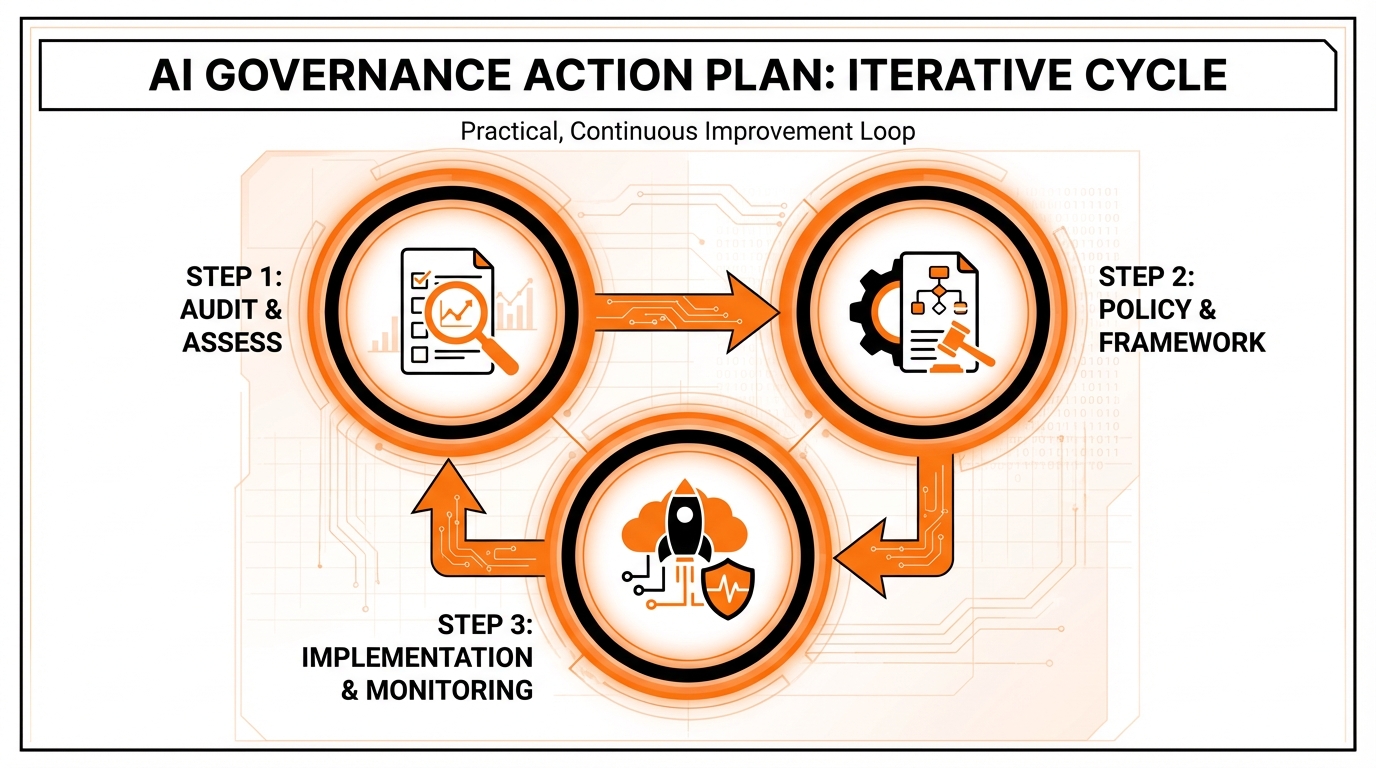
Ethics is not philosophy. It is a governance framework designed to protect your revenue. Implement these three steps immediately. Secure your digital operations now.
Step #7: Establish Human Oversight Checkpoints
AI drives efficiency. But unchecked AI drives massive liability. Every critical, revenue-facing function must have a mandatory human checkpoint. This is non-negotiable.
Checkpoints to Implement Today:
- Lead Qualification: AI handles the scoring. A human SDR must verify the fit (and the personalized contact data) before outreach begins. You cannot automate vetting.
- Final Content Review: AI drafts the initial 80%. A human editor verifies all factual claims, external links, and ensures the tone matches your E-E-A-T standards. Quality over volume.
- Client Communication: AI personalizes the email body (mass customization). But the final review, the send button, and the signature must be human-authorized. Protect your domain reputation.
Step #8: The Ethical Use Comparison Table
This is the line between scalable strategy and crippling risk. Use this table to instantly assess if your monetization strategy crosses the line from efficient automation to unethical deception.
| Strategy Focus | Ethical & Compliant Use | Unethical & High-Risk Use |
|---|---|---|
| Lead Generation | Using AI to find verified, publicly available PII for targeted B2B outreach (Legitimate Interest basis). | Scraping mass consumer data without consent or selling unqualified, unverified lead lists generated by AI. |
| Content Marketing | Using AI to structure articles, generate outlines, and draft initial paragraphs, followed by 50%+ human editing for expertise. | Mass-publishing 100% AI-generated content (SEO spam) solely to dominate low-value keywords for affiliate link insertion. |
| Customer Trust | Using AI chatbots that clearly identify themselves as automated assistants before engaging. | Generating fake reviews, deepfaking CEO video testimonials, or promising human consultation but delivering automated, unmanaged scripts. |
| Personalization | Using AI to analyze prospect data and suggest relevant case studies or pain points for a human SDR to use in outreach. | Using AI to fabricate highly personal, non-public details about a prospect to create a false sense of intimacy or surveillance. |
Step #9: Future Regulatory Outlook for Digital Creators (2026+)
Regulation always lags innovation. But that gap is closing faster than you think. We are already planning for 2026 enforcement.
The focus is shifting from general AI principles to specific domain enforcement:
- FTC Focus: Aggressively targeting deceptive AI practices. Specifically: fake reviews, misleading marketing claims, and automated sales scripts that impersonate human agents. High fines mean high risk.
- Platform Enforcement: Google and Meta are already penalizing content that lacks E-E-A-T (Experience, Expertise, Authoritativeness, and Trust). Automated, thin content will destroy your organic traffic.
- EU AI Act: While focused on high-risk systems (medical, finance), its transparency requirements are setting a global standard. If you sell internationally, this legislation will impact your data handling and disclosure policies.
The lesson is simple: Future-proof your revenue. Build your business today as if the regulation you expect in 2028 is already active. This isn’t compliance. This is strategic defense.
FAQs: Ethical AI and Revenue Generation

- Is it ethical to use AI to find a client’s personal email address?
- Yes. But compliance is non-negotiable. We use AI to source verified, publicly available data points.
The ethical standard hinges on “Legitimate Interest” (B2B):- Is the outreach relevant to their professional role?
- Are you balancing their privacy against your revenue goals?
- How much of my blog content can be written by AI before it is considered unethical?
- Stop focusing on percentages. The threshold is verification and deliverable value.
Unethical content is defined by:- Unverified facts (AI hallucinations).
- Misleading claims.
- Low-effort SEO spam (zero unique value).
- If an AI tool introduces bias into my lead scoring, am I legally liable?
- Absolutely. AI is a tool; it is not a liability shield. Your company is ultimately accountable for every output the system generates. If your lead scoring systematically discriminates,even unintentionally,you are liable.
Action item: You must continuously audit your systems to mitigate biased outcomes. Protect your reputation before the fine hits.
Ready to scale leads ethically?
Find verified B2B client emails and scale your outreach ethically. Secure your revenue stream today.
Start Your Free Trial