


You are using AI to scale. That much is obvious.
If you aren’t, you are already losing deals to competitors who moved past manual list building two quarters ago.
The problem isn’t the technology itself.
The problem is that most sales leaders treat AI prospecting tools like a black box,a magical engine that spits out emails and phone numbers without consequence.
That approach is naive. It is also dangerous.
In 2025, the ethical landscape isn’t about vague concepts like “fairness” or “doing good.” It’s about compliance, minimizing legal liability, and protecting the one asset that allows you to scale: prospect trust.
Unethical AI deployment, specifically in lead identification and outreach, doesn’t just risk fines.
It guarantees massive brand damage and deliverability issues that tank your entire outbound system.
This guide isn’t theoretical.
It’s the pragmatic, results-oriented blueprint for deploying AI lead generation ethically. We show you how to maximize conversions without crossing the line into litigation or creepiness.
Key Takeaways: The Ethical Mandate for Sales Leaders
- AI is a Liability Multiplier: Algorithmic bias in lead scoring doesn’t just exclude prospects; it reinforces systemic bias at scale, creating immediate legal risk.
- The Creepy Line: Personalization must be strictly based on professional data (LinkedIn, company website, news mentions). Do not scrape or reference personal social media data,it destroys trust instantly.
- Vendor Vetting is Non-Negotiable: You must audit your AI tool vendors on their data sourcing, security protocols, and compliance frameworks (specifically GDPR and CCPA). If they can’t prove clean data, you assume the liability.
- Human Oversight Pays: The most effective systems use AI for scale but require human intervention (Human-in-the-Loop) for nuanced decisions, quality control, and relationship management.
The 5 Non-Negotiable Pillars of Ethical Prospecting AI

You’ve accepted that AI is mandatory for scale. Now, you need to understand the operational mandates that keep you compliant and profitable.
Forget the academic debates about philosophy and ethics. When you are running a high-volume outbound operation, ethical AI boils down to five functional requirements. These requirements keep your data clean, your domain reputation intact, and your legal team quiet.
1. Algorithmic Bias: The Self-Imposed Revenue Ceiling
Bias is not a philosophical issue. It’s a mathematical failure that actively costs you revenue.
Your AI lead scoring model is trained on historical conversion data. If your previous sales team only closed deals with mid-market manufacturing companies in the Midwest, your AI will learn to heavily de-prioritize or completely ignore prospects outside those parameters.
This is the model becoming a mirror, reflecting past limitations instead of predicting future opportunities.
The Operational Risk:
If your AI is biased against specific industries, company sizes, or geographical locations (simply because you haven’t sold there yet), you are actively filtering out huge pools of potential revenue.
“If your AI system only recommends leads that look exactly like your last 100 clients, you haven’t built an AI; you’ve built an echo chamber with API access.” This is a self-imposed ceiling on your Total Addressable Market (TAM).
You must challenge the inputs. Rigorously audit the weighting factors in your scoring model to ensure they reflect strategic growth goals, not just historical accident. You need a forward-looking model.
(For a deeper dive on how to recalibrate your inputs, read our guide on AI Predictive Lead Scoring Models Explained.)
2. Data Privacy: The Global Compliance Minefield
Data privacy is the single biggest threat to unchecked AI lead generation. We are past the era where you could simply scrape a public website and call it a day. Regulators are closing the loopholes fast.
When you use AI software to find a client’s personal email address (which is often necessary for direct, high-level outreach), you are engaging in data processing that falls under strict legal scrutiny, especially if the prospect is in the EU, California, or Canada.
The GDPR/CCPA Reality Check:
In B2B, you operate under the legitimate interest basis for processing data (GDPR Article 6(1)(f)). This is complex. It means you must prove that your interest in outreach outweighs the prospect’s rights to privacy. You need verifiable data provenance.
If your AI tool is aggregating data from questionable, non-professional sources, or if it fails to provide clear mechanisms for opt-out and data deletion requests, your entire database is a ticking regulatory time bomb.
This is why vendor selection is paramount. You need a partner that ensures data provenance is clean and legally sound. If they can’t tell you exactly where they found that personal email, assume it’s high risk and ditch the tool.
(We break down vendor compliance and liability in detail in Lead Gen Tools: GDPR Compliance Comparison.)
3. Transparency and Explainability (XAI)
Transparency is trust. If a prospect asks, “How did you get my information?” or “Why are you targeting me?”, your SDR team needs an honest, concise answer,immediately.
In ethical AI, this is called Explainable AI (XAI). You don’t need to explain the neural network architecture, but you must be able to explain the rationale behind the outcome.
When your AI prospecting tool provides the specific data points that triggered the outreach, you empower your reps to personalize the message effectively and ethically. It shifts the conversation instantly.
Example: The Rationale Shift
- Black Box Failure: “Our system identified you as a high-value prospect.” (Trust Level: Zero. Relevance: Unproven.)
- Transparent XAI Success: “We target companies of your size ($50M+ ARR) in the FinTech sector who recently posted openings for a Head of Sales, indicating a clear scaling intent.” (Trust Level: High. Relevance: Proven.)
The second option changes the conversation from “How dare you contact me?” to “Okay, you clearly understand my current pain point.” That is how high-level deals are opened.
4. Accountability: Who Owns the Spam?
When an AI system goes rogue,and they will,who takes the hit?
If an automated sequence sends 5,000 poorly personalized, irrelevant emails that result in 300 spam reports, the AI doesn’t get fined. Your domain does. Your brand reputation suffers irreparable damage.
Accountability must be clearly defined before deployment. Failure to assign human oversight is not automation; it’s abandonment.
The Accountability Hierarchy:
- The Founder/Sales Leader: Responsible for setting the ethical thresholds, defining the ICP, and auditing the system’s performance metrics (e.g., spam rates, opt-out rates).
- The SDR/AE: Responsible for reviewing AI-generated content and data points before hitting ‘Send’ (The Human-in-the-Loop).
- The Vendor: Responsible for the integrity and compliance of the underlying data and software architecture.
If you automate 90% of the process but fail to assign 10% human oversight, the speed gain is not worth the risk of being blacklisted by major email providers or, worse, losing your company’s only path to market.
5. The Human-in-the-Loop Protocol (HILP)
Over-automation is the fastest way to kill a relationship. It happens when sales teams become lazy and trust the AI implicitly.
AI is brilliant at scale, data aggregation, and drafting personalized content skeletons. It is terrible at empathy, handling complex objections, and understanding subtle tone shifts.
The solution is the HILP: a mandatory checkpoint where a human reviews, edits, and approves the high-stakes outreach. This ensures the 10% human oversight required for accountability (Pillar #4).
When HILP is Mandatory:
- When leveraging The 5 Levels of AI Personalization for Cold Email ROI (especially Level 4 and 5, which require deep contextual review).
- Before sending the first touchpoint to any Tier 1 account (your ideal client profile).
- When the AI flags a lead interaction as “high emotional sentiment” or “negative response.”
- Before any legal or compliance-sensitive communication is sent.
The goal is strategic: Use AI to handle the 80% of repetitive data gathering and drafting. This frees up your SDRs to focus their cognitive effort on the 20% that actually closes the deal: strategic intervention, relationship building, and high-impact personalization.
Critical Frameworks for Sales Leaders (Stop Guessing)

Stop relying on vague ethical guidelines. Ethical implementation requires repeatable, non-negotiable systems.
You need battle-tested protocols your SDRs can execute without calling legal every five minutes. These frameworks turn abstract compliance into actionable revenue strategy.
1. The AI Vendor Vetting Checklist
Your vendor’s liability is your liability. If their data sourcing is illegal, your entire outbound operation is immediately compromised. Period. You absorb the risk, the fines, and the reputation damage.
Before integrating any AI prospecting software, you must demand clear, documented answers on their data supply chain. Use this non-negotiable framework:
| Vetting Criteria | Ethical Requirement (Must-Have) | Risk Mitigation Rationale |
|---|---|---|
| Data Provenance | Vendor must detail all data sources (public professional, aggregated). Must exclude personal/private social data entirely. | Ensures adherence to professional-use standards, avoiding intrusion claims and mitigating legal exposure. |
| Consent & Opt-Out | Verifiable, automated suppression lists and explicit consent withdrawal mechanisms (GDPR Article 17 mandate). | Protects sender reputation, ensures deliverability, and drastically reduces legal liability from unwanted contact. |
| Data Security (Encryption) | All PII (Personal Identifying Information) must be encrypted at rest and in transit (e.g., industry-standard AES-256). | The primary defense against data breaches, which carry catastrophic financial and reputational penalties. |
| Bias Mitigation Strategy | Must provide documented, routine audits of lead scoring models for unintended bias (industry, geography, size). | Guarantees a wider, more equitable Total Addressable Market (TAM) and prevents the exclusion of viable revenue segments. |
2. Defining the “Creepy Line” Policy
This is where high-volume outreach fails most often. Your team confuses “hyper-personalization” with “intrusive stalking.” Stop it.
The Creepy Line is simple: If the data point used could only have been gathered by monitoring a prospect’s personal life, you crossed it. You are no longer strategic; you are unsettling.
Your goal is to personalize the pain (professional challenge), not the person (personal life, family, hobbies).
The Pyrsonalize Data Boundary Rule:
Limit your AI data input and personalization outputs exclusively to publicly available, professionally relevant information. No exceptions.
- Acceptable Data (Professional Intent): Job history, company size, recent funding rounds, technology stack, public company news (M&A, product launches), professional forum activity (e.g., GitHub, industry blogs).
- Unacceptable Data (Personal Intrusion): Family details, personal hobbies (unless directly related to their current professional role), social media posts from non-professional accounts (Instagram, personal Facebook), precise real-time location tracking.
You may think referencing a prospect’s recent tweet about their favorite football team makes you relatable. It doesn’t. It makes your outreach feel manufactured and slightly unsettling. Focus on their professional challenges. That is where the budget lives.
3. Bias Audit Protocol for Prospecting Models
You cannot simply trust the algorithm. If your AI lead scoring model is biased, you are leaving viable revenue on the table. You are inefficient, and you are unethical.
Implement this structured, three-step audit protocol immediately. This is how you proactively check your models for systemic bias.
Step A: Define the Exclusionary Hypotheses
Start by identifying the historical biases embedded in your training data. Ask the hard questions:
- Did we historically prioritize leads based on gender-coded job titles, potentially excluding high-value decision-makers in non-traditional roles?
- Is our current conversion rate disproportionately low for companies in APAC or LATAM, even though they perfectly fit the Ideal Customer Profile (ICP)?
- Are we unintentionally filtering out high-growth SMBs because our AI is over-trained on historical Enterprise sales cycles?
Define 3-5 specific biases you believe might be present in the model. If you don’t look for them, they will persist.
Step B: Run Controlled Test Segments
Create two parallel test campaigns. The goal is to compare the performance of leads the AI loves versus leads the AI rejected:
- Control Group (AI-Scored): Leads identified and prioritized exclusively by the existing AI model (high score leads).
- Audit Group (Manually Selected): Leads that the AI model scored low (0-30), but which manually fit your ICP for the specific bias you are testing (e.g., SMBs in APAC).
Run the exact same high-quality outreach sequence against both groups.
Step C: Analyze Conversion Disparity
Review the results: If the Audit Group (low AI score) shows a statistically significant response or meeting booking rate compared to the Control Group, your AI model is clearly biased and excluding viable revenue.
The mandate is clear: You must immediately adjust the feature weighting in the model to reduce the bias against that specific segment (e.g., decrease the importance of ‘Company HQ Location’ if it’s unfairly penalizing APAC leads).
This is not a one-time fix. You must schedule this audit quarterly. The market shifts. Your product evolves. Your AI must evolve, or it becomes obsolete, and unethical.
Actionable Strategy: Compliance vs. Conversion

The sales floor is often paralyzed by a perceived trade-off: Strict Compliance versus Maximum Conversion Volume.
This is a false dichotomy.
The reality is simple: Ethical AI isn’t optional compliance; it is the only long-term foundation for high conversion.
Unethical volume is cheap. It’s fast. It is also completely unsustainable.
Ethical, personalized outreach requires more initial setup time, yes. But it delivers predictable, high-quality meetings,the kind that actually close.
The Trade-Off: Short-Term Gains vs. Long-Term Predictability
If you chase volume by ignoring ethical sourcing and transparency, you will see a temporary spike in lead counts. You will scrape more data, send more emails, and hit a higher initial contact rate.
This is a temporary high.
The fallout is swift. And it is catastrophic:
- Domain Score Annihilation: High spam complaints instantly degrade your domain score. 90% of your future emails,even the legitimate ones,will land in the spam folder. This kills your entire outbound channel overnight.
- Regulatory Landmines: Think about the cost of shortcuts. A single GDPR violation can clock in at 4% of global annual turnover. Are you prepared to risk millions for a marginal boost in meetings this quarter?
- Brand Trust Erosion: Prospects talk. If your brand is known for creepy, intrusive, or generic automated outreach, you burn trust before the first meeting even happens. You become noise.
You cannot build a scalable, predictable revenue engine on junk data. The AI is a multiplier, absolutely. But if the input is garbage, the output is scaled garbage.
We ran the numbers:
“Clients who invested just 20% more time in ethical data sourcing and human review saw their reply rates stabilize 3X higher than those who chose pure automation volume.”
The instruction is clear:
Focus on verified, quality lead identification first (finding the right person’s verified email). Then, apply AI for scale and personalization. Never the other way around.
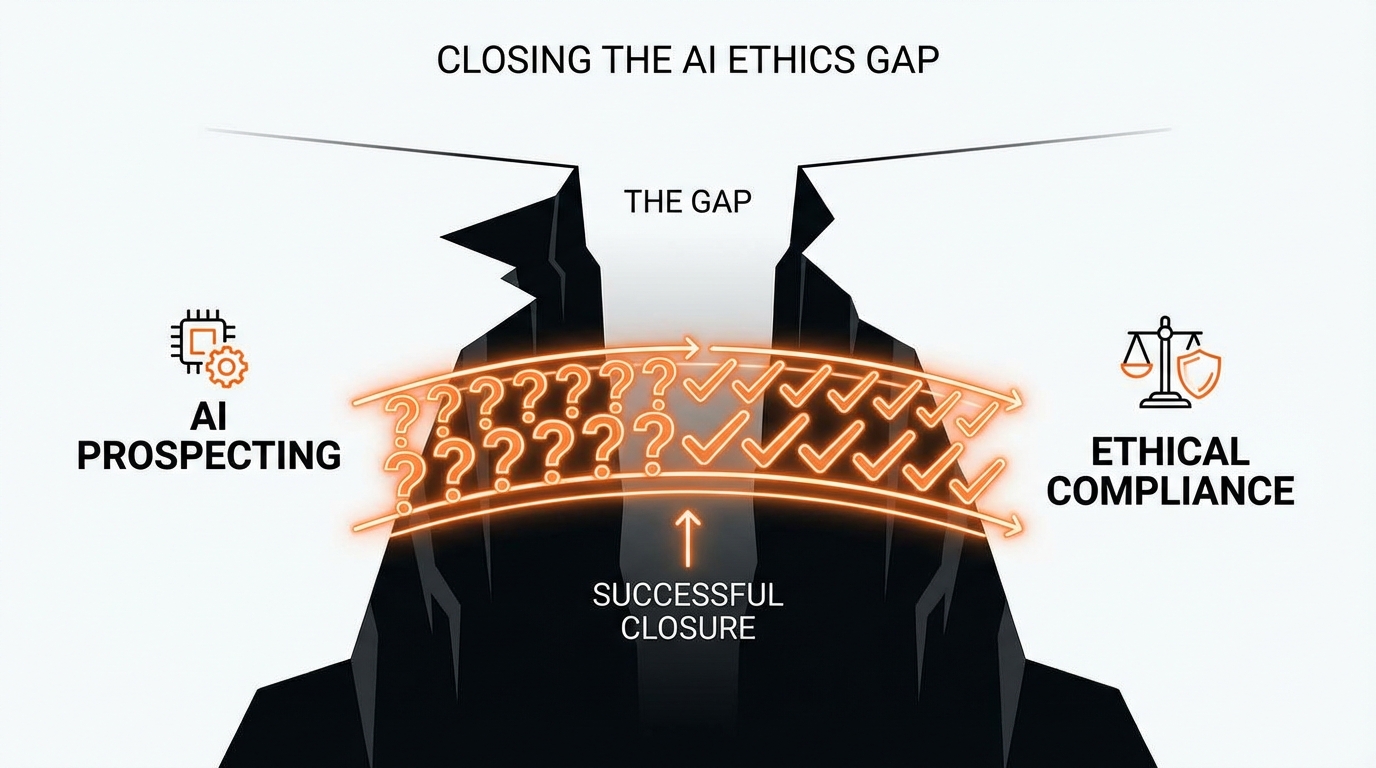
Frequently Asked Questions: Closing the Compliance Gap
- Is using AI to find a prospect’s personal email address ethical?
-
The answer is unequivocally yes,if you treat data as an asset, not just volume.
This requires meeting two mandatory requirements. Fail either one, and your entire prospecting operation is compromised.- Ethical Sourcing: The data cannot be hacked, scraped from private forums, or purchased from black markets. It must be verified professional data points tied to demonstrable business activity (which is what Pyrsonalize guarantees).
- Legal Adherence: GDPR, CCPA, and regional laws are non-negotiable. Your outreach must establish a clear, documented “Legitimate Interest” tied directly to the prospect’s professional role. Always provide an immediate, one-click opt-out.
- How often should we audit our AI lead scoring models for bias?
-
Bias kills conversion. If your model systematically excludes high-value segments, you’re leaving money on the table.
You must run two types of audits:- The Deep Dive Audit (Quarterly): This is mandatory every 90 days. Run a full, quantitative bias check immediately following any major shift in your Ideal Customer Profile (ICP), product launch, or sales territory expansion. This ensures you haven’t accidentally coded demographic or geographic exclusion bias into your scoring.
- Continuous Monitoring (Weekly): This should be part of your SDR weekly review. Track spam rates, delivery errors, and conversion rate variances across micro-segments (industry, company size, region). If a segment suddenly tanks, your model is biased against it. Fix it immediately.
- Should we tell prospects we are using AI?
-
Hiding automation is the fastest way to breed suspicion and end up in the spam folder.
The answer is yes, but you must frame it as a powerful benefit.
You don’t need to open with, “This email was drafted by an LLM.” Instead, use the AI-driven insight to demonstrate hyper-relevance. Transparency isn’t about revealing your tech stack; it’s about explaining how you earned the right to be in their inbox.
Example of Strategic Transparency: “Our system identified your recent pivot to SaaS integration, which is why I’m reaching out with this specific, high-ROI solution…” This builds trust by proving you did the homework.
Ready to scale ethical revenue?
Stop guessing on compliance and start finding verified, high-value leads today. Start Your Free Trial.
Start Your Free TrialReferences
- 5 Ethical Considerations of AI in Business – HBS Online
- Ethical AI Guidelines for B2B Prospecting & Data – Danish Lead Co.
- The Ethics of AI in B2B Prospecting: Challenges and Best Practices
- Top 10 Ethical Considerations for AI Projects | PMI Blog
- Ethics in AI: Why It Matters – Professional & Executive Development