


The modern Sales Development Representative (SDR) is not a spammer. They are a highly efficient, data-driven revenue machine—the undisputed engine of pipeline growth.
In 2025, relying on generic lists and clunky, disconnected tools is a guaranteed path to missed quota. You are not just losing deals; you are losing time, which is the SDR’s most valuable asset. Your competitors are already leveraging AI to personalize outreach at scale.
Our mandate is simple: Build a tech stack that minimizes administrative friction and maximizes trust-based, scalable lead acquisition.
This is not a list of 50 unnecessary tools. This is the strategic blueprint for the core technology an SDR needs to hit quota immediately and consistently.
To achieve this efficiency, we focus on four critical technology layers. If any layer is weak, your entire pipeline stalls and your investment delivers zero ROI.
Key Takeaways: The 2025 SDR Mandate
- Data is the Asset: The single biggest ROI driver is clean, verified, and personalized contact data. Invest here first.
- Integration is Non-Negotiable: Your stack must communicate seamlessly. Siloed tools create administrative overhead that kills SDR productivity and wastes budget.
- Prioritize AI for Personalization: Use AI to find deep context and build hyper-personalized messages, not just to write generic, high-volume emails.
- Focus on the Core Four: CRM (Foundation), Data (Fuel), SEP (Execution), and Conversation Intelligence (Optimization).
The Four Strategic Pillars of the SDR Tech Stack
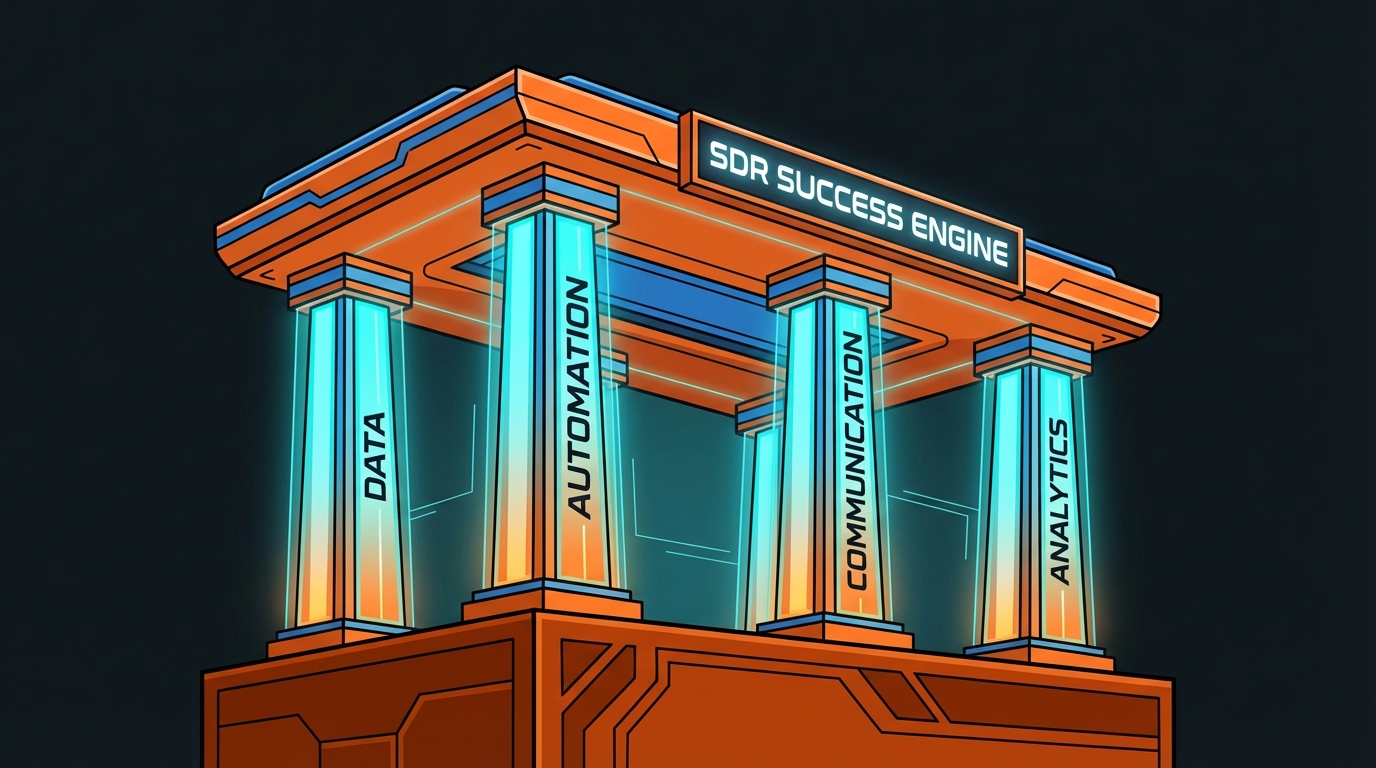
Building a high-performing sales stack requires architectural precision. Like a skyscraper, you must establish a solid, integrated foundation before executing high-level engagement. We categorize the essential tools into four distinct, yet interdependent, strategic pillars.
Pillar 1: The Foundation (CRM)
The Customer Relationship Management (CRM) system is the single source of truth. It serves as the memory, the map, and the motor of your entire revenue operation. Without a robust CRM, visibility collapses.
Crucially, for new SDR agents, the CRM must be intuitive and fast. Clunky CRMs kill data hygiene. Poor data hygiene is the fastest route to pipeline failure and wasted effort.
CRM Selection: Speed vs. Scale
We typically see two dominant choices, depending on your organization’s size and complexity. Both options are valid, but both demand strict governance and adherence to process.
Option A: Salesforce (The Enterprise Standard)
- Pros: Unparalleled customization. Deepest integration ecosystem available. Scales infinitely alongside complex business processes.
- Cons: Steep learning curve is unavoidable. High cost structure. Requires dedicated RevOps support to maintain workflows and ensure data integrity.
- SDR Impact: Best for large teams targeting complex enterprise accounts. It enables highly specific reporting and forecasting necessary for corporate finance.
Option B: HubSpot (The Growth Engine)
- Pros: Extremely intuitive interface and user experience. Seamlessly integrates sales, marketing, and service data natively. Offers faster time-to-value for new SDRs.
- Cons: Customization limits exist compared to Salesforce. Highest value achieved when the marketing team also utilizes the platform.
- SDR Impact: Ideal for startups and mid-market teams prioritizing speed and ease of use. Its native email sequencing and tracking features are excellent entry points for new reps.
“If your CRM isn’t fast, friendly, and flexible, everything slows down. SDRs should spend 80% of their time engaging, not logging.”
Pillar 2: The Fuel (Data & Prospecting Intelligence)
The most sophisticated Sales Engagement Platform (SEP) is worthless if it is fed stale data. Data decay is a critical 2025 reality: up to 30% of B2B contacts change roles or companies every year. This means your lists degrade rapidly.
Your investment must prioritize verified contact information—specifically direct dial numbers and personal emails—to bypass generic company inboxes and low-priority spam filters.
Essential Data Intelligence Tools
- LinkedIn Sales Navigator: This tool is non-negotiable for B2B prospecting. It functions as your primary social intelligence feed. SDRs must leverage its advanced filters (seniority, technographics, company size) to construct hyper-targeted, relevant lists.
- Contact Verification & Enrichment: You require market-leading tools to provide verified emails and phone numbers. ZoomInfo and Cognism remain industry standards. However, for high-trust manual outreach, you need personal contact data. This is where AI-driven tools provide the critical competitive edge.
- AI Lead Generation (The Precision Advantage): The market is shifting from bulk list purchases to precision targeting. Our proprietary AI Lead Generation Software, for instance, finds and verifies personal email addresses based on deep, contextual research. This allows your SDRs to skip the spam folders and land directly in the prospect’s primary inbox. That shift translates directly into a measurable increase in reply rates.
The goal is to move beyond simple job titles. Your SDRs must find the person who holds the budget and identify the specific context that makes them relevant today.
Action Step: Review your cold email subject lines. Are you leveraging the deep, contextual data you just acquired? If the data isn’t driving personalization, the investment is wasted.
Pillar 3: The Execution Engine (SEPs and Communication)
With clean data (Pillar 2) and a CRM foundation (Pillar 1), you need a system to execute multi-channel sequences consistently and at scale. Sales Engagement Platforms (SEPs) manage the cadence, ensuring every prospect receives the right touch at the optimal time.
Persistence is non-negotiable. It typically requires 8 to 12 touches to secure a qualified meeting. An SEP ensures your SDRs maintain that persistence and never abandon a sequence after touch two or three.
Core SEP Requirements for SDRs
- Multi-Channel Orchestration: The platform must manage email, phone calls, and LinkedIn touches seamlessly. The SDR’s primary view should be a prioritized, dynamic daily task list, not a messy, disorganized inbox.
- Automated Logging & Sync: All activities (calls logged, emails sent, replies received) must automatically sync back to the CRM (Pillar 1) without fail. Manual data entry is the enemy of scale and accuracy.
- A/B Testing & Analytics: You must be able to track which sequence steps, subject lines, and value propositions are driving positive results. If you can’t measure it, you cannot optimize or scale it.
Top Tools: Outreach and Salesloft are the industry titans here. Both offer robust sequencing, integrated dialing features, and the deep analytics required for effective, high-volume outbound campaigns.
Communication Augmentation
The SEP handles the sequence management. You need specialized tools to maximize efficiency within specific communication channels:
- Dialers (Parallel Assisted Dialers): For high-volume call teams, tools like ConnectAndSell or Orum are transformative. They accelerate connections by dialing multiple numbers simultaneously and passing only live connections to the SDR. This dramatically cuts down on wasted dial time (ring, no answer, voicemail).
- Meeting Scheduling: Calendly, Chili Piper, or native CRM scheduling tools (HubSpot Meetings). The goal is to eliminate the inefficient back-and-forth email chain. SDRs must be able to send a single link that converts an interested prospect into a booked meeting instantly.
- Cold Calling Scripts: Technology handles the dialing, but the human element handles the conversation. An effective SDR knows the value of a well-rehearsed, strategic script tailored to modern buyers. Ensure your team is equipped with B2B cold calling scripts that actually work.
Pillar 4: The Optimization Layer (Intelligence & Enablement)
You have the foundation, the fuel, and the execution engine. The final strategic pillar addresses the single biggest variable in sales: human performance. How do you ensure every SDR on your team performs consistently like your top 10%?
The optimization layer leverages AI to analyze performance, provide real-time coaching, and ensure messaging alignment across the entire team.
Conversation Intelligence (CI)
Gong and Chorus are essential investments here. These tools record, transcribe, and analyze every sales call. This is not merely for compliance; this is for achieving a critical competitive advantage.
CI tools provide objective, actionable data by identifying:
- The specific phrasing and talk tracks that differentiate top performers.
- The exact moments in a call when prospects raise critical objections or show strong buying intent.
- Talk-to-listen ratios (A critical metric: effective SDRs listen far more than they talk).
This data transforms coaching from subjective guesswork into objective, measurable action plans. SDR managers can pinpoint exactly where a rep struggles—whether it’s handling pricing objections, failing to establish rapport, or neglecting to set a clear next step.
Sales Enablement
Enablement platforms (such as Highspot or Seismic) ensure your SDRs are using the most relevant, approved, and high-converting marketing content (case studies, white papers, decks). This standardizes quality control.
When a prospect says, “Send me more info,” the SDR must instantly deliver the right asset, tailored specifically to the prospect’s industry and pain point. These tools track content usage and impact, correlating specific assets with higher conversion rates.
Failure to implement this layer means your SDRs are wasting hours hunting for the right collateral or, worse, sending outdated material. This is a common and easily preventable bottleneck. Address it strategically, especially when overcoming the SDR objection ‘Send Me More Info’.
Mapping the Stack: Core SDR Tools, Functions, and Impact
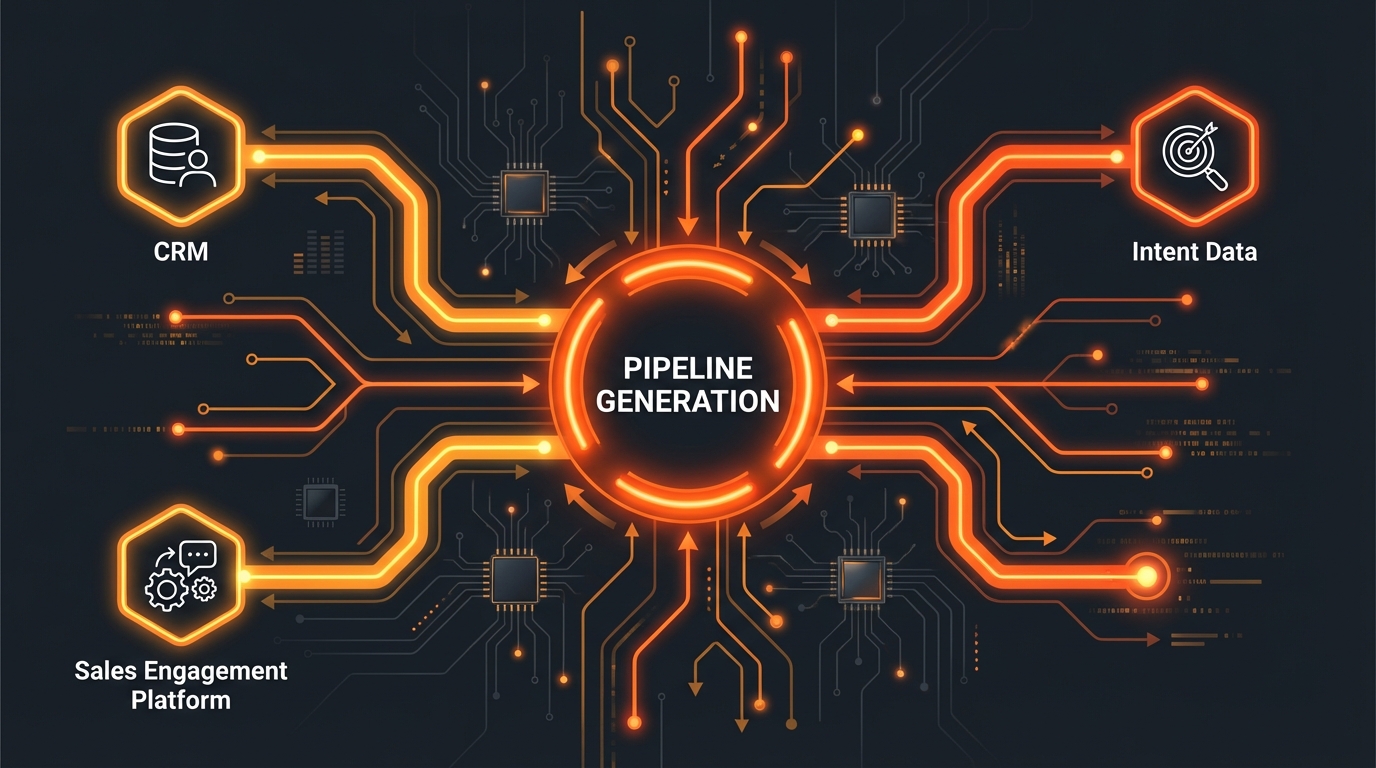
| Category (Pillar) | Tool Type Example | Primary SDR Function | Key Metric Impacted |
|---|---|---|---|
| Foundation | CRM (Salesforce/HubSpot) | Pipeline tracking, data logging, and complete contact management. | Data Hygiene, Forecasting Accuracy, Activity Compliance. |
| Fuel | Data Enrichment (ZoomInfo/Clearbit) | Finding verified contact details, validating emails, and gathering critical firmographic data. | Deliverability Rate, Connect Rate, List Quality. |
| Execution | Sales Engagement Platform (Outreach/Salesloft) | Automating multi-channel sequences (email, call, social) and managing task queues efficiently. | Volume of Touches, Follow-up Consistency, SDR Efficiency. |
| Optimization | Conversation Intelligence (Gong/Chorus) | Analyzing call transcripts for coaching, identifying winning talk tracks, and ensuring compliance. | Conversion Rate (Call-to-Meeting), Talk/Listen Ratio, Sales Cycle Length. |
Building Your Stack: Strategy Over Spending

The largest mistake revenue leaders make is buying tools to solve a process problem. Technology amplifies process; it does not replace it. If the underlying strategy is flawed, the most expensive tech stack will only help you fail faster.
You do not need a blank check. You need a strategic sequence of investment that aligns with the core SDR mandate: predictable, high-quality pipeline generation.
Step #1: Lock Down the Foundation and Fuel
Start with the CRM and the data layer. This is non-negotiable. If your SDRs are prospecting into the wrong accounts with inaccurate contact information, no Sales Engagement Platform (SEP) or Conversation Intelligence (CI) tool can save them.
The Focus: Achieve 100% data accuracy. Implement stringent verification processes that run automatically before the lead enters any sequence. Investing here prevents downstream waste, making this the single highest ROI decision you can make.
Step #2: Implement the Execution Engine
Once the data foundation is clean and reliable, layer in the Sales Engagement Platform (SEP). This is the execution engine that allows your SDRs to manage high-volume, multi-channel plays consistently and efficiently. Without a centralized SEP, scalability is impossible.
Warning: Your goal is to scale personalization, not volume. Use the SEP’s sequencing power to ensure timely, context-aware follow-up, not generic mass blasts. This requires strict governance and clear SOPs for sequence enrollment.
Step #3: Add AI for Personalization Depth
The 2025 advantage is context. Traditional data tools provide the ‘who’ and ‘where.’ AI-driven tools provide the critical ‘why now’—the trigger events that signal buying intent.
Integrate tools that scrape and analyze recent news, job changes, funding rounds, or technographic shifts. This context is the difference between a generic cold email and an outreach message that feels custom-written for the recipient’s immediate pain point.
Our observation: SDRs who leverage AI to find a single, relevant personalization hook see reply rates 3x higher than those relying solely on standard templates and basic firmographic data.
Step #4: Optimize with Intelligence
Only after the first three layers are functional and generating measurable activity should you invest heavily in Conversation Intelligence (CI) and Sales Enablement tools.
These tools are management and coaching multipliers. They transform subjective tribal knowledge into measurable, repeatable processes and provide real-time guidance. You are investing in reducing the ramp-up time for every new SDR you hire—a direct reduction in operational cost.
The Outcome: Your complete tech stack should not just track activity. It must track outcomes, identify performance gaps, and provide clear, actionable guidance that leads directly to predictable revenue generation.
The Danger of Tool Sprawl

After defining your core strategy, the next common pitfall is ‘Tool Sprawl’—or what we call ‘Frankenstack Syndrome.’ This is a messy collection of niche applications glued together with fragile integrations (often Zapier), creating massive shadow work and integration nightmares for your RevOps team.
Every incremental tool increases administrative overhead and directly decreases SDR adoption. If a rep must toggle between five or six interfaces just to log a sequence, track activity, and update a CRM record, they will not adhere to process. They will fail.
The Three-Point Stack Mandate
We operate under a strict investment mandate. Before purchasing any new technology, the tool must meet the following criteria:
- Demonstrably Shorten the Sales Cycle: Does it remove friction points or accelerate lead handoffs?
- Reduce Administrative Errors: Does it automate manual data entry or eliminate redundant tasks?
- Increase Conversion Rates: Does it lift conversion by a measurable, verifiable margin (e.g., sequence reply rate, meeting booked rate)?
If the answer to all three is not an unqualified “yes,” the purchase is vetoed. Stop buying features you don’t need. A tighter stack always beats a taller one.
Frequently Asked Questions (FAQ)
What is the most critical tool for a new SDR to master first?
The CRM (Customer Relationship Management) system is the non-negotiable foundation. Data enrichment tools fuel the outreach, but the CRM tracks every interaction, manages the pipeline, and guarantees data hygiene. If your new SDR cannot accurately log activity and manage contacts within the CRM, the entire downstream tech stack is functionally useless. Master the CRM first.
How should we balance AI and automation for our SDR team?
This is a critical distinction. Use automation for administrative leverage: logging calls, managing follow-up reminders, and executing multi-channel sequencing. Reserve AI for true personalization and intelligence: finding deep contextual insights, analyzing prospect intent, and recommending the next best action. The balance is simple: automate the repetitive 80% so the SDR can dedicate their time to high-value, human selling.
Is intent data useful for SDRs, or is it overrated?
Intent data is highly useful, provided you operationalize it immediately. Many organizations invest heavily in platforms (e.g., 6sense, Bombora) but fail because they lack a defined, high-priority sequence dedicated solely to intent signals. If the data is timely, accurate, and tied to a specific playbook, it delivers a massive competitive advantage by identifying accounts actively researching your solution right now.
What is the biggest productivity killer in a sales tech stack?
The biggest killers are manual data entry and excessive tool switching (toggling). If your CRM does not integrate seamlessly with your Sales Engagement Platform (SEP) and your data enrichment tools, SDRs are trapped doing repetitive administrative work. This directly reduces outreach volume, guarantees dirty data, and accelerates burnout. The only fix is integrated, bi-directional API syncing across all core tools.
Ready to take the next step?
Try AI Lead Generation Today
Click HereReferences
- The Modern Sales Tech Stack: Essential Tools for 2025 – Highspot
- The Ultimate SDR Tech Stack for 2025 – Kondo
- the ultimate sales “tech stack” (learned after 20 years as an SDR in …
- The Complete SaaS Sales Tech Stack: 15 Tools Every SDR Should …
- The Complete B2B Sales Tech Stack That We’d Recommend [Nov …