


You run a lean, high-ticket service operation. You secure significant retainers. The bank balance looks healthy.
But are you truly profitable?
Most agency founders confuse high revenue with high profit. They track total income, ignore critical labor costs, and then wonder why cash flow stalls.
This is a systemic failure.
In 2025, operating an agency without precise, service-level margin control is simply unsustainable. You cannot scale what you do not measure.
We built our lead generation and service delivery systems on a foundation of ruthless financial clarity. This framework demands visibility into three core profitability metrics.
You are about to learn the precise methodology we use to define, calculate, and aggressively optimize our margins per client service.
Key Takeaways: Strategy First
- Net Profit Margin is an agency-wide metric. It should target 25–30% EBITDA.
- Delivery Margin is the only reliable metric for assessing project and client profitability.
- Your project-level Delivery Margin must hit 70% or higher to absorb inevitable scope creep and overhead costs.
- Improving margins requires optimizing three levers: Average Cost Per Hour (ACPH), Average Billable Rate (ABR), and Delivery Utilization.
- Accurate margin calculation starts with determining the Fully Loaded Cost (FLC) of every team member.
Stop Guessing: The 3 Financial Metrics That Matter
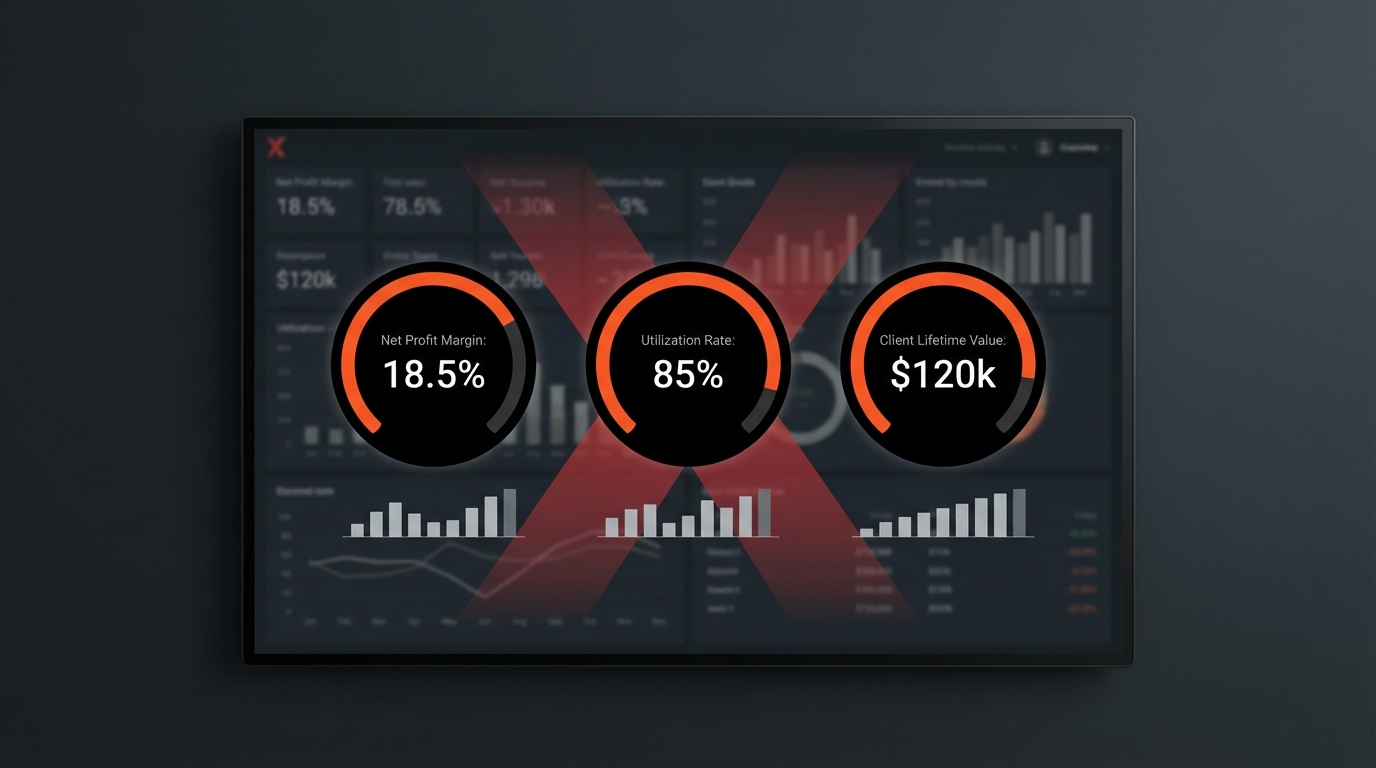
We do not manage by gut feeling. We manage by actionable data—the only way to scale sustainably.
To establish true profitability, you must move beyond simple gross revenue tracking. You need a hierarchical, three-tiered view of your finances, moving systematically from top-line billings down to true net profit. This framework is non-negotiable for any agency serious about growth.
Margin #1: Agency Gross Income (AGI)
Total Revenue is deceiving. It includes money that never belonged to you; it’s simply money passing through your books on its way to a vendor. We must focus exclusively on Agency Gross Income (AGI).
AGI is the revenue that remains after subtracting all pass-through costs—payments made to external vendors or platforms on behalf of the client.
- Pass-Through Costs Examples: Ad spend budgets (Google, Meta), third-party software licenses paid upfront, white-label contractor fees, or specialized service vendors.
Example: If you bill a client $50,000, but $15,000 is dedicated media spend, your agency only generated $35,000 in AGI. We calculate all subsequent profitability metrics against the AGI. This is the only money you actually control.
The AGI Formula:
AGI = Total Revenue - Pass-Through Costs
Margin #2: Delivery Profit Margin (The True Project Metric)
This is the most critical metric for assessing individual client or project health. It tells you exactly how efficient your internal delivery systems are.
The Delivery Profit Margin is the percentage of AGI left after covering the internal cost of delivering the service. Delivery Costs are almost exclusively internal labor.
This internal labor cost includes payroll and associated burdens (benefits, taxes, software usage, training) for every employee who contributes to the client work. We call this the Fully Loaded Cost (FLC).
Calculating Fully Loaded Cost (FLC)
You cannot manage labor costs based on annual salary alone. You must know what your team costs you per hour. The FLC incorporates salary plus all burdens.
FLC Calculation Steps:
- Calculate Total Annual Burden: Determine the true cost (Annual Salary + Benefits + Employer Taxes + Training + Software Allocation).
- Calculate Annual Billable Hours: Start with standard hours (2080), then subtract Holidays, PTO, and Non-Billable Internal Time (e.g., internal meetings, training). We typically use 1,600 to 1,800 working hours for realistic capacity planning.
- Determine Average Cost Per Hour (ACPH): Total Annual Burden / Annual Billable Hours.
Example: If a Project Manager has an FLC of $120,000 and 1,800 billable hours, their ACPH is $66.67/hour. If your team tracks 100 hours against Project Alpha, the Delivery Cost is $6,667.
Mandate: For this level of accuracy, dedicated Project Management (PM) software is essential. Without precise time tracking, your delivery costs are purely speculative. The Strategic PM Software Blueprint for Agency Profitability details our exact setup.
The Delivery Margin Formula
Once the Delivery Cost is established, the margin calculation is direct:
Delivery Profit = AGI - Delivery Costs
Delivery Margin % = (Delivery Profit / AGI) x 100
The 70% Mandate: Why We Set the Bar High
While general industry benchmarks suggest a 55% delivery margin across the entire P&L is “healthy,” we mandate a target of 70% at the individual project level. This 15% buffer is critical.
It proactively accounts for the inevitable factors that erode profit before the final Net Profit calculation:
- Scope Creep: The client always asks for “one quick thing.”
- Utilization Gaps: Your team will never be 100% billable 100% of the time.
- Overhead Coverage: This margin must be robust enough to cover all non-billable administrative salaries, rent, software licenses, and agency marketing costs later in the calculation.
If a project consistently hits 70% Delivery Margin, it is a winner. If it falls below 50%, you are either critically inefficient or actively losing money on that client relationship.
Margin #3: Net Profit Margin (The Big Picture)
Net Profit is the final, agency-wide health check. This is the ultimate metric that determines the viability of your business model—it shows what is left after absolutely every expense is covered.
Net Profit Margin factors in the final layer of cost: Overhead Costs (Operating Expenses).
Overhead costs are those that cannot be directly attributed to a single client project or delivery team:
- Overhead Examples: Office rent, administrative staff salaries (HR, Accounting, Executive), agency marketing budget, general business software subscriptions (CRMs, email platforms).
The Net Profit Formula:
Net Profit = Delivery Profit - Overhead Costs
The corresponding margin percentage is typically calculated against Total Revenue, not AGI, to provide a holistic view of overall financial health relative to total client billings.
Net Profit Margin % = (Net Profit / Total Revenue) x 100
Strategic Benchmarks: What Top Agencies Hit

To operationalize the three-tiered financial view, you must establish clear, non-negotiable targets for every metric. We do not set arbitrary goals. Our benchmarks are derived directly from an analysis of top-tier consulting firms and high-growth digital agencies—the firms that consistently scale past the $10M AGI mark.
These are the minimum performance metrics we enforce across all our service divisions. If your agency falls below these thresholds, your pricing model is fundamentally broken, or your operational efficiency is failing. There is no middle ground. Use this table to immediately diagnose where your agency is leaking profit.
| Metric | Definition & Calculation Base | Minimum Benchmark | Pyrsonalize Target |
|---|---|---|---|
| Agency Gross Margin (AGM) | Revenue minus Pass-Through Costs (Relative to Total Revenue) | 50% | 80% |
| Delivery Margin (P&L) | AGI minus Delivery Costs (All personnel and subcontractors; Relative to AGI) | 55% | 60% |
| Delivery Margin (Project) | AGI minus Project Labor (Relative to AGI for that specific project) | 60% | 70%+ |
| Net Profit Margin (EBITDA) | Profit after All Expenses (Relative to Total Revenue) | 15% | 25-30% |
| Overhead Costs | Fixed Operating Expenses (Rent, software, admin staff; Relative to AGI) | 30% Max | 20% |
Scaling Profitability: Three Levers to Optimize

Margin calculation is retrospective. Optimization is proactive. Once you know your target Delivery Margin (e.g., 70%), you must actively manage the variables that push you toward that goal.
If your Delivery Margin is consistently low—meaning you are leaking profit on service delivery—you have three primary, interconnected levers you can pull immediately to increase profitability without needing to find a single new client.
Lever 1: Average Cost Per Hour (ACPH)
Your ACPH defines your internal cost structure. Lowering this cost directly impacts and boosts your Delivery Margin. However, the approach must be strategic: you cannot simply slash salaries. That leads to high attrition, quality degradation, and inevitable client churn.
The strategic approach involves rigorous resource allocation and process engineering.
We ensure that high-cost talent (senior strategists, partners, directors) spends time only on high-leverage, complex tasks. Routine execution and standardized deliverables must be delegated to lower ACPH staff (juniors, specialists) or automated through ironclad Standard Operating Procedures (SOPs).
Actionable Steps to Lower Project ACPH:
- Tiered Staffing: Implement a strict staffing matrix. Utilize a junior designer ($30 ACPH estimate) for routine revisions and asset preparation instead of defaulting to a senior art director ($90 ACPH estimate).
- Process Standardization: Create ironclad SOPs for every repeatable task. Standardization drastically reduces the time needed for complex tasks, lowering the overall labor hours required per deliverable. Read our guide on the SOP Blueprint: Scale Your Agency Revenue in 2025.
- Technology Leverage: Invest strategically in tools and AI platforms that automate repetitive, high-volume tasks. This investment reduces the human hours required for delivery, permanently lowering the effective ACPH of the project.
Lever 2: Average Billable Rate (ABR)
The ABR is the effective price you charge for every hour spent on client work. In a fixed-fee retainer environment, this is calculated by dividing the Actual Gross Income (AGI) generated by the total delivery hours consumed.
ABR = AGI / Total Delivery Hours
A high ABR is the strongest indicator that your agency is highly efficient, accurately scoped, or charging a necessary premium rate.
A low ABR signals a major problem: you are either severely over-servicing the client or fundamentally under-pricing the retainer relative to the required effort.
Example: Efficiency Multiplies ABR
- Project A: $10,000 AGI. 100 hours spent. ABR = $100/hour.
- Project B: $10,000 AGI. 50 hours spent. ABR = $200/hour.
Project B delivers the same value in half the time. It is significantly more profitable because the ABR is doubled—meaning your margin potential is maximized.
Actionable Steps to Increase ABR:
- Value-Based Pricing (VBP): This is the single fastest way to jump ABR. Stop pricing based on hours (which links you to ACPH). Price based on the client outcome, the measurable value, and the impact delivered to the client’s bottom line. This strategically decouples your fee from your internal labor cost. We detail this aggressive strategy in Value-Based Pricing: The Small Agency Growth Blueprint.
- Rigorously Define Scope: Define the scope of work rigorously upfront. Any deviation requested by the client must immediately trigger a formal change order and a corresponding, proportional increase in AGI. Do not absorb scope creep.
- Strategic Price Increases: Periodically audit and increase retainers, especially for legacy clients whose effective ABR is currently below the threshold required to hit your 70% Delivery Margin target.
Lever 3: Utilization Rates
Utilization is frequently misunderstood. It is not merely about keeping your team busy; it is strictly about keeping your team busy on profitable work that directly contributes to AGI.
We track two distinct utilization rates to manage capacity and profit:
1. Employee Utilization (Capacity Management)
This metric measures the percentage of an individual employee’s total available capacity (after accounting for PTO, holidays, and training) that is spent on billable or client-related work.
Target: 80% to 90% for core delivery roles. If this rate is too low, your agency is overstaffed relative to current client demand.
2. Delivery Utilization (Profit Focus)
This metric is critical for efficiency. It measures the percentage of the time spent on client work that is directly billable (i.e., generating AGI and delivering core value).
While every hour in a flat-fee model is technically spent against the fixed price, Delivery Utilization helps you identify how much time is truly wasted on non-value-add activities: excessive internal meetings, unnecessary project administration, avoidable rework due to poor planning, or scope creep that was never billed.
Strategic Insight on Efficiency:
If your team is 90% utilized (meaning they are busy on client work) but your Delivery Margin is only 40%, you have a severe efficiency problem. The team is spending too much time on tasks that do not justify the fixed fee—they are busy delivering complexity, not core value.
The solution is not to work harder, but to work smarter: Process optimization and tighter project scoping are mandatory. You must ensure the team’s utilized time is spent delivering the scoped core value, not managing avoidable internal complexity or inefficiency.
The Service Line Profitability Audit

Tracking margins is only half the battle. Once you have consistent, accurate data, you must perform the critical Service Line Profitability Audit. This audit determines precisely where to allocate your sales and operational resources for maximum return.
We recommend segmenting your margin reports by service type. You must view profitability at the granular level (e.g., SEO retainer, Paid Media management, Web Development project). This segmentation allows you to quickly identify your “loss leaders” and your “profit engines.”
Use the audit findings to drive immediate strategic action:
- Low Margin Services (e.g., consistently below 55% Delivery Margin): These services are fundamentally inefficient or underpriced. They are prime candidates for massive price increases, heavy automation, or outright elimination. If a service line does not support your target profitability, cut it immediately.
- High Margin Services (e.g., 70%+ Delivery Margin): These offerings validate your pricing model and process efficiency. They represent your scale opportunities. Double down on lead generation and operational capacity for these specific services.
The core directive is simple: Do not scale a service line that is fundamentally unprofitable. Focusing your sales efforts exclusively on services with proven 70%+ delivery margins ensures rapid, sustainable growth and dramatically increases overall agency valuation.
Frequently Asked Questions

What is the difference between Gross Margin and Delivery Margin?
Gross Margin is the traditional accounting term: Total Revenue minus Cost of Goods Sold (COGS). For modern agencies, this metric is often too noisy. It includes media spend or other pass-through costs that you do not control, making it difficult to gauge internal efficiency.
We focus on Delivery Margin. This is defined as Agency Gross Income (AGI — revenue after pass-through costs) minus internal labor costs (FLC). Delivery Margin is the cleaner, more actionable metric. It isolates the true cost of your team’s time, making it the superior measure for project efficiency and pricing health.
Should I track Net Profit Margin on a per-client basis?
No. We strongly advise against tracking Net Profit per client or project. Overhead costs (rent, accounting software, administrative salaries, etc.) are fixed or shared expenses. Allocating these accurately to a single project creates immense measurement complexity that actively slows down critical decision-making.
Instead, use the correct metrics for the correct goal:
- Focus on Delivery Margin (70% target) for monitoring project health and spotting scope creep.
- Focus on Net Profit (25-30% target) for evaluating overall agency performance and organizational health.
If my Delivery Margin is high (80%), should I lower my prices?
Absolutely not. An 80% Delivery Margin is a powerful indicator of two things: exceptional internal efficiency and strong value-based pricing. You have achieved market alignment.
Lowering prices only erodes profit without guaranteeing increased volume in the high-ticket service sector. Instead, you must reinvest that high margin into strategic areas that protect your competitive advantage. Reinvest in improving lead generation systems, securing high-quality talent, or developing proprietary technology.
How often should I calculate and review my agency margins?
Margin calculation should align with the velocity of decision-making needed:
- Delivery Margin: This should be calculated continuously, ideally in real-time, using time-tracking software linked to your FLC data. We review Delivery Margin weekly at the project level to catch scope creep immediately and make fast adjustments.
- Net Profit Margin: This metric is organizational. It should be reviewed monthly, aligning with your standard Profit & Loss (P&L) reports.
Ready to take the next step?
Try AI Lead Generation Today
Click HereReferences
- Calculating Agency Margins & Profitability: A Beginner’s Guide – Scoro
- Agency Profitability: How To Calculate, Track & Maximize
- Calculate Agency Profitability: Key Insights for Marketers – Parakeeto
- A Complete Guide to Calculating Agency Margins – DashClicks
- The Advertising Agency Profitability Field Guide – AskCody