


The cold email landscape is saturated. Generic templates guarantee failure. This is 2025: Volume alone is dead.
Your SaaS or high-ticket service agency needs a new approach. We are past the era of mass-blasting lists purchased off Fiverr.
High-value lead acquisition—the kind that boosts our revenue by 77%—requires surgical precision. It demands hyper-personalization grounded in verifiable data.
We use AI lead generation software to find specific client emails, then we deploy strategic frameworks. This guide breaks down the exact templates and mindset required to convert C-suite prospects using trust-based, non-automated outreach.
The 2025 Cold Email Blueprint: What You Will Learn
This is not theoretical advice. We have stress-tested these frameworks across hundreds of campaigns. Inside this guide, you will receive the complete, actionable blueprint:
- The mandatory 3-point data validation checklist required before sending a single email (Stop sending blind emails).
- Our proprietary “Value-First” framework—the template that consistently yields 40%+ reply rates from Fortune 500 decision-makers.
- The precise 4-step follow-up sequence that converts 30% of qualified replies into discovery calls.
- Specific templates optimized for SaaS, B2B services, and high-ticket consulting agency outreach.
Key Takeaways for 2025 Cold Email Strategy
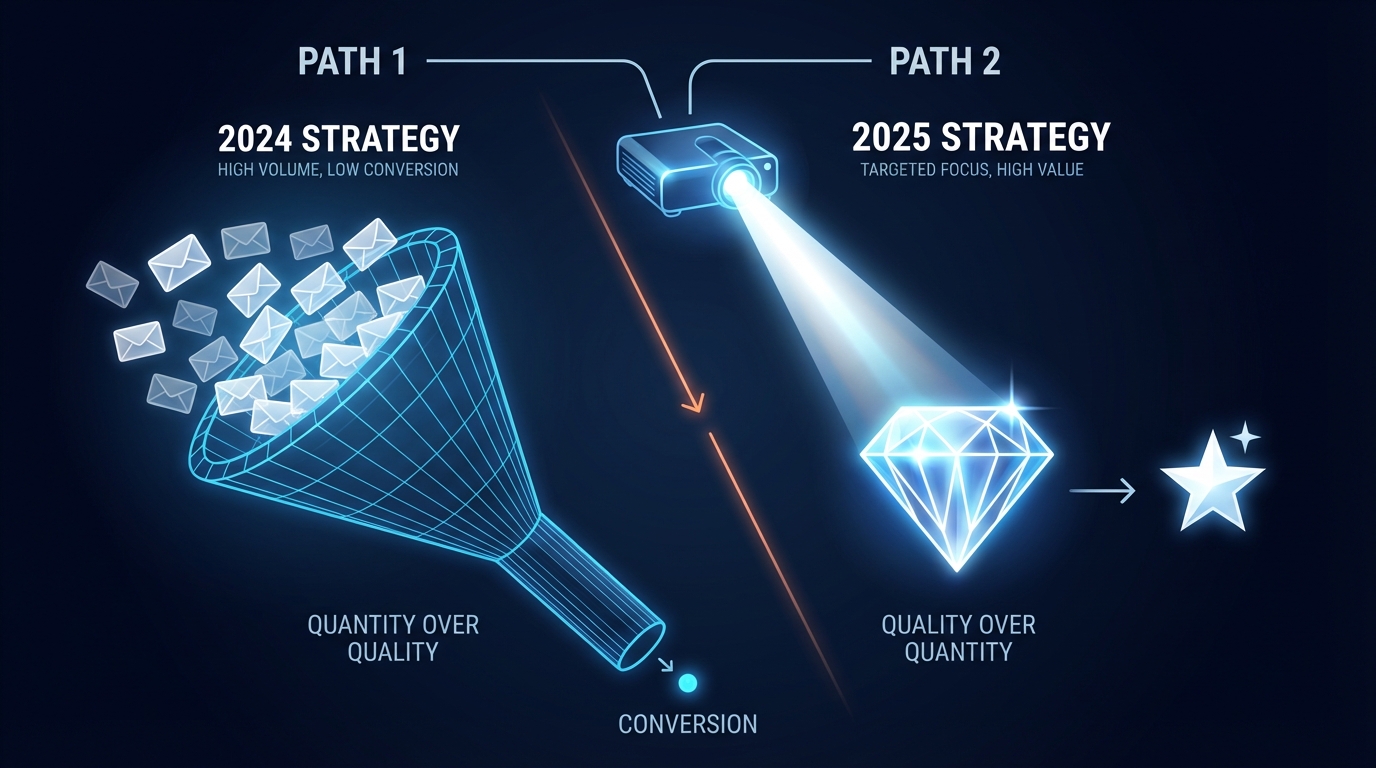
- Hyper-Personalization is Non-Negotiable: Standard merge tags ({First_Name}) are now table stakes—they are insufficient. We must move beyond surface-level data and reference specific triggers: recent funding rounds, key hires, competitor gaps, or technology changes.
- Focus on the Gap, Not the Service: High-ticket prospects do not buy processes; they buy quantifiable results. Frame your entire pitch around the missed revenue opportunity (the pain point) they are currently experiencing, not the features of your service.
- The Ultra-Concise Pitch (3-Sentence Structure): We adhere strictly to brevity. The core pitch must be reduced to three parts: 1) Specific Observation/Trigger, 2) Quantifiable Value Proposition, and 3) Single, Clear CTA. Long emails are deleted instantly; respect their time.
- AI is a Research Assistant, Not the Author: Leverage AI tools (like Apollo or specialized scraping) solely to gather hard data points (funding, tech stack, employee count). The actual email copy must be human-written, tailored, and emotionally resonant—AI-generated copy screams automation.
The Cold Email Reality: Why Generic Templates Fail

Generic cold emails fail because they prioritize the sender over the recipient. Most templates follow a predictable, low-leverage structure: they introduce the agency, list services, and immediately demand 15 minutes of the prospect’s time.This volume-based approach works only for low-ticket sales. It actively damages your chances of closing high-value retainers—the $10k+ contracts sought from SaaS CEOs and private equity firms.
High-level decision-makers filter noise instantly. They are looking for strategic partners, not commodity vendors. Your email must demonstrate pre-existing investment; we recommend dedicating at least 10 minutes of tailored research before the send button is hit. You must prove expertise.
We find that template failure consistently boils down to three critical and avoidable errors:
- The Self-Centric Pitch: The email focuses entirely on your agency’s history, awards, and client count. The prospect only cares about their immediate, measurable pain points.
- The Vague Value Proposition: Relying on empty phrases like “we help improve ROI” or “we offer full-stack solutions.” These are empty words that generate zero trust. Specify the exact metric and outcome: “We decrease customer churn by 14% within the first two quarters.”
- The High-Friction CTA: Asking for a “discovery call” or a “30-minute demo” is too high a commitment for an initial cold interaction. Lower the barrier to entry by asking for a simple, low-risk reply or permission to send a 2-minute personalized video analysis instead.
“If your email subject line could apply to 50 different companies, it will fail 50 times. Our goal is a subject line so specific, it could only be written for that single recipient.”
Step #1: Master the High-Ticket Agency Email Framework
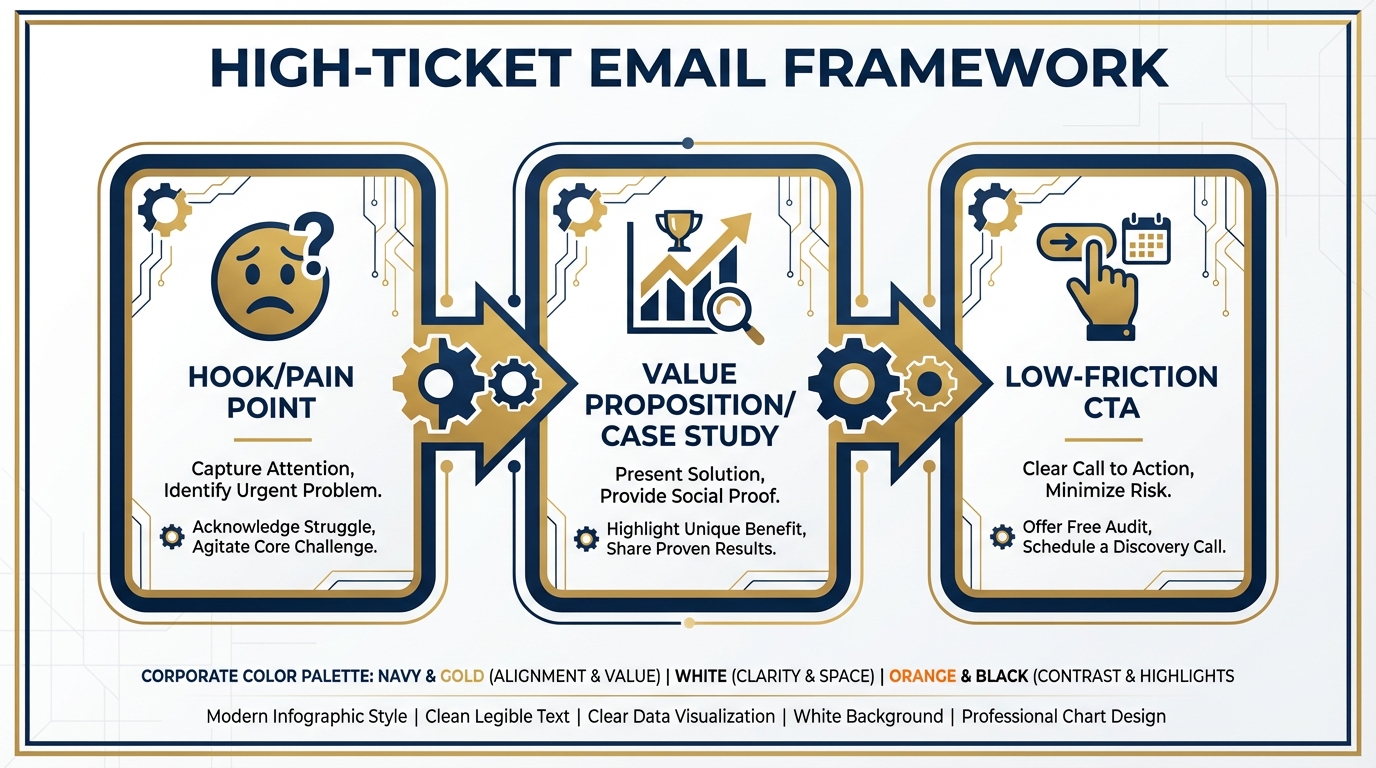
To close high-ticket retainers, you must abandon standard sales copy. Our most effective cold emails adhere to a strict, three-part framework—a sequence engineered to build trust and urgency instantly. This framework leverages the deep, proprietary data we acquire through advanced lead generation tools.
Part 1: The Specific Hook (1 Sentence)
This is the crucial first sentence. It must be a hyper-personalized, verifiable observation about the prospect’s business. If it can be automated using standard {First_Name} or {Company_Name} tags, it fails. The Hook’s purpose is to prove you did 10 minutes of research.
- Reference a recent, specific event: a new executive hire, a recent funding round announcement, or a detailed blog post they published last week.
- Cite a specific competitor’s recent, measurable success that the prospect is verifiably lagging behind on.
- Identify a technical or performance gap based on empirical data (e.g., “I noticed your core landing page load time is 4.1 seconds on mobile—which is costing you 15% of your sign-up conversions”).
Part 2: The Value Bridge & Proof (2 Sentences)
Immediately connect the specific observation (from Part 1) directly to a quantifiable business outcome you deliver. This section establishes authority by presenting external proof and measurable results, typically using social proof from a similar client.
- “We helped [Similar, Named Company] diagnose that exact technical issue, which resulted in a 35% increase in MQL volume within Q3.”
- “Based on your current traffic, that 4.1-second load time is costing you an estimated $X in lost organic sign-ups monthly. Our proprietary process solves this by [Specific, Named Mechanism].”
Part 3: The Low-Friction CTA (1 Sentence)
The final sentence must make the next step effortless. The goal of the initial email is not to book a meeting; it is to elicit a low-commitment, permission-based response—a simple “Yes” or “No.”
- “Would it be worth sending over the 3-point breakdown of what we found regarding the site speed?”
- “Should I forward the quick 90-second video explaining the solution we used for [Similar Company]?”
- “If this initial diagnosis resonates, just reply ‘Yes’ and I’ll share the full case study outline.”
Constraint Check: This entire core message—the Hook, Bridge, and CTA—must be 5 sentences maximum. Anything longer is filtered into the spam folder or immediately identified as a generic sales pitch. Brevity is the currency of executive attention.
Step #2: Strategic Cold Email Templates for Agencies (2025 Implementation)
![A close-up shot of a computer screen displaying a dark-mode email composition window. The email subject is 'Project Proposal Structure'. The body of the email contains placeholders highlighted in orange text, including '[Prospect Name]', '[Ultra-Specific Hook referencing prospect's recent achievement]', '[Relevant Case Study Metric]', '[Micro-Commitment CTA]', and '[Your Name]'.](https://pyrsonalize.com/blog/wp-content/uploads/2025/11/article-section-image-124.jpg "Template 1: Strategic Cold Email Structure with Placeholders for Agency Lead Generation")
Once the framework is mastered (Step #1), implementation requires precision. We have refined these four templates specifically for high-value B2B outreach and closing high-ticket retainers. Crucially, you must adapt the placeholders using precise, verifiable data points—the proprietary intelligence our advanced lead generation tools provide.
Template 1: The CEO Pain-Point Observation (High-Value Targets)
Use this template exclusively for founders or CEOs focused on market share expansion and revenue velocity. The goal is to immediately link a public event (funding, major hire) to a measurable competitive threat.
Subject Line Focus: Immediate relevance + Curiosity.
Subject: [Competitor] just captured 15% of your keyword group
Hi [Name],

I saw the recent news about your Series B funding—congratulations.

My team noticed that since [Competitor Name] launched their new product vertical last month, they have aggressively captured 15% of the high-intent keywords you previously dominated. This specific gap in [Target Service Area] is currently costing you an estimated 400 MQLs per quarter.

We specialize in strategic content defense for scaling B2B SaaS companies. We helped [Similar Client] recapture 80% of their lost traffic in 60 days using a similar counter-strategy.

Would you be open to me sharing the 3 specific keywords where they are currently winning?

Best,
[Your Name]
[Your Title]
Analysis: Why It Converts
This email converts because it leverages three critical elements: 1. **Precise Data:** It uses current, verifiable intelligence (e.g., specific keyword loss, quantified MQL cost). 2. **Urgency:** It frames the competitor’s action as an active threat to the prospect’s bottom line. 3. **Low Friction CTA:** It offers immediate, actionable intelligence (the 3 specific keywords) instead of asking for a time commitment (a meeting).
Template 2: The Technical Gap Audit (SaaS/Tech Targets)
Deploy this template when your expertise centers on technical optimization, site speed, or specific platform integration (e.g., HubSpot, Salesforce). The core data point must be irrefutable and easily verified by the recipient.
Subject Line Focus: Urgent Technical Issue.
Subject: Critical UX friction on your [Product Page]
Hi [Name],

We ran a quick technical audit on your main product page—the one targeting [Specific ICP].

I noticed a critical friction point: the primary CTA button placement requires 3 full scrolls on 60% of mobile devices. We’ve seen this exact error reduce conversion rates by 8-12% for companies in the [Industry] space.

We fix these high-leverage bottlenecks, turning existing traffic into immediate revenue. Our last client, [Client], saw a 14% lift in free trial sign-ups after we optimized just three key pages.

If you’re optimizing Q4 conversion rates, would you like the 2-point fix checklist?

Thanks,
[Your Name]
[Your Agency Name]
Actionable Strategy: The Trust Investment
This strategy mandates a quick, manual audit upfront. This is your trust investment: you prove you understand the problem (and its quantifiable revenue impact) before you ever pitch a solution. Scaling this type of precise outreach requires top-tier data acquisition—the foundation for closing technical retainers.
Template 3: The Referral Leverage (Warmest Cold Outreach)
If you identify a genuine mutual connection (via LinkedIn, a shared investor, or even a recently departed employee), leverage that relationship immediately. This strategy bypasses the initial trust-building phase, making the recipient immediately receptive.
Subject Line Focus: Familiarity + Authority.
Subject: Quick intro via [Mutual Connection Name]
Hi [Name],

[Mutual Connection Name] suggested I reach out to you regarding your growth initiatives for 2025.

They mentioned you are currently focused on maximizing [Specific Metric, e.g., European market penetration]. Our agency specializes in exactly this: we scale high-ticket offerings into new international markets via tailored SEO and localization.

We recently helped [Client Name] enter the DACH market, resulting in a 2.5x increase in qualified leads within 9 months.

Are you available for a quick 5-minute chat next week to see if there's an alignment?

Best,
[Your Name]
Strategy Note: Leveraging Soft Connections
If a direct referral is unavailable, reference a soft connection. This could be a recent industry event both parties attended or a public comment the prospect made online. Frame the opening as: “I saw your comment on LinkedIn regarding X…” This still provides a necessary layer of familiarity.
Template 4: The Strategic Follow-Up (Value-Add, Not Passive)
The majority of high-ticket replies occur after the initial email. Your follow-up is not a reminder; it must add new, compelling value—never just ask, “Did you see my last email?”
Wait Time: 3–5 business days after the initial email.
Subject Line Focus: New Data/Brevity.
Subject: Following up with data: [Company Name]
Hi [Name],

Understand you’re busy. Just wanted to circle back on the [Specific Issue, e.g., mobile CTA placement] I mentioned last week.

We ran a deeper analysis and found that your largest competitor, [Competitor X], is now running paid search campaigns directly targeting your brand name, leveraging that exact technical gap.

This is a defensive move that needs immediate attention if you want to protect your Q1 budget.

I’m happy to share the specific budget recommendation we developed for [Client Y] to counter this.

Does it make sense to send that over?

Best,
[Your Name]
Strategy Check: Escalation of Urgency
This follow-up successfully escalates urgency. It introduces new, potentially threatening intelligence (e.g., competitor action leveraging the exact gap identified). This requires an executive response. Crucially, it maintains the low-friction CTA: asking to send over a specific recommendation or data point, not immediately demanding a discovery call.
Step #3: Differentiating High-Ticket vs. Low-Ticket Outreach
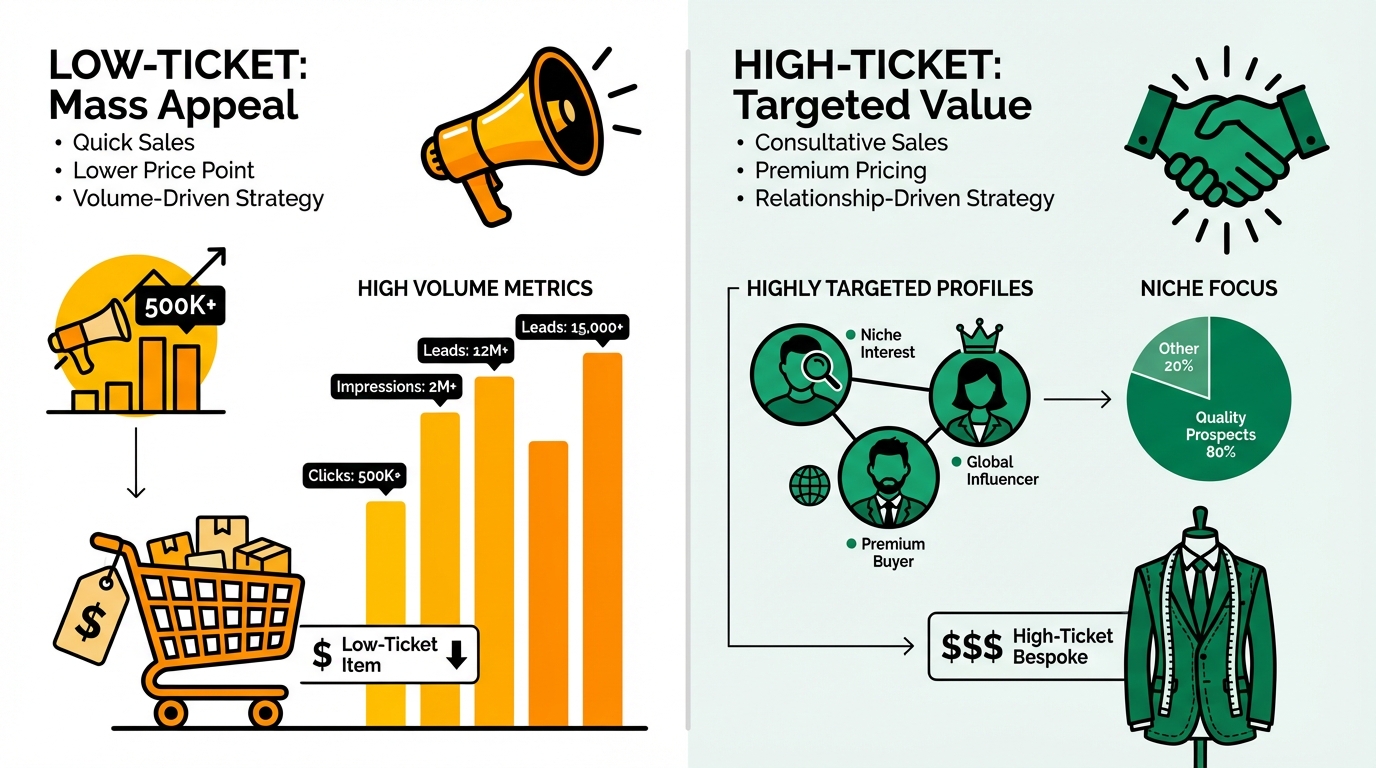
The strategy that closes a $500 retainer will fail when targeting a $100k+ annual contract. You cannot use the same tactics for a local SME versus a $50M ARR SaaS company.
This is the fundamental shift: Outreach must move from selling standardized services to selling verifiable strategic partnership. We transition from the mindset of a standard Sales Development Representative (SDR) to that of a specialized strategic consultant.
Understanding this distinction is crucial for maximizing your agency’s potential revenue and forms the core of The 2025 Blueprint for High-Ticket SEO Client Acquisition. We must analyze the levers that drive high-value contracts.
Analyze the strategic comparison that defines our approach:
| Metric | Low-Ticket/Volume Outreach | High-Ticket/Strategic Outreach (Pyrsonalize Model) |
|---|---|---|
| Target Persona | Marketing Manager, Operations Lead | CEO, Founder, VP of Revenue (The decision-maker controlling the budget) |
| Primary Goal | Book a 30-min call/demo | Elicit a specific, low-friction reply (“Yes,” “Send it,” or “What data are you seeing?”) |
| Personalization Depth | Name, Company, Job Title (Generic data points) | Funding Round, Recent Acquisition, Tech Stack, Competitor Activity, Personal Quote (Verifiable proprietary intelligence) |
| Value Proposition | “We offer SEO services” | “We solve the $40k/mo revenue leakage caused by X competitor activity in Q3” |
| Success Metric | Open Rate, Reply Rate (Volume metrics) | Response Quality, Conversion to Discovery Call (Revenue-centric metrics) |
Step #4: Operationalizing Hyper-Personalization with AI

High-ticket outreach demands strategic depth, but manual research immediately kills volume. To scale verifiable strategic partnerships, you must leverage technology. This is not optional; it is the operational layer that allows hyper-personalization to function efficiently.
Crucially, the AI’s role is not to write the email. The software acts as an intelligence aggregator—it feeds you the precise, verifiable data points required to craft the Hook (Part 1) and bypass generic introductions.
The AI Intelligence Workflow
- ICP Definition: Define your Ideal Customer Profile (ICP) based on precise firmographic data (revenue brackets, employee count, industry vertical, essential technology stacks).
- Target List Generation: Utilize specialized AI tools to scrape LinkedIn and verified databases. We prioritize finding target executives matching the ICP and verifying their direct, personal email addresses.
- Data Enrichment (Trigger Events): The AI then enriches these leads by searching for high-value trigger events:
- Recent funding announcements (via Crunchbase, indicating capital influx).
- Specific technologies installed (via BuiltWith, confirming tech stack alignment).
- Current hiring patterns (e.g., hiring a “Head of Growth” signals immediate pain or new initiatives).
- Recent product launches or major press releases.
- Manual Review & Customization (The Non-Negotiable Step): We never automate the send. We mandate a manual review, selecting the 2-3 strongest data points provided by the AI to craft the 3-5 sentence personalized opener. This maintains the human, trust-based element essential for high-ticket conversion.
Warning: The Automation Trap. Skipping the manual review step is the single most common, and most costly, mistake we observe agencies make. Automated personalization is still detectable by experienced executives and instantly fails the high-ticket trust test. Do not sacrifice strategic integrity for marginal volume gains. This failure point is detailed further in our guide: Lead Generation Mistakes: 12 Strategic Errors Costing You Revenue.
Step #5: Subject Line Strategies That Cut Through the Noise
The subject line is the final gatekeeper. You have invested in hyper-personalization (Step 4); now you must guarantee the email gets opened. If your subject line fails the “must open now” test, the email is instantly deleted. We treat the subject line as a firewall.
Immediately eliminate all salesy language. Phrases like “Quick Question,” “Exclusive Offer,” or “Checking In” are spam triggers that dilute trust and kill open rates. High-ticket outreach demands directness, urgency, and verifiable relevance.
High-Converting Subject Line Frameworks:
We have rigorously tested thousands of subject lines across diverse B2B verticals. These four frameworks consistently deliver the highest open rates necessary for successful high-ticket outreach:
- The Specific Observation: Directly reference the hyper-personalized data point identified in Step 4. This proves you did the research.
- Examples: “Friction on your mobile CTA,” “Re: [Competitor] Q3 content strategy,” “4.1s load time on [Page Name].”
- The Mutual Connection/Referral: Leverage social proof immediately to bypass skepticism.
- Examples: “Intro from [Name],” “Referred by [VC Firm Name],” “Quick chat about [Mutual Connection’s] advice.”
- The Direct Value Add: Focus on the immediate, measurable benefit, not the service you provide.
- Examples: “Idea to reduce churn by 14%,” “Fix for [Problem] at [Company],” “90-second fix for [Specific Metric].”
- The Ultra-Short/Internal Memo Style: Mimic internal communication to bypass cognitive filters and spam traps.
- Examples: “Q4 initiative,” “Follow up: [Topic],” “Data on [Company Name].”
The Unbreakable Rule: Character Limits. Never exceed 50–60 characters. Over 60 characters, and major mobile clients (where 70% of C-suite check email first) will truncate the line, rendering your carefully crafted hook useless. Keep it short. Keep it actionable.
Step #6: The Deliverability Component
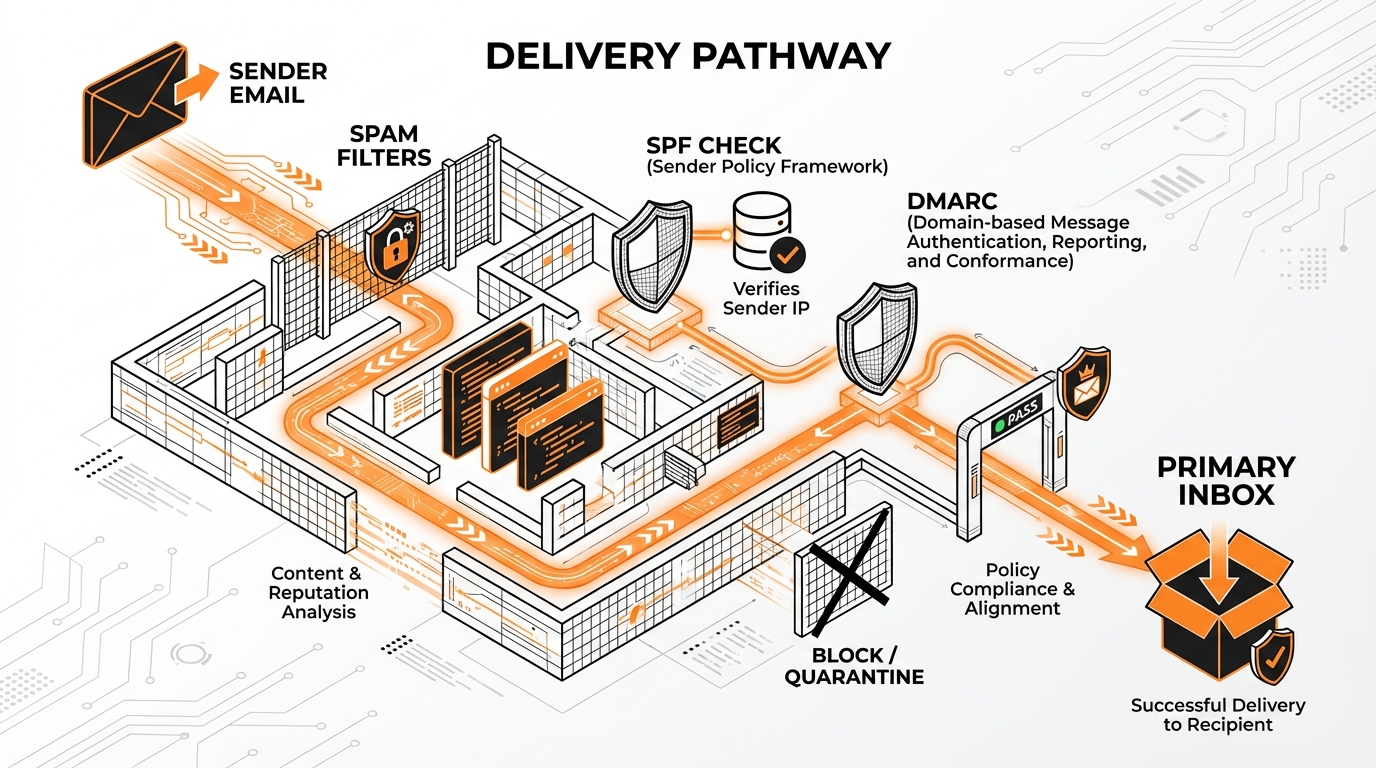
Step 5 ensures the email gets opened; Step 6 ensures it actually lands in the primary inbox. Deliverability is not a technical footnote—it is the foundation of the entire cold outreach strategy. Even the perfect hyper-personalized template is useless if the ISP treats you like spam.
In 2025, deliverability is a strategic asset we must master. If your emails fail this test, your sender reputation is instantly damaged, and your entire campaign budget is wasted.
The Non-Negotiable Technical Checklist for High Deliverability:
- Dedicated Sending Domain: Never send cold email from your primary business domain (e.g., @agencyname.com). We enforce this rule universally. Use a separate, dedicated, and warmed-up domain specifically for outreach (e.g., @agencyname-outreach.com). This protects your core business asset.
- Domain Warming: Before launching any campaign, you must simulate human email traffic. Use automated tools to send and receive replies naturally for 4–8 weeks. Skipping this step guarantees you hit the spam folder instantly.
- SPF, DKIM, DMARC Authentication: These are non-negotiable security records. Ensure all authentication records are correctly set up and verified. This proves to the recipient server that you are who you claim to be, drastically increasing inbox placement.
- Clean Lists & Low Bounce Rate: Verify every single email address immediately before hitting send. High bounce rates—anything over 5%—will tank your sender reputation instantly, leading to blacklisting. This is why utilizing verified, real-time data from premium AI tools is paramount for our success.
Frequently Asked Questions

What is a good reply rate for a cold email campaign?
Do not obsess over open rates; they are a vanity metric, especially given the prevalence of Apple Mail Protection and other privacy filters. We measure success strictly by the reply rate (the only metric that drives revenue). A world-class campaign achieves a 10%+ reply rate. For a strong, actionable campaign leveraging hyper-personalization, aim for 5% to 8%. If your reply rate consistently falls below 3%, your targeting, template, or deliverability system is fundamentally broken. Stop the campaign and fix the core issue immediately.
How many cold emails should my agency send daily?
Scaling must be gradual. Deliverability is highly dependent on your email account’s warm-up status. Never blast 500 emails on day one. We recommend starting at 20–30 emails per day per dedicated mailbox. Once you maintain a 5%+ reply rate and have confirmed solid deliverability, scale up by 10% weekly. The maximum sustainable volume per dedicated mailbox is 50–75 emails per day. Pushing beyond this threshold risks damaging your sender reputation—a cost that far outweighs the short-term increase in volume.
What is the best time and day to send cold outreach?
While hyper-personalization is the main driver of success, timing offers a measurable optimization lift. Data consistently shows that Tuesday, Wednesday, and Thursday are peak performance days. We strictly avoid Monday (prospects catching up) and Friday (prospects checking out). Focus on sending between 9:30 AM and 11:30 AM local time for the prospect, or 1:30 PM and 3:30 PM local time. Optimizing timing is not transformative, but it reliably provides a 1% to 2% increase in engagement, which adds up when we scale.
Should I use AI tools to write my cold emails?
AI is an efficiency tool, not a replacement for strategy. Use AI to handle the heavy lifting of personalization—specifically, generating unique, contextualized first lines (Step #4). However, the core template structure (Hook, Value Proposition, CTA) must be human-written and rigorously tested. AI-generated copy often sounds robotic or generic, which instantly triggers the prospect’s spam filter (both technical and mental). We leverage AI for scale, but we mandate human oversight for quality control.
What is the ideal cold email length for high-ticket agencies?
The ideal cold email length is 50 to 100 words—no more than 3 to 7 sentences total. Brevity is mandatory for high-ticket outreach. Decision-makers are scanning emails, often on mobile devices, not reading detailed proposals.
Our mandate is simple: If the prospect has to scroll, the email is too long. You must deliver the value proposition (the hook) and the Call-to-Action (CTA) within the first two visible lines. Every additional sentence is a potential point of distraction that kills our conversion rate.
Should I use AI to write the entire cold email?
The short answer is a definitive no. While AI is an indispensable tool in our stack, it must be leveraged exclusively for data gathering—not for creation. High-ticket conversions rely on human nuance and trust; automated copy kills both.
We mandate that our teams use AI lead generation software only to gather the critical data points necessary for hyper-personalization. This allows us to craft a unique hook that demonstrates we did our homework:
- Identifying trigger events (e.g., recent funding rounds, new executive hires).
- Scraping recent press releases or major product updates.
- Analyzing their current tech stack for integration opportunities.
The final email draft must be manually written and polished by a human. If the prospect suspects the email is a mass-produced, generic output—which current AI models consistently generate—you fail the trust test immediately. Generic sales copy does not close $20k+ deals.
How many follow-up emails should be in a sequence?
For high-ticket digital marketing outreach, our data mandates a sequence of **4 to 6 targeted emails**. This is the optimal range for maximizing conversion rates without triggering spam reports or appearing desperate. We deploy this sequence strategically over a 15- to 20-business-day window.
The core rule for success is non-negotiable: Every subsequent email must offer new value or introduce a fresh angle. You are not reminding them; you are providing a new reason to engage.
Examples of mandatory value additions include:
- A direct case study link showing ROI for a similar client.
- Specific competitor data analysis (identifying a critical gap in their current strategy).
- A new, actionable observation concerning their existing technology stack or recent announcement.
Crucially, you must never follow up passively. Messages like “Just checking in” or “Did you see my last email?” are conversion killers. They immediately signal low value and disrespect the prospect’s time, negating all prior personalization efforts.
What is the best time/day to send cold emails in 2025?
We have segmented thousands of outreach campaigns targeting high-level decision-makers globally. While automation tools promise universal timing, our proprietary data isolates a clear, peak window of engagement. Timing matters—but only slightly less than the personalization depth of your message.
For maximizing open and reply rates, adhere strictly to the following schedule:
- Optimal Days: Tuesday, Wednesday, and Thursday. These are the core working days where recipients are focused but not yet overwhelmed by deadlines.
- Optimal Time: 9:00 AM to 11:00 AM (Recipient Local Time). This window targets the crucial pre-lunch productivity spike.
Avoidance Strategy: We see significant degradation in performance outside this window. Avoid Monday mornings (the recipient is battling “inbox zero” purgatory). Skip Friday afternoons (mental checkout is already in progress). We record the sharpest drop in replies after 2:00 PM local time on Fridays across all industries.
The strategic takeaway remains consistent: If your personalized hook is weak, no amount of perfect timing will save it. Strong value and hyper-specific insights transcend the clock.
How can I find the personal email addresses of CEOs?
Targeting generic contact forms or info@ addresses guarantees failure. To secure a high-level meeting, you must reach the direct, personal inbox of the decision-maker. This is the greatest bottleneck in scaling outreach.
Traditional manual methods—such as guessing formats (e.g., first.last@company.com) or using outdated databases—are obsolete. They lead to catastrophic bounce rates, immediately damaging your domain’s sender reputation and increasing the risk of being flagged as spam.
To maximize deliverability (aiming for 98%+), we employ a specialized, three-stage AI verification pipeline that ensures accuracy and allows us to target decision-makers directly:
- Intelligent Scraping: We use proprietary lead generation software designed to scrape and identify direct corporate emails, often bypassing publicly listed contacts.
- Real-Time Verification: Every sourced email is immediately checked via SMTP ping and server validation. This ensures the mailbox is active and receiving messages right now.
- Suppression Filtering: The list is cross-referenced against global suppression lists and known spam traps, minimizing risk and maximizing the validated quality needed for high-volume campaigns.
This ensures accuracy and allows us to target specific decision-makers directly, maximizing deliverability and minimizing spam risk. We shift focus from sheer quantity to validated quality.
Ready to take the next step?
Try AI Lead Generation Today
Click HereReferences
- The Perfect Cold Email: 5 Templates for Marketing Agencies – SPP.co
- Top 5 Cold Email Templates for Digital Marketing Services – Smartlead
- 25 Cold Email Templates I Use to Skyrocket Reply Rates in 2025
- What are some of the most effective cold email templates for B2B …
- 17 Cold Email Template Examples (And When to Use Them)