


Cold calling is not dead. It is simply misunderstood.
The average SDR conversion rate hovers near 2.3% in 2025. That is the industry average: it is a failure metric.
Our internal teams (focused on high-ticket service sales and SaaS adoption) consistently hit 6% to 8% meeting-booked rates from cold dials. This is not achieved through luck.
We achieve it through structured intelligence: We know exactly who we are calling, why we are calling them, and what their current pain points are before the phone even rings.
This guide is the definitive blueprint for SDR cold calling in 2025. This is how you stop reading generic scripts and start engineering real conversations.
In this Blueprint, we redefine the cold call process. You will learn:
- How to move past the 2.3% failure rate using intelligence-driven research.
- The five essential frameworks (not scripts) for B2B engagement.
- Our proprietary opening lines designed to earn 10 seconds, not 3.
- Advanced objection handling techniques focused on value anchoring and disarming resistance.
Stop dialing for dollars. Start dialing with purpose.
Key Takeaways: The High-Conversion Mandate
- Eliminate the Permission Opener: Never ask, “Is this a bad time?” This immediately hands control to the prospect and invites rejection. Use a brief, assumptive opening that validates *their* time, not your intrusion.
- The 45-Second Value Mandate: Your opening must deliver the core pillars—who you are, the specific problem you solve, and the purpose of the call—in under one minute. Efficiency dictates conversion.
- Sell the Next Step (Not the Product): The cold call’s KPI is not a sale; it is securing a qualified follow-up meeting. You are selling 15-20 minutes on their calendar, nothing more. Keep the scope tight.
- Prioritize Pain Over Features: Features are irrelevant on a cold call. Use hyper-personalized intelligence (leveraging AI insights) to immediately tie your solution to their specific, measurable organizational pain points.
Why Your SDR Scripts Fail (The 2025 Reality Check)

Your current cold call scripts are failing because they are fundamentally misaligned with the modern buyer’s attention span and information overload. Most scripts are built on three fatal, outdated assumptions that guarantee early rejection:
- The prospect has time to listen to a narrative longer than 45 seconds.
- The prospect cares about your company’s internal features more than the specific business outcome you deliver.
- The SDR can rely on rote memorization instead of a dynamic, pre-mapped objection framework.
None of these assumptions hold true today. Attention is the scarcest resource in B2B sales. If your SDR sounds like they are reading from a document—any document—the call is statistically over in under 15 seconds, regardless of how good the product is.
Our internal data shows that 80% of script failure occurs within the first 20 seconds. This failure is rarely about the specific words used; it is almost always about the structural design and the *perceived value* delivered immediately upon connection. If the structure feels intrusive or generic, the call collapses.
“The biggest mistake sales leadership makes is treating the script as a static document. The script should be a dynamic map, informed by deep, actionable intelligence, not just boilerplate language lifted from a competitor’s site.”
We are past the era of relying on “better words.” The solution is not merely a better script. The solution is a superior, high-conversion system that treats the script as a flexible framework for intelligence, not a fixed text.
The Pyrsonalize 3-Phase Cold Call System
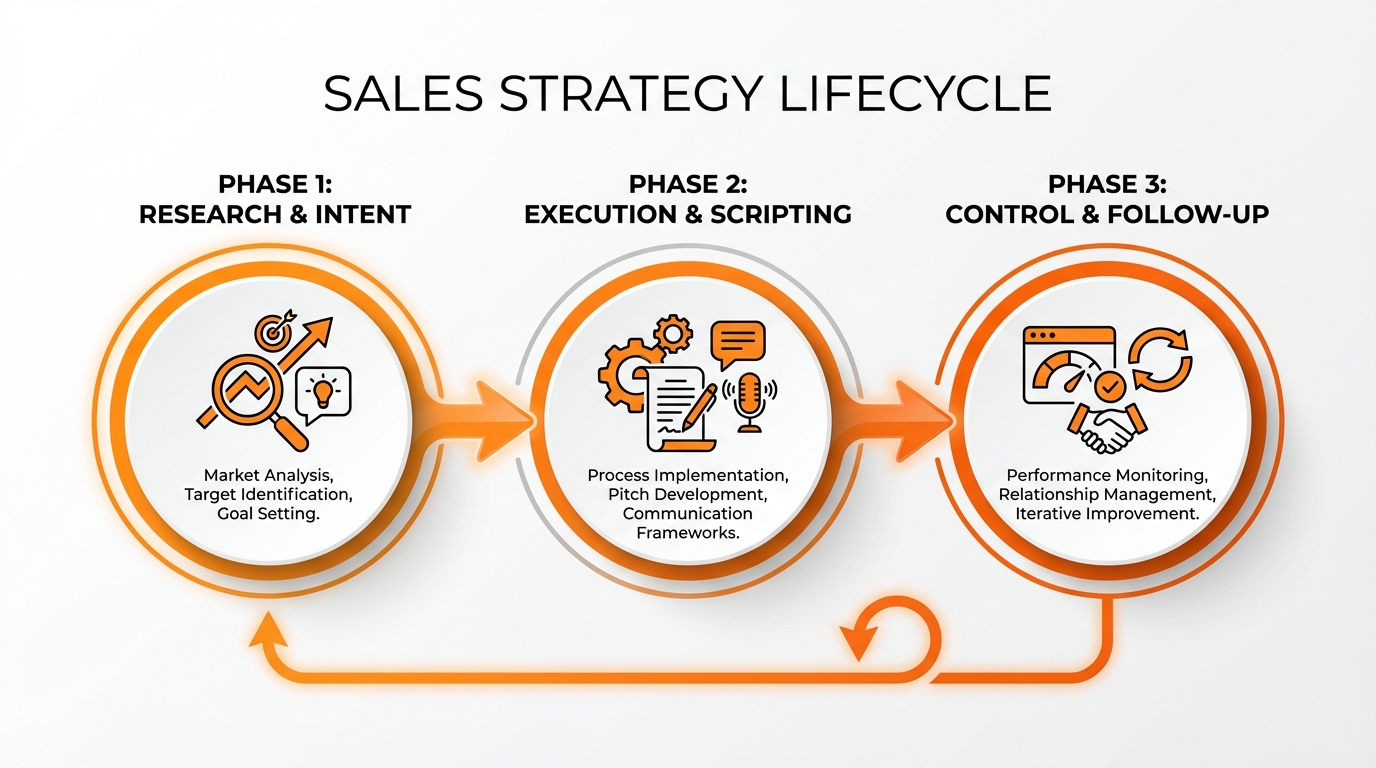
To counteract the modern buyer’s hostility toward traditional cold calls, we developed a system built on speed and hyper-relevance. We break the successful B2B cold call into three non-negotiable phases. Ignoring any one phase guarantees failure; mastering them guarantees pipeline generation.
Phase 1: Pre-Call Intelligence (The Data Edge)
A high-conversion cold call is impossible without high-quality data. Preparation is not optional—it is the competitive advantage. We leverage modern AI lead generation to pull verified, direct contact information and contextual triggers that justify the interruption.
This intelligence determines your ability to personalize the conversation beyond the lazy “I saw you work at X company.”
- Targeted Persona Mapping: We identify the specific decision-maker (e.g., VP of Revenue Operations), not just a generic job family.
- Trigger Identification: What happened in the last 90 days? A funding round, a hiring spree, a new product launch, or a major competitor loss? This trigger is the single justification for your call.
- Verified Contact Data: Use tools that provide accurate, personal emails and direct dials. Bypassing generic inboxes and gatekeepers is mandatory. (This is where our AI Lead Generation solution delivers measurable ROI.)
- The 3×3 Rule: Spend three minutes finding three relevant, solution-related facts about the prospect or their company. Stop after three minutes.
Phase 2: The 45-Second Conversation Sequence (The Script Core)
This is the execution window. The goal is simple: move from introduction to value proposition to discovery question before the prospect can formulate a hard rejection. We ruthlessly prioritize efficiency, recognizing that every wasted second reduces conversion probability.
- The Pattern Interrupt: Immediately state the reason for the call based on their trigger (Phase 1 data). Cut the fluff; get right to the point.
- The Value Bridge: Connect your solution directly to their identified pain point or recent trigger. This must be outcome-focused, not feature-focused.
- The Strategic Question: Force them to talk about their current process, budget, or pain. The call shifts from a monologue to a discovery phase.
- The Controlled Close: Ask for the meeting time directly. Do not ask “Are you interested?” Ask “Do you have 15 minutes next Tuesday, or is Wednesday better?”
Phase 3: The Controlled Close & Next Steps
The close is where most SDRs lose control. Your goal is not to sell the product—it is to sell the next 15 minutes on the calendar.
Handling Objections (Acknowledge, Re-assert, Pivot)
If the prospect objects, you do not argue or defend. You acknowledge the objection (“I understand you’re busy”), re-assert the specific value of the meeting time (not the product), and pivot back to the close.
Mandatory Post-Call Procedure:
- Immediate Confirmation: If you secure the meeting, send the calendar invite and a brief confirmation email detailing the agenda immediately.
- Pre-Qualify the Meeting: Always ask who else needs to be involved in that follow-up conversation. This crucial step maximizes the chance of the meeting holding and converting down the pipeline.
Phase 2 & 3: Script Execution and Control (The High-Conversion Template)
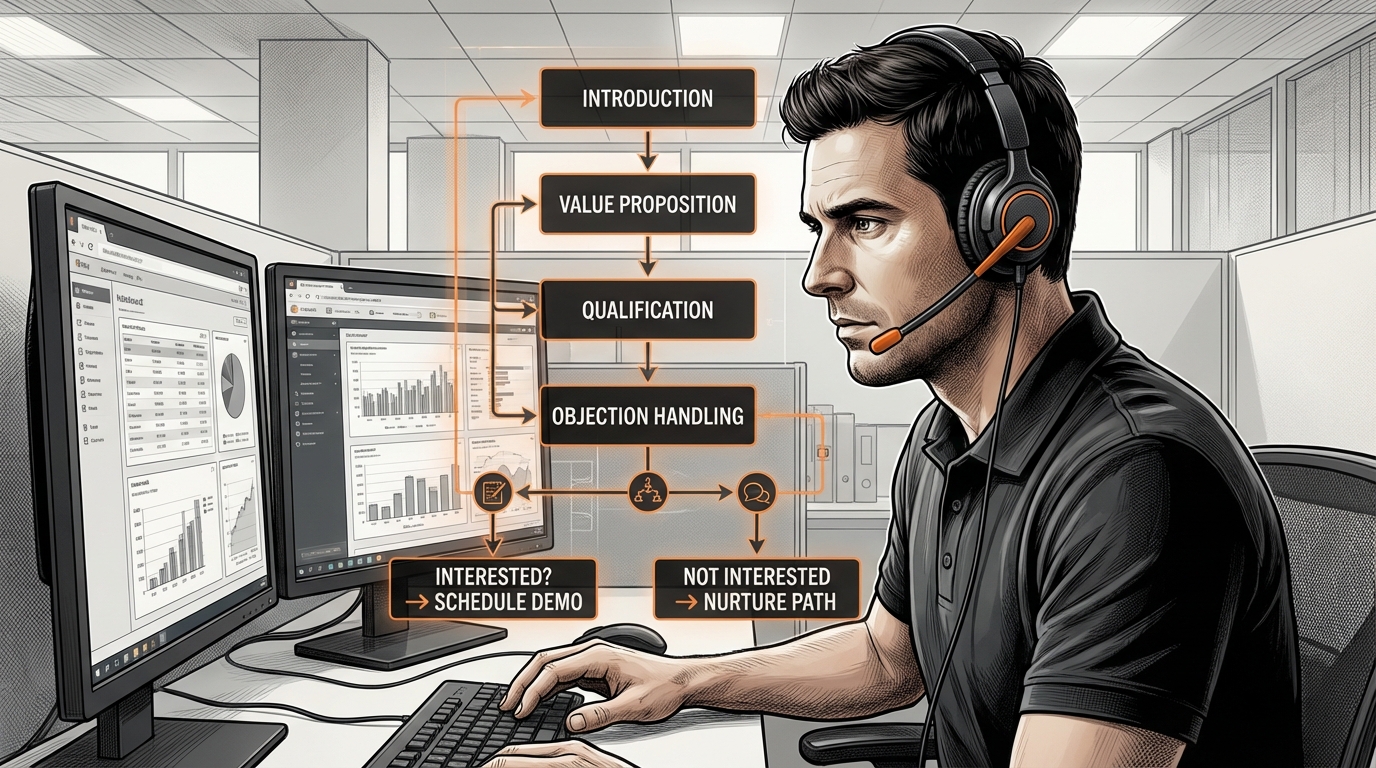
A successful cold call is a carefully engineered conversation, not a random pitch. This template is the core of the Pyrsonalize system, built for speed, relevance, and immediate qualification. Adapt the italicized sections below to align perfectly with your Ideal Customer Profile (ICP) and specific value proposition.
Step 1: The Pattern Interrupt Opener
Your opening must immediately differentiate you from the 99% of spam calls they receive. Use the intelligence gathered in Phase 1 to sound planned, not random. Never use permission-seeking phrases like “Did I catch you at a bad time?”
Goal: Gain 30 seconds of attention by proving relevance.
Example Opener:
“Hi [Prospect Name], this is [Your Name] calling from Pyrsonalize.
I’ll be brief: I saw you just hired three new SDRs in Q3, and I had a specific question about how you are onboarding them onto your lead data acquisition process.
Do you have 30 seconds for me to explain why I called?”
Why this works:
- The Trigger: It uses a specific, recent, and relevant trigger (“hired three new SDRs”). This grounds the call in their current reality.
- The Frame: It frames the call as a “question” or “sanity check,” immediately minimizing perceived risk.
- Respect for Time: It sets a hard time limit (30 seconds), making it easy to say yes.
Step 2: The Hyper-Specific Value Bridge
Once they grant permission, move immediately into the value proposition. This is not a feature dump. It is a rapid, 45-second pain-point alignment that connects their struggle directly to your quantifiable solution.
Goal: Validate a known industry pain point and introduce your solution as the proven fix.
Example Value Bridge:
“Thank you. We work specifically with [Your Role Peers, e.g., CROs at mid-market SaaS] who are currently trying to [primary outcome, e.g., increase connect rates by 40% in the next quarter].
What we are finding is that 90% of those teams are still wasting hours on inaccurate contact data, forcing their reps to manually verify emails and chase dead ends.
We solve that. We provide AI-verified, direct contact data for key decision-makers. This means your new SDRs spend 90% of their time talking to qualified leads, not researching them.”
Style Notes: Use short, declarative statements. Always emphasize the quantifiable result (90% time saved, 40% increased connect rate). We are selling the outcome, not the product.
Step 3: The Strategic Discovery Question
You have asserted value. Now, you must confirm the pain point is real and relevant to them right now. This is where you qualify or disqualify the prospect.
Ask one powerful, open-ended question that forces them to reflect on their current internal struggle.
Goal: Shift the conversation from your pitch to their process and internal priorities.
Example Discovery Question:
“I know that’s a lot to take in quickly. But right now, how confident are you in the accuracy and scale of the contact data your current SDR team is working with?”
Alternative: “Where does [Pain Point, e.g., data quality] sit on your priority list this quarter: mission-critical, or a ‘nice-to-have’?”
Wait for the Answer: Listen closely. Their response provides the ammunition—the specific pain points, objections, or priorities—required for the close.
Step 4: The Controlled Close (Selling Time)
This is Phase 3: Control. Never ask if they are “interested.” Interest is passive. We are selling the value of their time, positioning the next meeting as a strategic working session.
Goal: Secure a 15-20 minute follow-up meeting.
Example Close:
“That makes sense. It sounds like there is a real opportunity to streamline that process.
I am not going to pitch you on the phone right now. But I would like to schedule 20 minutes with you and one of our strategists next week.
We can map out your current data flow and show you exactly where we can inject verified contact data to save your reps [quantifiable time/money]. We focus on showing ROI in the first 90 days.
How does Tuesday at 1 PM or Thursday at 10 AM look for a quick working session?”
This is a double-option close. It assumes the meeting is happening, eliminating the “yes/no” option and forcing them to choose a time. This maintains control and drastically increases conversion rates from cold call to meeting booked.
Handling the Toughest SDR Objections
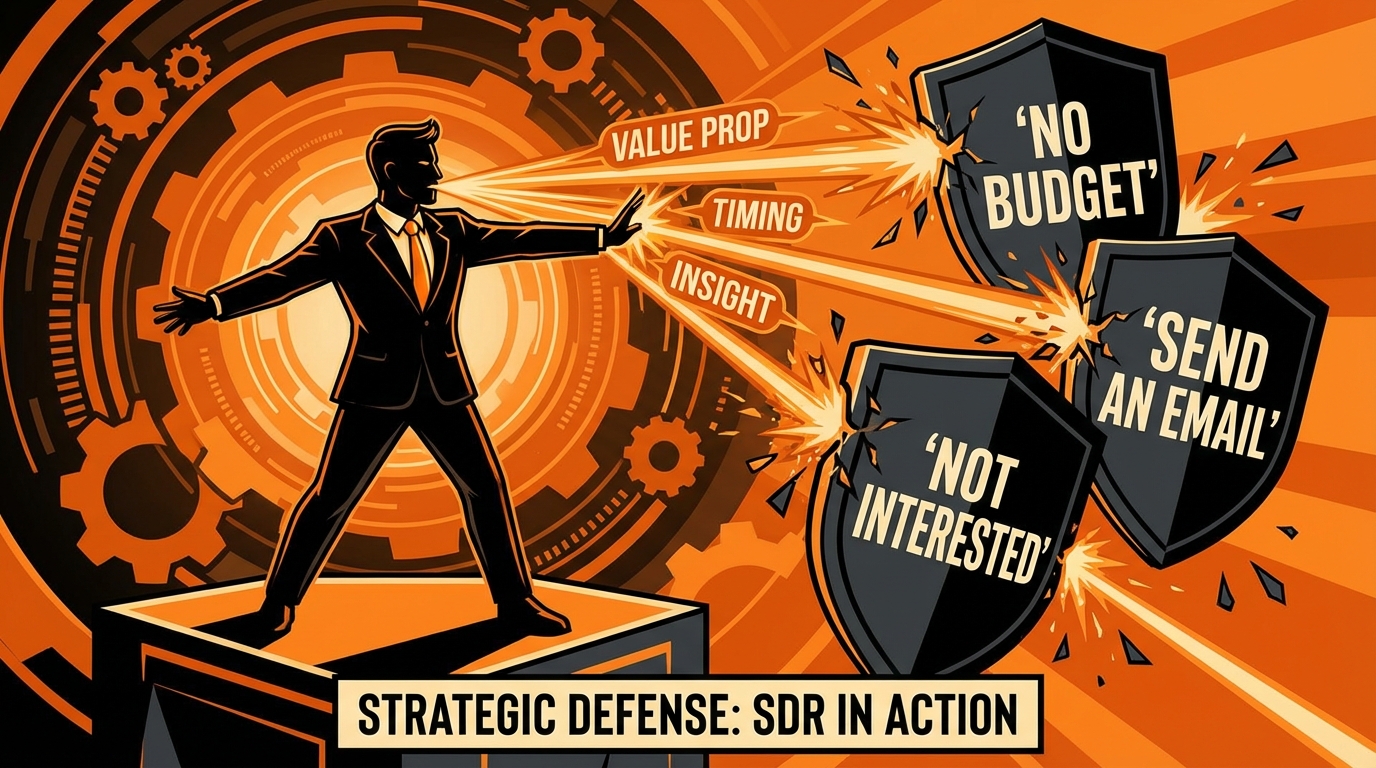
If you execute the script correctly, objections are inevitable. They are not rejections; they are simply requests for clarification, timing, or priority alignment. A weak SDR hears “no”; an expert SDR hears a qualification signal.
The Pyrsonalize system requires our team to anticipate the top 5 roadblocks before dialing. We train them to respond using the A-P-C framework: Acknowledge the concern, Pivot back to the core value, and Control the next step. This approach prevents stalls and immediately shifts the conversation back toward scheduling the meeting.
Here is our internal playbook for handling the most common SDR objections:
| Objection | The Generic/Failing Response | The Strategic/Pyrsonalize Response |
|---|---|---|
| “Just send me an email.” | “Sure, I can do that. What should I include?” | “I’d be happy to. But typically when people ask for an email, it means this isn’t a top priority right now. Before I send anything, is improving your lead data something you’re actively prioritizing this quarter?” (Overcoming the SDR Objection: Send Me More Info) |
| “We already use a provider for that.” | “Which provider are you using? Are you happy with them?” | “I hear that. Most of our clients were already using a solution—they came to us when their connect rates stalled due to data decay. If I could show you how we guarantee 98% accuracy on mobile and personal emails, would 15 minutes next week be worth your time?” |
| “I don’t have the budget/time right now.” | “I understand, perhaps next quarter?” | “I appreciate you being direct about bandwidth. The reason I called is specifically to save you time and budget. If we can cut the time your reps spend researching by 50%, that frees up immediate bandwidth. Let’s find 20 minutes to see if the math adds up. How does [Time Option A] look?” |
| “I need to talk to my team/boss.” | “Can you give me their contact information?” | “Absolutely. To make that internal conversation easier, let’s get that 20-minute working session scheduled first. That way, you have all the data points and a clear roadmap to present to your team. Who else should I include on the invite for Thursday?” |
Optimizing Performance: The Only Metrics That Matter
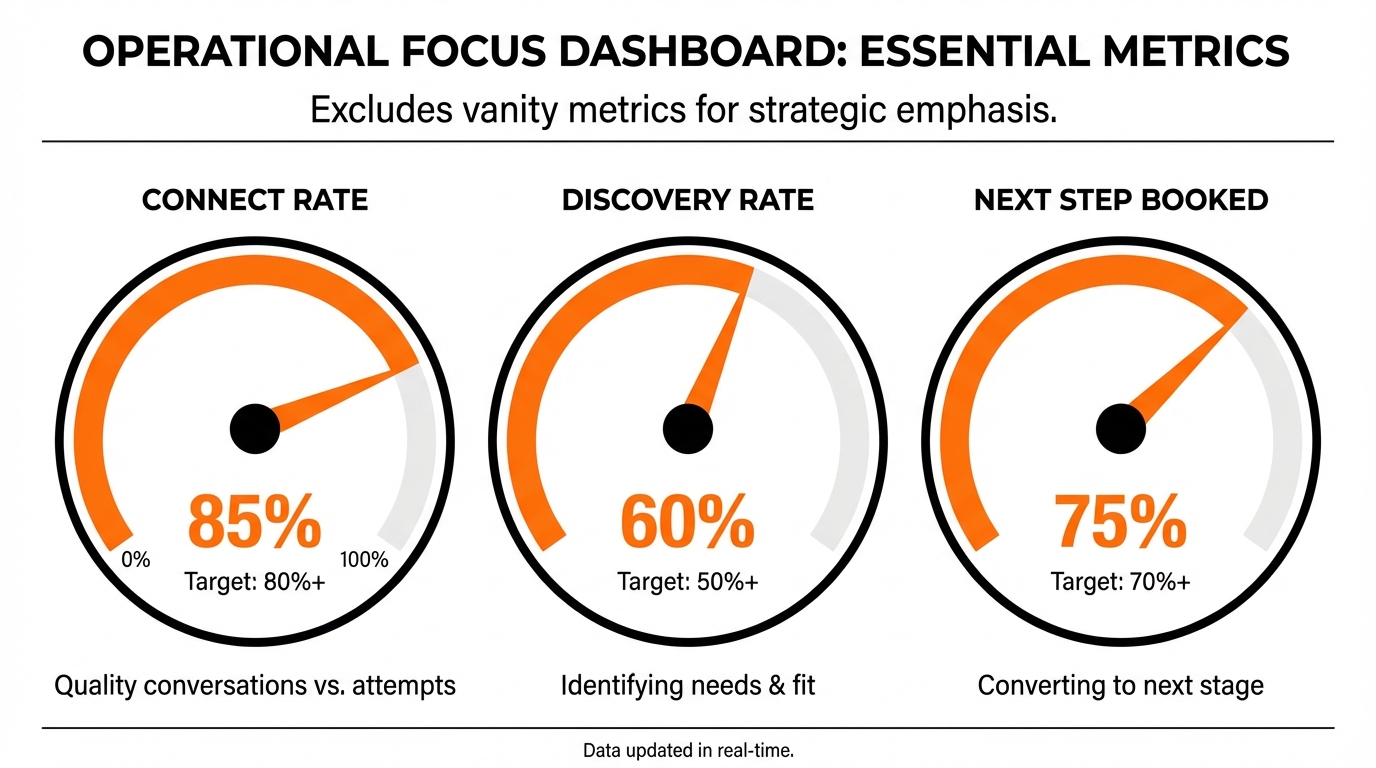
Execution is worthless if you cannot measure the outcome. Stop tracking vanity metrics—like “dials made” or total talk time. Those metrics reward activity, not results. We focus strictly on conversion performance at every stage of the cold call.
To truly understand script effectiveness and SDR efficiency, we track four core metrics:
1. Connect Rate (CR)
The percentage of dials resulting in a live conversation with the target prospect (excluding gatekeepers, assistants, or voicemail). A low CR signals fundamental flaws in your data or timing.
- Benchmark: 8% to 15%. (High-quality, verified data is absolutely essential here).
- If low: Your data quality is failing, your calling time is off, or your dialer settings are inefficient.
2. Conversation-to-Meeting (C2M)
This is the most critical metric. It measures the percentage of live conversations that successfully convert into a booked follow-up (e.g., demo, discovery call, or next step).
- Benchmark: Top teams hit 10% to 20%.
- If low: Your value proposition is weak, your discovery question is poor, or your close is ineffective. This conversion rate directly reflects the quality and structure of your script.
3. Time-to-Meeting (TTM)
The average amount of time (in minutes) an SDR spends on the phone to successfully book one meeting. This is the true measure of efficiency.
- Goal: Optimize this relentlessly. If your script is structured for speed (45 seconds), your TTM will drop dramatically, increasing SDR efficiency and lowering acquisition costs.
- We monitor this closely using strategic time tracking tools to ensure reps are focused on quality, not simply volume.
4. Downstream Pipeline Value (Script A/B Testing)
Never rely on a single script. We mandate constant A/B testing. Tracking meetings booked is insufficient; you must track the downstream pipeline value generated by each script variant 60 to 90 days later.
- Action: Run two distinct value bridges (Script A: focuses on data accuracy; Script B: focuses on time savings) for 300 dials each. See which version generates higher-value opportunities and better close rates 90 days out.
- Retire the weaker script immediately. If it doesn’t generate pipeline, it doesn’t matter how many meetings it booked.
The Strategic Use of Tone and Delivery: Mastering Execution

Metrics track what happens; delivery dictates why it happens. A perfect script fails if delivered robotically. We know this because poor delivery tanks conversion rates immediately. Your SDRs must master the execution.
We focus on three non-negotiable techniques that elevate delivery from reading to selling:
1. Authority, Not Apology
Your SDR is not asking for permission; they are delivering value. We only cold call accounts where we have a measurable solution to a known pain point. SDRs must project this confidence—they are providing a service, not asking for a favor.
- Tone: Use an authoritative, confident tone, grounded in certainty.
- Pacing: Speak slowly and clearly. This is essential when delivering the Value Bridge (the quantifiable result).
- Inflection: Eliminate vocal fry and rising inflections. Statements must sound like statements, not tentative questions.
2. The Power of the Pause
Silence is a control mechanism. Strategic pauses force the prospect to listen, process key statistics, or, crucially, break the silence themselves. We use pauses to gather intelligence.
- After the Trigger (Step 1): Pause immediately after the personalization statement. Let the relevance sink in.
- After the Quantifiable Result (Step 2): Pause after delivering the core Value Bridge. This is the moment we demand attention.
- After the Discovery Question (Step 3): Pause and wait. Do not fill the silence. The prospect will rush to speak—let them initiate the conversation shift.
The prospect rushing to speak is the goal. This is the moment you transition from pitching to gathering high-value intelligence.
3. Mirroring and Matching
Friction kills cold calls. Mirroring is the fastest way to remove subconscious friction points. If the prospect speaks quickly, match their cadence. If they use formal language, maintain that formality. This builds instant, subconscious rapport.
- Vocabulary: Listen actively. If the prospect uses specific industry terminology (e.g., “pipeline generation”), use that exact language, not generic substitutes (“lead flow”).
- Energy: Match their level. If they are measured and calm, be strategic and steady. If they are highly engaged, increase your energy slightly to meet them.
This technique is about removing distractions. When the prospect feels comfortable, they focus purely on the value proposition, not on the delivery mechanism.
Frequently Asked Questions (FAQs)
How long should a successful B2B cold call script last?
The core sequence—from the opening hook to the meeting request—must be sharp and under 60 seconds. Our internal benchmark is 45 seconds. Exceeding this limit often leads to premature pitching, destroying the appointment rate. Remember: The script’s function is speed and control. Get in, establish immediate value, and secure the next step.
Should SDRs use different scripts for C-Suite versus Managers?
Absolutely. This is non-negotiable segmentation. C-Suite scripts must address strategic outcomes exclusively (revenue generation, risk mitigation, massive cost reduction). They ignore features. Conversely, Manager-level scripts should focus on tactical benefits (process efficiency, time savings, immediate improvements). The value bridge must always align with the persona’s daily operational pain points.
What is the most common mistake SDRs make when using a script?
The single biggest error is confusing the script with the conversation itself. The script is a structured roadmap—it is not dialogue to be read verbatim. When the prospect inevitably deviates, the SDR must utilize active listening to pivot back to the nearest checkpoint (the strategic question or the close). Reading kills authority; mastering the roadmap ensures control.
Ready to take the next step?
Try AI Lead Generation Today
Click HereReferences
- Cold Calling Scripts: Hub of the Best Templates for 2026 – Cognism
- Cold Calling for SDRs: The Script That Actually Works – YouTube
- Cold Calling Scripts: 10 Templates for B2B Success | SalesHive Blog
- Cold Calling Scripts That Actually Work (With Examples) – Cleverly
- Crafting the Best Cold Calling Scripts That Actually Work – SalesRoads