
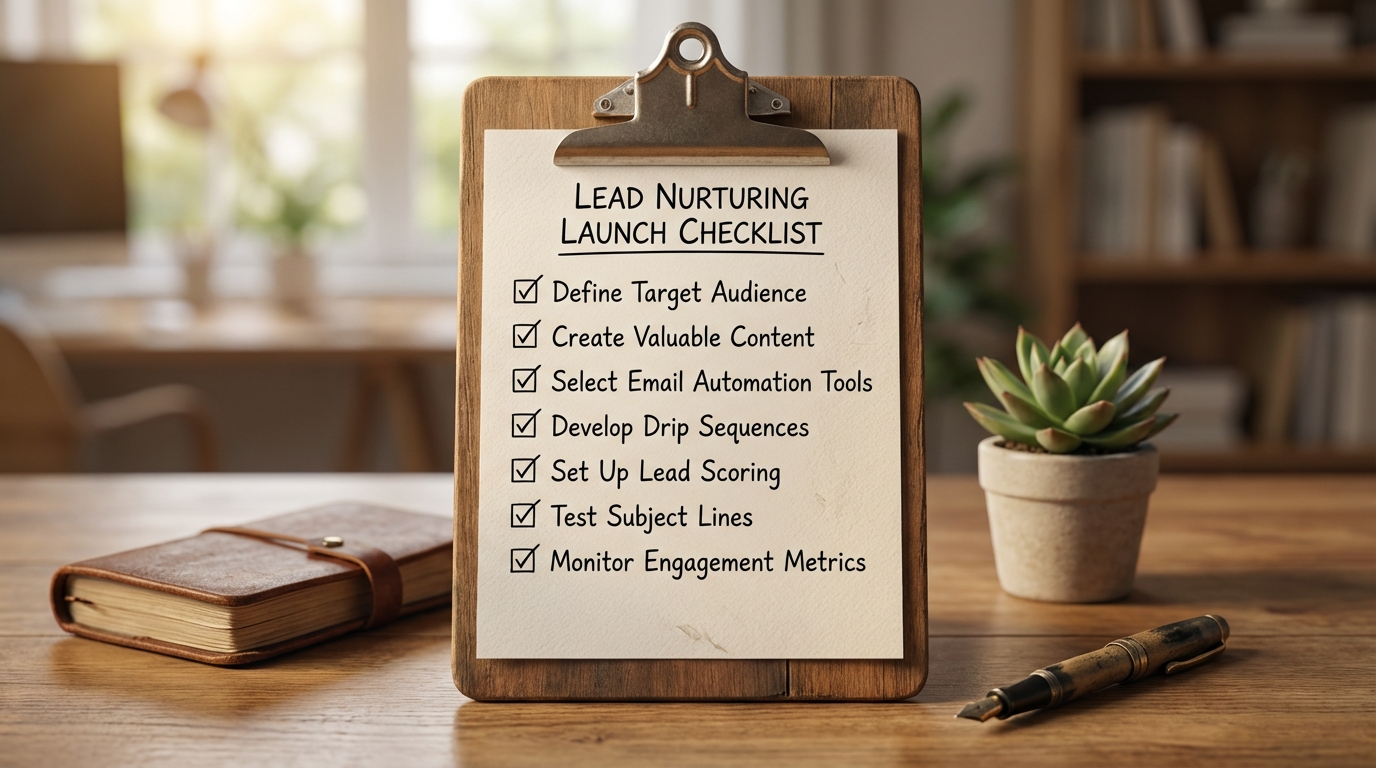

Lead nurturing is not a passive activity. In the high-ticket B2B and SaaS markets of 2025, leads expect relevance, speed, and genuine value. The era of generic, automated drip sequences is over. We must build campaigns that prioritize trust and strategic personalization.
Our objective is simple and non-negotiable: We must move a Marketing Qualified Lead (MQL) to a Sales Qualified Lead (SQL) using a methodical, multi-touch strategy. This requires a rigorous blueprint, not guesswork. If 80% of new leads fail to convert, the failure lies in the nurturing process, not the quality of the lead itself.
This checklist provides the mandatory steps required to launch a successful, high-conversion lead nurturing campaign in the current market environment.
Key Highlights: The Trust-Based Nurturing Mandate
- Hyper-Personalization is Required: Generic sequences kill conversion velocity. Utilize AI and behavioral data to generate specific, actionable insights that fuel true 1:1 outreach and customized value delivery.
- Multi-Channel Consistency: Nurturing cannot live solely in the inbox. Integrate critical touchpoints, including LinkedIn outreach, personalized video, and behaviorally triggered retargeting.
- Trust Thresholds: Implement dynamic lead scoring models that prioritize genuine intent and relationship signals over simple demographic data points.
Phase 1: Strategic Foundation and Data Alignment
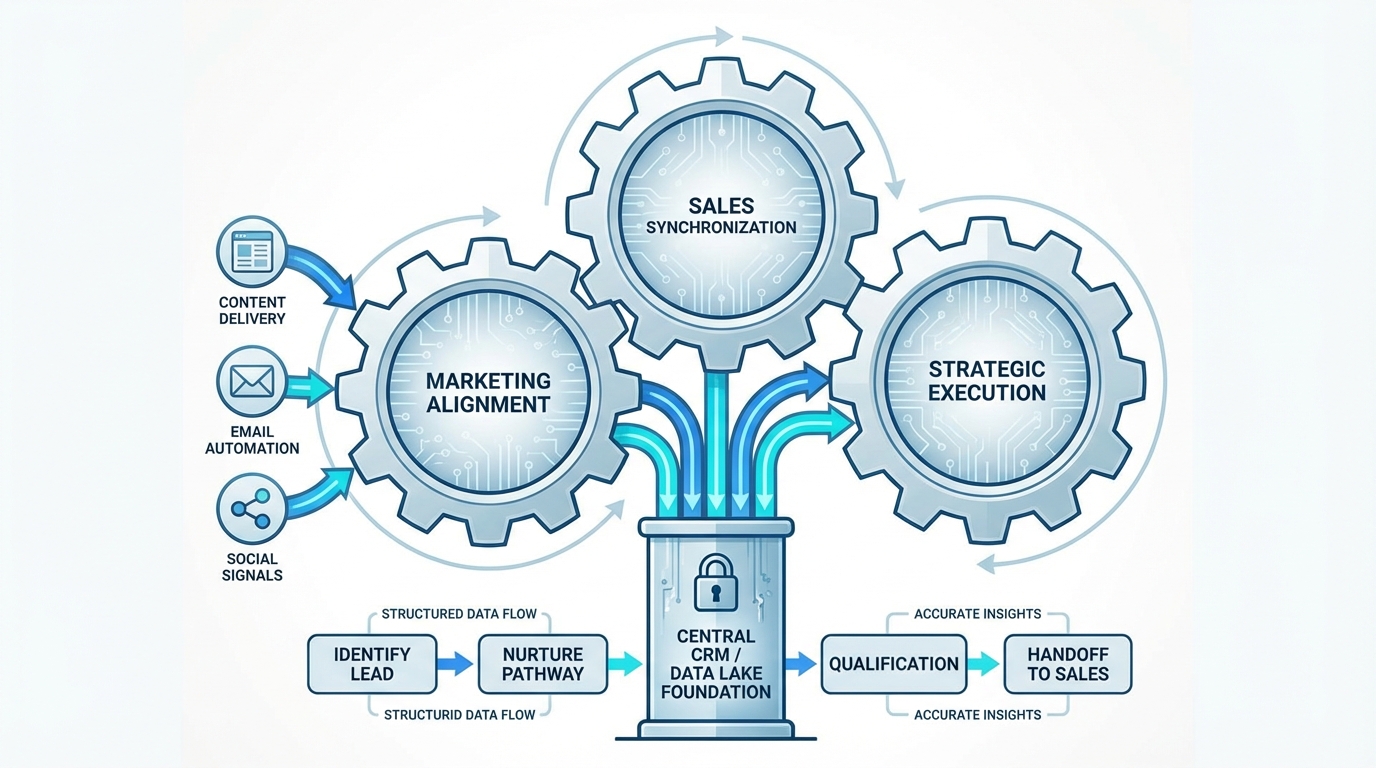
The success of any lead nurturing campaign hinges on a robust, data-aligned foundation. Before drafting a single email or configuring automation, we must define the core parameters of success: who we are targeting, why, and—most importantly—what measurable success looks like. This strategic phase ensures alignment between marketing effort and sales capacity.
Step 1: Define the Conversion Metric (Anti-Generic Goal Setting)
A campaign without a precise, measurable goal is merely a broadcast. We define success not just by vanity metrics like open rates, but by the tangible action that qualifies the lead for immediate sales intervention (the MQL-to-SQL handoff).
We use the SMART framework, adapted for high-ticket B2B velocity:
- ✅ Specific Goal: Identify the exact, high-value action required. Is it a demo request, a completed pricing page visit (with specific time on page), or a direct reply to a personalized email?
- ✅ Measurable Target: Set a quantifiable objective for the progression rate. Example: Achieve a 15% progression rate from MQL to SQL within 45 days.
- ✅ Attainable Resources: Confirm the sales team has the capacity and standardized playbook to handle the projected volume of SQLs generated by the campaign.
- ✅ Relevant Outcome: Ensure the goal directly impacts revenue. Focus on deal size potential and speed to close, rather than just total lead volume.
- ✅ Time-Bound Deadline: Define the maximum allowable time for a lead to remain in the active nurturing sequence (e.g., 60 days maximum before automatic re-engagement or archival).
Step 2: Rigorous Lead Segmentation (Beyond Basic Demographics)
Generic nurturing fails because it treats all MQLs equally. Our strategy demands granular, dynamic segmentation based on two critical factors: source intent and behavioral triggers. This allows us to deliver hyper-relevant content that accelerates trust.
Segmentation Mandates:
- Source Intent: How did the lead enter the funnel, and what was their stated interest?
- High Intent: Leads who requested a demo, attended a private executive briefing, or downloaded a highly technical whitepaper requiring specific industry data.
- Medium Intent: Leads who subscribed to a general newsletter, attended a high-level webinar, or accessed an un-gated resource.
- Low Intent: Leads sourced from general content syndication or top-of-funnel social campaigns (requires heavy initial education).
- Behavioral Triggers: What actions have they taken since entry, indicating their readiness to buy?
- Product Specificity: Segment leads who visited three or more feature pages related to a single, high-value product module.
- Pricing Engagement: Segment leads who visited the pricing page more than once, but did not convert or schedule a call.
- Content Consumption: Segment leads who consumed a video or case study relevant to their specific industry (a firmographic match).
Each defined segment requires a dedicated, unique nurturing sequence. We must move away from the linear drip sequence toward dynamic content paths based on real-time engagement and intent signals.
Step 3: Establish the Trust Threshold (Lead Scoring 2.0)
Lead scoring defines the threshold at which a lead is deemed sales-ready (SQL). In 2025, this scoring model must heavily weight trust signals and personal interaction over passive behavior. Leads must earn the right to be contacted by sales.
We must collaborate directly with sales leadership to define the critical SQL score. This score must quantify intent, authority, and engagement history. For detailed guidance on building a robust scoring model, review The Strategic Lead Scoring System for High-Ticket B2B Sales.
Mandatory Scoring Adjustments for 2025: Prioritizing Intent over Volume
| Activity Type | Score Weight (Trust Signal) | Rationale |
|---|---|---|
| Email Open (Generic Broadcast) | +1 | Low intent; easily inflated by security scanners. |
| Clicked CTA (Product Demos/Pricing) | +10 | High commercial intent shown; investigating solution. |
| Reply to Personalized Email (Manual Touch) | +25 (Critical Trigger) | Direct, personal engagement requires immediate sales follow-up. |
| Visited Careers/About Us Page | -5 (Non-Commercial Signal) | Indicates general research about the company, not buying intent. |
| Downloaded Case Study (Matching Industry) | +15 | Seeking proof of concept relevant to their business challenge. |
Phase 2: Content Mapping and Sequencing Blueprint
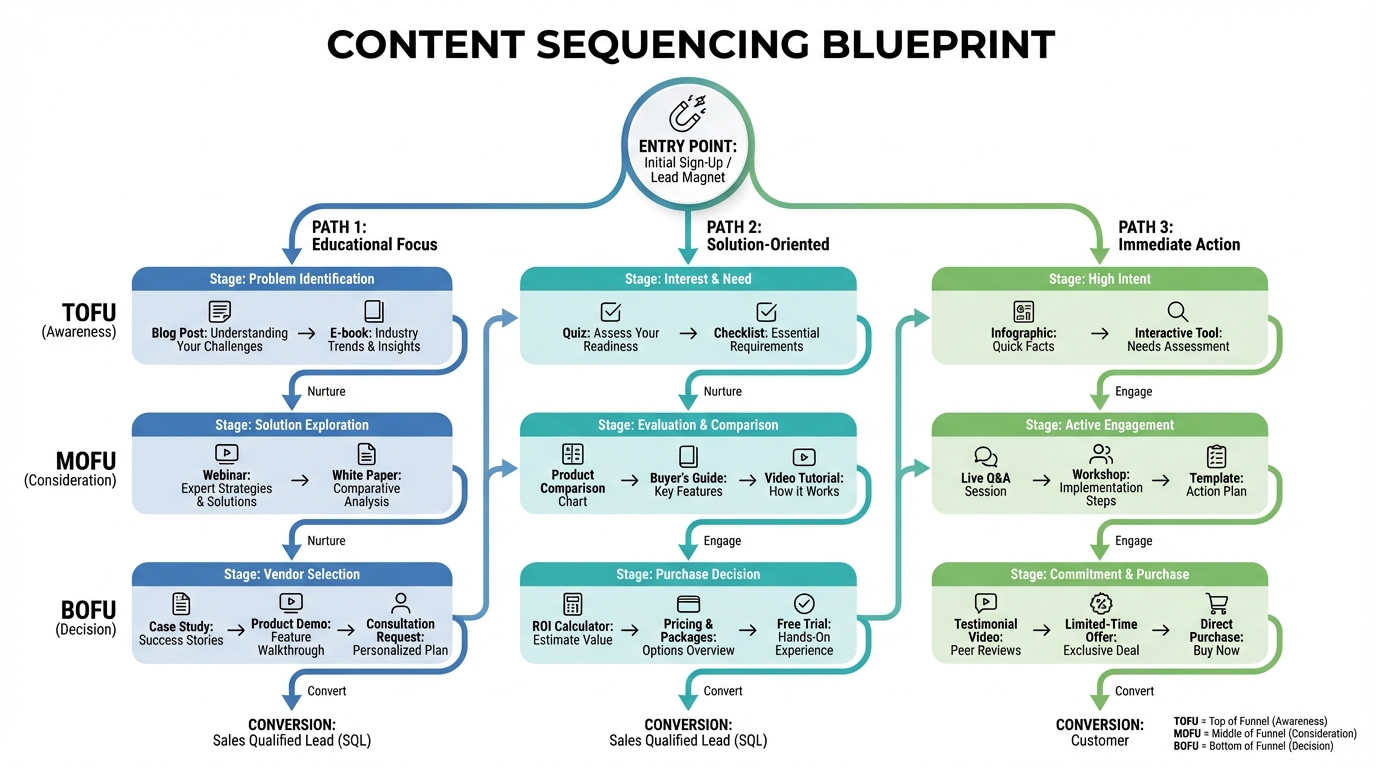
In the high-ticket B2B environment, content is the currency of trust. This phase ensures that every asset delivered aligns perfectly with the lead’s current stage in the buying cycle. We operate as educators first and sellers second, meaning our content must solve immediate, tangible problems while strategically positioning our solution as the inevitable next step.
Step 4: Map Content to the Buyer’s Journey (The Value Hierarchy)
Effective nurturing requires dividing the journey into three distinct phases. Crucially, every touchpoint must serve a singular, defined purpose tied to the lead’s psychological readiness.
- Awareness (Top of Funnel – TOFU): The lead recognizes and defines a fundamental business problem.
- Content Goal: Validate the pain point and establish undeniable industry authority.
- Content Type: Proprietary industry research reports, comprehensive best practice guides, high-level educational webinars.
- Example Email 1: The Welcome/Validation Email. “We see you downloaded our guide on scaling B2B outreach efficiency. Did you know 60% of founders struggle with XYZ visibility due to outdated data aggregation methods?”
- Consideration (Middle of Funnel – MOFU): The lead actively researches potential solutions and methodologies.
- Content Goal: Introduce our unique methodology. Demonstrate a clear, measurable Unique Value Proposition (UVP) against competitors.
- Content Type: Case studies specific to their vertical, competitive comparison matrixes, ROI calculators, expert interviews.
- Example Email 3: The Social Proof Email. “See how [Direct Competitor/Similar Company] achieved a 4x increase in MQL-to-SQL conversion using our proprietary AI approach to lead data acquisition.”
- Decision (Bottom of Funnel – BOFU): The lead is ready to purchase and is comparing vendors.
- Content Goal: Remove all remaining friction points. Validate the financial and strategic investment required.
- Content Type: Personalized demo offers, free trial invitations (where applicable), detailed implementation roadmaps, tiered pricing breakdowns, security audits.
- Example Email 5: The Conversion Email. “Ready to eliminate manual data entry and onboard in under 7 days? Book a 15-minute tailored strategy session with our implementation team this week.”
Step 5: Crafting the Personalized Outreach Sequence (The AI Bridge)
Generic drip campaigns fail in the high-value space. Our competitive advantage relies on leveraging AI tools to find highly specific, verifiable personal contact information and data points. This fuels hyper-personalized, non-automated outreach that bypasses generic spam filters and builds immediate, genuine trust.
This mandatory 5-step sequence must seamlessly integrate the data harvested during Phase 1 and our AI lead generation tools.
Touch 1: Immediate Gratification (Automated Email, 0 hours)
Deliver the promised asset (e.g., the eBook or guide). The design must be professional and clean. Include a secondary, low-friction CTA to consume a related, high-value piece of content. This step confirms the lead’s email validity and immediately sets the expectation for future value delivery.
Touch 2: Value Reinforcement (Automated Email, 48 hours)
Focus on a single, critical pain point directly related to the asset they downloaded. Use compelling industry statistics to reinforce the gravity and cost of the problem. Maintain the educational tone; selling is still prohibited at this stage.
Touch 3: The Personalized Data Drop (Manual/Semi-Automated, Day 5)
This is the critical pivot point where we introduce the human element and leverage our unique data advantage. This message should be plain text, sent directly from a sales representative (SDR/AE), referencing specific, non-generic data points gathered via AI research.
- Template Mandate: “Hi [Name], I noticed you work at [Company] and your team focuses on [Specific Role/Problem, e.g., optimizing data hygiene]. We recently helped [Competitor/Similar Company] achieve [Metric, e.g., 99% data accuracy]. I have a quick 3-point strategy outline relevant to your specific operational challenge.”
- Structure Rule: Keep the email under 5 sentences. Require a low-friction reply (e.g., “Yes, I’m interested” or “Send it over”) rather than requesting a meeting.
Touch 4: Multi-Channel Expansion (Manual, Day 8)
If no response is received from Touch 3, we strategically move the conversation to their primary professional channel, typically LinkedIn. (Review LinkedIn Lead Generation: The 2025 Trust Blueprint for specific methodology.)
- Action Required: Send a connection request referencing the previous email’s context. Follow up with a personalized message (avoid standard InMail templates).
- Focus: Offer a highly specific, personalized asset, such as a 60-second video analysis of their current operational bottleneck or website strategy.
Touch 5: The Breakup/Re-engagement (Automated, Day 14)
If the lead remains unresponsive, deploy a concise, high-urgency “breakup” email. This touch is highly effective at generating a response from otherwise silent leads.
- Tone: Maintain professional respect for their time. State clearly that you will cease sending communications unless they explicitly indicate continued interest.
- Alternative CTA: Offer a resource that requires minimal commitment, such as a private Slack channel invitation, an exclusive data dashboard preview, or a simple one-click survey about their biggest current challenge.
Phase 3: Launch Execution and Trust-Based Touchpoints

Execution requires precision. This phase mandates that the lead nurturing campaign integrates seamlessly across technology platforms and maintains absolute consistency across every single touchpoint. We move from blueprinting to deployment, ensuring operational rigor and personalized delivery.
Step 6: Deploy Multi-Channel Nurturing (Beyond Email)
Reliance on email alone is a critical failure point in 2025 B2B sales. A successful high-ticket campaign integrates at least three distinct channels to maximize visibility, reinforce messaging, and drive impact.
Mandatory Multi-Channel Integration:
- Retargeting Campaigns: Segment leads based on specific content consumption (e.g., those who read a case study or pricing page) and retarget them with high-intent ads (e.g., demo offers, free trial CTAs) on platforms like LinkedIn and the Google Display Network.
- Personalized Video Integration: Utilize personalized video messaging tools (e.g., Loom, Vidyard) within manual, high-value touchpoints. A personalized video drastically increases perceived effort and trust, driving significantly higher reply rates for high-ticket services.
- Conversational AI Integration: Ensure your website’s chatbot or conversational AI platform recognizes returning nurtured leads. The AI must offer specific, context-aware assistance (e.g., “Welcome back, [Name]. Are you still reviewing the [Specific Product] solution?”).
Consistency Mandate: The messaging must remain unified. The language used in the email sequence must mirror the tone and offer presented in the retargeting ads and chatbot interactions. Any dissonance erodes trust.
Step 7: The Manual High-Ticket Intervention (Non-Automated Trust)
For high-value leads—specifically those scoring above 70% of the Sales Qualified Lead (SQL) threshold—automation must cease immediately. These leads require a dedicated, non-automated intervention designed to build immediate human rapport and expedite the sales cycle.
The Intervention Protocol:
- Immediate Handoff: The lead must be assigned to a specific Sales Development Representative (SDR) within one business hour of hitting the defined SQL score.
- Context Review: The SDR must review the lead’s entire history: content consumed, pages visited, and replies sent. Leverage AI-driven lead generation data to provide the precise personal and behavioral context required.
- The Value Call: The first communication should be a short, direct phone call or a highly customized email that references their specific activity. Avoid generic scripts. Reference the precise whitepaper they downloaded or the specific competitor they researched.
- Goal: Secure a 15-minute introductory meeting focused on relationship establishment and further qualification—not a hard pitch.
Step 8: CRM Integration and Data Hygiene (The Operational Mandate)
A sophisticated nurturing campaign is only as effective as the data supporting it. We must ensure the CRM (or lead management platform) is rigorously configured to handle the complexity of dynamic nurturing flows and maintain data integrity.
Mandatory Operational Checks:
- Two-Way Sync: Ensure the marketing automation platform and the CRM share real-time, bidirectional data. Any activity tracked by marketing (e.g., email click, video view) must instantly update the lead record for the sales team.
- Strict Suppression Lists: Implement rigorous suppression rules. Leads who have converted (became a customer), unsubscribed, or manually requested removal must be purged from all active nurturing and retargeting flows immediately to ensure compliance and respect privacy.
- Lead Archival Policy: Define clear criteria for archiving cold leads. If a lead remains completely inactive for 90 days after completing the primary sequence, archive them to maintain list health and focus resources on active, engaged prospects.
- Data Enrichment Automation: Utilize continuous data enrichment tools to verify lead quality (e.g., validating job titles, company size, and contact information). Outdated data leads directly to irrelevant nurturing, which severely damages brand reputation.
Phase 4: Measurement, Optimization, and Mandatory Iteration
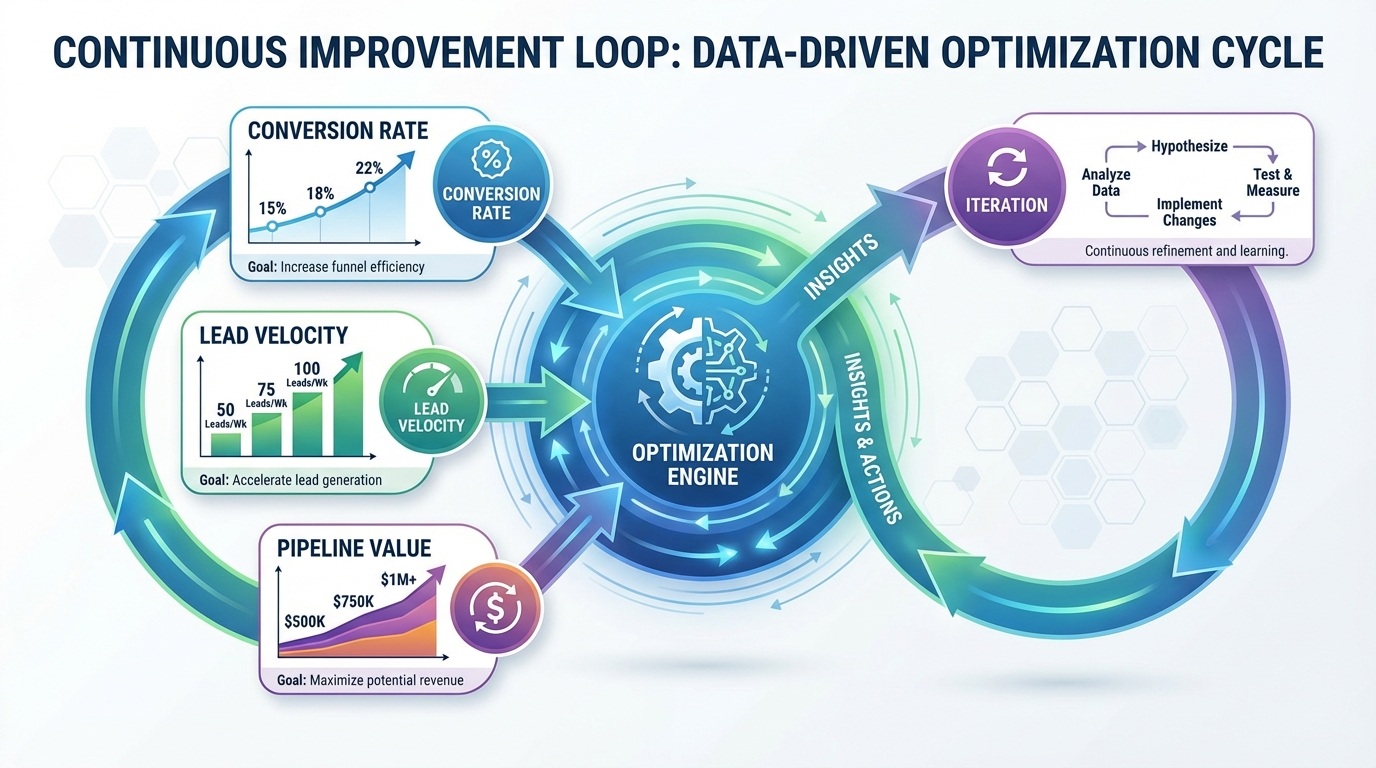
In high-ticket B2B, deployment is merely the starting line. We do not launch a campaign and forget it. Continuous measurement and rapid iteration are mandatory. The strategic advantage in 2025 is held by those who can adapt their sequences fastest based on real-time performance data.
Step 9: Tracking Conversion Velocity and Strategic KPIs
Beyond vanity metrics like standard open and click-through rates, we must fixate on indicators that measure the speed, quality, and financial impact of lead progression through the funnel.
Mandatory Nurturing KPIs:
- MQL to SQL Conversion Rate: The percentage of nurtured leads that achieve the sales-ready score. This is the primary metric of campaign success and lead quality validation.
- Conversion Velocity (Time to Conversion): The average number of days required for a lead to move from initial contact to SQL status. Reducing this time is a core objective for increasing sales efficiency.
- Content Engagement Rate: Track which specific assets (e.g., Case Study A vs. Whitepaper B) generate the highest click-through rates and subsequent scoring activity. This data directly informs future content strategy and personalization efforts.
- Unsubscribe Rate per Touchpoint: High unsubscribe rates signal content fatigue or irrelevance at a specific touchpoint. Test subject lines and content relevance immediately upon identification of spikes.
- Revenue Impact (ROI Validation): Track the average deal size and lifetime value (LTV) of leads sourced through the nurturing campaign versus non-nurtured leads. Nurtured leads must demonstrate significantly higher LTV and reduced churn to justify the campaign resource investment.
Step 10: Establishing the Mandatory Review and Optimization Cadence
Performance review must be a structured, non-negotiable, cross-departmental exercise involving both sales and marketing leadership. This protocol ensures absolute alignment on lead quality, messaging effectiveness, and revenue prioritization.
Mandatory Review Protocol:
- Weekly Data Check (Marketing Focus): Marketing leadership reviews automated metrics (progression rates, drop-off points, immediate sequence bottlenecks, and open/click rates) to identify tactical adjustments needed within the current week.
- Bi-Weekly Qualitative Review (Smarketing Alignment): Sales and Marketing meet to conduct a deep dive on specific leads that stalled or converted unexpectedly fast. Sales provides crucial qualitative feedback on the real-world quality of the SQLs delivered and the messaging relevance.
- Monthly Optimization Sprint: Based on the combined qualitative and quantitative data, dedicate engineering and content resources to A/B test the weakest performing touchpoints (e.g., testing two different CTAs in Touch 3, or adjusting the time delay between automated emails). This continuous optimization loop is vital for maintaining relevance in high-ticket sectors; for instance, see our Lead Generation Blueprint for Financial Advisors (2025) for context on required agility.
The Mandatory Pre-Flight Launch Checklist
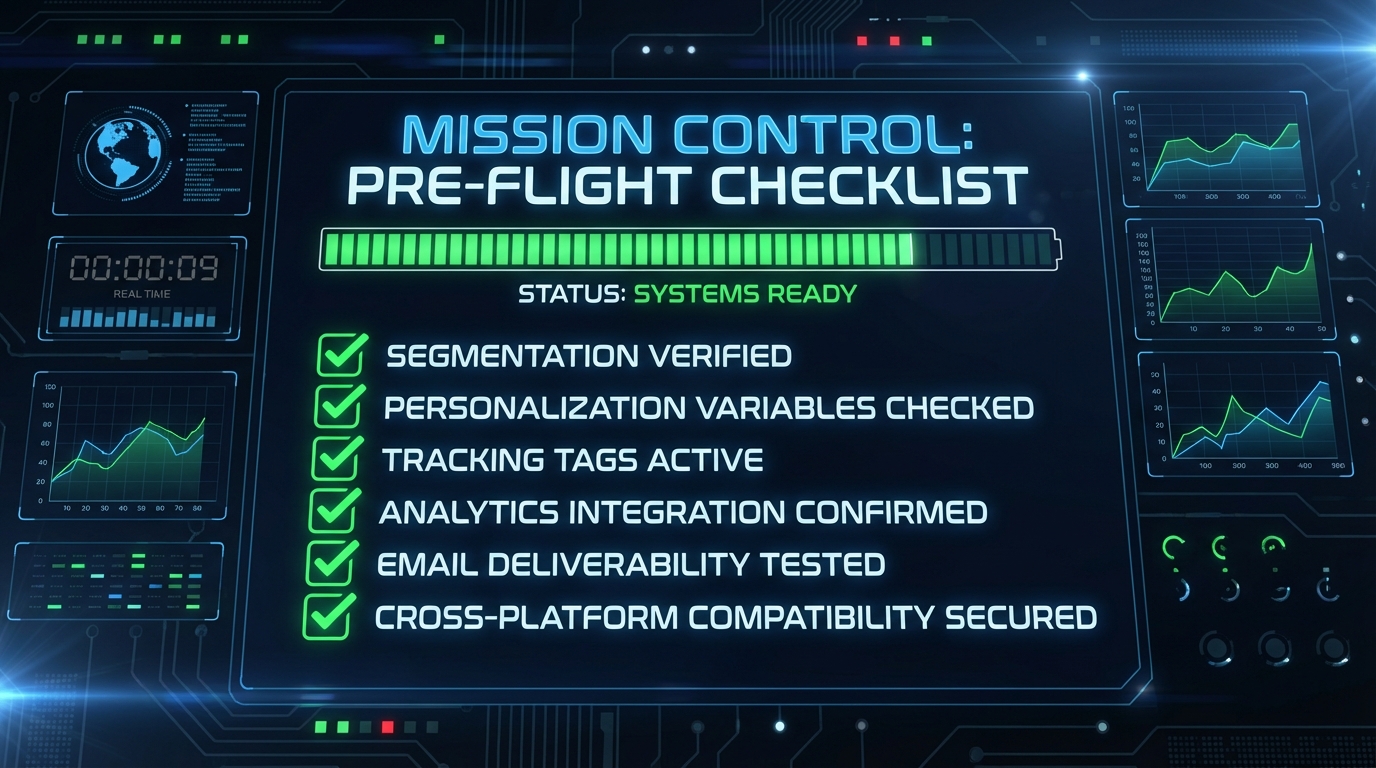
Before deployment, use this mandatory checklist as your final verification step. In the high-stakes B2B environment, skipping any critical component compromises the integrity of the campaign flow, leading to wasted budget and missed revenue opportunities.
- ✅ Strategic Goal: Defined the single primary conversion goal for the entire campaign (MQL to SQL).
- ✅ Audience Segmentation: Segmented the target audience based on current intent signals and observable behavior.
- ✅ Scoring Model: Established the dynamic lead scoring model, with the specific Trust Threshold clearly defined.
- ✅ Content Mapping: Mapped all content assets (Awareness, Consideration, Decision) precisely to the buyer’s journey stages.
- ✅ Sequence Design: Designed the complete outreach sequence, including the mandatory manual, personalized touchpoints.
- ✅ Asset Audit: Ensured all content assets (eBooks, case studies, videos) are current, relevant, and optimized for 2025 standards.
- ✅ Multi-Channel Setup: Configured multi-channel integration, specifically validating Retargeting ads and personalized LinkedIn messaging.
- ✅ Data Integrity: Verified seamless two-way data synchronization between the marketing automation platform and the CRM.
- ✅ Handoff Protocol: Established the immediate handoff protocol for high-scoring leads, enabling rapid Manual Intervention by sales.
- ✅ KPI Definition: Defined the Key Performance Indicators for tracking conversion velocity and overall revenue impact.
- ✅ Review Cadence: Scheduled the mandatory weekly and monthly performance review cadences for rapid iteration.
Implementing this rigorous, data-driven framework ensures your nurturing efforts shift decisively from generic broadcasting to strategic, trust-based conversion engineering. This comprehensive approach is the only path to scalable and profitable lead conversion in the high-stakes environment of 2025.
Ready to take the next step?
Try AI Lead Generation Today
Click HereReferences
- The ultimate lead nurturing guide for 2025 (strategy & statistics)
- Creating Your Lead Nurturing Strategy: The Complete Guide
- 5 stage lead nurturing email checklist – Data & Marketing Association
- What’s an example of a lead nurturing campaign in action?
- 6 Lead Nurture Campaign Best Practices – Act-On Software