


You are closing an online store. Understand this: It is not the same as locking up a physical retail location for the night.
Generic closure advice focuses on cash drawers and securing the front door. That advice is worthless to modern e-commerce founders.
Our focus is strategic: The critical digital assets, the maximum legal write-offs, and the precise logistics termination.
These are the steps that prevent massive financial penalties. They ensure a clean, auditable exit.
We approach this closure with the same strategic intensity we apply to SaaS lead generation strategy.
It must be systematic. It must be documented. We demand a specific result: A verified zero-inventory count and a final tax filing that minimizes liability.
Here is the four-phase blueprint we use for permanent e-commerce inventory shutdown.
Key Takeaways: The E-commerce Closure Mandate
- Mandate 1: Data Archival. Archive every metric, especially historical COGS data. Do this before deleting the digital storefront,it is required for audits.
- Mandate 2: Strategic Disposition. Liquidation is not disposal; it is a financial write-off strategy. Document the process for strict tax compliance and maximum benefit.
- Mandate 3: Logistics Termination. Formal 3PL contract termination must be timed precisely. This manages final returns and pickups, avoiding costly penalty fees.
- Mandate 4: Final Valuation. Your final inventory valuation dictates the Cost of Goods Sold (COGS) for the last operating period. Accuracy here minimizes tax liability.
Phase 1: Pre-Closure Data Audit & Archiving (The Financial Defense)

The biggest closure mistake founders make? Focusing on logistics (moving boxes) instead of securing assets (data).
Your historical inventory records are your single biggest defense during a tax audit. Lose that data, and you forfeit control over your final COGS calculations. This is a liability we cannot afford.
Step #1: Perform Final Digital Inventory Reconciliation
We need a perfect, financially defensible snapshot before any liquidation begins. Your digital ledger must align *exactly* with the physical stock held in storage.
- Schedule the Zero-Tolerance Count: Mandate a final, comprehensive physical count with the 3PL or warehouse team. This must precede all final sales activity.
- System Synchronization: Manually cross-reference this physical count against your platform figures (Shopify, WooCommerce, etc.). Zero variance is the only acceptable outcome.
- Log and Write-Off Discrepancies: Document all variances (shrinkage, loss, damage) immediately. These documented write-offs reduce inventory valuation *before* the final closure period, strategically minimizing your tax burden.
Step #2: Export and Archive Critical Inventory Data
This step is mission-critical, especially for founders planning a B2B pivot. You are not just exporting records; you are preserving the foundation for your next venture’s financial modeling and lead generation strategy.
You must pull comprehensive, raw data reports from every system:
- Historical COGS per SKU: Export a master spreadsheet detailing the exact cost of acquisition for every unit (sold and remaining). This validates final profit/loss statements for the IRS.
- Supplier Contracts & Invoices: Archive all documents,MOQs, historical pricing, and vendor agreements. Legal defense requires seven years of retention.
- Customer Data Segmentation: Segment your entire customer list based on LTV and purchase frequency. This archived data is a measurable asset if you pivot to a B2B or SaaS model later (e.g., finding ideal customer profiles for cold outreach).
Warning: Do not rely on platform backups. Export raw CSV files. Store them securely in at least two separate, long-term cloud solutions (e.g., Google Vault, dedicated encrypted storage). Mandate a seven-year minimum retention period. Non-negotiable.
Step #3: Retire SKUs and Manage Strategic Redirections
We manage the digital storefront strategically. Our goal: zero customer frustration and zero SEO decay. We do not sacrifice link equity simply because we are closing. That link authority is a future asset.
- Draft Products, Do Not Delete: Immediately move all SKUs to “Draft” or “Archived” status within your platform. Deleting products causes 404 errors; this destroys SEO value and user trust.
- Mandatory 301 Redirects: Identify all high-traffic, high-ranking product pages. Set up a 301 permanent redirect from those specific URLs to a dedicated closure announcement page. This preserves 100% of the earned link equity.
- Disable Transactions: Completely disable all cart, checkout, and payment gateway functions across the entire site. Ensure no new orders can be placed under any circumstance.
Phase 2: Inventory Disposition Strategy & Execution

Inventory disposition is not just moving boxes. It is the legal and financial disposal of all remaining stock. The strategy we select,liquidation, donation, or destruction,directly dictates our final tax liability. This decision is strategic, not purely logistical.
Step #4: Execute Liquidation Plan (Bulk Sales, Auction, Deep Markdowns)
We must move product fast. Time is not revenue here; time is actively compounding 3PL storage fees. Our singular goal is rapid velocity and total inventory zero-out.
Choose one dominant liquidation channel:
| Disposition Method | Financial Impact | Speed & Effort |
|---|---|---|
| Deep Markdowns (70%+ Off) | Recoups some cash; Low revenue, but high volume movement. | High effort (requires final marketing push); Medium speed. |
| Bulk Liquidation Sale (B2B) | Low per-unit value; Fastest cash injection. | Low effort; Very high speed (single transaction). |
| Inventory Donation | Zero cash return; Highest potential tax write-off (if properly valued). | Medium effort (requires appraisal); High speed once charity is secured. |
Strategic Mandate: If you execute a bulk liquidation, the buyer must handle pickup directly from your 3PL. Do not become the logistics intermediary. This transition must be clean, fast, and documented.
Step #5: Document Inventory Transfers or Donations (For Legal Write-Offs)
Every single unit leaving our inventory must be accounted for. This is the critical juncture where the paper trail transitions from an asset to a tax defense mechanism. Zero exceptions.
- Mandatory Donation Receipt: Secure a formal receipt from the registered non-profit. This receipt must explicitly detail the quantity, specific SKUs, and general condition of the donated items.
- CPA Consultation & Valuation: Consult your CPA immediately. Donated inventory is usually valued at the lesser of Fair Market Value or COGS. Accurate documentation allows us to legally execute the write-off, impacting our final tax burden favorably.
- Formal Transfer Documentation: If moving stock to a new entity or storage unit, generate a formal Bill of Lading (BOL). This document must log the transfer date, the authorized recipient, and the precise unit count.
Step #6: Coordinate Final Disposal of Unsalable/Expired Stock
We will inevitably hold unsalable inventory: damaged returns, expired goods, or obsolete packaging. These units must be formally removed from the inventory count to achieve the required zero balance.
Do not simply discard them. This requires a formal, auditable destruction process:
- Issue Formal Destruction Order: Send a written, formal Destruction Order to your 3PL or warehouse manager.
- Demand Certification of Destruction: We require photographic evidence or a signed Certificate of Destruction from the facility manager. This is the proof required to legally remove the items from our asset ledger.
- Verify Environmental Compliance: Ensure all disposal methods meet local, state, and federal environmental regulations (especially crucial for electronics, batteries, or hazardous materials).
Phase 3: Logistics and Fulfillment Closure

Phase 3 is about logistics closure. This means terminating contracts without penalty and managing the tail end of customer transactions. Understand this: Your 3PL is designed to scale up, not shut down. Their contracts reflect this bias. You must manage the terms aggressively.
Step #7: Issue Formal Termination Notice to 3PL/Warehouse Partner
Review that contract immediately. Most 3PL agreements mandate 30 to 90 days written notice for termination. Miss that window, and we guarantee you will pay for months of unnecessary storage fees. It is a critical revenue drain.
- Timing is the Only Thing: Calculate the notice period based on your final inventory pickup date. Our goal is zero overlap: paying full storage fees while holding zero inventory is a failure point.
- Final Billing Audit: Demand a line-item breakdown of all final fees: outstanding receiving charges, final pick-and-pack labor, and any early termination penalties. Do not accept estimates.
- Post-Closure Returns Protocol: Establish the returns handling process for items received after the termination date. This requires a formal forwarding agreement or a guaranteed final return address change protocol.
Step #8: Set and Communicate the Final Customer Return Window Policy
Customer service does not vanish when the store closes. Handling post-closure returns cleanly prevents chargebacks and protects your merchant accounts. This is a liability mitigation step.
We implement a hard 30-day window following the official closure announcement. This provides immediate clarity and a non-negotiable deadline for customers who purchased during the final liquidation phase. This strategy prevents the slow, expensive drain of legacy customer service inquiries that haunt founders for years.
Communication Channels:
- Email all active customers with the definitive final return policy.
- Place a clear, non-removable banner on the archived website (or redirect landing page).
- Set up an auto-responder on your support email detailing the exact process and deadline.
Strategic Asset Note: If your next venture pivots to B2B software, this final customer list is a goldmine for initial prospecting. We use advanced AI lead generation systems,similar to those detailed in our guide on Best AI Lead Generation Tools,to segment and manage these legacy lists compliantly. *This list is organic lead data; do not waste it.*
Step #9: Arrange Final Inventory Pickup/Transfer from Fulfillment Center
This is the final, physical manifestation of the zero-inventory goal. Schedule this pickup precisely: it must align perfectly with your 3PL termination date to avoid unnecessary fees.
- Carrier Coordination: Secure the freight carrier (LTL or dedicated service) immediately. Provide the 3PL with the carrier name, BOL number, and a locked-in pickup date/time window.
- Signed Inventory Manifest: The 3PL must issue a final, signed manifest confirming the exact pallet/box count transferred out. This document is your last legal proof of inventory movement.
- Zero-Balance Confirmation (Mandatory): Obtain written, formal confirmation from the 3PL that the storage area is empty and that their system logs a definitive zero inventory balance for your account. This closes the liability loop.
Phase 4: Financial & Administrative Finalization
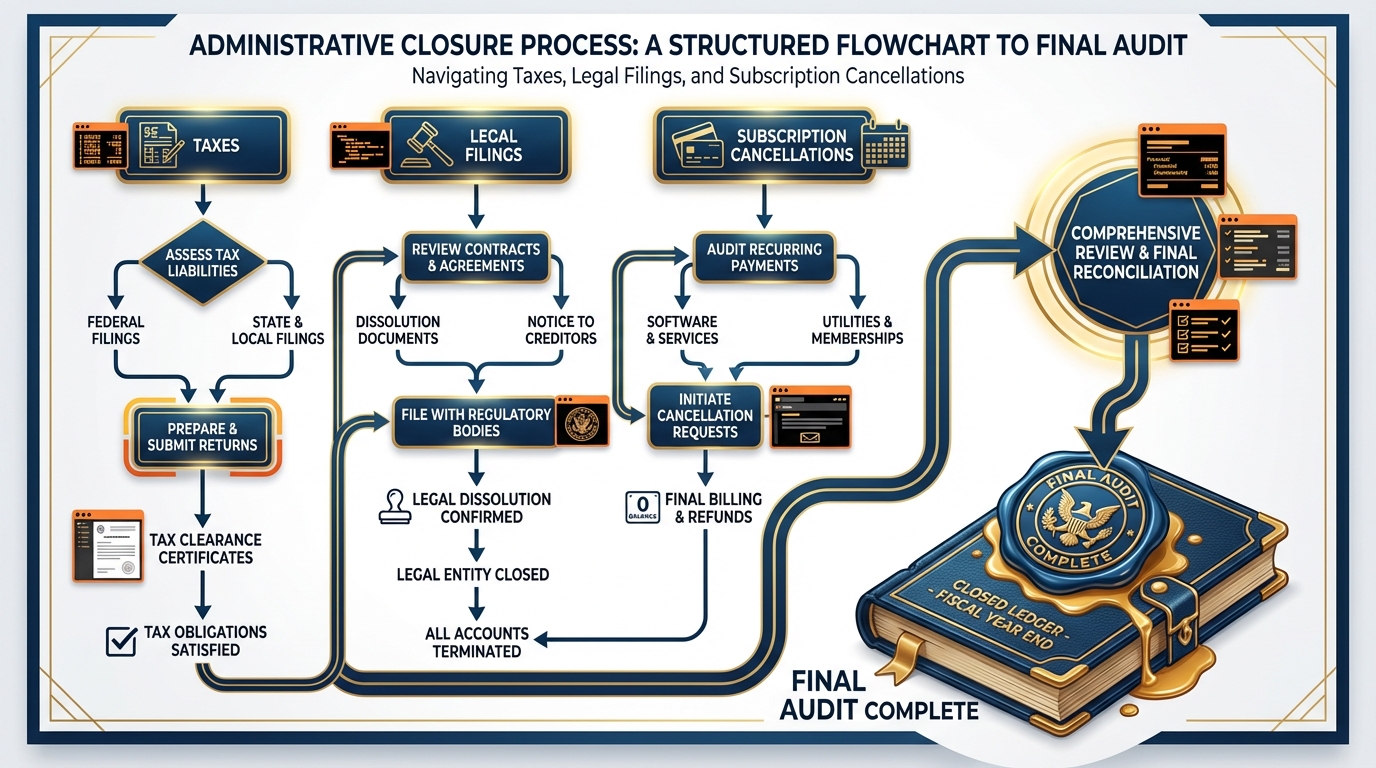
This final phase is non-negotiable. It locks down legal compliance and zeroes out all financial liabilities. Crucially: This is where you determine your final tax burden for the fiscal year.
Do not treat this as an administrative afterthought. Treat it as a final strategic financial maneuver.
Step #10: Calculate Final Inventory Valuation and Document All Write-Offs (for Tax Filing)
The inventory data archived in Phase 1 is now your primary actionable tool. You must calculate the exact Cost of Goods Sold (COGS) for the final closure period.
The Final COGS Equation:
Beginning Inventory (Start of Closure Period) + Purchases (Must be zero) – Ending Inventory (Actual Zero Count) = COGS for Final Period.
- Document Losses for Tax Relief: Compile comprehensive documentation for all lost, damaged, destroyed, or donated inventory. Inventory losses are recognized as expenses. This directly reduces your taxable income.
- Immediate CPA Review: Submit the final inventory reconciliation, sales records, and write-off documentation to your CPA immediately. We cannot stress this enough: Do not file the final business taxes until this inventory valuation is locked down and verified by your accountant. Your liability depends on this verification.
Step #11: Close All Shipping, Carrier, and Payment Accounts
Dormant accounts are slow, persistent financial leaks. We eliminate them entirely. Zero out every recurring fee immediately to prevent future administrative drag.
- Shipping Platforms: Cancel subscriptions to all SaaS integrations (ShipStation, Shippo, etc.). Obtain formal cancellation confirmation numbers.
- Carrier Accounts: Contact UPS, FedEx, DHL, and any regional carriers. Request formal account closure. Get written confirmation that all outstanding invoices are settled and the account balance is zeroed out.
- Payment Gateway Termination: Close your accounts with Stripe, PayPal, and your primary merchant processor. Confirm the final payout of any remaining held funds.
- PCI Compliance Mandate: Ensure the deletion of all stored customer payment information. Failure to maintain PCI compliance, even during closure, incurs massive risk.
This systematic process ensures the closure is not a logistical burden. It is a strategic financial maneuver. We eliminate future liability, minimize final tax exposure, and maximize the utility of the archived data for your next, more profitable venture.
Frequently Asked Questions

What is the single biggest financial risk when closing inventory?
The biggest risk is failing to legally document inventory write-offs. Period.
If you simply dispose of stock without formal destruction orders or donation receipts, the tax authorities will challenge that loss deduction. This is a critical mistake: it forces you to carry the inventory value on your books, artificially inflating your final taxable income.
Secure the paper trail. Every unit that doesn’t sell needs documented proof of its demise or donation.
Should I delete our old e-commerce website immediately?
Absolutely not. We mandate a minimum 90-day maintenance period post-closure.
Why? Deleting the site immediately creates a chaotic customer service environment and actively destroys accumulated SEO authority,a strategic waste.
This 90-day window is non-negotiable for three key reasons:
- It allows customers to view the final return policy and access historical order information.
- It ensures all 301 redirects have sufficient time to propagate (critical for link equity preservation).
How long should we keep archived inventory data?
Keep all critical financial and inventory data for a minimum of seven years. This is a hard rule aligned with standard IRS audit periods.
This archive must include:
- Cost of Goods Sold (COGS)
- Formal write-off documentation
- Complete sales ledgers
Treat this archive as proprietary, strategic intelligence. It is vital for future business planning,especially if your next move involves launching a new product line or pivoting to a high-growth B2B SaaS model.
Ready to take the next step?
Use AI to find the personal emails of founders and sales leaders for your next strategic move. Start Your Free Trial.
Start Your Free TrialReferences
- Retail Shutdown Success: Your Essential Store Closing Checklist
- Retail Store Opening and Closing Procedures Checklist (2024)
- The Ultimate Retail Store Opening and Closing Procedure Checklist
- Retail Store Closing Checklist: Overview, Daily-Periodic-Final …
- Retail Store Closing Checklist Template – Free PDF Download