


The SDR role is not about luck; it is about repeatable, scalable execution. We treat pipeline generation as an engineering function.
In 2025, your success depends on more than just high-volume dials and generic cold email. It demands strategic thinking. It requires understanding the buyer’s psychology, mastering advanced qualification, and executing a documented system.
We built our internal lead generation engine entirely on proven frameworks. This reading list is not generic motivational fluff. It cuts through outdated tactics and focuses solely on the actionable systems that move the needle: pipeline generation and conversion.
These 10 books underpin our 2025 SDR training curriculum. They are mandatory reading for anyone serious about elevating their performance from quota-chaser to revenue-driver.
How We Organized This Essential SDR Reading List:
This curriculum is structured to build a complete SDR skillset, moving beyond basic outreach:
- Section 1: The Mindset Shift. Focus on mental toughness and high-performance habits.
- Section 2: Tactical Execution. Mastering prospecting, cold calling, and email frameworks.
- Section 3: Strategic Qualification. Understanding complex B2B buying cycles and high-level negotiation.
Start here to transform your approach to sales development.
Key Takeaways: The Strategic SDR Reading Strategy

Success in sales development is engineered, not accidental. Before diving into the specific list, adopt these four strategic principles to maximize the ROI of your reading time:
- Prioritize Foundational Systems. Before diving into advanced buyer psychology, master the core process. We must build a repeatable, scalable engine (e.g., *The Sales Development Playbook*). Systems drive predictable revenue.
- Master Strategic Qualification. The SDR’s mandate is pipeline quality, not closing deals. Accurate discovery is non-negotiable. Leverage proven frameworks like *SPIN Selling* or *Gap Selling* to vet opportunities efficiently and protect AE time.
- Treat Mindset as a Performance Metric. High-volume execution guarantees high rejection rates. Consistency is the ultimate differentiator. Dedicate time to structured resilience and habit-building strategies (e.g., *Atomic Habits*).
- Reject Anecdotes; Demand Frameworks. We operate on data-backed methodologies, not individual hero narratives. Prioritize books that offer scalable, repeatable processes that work across the entire team, ensuring predictable revenue growth.
Category 1: Foundational Prospecting and High-Volume Execution

Before you can optimize outreach or master buyer psychology, you must standardize the core engine. You cannot optimize what you have not first defined. This category provides the necessary blueprints for the SDR function itself: mastering volume, structuring the workflow, and understanding pipeline mechanics.
1. The Sales Development Playbook by Trish Bertuzzi
This is the definitive guide to the SDR role. If you are starting out, or if your current sales development structure is failing, this is the mandatory starting point.
Bertuzzi systematically breaks down the Sales Development function into six core, scalable elements: Strategy, Specialization, People, Process, Technology, and Sales/Marketing Alignment. This book is not about sales tactics; it is about engineering a repeatable, high-output engine.
Why This Book is Essential for SDRs:
- Role Clarity: It precisely defines what an SDR should and should not do. This framework stops the scope creep that invariably kills productivity and pipeline quality.
- KPI Alignment: It directly connects activity metrics to measurable business outcomes. It helps you move beyond vanity metrics to focus on true pipeline contribution. (Understanding your SDR Agent KPIs is mission-critical.)
- Scalability Framework: It provides a clear audit structure. Our teams use these six pillars to diagnose performance issues and identify specific bottlenecks in the outreach process.
We have observed that 90% of struggling SDR teams fail because they never specialized the role. They treat SDRs like junior AEs or marketing assistants. This playbook corrects that fatal, costly flaw.
2. Fanatical Prospecting by Jeb Blount
High-volume, consistent prospecting requires a specific, often brutal, discipline. Blount delivers that discipline without apology or compromise.
This book is the essential antidote to the “passive social selling” trend that plagues many new reps. It stresses consistency, multi-channel outreach, and the necessity of filling your pipeline daily,a core requirement for any high-growth SaaS or service business model.
Key Takeaways for Daily SDR Activity:
- The 30-Day Rule: Your pipeline today is a direct reflection of the effort and work you executed 30 days ago. This rule forces future-focused behavior and eliminates procrastination.
- Channel Agnosticism: You must use the phone, email, social, and text. The goal is simple: reach the prospect. You cannot afford to adhere to one ‘favorite’ or comfortable channel.
- The Prospecting Mindset: It teaches you how to embrace the necessary grind. Prospecting is a non-negotiable activity that must be done every day, not just when the pipeline is dry.
3. Predictable Revenue by Aaron Ross and Marylou Tyler
While often cited by sales leadership, this book established the foundational blueprint for modern B2B sales specialization: the necessary division between Prospecting (SDR/BDR) and Closing (AE).
If you want to understand the why behind your specific role,the economic theory driving the specialized sales machine,you need this book. It details how Salesforce built its initial $100M pipeline using these exact methods of specialization and process.
It is the foundational document for the concept of the “Cold Calling 2.0” model: a shift toward high-quality, targeted outreach instead of mass-volume spamming.
Why SDRs Need This Historical Context:
- The Specialization Model: Understand that your role is not transitional; it is a specialized function designed for efficiency. This structure is what drives scalability.
- Cold Calling 2.0: This framework is the intellectual foundation for modern Account-Based Prospecting (ABP). It proves that quality targeting trumps high-volume, untargeted activity.
- The Power of Process: The book validates that consistent, standardized outreach,not heroic, individual closing efforts,is the only way to generate predictable, scalable revenue.
Category 2: Qualification Mastery and Deep Discovery

An SDR’s true value is measured not just by the quantity of meetings booked, but by the quality of the opportunities created. Qualification is the highest-leverage skill you possess,it determines whether you spend time on a pipeline filler or a future customer.
This category provides the necessary frameworks to ask the right questions, questions that aggressively disqualify bad-fit prospects quickly and accelerate high-potential deals effectively. Mastering qualification is the difference between being a meeting setter and being a pipeline driver.
4. SPIN Selling by Neil Rackham
Published in 1988, SPIN Selling remains the most scientifically validated guide to effective discovery and qualification in complex sales environments.
Rackham’s team analyzed over 35,000 sales calls to develop the powerful SPIN framework: Situation, Problem, Implication, and Need-Payoff questions. This structure systematically moves the conversation from simple data gathering (basic research) to true, high-stakes pain identification.
Why SPIN is Critical for SDRs:
- Moving Beyond Features: It trains you to uncover deeper, systemic business issues rather than getting stuck discussing product features or pricing.
- Implication Questions are Revenue Drivers: This is where the SDR earns their value. Asking about the consequences and ripple effects of the problem (Implication) creates the urgency and palpable pain required to warrant a high-priority follow-up meeting with an Account Executive (AE).
- High-Value Selling Foundation: SPIN principles are specifically designed for large, complex B2B deals,exactly the high-ticket environment where top-tier SDRs operate.
5. Gap Selling by Keenan
Keenan’s methodology is the modern, aggressive counterpoint to traditional consultative selling. It cuts through the noise, focusing relentlessly on the fundamental gap: the measurable distance between the buyer’s undesirable Current State and their desired, quantifiable Future State.
The core concept is simple and actionable: You do not sell products; you sell the solution to the gap. This demands a mastery of diagnosing pain and immediately quantifying the financial impact of the problem before offering any solution.
How Gap Selling Complements SPIN:
- Diagnosis First: Keenan argues that most sellers are solution-focused pitch machines. SDRs must act as objective diagnosticians first. If you cannot diagnose the problem, you cannot prescribe a solution.
- Mandatory Quantification: This method forces the SDR to find metrics: How much is the current problem costing the client in revenue, time, or risk? This immediately elevates the conversation from tactical chatter to strategic, financial discussion.
- Anti-Product Bias: It ensures you never, ever lead with the product. You lead exclusively with the business problem, which is a non-negotiable rule for effective lead conversion and high-quality handoffs.
For strategic SDRs, understanding the difference,and the overlap,between these two methodologies is crucial. The most successful teams use a hybrid approach:
| Methodology | Primary Focus | SDR Application | Key Benefit |
|---|---|---|---|
| SPIN Selling | Question Sequencing (Situation, Problem, Implication, Need-Payoff) | Structuring the discovery call flow to uncover latent, unrecognized pain points. | Provides a validated, repeatable framework for complex sales conversations. |
| Gap Selling | Current State vs. Future State | Diagnosing and quantifying the financial cost of the problem before offering a solution. | Forces strategic, high-value conversations immediately. |
| Hybrid Approach | Diagnosis + Implication (Quantified Pain) | Use SPIN to navigate and structure the conversation; use Gap Selling principles to quantify the pain and urgency. | Guarantees high-quality, high-urgency lead generation ready for the AE. |
6. The Challenger Sale by Matthew Dixon and Brent Adamson
This book, while often debated, is necessary reading for every SDR aiming for promotion. Why? Because it scientifically proves that the best sellers,the ones who consistently outperform,are “Challengers.” They teach the customer, tailor their message, and take constructive control of the conversation.
While full-scale Challenger implementation is often an organizational effort, the SDR can and must adopt key elements to secure meetings:
- Commercial Teaching: Stop asking prospects about their problems; start teaching them about a critical problem they didn’t even know they had. Introduce new insights that disrupt their status quo.
- Tailoring: Your outreach must be specifically tailored to the prospect’s industry, their role, and their specific business challenges. Generic outreach is officially dead in the modern B2B landscape.
- Constructive Tension: You must be comfortable challenging the prospect’s current way of doing things. If the prospect is too comfortable, they have no motivation to move forward.
A Challenger SDR doesn’t just book a meeting; they frame the problem in a way that makes the prospect realize their current approach is actively failing them. That realization is the leverage required to secure high-quality demos and transfer urgency to the AE.
Category 3: Mindset, Resilience, and Personal Systems

The SDR role is a crucible of rejection. We know the stats: it often takes 100+ touches to secure a single, qualified meeting. This environment demands more than just skill; it requires a bulletproof mindset and disciplined personal systems. Burnout is the default outcome without them. This category details the essential internal architecture required for sustained, long-term performance.
7. Atomic Habits by James Clear
Atomic Habits is the most critical book for long-term SDR success,even though it isn’t a “sales book.” Success in prospecting is rarely about massive, unsustainable action. It is built on 1% daily improvement, compounded over quarters.
SDR performance hinges entirely on routine: consistent follow-up, non-negotiable dial blocks, and meticulous CRM hygiene. Clear’s framework is the foundation for building those necessary, high-leverage habits.
Applying Atomic Habits to SDR Work:
- Make it Obvious: Schedule your power hours (e.g., cold call blocks) and treat them as non-negotiable meetings. Protect this time aggressively.
- Make it Attractive: Stack your habits. Only allow yourself to check LinkedIn messages after completing 10 dials or finishing your primary research block.
- Make it Easy: Optimize your sales tech stack so the path of least resistance is the path of highest productivity. Eliminate friction points.
- Make it Satisfying: Track your activity KPIs diligently. Seeing the numbers increase reinforces the habit loop and builds momentum.
8. Extreme Ownership by Jocko Willink and Leif Babin
We operate on radical accountability. Extreme Ownership, written by former Navy SEAL commanders Jocko Willink and Leif Babin, instills the ultimate principle of high-stakes leadership: There are no bad teams, only bad leaders.
For the SDR, this translates directly into radical ownership of your territory, your pipeline, and your quota attainment.
- Own the Failure: Missing quota is never the fault of the lead quality, the marketing team, or the product. It is a failure of process. Identify the flaw in your execution and fix it immediately.
- Decentralized Command: SDRs must operate with complete initiative. Do not wait for your manager to dictate the next step. Analyze your territory, identify the highest-leverage action, and execute command.
- Prioritize and Execute: This SEAL principle is essential for managing a massive pipeline. Tackle the highest priority task,the one that drives revenue,first, every time.
Category 4: Negotiation and Influence (Preparing for the AE Role)

The SDR role is the proving ground for future Account Executives. Category 4 focuses on the core skills,negotiation and influence,that bridge the gap between setting meetings and closing deals. Mastering these concepts now doesn’t just prepare you for promotion; it immediately sharpens your qualification process, dramatically improves objection handling, and gives you a deep, tactical understanding of human decision-making.
9. Never Split the Difference by Chris Voss
Chris Voss, a former FBI hostage negotiator, fundamentally reframes negotiation. His core thesis is critical: Negotiation is not a logical process; it is an emotional one. This book is mandatory for SDRs who need to handle complex objections, navigate tough gatekeepers, and control high-stakes conversations.
Actionable Voss Techniques for SDRs:
- Mirroring: Repeating the last three words of a prospect’s statement (or a critical phrase). This encourages them to elaborate and builds subtle, non-threatening rapport.
- Labeling: Acknowledging the prospect’s emotion (“It sounds like you’re frustrated with your current vendor,” or “It seems like budget is a major concern.”). This defuses tension, creates empathy, and gets them to confirm your understanding.
- The Power of “No”: Voss teaches that getting the prospect to say “No” early (meaning, “I am not ready” or “I don’t agree with that premise”) is safer than forcing a premature “Yes.” It gives them control and makes them feel safe enough to share the real constraints.
10. Influence: The Psychology of Persuasion by Robert Cialdini
Robert Cialdini provides the scientific foundation for why people say “Yes.” This is pure, vetted behavioral science, outlining six universal principles of persuasion constantly at play in every human interaction. Understanding these principles allows you to strategically structure your entire outreach motion,emails, calls, and LinkedIn messages,to leverage natural human tendencies and achieve immediate engagement.
The Six Principles Applied to SDR Outreach:
- Reciprocity: Give value first. Offer a unique insight, a piece of proprietary research, or a highly personalized audit before asking for time on their calendar.
- Commitment and Consistency: Get small commitments early. Start by asking them to agree that the status quo is unsustainable or that their current approach is costly.
- Social Proof: Reference similar clients or competitors. (“We helped [Competitor X] achieve Y results, and I wanted to see if you faced similar challenges.”)
- Liking: People buy from people they like. Personalize your outreach to find genuine common ground, reference shared experiences, or show genuine curiosity about their industry.
- Authority: Position yourself (or your company’s data/CEO) as the definitive expert in solving the prospect’s specific problem space. Use strong, data-backed claims.
- Scarcity: Highlight unique or time-sensitive opportunities (e.g., limited access to a beta program or a specific year-end pricing structure). Use sparingly and honestly.
The 2025 SDR Reading Strategy: Application is Everything
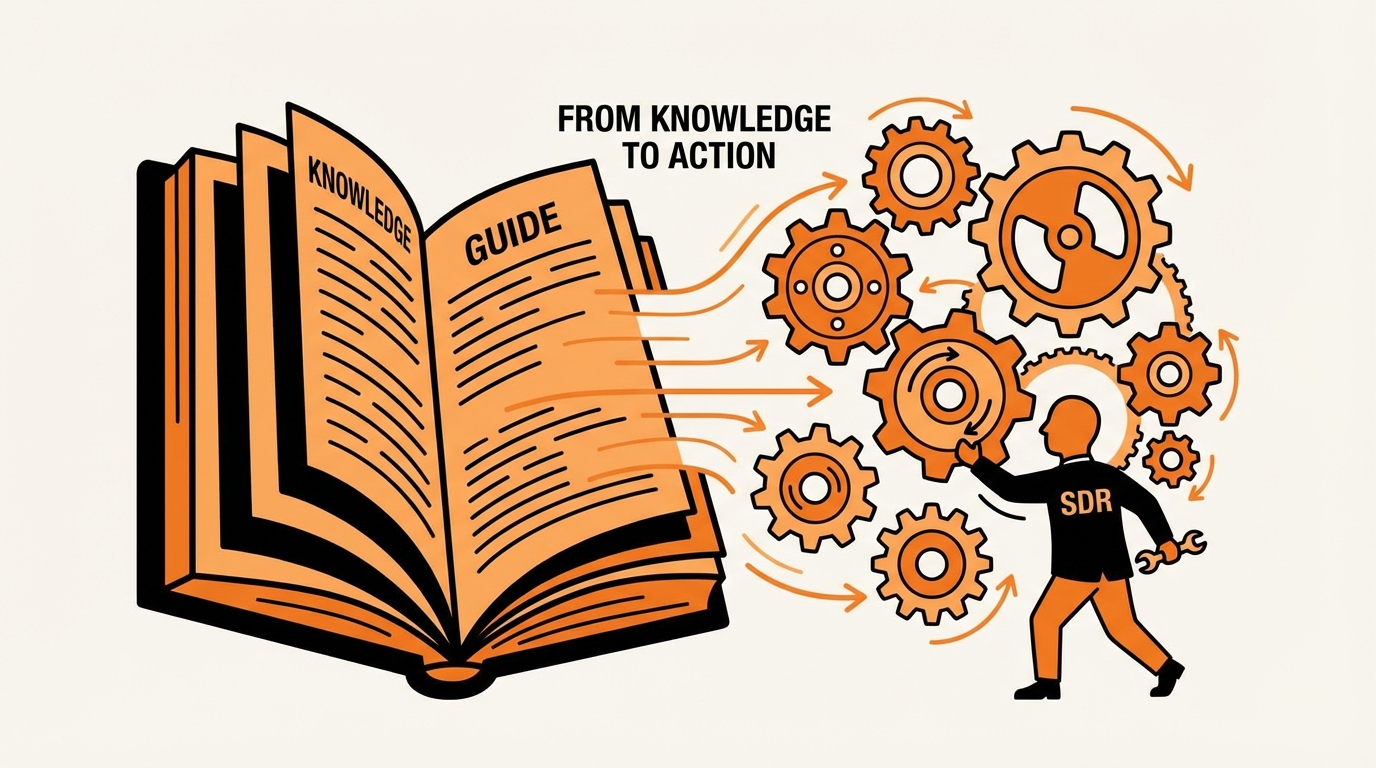
Reading is consumption; execution is revenue. Your goal is not to passively finish 10 books. Your goal is to strategically integrate 10 core concepts into your daily workflow,and prove their financial impact.
We see too many SDRs attempt to master complex methodologies simultaneously. This guarantees failure. The elite approach requires phased implementation, ensuring that reading translates directly into measurable pipeline growth.
Step #1: Focus on Volume and Habit (Quarter 1)
Before you can be strategic, you must be consistent. The first 90 days are dedicated to building the operational machine. You cannot layer technique onto inconsistent activity.
Core Focus: Read The Sales Development Playbook and Atomic Habits.
- Dedicate the entire quarter to perfecting your daily routine and activity metrics (calls, emails, connection rates).
- Establish the non-negotiable habit stack that ensures you hit 100% of your activity goals daily.
- The Result: Consistent, predictable volume. This is the foundation upon which all other skills rest.
Step #2: Script Revision and Deep Discovery (Quarter 2)
Once volume is consistent, shift focus to quality and technique. This is where you move from merely setting meetings to qualifying opportunities that actually close.
Core Focus: Read SPIN Selling and Gap Selling.
- Implement SPIN: Rewrite your discovery script using the SPIN framework (Situation, Problem, Implication, Need-Payoff).
- Quantify Pain: Identify the three most common problems your solution solves. For each problem, develop three quantifiable implication questions (the ‘I’ in SPIN) that force the prospect to articulate the financial cost of inaction.
- Mandatory Practice: Role-play these new scripts daily with your manager. This is mandatory for promotion.
Step #3: Mastering Objections and Negotiation (Quarter 3)
The highest performers handle tension; they do not avoid it. This phase focuses on the advanced communication techniques that prepare you for the Account Executive seat.
Core Focus: Read Never Split the Difference.
- Identify & Label: Catalog your top five recurring objections (e.g., “Send me more info,” “Too expensive”). Develop a specific mirroring or labeling response for each.
- Force Leverage: Practice the calibrated question, “How am I supposed to do that?” This forces the prospect to solve their own objection, giving you critical leverage and insight into their decision-making process.
- The Result: You gain tactical control over the conversation, reducing “no-shows” and increasing qualification depth.
This systematic, quarter-by-quarter approach ensures that every hour spent reading translates directly into measurable revenue impact and faster career acceleration.
Frequently Asked Questions
What is the single most important book for a brand-new SDR?
If we had to choose only one foundational text, it is unequivocally The Sales Development Playbook by Trish Bertuzzi. This book provides the essential structure and specialization blueprint required for the modern SDR role. Without mastering these fundamental mechanics, advanced concepts like negotiation tactics or complex psychology are revenue-neutral. We prioritize building the foundation before attempting the skyscraper.
Should SDRs focus on mindset books or tactical sales books?
You need both, but they must be prioritized sequentially. Tactical books (e.g., SPIN Selling) teach you the necessary what,the scripts and process flows. Mindset books (e.g., Atomic Habits, Extreme Ownership) teach you the critical how,how to maintain consistency and execute those tactics after facing 10 consecutive rejections. Our recommended ratio is 70/30: 70% focus on tactical/strategic sales process, 30% dedicated to resilience and system optimization.
Are older classics like “How to Win Friends and Influence People” still relevant for B2B?
Absolutely. While Dale Carnegie’s work lacks B2B process specificity, it remains the ultimate resource for mastering interpersonal dynamics: building rapport, demonstrating empathy, and securing genuine connection. In an era dominated by automated outreach, AI tools, and generic sequences, the human touch is the ultimate differentiator. SDRs must prioritize mastering the fundamentals of human connection; only then can modern technology be used effectively to scale that connection.
How quickly should an SDR aim to finish this list?
Do not rush completion. We stress quality over quantity. This list represents a core curriculum, not a reading challenge. If you follow our strategy,dedicating one month per book for integration and application,this becomes a 10-month curriculum focused solely on driving revenue. The goal is mastery, not merely checking a box. If you are reading to learn, you must take notes, define action items, and implement changes immediately.
Ready to take the next step?
Try AI Lead Generation Today
Click Here