


The rules of fraud have fundamentally changed. Completely.
You are reading this in late 2025: the market is now flooded with AI-generated content.
Hyper-realistic deepfakes and instant payment systems have created the perfect operating environment for high-volume criminals.
The risk is no longer just capital loss. The real, strategic threat is that these scams look indistinguishable from legitimate business opportunities.
We work with founders and sales teams who understand risk. They know that securing revenue means securing identity and process integrity.
If you are pursuing aggressive online income goals (or trying to protect your corporate assets), you must know this new landscape. Immediately.
Generative AI has democratized fraud. Period.
It allows high-volume, hyper-personalized attacks that bypass human skepticism entirely.
The old rules of spotting a misspelled email are obsolete. That defense mechanism is dead.
We broke down the common mechanisms and systems these criminals use. Here are the 15 critical online money-making scams you must avoid in 2026.
Key Takeaways: The 2026 Fraud Landscape
- AI is the Scammer’s Weapon: Deepfakes and synthetic identities are bypassing traditional KYC/AML checks. Trust is now impossible without technical verification.
- The Mule Mechanism: Fake remote job offers are the primary method for recruiting unwitting employees to launder stolen funds through personal accounts.
- Speed Kills: Instant payment systems mean recovery is nearly impossible once funds are transferred. Detection must happen pre-transactional.
- Corporate Impersonation: AI now enables flawless CEO and VP deepfakes, targeting finance departments for urgent wire transfers (Whaling attacks).
Section 1: Investment & Digital Asset Lures (The Capital Drain)

Founders operate with high risk tolerance. This is a strategic asset,but it is also precisely what these traps exploit.
These scams promise unrealistic, exponential returns. They leverage emerging technology (AI, DeFi) to make the offer sound exclusive and strategic. Our analysis shows these are the highest capital-drain threats in 2026.
#1: AI Brokerage Bots: The Ponzi V3
This is the evolved Ponzi scheme. It uses AI as the core justification for impossible returns.
Scammers launch proprietary platforms claiming AI algorithms guarantee 300%+ annual returns. This is the first red flag: No legitimate trading system guarantees returns, let alone multiples of the S&P 500.
- The Hook: Hyper-slick dashboards; instant, verifiable (but fake) daily gains; and deepfake video testimonials from supposed “quant analysts.”
- The Mechanism: You deposit capital. The UI shows massive, consistent gains. When you request a withdrawal, the system locks up. It demands an additional “tax,” “regulatory compliance fee,” or “premium activation.”
- The Outcome: The capital is liquidated instantly. There is no trading bot. There is only a high-fidelity user interface designed for one purpose: immediate capital theft.
#2: DeFi Rug Pulls (V2 Protocols)
Rug pulls are not new. But they are now strategically lethal. In 2026, we are analyzing V2 protocols engineered to survive for months, building trust before the final drain.
The new attack vector involves complex tokenized assets and cross-chain swaps. Criminals launch a token, leverage massive AI-generated hype (fake articles, deepfake AMAs), and seed fake liquidity pools. Once community investment peaks, the developers vanish.
This is the critical defense:
- Verify Audits: Mandate verification of legitimate, third-party smart contract audits (e.g., CertiK).
- Check Liquidity Lock: Ensure the liquidity pool is verifiably time-locked or burned.
We operate on a simple principle: If the investment demands urgency and promises guaranteed returns exceeding 50% monthly, it is a scam. Legitimate founders know the market does not yield that outcome.
#3: NFT Wallet Drainers: Phishing for Keys
NFTs remain a high-volume asset class. The strategic shift here is critical: Scammers are no longer focused on selling fake JPEGs. They want direct wallet access.
Their goal is to execute a full wallet drain.
- The Minting Trap: You are invited to mint a “free” or cheap NFT,a high-urgency offer. The underlying smart contract, however, contains a malicious function (a ‘setApprovalForAll’ or similar exploit) that grants the scammer permission to liquidate all other assets in your wallet.
- The Airdrop Phish: You receive a notification (often via a fake Twitter/X DM) about an enormous token airdrop. You click the link, connect your wallet, and approve a transaction that silently steals your private keys or grants spending authority.
Actionable Defense: Always use a burner wallet for unverified transactions. Never connect your primary operational wallet to any unknown domain. Verify contract addresses on Etherscan or similar explorers,every single time.
Section 2: The Employment & Side Hustle Traps (The Mule Mechanism)
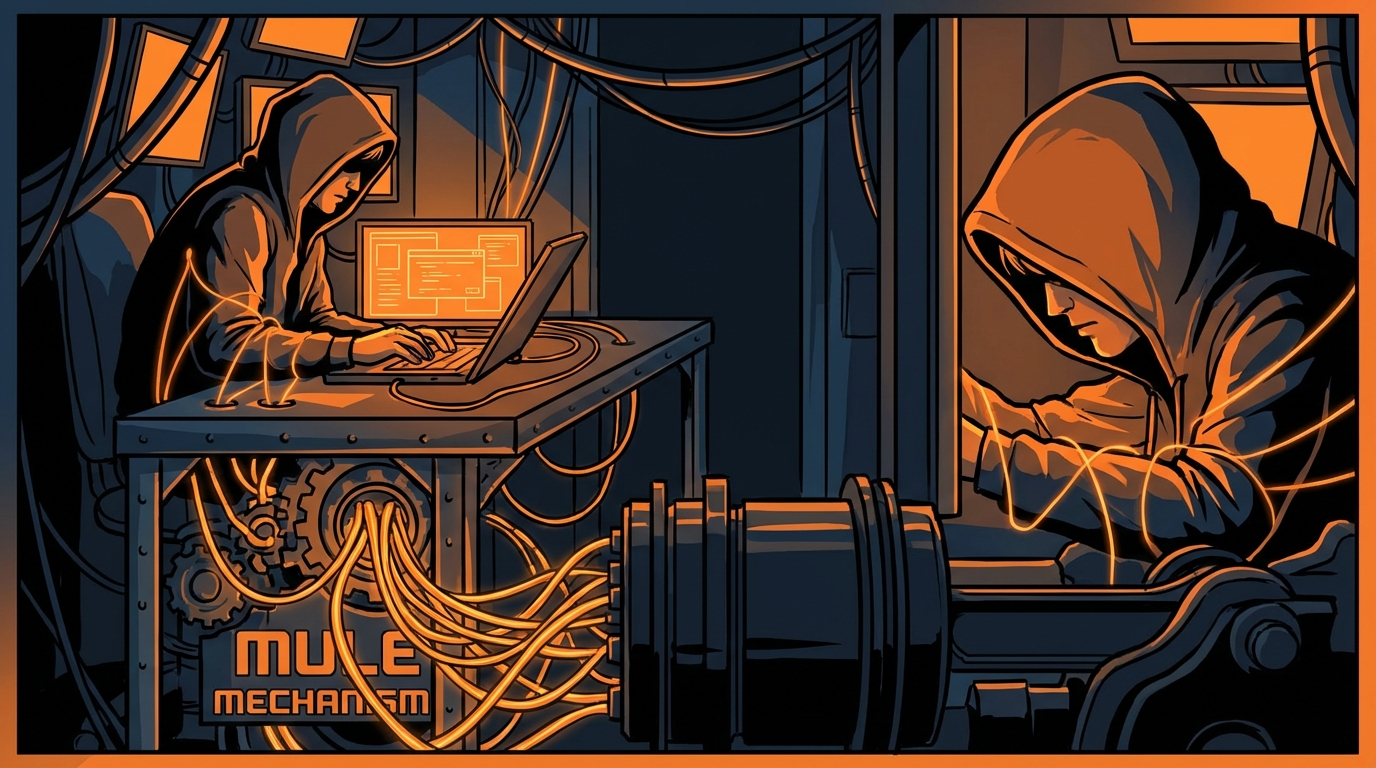
Founders and their teams are prime targets here. Scammers exploit the demand for legitimate remote work. The goal is simple: turn your employees,or you,into unwitting money mules.
This isn’t just about losing cash. It’s about crippling operational integrity and facing massive legal liability.
#4: AI-Recruited Money Mules (Synthetic Bosses)
This is the single most dangerous trend we forecast for 2026. Scammers are now leveraging advanced AI to create synthetic identities.
Think fake HR Managers, convincing CEOs, or strategic recruitment consultants. They run full, legitimate-sounding interview and onboarding processes.
The trap is simple:
- The Role: Always advertised as low-friction: “Financial Assistant,” “Payment Processor,” or “Remote Data Entry.”
- The Mechanism: You are instructed to receive stolen funds into a personal account (bank or P2P app). You then immediately wire that money (minus your small commission) to a designated “supplier” or “vendor.”
- The Reality Check: The initial money was stolen. You just executed money laundering for a criminal network. Your personal and business accounts will be frozen. You face immediate legal liability for financial crime.
We need to be clear: Any job demanding you move company money through your personal accounts is illegal. Period. This is a massive violation of fundamental AI ethics and financial compliance protocols.
#5: Fake Dropshipping Supplier Schemes
Dropshipping is a proven model. But the market is now saturated with scams disguised as “exclusive” supplier directories and fulfillment partnerships.
We see this trap constantly:
- The Hook: You pay a steep upfront fee,often $500 to $2,000,for immediate access to an “exclusive, high-margin supplier list.”
- The Outcome: The list is useless. It’s outdated, generic, or links directly to shell companies. They collect the fee and vanish. You have zero product and zero recourse.
#6: Bogus AI Prompt Engineering Courses
Prompt engineering is a high-value skill. This high demand has created a massive opportunity for opportunistic course creators.
The scam is selling grossly overpriced, non-actionable courses. They promise six-figure remote roles after a single weekend of training.
What you actually buy:
- Repackaged, low-value information.
- Stolen or outdated PLR content.
Before you invest in any training, always verify the instructor’s measurable industry background. Rushing skill acquisition is a common trap when trying to scale a business or build a digital product empire.
#7: Paid Survey/Data Entry Fee Scams
These offers promise easy, high-paying micro-tasks. They are almost always a fee trap.
The mechanism relies on volume:
- The company demands a small upfront fee: “registration fee,” “background check fee,” or “software license fee.”
- Once you pay, the company vanishes.
The entire operation is designed solely to collect thousands of micro-payments. There is no actual work. Remember this rule: Legitimate online work,even high-paying roles like website testing jobs,never requires you to pay to start working.
#8: Unrealistic “Make Money Fast” Blueprints
We constantly advocate for velocity and efficiency in business operations. But we must draw a line at schemes promising unrealistic gains: $5,000 in 48 hours with zero effort is pure fantasy.
These blueprints are structured to exploit urgency.
- They often mask pyramid structures (MLM traps).
- They require you to recruit others to earn commissions on their entry fees.
They exploit the short-term desire to make $500 fast online but deliver zero sustainable value. Focus your strategy on verifiable, repeatable, and scalable lead generation systems instead.
Section 3: Identity & Phishing Vectors (Access Scams)
Access scams are not about minor theft. They are engineered to steal corporate credentials and sensitive lead data. This leads directly to massive financial loss and Account Takeover (ATO),a critical, systemic threat to your entire sales infrastructure.
#9: Deepfake CEO/Impersonation Scams (Whaling)
This is the ultimate corporate threat vector for 2026.
Scammers use high-resolution, generative AI to mimic a Founder, CEO, or senior executive’s voice and appearance. The visual and auditory evidence is flawless.
The target: Usually an employee in finance or accounting.
The request: An urgent wire transfer for an “emergency acquisition.” Because the simulation is perfect, traditional internal controls fail.
You need a hard rule:
- Actionable Defense: Implement mandatory, cross-departmental verbal verification (using a pre-set code word) for all wire transfers exceeding $10,000.
#10: GenAI-Powered Phishing Campaigns
Generic phishing emails are dead. They are obsolete.
AI now generates hyper-personalized, contextually flawless communications. These emails reference real projects, real colleagues, and real deadlines specific to your company.
They are successful because they look legitimate: perfect grammar, correct terminology, zero red flags.
The payload: A request to click a link to “verify updated HR policy” or “review the Q4 budget draft,” leading directly to a credential harvesting site.
Defense Strategy: Train your SDRs and Ops teams to ignore the display name completely. They must scrutinize the actual sender’s email address and hover over every link before clicking.
#11: Authentication Code Scams (The Urgency Trap)
This tactic relies entirely on panic and speed.
The scammer contacts you (via call or text) posing as a bank or major cloud provider. Their claim: Suspicious activity on your account requires immediate confirmation.
Simultaneously, they initiate a login attempt on your account, triggering a Two-Factor Authentication (2FA) code sent to your phone.
They pressure you to read the code back “to verify your identity.” Once you provide that code, they bypass 2FA and take full control of your account.
The Rule: Your bank or tech provider will never ask you to read a verification code back to them. Never share these codes. Period.
#12: Fake Tech Support & Remote Access Scams
The setup: A sudden pop-up warning or an unsolicited phone call claiming to be from a major tech company (Microsoft, Apple, etc.).
The goal: Convince you to grant them remote access to your work device (often via TeamViewer or AnyDesk).
Once they have access, the consequences are immediate:
- Theft of sensitive client lists and proprietary data.
- Installation of ransomware or keyloggers.
- Immediate extraction of fees to fix “fake” problems they just created.
Our Policy: Never grant remote access unless you, the user, initiated the support request through a verified, official company channel. This is non-negotiable for data security.
Section 4: The Fraud Evolution: Why 2026 Requires New Defenses

We need a hard reset on how we view online risk. The fraud landscape didn’t just evolve; it executed a full, systemic takeover.
Pre-2023 scams relied on volume and obvious errors. Now, we face high-tech psychological warfare powered by AI.
This shift directly impacts your lead generation and sales infrastructure. If your team cannot spot the difference between the old way and the new way, you will lose revenue.
Here is the necessary comparison:
| Fraud Mechanism | Pre-2023 (The Old Way) | 2026 (The AI Way) |
|---|---|---|
| Identity | Stolen credentials; poorly forged documents; heavy accents on phone calls (easy to profile). | Synthetic identities (AI-generated profiles built on real data); perfect voice/video deepfakes; native language fluency across 100+ languages. |
| Scale/Volume | Manual effort; mass emails using generic templates (low conversion rate). | Hyper-personalized volume: AI writes 10,000 unique, contextually relevant emails per hour. It targets specific roles in your organization. |
| Payment Method | Wire transfers (slow, with banking delays); physical checks (traceable). | Instant P2P apps (Venmo, Zelle, Cash App); DeFi swaps; untraceable stablecoin transfers (instantaneous loss). |
| The Lure | Nigerian Prince letters; obvious lottery winnings; easy-to-spot phishing links. | Fake high-paying job offers; exclusive crypto pre-sales tied to current events; urgent CEO/Founder requests (Whaling) demanding immediate action/transfer. |
Prevention Guide: The 7 Universal Red Flags for 2026
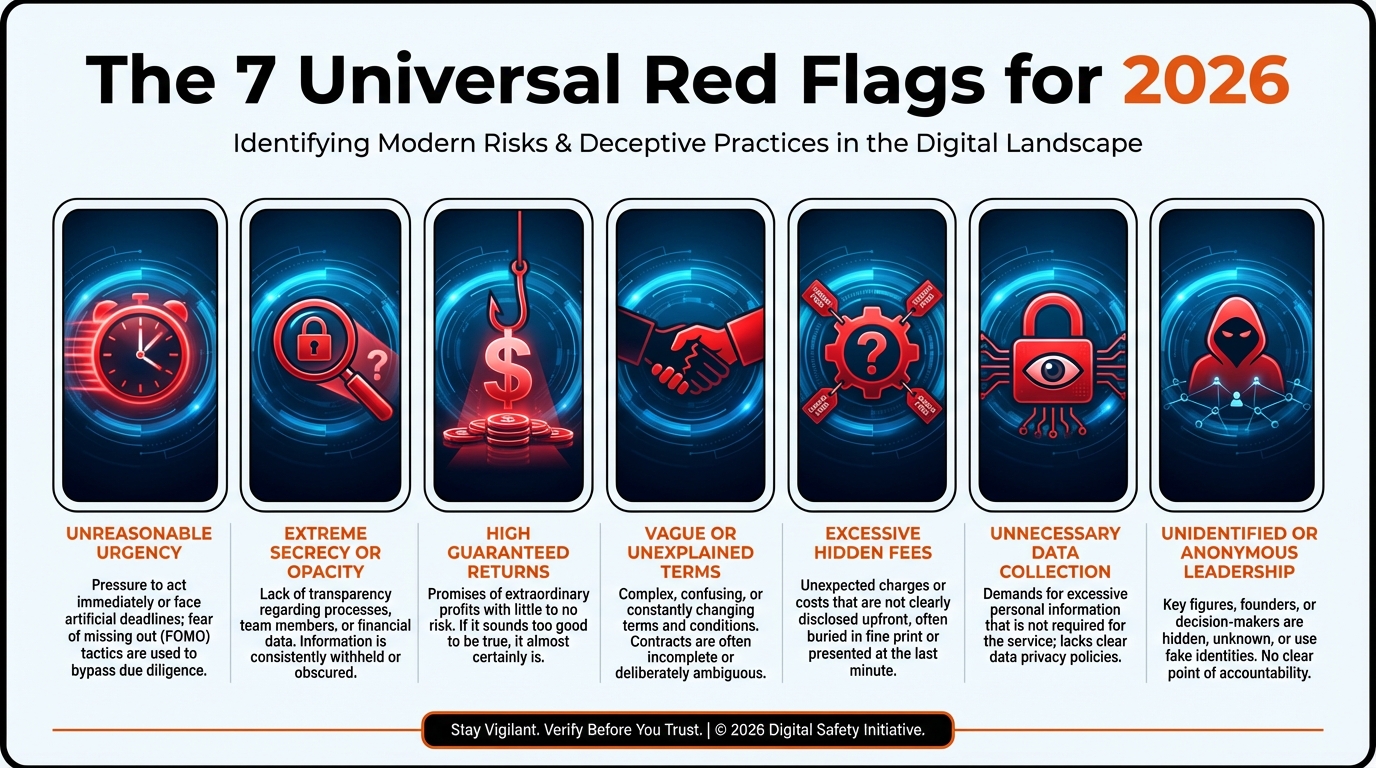
You cannot fight specific scams; you must recognize the underlying pattern. This is a systemic defense.
If any offer triggers even two of these flags, you initiate the abort sequence immediately. No negotiation.
- Unrealistic Velocity and Guaranteed Returns. Promises of massive, guaranteed returns are fiction (e.g., “10x your investment in 30 days”). Legitimate growth is strategic, measurable, and slow.
- Urgent, High-Stress Payment Demands. Scammers use manufactured urgency to bypass critical thinking. If the communication involves high-stress language (“Account suspended,” “Deal closes in 15 minutes”), it is a threat signal: Stop the process.
- Upfront Fees to Secure Employment. You should never pay to start a job. This includes “registration fees,” “training costs,” or mandatory software licenses. Legitimate infrastructure pays the employee; the employee does not pay the infrastructure.
- Payment Method Mismatch. Legitimate businesses accept standard methods (credit cards, corporate ACH). Being forced to use gift cards, untraceable crypto, or wire transfers to an unrelated personal account is the primary sign of theft.
- Personal Account Fund Movement (The Money Mule Trap). If a “job” requires you to receive funds into your personal bank or payment app, and then immediately transfer those funds elsewhere, you are laundering money. This is not a gray area: It makes you a criminal accomplice.
- Request for 2FA/Verification Codes. Sharing a one-time login code (2FA) is equivalent to handing over your keys. No legitimate bank, security team, or vendor will ever ask you to read back a verification code. Ever.
- Source Discrepancy (Non-Corporate Channels). A real CEO, HR Manager, or Vendor will use official corporate channels. If they demand communication via personal Gmail, WhatsApp, or Telegram, cross-verify immediately. If the source cannot be confirmed via the company’s main domain, shut down the conversation.
Emergency Protocol: Immediate Action After a Scam Attack

You failed the defense test. Now, speed is the only metric that matters.
If you recognize a compromise, you must execute the counter-attack faster than the criminals can liquidate your assets. We call this the Emergency Protocol.
Step #1: Initiate Immediate Comms Blackout
Stop responding. Period.
Block the number, email, and social profile instantly. Do not negotiate, do not engage, and do not try to “get closure.”
Every interaction provides the scammer with more data points for future exploitation. Cut the line entirely.
Step #2: Execute Financial Freeze (The 60-Minute Window)
This is time-sensitive. Call your bank, credit card company, or payment provider (PayPal, Venmo, Crypto Exchange) immediately.
Report the transaction as fraudulent. State clearly that you were scammed.
For recent transfers,especially domestic bank wires,there is a narrow window (often less than 60 minutes) where funds can be frozen or reversed. Act now.
Step #3: Assume Total Digital Compromise
If you clicked a phishing link, shared a 2FA code, or installed unknown software: assume your core accounts are compromised.
Immediate action:
- Change passwords on banking, professional email, and crypto wallets.
- Review all account recovery emails/phone numbers for unauthorized changes.
- Implement strong, hardware-based 2FA (YubiKey) on critical assets.
We cannot stress this enough: Scammers often install backdoors for later exploitation.
Step #4: Documentation and Official Reporting
Your goal now is documentation. Collect every possible data point:
- Transaction receipts and wire details.
- Full chat logs, texts, and emails (with headers).
- Phone numbers, website URLs, and names used by the scammer.
Report the incident immediately to the relevant federal agencies. This is mandatory for legal and insurance purposes:
- The FBI Internet Crime Complaint Center (IC3).
- The Federal Trade Commission (FTC).
- Local law enforcement (if your bank requires a police report number for fraud processing).
Ready to take the next step?
Stop wasting time on low-ROI leads. Use our AI Lead Generation Software to find clients’ personal emails and scale your outreach with precision.
Start Your Free TrialReferences
- A Complete Guide to Money Laundering Scams in 2026 – AiPrise
- 5 Venmo Scams To Avoid in 2026 , and How To Stay Safe | Nasdaq
- How to Avoid Common Online and Affiliate Marketing Scams in 2026
- Popular Fraud Schemes to Watch Out for in 2026 – SouthState Bank
- Predictions for 2026: Scams, AI, and Fintech | Feedzai