


You are running a profitable, high-ticket service operation. Congratulations—you have built a machine that works.
But now you are hitting a ceiling. That ceiling is capacity. It is you.
The question every successful solo founder eventually asks is critical: When is the precise, strategic moment to hire?
The answer is not based on feeling or stress levels. It is based on measurable, predictable financial metrics and operational leverage.
Hiring your first employee is not a cost; it is a strategic capacity multiplier. This is the pivot point: moving from 100% execution to scaling the business.
We consistently observe agencies failing this critical transition: they hire too late (burning themselves out), too early (destroying cash flow), or they hire the wrong role (creating chaos). This guide is your operational blueprint. We will focus strictly on the data, the required financial infrastructure, and the exact roles that generate immediate ROI.
This is the strategic checklist you need to successfully transition from founder-operator to CEO.
The Non-Negotiable Thresholds: Strategic Hiring Triggers

Hiring is the single greatest lever for growth, but also the greatest risk. Before you post that job description, you must meet measurable standards. These are the non-negotiable triggers that signal true readiness:
- The Financial Safety Net: Secure a minimum of six months of the potential employee’s fully loaded salary (including benefits, taxes, and overhead) in liquid cash reserves. We never hire based on projected revenue; we hire based on secured runway.
- The Capacity Trigger (The 20% Rule): You are consistently turning down high-value client work, or you are sacrificing quality (scope creep, missed deadlines) on 20% or more of your active projects. This is the moment revenue is actively being left on the table.
- The Founder’s 80/20 Trap: Your weekly time allocation must show 80% dedicated to tactical execution and only 20% dedicated to high-leverage activities (strategy, sales, or leadership). If you are the bottleneck, you must hire to reclaim your strategic time.
- The Documentation Mandate: Standard Operating Procedures (SOPs) must be 70% documented, tested, and stored in a shared knowledge base before the job posting goes live. Remember: You cannot delegate chaos; you can only delegate systems.
- The Specialist Strategy: Never hire a Generalist first. Instead, hire a specialist who can immediately take ownership of your lowest-leverage, highest-time-sink task (e.g., detailed reporting, initial data analysis, link building). This must provide immediate, measurable ROI.
Step #1: Quantifying the Capacity Ceiling
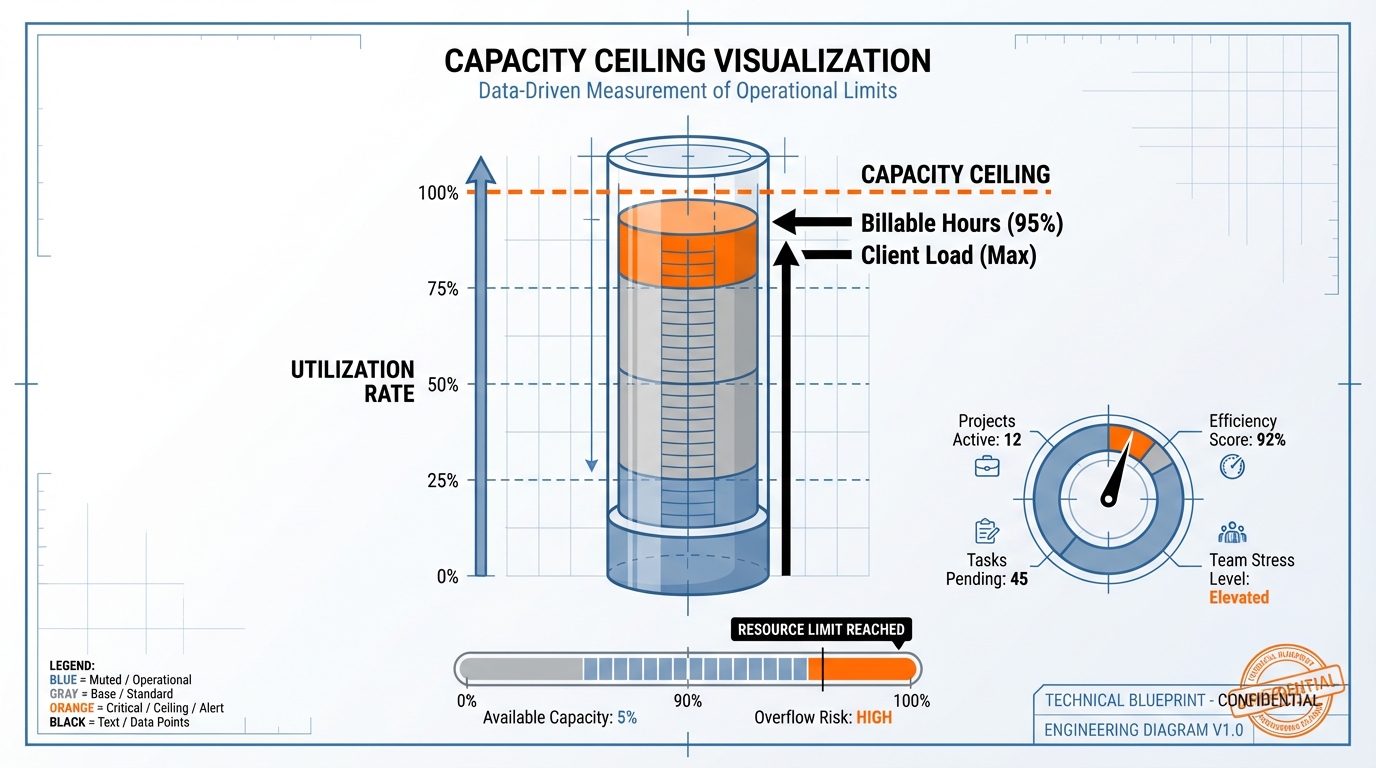
Hiring readiness isn’t just about cash flow; it’s about operational necessity. The single most reliable sign you need to hire is not revenue growth. It is quality degradation.
When operating as a solo founder, your time is finite. You become the critical bottleneck. As client load increases, something must fail—either your personal life, or the quality of the deliverable itself. We track three primary indicators that signal an urgent, quantifiable need to expand capacity immediately.
1.1 The High-Leverage Opportunity Cost
How much time are you currently spending on $15/hour tasks?
If you are a founder closing $15k retainers, your effective hourly rate is likely $300–$500 per hour. When you spend two hours setting up a weekly reporting dashboard or formatting client meeting notes, you are not just wasting time—you are losing $600–$1000 in potential revenue generation.
This is the core concept of opportunity cost. We must eliminate low-leverage activities.
We track founder time religiously. When our CEO spends more than 10% of their week on non-strategic execution (i.e., tasks someone else can do for $40k annually), we know we have a staffing gap. Your focus must shift exclusively to high-leverage activities: closing deals, refining the core service offer, and strategic client retention.
1.2 The Client Satisfaction Decay Rate
Are you consistently hitting deadlines? If the answer is anything less than a resounding “Yes,” you have already crossed the capacity ceiling.
Capacity failure manifests in subtle but lethal ways: client reports are submitted late; follow-up emails are delayed by 48 hours; strategy documents are rushed. Clients notice every single point of failure.
This decay directly impacts your ability to negotiate higher retainers and secure long-term contracts. If your Net Promoter Score (NPS) or client retention rate drops by even 5% due to operational strain, the lifetime value of lost clients far outweighs the annual salary of a new hire. Capacity issues are revenue killers.
1.3 Turning Down High-Value Work
This indicator is the clearest, most painful red flag.
If you are actively saying “No” to new, high-ticket clients or strategic projects because your current capacity is maxed out, you are not just limiting growth—you are actively shedding guaranteed revenue.
Look at the math: Turning away a single $10,000 retainer means you need to hire someone whose annual output can generate that $10,000 (plus profit margin) multiple times over. This scenario immediately justifies the hire. When capacity limits revenue, the time to hire was yesterday.
Step #2: Establishing Financial Predictability: The 6-Month Rule

Nervousness about the financial commitment is valid. Many growing agencies hire based on a single high-revenue month, only to face an immediate cash crunch three months later. That approach is fatal.
We do not hire based on transient success. We mandate hiring only after achieving proven financial predictability and stability.
2.1 Predictable Revenue vs. Spikes
Review your last 12 months of revenue. Is the graph volatile, showing extreme spikes and troughs, or does it present a steady, upward-trending line?
We require three consecutive quarters (nine months) of stable, predictable revenue before considering a hire. This revenue must comfortably cover existing operating costs plus the proposed Fully Loaded Salary (FLS) of the new team member.
What is Fully Loaded Salary (FLS)? FLS is the total cost of the employee to the agency, not just their paycheck. This typically adds 20% to 40% on top of the base salary and includes:
- Employer payroll taxes and mandatory contributions.
- Health benefits, retirement matching, and perks.
- Software licenses, necessary equipment (laptop, monitor, etc.).
- Training and professional development costs.
2.2 The Liquidity Buffer Requirement
While some advisors suggest a three-month buffer, we mandate a minimum of six months. This is non-negotiable.
You must secure six months of the new employee’s FLS and reserve it in a dedicated operational account. This cash reserve is not for spending; it is your ultimate safety net. It protects your business—and your new hire—from market volatility or sudden client churn, preventing the need for an immediate, premature layoff.
If securing this cash reserve feels impossible, you do not have a staffing problem; you have a pricing problem. You must review your Value-Based Pricing Strategy immediately. Furthermore, if you are agonizing over the cost of an accountant, you absolutely cannot afford the complexity and risk of a full-time employee.
2.3 Calculating Required Revenue Per Hire (RPH)
Hiring is an investment, not an expense. Every employee must generate a predictable multiple of their total cost.
For your critical first hire—typically focused on operations or delivery—we target a minimum 3:1 Revenue Per Hire (RPH) ratio. This means the employee must indirectly enable the agency to generate three times their cost.
| Metric | Value |
|---|---|
| Employee Fully Loaded Salary (FLS) | $60,000 per year |
| Target RPH Ratio | 3:1 |
| Required Annual Revenue Generation | $180,000 (3x FLS) |
If you were hiring a dedicated sales role, this RPH ratio should be significantly higher (5:1 or more). However, the first operational hire must effectively free up enough of your time—the founder’s time—to actively generate that required $180,000 through new client acquisition or service expansion.
Step #3: Pre-Hiring Infrastructure: Stop Delegating Chaos

Hiring someone to fix your broken processes is a catastrophic failure mode. It is the fastest way to waste capital and destroy agency morale.
Before you commit to a salary, you must have documented, repeatable systems in place. If the founder cannot clearly explain the process, the new employee cannot execute it effectively. We call this the Infrastructure Mandate.
3.1 Documenting Standard Operating Procedures (SOPs)
Before hiring, identify the 3–5 core repeatable tasks the new hire will own. These are the tasks currently consuming your time—client reporting, content scheduling, or basic outreach, for example.
You must document these processes step-by-step. Use video recordings (Loom or similar), detailed screenshots, and simple flowcharts. Our standard: An average person should be able to follow the SOP and achieve 80% effectiveness without your direct intervention.
This level of documentation is critical. It enables rapid onboarding, maintains quality control, and proves the process is scalable—not reliant solely on the founder’s institutional knowledge.
3.2 Legal and Compliance Readiness
Moving from a contractor (1099) model to an employee (W-2) model fundamentally shifts your legal liability and operational structure. You must formalize your business foundation before the first paycheck is issued.
This includes securing an Employer Identification Number (EIN), setting up compliant state and federal payroll systems, and understanding current labor laws (wage, hour, and termination requirements).
Ensure your foundational legal documents are robust. Review our guide on Agency Contracts: The 5 Non-Negotiable Documents for Scale to ensure compliance and protection.
The essential pre-hiring infrastructure checklist:
| Infrastructure Component | Readiness Score (Required) | Impact on Agency Scale |
|---|---|---|
| Defined Role & Job Description | 100% | Prevents scope creep and ensures targeted recruitment. |
| Core Task SOPs (70% Minimum) | 70% | Enables fast delegation and consistent service delivery. |
| Payroll & Tax System Setup | 100% | Mandatory legal compliance. Avoids penalties. |
| Onboarding Plan (First 30 Days) | 90% | Reduces time-to-productivity for the new hire. |
| Performance Metrics (KPIs) | 100% | Allows objective management and performance review. |
3.3 Leadership and Management Readiness
This is often the biggest hurdle for successful solo founders: the mental shift. You are transitioning from a 100% executor role to a management role.
You are now a coach, a leader, and a primary trainer. This requires a dedicated time commitment. You must allocate 5–10 hours per week specifically for 1:1 meetings, advanced training, issue resolution, and performance reviews.
If you cannot commit to this weekly management overhead, you are not ready to hire a full-time employee. Failure to manage proactively guarantees burnout, high turnover, and the immediate loss of the capital you invested in hiring and training.
Step #4: The Critical First Hire: Multiplier vs. Reliever
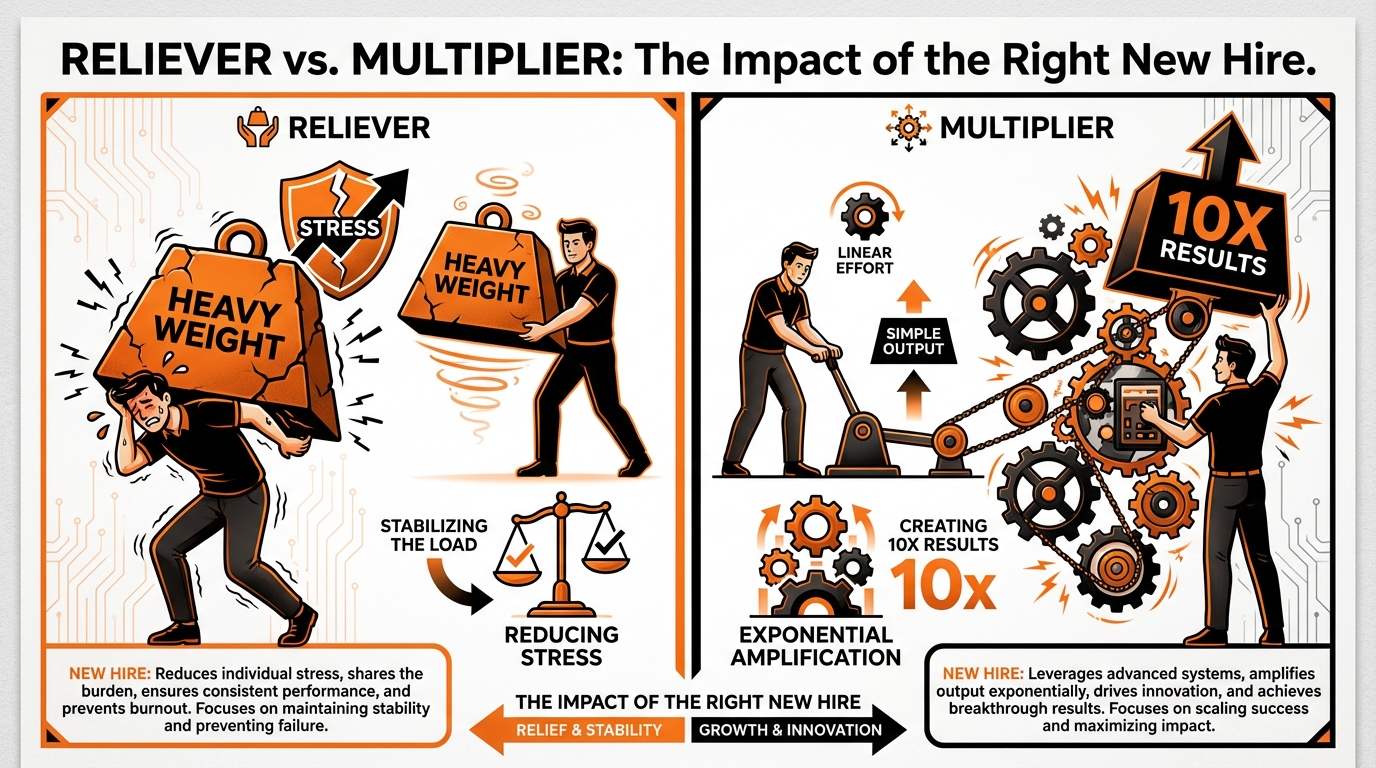
Assuming you have successfully implemented the Infrastructure Matrix (Step #3), you now face the most consequential decision for your agency’s near future: Who do you hire first?
This single strategic choice determines the trajectory of your agency for the next 12 to 18 months. The answer is not based on who you like, but on identifying and alleviating your current, most critical bottleneck.
4.1 The Operations/Delivery Specialist (The Reliever)
If you are consistently working 60-hour weeks, missing deadlines, or seeing quality slip due to operational overwhelm, you need a Reliever.
The Reliever’s job is to take over core, repeatable service delivery tasks. They absorb the chaos, stabilize client accounts, and immediately free up the founder’s time for high-value activities like sales and high-level strategy.
- Role Focus: Project Management, Client Reporting, Initial Campaign Setup, Content Drafting, or repetitive service execution.
- Key Benefit: Immediate capacity relief. Stabilized service quality, leading directly to reduced client churn.
- When to Hire: When client churn risk is high due to founder burnout or operational overwhelm.
Crucially, this person must be a reliable executor of your documented SOPs. They are hired for organization and process adherence, not necessarily for strategic genius.
4.2 The Sales/Lead Generation Specialist (The Multiplier)
If your current operations are stable (you have 10-15 solid clients) but your pipeline is inconsistent or dry, you need a Multiplier.
This hire focuses purely on generating new, qualified leads and closing deals. They are a direct, measurable investment: their cost is immediately offset by the new revenue they bring into the business.
- Role Focus: Cold outreach campaigns, qualifying inbound leads, managing the CRM, setting discovery calls, and closing small deals.
- Key Benefit: Accelerates scalable growth. Converts existing operational capacity into new, billable revenue.
- When to Hire: When you have the existing operational capacity to handle 2-3 new clients per month, but lack the lead flow to achieve it.
For most high-ticket agencies looking for rapid growth, the Multiplier is the stronger first choice—provided the founder can maintain delivery quality while dedicating time to training and supporting the new sales hire. We advocate for aggressive Strategic Lead Generation early on.
4.3 The Sales vs. Operations Decision Matrix
Use this matrix to objectively determine your primary bottleneck and prioritize the first critical hire:
| Current Agency Status | Primary Bottleneck | Recommended First Hire | Justification |
|---|---|---|---|
| Stable Revenue, Maxed Founder Hours (50+ hrs/wk) | Delivery/Execution Capacity | Operations Specialist (Reliever) | Free up founder time for strategy and sales; reduce burnout risk. |
| Low Founder Hours, Low Revenue (Pipeline Dry) | Client Acquisition | Sales Specialist (Multiplier) | Generate immediate revenue to fund future operational hires and scale faster. |
| High Volume, Volatile Quality/Missed Deadlines | Process & Quality Control | Project Manager / QA Specialist | Stabilize output using documented SOPs before attempting to increase volume or revenue. |
Step #5: Avoiding the First Hire Pitfalls (Execution Errors)
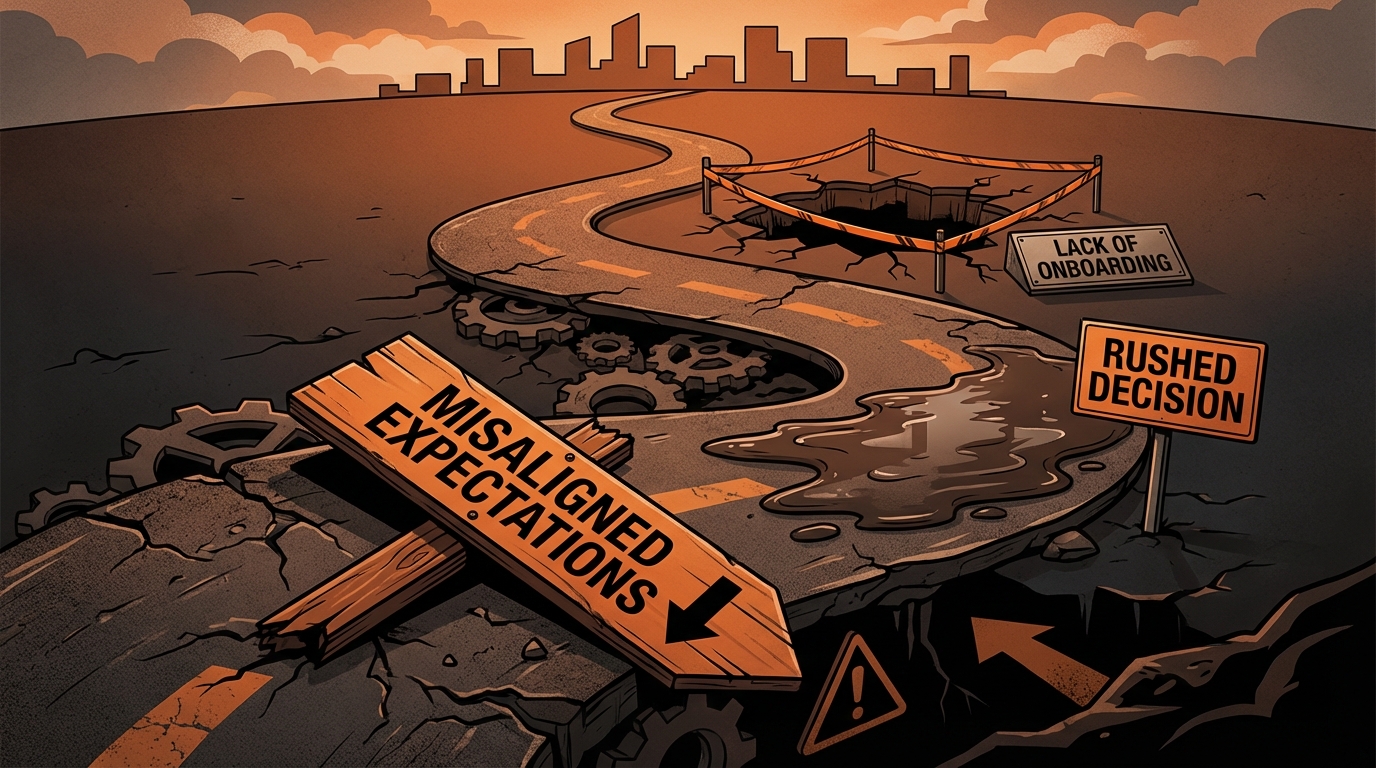
You have identified the strategic need (Reliever or Multiplier). Now, you must execute the hiring process perfectly. The first hire is the highest-risk personnel decision you will make. Minimize that risk immediately by avoiding these three common, agency-killing mistakes.
5.1 Hiring for Personality Over Process
You are hiring for competence and adherence to systems—not for a new lunch partner. While cultural fit is important, performance is mandatory.
Your first employee must execute reliably, consistently, and without constant supervision. They are being brought in to relieve bottlenecks, not create new management overhead.
If they cannot immediately respect and adhere to the documented processes you built in Step #3, they are a liability, regardless of how affable they are. Prioritize the ability to execute the process above all else.
5.2 Outsourcing Your Core Competency
Never outsource the primary service your clients pay you to deliver. This is a fatal mistake for a scaling agency.
If you run a Content Marketing agency, your core strategy and writing execution must remain in-house. Outsourcing core execution immediately compromises:
- Quality Control: Your brand reputation hinges entirely on execution quality.
- Intellectual Property (IP): You lose control over proprietary systems, methodologies, and data.
- Client Relationship: The primary service differentiator becomes diluted and inconsistent.
You can outsource administrative or enabling functions (e.g., bookkeeping, payroll processing, IT support). Keep the core revenue engine internal.
5.3 The Over-Skilled, Under-Managed Executive
A common mistake is hiring a high-level executive (VP, Director) who is used to managing a large team and delegating tasks. Your agency is still operating in the weeds; your first hire must operate there too.
You need a Player-Coach, not a pure Manager. They must be comfortable with ambiguity, willing to wear multiple hats, and capable of taking direct, tactical instruction from the founder.
Avoid the established and rigid. Seek the hungry and adaptable: We look for candidates who crave systems and growth opportunities, not those who demand immediate autonomy and a massive salary reflective of their previous corporate structure. Your agency cannot support that management infrastructure yet.
Frequently Asked Questions

Do I need to hire full-time, or can I start with a contractor?
You should always start with a contractor or high-level freelancer. This is especially true if the work is sporadic or project-based. Use this contractor period as your testing phase: validate your workflows and standard operating procedures (SOPs).
Convert the role to a full-time employee only when two criteria are met: 1) The workload consistently exceeds 30 hours per week; AND 2) The work involves core client communication or requires access to proprietary processes. This structured approach mitigates the significant financial risk associated with the first six months of employment.
What is the average cost of a first employee in 2025?
The cost varies wildly based on location and the required role (e.g., Operations Specialist versus Developer). For a competent, remote Operations Specialist in the US market, budget a base salary of $50,000 to $70,000.
Crucially, factor in an additional 25–35% for the Fully Loaded Salary. This covers employer taxes, software licenses, basic benefits, and other overhead. This places your total annual expenditure between $62,500 and $94,500. Always budget toward the higher end of this range to secure and retain reliable, high-performing talent.
How long should I wait before hiring the second employee?
Do not rush the second hire. Wait until the first employee is fully onboarded, productive, and has mastered 90% of their core responsibilities (this typically takes 4–6 months).
The second hire should be planned only when two conditions are met:
- The first employee’s capacity is consistently approaching 80%.
- The founder has successfully pivoted to spending 70% or more of their time on high-leverage activities like sales, strategy, and business development.
The second hire must strategically fill the capacity or skill gap the first hire created (e.g., pairing an Operations specialist with a dedicated Sales/Business Development role).
Ready to take the next step?
Try AI Lead Generation Today
Click HereReferences
- How do you determine the right time to hire your first employee?
- When to Hire Your First Employee & Build a Team | The Admin Bar
- When Is It Time To Hire Your First Employee? – Seven Figure Agency
- When to hire your first employee: a checklist | Diane Prince posted …
- When should a startup digital agency start hiring? – Quora