

The agency market is saturated. Every competitor promises “results” and “growth.” This generalized noise is immediately filtered out by high-ticket prospects.
SaaS founders, executives, and established professionals ignore promises. They demand proof. Specifically, they demand the mechanism of success—the documented process that moves a client from a measurable, painful problem to a guaranteed, profitable outcome.
Case studies are not marketing fluff; they are the single most powerful sales tool in the B2B space. Yet, most agencies utilize them incorrectly.
They focus entirely on the “what” (the tasks delivered: we ran 5 ad campaigns) instead of the “transformation” (the measurable ROI: we generated $200k in 90 days). This approach fails to convert high-value clients and wastes valuable sales time.
This document is the definitive 2025 blueprint. We will show you how to structure strategic case studies that effectively do the selling for you. They qualify the lead, preemptively handle objections, and pre-position your agency as the inevitable, highest-value solution.
Key Takeaways: The Strategic Imperative
- Focus on Transformation, Not Tasks: High-value clients buy lifestyle and revenue changes, not “SEO optimization.” Document the transformation from point A (painful status quo) to point B (measurable freedom).
- Mandate Hard Data: Every claim must be supported by verifiable ROI metrics. We require a minimum 3X return documented in every case study we publish for maximum conversion impact.
- Use the “Pre-Qualification Filter”: Structure your case studies to actively repel clients who cannot afford your rates or do not value strategic thinking. This saves our sales team hundreds of hours in vetting low-fit leads.
- Video is Non-Negotiable: A written PDF is static. A 5-minute client interview video (even simple Zoom footage) adds critical authenticity, accelerates trust, and proves the results are real.
Section 1: The New Case Study Imperative in 2025

The digital landscape is saturated. Trust is scarce; buyers are inherently cynical. They have seen the generic agency websites and the empty promises—claims that cannot be verified.
Download the Visual Guide
Get the slide-by-slide visual summary of this article (PDF) for free.
Your case study must therefore function as a deep-dive, verifiable audit of success, not a marketing fluff piece.
We treat case studies as mandatory pre-sales documentation. They are engineered specifically to answer every logical objection and mitigate risk *before* the prospect ever books a discovery call.
Why Generic Case Studies Fail
Most agencies structure their case studies like self-congratulatory press releases. They prioritize narrative over measurable data. This approach fails because high-ticket clients immediately dismiss documentation that is light on verifiable details.
Prospects are looking for documented proof of ROI. They ignore content that includes:
- Vague, unquantifiable language (e.g., “Improved efficiency,” “Better brand awareness”).
- Focus on vanity metrics (e.g., increasing social likes by 15%) instead of revenue or enterprise value.
- Failure to contextualize the investment required (the prospect needs to know the necessary budget and timeline).
- Lack of authentic client voice (no verifiable quotes, video testimonials, or third-party confirmation—just agency interpretation).
Our goal is to shift the conversation from the defensive question, “Can you do this?” to the urgent question, “How quickly can you do this for us?”
Section 2: The 5-Part Transformational Framework
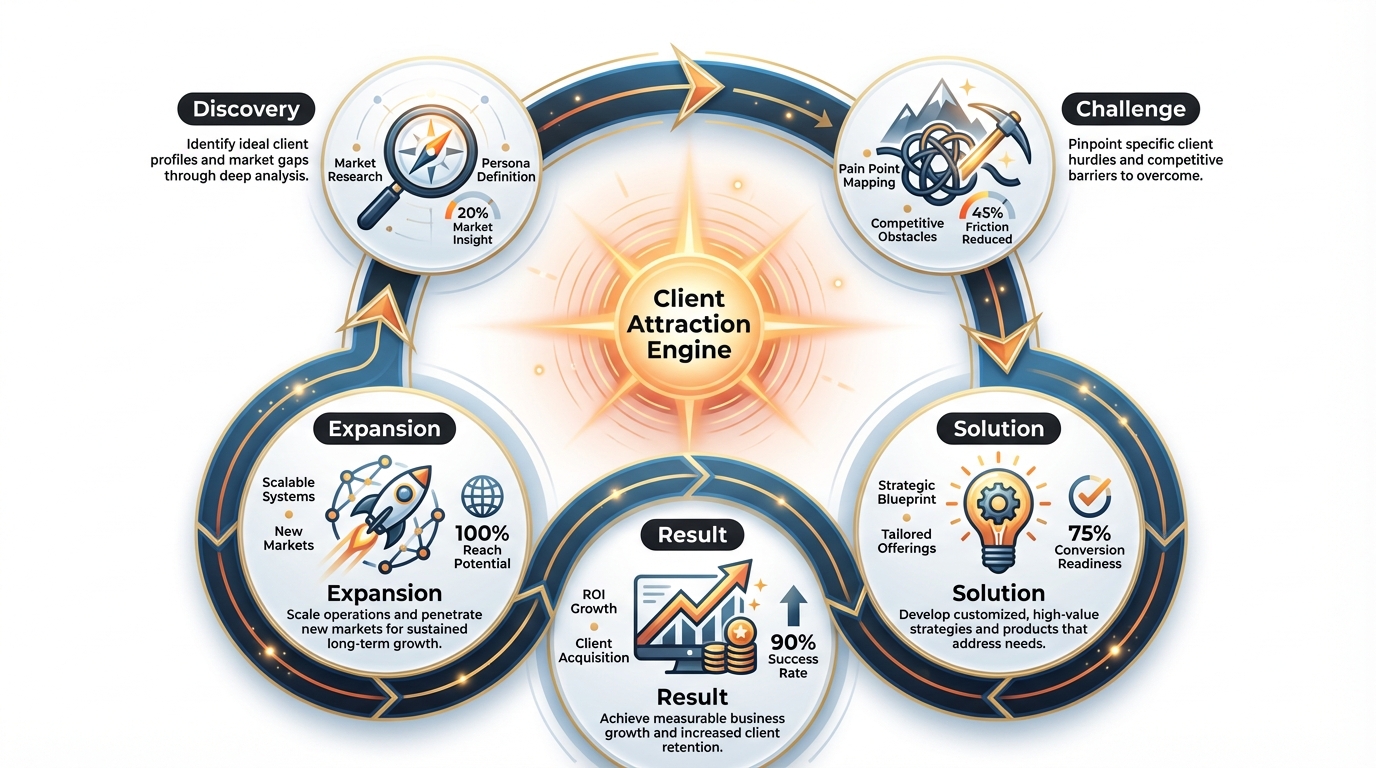
We deploy a structured, narrative-driven framework—the 5-Part Transformational Framework—that forces the entire focus onto the client’s journey and the verifiable, quantifiable change your agency delivered. This structure accelerates trust and positions your agency as an operational partner, not just a vendor.
Step #1: Define the Status Quo Pain (The “Before”)
Never start with the client’s industry or history. You must immediately define their central, operational pain point. This definition must be hyper-specific and instantly relatable to your ideal prospect.
If we target SaaS founders, for example, the pain must revolve around high Customer Acquisition Cost (CAC), unsustainable churn, or critical pipeline leakage.
Use specific data points here:
- “Client X was spending $120,000 annually on paid ads, generating 40 MQLs per month. Their average Customer Acquisition Cost (CAC) was $3,000.”
- “Their sales team was wasting 3 hours daily qualifying leads due to poor form integration.” (See our guide on Lead Generation Mistakes: 12 Strategic Errors Costing You Revenue for common pitfalls.)
The goal is for the reader to think: “That is precisely the problem I am facing right now.”
Step #2: Identify the Strategic Obstacle (The “Why”)
This step is the primary vehicle for demonstrating your agency’s intellectual expertise. Why did their previous internal or external attempts fail?
It is insufficient to state, “They needed better marketing.” You must isolate the core strategic flaw that only your agency’s proprietary analysis could recognize.
Example: “The previous agency focused entirely on top-of-funnel volume. Our analysis showed the failure was not traffic volume, but the absence of strategic lead segmentation. They were capturing volume, but qualifying zero intent, leading to a massive operational bottleneck.”
We reposition the strategic obstacle as the direct barrier to revenue. When we define the problem better than the client defines it themselves, the sale is already closed.
Step #3: Detail the Solution & Investment (The “How”)
Vague descriptions are where most agencies fail. You must outline the solution with precision, but critically, you must anchor the expected investment.
High-ticket prospects inherently understand that quality requires significant financial commitment. Hiding the complexity or the scale of the engagement breeds immediate distrust; transparency builds authority.
Mandatory inclusions:
- The Scope: Define the duration and scale (e.g., Was this a 6-month engagement or a 12-month retainer?).
- The Core Mechanism: Name the proprietary methodology or system used (e.g., “We implemented our 3-Stage Intent Qualification Funnel”).
- The Cost Anchor: Mentioning that “This client committed to our $15,000/month retainer, plus the mandatory Agency Setup Fees: The Non-Negotiable Cost of Scale,” immediately qualifies the reader. If they blanch at the number, they are not your target client.
Step #4: Deliver the Measurable Results (The “After”)
Focus strictly on **ROI** and the client’s primary business metrics: Net Revenue, Profit Margin, Lifetime Value (LTV), or significant operational time saved. We forbid vanity metrics.
If traffic increased, that increase must be immediately tied to qualified opportunities or pipeline acceleration. Only report metrics that directly impact the balance sheet.
Key performance indicators (KPIs) we prioritize:
- Reduction in CAC (e.g., dropped from $3,000 to $950).
- Increase in deal velocity (e.g., sales cycle shortened by 35 days).
- Total contract value (TCV) increase (e.g., average client contract size increased by 20%).
- Annualized Return on Investment (ROI) relative to agency fees.
Step #5: The Client Transformation Quote (The “Proof”)
The final element is the client’s personal statement—the ultimate validation of the transformation. This quote must transcend simple numerical results.
It should address the emotional and operational shift: the reduction of executive stress, the newfound scalability, or the ability to hire strategically because lead flow is predictable. A video quote is ideal; otherwise, the written statement must be direct, powerful, and specific.
Before Pyrsonalize, we were guessing. Now, we have a machine. The $200k in new revenue is great, but the predictability is what changed the trajectory of our business.
Section 3: Mandatory Data: Quantifying the ROI

The foundational narrative—the client’s transformation—only works if it is underpinned by cold, hard numbers. Data is the currency of trust. Your case study must be relentlessly numerical, moving past vanity metrics and straight to capital efficiency.
To isolate the verifiable strategic impact of our work, we mandate the use of a simple Before/After comparison table. This format is non-negotiable for attracting high-ticket agency clients: they skim content specifically looking for verifiable ROI.
Weak Metrics vs. Strategic ROI Metrics
Most agencies make the critical error of focusing on effort. We focus on efficiency and verifiable financial return. A weak case study reports activity; a strategic case study reports the resulting increase in profit margin or decrease in operational cost.
| Metric Focus | Weak Case Study (Focus on Effort) | Strategic Case Study (Focus on ROI & Efficiency) |
|---|---|---|
| Lead Volume | 100% Increase in Leads Generated | 18% Increase in Sales Qualified Leads (SQLs) |
| Cost Metric | Decreased Ad Spend by 15% | Reduced Customer Acquisition Cost (CAC) from $1,800 to $650 |
| Engagement | 3,000 New Website Visitors | 2.1% Improvement in Lead-to-Opportunity Conversion Rate |
| Business Impact | Client is “Very Happy” | $450,000 in Annualized Recurring Revenue (ARR) Added |
| Time/Scale | “Project completed quickly” | Reduced average sales cycle duration by 42 days |
Your prospects are investors. They do not care about your effort, your hours, or your process complexity. They only care about the return on their capital investment (ROI).
Section 4: Distribution Strategy: Leveraging Case Studies for Conversion

A perfectly crafted case study (now backed by verifiable ROI data, as mandated in Section 3) is useless if it sits dormant. The asset must be actively injected into every stage of your sales funnel. Distribution is not passive; it is the conversion multiplier.
This is the leverage point: using one high-value, verified asset to consistently drive multiple conversions and drastically shorten the sales cycle.
Tactic 1: The Pre-Meeting Warm-Up (Shortening the Sales Cycle)
Once a prospect schedules a high-value call (a discovery session or strategy review), the clock starts. Immediately send them the single most relevant case study related to their industry or core pain point. This is strategic pre-selling.
- Industry Match: If the prospect is a B2B service provider, send the case study specific to professional services optimization.
- Metric Match: If they are a SaaS company, prioritize the case study detailing critical SaaS metrics (e.g., CAC reduction, LTV increase).
This “warm-up” ensures the prospect arrives on the call already convinced of your expertise and the validity of your process. The conversation immediately shifts from proving value to discussing implementation and logistics—drastically accelerating closure.
Tactic 2: Segmented Email Outreach (Targeted Acquisition)
Case studies are the most effective anchor for manual, targeted cold email campaigns. We do not blast generic lists; we target specific executives based on verified firmographics (often utilizing specialized lead generation tools to acquire high-quality, professional emails).
The email hook must be simple, direct, and competitive:
“We just documented how [Competitor/Peer Company] achieved a verified [Specific ROI Metric, e.g., 65% increase in lead velocity] using our framework. Would you be interested in seeing the 5-step blueprint that delivered this result?”
This approach bypasses generic marketing noise entirely. You lead with verifiable, relevant results that address their immediate pain points, triggering competitive urgency. For a deeper dive into scaling this specific outreach method, review our 2025 Blueprint for High-Ticket SEO Client Acquisition.
Tactic 3: Repurposing for Nurture Sequences (Maximized Asset Value)
The true ROI of your case study is realized when you maximize its distribution footprint. Every comprehensive case study must be systematically broken down and repurposed into at least three separate content assets tailored for different consumption habits:
- The Full, Detailed PDF/Web Page: The Logical Proof, required for the bottom-of-funnel decision-maker.
- The 60-Second Video Summary: The Emotional Hook, perfect for social platforms (LinkedIn) and initial awareness.
- The 3-Point Bullet List/Infographic: The Acquisition Bait, optimized for paid social ads and rapid consumption.
These segmented assets feed directly into your automated nurture sequence, systematically building trust and demonstrating capability over time. A lukewarm prospect may ignore a generic whitepaper, but they rarely ignore documented, verifiable proof of a competitor’s 77% revenue boost or a 50% CAC reduction.
Section 5: AI-Driven Lead Generation: Finding the Perfect Audience

Distribution (Section 4) demands surgical precision. The most compelling case study in the world is useless if it is shown to the wrong lead.
Our mandate here is high-fidelity targeting: identifying individuals who are currently suffering the exact “Status Quo Pain” documented in your successful outcome. This is where AI-supported, manual lead generation shifts from passive outreach to a targeted conversion engine.
Process: Matching Proof to Prospect
We treat the case study not as a passive document, but as the master key to unlock a specific segment of the market.
Step #1: Profile Your Case Study Client
We must reverse-engineer the successful client profile. Define their specific characteristics to build the ideal target avatar:
- Industry & Niche: (e.g., B2B SaaS, specializing in MarTech for SMBs).
- Revenue/Scale: (e.g., $5M – $20M ARR, preparing for Series B).
- Role & Title: The exact decision-maker (e.g., VP of Growth, CEO/Founder).
- Strategic Pain: The precise problem solved (e.g., reliance on expensive, unsustainable paid channels for lead volume).
Step #2: Identify Look-Alikes Using AI Platforms
We leverage specialized AI lead generation software to scan public data and proprietary databases. The goal is to generate a list of 500+ high-probability “look-alike” companies that mirror the profile identified in Step #1.
These tools filter based on critical indicators: recent funding rounds, technology stack dependencies, employee count spikes, and specific job postings—all signals of strategic pain or imminent growth intent that match the case study narrative.
Step #3: Acquire Direct Contact Information
The system must bypass gatekeepers. We extract verified, direct contact information (the personal email addresses) for the key decision-makers (the CEO, Founder, or VP) within those look-alike companies.
This ensures your high-value proof lands directly on the desk of the person authorized to sign the contract, maximizing asset utility.
Step #4: Execute Hyper-Personalized Outreach
This is the moment of conversion. Your outreach sequence must be hyper-personalized, strategic, and direct. The email structure is non-negotiable:
- Acknowledge Status: Reference a specific, verifiable detail about their company (e.g., “I noticed your recent Series B funding announcement” or “I see you just hired a new Head of Demand Gen.”).
- State the Strategic Pain: Align their status with the recurring industry challenge you solve (e.g., “Scaling past $10M usually breaks the internal lead system, forcing reliance on agencies.”).
- Present the Relevant Case Study as Proof: Provide immediate, verifiable evidence of success (e.g., “We solved this precise issue for [Client Name], shifting their dependency and boosting LTV by 45%.”).
- Call to Action (CTA): Keep the commitment low. “Schedule a 15-minute diagnostic call to see if your current funnel shares these critical vulnerabilities.”
This system — detailed in our Strategic Lead Generation for Small Agencies: The 2025 Blueprint — turns your validated case study into a high-powered, targeted missile, not just a static webpage.
Frequently Asked Questions

How long should a high-ticket case study be in 2025?
Length is dictated by complexity, not arbitrary word count. For high-ticket B2B services, the written narrative must be concise: target 500 to 750 words maximum. High-level executives scan, they do not read. Use short, punchy paragraphs, strategic bolding, and bullet points.
The true depth—the proof—comes from the verifiable data tables and supporting video/audio testimonials, never verbose text blocks.
What if a client won’t allow us to use their name or specific revenue figures?
Confidentiality is a frequent hurdle, especially when dealing with market leaders. If the company name is restricted, reference them by industry and verifiable size (e.g., “A $15M ARR Enterprise SaaS Platform”).
If exact revenue figures are off-limits, always default to percentages and verifiable ratios (e.g., “Achieved a 2.5X Return on Investment (ROI) within 9 months”). Anonymity is acceptable, but verifiability is non-negotiable.
Should we gate case studies behind an email form?
We strongly advise against gating the core case study for high-ticket B2B services. The case study is your primary proof asset; it must be immediately accessible to rapidly build trust.
Instead, gate a high-value, secondary asset related to the success story—perhaps the “Implementation Checklist” or the “Proprietary Strategy Blueprint” used in that specific project. This strategy delivers immediate proof while strategically capturing the lead.
Ready to take the next step?
Try AI Lead Generation Today
Click Here