
The 2025 mandate for high-ticket service providers and SaaS founders is clear: generic lead generation is obsolete. Traditional static landing pages served their purpose, but they fundamentally fail to meet the modern buyer’s demand for personalization and immediate, actionable value.
We are observing a strategic pivot across our client base. Companies are moving away from simple form fills toward interactive quiz funnels. This shift is not merely about aesthetics; it is driven by the necessity for superior lead qualification and advanced data acquisition.
Interactive quizzes effectively act as automated consultants, providing personalized value and segmentation data before a prospect is asked for their contact details.
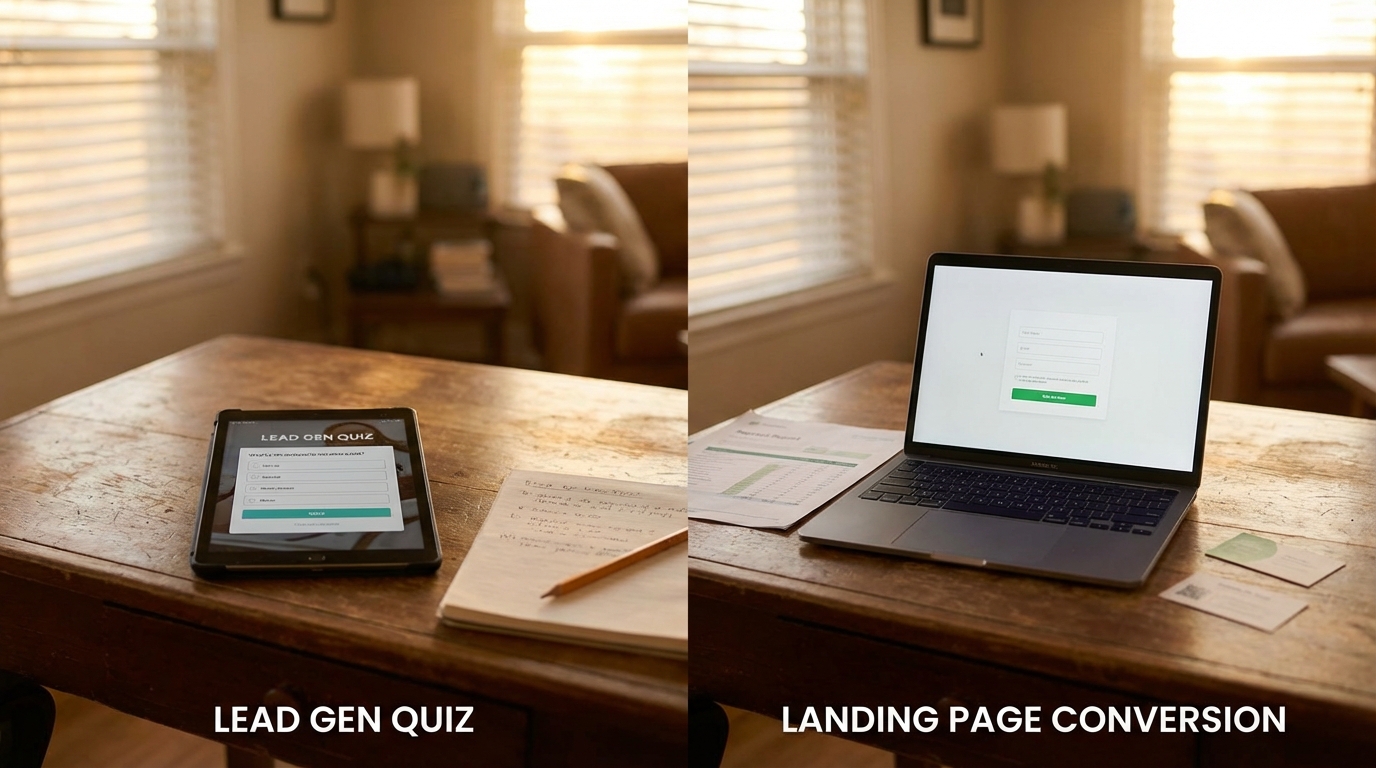
This comprehensive guide details the strategic differences between the legacy approach of Landing Page Conversion (LPC) and the modern methodology of Interactive Quiz Conversion (IQC). We will outline the technical blueprints required to transition your funnel and maximize your conversion rates in 2025.
The Strategic Shift: Static vs. Interactive Engagement
This strategic pivot—moving away from generic lead capture—is rooted in the fundamental difference between passive and active engagement. To properly execute this shift and understand the competitive advantage of quizzes, we must first define the operational goals of each format within the sales funnel. Both methods aim to capture prospect data, but they operate on fundamentally different psychological principles.
Defining Static Landing Page Conversion (LPC)
LPC relies on a simple, passive transaction: the visitor provides contact information in exchange for a static lead magnet—an eBook, a checklist, or a webinar registration. This process is passive and relies heavily on the quality of the headline and the perceived, generalized value of the offer.
LPC Key Characteristics:
- Goal: High volume lead capture at the top of the funnel.
- Data Collected: Name, Email, sometimes Company Name.
- Engagement Model: Passive consumption (reading copy, downloading files).
- Friction Point: The prospect must stop reading and commit their information for an unknown, generalized return value.
- Qualification: Minimal. Leads are often unqualified, requiring extensive downstream nurturing by sales or marketing automation.
While effective for building large email lists, static pages fundamentally struggle with lead quality and segmentation depth. They treat every visitor equally, which is highly inefficient for high-ticket B2B sales cycles where context is crucial.
Defining Interactive Quiz Conversion (IQC)
IQC leverages interactive content—a quiz, assessment, or diagnostic calculator—that guides the visitor through a personalized diagnostic process. The prospect invests time and effort answering strategic questions related to their specific pain points or business needs. Crucially, the contact gate (the form) is placed immediately before the personalized results are delivered.
This structure exploits two powerful psychological drivers: the Curiosity Gap (the need to know the personalized outcome) and the Endowment Effect (valuing something more after investing effort into it). The visitor willingly provides data because the personalized result is perceived not merely as a download, but as high-value, immediate consultation.
IQC Key Characteristics:
- Goal: High-intent, qualified lead capture and immediate segmentation.
- Data Collected: Contact details plus specific zero-party data (budget, timeline, current tech stack, pain points).
- Engagement Model: Active participation (answering 5-10 strategic questions).
- Friction Point: Significantly reduced. The commitment is justified by the imminent, personalized insight.
- Qualification: High. Quizzes automatically score and segment leads based on their answers, delivering Sales Qualified Leads (SQLs) directly to the CRM without manual intervention.
Measuring Success: Core Metrics for High-Ticket Lead Generation
When analyzing the effectiveness of either a static landing page (LPC) or an interactive quiz (IQC), volume alone is misleading. For high-ticket B2B services and complex SaaS products, the primary focus must shift from sheer quantity to data quality and pipeline velocity.
To accurately gauge performance and justify the strategic pivot toward interactivity, we prioritize three strategic metrics that directly impact sales efficiency, moving beyond standard click-through rates:
- Completion Rate: The percentage of prospects who finish the defined interaction (crucial for filtering out low-intent traffic).
- Data Depth (Zero-Party Data): The richness of prospect insights collected *before* the first sales touchpoint.
- Lead Quality Score: The automated, measurable intent signal generated by the interaction itself.
Interactive content, by its nature, necessitates active participation, dramatically increasing engagement time and yielding superior results. Current data consistently shows that properly structured lead quizzes can generate up to 300% more qualified leads than their static counterparts because the increased engagement time acts as a powerful pre-qualification filter.
The following table summarizes the expected performance differences, providing essential benchmarks based on current 2025 industry standards:
| Metric | Static Landing Page (LPC) | Interactive Quiz (IQC) |
|---|---|---|
| Average Conversion Rate (Opt-in) | 5% – 15% | 35% – 55% (Often higher for gated results) |
| Data Quality | Shallow (Contact info only) | Deep (Zero-Party Data, Intent, Pain Points) |
| Time Spent on Page | Under 2 minutes (Passive scanning) | 4 – 8 minutes (Active engagement) |
| Lead Qualification Level | Low (Requires manual scoring/follow-up) | High (Automated scoring and segmentation) |
| Average Sales Cycle Reduction | Minimal impact | Up to 40% reduction reported due to pre-qualification |
Quizzes: The Zero-Party Data Advantage
As 2025 data privacy restrictions tighten globally, relying solely on vulnerable third-party tracking becomes an unsustainable strategy. The interactive quiz funnel is the definitive answer, prioritizing Zero-Party Data (ZPD)—information proactively and intentionally shared by the customer to improve their own experience.
Unlike restrictive static forms, a well-designed quiz provides a structured, low-friction environment to ask the highly specific, pre-qualifying questions necessary for high-ticket sales. This ZPD is not just data; it is immediately actionable intelligence that drives pipeline quality.
Strategic Lead Segmentation via Quiz Responses
Every answer a prospect provides acts as a strategic tag for your CRM. This capability allows high-ticket providers to move beyond basic demographic segmentation (location, industry size) and implement sophisticated behavioral and intent segmentation (budget readiness, specific pain points, existing tech stack, preferred solution architecture).
For B2B sales teams managing complex pipelines, this is critical. We utilize conditional logic within the quiz structure to assign weighted scores to specific responses. For instance, a prospect who confirms they have an allocated budget and a defined purchasing timeline of 30 days is immediately flagged as a high-intent, sales-ready lead, allowing them to bypass standard, time-consuming nurturing sequences.
This efficiency allows your sales team to prioritize outreach based on verifiable intent and budget allocation, rather than mere form completion volume. (For a deep dive into structuring these systems, see: Strategic Lead Segmentation: Quizzes for High-Intent B2B.)
The Psychology of Interactive Conversion
Why are prospects willing to spend five or more minutes answering detailed questions in a quiz, yet they bounce from a static landing page in seconds? The difference lies in perceived value, psychological commitment, and the immediate reward structure.
- The Personalization Effect: The quiz simulates a 1:1 consultation. The prospect is not downloading a generic asset; they are receiving a custom diagnosis of their unique situation. This immediate provision of value builds trust faster than any static copy.
- Commitment and Consistency: Once a user initiates the quiz (a small initial commitment), they are psychologically inclined to finish the process (consistency). This intrinsic momentum carries them past the email gate required to retrieve their personalized results.
- Mitigating Risk: Personalized results frame your product or service as the logical, specific solution to their unique problem, rather than a broad, generic sales pitch. By reducing ambiguity and demonstrating relevance, the perceived risk of purchase is significantly lowered.
Technical Blueprint: Implementing High-Intent Quizzes
Implementing a successful, high-converting quiz funnel requires more than just embedding a form. It represents a technical commitment demanding strategic design, robust conditional logic, and seamless integration with your existing marketing stack—the true blueprint for capitalizing on Zero-Party Data.
Mandatory Conditional Logic Implementation
The quality and perceived personalization of your quiz hinge entirely on its ability to adapt. Conditional logic ensures the quiz flow changes dynamically based on prior answers, making the experience feel truly custom and relevant. For example, if a SaaS founder indicates their company is pre-Series A, we immediately branch them away from complex, enterprise-level feature questions, maintaining focus and efficiency.
Steps for Implementing High-Impact Conditional Logic:
- Map Buyer Personas: Identify 3-5 distinct result types that align perfectly with your Ideal Customer Profiles (ICPs). These results form the foundation of your lead segmentation.
- Define Qualifying Questions: Determine 2-3 mandatory questions early in the flow that drastically alter the lead’s eventual score or result (e.g., budget size, immediate need, decision maker status).
- Set Branching Paths: Use logic to skip irrelevant or generalized questions. If the user selects ‘B2B Enterprise’, ensure they never see e-commerce specific or SMB-focused questions.
- Assign Weighted Scores: Every answer must contribute to a final, cumulative lead score. High-value answers (signaling high intent or high fit) must receive significantly higher point totals than generic demographic information.
Integrating Quiz Data into the Sales Pipeline
The rich Zero-Party Data collected by the quiz must flow instantly and automatically into your CRM (HubSpot, Salesforce, Pipedrive). Manual data entry kills speed, introduces errors, and negates the velocity advantage of a quiz funnel. Modern quiz platforms offer robust, native integrations, eliminating the need for complex, often fragile, Zapier chains.
Integration Checklist for Automated Lead Qualification:
- ✅ Automatic tagging of lead segments (e.g., “Segment_A_High_Budget,” “ICP_Fit_90%”).
- ✅ Instant transfer of the final calculated lead score to the CRM contact record upon completion.
- ✅ Triggering of immediate, personalized email nurturing sequences based specifically on the user’s quiz results and assigned segment.
- ✅ Alerting the sales team only when the lead score meets the pre-defined Sales Qualified Lead (SQL) threshold.
This automated system ensures that high-intent leads receive personalized outreach within minutes, drastically improving conversion-to-sale velocity and maximizing the ROI of your quiz funnel. We recommend implementing a rigorous, transparent scoring system to manage this influx of qualified data efficiently. For a detailed framework, consult: The Strategic Lead Scoring System for High-Ticket B2B Sales.
Optimizing for B2B and High-Ticket Sales
For organizations focused on high-ticket offerings (>$5,000 ACV) or complex B2B sales cycles, the lead qualification quiz shifts from optional strategy to mandatory infrastructure. The primary goal is not conversion volume, but conversion quality.
A well-designed Interactive Quiz Funnel (IQC) acts as the essential pre-sales filter, efficiently screening out “tire-kickers” and ensuring sales resources are exclusively dedicated to prospects who precisely match your Ideal Customer Profile (ICP).
When to Use a Static Landing Page vs. an Interactive Quiz
We do not advocate for the wholesale elimination of static Landing Page Conversions (LPCs). They retain a strategic purpose, particularly for distributing universal, top-of-funnel content (e.g., industry reports) or for capturing leads with minimal friction when qualification is not the immediate priority. The distinction lies in the intent and required qualification depth.
Pros & Cons: Static Landing Page (LPC)
Pros:
- Rapid deployment and streamlined A/B testing of simple elements (headlines, CTAs).
- Ideal for generic, universally appealing lead magnets.
- Low friction, maximizing initial volume capture.
Cons:
- Minimal lead qualification depth, resulting in high volume of unqualified MQLs.
- Collects zero behavioral or intent-based data points.
- Significant drop-off rate when mandatory qualification fields (budget, size) are introduced.
Pros & Cons: Interactive Quiz (IQC)
Pros:
- Exceptional lead qualification and deep segmentation capabilities.
- Proven higher conversion rates (35%+) for qualified funnel entry.
- Collects crucial zero-party data, enabling hyper-personalized follow-up.
- Dramatically reduces sales cycle length by pre-qualifying leads.
Cons:
- Higher initial strategic planning and setup time commitment.
- Requires dedicated quiz software integration (a specialized subscription layer).
- Success is contingent upon providing genuinely valuable, personalized results that justify the time investment.
Actionable Steps for Launching Your First Lead Quiz Funnel
Transitioning from static lead capture to an Interactive Quiz Funnel (IQC) requires a disciplined, systematic approach. These six steps form the essential deployment checklist, optimizing your funnel specifically for high-intent, qualified lead capture.
- Identify the Core Pain Point Diagnosis: Do not create a quiz about your product features. The quiz must diagnose the prospect’s single biggest operational or strategic pain point. Use diagnostic titles: e.g., “What is Your SaaS Onboarding Friction Score?” or “Calculate Your Current Lead Acquisition ROI.”
- Design the Irresistible Value Exchange: The result must deliver immediate, personalized, and high value. This could be a calculated metric (ROI, cost savings), a personalized strategic audit, or a specific, actionable recommendation. This quantifiable value justifies the email gate.
- Implement Progressive Profiling: Leverage psychological momentum by delaying the contact information request. Only ask for the email and name on the final step, immediately preceding the delivery of the personalized results. This ensures the prospect is invested before the friction point.
- Optimize the Results Page (The Conversion Engine): The results page serves as your high-converting landing page. It must immediately present three critical elements: (a) The personalized result/score, (b) A clear explanation of why that result matters and the implied consequence of inaction, and (c) A high-friction, high-value CTA (e.g., “Book a 15-Minute Strategy Call” or “Claim Your Custom Implementation Plan”).
- Configure Dynamic Nurturing Segmentation: Ensure your quiz platform dynamically tags the lead based on their specific answers and final score. Immediately drop these segmented leads into corresponding, personalized email sequences designed to address their diagnosed pain points.
- A/B Test the Gating Strategy: Rigorously test gating the results (mandatory email capture) versus asking for the email after the results are delivered. For high-ticket B2B services, gating is typically superior because the perceived value of the diagnostic report is higher, justifying the required exchange.
Deploying an effective IQC requires tying the initial diagnosis directly to the final sales conversion mechanism. To accelerate deployment and utilize proven, conversion-focused frameworks, reference our detailed funnel blueprint:
The 2025 Blueprint for High-Intent Quiz Lead Funnels
Strategic Quiz Funnel FAQ: Expert Answers
What is the ideal length for a lead generation quiz?
For B2B and high-ticket sales, the optimal length is 5 to 10 strategic questions. This length is sufficient to collect meaningful zero-party data and qualify the lead effectively, while remaining short enough to maintain high engagement and completion rates, typically above 40%.
Should I use a quiz or a calculator for my SaaS business?
This decision depends entirely on your core value proposition:
- If your value proposition is quantifiable (e.g., cost savings, time efficiency, ROI calculation), utilize a calculator.
- If your value proposition is diagnostic or recommendation-based (e.g., finding the right service tier, assessing readiness, identifying systemic roadblocks), utilize a quiz.
Both tools are highly effective interactive formats for capturing high-intent leads.
How do I ensure the leads from my quiz are high quality?
Lead quality is a function of strategic question design and rigorous conditional logic. To guarantee high-intent leads reach your sales team, implement the following structure:
- Qualification Questions: Structure questions to reveal critical buying signals such as budget, timeline, and decision-making authority (BANT criteria).
- Weighted Scoring: Apply a weighted scoring system where high-intent answers receive greater weight.
- Threshold Filtering: Only pass leads that score above a specific, predetermined threshold directly to sales outreach or CRM integration.
- Strategic Nurturing: Direct leads that fall below the threshold to a personalized, low-friction nurturing sequence (e.g., automated email drip) rather than immediate high-pressure sales contact.
Can I use a quiz to segment my existing email list?
Absolutely. Deploying a quiz to existing subscribers is one of the fastest ways to update stale contact records with fresh zero-party data. You can then use the results to trigger hyper-personalized re-engagement campaigns, drastically improving relevancy and deliverability.
Ready to take the next step?
Try AI Lead Generation Today
Click Here
References
- Lead Generation vs Conversion – Key Differences – Landingi
- Anyone here using landing page builders for lead gen? Which one’s …
- Why Conversion Landing Pages Need Interactive Quiz Tools
- How to Use Quizzes for Lead Generation: A High-Intent Strategy
- How important are quizzes for landing pages to increase the … – Quora