

You are using webinars for lead generation because you understand that high-ticket sales require trust, authority, and deep engagement. But here is the brutal truth: most webinars in 2025 are catastrophic failures. They generate low-intent MQLs (Marketing Qualified Leads) who registered for a free gift and promptly forget your name.
The strategic mandate for SaaS founders, high-ticket service providers, and sales professionals is simple: stop chasing volume and start engineering high-intent conversion events. A webinar is not a broadcast; it is a controlled sales environment designed to identify and qualify prospects who are ready to buy-right now.
This 2025 blueprint cuts through the generic advice. We are focusing exclusively on the structure, content, and post-event systems that turn anonymous registrants into qualified, trust-based leads.
The Brutal Truth About Webinars in 2025

The market is saturated. Your target audience is suffering from content fatigue. They have attended 10 webinars this month promising “secrets” and delivering generic fluff. If your webinar looks like a sales pitch disguised as education, your attendance rate will plummet below 20%. This is not a sustainable model.
Your goal is not registration volume. Your goal is conversion proximity. Every element of your webinar strategy-from the title to the closing CTA-must filter out the tire-kickers and amplify the intent signals of your ideal client.
Why Traditional Webinar Metrics Are Obsolete
The classic metrics-registration rate, attendance rate, cost per lead-are vanity metrics if they don’t correlate directly to pipeline and revenue. A high MQL count is useless if your sales team spends 80% of their time chasing cold, unqualified contacts.
In 2025, we focus on engagement quality and behavioral data. Did the lead ask a specific question about pricing? Did they stay until the live Q&A? Did they click the link for the next step? These are the indicators of true intent, and they are mandatory for successful lead scoring.
Phase 1: Strategic Pre-Launch and Promotion
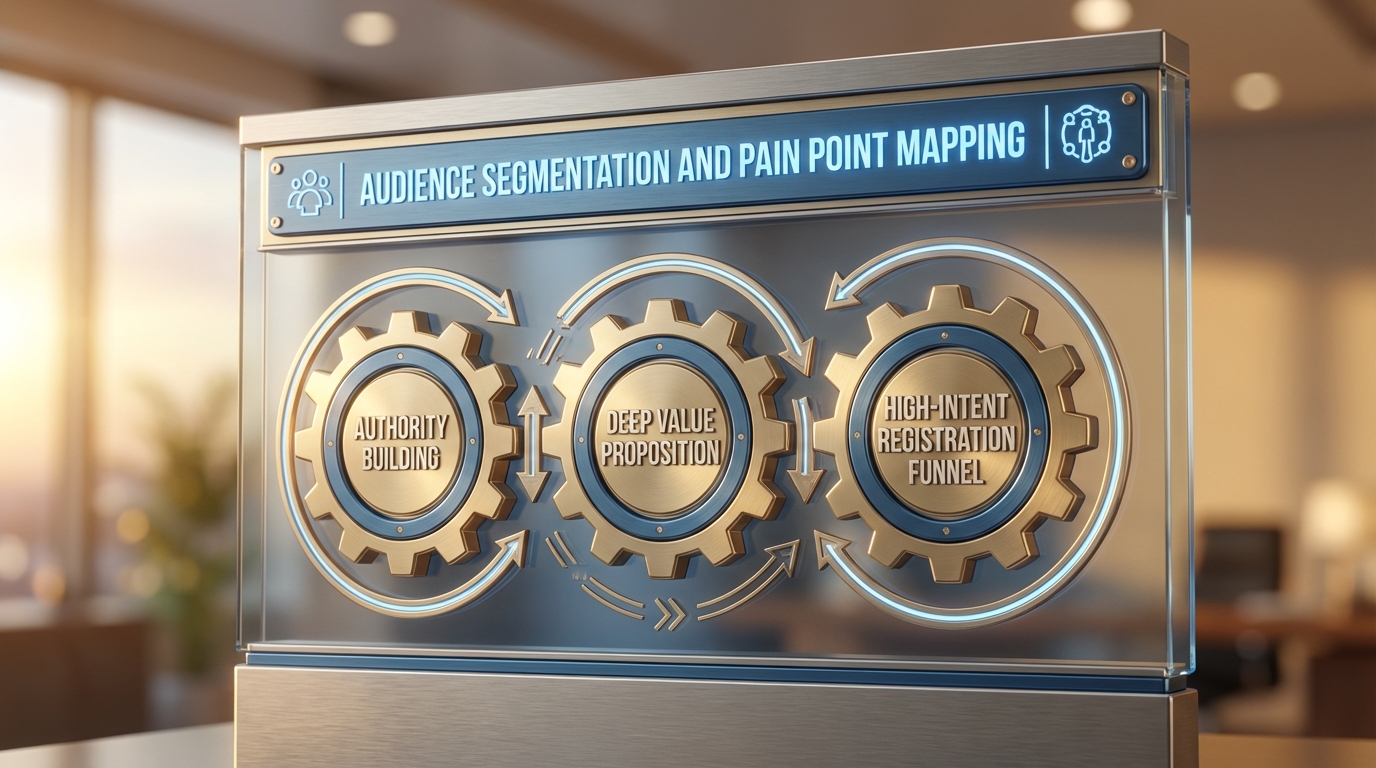
Webinar success is determined long before the camera turns on. It begins with the precise definition of your audience’s urgent pain and the promise of an immediate, actionable solution.
Mandatory Topic Selection: Solve a Specific, Urgent Problem
Stop hosting webinars titled “The Future of X.” Your audience does not need vague thought leadership. They need a tactical, immediate fix for a problem costing them money right now.
- Anti-Generic Example: Instead of “How to Improve Your Sales Process,” use “The 3 Mandatory Scripts High-Ticket Closers Use to Handle the ‘Send Me a Proposal’ Objection.”
- Focus on the Gap: Identify a common failure point that your product or service uniquely solves. The webinar should teach them 80% of the solution, making the final 20%-your core offering-irresistible.
- The 5-Second Test: If your webinar title requires more than five seconds to understand the immediate benefit, change it. Urgency drives registration.
The Anti-Generic Registration Page
Your landing page is your first qualification tool. Don’t just ask for a name and email. Use the registration form to gather mandatory qualification data. This allows you to segment and personalize follow-up instantly.
Pre-Webinar Strategy Audit: The Qualification Checklist
- ✅ Is the registration form asking for current company size or annual revenue? (Mandatory for B2B/SaaS)
- ✅ Are you asking the registrant’s #1 current challenge related to the topic? (Crucial for sales context)
- ✅ Is your registration confirmation email linking to mandatory pre-work? (Tests commitment and intent)
- ✅ Are you leveraging platforms where high-intent professionals congregate, like LinkedIn, for promotion? (See: Mandatory LinkedIn Lead Gen: The 2025 Trust Blueprint)
- ✅ Have you segmented your existing list based on past engagement (e.g., did they attend a previous webinar or download a whitepaper)?
Text-Based Infographic: The Show-Up Rate Reality
Webinar Attendance: The 2025 Reality Check
STANDARD REALITY: Average webinar show-up rate is 35%. If you get 500 registrations, expect 175 attendees.
HIGH-INTENT GOAL: High-ticket service businesses must aim for 50%+ attendance. You achieve this via personalized, non-automated reminders.
CRITICAL STAT: 60% of attendees register within one week of the event. The most critical reminder email is one hour before the start time.
TRUST FACTOR: Webinars co-hosted with a recognized industry authority (not just a partner) see a 25% increase in both registration and attendance.
Phase 2: Execution and Engagement for Trust Building
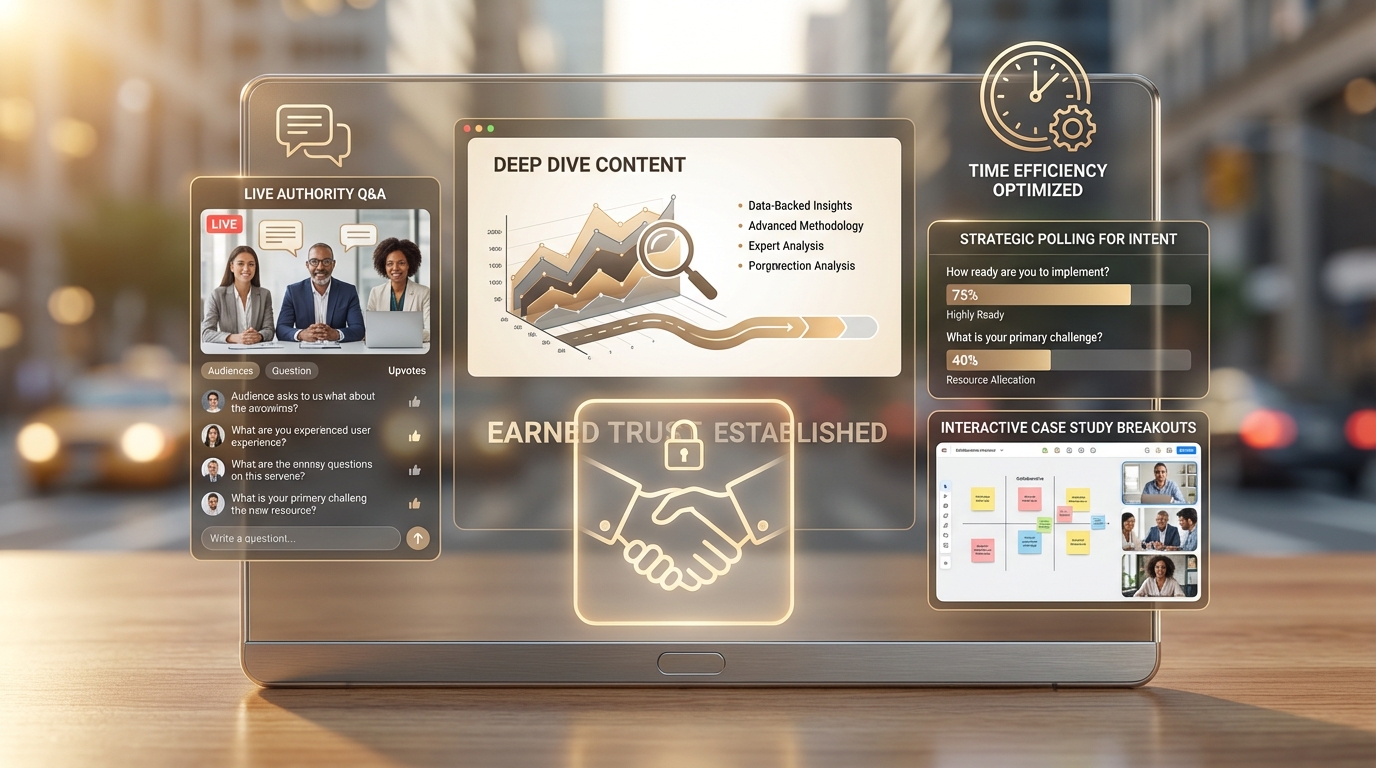
The webinar itself must be a masterclass in value delivery, not a 60-minute pitch. Your primary objective during the live session is to build credibility and extract real-time behavioral data.
Format Wars: Live vs. Hybrid vs. Evergreen
The choice of format dictates your lead quality. While evergreen (pre-recorded) webinars are convenient for volume, they fail the trust-building test required for high-ticket sales. For maximum conversion proximity, live interaction is mandatory.
| Strategy | Conversion Intent | 2025 Mandate |
|---|---|---|
| Live (Pure) | Highest. Builds immediate trust via real-time Q&A. | Mandatory for product demos, high-ticket services, and complex SaaS solutions. Requires high preparation. |
| Hybrid (Pre-recorded content + Live Q&A) | High. Efficient delivery of core content, but maintains real-time interaction for qualification. | Recommended for founders with limited time. Allows focus on the critical qualification phase (Q&A). |
| Evergreen (On-Demand) | Low to Medium. Great for top-of-funnel awareness and data capture. | Use only for repurposing or low-commitment lead magnets. Do not expect immediate high-ticket sales. |
Mandatory Interaction: The Real-Time Qualification Filter
If your audience is passive, they are not engaged. If they are not engaged, they are not qualified. You must force interaction every 5-7 minutes.
- Live Polling: Use polls not just for fun, but for segmentation. Ask questions like, “Which of these three problems is costing you the most time/money right now?” The answer is a direct data point for your sales team.
- The Chat Monitor: Assign a dedicated, highly trained team member (not the presenter) to monitor the chat. They must answer logistical questions but flag specific, high-intent questions (e.g., “Does this integrate with X CRM?” or “What is the typical ramp-up time?”).
- The Mid-Presentation CTA: Don’t wait until the end. At the 40-minute mark, drop a link for a “Deep Dive Resource” or a “Free Tool.” Anyone who clicks this link mid-session is showing extreme urgency and must be flagged as a P1 lead.
Phase 3: Post-Webinar Conversion: Where 90% Fail
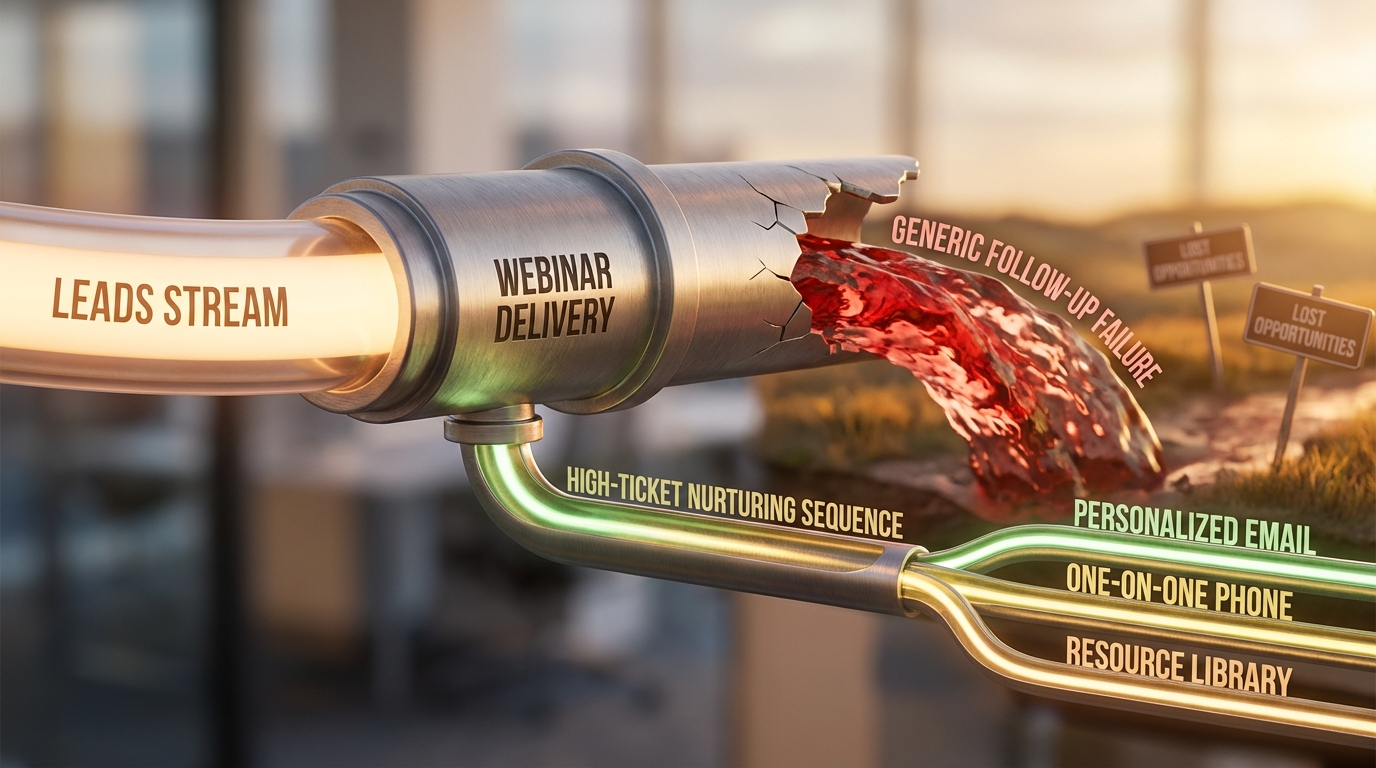
The webinar is merely the mechanism for gathering trust and intent data. The conversion happens in the 48 hours immediately following the event. If your follow-up is generic, you fail.
Lead Qualification Beyond the MQL Score
Forget MQLs. We are focused on HQLs (High-Quality Leads)-leads who exhibit measurable behaviors that signal immediate readiness for a sales conversation. This requires a sophisticated lead scoring process that weights engagement over mere registration.
Key Highlights: High-Intent Scoring Model
You must assign points based on these mandatory actions:
- +10 Points: Registered and attended live.
- +25 Points: Stayed for 75%+ of the session duration.
- +40 Points: Clicked the mid-presentation CTA or requested a specific resource.
- +50 Points: Asked a question related to pricing, implementation, or specific use cases (Sales-ready questions).
- +75 Points: Responded to a poll indicating a current budget or urgent need.
Action Threshold: Any lead hitting 100+ points must receive a direct, personal outreach within 4 hours.
The 2025 Follow-Up Blueprint (Manual & Personalized)
High-ticket sales demand manual effort. Automation handles the logistics; humans handle the conversion. Your follow-up sequence must be hyper-personalized, referencing the data you collected during the webinar.
For the highest scoring leads, immediate, personal outreach is non-negotiable. This is where AI lead generation tools become mandatory. You must bypass generic company emails and find the personal, direct contact information of the decision-maker for a truly tailored conversation.
Scenario A: The Engaged Attendee (100+ Points)
- Immediate (0-4 hours): Personalized email from the presenter referencing the specific question the lead asked or the poll answer they provided. Start the conversation based on their pain point, not your product.
- Next Day (24 hours): A short, personalized Loom video (or similar) addressing the lead by name, thanking them for attending, and offering a specific, relevant resource based on their qualification data.
- Day 3: Direct connection attempt via LinkedIn or Manual Follow Up Strategy For Facebook Lead Generation, reinforcing the value proposition.
Scenario B: The No-Show Registrant (10-30 Points)
Do not dismiss them. They showed initial interest. Send them the recording link immediately, but gating the high-value takeaways. Offer them a specific excerpt or a related guide as a second chance to engage.
Pros & Cons of Gating Webinar Content Post-Event
The debate on gating content is fierce. For high-intent conversion, a hybrid approach is best.
- Maintains scarcity and value of the core training.
- Forces leads to take a second action (e.g., download a checklist) which serves as a second intent signal.
- Allows you to leverage the recording as an Organic Facebook Lead Magnet Setup: The 2025 High-Efficiency Guide.
- May frustrate leads who genuinely missed the session.
- Limits overall brand reach and awareness.
- Requires more manual effort to distribute customized resources.
Critical Metrics: Measuring True ROI (Not Just Registrations)

If you cannot measure it, you cannot scale it. You must move beyond simple registration counts and track conversion rates at three mandatory stages.
- Attendance-to-Sales-Appointment Rate: Of those who attended, how many booked a discovery call or demo? This measures the effectiveness of your webinar content and CTA.
- High-Intent Score Velocity: How quickly did P1 leads move from the webinar to the sales pipeline? High velocity indicates urgent need and effective post-webinar follow-up.
- Repurposing ROI: Every webinar must become 5-10 pieces of content (blogs, social snippets, podcasts). Track how many new, high-quality leads register for future events or resources based on the repurposed material. This maximizes the lifetime value of your single event.
Frequently Asked Questions

How long should a high-intent webinar last in 2025?
A high-intent webinar should be 45 to 60 minutes maximum. Your audience has limited attention. Allocate 30-40 minutes for core, valuable content, and 15-20 minutes for live, interactive Q&A. The Q&A is where qualification happens, so never skip or shorten it. Ending exactly on time shows respect for your audience’s schedule and reinforces your professionalism.
Should I use a co-host or panel format for B2B webinars?
Yes, co-hosting or using a panel is highly strategic, but only if the speakers are genuine industry experts or successful clients, not just internal staff. Panels increase reach (you tap into your partners’ audiences), boost credibility, and provide diverse perspectives. However, you must use a strong moderator to ensure the conversation remains focused on the conversion goal and doesn’t devolve into a vague discussion.
What is the most common catastrophic mistake in webinar lead generation?
The single biggest failure point is having a weak, generic Call to Action (CTA). If you end the webinar by saying, “Visit our website,” you have failed. The CTA must be highly specific, urgent, and tied directly to the solution you just taught. For high-ticket services, the CTA should be a high-friction request that naturally filters leads, such as “Book your 15-Minute Strategic Audit” or “Apply for a Free Custom Blueprint Session.” High friction equals high intent.
How can AI tools enhance post-webinar personalization?
AI tools, particularly those designed for lead generation, are mandatory for finding the direct, personal contact details of decision-makers who attended. This allows your sales team to move beyond generic email blasts and send a hyper-personalized message via their personal email or phone, referencing their specific company pain points derived from the registration form or live Q&A. This level of personalization is critical for closing high-value deals.
Ready to take the next step?
Try AI Lead Generation Today
Click Here