

You are likely tired of generic lead magnets. The 20-page PDF guide or the “Free Ebook” strategy is functionally dead in 2025. It generates volume, yes, but the quality of intent is so low that your sales team spends 80% of their time filtering noise.
This is the brutal truth: if your lead generation system optimizes for email volume over purchase intent, you are setting yourself up for catastrophic failure. Time is the most expensive resource you have, and wasting it on unqualified prospects is financially irresponsible.
The strategic alternative is the High-Intent Lead Generation Quiz. This is not the “Which Disney Princess Are You?” Buzzfeed nonsense that floods social feeds. This is a mandatory pre-qualification tool designed to extract critical, non-negotiable data points before your prospect ever speaks to a human.
We are going to dissect the 2025 Blueprint for building quizzes that serve one purpose: identifying the buyer who is ready to transact now, or who has the specific pain points your high-ticket service is engineered to solve.
The Brutal Truth: Quizzes Are Not About Virality

Most marketers treat quizzes as engagement tools. That is a tactical error. We treat them as data acquisition systems. The goal is not a high share count; the goal is a perfectly segmented, high-value lead profile.
If you are running a high-ticket service business-SaaS, specialized consulting, complex real estate, or advanced financial advisory-you cannot afford low-intent leads. Your quiz must act as a digital gatekeeper.
The High-Intent Imperative
A quiz forces a prospect to invest time-not just an email address-to get a personalized result. This investment immediately differentiates them from passive browsers. More importantly, it allows you to utilize conditional logic to ask the mandatory questions that determine fit.
Text-Based Infographic: The Interactive Advantage
- Conversion Rate: Interactive content (like quizzes) converts at rates up to 3X higher than static content (e.g., e-books).
- Completion Rates: High-value quizzes maintain average completion rates of 75% or higher, provided they are strategically brief (under 8 questions).
- Data Points Per Lead: A qualification quiz delivers an average of 5-8 usable data points (budget, timeline, specific pain, current system) versus 1-2 (name, email) from a standard form.
You are not just collecting an email. You are collecting the core data needed to tailor the first follow-up conversation, making your outreach hyper-relevant and non-generic. This is mandatory for building trust in the 2025 marketplace.
Foundational Elements of a Mandatory Qualification Quiz
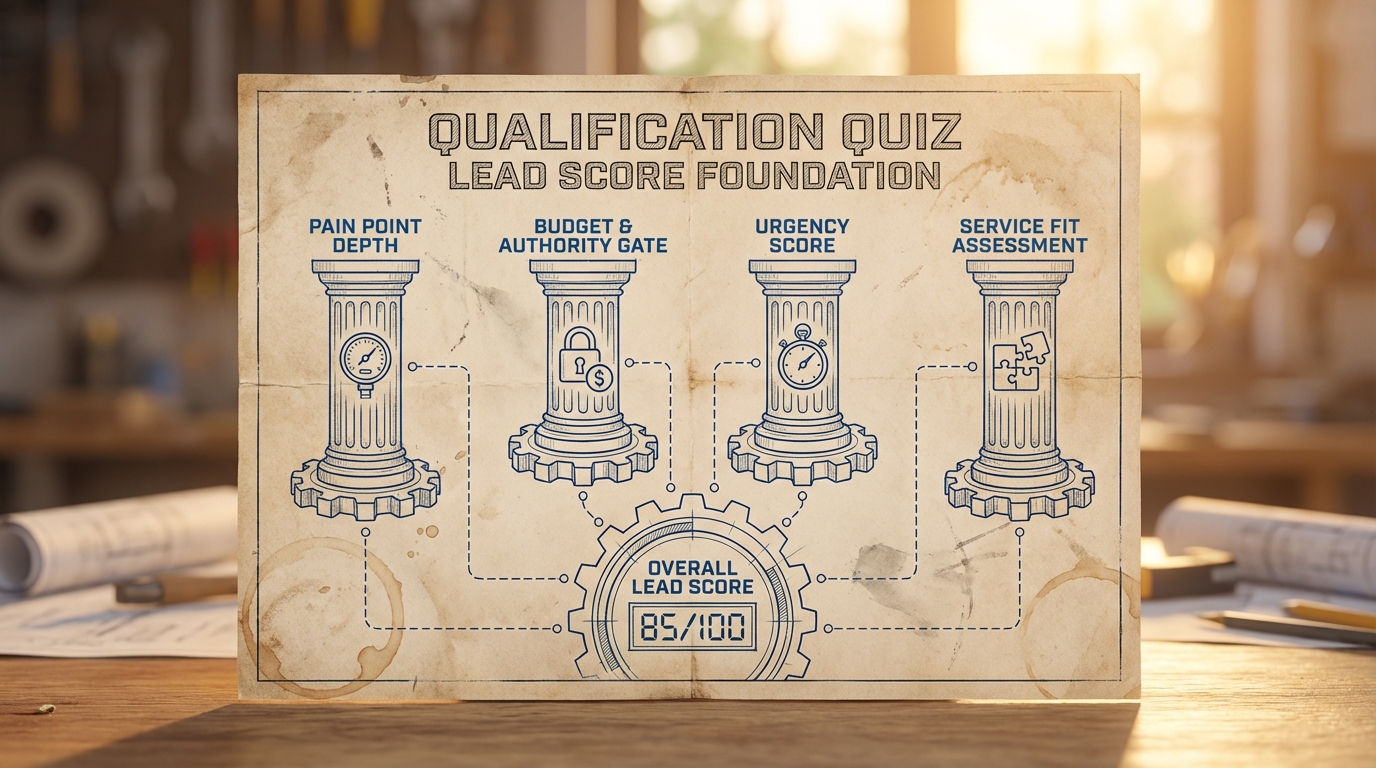
A successful lead generation quiz for service businesses must pivot away from “fun” and towards “functional diagnosis.” Every question must serve a strategic purpose, either for segmentation or immediate qualification.
The 4 Non-Negotiable Questions You Must Ask
These questions cut through the noise and deliver the essential metrics required for your sales team to prioritize outreach. Use conditional logic to skip irrelevant branches based on early answers.
- ✅ Current Pain Point Specificity: Do not ask “Are you struggling?” Ask: “Which of these specific issues is costing your business the most money right now? (A) Inefficient server architecture, (B) Unpredictable lead flow, (C) High staff turnover.”
- ✅ Budget Qualification (The Soft Ask): Frame budget questions around investment readiness. Example: “For a definitive solution to this problem, are you currently allocating resources in the range of: (A) Less than $5k, (B) $5k – $15k, (C) $15k+.” This immediately qualifies fit for high-ticket services.
- ✅ Timeline Urgency: This separates researchers from buyers. Ask: “When do you need this problem solved? (A) Just exploring, 6+ months, (B) Next 90 days, (C) This quarter-mandatory.”
- ✅ Decision Maker Status: Determine if you are speaking to the end-user or the budget holder. Ask: “Are you the final decision-maker for this investment?” This is crucial for B2B cycles.
High-Intent Quiz Ideas for Service Businesses (The 2025 Blueprint)

Forget generic assessments. Your quiz titles and questions must reflect the precise transformation you offer, making the prospect realize that their current position is unacceptable.
For High-Ticket Service Providers (Consulting/Coaching)
Your value is tied to solving systemic, expensive problems. The quiz must diagnose the specific stage of failure the client is experiencing.
- The “Operational Leak” Diagnostic:
- Title: “Find Your Hidden Profit Leak: The 5-Minute Operational Audit.”
- Focus: Questions target bottlenecks in internal processes, client onboarding, or staff utilization.
- Outcome: A score (e.g., “Critical Risk Level: 8/10”) that quantifies their current inefficiency, followed by a personalized action plan that only your consulting package can deliver.
- The “Scale Readiness” Assessment (SaaS & Agency):
- Title: “Are Your Systems Ready for 10X Growth? Scale Readiness Test 2025.”
- Focus: Assesses current CRM complexity, technical debt, marketing bandwidth, and lead volume consistency.
- Outcome: Divides leads into ‘Foundational,’ ‘Stalled,’ or ‘Optimized.’ You immediately know which stage of service they require.
For SaaS Founders (Pre-Demo Qualification)
Your time is too valuable for unqualified demos. The quiz must replace the initial discovery call, ensuring anyone who books a demo is a perfect fit, technically and financially.
- The “Integration Compatibility” Checker:
- Title: “Will Our AI Tool Integrate Seamlessly? Compatibility Check.”
- Focus: Technical questions about their existing tech stack (e.g., “Which CRM are you currently running?” “Do you require API access for XYZ?”).
- Outcome: Immediate, definitive results: “Perfect Fit,” “Minor Adjustments Required,” or “Not Compatible.” The “Perfect Fit” leads are rushed to the Demo booking link.
- The “ROI Calculation” Quiz:
- Title: “Calculate the Mandatory ROI of Switching to [Your SaaS Name].”
- Focus: Asks for current metrics (e.g., cost per lead, monthly churn rate, time spent on manual task X).
- Outcome: The final result is a calculated, personalized estimate of savings or revenue gain (e.g., “Your estimated annual savings: $45,000”). This uses tangible numbers to justify the high-ticket price before the demo even starts.
For Real Estate & Financial Services (Asset-Specific Intent)
These industries demand trust and specificity. Generic quizzes fail here. You must diagnose their specific investment risk profile or asset need.
- The “Investment Risk Profile” Diagnoser (Financial Advisors):
- Title: “What is Your True Financial Risk Appetite? 2025 Assessment.”
- Focus: Questions about existing portfolio size, liquidity needs, reaction to market downturns, and long-term goals.
- Outcome: A definitive risk score (e.g., “Aggressive Growth Seeker”) that allows the advisor to prepare a personalized, compliant strategy document immediately.
- The “Mandatory Property Acquisition” Filter (Real Estate):
- Title: “Find Your Next High-Yield Investment Property Criteria.”
- Focus: Moves beyond general location/budget. Asks about cap rate expectations, desired asset class (multi-family, commercial, short-term rental), and required financing structure (e.g., “Are you seeking 1031 exchange opportunities?”).
- Outcome: A highly detailed property profile that enables the agent to send 3-5 perfectly matched listings immediately, demonstrating expertise and speed. This is a mandatory component of modern Mandatory Local Lead Gen Strategies for 2025.
Data Utilization: Fueling the Manual Follow-Up System

The quiz is not the endpoint; it is the data acquisition phase that powers your manual, trust-based follow-up. If you automate the entire process, you lose the trust advantage.
The core difference between a low-intent (BuzzFeed) quiz and a high-intent qualification quiz is the utility of the collected data for the sales professional.
Comparison Table: Low-Intent vs. High-Intent Quiz Data
| Data Point | Low-Intent Quiz (BuzzFeed Style) | High-Intent Qualification Quiz |
|---|---|---|
| Primary Goal | Entertainment / List Volume | Pre-Qualification / Problem Diagnosis |
| Key Data Collected | Email, Name, Personality Type | Budget Range, Timeline, Specific Pain, Decision Status, Current System |
| Sales Utility | Low. Requires extensive discovery call. | Immediate. Enables personalized, high-value outreach. |
| Follow-Up Strategy | Generic newsletter sequence. | Manual outreach referencing quiz answers. |
When a lead completes a qualification quiz, you are immediately armed with the ammunition to bypass small talk. Your first manual communication should sound like this: “I saw you completed the Operational Audit and identified ‘Unpredictable Lead Flow’ as your critical issue, targeting a resolution within 90 days with a $15k+ budget. Based on your current CRM, here is the specific 3-step solution we deploy for clients like you…”
That is not automation. That is hyper-personalization powered by mandatory data acquisition. This approach drastically reduces the time to close. To maximize the effectiveness of this data, you must have a rigorous system for processing and acting on the input. Learn more about tracking these manual efforts here: The 2025 Guide to Tracking Manual Facebook Lead Generation Efforts.
Implementation Strategy: The Conversion Funnel

How do you integrate this high-intent quiz into your existing lead acquisition funnel? It replaces the traditional, static lead magnet at the top or middle of the funnel.
Pros & Cons: Quiz vs. Traditional Ebook Lead Magnet
Pros of the High-Intent Quiz
- Forces self-diagnosis and urgency.
- Delivers actionable segmentation data instantly.
- Higher perceived value (personalized results).
- Qualifies budget and timeline pre-sales.
- Reduces manual qualification time significantly.
Cons of the Traditional Ebook/PDF
- Low barrier to entry = high lead volume, low intent.
- Zero qualification data (requires lengthy follow-up).
- Often perceived as generic or outdated content.
- High content creation time for static asset.
- Leads often consume and forget immediately.
The Three-Step Quiz Funnel Flow
- The Hook (Landing Page): The title must agitate the pain point and promise an accurate diagnosis. Example: “Stop guessing your marketing budget. Get your definitive ROI score now.” Use strong language.
- The Qualification (The Quiz Itself): Keep it brief. 7-10 questions maximum. Utilize image choices where possible to increase speed. Crucially, ask the 4 mandatory questions outlined above.
- The Gate and Prescription (Results Page): This is where you collect the email. You show a teaser of the results (e.g., “Your Operational Risk Score is 8/10. Enter your email for the full personalized diagnostic report and 3 mandatory steps to fix it.”). The report must prescribe your service as the logical, definitive solution.
Mandatory Post-Quiz Nurturing and Segmentation

A lead is not qualified until they have confirmed their intent. Your follow-up strategy must leverage the data you just acquired to deliver hyper-specific value.
Key Highlights: Segmenting Based on Intent
Use the quiz results to create three non-negotiable segments:
- Red Hot (Immediate Outreach): Leads who scored high on pain, high on budget, and specified a 90-day timeline. These leads receive a manual, personalized email or connection request within 1 hour.
- Warm Nurture: Leads with high pain but a 6-month timeline or lower budget. These enter a specific sequence providing case studies relevant to their diagnosed pain point.
- Low Priority (Database): Leads who were just exploring. These receive general newsletters.
Your follow-up email sequence must not be generic. If they identified “Inefficient server architecture,” your first email must immediately provide a case study demonstrating how you solved that exact problem for a similar company. This is how you establish definitive authority.
This level of personalization is not optional; it is the 2025 standard for high-ticket sales. For a deep dive into converting these warm leads, review our guide on Manual Follow Up Strategy For Facebook Lead Generation.
Operational Checklist: Launching Your High-Intent Quiz

Before deployment, ensure you have ticked every box in this strategic checklist. Skipping any step compromises the quality of your lead flow.
- ✅ Define the Single Goal: Is the goal to book a demo, generate a quote, or qualify for a consultation? Stick to one definitive outcome.
- ✅ Question Audit: Ensure every question directly contributes to qualification (budget, timeline, fit). Remove all “fluff” or generic engagement questions.
- ✅ Conditional Logic Map: Build the quiz flow so that irrelevant questions are skipped. If they say “Under $5k budget,” they should bypass all high-ticket specific questions.
- ✅ CRM Integration: Ensure the quiz data fields map precisely to your CRM. The sales team must see the budget and timeline data instantly when the lead lands.
- ✅ Results Page Authority: The final results page must be designed to agitate the problem further and position your service as the only definitive cure. Include mandatory social proof (case studies/testimonials) here.
- ✅ Mobile Optimization: Over 60% of interaction happens on mobile. Test the quiz flow repeatedly on mobile devices to ensure zero friction.
Frequently Asked Questions

How many questions should my high-intent quiz contain?
The mandatory limit is 7 to 10 questions. Attention spans are short, and every additional question causes drop-off. Focus on high-leverage questions that provide qualification data (budget, timeline) rather than low-value demographic data.
Should I use a personality quiz style for B2B services?
Only if the “personality” directly translates to a strategic business diagnosis. Example: “What’s Your B2B Outreach Style?” where the outcome is “The Cold Caller” (inefficient) or “The Relationship Builder” (optimized). Use the personality framework to deliver a tactical diagnosis, not just entertainment. For other strategies that bypass cold outreach entirely, read our guide on B2B Lead Generation Ideas Without Cold Calling.
When should I ask for the email address in the quiz flow?
Always gate the results. Ask for the email address immediately before delivering the personalized outcome report. The prospect has invested 2-3 minutes answering questions, maximizing the perceived value of the results and making them highly likely to exchange their contact information for the diagnosis.
Ready to take the next step?
Try AI Lead Generation Today
Click Here