

The digital landscape has fundamentally changed how we sell.
Are you still relying solely on cold outreach?
If so, you are missing the biggest shift of 2025: the rise of the trust economy.
For SaaS companies and service businesses, reputation is not a passive byproduct.
It is a measurable, active component of your lead generation strategy.
Ignoring the importance of reputation management in sales funnel development is no longer sustainable.
It means leaving qualified leads and significant revenue on the table.
This comprehensive guide details exactly how online perception drives conversions at every stage.
We will show you how to leverage your digital reputation to scale trust and accelerate sales velocity.
The Trust Economy: Why Reputation Precedes Lead Capture

Today’s buyers are hyper-aware.
They research every decision meticulously.
Studies show 90% of B2B buyers read reviews before making a purchase decision.
Before a prospect ever clicks on your ad or replies to your cold email, they Google you.
They check your reviews on G2, Yelp, and industry-specific forums.
This pre-funnel research dictates whether a lead enters your funnel at all.
This is the concept of E-E-A-T (Experience, Expertise, Authoritativeness, Trustworthiness) applied directly to sales velocity.
If your digital footprint lacks authority, your outreach efforts are instantly undermined.
The Immediate Impact on Lead Quality
Poor reputation acts as a lead filter, but not in a good way.
It actively repels high-quality prospects who prioritize proven vendors.
Think about a typical SaaS buyer in 2025.
They are looking for scalable solutions and predictable results.
If your average star rating is 3.5, or worse, if you have negative articles dominating your search results, they will move on.
A single star rating increase can boost revenue by 5-9%.
Your reputation determines the *temperature* of your incoming leads.
Are they warm and ready to engage, or cold and skeptical?
- Filtering Out Trust: Prospects use reviews to disqualify vendors immediately.
- Raising Acquisition Costs: If prospects are skeptical, sales cycles lengthen, requiring more touchpoints and higher ad spend to overcome friction.
- Diminishing Outreach Effectiveness: Personalization fails if the recipient finds damning evidence against your brand moments later.
We often talk about optimizing landing pages.
But what about optimizing the search results page that leads them there?
A strong reputation functions as the ultimate trust signal.
It maximizes the effectiveness of every marketing dollar you spend, directly supporting high conversion rates. Learn more about how to incorporate these elements in your funnels by reading about Trust Signals: Maximize Landing Page Conversion.
Mapping Reputation to the Sales Funnel Stages
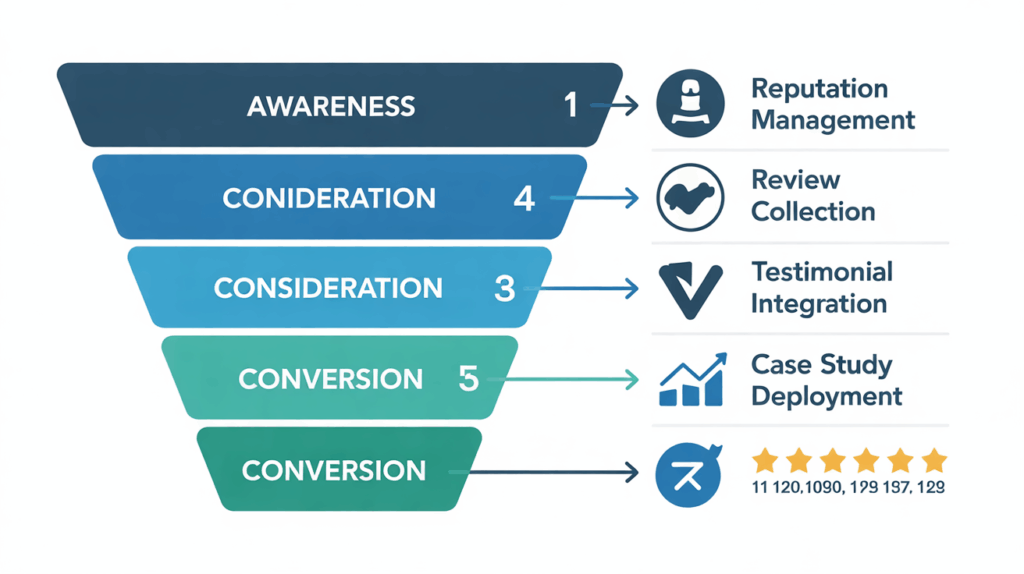
Reputation management is not a siloed PR activity.
It is an integrated strategy that provides leverage at every stage of the modern sales funnel.
Understanding the importance of reputation management in sales funnel structure requires a stage-by-stage analysis.
Stage 1: Awareness (Top of Funnel – ToFu)
This is where leads first encounter your brand.
Visibility is key, but visibility without credibility is worthless.
How Reputation Drives Awareness:
- SEO Power: Search engines reward authority. Google Business Profiles and high-ranking review sites (like Capterra, Clutch) with fresh, positive feedback signal relevance and trust. This improves your organic ranking.
- Content Amplification: Case studies and testimonials are content. If your base reputation is strong, this content is taken seriously. If your reputation is weak, those positive stories look fabricated.
- Local Search Dominance: For service businesses, local pack results are vital. High star ratings and review volume are the primary factors determining who appears first in local searches.
Stage 2: Consideration (Middle of Funnel – MoFu)
The prospect is comparing solutions.
They are evaluating your features against competitors’ features.
But they are also evaluating your risk profile against theirs.
Reputation is the tie-breaker here.
Reputation as the Deciding Factor:
- Review Comparison: Prospects look for patterns. They read the negative reviews to see if the complaints are consistent or resolved.
- Social Proof Validation: They check LinkedIn and social channels to see if real people are endorsing your product, often cross-referencing names or companies mentioned in testimonials.
- Response Strategy: How you respond to negative feedback speaks volumes about your customer service commitment. A professional, measured response can mitigate serious damage.
A single, unaddressed negative review can derail a well-nurtured lead.
We have seen the data on this repeatedly: a negative public perception can drop lead conversion rates by up to 15%.
A poor review score dramatically increases friction and significantly harms your lead conversion rate. This is why it is essential to monitor How Negative Reviews Impact Lead Conversion Rate.
Stage 3: Conversion (Bottom of Funnel – BoFu)
The deal is nearly closed.
The prospect is just looking for final confirmation.
This is the final due diligence check before signing the contract or inputting payment details.
Sealing the Deal with Trust:
Are they asking for references?
Are they doing one last search for news coverage?
If they find a recent, positive mention-a press release, a new case study, or a stream of fresh 5-star reviews-it provides the psychological safety net needed to convert.
Conversely, discovering a recent complaint that was never resolved can trigger instant cold feet.
Reputation management ensures that the closing argument is made by your satisfied customers, not just your sales team.
But how do you maintain this level of positive momentum across hundreds of digital touchpoints?
Reputation Management Goals by Funnel Stage
| Funnel Stage | Reputation Goal | Impact on Lead Gen/Sales |
|---|---|---|
| Awareness (ToFu) | Increase visibility via high star ratings (SEO). | Higher organic traffic; lower CPA on paid ads due to higher CTR. |
| Consideration (MoFu) | Demonstrate responsiveness and resolve issues publicly. | Faster lead qualification; reduced competitor comparison time. |
| Conversion (BoFu) | Provide fresh, relevant social proof and testimonials. | Reduced churn risk; decreased sales cycle length; higher close rates. |
The AI Advantage: Scaling Reputation Monitoring and Response

Reputation management used to be a massive time sink.
Monitoring dozens of platforms manually was impractical for SMBs and lean SaaS teams.
The good news? The rise of AI has democratized this crucial function.
In 2025, AI-powered tools are essential for achieving scale and speed in reputation management.
Automating the Review Cycle
Your team cannot manually check every corner of the internet daily.
AI can.
The modern AI lead generation stack includes tools that actively monitor brand mentions, sentiment, and review scores across all relevant channels.
This provides real-time alerts for critical issues.
Key AI Applications in Reputation Management:
- Sentiment Analysis: AI reads and classifies reviews instantly. It flags reviews needing immediate attention (high-severity negative feedback) versus general comments.
- Automated Review Requests: Integrating with your CRM, AI tools automatically trigger review requests post-purchase or post-service completion, ensuring a steady stream of fresh, positive social proof.
- Drafting Responses: AI models can generate professional, context-aware drafts for both positive and negative reviews, maintaining brand voice and ensuring rapid response times.
- Competitive Benchmarking: AI monitors competitor reputation scores and identifies areas where your brand can strategically outperform them in public perception.
This is where smart tools like Pyrsonalize.com come into play.
Our platform focuses on identifying and engaging leads, but that engagement is only successful if your brand foundation is solid.
AI allows your small team to manage reputation like an enterprise.
It turns a defensive task (damage control) into an offensive sales strategy (trust building).
Integrating Reputation Data with Lead Scoring
Reputation extends beyond simply responding to reviews.
It impacts how you view your prospects and how they view you.
Data enrichment tools now frequently incorporate reputation signals directly into lead scoring models.
For example, if a prospect works for a company that recently gave you a 5-star review, that lead automatically scores higher.
Why?
Because the trust barrier is already broken, indicating a higher propensity to convert.
AI helps you leverage existing customer advocacy to prioritize your best new opportunities.
Tactical Strategies: Building and Protecting Your Digital Assets
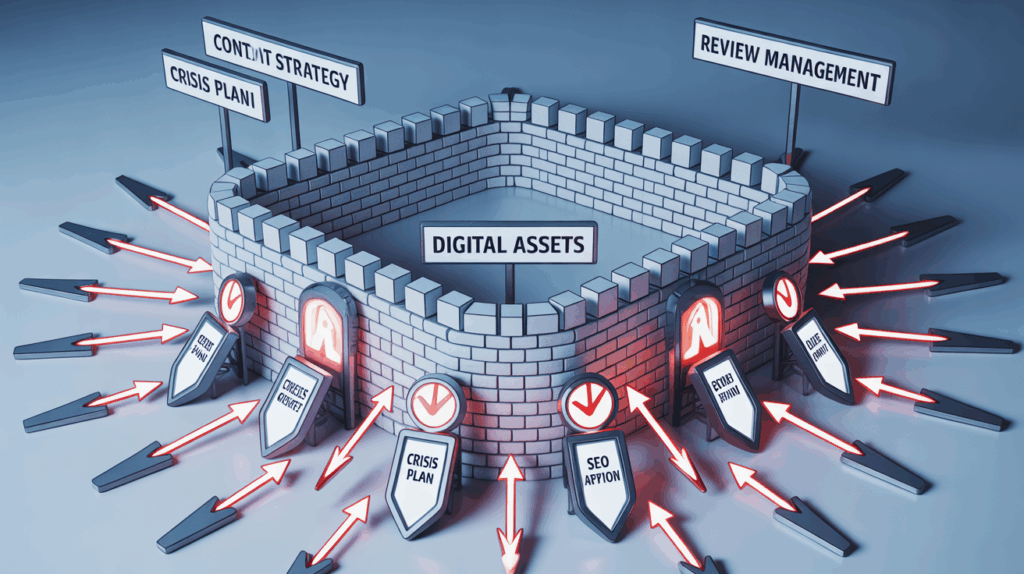
Managing reputation requires consistency and a clear process.
You must be proactive, not reactive.
For small businesses and SaaS founders, resources are limited, so every action must yield maximum ROI.
Strategy 1: Systematize Review Collection
Positive reviews do not happen by accident.
You must ask for them, and you must make it effortless.
The goal is to create a continuous, flowing stream of fresh endorsements.
Actionable Steps for Review Flow:
- Identify the Right Moment: Trigger requests immediately after a positive interaction (e.g., successful onboarding, high NPS score, renewal).
- Use Preferred Channels: Send requests via the communication method your customer prefers (SMS, email, in-app notification).
- Offer Direct Links: Never make the customer search. Provide one-click links to your preferred review platforms (Google Business Profile, G2, etc.).
- Train Your Team: Empower every customer-facing employee to identify happy customers and gently prompt them for feedback.
Strategy 2: Embrace Negative Feedback (The Recovery Loop)
Negative reviews are inevitable.
They are not failures; they are opportunities.
A well-handled complaint can be more powerful than ten positive reviews.
It shows potential buyers that you own your mistakes and prioritize resolution.
How do you handle a public critique professionally?
- Respond Quickly: Aim for a response within 24 hours. Speed shows you care.
- Take It Offline: Acknowledge the issue publicly, but invite them to a private channel (phone, support ticket) to resolve the specifics. This protects sensitive details and shows commitment.
- Be Empathetic and Professional: Never get defensive. Use standard brand language that expresses regret for the inconvenience.
- Follow Up: Once resolved privately, ask the customer to update or remove the original review. This turns a negative asset into a positive one.
Turning a negative situation into a marketing win requires strategy and nerve. For detailed steps on this process, see our guide on Turn Bad Reviews into Positive Marketing Assets.
Strategy 3: Centralize Monitoring and Reporting
You need a single source of truth for your reputation data.
Scattered monitoring leads to missed alerts and delayed responses.
Utilize reputation management software that aggregates data from all key platforms.
This centralization allows you to benchmark performance and correlate reputation scores directly with sales pipeline velocity.
Essential Monitoring Metrics:
- Review Volume & Velocity: How many new reviews are you getting, and how frequently? Consistency is key.
- Average Star Rating: Track trends, especially localized dips or spikes.
- Response Time: The average time taken to acknowledge both positive and negative reviews.
- Sentiment Trend: Are the reviews becoming more positive or negative over the last 90 days?
This data must feed back into your marketing and product teams.
Reputation management is a feedback loop, not just a cleanup crew.
Reputation and Lead Generation: Maximizing ROI

Why invest budget in reputation management when you could be running more ads?
Because reputation management is the multiplier for your existing marketing efforts.
It is the foundation upon which scalable lead generation is built.
Think of it as conversion rate optimization (CRO) for your entire brand identity.
Reducing Customer Acquisition Cost (CAC)
When prospects trust you immediately, they require less convincing.
This shortens the sales cycle and reduces the burden on your sales team.
If your ads point to a credible, well-reviewed business, your Quality Score improves, and your conversion rates climb.
This lowers your effective CAC, freeing up capital for further growth.
Building Defenses Against Crises
A positive reputation acts as a buffer.
If you have 100 recent 5-star reviews, one disgruntled customer posting a negative comment is a minor inconvenience.
If you only have 5 reviews total, that single negative review causes catastrophic damage.
Proactive reputation building is your insurance policy against future crises.
It ensures that when a negative mention surfaces, the sheer volume of positive data pushes it down the search results.
Focusing on Scalable Trust for SaaS and Service Firms
SaaS companies especially rely on validation.
Buyers want proof that the software integrates smoothly and solves complex problems.
Your reputation across integration marketplaces, security forums, and review platforms is non-negotiable.
For service firms, expertise is the currency.
Client testimonials and case studies must be easily accessible and overwhelmingly positive to justify premium pricing.
The importance of reputation management in sales funnel success ultimately boils down to one thing: trust drives transactions.
Ensure your digital presence reflects the high value you deliver.