

Negative reviews challenge even the most robust brands.
They are an inevitable reality in the digital landscape. Every business, especially SaaS and service providers, deals with criticism.
Do you panic when you see that one-star rating? You should not.
Smart marketers understand these reviews are not liabilities. They are untapped assets waiting for conversion.
This guide shows you exactly how to turn bad reviews into positive marketing assets. We move beyond simple damage control. We focus on leveraging criticism to generate qualified leads, build unparalleled trust, and fundamentally strengthen your E-E-A-T.
Your public response to criticism defines your brand’s integrity. Are you ready to convert complaints into conversions?
The Trust Equation: Why Negative Feedback Drives Leads

Consumers are highly skeptical today.
The market is saturated with polished, five-star review averages. Perfect scores look engineered. They trigger immediate distrust from sophisticated buyers.
What do these buyers actually seek? Authenticity and proof of commitment.
Nearly nine out of every ten consumers globally attempt to read online reviews before making a purchase. Furthermore, 76% of consumers trust online reviews just as much as personal recommendations.
This means your online reputation is your most critical lead magnet. Success is not just about having good reviews; it is about managing the bad ones transparently.
The Transparency Advantage
Transparency is the new currency of trust.
When potential customers browse your reviews, they are not just reading the complaint. They are meticulously studying your reaction.
They are running a psychological assessment of your operational maturity. They ask: How will this company treat me when their system fails?
A well-handled negative review provides more E-E-A-T proof than ten perfect reviews combined. It demonstrates genuine customer commitment and operational maturity.
Consider the core questions your response must answer publicly:
- Do you take immediate responsibility for operational mistakes?
- Are you defensive or solution-focused in your approach?
- Will you genuinely commit resources to make things right?
Your proactive, measured response is a public demonstration of service quality. It instantly elevates your brand above competitors who hide criticism or ignore public discourse.
The Conversion Cost of Silence
Ignoring negative feedback costs you immediate revenue.
It actively pushes qualified leads toward your competition. Research shows a dramatic split in consumer behavior based on your responsiveness.
89% of consumers are more likely to use businesses that respond to all reviews. Only 47% will engage with businesses that do not bother to respond.
That is nearly a 2:1 advantage gained simply by engaging publicly.
Silence signals apathy. It suggests you do not value the customer experience enough to engage publicly. This apathy directly impacts your bottom line and severely limits your lead conversion rates. If you want to understand the true financial impact, read our deep dive on How Negative Reviews Impact Lead Conversion Rate.
Conversely, businesses responding to reviews within 24 hours often see a significant boost in customer advocacy. Ignoring complaints leads to a sharp, measurable decline in advocacy.
The math is simple: Responsive reputation management is high-ROI lead generation.
Strategic Triage: Categorizing and Addressing Negative Reviews
You cannot respond to every review using the same protocol.
A systematic triage process is mandatory for scalability. This is especially true for growing SaaS platforms and high-volume service businesses. You need a structured filter.
This system allows you to prioritize high-impact reviews. It filters out noise efficiently. It ensures your team spends time resolving genuine operational issues, not arguing with bad-faith actors.
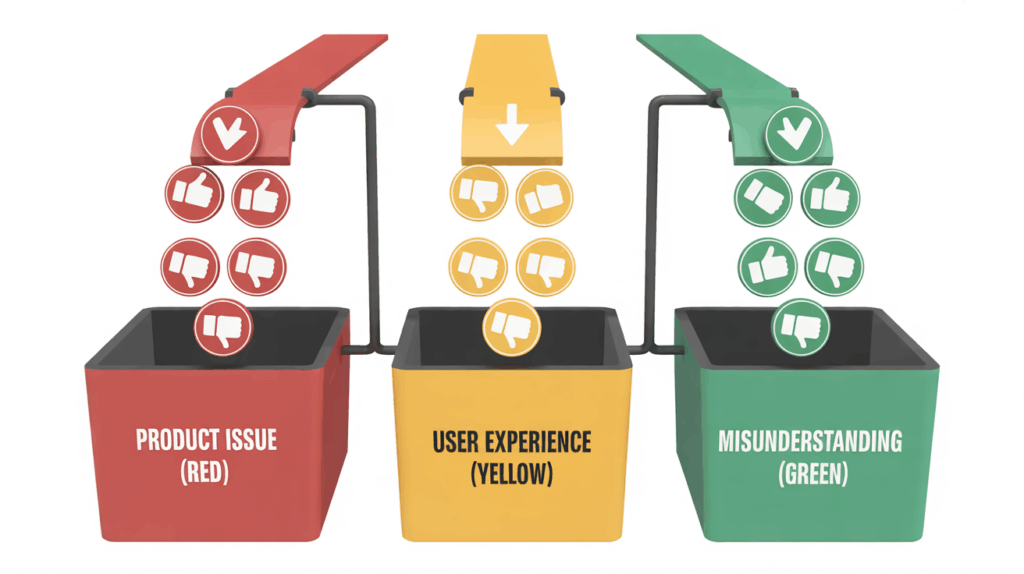
Identify the Three Review Types
Not all bad reviews are created equal. You must quickly categorize incoming feedback to deploy the correct resource.
Here are the three types of negative reviews and the expert approach for each:
- The Constructive Critique: This is marketing gold. The review is negative but provides specific, actionable insights (e.g., “The API documentation was outdated,” or “Your support chat took 48 hours to respond during peak hours.”). This high-value feedback must be addressed immediately. It must be internally routed for prompt, documented resolution.
- The Destructive Rant: This feedback is often vague, highly emotional, or contains outright inaccuracies and insults. It fundamentally lacks substance and actionable data. These reviews should be reported to the hosting platform (Google, Yelp, G2) if they violate terms of service, rather than engaged in a public, unproductive debate.
- The Misunderstanding: The customer is frustrated, but the issue stems from a lack of clarity regarding product features, service scope, or expectations. This is a prime opportunity for education and clarification. It often leads to a quick resolution and, critically, a review update.
Your strategic focus must be on the Constructive Critique and the Misunderstanding. These are the reviews you can reliably flip into powerful positive marketing assets.
The 24-Hour Response Imperative
Speed matters immensely in online reputation management. It is a non-negotiable metric.
Delaying a response only amplifies the reviewer’s frustration. A delay signals that the complaint is not a high-priority operational concern.
We recommend establishing a strict 24-hour response window for all negative feedback posted on major public platforms. This urgency demonstrates commitment and operational rigor.
| Action Stage | Goal | Required Tone |
|---|---|---|
| Stage 1: Acknowledge (Immediate) | Validate the customer’s frustration. Thank them sincerely for providing the feedback loop. | Apologetic, Empathetic, Engaged |
| Stage 2: Investigate (Within 12 Hours) | Ask specific, clarifying questions (e.g., date of service, specific staff member, error code, account ID). Move the conversation immediately offline to a private channel. | Professional, Detail-Oriented, Solution-Seeking |
| Stage 3: Resolve (Within 48 Hours) | Provide a concrete solution, compensation, or clear plan of action. Publicly summarize the positive resolution outcome (if appropriate and permitted). | Actionable, Confident, Generous |
Remember, the public response is your sales pitch to every future potential client. It assures them that you have a formal, serious process in place to handle issues. This proactive approach is a cornerstone of Reputation Management: Fueling Your 2025 Sales Funnel.
The AI-Powered Response Framework for Scale

Managing high review volume manually is inefficient and prone to error.
Scaling SaaS platforms and service companies require efficiency. You must leverage AI to handle the initial heavy lifting of reputation management.
AI tools are essential for rapid issue identification. They draft empathetic responses at scale. They ensure consistency and speed across dozens of disparate review platforms.
Automating Sentiment Analysis
The first step in crisis management is instant situational awareness.
AI-powered sentiment analysis tools monitor review sites, social media, and forums instantly. They flag negative feedback based on severity, volume, and critical keywords.
How quickly can your organization identify a potential PR crisis? AI makes it instantaneous, not retrospective.
These tools integrate seamlessly with your CRM and lead generation stack. They turn unstructured text data into actionable support tickets. This accelerates the resolution process.
This automation allows your human team to focus only on resolution and personalization, not monitoring. This saves countless hours that can be redirected toward core sales outreach or critical product development.
Crafting Empathy at Scale
AI can draft high-quality, contextually personalized response templates.
This is not about generic, automated copy-pasting. Modern AI understands context, required tone, and brand guidelines.
It can generate a draft response that incorporates the reviewer’s specific complaint. It maintains your required authoritative brand voice. A human agent then reviews, customizes, and posts the final, validated reply.
This drastically reduces response time by an estimated 60%. It maintains the required level of human empathy and attention to detail.
Key elements AI assists in generating efficiently:
- A sincere apology tailored to the specific complaint details.
- A brief emphasis on your company’s core value (e.g., “Customer success is our ultimate operational priority”).
- Clear, direct contact information for a senior manager to move the discussion privately and efficiently.
While Pyrsonalize.com focuses primarily on high-volume lead generation, the data captured during the lead process directly influences future product expectations. Using AI to manage the resulting feedback loop closes the system effectively. For scaling outreach efforts, explore Top AI Tools for High-Volume Cold Outreach 2025, which often overlap with reputation management tools.
Leveraging Feedback for Product Enhancement (The Fix-and-Broadcast Strategy)
A constructive negative review is a free consultation from a paying user.
It highlights a critical flaw in your product, service, or process that your customers are actively experiencing. You must immediately utilize this intelligence.
The most powerful way to turn a bad review into a marketing asset is to fix the underlying issue, and then strategically broadcast that fix.
- Internalize the Critique: Route the constructive feedback to the relevant department (Engineering, Customer Success, Operations). Assign a specific ticket ID.
- Implement the Change: Fix the bug, retrain the staff, or update the confusing documentation. Prioritize rapid deployment of the solution.
- Follow Up Publicly: Return to the original review thread. Thank the customer again by name (if possible). State clearly, “Because of your detailed feedback, we identified a critical flaw in X process. We have now implemented Y solution and pushed it live in release 4.2.”
This “Fix-and-Broadcast” method is marketing genius in action. It shows prospective buyers two undeniable facts:
- You actively listen to user input.
- Your product is constantly improving based on real-world user needs.
When a prospect sees you took a one-star review and turned it into a permanent product update, they trust your commitment to quality instantly. This is quantifiable E-E-A-T in action, leading to higher conversion rates.
Turning Criticism into Content: Marketing Assets
You have responded privately and fixed the underlying issue. The internal work is complete.
Now, it is time to use the negative review externally. This is the advanced stage of how to turn bad reviews into positive marketing assets.
We are talking about proactive, bold marketing campaigns. These campaigns leverage skepticism to build trust and efficiently qualify incoming leads.
The Domino’s Strategy: Radical Honesty
Recall the famous Domino’s Pizza Turnaround campaign.
They did not hide their negative reviews. They leveraged them. They put the worst, most cutting reviews on national television. Executives acknowledged the criticism openly: “Our pizza tasted like cardboard.”
This radical honesty was revolutionary. It created immense goodwill and trust because it was unexpected, raw, and verifiable.
How can your SaaS or service business apply this high-stakes strategy?
- Create a “We Heard You” Page: Dedicate a section of your website to publicly listing major past flaws and detailing exactly how they were fixed and iterated upon.
- Use Review Quotes in Ads: If a past review says, “Your interface was confusing last year,” run a targeted ad campaign that states, “It was confusing. We rebuilt it from the ground up based on 1,000 user inputs. See the new V3 interface now.”
- Internal Case Study: Create a video or detailed blog post detailing the journey of fixing a major, publicly cited flaw. Name the specific product feature that was fundamentally improved due to user input.
Radical honesty stops prospects from searching for flaws. You presented them first, along with the concrete solution. This builds a powerful, resilient bridge to customer loyalty.
The Oats Overnight Tactic: Differentiation by Exclusion
Sometimes, a negative review simply highlights that the customer was not a good fit for your product’s core value proposition.
This is a fantastic opportunity for proactive lead qualification. You can use the negative feedback to clearly define your target audience and strategically repel bad-fit leads.
Consider the example of Oats Overnight. They ran Instagram ads featuring 1-star reviews that complained about the product being “Too chocolatey” or “Not traditional hot oatmeal.”
For their actual target audience (busy professionals seeking portable, cold, high-protein breakfast solutions), these “negative” reviews were actually powerful selling points.
Use negative reviews to clarify your market position:
| Negative Review Statement | Marketing Asset Translation (Expert Tone) | Lead Qualification Effect |
|---|---|---|
| “Too complex for basic users. I need simple drag-and-drop.” (SaaS) | “This platform is engineered for the sophisticated enterprise user, prioritizing integration depth and feature density.” | Repels basic users, attracts high-value, sophisticated leads who need power. |
| “Expensive compared to generic options. I found a cheaper vendor.” (Service) | “We are not the cheapest provider. We are the most comprehensive solution for guaranteed compliance and speed of delivery.” | Filters out budget shoppers, attracts quality clients prioritizing results over minimal cost. |
| “I couldn’t enjoy drinking my breakfast. It felt too fast.” (Product) | “Built exclusively for the demanding, on-the-go lifestyle. If you need a fast, drinkable meal replacement, this is your solution.” | Clearly defines the product use case and filters for the high-priority buyer persona. |
By highlighting what you are not, you speak louder and clearer to the audience you truly serve. This is efficient, sophisticated lead qualification achieved through transparent marketing.
Repurposing Responses as Case Studies
Every successful resolution is a mini-case study on customer service excellence. You must capture this data.
Do not allow your detailed, empathetic response to live only on Google Reviews. Capture that exchange and leverage it.
How you handled the problem is a powerful sales tool. It proves your commitment better than any mission statement or corporate value slide.
Steps to repurpose a resolution asset:
- Anonymize and Summarize: Take a compelling negative review and your subsequent resolution process. Anonymize all customer identifying details.
- Focus on the Process: Detail the specific steps taken: investigation, internal team collaboration (Engineering, Success), solution implementation, and the final generous offer (e.g., a complimentary month of service).
- Create Content: Turn this into a professional blog post titled, “How We Handled a Critical Service Failure in Q3,” or a short, data-driven LinkedIn post.
- Integrate into Sales Training: Use these documented examples internally. Train your sales team on objection handling and effective service recovery.
When a prospect asks, “What happens if I have a major problem with your service?” your sales team can point directly to a documented, successful service recovery asset. That is the ultimate, non-negotiable demonstration of trustworthiness.
Negative reviews are not setbacks. They are high-value opportunities for aggressive, transparent marketing. They build the E-E-A-T foundation necessary for sustainable lead generation and long-term customer relationships. Start viewing every complaint as a structured chance to publicly prove your commitment to operational excellence.