

The digital landscape has fundamentally changed how leads are generated.
Your website used to be your storefront. Now, your online reputation is the foundation of your entire sales funnel.
For SaaS founders and SMB leaders, ignoring Online Reputation Management (ORM) is financial negligence.
In 2025, trust is the ultimate conversion metric.
How can you expect scalable lead generation if prospects distrust your brand before they even reach your landing page?
This comprehensive guide dives deep into the critical importance of reputation management in sales funnel optimization.
We show you exactly how E-E-A-T (Experience, Expertise, Authoritativeness, Trustworthiness) drives revenue, especially when amplified by modern AI tools like Pyrsonalize.com.
The Digital Trust Crisis: Why Reputation is the New Lead Magnet

Forget outdated marketing models.
The traditional funnel is dead. It has been replaced by a looping, non-linear customer journey.
This journey is dominated by peer validation and social proof.
Consumers do not rely solely on your marketing copy anymore.
They rely on what other customers say about you.
Understanding this fundamental shift is the first step toward optimizing your lead flow.
The 2025 Consumer Behavior Shift
Data consistently proves this shift.
The vast majority of consumers, around 95%, read online reviews before committing to a purchase decision.
Even more critically, negative feedback causes significant avoidance.
If your business has poor ratings, nearly 9 out of 10 prospects will avoid you entirely.
This is not a mere branding issue; it is a direct lead volume problem.
Your online reputation acts as a powerful gatekeeper to your sales funnel.
What happens if that gate is locked by negative reviews? Leads simply stop flowing.
We must acknowledge the core components that define digital trust today, directly supporting E-E-A-T:
- Review Recency: Prospects prioritize reviews left within the last 3 to 6 months. Old praise holds less weight, diminishing perceived Expertise.
- Response Rate: Businesses that actively respond to feedback are perceived as 1.7x more trustworthy than those that remain silent. This shows accountability and Experience.
- Platform Consistency: High, consistent ratings across multiple platforms (Google, Yelp, G2, Capterra) reinforce credibility and Authoritativeness.
- E-E-A-T Signaling: High-quality reviews detailing specific customer success experiences validate your product’s performance and Trustworthiness.
Reputation management is no longer a reactive public relations task.
It is a proactive, scalable strategy directly linked to lead generation success.
Reputation vs. Traditional Marketing Spend
Consider your current marketing budget.
How much are you spending on paid ads or content creation?
If your reputation is weak, that spending is highly inefficient.
Think of ORM as optimizing the conversion rate of your entire marketing investment.
A strong reputation provides crucial leverage.
It makes every dollar spent on lead generation, from cold outreach to SEO, work harder.
Why pour budget into traffic acquisition if that traffic immediately bounces after reading a negative review?
A poor reputation leads to several costly outcomes:
- Increased CPA (Cost Per Acquisition): You must spend more to convince skeptical prospects.
- Lower Quality Leads: Prospects who ignore negative signals are often less qualified or more price-sensitive, harming deal size.
- Higher Churn Rate: If reviews reveal service gaps, new customers are likely to leave quickly, harming Customer Lifetime Value (CLV).
- SEO Penalties: Local SEO algorithms favor businesses with high ratings and review volume, directly impacting organic lead discovery and visibility.
Investing in reputation management is an investment in funnel insulation.
It ensures that the leads you acquire are ready to convert, maximizing ROI.
Mapping Reputation to the Modern Sales Funnel Stages
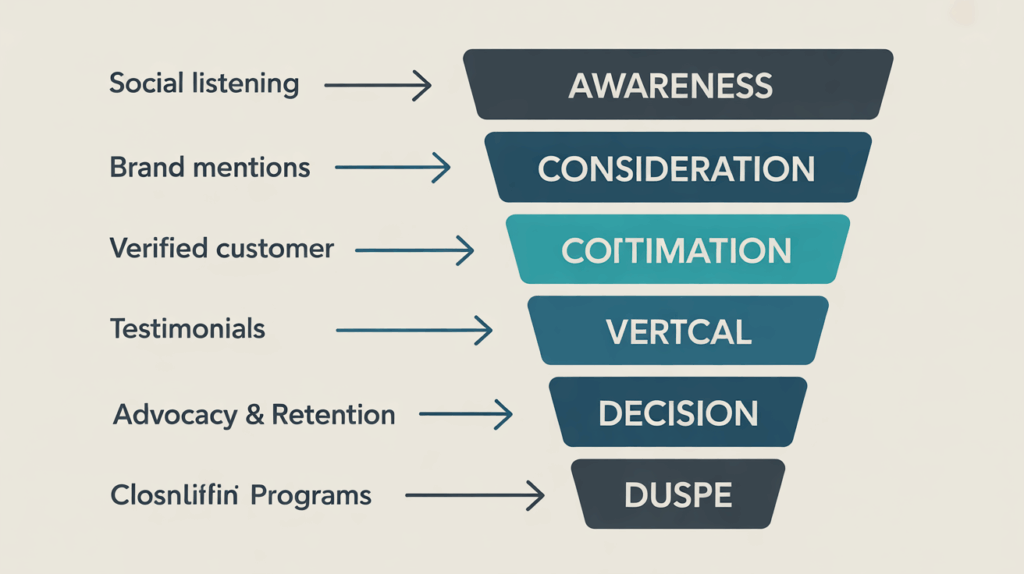
The importance of reputation management in sales funnel integrity cannot be overstated.
Reputation impacts every single stage, from initial awareness to final retention.
Let’s map out exactly how a managed reputation drives prospects forward through the contemporary buying journey.
Awareness and Discovery
This is the top of the funnel (ToFu).
The prospect recognizes a problem and begins searching for solutions.
How does reputation play a role here? It determines whether your business even appears in the search results.
- SEO Visibility: Search engines like Google prioritize local businesses with high ratings. Positive reviews are a critical ranking factor, especially in the Google Maps pack.
- Social Proof Signaling: When prospects see high star ratings adjacent to your brand name in search results or social feeds, awareness is instantly coupled with credibility.
- Referral Velocity: Satisfied customers are more likely to recommend you, feeding new, highly qualified leads directly into the awareness stage.
A strong reputation acts as a magnet, drawing qualified traffic from the start.
If you are struggling with visibility, check your review profile first.
Interest and Consideration
The prospect has found you. Now they are actively evaluating you.
They are visiting your website, comparing features, and looking at case studies.
Crucially, they are reading your reviews.
During this critical middle-of-the-funnel (MoFu) stage, reputation dictates momentum and competitive viability.
What are prospects looking for in reviews during consideration?
- Specific Use Cases: They look for reviews that mirror their own business needs. Does your SaaS solve problems for companies their size and industry?
- Service Quality: Reviews about customer support, onboarding, and responsiveness are key differentiators. These details validate your long-term trustworthiness.
- Addressing Weaknesses: They want to see how you handle problems. A professional, timely response to a negative review often builds more trust than a hundred positive ones.
This stage is where your AI lead generation strategies must align with your reputation.
If you are using tools for Data Enrichment Tools: Score Leads Faster in 2025, ensure the personalized outreach references genuine social proof.
A personalized message backed by stellar G2 reviews is far more impactful than a generic pitch.
Conversion and Retention
We are now at the bottom of the funnel (BoFu).
The prospect is ready to buy but is likely considering one or two competitors.
Reputation seals the deal.
Positive testimonials featured prominently on conversion pages act as powerful, final trust signals.
Consider the final conversion signals provided by reputation:
- Final Push Trust: Using specific review quotes in Call-to-Action (CTA) language encourages immediate action by alleviating risk.
- Competitive Edge: When two SaaS solutions are nearly identical in features, the one with the higher recent rating wins the business 90% of the time.
- Retention Feedback Loop: Post-purchase review requests and feedback mechanisms are critical. They ensure satisfaction continues, lowering churn and driving future referrals, restarting the funnel.
A strong reputation isn’t just about getting the first sale.
It’s about building a loyal customer base that actively fuels the top of your funnel through positive word-of-mouth and case studies.
Operationalizing ORM: AI Strategies for Lead Generation
Managing reputation manually is impossible for scaling businesses.
Small businesses and SaaS companies need efficiency and precision.
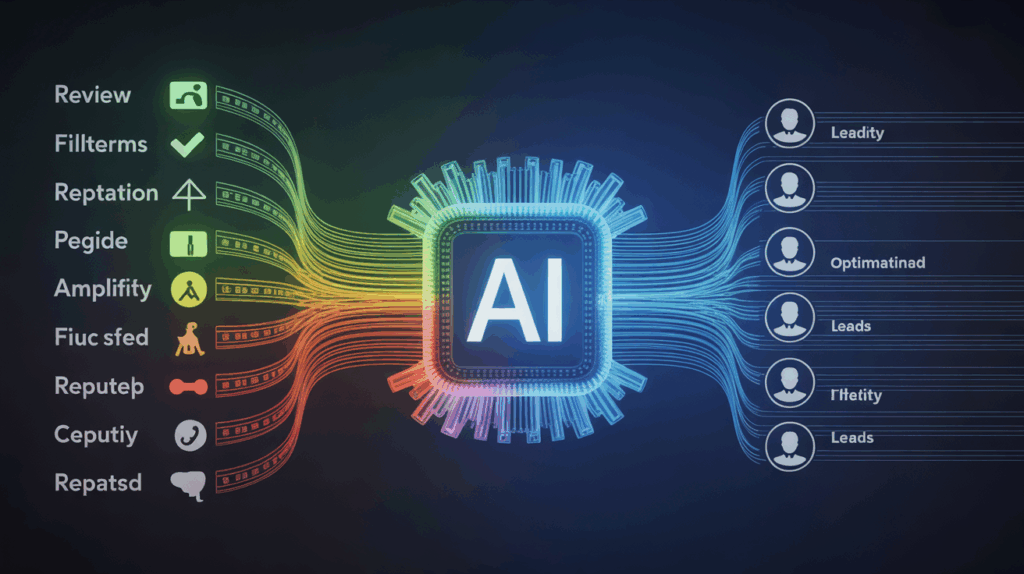
This is where AI-powered lead generation tools become essential partners in ORM.
You must automate the monitoring, gathering, and leveraging of customer feedback.
Automated Monitoring and Response Loops
You cannot respond quickly if you don’t know a review exists.
Modern AI tools monitor dozens of platforms simultaneously, 24/7.
They alert your team the moment a mention or review (positive or negative) appears.
This speed is vital. Timeliness demonstrates commitment to customer service.
It satisfies the prospect’s need for instant validation and Trustworthiness.
How AI enhances the ORM workflow:
- Sentiment Analysis: AI immediately categorizes reviews by sentiment (positive, neutral, critical), prioritizing urgent responses and identifying crisis points.
- Keyword Extraction & Topic Modeling: It identifies recurring themes (e.g., “slow support,” “great UI,” “pricing issue”). This provides actionable insights for product development and marketing messaging.
- Drafting Responses: AI can generate professional, context-aware response drafts based on the review content, significantly saving hours for your customer success team.
This automation should integrate seamlessly into your existing tech stack.
Are your review alerts feeding directly into your CRM? They should be. This creates a closed-loop system for continuous improvement.
Leveraging Positive Feedback for Outreach
Positive reviews are not just vanity metrics. They are powerful lead generation assets.
You must repurpose this content strategically and systematically.
Think about how you use Pyrsonalize.com to personalize outreach.
The content of a positive review provides the perfect, highly specific personalization hook, validating your E-E-A-T.
Here is how to leverage positive reviews in sales outreach:
- Case Study Identification: Identify the most detailed, positive reviews highlighting ROI. Contact that customer and ask if they will convert their review into a full case study or testimonial video.
- Targeted Outreach Messaging: If a prospect expresses a pain point similar to one solved in a recent review, use that review snippet in your cold outreach email to establish immediate credibility.
- Social Media Amplification: Turn snippets into engaging graphics for LinkedIn and Twitter. This instantly broadcasts your expertise and authority to cold audiences.
When executing Top AI Tools for High-Volume Cold Outreach 2025, always lead with social proof.
It cuts through the noise and immediately establishes trust.
Handling Negative Reviews Professionally
Negative feedback is inevitable. It is not a crisis; it is an opportunity to showcase integrity.
Prospects understand that no business is perfect.
What they judge is your reaction to imperfection.
A well-handled negative review can actually increase trust, demonstrating accountability and commitment to resolution.
Follow these non-negotiable best practices for responding to negative reviews:
| Step | Action Mandate | Goal |
|---|---|---|
| 1. Acknowledge Promptly | Respond within 24 hours, even if only to say, “We are investigating this issue.” | Demonstrate responsiveness and care to the public audience. |
| 2. Stay Professional | Never argue or become defensive. Use calm, objective language aligned with your brand voice. | Maintain brand integrity under pressure. |
| 3. Apologize (If Applicable) | Offer a sincere apology for the negative experience, validating the customer’s feelings. | Show empathy and ownership. |
| 4. Move Offline | Provide a direct email or phone number to resolve the specific issue privately. | Protect sensitive information and prevent public escalation. |
| 5. Follow Up | After resolution, ask the customer to update their review (never demand it). | Show future prospects that issues get resolved and closed. |
Remember, every response you write is not just for the reviewer.
It is for the hundreds of future prospects reading that thread and judging your business model.
The ROI of Trust: Metrics That Matter in ORM
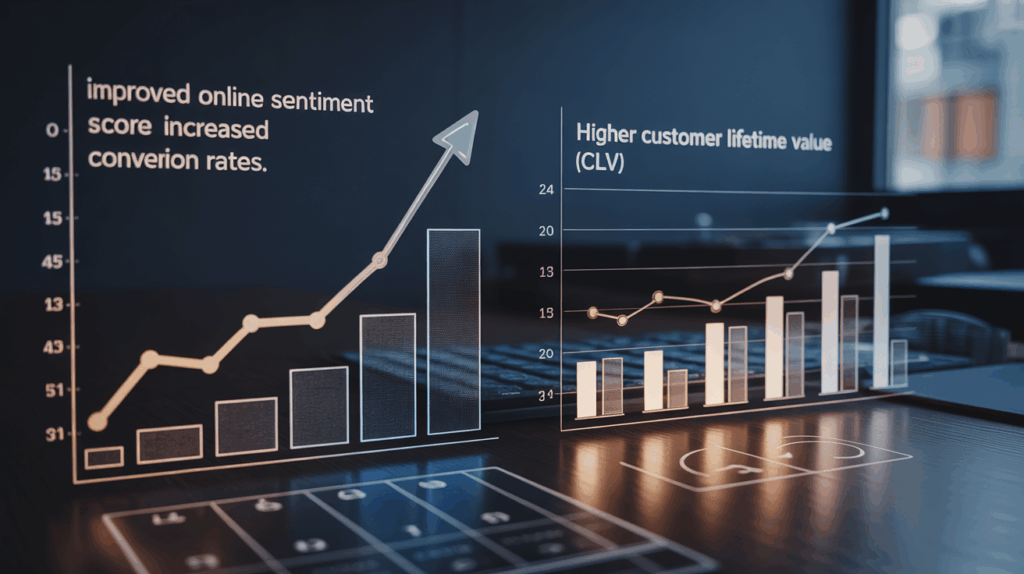
Reputation management must be quantifiable.
How do you prove that investing in ORM directly impacts your bottom line?
You track the right metrics, tying ORM activities directly to revenue goals.
In 2025, ORM is a revenue driver, not a cost center.
Conversion Rate Uplift
The most direct measure of successful ORM is improved conversion rates.
When prospects arrive at your site with high pre-existing trust, the friction to convert drops dramatically.
A quantifiable benchmark: moving from a 3.0 to 4.0 star rating can increase overall revenue by 5% to 9%.
This uplift is quantifiable across several key areas:
- Trial Sign-ups: Visitors who read a positive third-party review are significantly more likely to start a free trial or request a demo on the spot.
- Landing Page Performance: A/B test landing pages that feature prominent, recent testimonials against those that do not. The difference in conversion percentage is often stark.
- Sales Cycle Velocity: Sales reps spend less time overcoming skepticism and more time discussing solutions, leading to faster deal closures and improved efficiency.
If your lead generation efforts are consistently bringing in traffic, but conversions are lagging, look at your reputation score first.
The correlation between star rating and revenue is undeniable.
Reducing Cost Per Acquisition (CPA)
We discussed the inefficiency of spending on ads when trust is low.
Conversely, a strong reputation lowers your CPA by optimizing existing spend.
How does this happen?
Strong ORM reduces CPA by:
- Improving Ad Quality Score: Google and social platforms reward advertisers whose landing pages and brand profiles match user expectations. High ratings boost perceived quality, lowering bid costs.
- Increasing Organic Leads: Better SEO visibility from review volume means fewer leads must be purchased via expensive paid channels.
- Boosting Referral Rates: Satisfied customers refer new business-these are the lowest CPA leads possible and carry inherent trust.
If your SaaS relies on high-volume lead generation, every percentage point of conversion rate improvement matters.
Pyrsonalize.com helps you acquire high-quality leads efficiently.
ORM ensures those leads trust you enough to engage with your targeted outreach.
The integration of scalable lead identification and robust reputation management creates a true growth engine for your business in 2025.