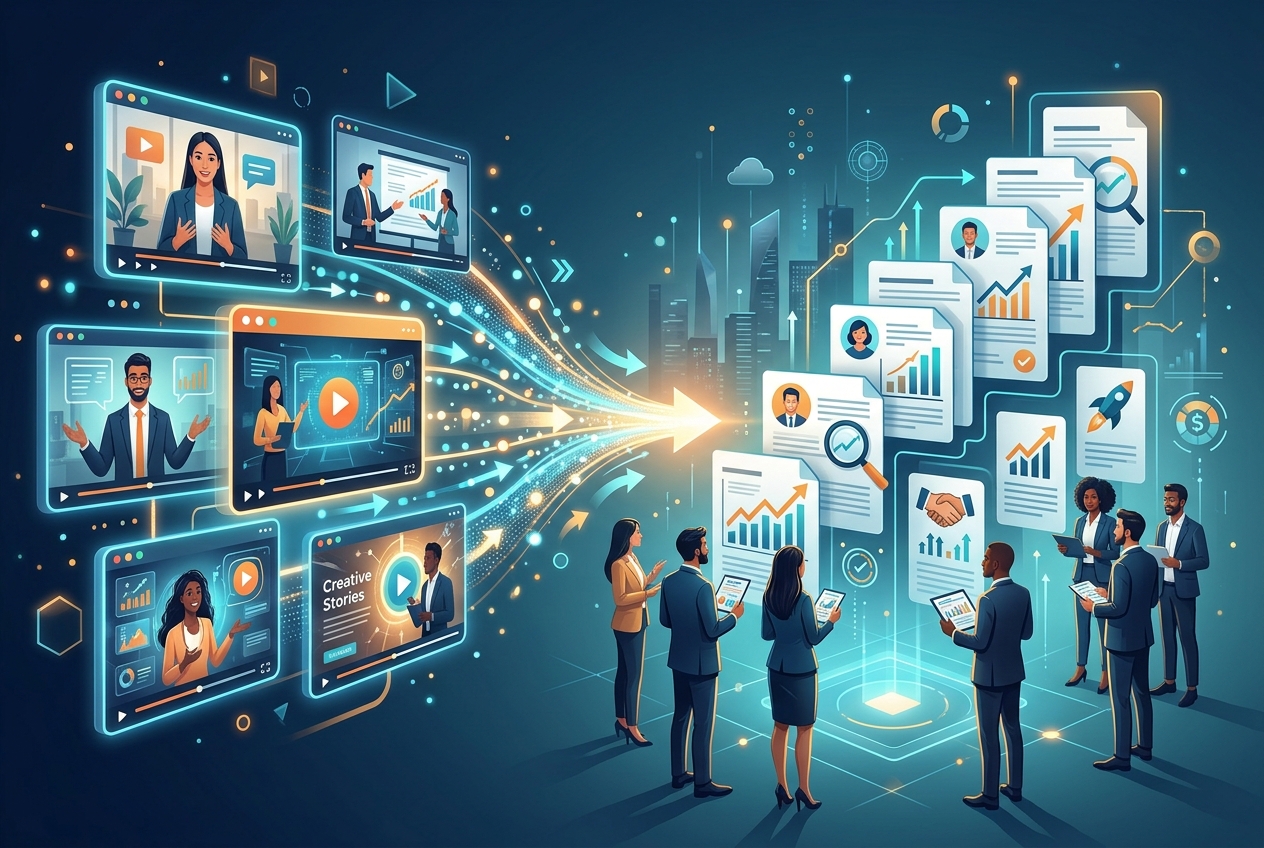

The Impact of Video on Lead Generation in 2026
Video marketing is no longer just a trend. It’s a vital part of successful lead generation strategies in 2026. The internet is full of content. Standing out requires fresh approaches. At pyrsonalize.com, we understand the changing needs of B2B marketers. Video is essential for getting attention and increasing conversions.
The challenge is creating videos that connect with your audience, offer real value, and fit into your lead generation process. Buyers have high expectations. Generic content won’t work. Marketers must use data, personalization, and smart distribution to get the most from their video efforts.
This section looks at how video affects lead generation now. It highlights important strategies and gives examples of businesses using video to get great results. We’ll examine video content syndication, personalized video, and matching your video strategy to the buyer’s journey. Discover how to use video to improve lead generation and get better results.
Here’s what we’ll cover:
- The evolving role of video in B2B marketing: Understanding how video consumption habits have changed and what it means for your strategy.
- Key video formats for lead generation: Exploring the effectiveness of different video types, from explainer videos to webinars and customer testimonials.
- Personalization strategies for video marketing: How to create tailored video experiences that resonate with individual prospects.
- Integrating video into your lead generation funnel: Best practices for incorporating video into your website, landing pages, and email campaigns.
- Measuring the ROI of your video marketing efforts: Key metrics to track and how to optimize your video strategy for maximum impact.
We’ll also see how video works with other lead generation methods, like:
- Content Syndication: Repurposing video content for broader reach and lead capture on third-party platforms.
- Account-Based Marketing (ABM): Creating personalized video experiences for target accounts to drive engagement and accelerate the sales cycle.
- Intent Data: Using intent data to identify prospects who are actively researching solutions related to your video content.
By combining these strategies with strong video content, you can build a lead generation system that gets results. Let’s look at the possibilities of video marketing for lead generation.
Optimizing Your Website for B2B Lead Generation
Your website is the first point of contact for potential clients. It’s a vital tool for B2B lead generation. A good website improves lead generation. A poorly designed one can push prospects away. Let’s examine the key parts of a successful website for generating leads.
Contact Accessibility: A Smooth User Experience
A core element of a website that generates leads is simple contact options. Potential clients should easily find ways to connect with your company, no matter where they are on your site. Place contact information and clear calls to action (CTAs) strategically throughout your website.
- Prominent Contact Information: Your phone number, email address, and physical address (if applicable) should be easy to find, ideally in the header or footer of every page.
- Clear “Contact Us” Page: A dedicated “Contact Us” page should have a contact form, a map (if you have a physical location), and links to your social media profiles.
- Strategic CTAs: Use direct CTAs like “Request a Demo,” “Get a Quote,” or “Download Our Guide” to encourage visitors to take the next step.
- Live Chat Integration: Think about adding a live chat feature to give support and answer questions immediately. This can improve engagement and lead capture.
When visitors can easily contact you, you reduce friction. This increases the chance of creating leads.
Avoiding Overwhelming CTAs: Balancing User Needs
Clear CTAs are important. However, too many can hurt your efforts. Too many pop-ups, intrusive chatbots, and overwhelming links can make users feel negatively about your site. This can drive prospects away. The trick is to find the right balance.
- Prioritize Key CTAs: Focus on the most important actions you want visitors to take. Highlight those CTAs.
- Avoid Excessive Pop-ups: Use pop-ups sparingly. Make sure they relate to the content on the page. Time them well so they don’t interrupt the user.
- Use Chatbots Strategically: Chatbots can be useful. Don’t use them in an aggressive way. Offer them as an option for visitors who need help, instead of forcing a conversation.
- Simplify Navigation: A clean navigation structure helps visitors find what they need. They won’t feel overwhelmed by too many choices.
The goal is to guide visitors through your website in an enjoyable way. Avoid bombarding them with distractions.
Website Navigation and Landing Page Optimization
A well-structured and easy-to-use website is key for attracting potential customers. People should quickly find what they need without frustration. This demands careful thought and attention.
- Clear Site Architecture: Organize website content into logical categories. A hierarchical structure helps visitors understand the relationship between different pages.
- Intuitive Navigation Menu: The navigation menu should be clear and easy to use. Descriptive labels should accurately reflect each page’s content.
- Search Functionality: A search bar lets people quickly find specific information.
- FAQ Section: A detailed FAQ section answers common questions and addresses concerns. This saves time for both your team and visitors.
- Mobile Optimization: The website must be fully responsive on mobile devices. Much web traffic comes from phones, so a smooth mobile experience is important.
Prioritizing easy navigation helps people find information fast, boosting lead generation.
Landing pages capture leads and drive conversions. They often support marketing campaigns, like email or paid ads. To improve landing page performance, concentrate on a clean design, strong calls to action (CTAs), and testimonials.
| Element | Description | Best Practices |
|---|---|---|
| Clean Design | A visually appealing design focuses attention on the key message. | Use white space, limit images and videos, and ensure readability. |
| Strong CTA | A clear call to action encourages visitors to take the desired action. | Use action words, make the CTA button prominent, and place it where it’s easily seen. |
| Testimonials | Social proof demonstrates the value of your product or service. | Use real testimonials from actual customers. Include photos and names, and highlight specific benefits. |
Even if website changes take time, improving landing pages can significantly improve lead generation. A well-made landing page can turn a missed chance into a lead.
Setting up a website for B2B lead generation requires considering ease of contact, user experience, navigation, and landing page design. Prioritizing these things creates a website that attracts visitors and converts them into leads.
Make it Easy to Contact You
In 2026, straightforward contact methods are essential for successful lead generation. Your website should act as an accessible hub, offering visitors multiple ways to connect with your company. Providing varied contact options accommodates different user preferences, improving lead capture.
Here’s how to make communication simple on your site:
- A Prominent “Contact Us” Button: This is essential. The “Contact Us” button should stand out visually and be easily found on every page. Place it in the header, footer, and main navigation. The button should link to a dedicated contact page featuring a user-friendly form, your email, phone number, and physical address (if applicable).
- Free Downloadable Resources (Lead Magnets): Offer resources like ebooks, whitepapers, templates, or checklists in exchange for contact information. This is a strong lead generation method. These resources should address specific issues for your target audience. The download process should be simple, requiring minimal user effort.
- Newsletter Signup Options: Building an email list helps nurture leads and maintain visibility. Add newsletter signup forms throughout your site, such as in the footer, sidebar, or within relevant blog posts. Clearly state the benefits of subscribing, such as exclusive content, industry insights, or special offers.
- Live Chat Support: A live chat feature allows real-time engagement with visitors, answering their questions instantly. This improves user experience and increases lead capture. Ensure knowledgeable representatives staff your chat support to provide helpful answers.
- Social Media Integration: Include links to your social media profiles on your website. Visitors can connect on their preferred platforms and stay updated on your news and content.
- Clear and Concise Contact Forms: Keep contact forms short, asking only for essential information. Lengthy forms can deter visitors. Use clear labels for each field and provide instructions where needed.
Implementing these strategies creates an accessible online presence that encourages visitors to connect with your company and become leads. The easier the contact process, the more likely people are to reach out.
Reference this table:
| Contact Method | Placement | Benefits |
|---|---|---|
| “Contact Us” Button | Header, Footer, Navigation Menu | Easy access to contact information |
| Free Downloadable Resources | Landing Pages, Blog Posts | Captures leads with content |
| Newsletter Signup | Footer, Sidebar, Blog Posts | Builds an email list |
| Live Chat Support | All Pages | Real-time engagement |
Avoid Too Many CTAs
User Experience First: Avoiding Too Many CTAs
When generating leads in 2026, the temptation to overwhelm website visitors with calls to action (CTAs) can be strong. A pushy approach, however, can backfire. It can frustrate users and hurt your lead generation efforts. The trick is finding the right balance. You must guide visitors toward conversion while ensuring a smooth, pleasant browsing experience.
Think about walking into a store where aggressive salespeople hawk different products. You would likely leave, feeling overwhelmed and annoyed. Your website works the same way. Too many pop-ups, intrusive chatbots, and a cluttered layout with too many links can create unease, driving potential leads away.
Instead of overwhelming people, focus on placing a few, well-chosen CTAs strategically. Make sure they fit the context of each page. For instance, a blog post about a specific product feature should include a CTA to “Learn More” or “Request a Demo,” rather than a generic “Contact Us” button.
Here are ways to avoid overloading visitors with CTAs:
- Limit Pop-up Frequency: Pop-ups can grab attention, but use them sparingly. Don’t display them immediately when a page loads or while users are reading content. Consider exit-intent pop-ups. These only appear when someone is about to leave.
- Use Chatbots Carefully: Chatbots can assist visitors, but should not be intrusive. Avoid starting a chat as soon as someone visits your site. Instead, offer the chatbot as an option for those who want help. Let them start the conversation.
- Simplify Navigation: Clear, intuitive navigation guides visitors to the information they want. Don’t clutter your navigation menu with too many options. Use descriptive labels that accurately describe each page’s content.
- Prioritize Key CTAs: Determine the most important actions you want visitors to take. Focus on promoting those CTAs. Avoid weakening their impact by including too many secondary CTAs.
- A/B Test Your CTAs: Test different CTA placements, designs, and wording to see what works best for your audience. Use A/B testing to track performance and refine your CTAs for the best results.
The goal is to guide visitors naturally, not to force them into an action. By prioritizing user experience and avoiding too many CTAs, you create a welcoming online presence. This can lead to higher conversion rates.
Consider this:
| Bad Practice | Good Practice |
|---|---|
| Displaying a pop-up ad for a free ebook immediately upon page load. | Offering the free ebook as a downloadable resource within a relevant blog post. |
| Automatically initiating a chatbot conversation as soon as a visitor lands on the homepage. | Providing a chatbot icon in the corner of the screen, allowing visitors to initiate the conversation if they need assistance. |
| Cluttering the navigation menu with dozens of options, making it difficult for visitors to find what they’re looking for. | Simplifying the navigation menu by grouping related items together and using clear, descriptive labels. |
By focusing on the user and avoiding too many CTAs, you can create a website that attracts visitors and converts them into leads.
Website Navigation for Lead Generation
A difficult-to-use website spells disaster for lead generation. Potential customers have short attention spans and many choices. If they cannot quickly find what they need on your site, they will go to a competitor. Prioritizing website navigation is more than just good user experience. It is key to a successful lead generation plan.
A well-designed website guides visitors through the sales funnel. It gives them the information they need at each step. This reduces friction, boosts engagement, and increases lead conversion. Here are key elements of easy website navigation:
- Clear and Intuitive Site Structure: Easy navigation starts with a well-defined site structure. Organize your content into logical categories and subcategories. This makes it easy for visitors to understand the relationship between pages. Use a hierarchical structure with clear parent and child pages to guide visitors.
- Prominent Navigation Menu: Your navigation menu should be visible on every page, usually in the header or sidebar. Use clear labels that accurately describe each page. Avoid jargon that might confuse visitors. Use a dropdown menu for subcategories to keep the main menu clean.
- Effective Search Bar Functionality: A search bar helps visitors quickly find information. Place it in a visible spot, like the header, and make it easy to use. Use a search engine that accurately finds relevant results based on keywords.
- Comprehensive FAQ Section: A good FAQ (Frequently Asked Questions) section answers common questions. This saves time for your team and your visitors. Categorize FAQs by topic to help visitors find answers. Provide clear answers that are easy to understand.
- Breadcrumb Navigation: Breadcrumb navigation shows visitors where they are on your website. It lets them easily go back to previous pages. This is helpful for websites with complex structures.
- Internal Linking: Use internal links to connect related pages. This gives visitors more resources and guides them through the sales funnel. Internal links also help search engines understand your website’s structure.
- Mobile-Friendly Design: Many people visit websites on mobile devices. Make sure your website is responsive and works well on phones and tablets. This ensures a good navigation experience on any device.
Here’s a quick reference table:
| Navigation Element | Description | Benefits |
|---|---|---|
| Site Structure | Logical organization of content | Easy to understand relationships between pages |
| Navigation Menu | Prominent display of page links | Quick access to key website sections |
| Search Bar | Tool for finding specific information | Allows users to locate content quickly |
| FAQ Section | Answers to common questions | Reduces support inquiries and provides instant answers |
By making website navigation easy, you create a better online experience. This can lead to higher lead generation rates. A website that is easy to use is a website that converts.
Content Syndication with Video for Lead Generation
Content syndication remains a strong strategy for B2B lead generation in 2026. Video, with its engaging format, makes content syndication even more effective. This approach distributes your video content across third-party websites. Doing so expands your audience and reaches more targeted prospects. Content syndication grows your reach, produces qualified leads, and positions your brand as an industry expert.
Success with video content syndication hinges on choosing a trustworthy partner. A good syndication partner offers details about video placement, lead generation methods, and lead quality. This transparency lets you make informed choices. You can then refine campaigns and secure the best return on investment.
One benefit of content syndication is predictable budgeting through a fixed cost-per-lead (CPL) model. You can accurately forecast lead generation costs and avoid surprises. A reliable supplier will help set a CPL that matches your budget and target audience. This ensures fair pricing for each qualified lead.
A successful video content syndication campaign includes several key elements:
- High-Quality Video Content: Compelling video content resonates with your target audience. Videos should be informative, engaging, and relevant.
- Targeted Distribution: A syndication supplier should distribute videos to relevant websites frequented by your target audience. This increases the likelihood of lead generation.
- Clear Call to Action: Videos should include a clear call to action. Encourage viewers to visit your website, download resources, or contact sales.
- Lead Capture Forms: Integrate lead capture forms on video landing pages to gather contact information. Short, simple forms maximize conversion rates.
- Performance Tracking and Analytics: Closely track campaign performance. Monitor views, clicks, leads, and conversion rates to refine campaigns.
Consider this scenario to see how video content syndication works:
A B2B software company seeks leads for its new project management tool. It creates explainer videos highlighting the tool’s features and benefits. The company then partners with a content syndication supplier specializing in B2B software content distribution.
The supplier distributes the videos across industry-specific websites, blogs, and online communities used by project managers. Each video encourages viewers to download a free software trial.
Viewers who click the call to action are directed to a landing page with a lead capture form. The software company collects contact information and nurtures these leads through its sales process.
The campaign’s results are impressive. The software company gains a large number of qualified leads at a predictable CPL. This boosts their sales pipeline and grows revenue.
This example shows how video content syndication generates leads. Combining compelling video, targeted distribution, and a clear call to action effectively reaches your audience. You can then generate qualified leads and meet business goals.
The following table summarizes the benefits of video content syndication:
| Benefit | Description |
|---|---|
| Expanded Reach | Reach a wider audience beyond your website and social media channels. |
| Targeted Lead Generation | Generate qualified leads from viewers who are genuinely interested in your products or services. |
| Cost-Effective | Budget confidently with a fixed cost-per-lead (CPL) model. |
| Brand Awareness | Establish your brand as a thought leader in your industry. |
| Improved ROI | Maximize the return on your video marketing investment. |
Video content syndication is a useful lead generation strategy for B2B businesses in 2026. Partnering with a trustworthy supplier and creating compelling videos helps you reach your audience, generate leads, and grow revenue.
Content Syndication Campaign Types
Content syndication in 2026 includes different ways to engage potential leads. Understanding these options helps you get the most from your lead generation efforts. One method exposes leads to your content repeatedly. This provides a deeper understanding of their interests. Campaigns like Nurture Track and SoftBANT show how a multi-touch strategy can improve lead qualification and follow-up.
A Single Touch campaign exposes leads to one piece of your syndicated content. This is a good way to reach a large audience and generate many leads. It gives limited insight into a lead’s specific interests.
Nurture Track campaigns give you more information about your leads. These campaigns expose new prospects to your brand multiple times through related content. This lets you track their engagement and identify their interests.
SoftBANT lead generation campaigns add BANT (Budget, Authority, Need, Timeline) qualification questions to content syndication. This helps identify leads interested in your product and able to make a purchase.
Multi-touch campaigns provide a better understanding of each lead. You can then tailor your follow-up. For example, focus on a specific product feature if a lead engages with content about it. Prioritize leads for sales outreach if they answer BANT questions indicating a pressing need and a budget.
Here’s a comparison of content syndication campaign types:
| Campaign Type | Description | Benefits | Ideal For |
|---|---|---|---|
| Single Touch | Exposes leads to one piece of content. | Generates a large volume of leads quickly. | Broad awareness campaigns. |
| Nurture Track | Exposes leads to multiple pieces of related content. | Provides more information about lead interests and engagement. | Qualifying leads and tailoring follow-up efforts. |
| SoftBANT | Incorporates BANT qualification questions. | Identifies leads with budget, authority, need, and timeline. | Prioritizing leads for sales outreach. |
Carefully select the right content syndication campaign type. This will help you focus on the most promising prospects. Analyze campaign results and adjust your strategy to improve your return on investment.
Lead Generation Case Study 2: Localized Video Campaigns
If your audience includes multiple countries or regions, localization becomes key. Run video campaigns in the local language and on websites specific to each country. Tailoring your campaigns to resonate with local viewers boosts authenticity and trust. In 2026, generic, English-only video campaigns likely won’t generate as many leads as those made for specific local markets.
Localization requires more than simple translation. Adapt your video content to reflect the cultural values and preferences of your target audience. Use local actors, settings, and humor. Ensure your messaging is culturally appropriate. A well-localized video campaign builds a strong connection, fostering trust and improving lead generation.
Consider this scenario to see how localized video campaigns work:
A global cybersecurity company wants to find leads in Germany for its new threat detection software. Instead of translating existing English videos, they create a new video series for the German market. These videos feature German actors. They show real-world situations relevant to German businesses. The humor suits German culture.
The company also works with German websites and online communities to share the videos. They host the videos on platforms popular in Germany. The surrounding content is also in German.
The localized video campaign performs far better than previous English-only campaigns. The German videos have higher engagement. They generate more qualified leads. The company’s brand gains a stronger reputation in Germany.
This example shows why localization matters for video campaigns. Adapting your video content to the needs and preferences of your target audience improves your lead generation results.
Keep these points in mind when creating localized video campaigns:
- Language: Use native speakers to translate and subtitle your videos accurately.
- Culture: Adapt your video content to reflect the cultural values and preferences of your target audience.
- Actors: Use local actors who represent your brand authentically and connect with your target audience.
- Settings: Show real-world settings familiar to your target audience.
- Humor: Use humor that suits the local culture. Avoid jokes that could offend.
- Distribution: Work with local websites and online communities to distribute your videos.
Consider these examples to understand the importance of cultural sensitivity:
| Cultural Aspect | Example | Considerations |
|---|---|---|
| Gestures | A hand gesture considered positive in one culture might offend in another. | Research common gestures in your target culture. Avoid any that could be misunderstood. |
| Colors | Certain colors carry different meanings across cultures. | Consider the symbolism of colors in your target culture. Use them carefully. |
| Humor | Humor is subjective and easily misinterpreted. | Use humor sparingly. Avoid jokes that could offend or seem insensitive. |
Paying attention to these details allows you to create localized video campaigns that resonate with your target audience. You can build trust and generate qualified leads.
The Value of Localization: Headley Media’s Expertise
Headley Media understands how vital localization is in a global market. They help clients translate and adapt lead generation campaigns to connect with audiences across different languages and cultures. This goes beyond simple translation. It involves understanding cultural details and crafting messages that speak to local consumers.
One service Headley Media provides involves translating landing pages. A translated landing page helps capture leads in a specific market. Potential customers can understand your value proposition and navigate the process. Headley Media’s translators and localization experts ensure landing pages are accurate, culturally relevant, and engaging.
Headley Media also translates email content. Email marketing helps nurture leads and drive conversions, but only if your messages communicate well in the recipient’s language. Headley Media’s translation services tailor your email campaigns to the linguistic and cultural preferences of your target audience. This improves engagement and response rates.
Working with Headley Media for localization offers several advantages:
- Improved Communication: Accurate translations ensure your message is understood.
- Increased Engagement: Localized content resonates with potential customers, boosting engagement.
- Enhanced Trust: Speaking to your audience in their language builds trust.
- Higher Conversion Rates: Localized campaigns generate more leads and conversions.
- Global Reach: Expand to new markets and find untapped potential.
Headley Media focuses on quality and cultural awareness. This ensures your lead generation campaigns work well, no matter your target market. Their localization helps you connect with audiences around the world and reach your business goals.
Account-Based Marketing (ABM) with Personalized Video
Account-Based Marketing (ABM) focuses marketing on a select group of high-value target accounts. By 2026, ABM has become a mainstream strategy for B2B organizations seeking to increase their ROI and revenue. When combined with personalized video, ABM becomes a stronger method for lead generation and customer acquisition.
The main idea of ABM is to treat each target account individually, tailoring marketing messages and content to their specific needs, challenges, and interests. This requires understanding each account, including their industry, business goals, decision-makers, and competitive situation. Personalizing video content to address these factors can increase engagement, build relationships, and drive conversions.
Personalized video in ABM involves creating custom video content that speaks directly to a prospect’s problems. It demonstrates how a solution can address their challenges and shows the value it brings to their organization. This level of personalization requires time and resources, but the results can be worthwhile.
Consider this scenario to see how ABM works with personalized video:
A cloud computing company wants to target an enterprise client in financial services. They identify the key decision-makers and research their business priorities and technology. Based on this, they create personalized videos for each decision-maker.
One video targets the CIO, showing how the cloud computing solution can improve IT, reduce costs, and increase security. Another video targets the CFO, demonstrating how the solution can improve financial performance. A third video targets the CEO, showcasing how the solution can encourage innovation.
Each video features the decision-maker’s name, company logo, and references to their business challenges. The videos are distributed through personalized email and LinkedIn.
The cloud computing company secures a meeting with the target account’s executive team and closes a multi-million dollar deal. The personalized videos captured the attention of the decision-makers, building trust and demonstrating the company’s value.
This shows the impact of ABM with personalized video. Tailoring video content to the needs of target accounts can increase engagement, build relationships, and increase revenue.
Sales and marketing teams must collaborate for successful ABM campaigns. The sales team offers insights into the target accounts. The marketing team creates the personalized video content and manages distribution. By working together, these teams align the ABM campaign with business goals and deliver the right message to the right people.
Here are steps for implementing ABM with personalized video:
- Identify Target Accounts: Select high-value target accounts that align with business goals.
- Conduct Thorough Research: Gather information about each target account, including their industry, business goals, decision-makers, and competitive situation.
- Create Personalized Video Content: Develop custom video content that speaks to the problems of each target account.
- Distribute Videos Strategically: Use personalized email, LinkedIn, and other channels to reach the intended recipients.
- Track and Measure Results: Monitor video views, engagement, and lead conversions to track campaign performance.
- Collaborate Between Sales and Marketing: Foster collaboration between sales and marketing teams to ensure alignment.
Consider this table for a quick reference:
| ABM Element | Description | Benefits |
|---|---|---|
| Targeted Accounts | Focus on high-value prospects | Efficient resource allocation |
| Personalized Content | Tailored messaging for each account | Increased engagement and relevance |
| Sales & Marketing Alignment | Collaboration for a unified approach | Improved campaign effectiveness |
| Measurable Results | Tracking key performance indicators | Data-driven optimization |
Sales and Marketing Alignment in ABM
ABM depends on the synergy between sales and marketing teams. It’s about marketing with sales, using their insights to create targeted campaigns. Without this, even creative personalized video strategies can fail.
The sales team identifies the best target accounts. They know the market, understand the competition, and have relationships with decision-makers. Their insights determine which accounts are likely to convert and which need personalization.
Marketing teams create and execute the personalized video campaigns. They use the sales team’s insights to develop video content that addresses the needs of each account. This requires understanding the account’s business goals and industry.
Here’s a breakdown of team responsibilities:
| Team | Responsibilities |
|---|---|
| Sales |
|
| Marketing |
|
To ensure alignment, sales and marketing teams should establish communication channels and processes. This includes regular meetings, shared dashboards, and a collaborative approach to campaign planning. By working together, these teams create a unified ABM strategy.
Here are strategies for fostering sales and marketing alignment in ABM:
- Establish a Shared Definition of Success: Ensure both teams agree on the goals of the ABM campaign.
- Develop a Joint Account Plan: Create a plan for each target account, outlining the strategies used.
- Share Data and Insights: Regularly share data about account engagement and campaign performance.
- Provide Regular Feedback: Encourage communication and provide feedback on campaign effectiveness.
- Celebrate Successes Together: Recognize the achievements of both teams to foster collaboration.
By prioritizing sales and marketing alignment, organizations can reach the potential of ABM and increase revenue. When sales and marketing teams work together, they generate leads and acquire customers.
Intent Data-Driven Video Marketing
In 2026, intent data is vital for B2B marketers. It reveals prospects’ research behavior, active interests, and potential needs. Using intent data to guide video marketing creates targeted campaigns. These campaigns resonate with viewers and generate more leads. This strategy makes sure videos reach prospects actively seeking solutions, boosting engagement and conversion.
Intent data pinpoints prospects showing interest in specific topics, products, or services. Information comes from website activity, content downloads, social media, and data providers. Analyzing this data helps understand prospect needs. Then, video content can be tailored accordingly.
For instance, target a prospect researching cloud security with a video about how your platform solves their problems. Similarly, reach out to someone downloading data analytics content with a video showing how your tools provide insights.
Consider this scenario to see how effective intent data-driven video marketing can be:
A marketing automation firm wants leads for its AI platform. It uses intent data to find prospects researching AI marketing and automation. Then, it creates videos highlighting the platform’s features and benefits. These videos address the prospects’ likely pain points.
The videos are shared through email, social media, and website personalization. The company also customizes the video content, tailoring the message to each prospect’s industry and needs.
The results are impressive. The company generates more qualified leads than previous campaigns lacking intent data. Video engagement is also higher, showing the content resonates with viewers.
This example shows how intent data-driven video marketing works. Identifying and targeting prospects with relevant video content improves lead generation and boosts revenue.
Here are steps for using intent data in video marketing:
- Identify Your Target Audience: Define your ideal customer and their key traits.
- Gather Intent Data: Collect data from your website, social media, and data providers.
- Analyze Intent Data: Find prospects researching solutions related to your offerings.
- Create Targeted Video Content: Develop videos addressing the specific needs of these prospects.
- Distribute Videos Strategically: Use email, social media, and website personalization to deliver videos to the right people.
- Track and Measure Results: Monitor video views, engagement, and lead conversions to assess campaign performance.
Here’s a quick reference table:
| Intent Data Element | Description | Benefits |
|---|---|---|
| Data Collection | Gathering information on prospect research | Understanding buying intent |
| Targeted Content | Creating videos based on research interests | Increased relevance and engagement |
| Strategic Distribution | Reaching prospects at the right time | Improved conversion rates |
| Performance Measurement | Tracking key metrics | Optimizing campaign effectiveness |
Intent data-driven video marketing is a strong lead generation strategy for B2B firms in 2026. Targeting prospects with relevant video content improves results and helps meet business goals. This focuses video marketing on the most promising prospects, improving ROI and boosting revenue.
How Headley Media Uses Intent Data
Headley Media uses a detailed intent data strategy to improve B2B lead generation campaigns. They give clients insight into prospect buying behavior. Their method involves using content topic keywords to tag assets within their content library websites. This tracks audience interaction with topics, creating first-party intelligence.
As users engage with content on Headley Media’s network, their profiles are tagged with content topic keywords. This builds an understanding of each user’s interests and research. By scoring user behavior based on content consumption, Headley Media measures the buying intent behind their research.
To better understand prospect intent, Headley Media compares their first-party insights with third-party intent data. This provides a view of customer behavior, offering a picture of their buying journey. Combining data sources gives clients intelligence to improve B2B lead generation.
This helps create targeted video marketing. By knowing the topics and solutions prospects are researching, businesses can create videos addressing their needs. This increases engagement, improves lead quality, and increases conversion rates.
Here’s a list of the key parts of Headley Media’s intent data approach:
- Content Topic Keywords: Tagging content with keywords to track audience engagement.
- Progressive Profiling: Building user profiles based on content consumption.
- Behavioral Scoring: Scoring user behavior to measure buying intent.
- Third-Party Data Integration: Comparing first-party insights with third-party data.
- 360-Degree View: Providing a view of customer behavior.
Using this intent data strategy, businesses can create video marketing campaigns focused on their audience’s needs, improving lead generation and driving results.
Audience Intelligence for Video Lead Generation
In 2026, successful video lead generation depends on a deep understanding of your audience. Broad video content, even if visually appealing, often misses the mark with potential customers. Audience intelligence strategies let you gather data about your viewers. This allows you to create focused video experiences that encourage conversions. Collect information strategically through gated forms. Ask questions that reveal their needs, budget, and decision-making power.
The trick is balancing information gathering with a smooth user experience. Forms that are too intrusive or long can scare away potential leads. Failing to ask important questions can result in many unqualified prospects. A smart audience intelligence strategy gets the most data without hurting user engagement.
Here’s how to put audience intelligence strategies to work for video lead generation:
- Strategic Gated Forms: Ask viewers for contact information before they can see premium video content. Examples include webinars, case studies, or tutorials. Keep forms short. Only ask for what you must know: name, email, company, and job title.
- Qualifying Questions: Put qualifying questions in your forms or in the video itself. Learn about viewers’ needs, budgets, and decision-making roles. Use multiple-choice, open-ended questions, or rating scales.
- Progressive Profiling: Gather information about leads gradually. Ask different questions on each form. This avoids overwhelming viewers with long forms at the start.
- Personalized Video Experiences: Use collected data to customize the video experience. Change the video content, messaging, and calls to action based on specific needs and interests.
- Data Segmentation: Group your audience based on collected data. Create video marketing campaigns aimed at each group. Send the right message to the right people when they’re ready to hear it.
Consider this scenario to see how audience intelligence strategies work:
A CRM software company wants to find leads for its enterprise product. They make webinars showing the software’s main features and benefits. To see the webinars, viewers must fill out a form with questions like these:
- How big is your company?
- What CRM problems do you face?
- What is your budget for CRM?
- Do you make the CRM buying decisions?
The CRM company sorts its audience based on the answers. Then, it creates video marketing campaigns for each group. For example, viewers who make the decisions and have a large budget get personalized demos and sales outreach. Viewers with specific CRM problems receive case studies and tutorials that address those problems.
The video marketing campaign, guided by audience intelligence, gets great results. The CRM company finds far more qualified leads and closes more sales. The personalized videos connect with the audience, building trust and encouraging conversions.
This shows the value of audience intelligence strategies for video lead generation. When you collect data about your viewers and use it to create relevant video experiences, you can improve your results and reach your business goals.
Here’s a table summarizing the benefits of audience intelligence strategies:
| Benefit | Description |
|---|---|
| Improved Lead Quality | Find more qualified leads by knowing your viewers’ needs and interests. |
| Personalized Experiences | Create video experiences that speak to individual prospects. |
| Increased Engagement | Get higher engagement by delivering content that matters. |
| Higher Conversion Rates | Turn more leads into customers by solving their specific issues. |
| Data-Driven Optimization | Improve your video marketing campaigns using audience data. |
Audience intelligence strategies are vital for video lead generation in 2026. Collect data about your viewers. Then, use that data to create relevant video experiences. You can then improve your results and reach your business goals. This approach focuses your video marketing on the most promising prospects. It also increases your ROI and grows revenue.
Using Qualifying Questions for Better Targeting
To get the most from your video lead generation efforts in 2026, don’t just grab contact information. Ask smart questions in your lead forms. This lets you learn about a prospect’s needs, budget, and role in making decisions. You can then tailor your video content and messaging for the best effect. Send the right message to the right people at the right time.
Questions act as a filter. They help you find the best leads and focus your sales efforts. When you know a prospect’s problems, budget limits, and authority level, you can make personalized video experiences. These connect with their situation and boost the chance of a conversion. This approach improves lead quality and makes your sales and marketing teams more effective.
Here are some examples of good questions to ask in your lead forms:
- What are your biggest problems with [your industry/product category]? This helps you understand their issues. Then, you can tailor your video content to address them.
- What is your budget for a solution like ours? This lets you judge their financial ability. You can then decide if they are a good fit for your product or service.
- What is your role in making decisions? This helps you find the key people in the organization. Focus on those who have the most influence.
- What are your main goals for the next quarter? This shows you their short-term goals. You can then show how your solution can help them reach those goals.
- What other solutions are you looking at? This helps you see the competition. You can then show how your product or service is different.
When writing your questions, balance getting information with providing a good user experience. Don’t ask too many questions at once. This can stop potential leads from finishing the form. Instead, gather information over time. Ask different questions each time they submit a form.
Here’s a table showing the benefits of asking questions:
| Benefit | Description |
|---|---|
| Improved Lead Quality | Find the best leads based on their needs, budget, and decision-making power. |
| Personalized Video Experiences | Change your video content and messaging to connect with individual prospects. |
| Enhanced Sales Efficiency | Focus your sales efforts on the leads most likely to convert. |
| Data-Driven Insights | Learn about your audience’s preferences and problems. |
When you ask smart questions in your lead forms, you can change your video marketing. Instead of a broad approach, you’ll have a focused lead generation engine. This data-driven strategy lets you send the right message to the right people. It also increases your ROI and grows revenue.
Video Retargeting Through Display Campaigns
Capturing audience attention is essential for lead generation in 2026. Compelling video content can spark initial interest. However, a strategic follow-up often nurtures prospects, guiding them toward conversion. Display campaigns with video retargeting create a synergy, keeping your brand visible and reinforcing your message.
This approach targets people who have already shown interest in your brand by watching your videos. Retargeting these viewers with well-placed display ads subtly reminds them of your value. It encourages them to take the next step. This creates a “surround-sound” effect, consistently presenting your brand across multiple points. The result is increased brand recall and more conversions.
Here’s how to implement display campaigns with video retargeting:
- Define Your Target Audience: Identify the demographics, interests, and behaviors of your ideal customer. This helps create targeted display ads that resonate.
- Create Engaging Video Content: Develop videos that capture attention, offer something useful, and encourage viewers to learn more.
- Implement Video Tracking: Use analytics to track who watches your videos, how long they watch, and which parts engage them most.
- Segment Your Audience: Group your audience based on their video engagement. Create segments for viewers who watched the whole video, part of it, or clicked a call-to-action.
- Create Targeted Display Ads: Develop display ads tailored to each segment’s interests. Use compelling visuals, persuasive text, and clear calls to action.
- Retarget Your Audience: Use retargeting platforms to show your ads to people who watched your videos. Target them on social media, news sites, and industry blogs.
- Refine Your Campaigns: Monitor your display campaign’s performance. Adjust ad creatives, targeting, and bidding strategies to improve results.
Consider a cybersecurity company that creates explainer videos about its threat detection platform. They promote the videos on their website and social media. Then, they use video retargeting to show targeted ads to video viewers. The ads highlight platform features and offer a free trial.
The company saw more website traffic, lead generation, and free trial sign-ups. The retargeted display ads reinforced the videos’ message, encouraging viewers to take the next step.
This shows the strength of display campaigns with video retargeting. Combining engaging video with targeted display ads creates a “surround-sound” effect. This keeps your brand in people’s minds and increases conversions.
The table below summarizes the benefits of this approach:
| Benefit | Description |
|---|---|
| Increased Brand Awareness | Keeps your brand visible by consistently displaying ads to interested prospects. |
| Reinforced Messaging | Reinforces the key messages from your video content, increasing brand recall. |
| Improved Lead Generation | Drives more leads by encouraging viewers to take the next step. |
| Higher Conversion Rates | Increases conversion rates by targeting prospects who have already shown interest. |
| Cost-Effective | Allocates your advertising budget efficiently by targeting promising prospects. |
A 360-Degree Approach with Headley Display Campaigns
Headley Display campaigns complement lead generation efforts. They offer a holistic approach to reaching your audience. Integrating display advertising with video lead generation creates a synergy. This boosts brand visibility and drives conversions.
The main idea is to use multiple channels to reinforce your message and keep your brand in mind. Video content captures initial interest. Display advertising serves as a reminder, moving prospects further down the sales funnel.
Here’s how Headley Display campaigns support a lead generation strategy:
- Enhanced Brand Recall: Consistent exposure across channels increases brand recognition. Prospects are more likely to think of you when ready to buy.
- Reinforced Messaging: Display ads reinforce key messages from your videos, ensuring your value is communicated.
- Targeted Reach: Display campaigns target your ideal customer, ensuring relevant audiences see your ads.
- Increased Website Traffic: Display ads send traffic to your website, giving prospects more chances to learn about your offerings.
- Improved Lead Quality: Targeting people who watched your videos improves lead quality and conversion likelihood.
Combining video lead generation with display advertising creates a synergy. This maximizes reach, reinforces messaging, and drives conversions. This approach ensures your brand is present across touchpoints, increasing your chances of success.
The following table provides a quick reference:
| Component | Description | Benefit |
|---|---|---|
| Video Lead Generation | Captures initial interest. | Provides information and builds trust. |
| Display Advertising | Reinforces messaging and keeps brand visible. | Drives traffic and improves lead quality. |
| 360-Degree Approach | Combines channels for maximum impact. | Increases brand visibility and drives conversions. |
The Buyer’s Journey and Video Content
In 2026, marketers must understand the buyer’s journey to create effective lead generation strategies. This journey maps the stages a potential customer experiences, from initial awareness to the final purchase. Aligning video content with each stage ensures messaging resonates with prospects, addresses their needs, and increases conversions.
Generic video content, even if visually appealing, often misses the mark with prospects at different points in their buying process. Videos tailored to the buyer’s journey create a more personal and engaging experience, leading to higher conversion rates.
The buyer’s journey includes three main stages:
- Awareness Stage: The buyer recognizes a problem or need.
- Consideration Stage: The buyer researches potential solutions.
- Decision Stage: The buyer compares solutions and makes a purchase.
Each stage benefits from different video content to engage prospects and move them through the sales funnel. Here are effective video types for each stage:
Awareness Stage: Capturing Attention
At the awareness stage, potential customers begin to recognize a problem. Video content should capture their attention, define the problem, and highlight the consequences of inaction. The aim is to educate prospects about the challenges they face.
Consider these video formats for the awareness stage:
- Explainer Videos: Short videos that explain complex concepts quickly.
- Problem/Solution Videos: Videos that highlight a common problem and present your product or service as a solution.
- Thought Leadership Videos: Industry experts share insights on relevant topics.
- Animated Videos: Visually appealing content that grabs attention.
Keep these videos short, informative, and engaging. Avoid being overly promotional; instead, provide value to your audience.
Consideration Stage: Building Trust Through Solutions
During the consideration stage, prospective customers actively seek answers. Your video content should present your product or service as a practical answer and foster confidence. The aim is to illustrate how your offering tackles their specific needs.
Consider these video formats for this stage:
- Product Demos: These offer a detailed look at your product or service, spotlighting its features and advantages.
- Case Studies: These present real-world examples of how your product or service has aided other customers.
- Testimonial Videos: These showcase satisfied customers sharing their experiences with your product or service.
- Webinars: These live or recorded sessions give detailed information on topics and enable interaction with viewers.
Provide thorough information. Show the value of your answer. Bolster confidence with examples and testimonials.
Decision Stage: Addressing Concerns and Sealing the Deal
In the decision stage, potential customers weigh options before buying. Your video content should resolve lingering doubts and finalize the transaction. The purpose is to give the final incentive needed to persuade prospects that your solution is the superior one.
Consider these video formats for the decision stage:
- Comparison Videos: These contrast your product or service with competitors, emphasizing its strengths.
- Pricing Videos: These offer transparent details on your pricing structures.
- FAQ Videos: These tackle typical questions and worries about your product or service.
- Limited-Time Offer Videos: These highlight promotions and discounts to motivate purchase.
Address any remaining worries. Give clear pricing. Create a sense of urgency. Use strong calls to action to prompt the next step.
Here’s a quick reference table:
| Buyer’s Journey Stage | Goal | Effective Video Formats |
|---|---|---|
| Awareness | Capture attention and define the problem. | Explainer Videos, Problem/Solution Videos, Thought Leadership Videos |
| Consideration | Showcase solutions and build trust. | Product Demos, Case Studies, Testimonial Videos, Webinars |
| Decision | Overcome objections and close the deal. | Comparison Videos, Pricing Videos, FAQ Videos, Limited-Time Offer Videos |
Aligning video content with the buyer’s journey personalizes the experience, leading to higher conversion rates. Track results and refine your approach to ensure you are getting the most from your investment.
Mapping Video Content to the Buyer's Journey
To get the most from video marketing in 2026, align your video content with each stage of the buyer’s journey. Deliver the right message to the right people when they need it. This will increase engagement and encourage conversions. Understand what your potential customers need at each stage. Then, create videos that speak to them and move them closer to a purchase.
Here’s how to connect your video content to the buyer’s journey:
Awareness Stage: Sparking Interest
The main goal at the awareness stage is to grab potential customers’ attention. Make them aware of a problem they have or an opportunity they’re missing. Your videos should inform, engage, and look good. Focus on teaching your audience instead of pushing your product or service.
Video formats that work well for awareness include:
- Explainer Videos: These short, animated videos quickly explain complicated ideas or problems. They’re great for introducing new subjects and getting the attention of busy people.
- Thought Leadership Videos: These videos show experts sharing their thoughts on trends and challenges. They can help make your brand a reliable source of information and build trust with viewers.
- Problem/Solution Videos: These videos point out a common problem for your audience and subtly present your product or service as a possible fix. Focus on the problem, not aggressively selling your solution.
- Behind-the-Scenes Videos: These videos show what your company is like, including its values and how it works. They help people relate to your brand.
The trick is to make videos that are helpful and educational without being too sales-oriented. Concentrate on teaching your audience and making them aware of their needs.
Consideration Stage: Showcasing Solutions
During the consideration stage, potential customers are actively looking at ways to solve their problem. Your videos should show how your product or service is a good choice. They should also build confidence in your brand. Now is the time to highlight what makes your solution special and how it meets their specific needs.
Video formats that work well here:
- Product Demos: These videos give a detailed look at your product or service. They show its main features and how it works. Be clear, concise, and focus on the advantages it provides.
- Case Studies: These videos share examples of how your product or service has helped customers solve problems. They offer proof and show the value of your solution in a real-world way.
- Testimonial Videos: These videos feature happy customers sharing their good experiences with your product or service. They can strongly build trust with viewers.
- Webinars: These live or recorded presentations give detailed information on topics. They also let you talk to your audience in real-time. They’re a good way to show your knowledge and answer questions from potential customers.
Give detailed information, show the value of your solution, and build trust. Use examples and customer stories to back up what you say.
Decision Stage: Driving Conversions
At the decision stage, potential customers are comparing options before making a final choice. Your videos should address any doubts they have and encourage them to buy. Highlight what makes you better than the competition, offer deals, and tell them exactly what to do next.
Video formats that work well for this stage:
- Comparison Videos: These videos compare your product or service to others. They highlight what makes you different and better. Be fair and focus on the specific features that set you apart.
- Pricing Videos: These videos clearly explain your pricing plans. Make it easy for potential customers to understand the cost.
- FAQ Videos: These videos answer common questions about your product or service. They reassure potential customers and build confidence.
- Limited-Time Offer Videos: These videos promote special deals to get potential customers to buy. Create a sense of urgency to encourage quick action.
Address any remaining worries, give clear pricing, and create a sense of urgency. Use strong calls to action to encourage potential customers to request a demo, sign up for a free trial, or buy.
Here’s a table that summarizes video formats for each stage of the buyer’s journey:
| Buyer’s Journey Stage | Goal | Effective Video Formats |
|---|---|---|
| Awareness | Capture attention and educate prospects. | Explainer Videos, Thought Leadership Videos, Problem/Solution Videos, Behind-the-Scenes Videos |
| Consideration | Showcase solutions and build confidence. | Product Demos, Case Studies, Testimonial Videos, Webinars |
| Decision | Overcome objections and drive conversions. | Comparison Videos, Pricing Videos, FAQ Videos, Limited-Time Offer Videos |
By carefully connecting your videos to the buyer’s journey, you create a more personal experience that leads to more sales. Remember to watch your results and adjust your plan to get the best return on your investment.
Using Video to Offer a Free Trial
Offering a free trial remains a good way to generate leads, especially for SaaS and subscription businesses. The chance to try a product or service without paying anything upfront makes it easier for potential customers to try it out. However, just offering a free trial isn’t enough. To get the most from it, give new users a smooth introduction that guides them through the main features of your product. Video can transform a potentially confusing trial into a positive experience.
Video uses visual communication to guide new users through the initial setup and key features of your product. Instead of relying on text guides, video offers an engaging way for users to learn how to get the most from their free trial. This improves the user experience and makes them more likely to become paying customers.
Here’s why video is effective for free trials:
- More Engaging: Video grabs attention and holds it longer than text. This lets you share important information and guide users through the process in a better way.
- Easier to Understand: Video can show complex ideas and processes, making it easier for users to understand how your product works. This shortens the learning curve and lets them quickly see the value.
- Personalized: Video lets you create a more personal introduction by adjusting the content for different users. This makes sure users see the information that matters most to them.
- Increased Use: By giving a smooth introduction, you can encourage users to actively use your product during their free trial. This makes them more likely to become loyal customers.
- Reduced Drop-off: A good video introduction can help reduce drop-off by answering common questions upfront. This makes sure users don’t get frustrated during their free trial.
To create effective video introductions for your free trial, follow these tips:
- Keep it Short: Users have short attention spans, so keep your videos brief. Focus on the most important information.
- Focus on Key Features: Highlight the main features of your product that will appeal to new users. Show them how to quickly achieve their goals.
- Use a Friendly Tone: Speak to users in a friendly way. Avoid using technical terms they might not understand.
- Include Visuals: Use screen recordings and animations to show how to use your product. This will help users follow along more easily.
- Add a Call to Action: At the end of each video, tell users what to do next, such as exploring a feature or upgrading to a paid plan.
Here’s a table that summarizes the benefits of video introductions for free trials:
| Benefit | Description |
|---|---|
| Enhanced User Engagement | Captures attention and holds it for longer periods. |
| Improved Understanding | Visually demonstrates complex concepts and processes. |
| Personalized Experience | Tailors content to specific user segments or use cases. |
| Increased Product Adoption | Encourages active use of the product or service. |
| Reduced Churn | Addresses common user questions and concerns upfront. |
By combining a free trial with a good video introduction, you can improve your lead generation and make new users more likely to become paying customers. This approach gives a smooth experience that shows the value of your product and builds trust.
Consider these video types for your introduction:
- Welcome Video: A short video greeting new users and setting expectations.
- Feature Highlight Videos: Short videos showing key features.
- “How-To” Videos: Step-by-step guides on common tasks.
- Troubleshooting Videos: Addressing common issues.
Video Onboarding: Converting Free Trials
In 2026, the free trial often provides a potential customer’s first impression of your product. A positive initial experience is vital to convert trial users into paying customers. Video onboarding guides users, demonstrates key features, and answers common questions. This ensures they quickly understand the value of your product.
Video onboarding offers a more engaging learning experience than traditional text tutorials. Users can watch step-by-step instructions, which simplifies understanding complex features. This reduces frustration, encourages exploration, and increases the chance of conversion.
Here’s how to build effective video onboarding for free trial users:
- Welcome Video: Start with a brief video that introduces your product and sets expectations for the trial. Highlight the main benefits users can expect.
- Feature Highlight Videos: Create short videos that demonstrate the most important product features. Show how these features solve problems or improve workflows.
- “How-To” Videos: Provide step-by-step instructions for common tasks. Use screen recordings and clear narration.
- Troubleshooting Videos: Address common issues users might face. Offer clear solutions to help them overcome these challenges.
- Progressive Onboarding: Release onboarding videos gradually, based on user behavior. Avoid overwhelming users with too much information at once.
- Personalized Recommendations: Use data to personalize the onboarding. Recommend specific videos or features based on user roles or industry.
Implementing video onboarding transforms a passive free trial into an engaging journey that boosts conversions and builds customer loyalty. This approach helps users quickly see the product’s value, making them more likely to become paying customers.
Here’s a quick reference:
| Video Type | Purpose | Benefit |
|---|---|---|
| Welcome Video | Introduces product and sets expectations | Creates a positive first impression |
| Feature Highlight | Showcases key features and benefits | Demonstrates value and encourages exploration |
| “How-To” Guides | Provides step-by-step instructions | Reduces friction and improves user understanding |
| Troubleshooting | Addresses common issues and questions | Prevents frustration and reduces churn |
Interactive Video Tools for Lead Generation
In 2026, capturing audience attention is essential. Static video, while informative, often lacks the engagement needed to turn viewers into leads. Interactive video offers a solution, changing passive viewing into an active experience. By adding quizzes, assessments, and branching narratives, you create video that informs and engages viewers. This gathers data and boosts conversions.
The secret to successful interactive video lead generation is providing real value. Interactive elements should relate to audience interests, offering insights and solutions. A compelling experience encourages participation. The data gathered can then shape marketing efforts and nurture viewers toward becoming customers.
Here’s how to create effective interactive video tools for lead generation:
- Identify Your Target Audience’s Pain Points: Understand the specific challenges your audience faces. This helps you create relevant interactive elements.
- Choose the Right Interactive Format: Select a format that fits your audience’s interests and your video’s goals. Quizzes, assessments, polls, and branching narratives are all good choices.
- Create Compelling Content: Develop high-quality video that is informative and visually appealing. Integrate interactive elements to improve the viewing experience.
- Offer Personalized Results: Provide viewers with results based on their input. This could include recommendations, insights, or an assessment report.
- Collect Contact Information Strategically: Ask viewers for their contact information before showing personalized results. This captures leads and allows for follow-up.
- Promote Your Interactive Video: Promote your video on social media, through email, and on your website. Use strong calls to action to encourage participation.
Consider these examples of interactive video tools:
- A marketing agency creates a “Marketing Strategy Assessment” video: Viewers answer questions about their marketing, and the video assesses their strengths and weaknesses. It also offers recommendations. Contact information is required to see the results.
- A financial services company creates a “Retirement Planning Quiz” video: Viewers answer questions about their age, income, and goals. The video then provides a retirement plan. Contact information is needed to receive the report.
- A software company creates a “Product Recommendation Tool” video: Viewers answer questions about their needs, and the video recommends a software product. Contact information is required for the recommendation.
Here’s a table highlighting the benefits of interactive video for lead generation:
| Benefit | Description |
|---|---|
| Increased Engagement | Interactive elements capture attention. |
| Personalized Experience | Viewers receive customized results. |
| Valuable Data Collection | Gather insights into audience needs. |
| Improved Lead Quality | Target viewers who are actively engaged. |
| Higher Conversion Rates | Provide personalized solutions. |
By creating engaging interactive video, you can capture leads, gather data, and boost conversions. This turns passive viewing into a rewarding experience, building trust with your audience.
These are some interactive video formats:
- Quizzes: Test knowledge and provide results.
- Assessments: Evaluate skills and offer recommendations.
- Polls: Gather opinions from your audience.
- Branching Narratives: Allow viewers to choose their path.
Communicate the value of your interactive video and make participation easy. A compelling experience helps capture leads and increase conversions.
Personalized Video Quizzes for Lead Capture
Video quizzes have become a refined lead generation method. They offer both engagement and personalization. Standard quizzes don’t have the visual storytelling that video provides. Strategic video elements transform a simple quiz into an appealing lead magnet. This attracts prospects and gathers data.
To create effective video quizzes, address your audience’s main concerns. Design quiz questions to uncover their specific challenges. Video elements should offer relevant insights. Providing custom results shows you understand their situation. It also positions you as a reliable advisor.
Here’s how to develop interactive video quizzes that address your target audience’s main concerns:
- Identify Your Target Audience’s Pain Points: Research to understand the specific challenges of your target audience. Analyze customer feedback, conduct surveys, or interview experts.
- Develop Relevant Quiz Questions: Craft quiz questions that directly address those concerns. Use language that is clear and easy to understand.
- Create Engaging Video Elements: Add video elements that improve the quiz experience. Use short explainer videos, customer testimonials, or animated graphics.
- Offer Personalized Results: Give viewers custom results based on their quiz responses. This could include recommendations, insights, or an assessment report.
- Collect Contact Information Strategically: Ask viewers for contact information before showing the results. This captures leads and allows follow-up after the quiz.
Promote your video quiz effectively to reach your target audience. Consider these strategies:
- Social Media: Share your quiz on social media. Use visuals and persuasive copy to encourage participation. Use relevant hashtags to reach more people.
- Email Marketing: Send targeted email campaigns to subscribers. Invite them to take the quiz and get custom results. Segment your email list to ensure relevance.
- Website: Embed the quiz on your website. Make it easily accessible to visitors on your homepage, blog, or landing pages.
- Paid Advertising: Use paid ads to promote your quiz to a specific audience. This can reach new prospects unfamiliar with your brand.
Consider this example of a successful video quiz:
A cybersecurity company creates a “Cybersecurity Risk Assessment” video quiz. It asks about current security practices. It then provides a custom risk assessment and recommendations. Contact information is required to see the assessment results.
The company promotes the quiz on social media and through email. The quiz generates many qualified leads. The company uses the data to tailor its sales and marketing.
Here’s a table summarizing the benefits of personalized video quizzes for lead capture:
| Benefit | Description |
|---|---|
| Increased Engagement | Video quizzes capture attention and encourage participation. |
| Personalized Experience | Viewers receive customized results and recommendations. |
| Valuable Data Collection | Gather insights into your audience’s needs and interests. |
| Improved Lead Quality | Generate more qualified leads by targeting viewers who are actively engaged. |
| Higher Conversion Rates | Drive conversions by providing personalized solutions and recommendations. |
By creating and promoting video quizzes that address your audience’s concerns, you can capture leads. You’ll also gather data and drive conversions. This turns a simple quiz into a lead magnet. It attracts prospects and positions you as an advisor.
Personalized Video in Email Marketing
Email marketing is still a key part of lead generation. It offers a direct channel for nurturing prospects and driving sales. A crowded inbox means standing out requires new methods. Adding custom video to your email campaigns can improve engagement. It captures attention and creates a memorable experience. Tailoring video content shows you understand their needs. This builds trust and increases the chance of a sale.
Custom video in email marketing connects with prospects on a human level. Unlike text emails, videos convey emotion and build rapport. They also deliver information in an engaging way. This is helpful for explaining products, showing testimonials, or providing recommendations.
Here’s how to add custom video to your email marketing:
- Segment Your Email List: Segmentation is the base of any email campaign. Divide your list into smaller groups based on demographics, interests, or purchase history. This lets you tailor your video content to each group’s needs.
- Personalize the Video Content: Use tokens to add the recipient’s name or company to the video. This creates a more personal experience.
- Craft a Compelling Subject Line: Your subject line is the first thing people see. Make it relevant. Use tokens to grab attention and highlight the video’s value.
- Keep the Video Short and Sweet: Most people have short attention spans. Keep your videos brief. Focus on delivering the most important information clearly.
- Include a Clear Call to Action: Tell viewers what to do after watching. Add a call to action that encourages them to visit your website or contact sales.
- Track Your Results: Monitor metrics such as open rates and conversion rates. Use this data to improve your strategy.
Consider these examples of personalized video in email marketing:
- A real estate agent sends a custom video to potential buyers: The video introduces the agent and highlights a property’s features that match the buyer’s criteria.
- A software company sends a custom video to new trial users: The video gives a quick overview of the software and guides them through setup.
- An e-commerce company sends a custom video to loyal customers: The video thanks them for their support and offers a discount.
Here’s a table summarizing the benefits of personalized video in email marketing:
| Benefit | Description |
|---|---|
| Increased Engagement | Personalized videos capture attention and hold it longer. |
| Improved Click-Through Rates | Viewers are more likely to click on emails with custom videos. |
| Higher Conversion Rates | Personalized videos can drive conversions by building trust. |
| Enhanced Brand Recognition | Personalized videos create a memorable brand experience. |
| Improved Customer Loyalty | Personalized videos show you value your customers. |
By adding custom video to your email campaigns, you create a more engaging experience. This lets you connect with prospects, build trust, and drive conversions. Segment your list, personalize the content, and track results to improve your ROI.
Consider these video types for your email campaigns:
- Welcome Videos: Introduce your brand to new subscribers.
- Product Demo Videos: Show key features.
- Customer Testimonial Videos: Build trust.
- Personalized Thank You Videos: Show appreciation.
Keep your videos short and relevant. Providing content and a personal experience helps nurture leads and drive conversions.
Supercharging Email Campaigns with Personalized Video
By 2026, mass email blasts will feel dated. B2B marketers will need to embrace personalization to truly grab attention and get results. Video offers a strong way to personalize your message. Imagine an email where the sender uses your name, mentions your past interactions with their company, and includes a video made just for you. That illustrates the potential of personalized video in email marketing.
Personalized video involves more than just inserting a name into a pre-made template. It means creating a unique video experience for each person, showing that you understand their specific issues and want to provide relevant answers. This level of personalization creates trust, encourages interaction, and increases conversion rates.
To boost your email campaigns with personalized video, consider these steps:
- Segment Your Audience: Effective personalization starts with segmentation. Divide your email list into smaller, focused groups based on things like demographics, industry, company size, purchase history, or website activity. The more specific your segments, the more tailored your videos can be.
- Gather Data: Collect as much information as you can about your potential customers. This information will shape the content of your personalized videos. Use CRM systems, marketing automation platforms, and website analytics to follow prospect behavior and gather useful information.
- Create Video Templates: Design video templates that are easy to personalize with information that changes. These templates should have spaces for the recipient’s name, company, industry, and other details.
- Use Personalization Tokens: Use personalization tokens to automatically add changing information to your video templates. This lets you make personalized videos at scale without editing each one by hand.
- Tailor the Video Content: Change the video content to fit the specific needs and interests of each person. This might mean highlighting relevant product features, showing examples from similar companies, or giving personalized advice.
- Craft a Compelling Subject Line: Your email subject line must grab attention. Use personalization tokens to make the subject line relevant to each person. For example, “John, see how [Your Company] can help [Their Company] solve [Their Biggest Challenge].”
- Track Your Results: Watch metrics like open rates, click-through rates, and conversion rates to see how your personalized video email campaigns are doing. Use this information to improve your strategy and get better results.
Here are some ways to use personalized video in your email campaigns:
- Welcome Emails: Send a personalized welcome video to new subscribers. Introduce your brand and highlight the main advantages of your product or service.
- Lead Nurturing Emails: Send personalized videos to guide leads through the sales process. Give them useful information and address their specific questions.
- Sales Follow-Up Emails: Send personalized videos to follow up with potential customers after a sales meeting or demo. Reiterate the main benefits of your solution and answer any remaining questions.
- Customer Onboarding Emails: Send personalized videos to help new customers get started. Walk them through the initial setup and show the key features of your product or service.
- Customer Appreciation Emails: Send personalized videos to thank loyal customers. Show your appreciation for their support and offer special discounts or promotions.
By using these tactics, you can change your email campaigns from general messages into personalized experiences. These experiences will connect with your audience, build trust, and increase conversion rates. In the competitive environment of 2026, personalized video is no longer optional. It is needed for B2B marketers who want to stand out and reach their lead generation goals.
Here is a quick reference table:
| Element | Description | Benefit |
|---|---|---|
| Audience Segmentation | Dividing your email list into targeted groups | Allows for highly relevant video content |
| Data Gathering | Collecting information about your prospects | Informs the personalization of your videos |
| Video Templates | Creating reusable video frameworks | Enables efficient video personalization at scale |
| Personalization Tokens | Dynamically inserting data into videos | Creates a unique experience for each viewer |
Using Video on LinkedIn for Lead Generation
LinkedIn will still be a top platform for B2B lead generation in 2026. It provides access to a professional audience. Video, which is engaging and informative, is a strong way to grab attention and get results on LinkedIn. By using LinkedIn video campaigns strategically, you can reach important decision-makers, show your industry knowledge, and create qualified leads for your company.
Success on LinkedIn depends on understanding its audience and tailoring your video content to them. LinkedIn users usually want professional development, industry information, and networking opportunities. Your videos should offer value to them. Provide relevant information, practical advice, or interesting stories that connect with their career goals.
To use LinkedIn video campaigns effectively for lead generation, follow these steps:
- Define Your Target Audience: LinkedIn has good targeting options. You can reach specific professionals based on job title, industry, company size, skills, and other things. Carefully define your target audience to make sure the right people see your videos.
- Create High-Quality Video Content: Your videos should be well-made, informative, and interesting. Focus on giving value to your audience by sharing your expertise, examples, or testimonials.
- Optimize Your Video for LinkedIn: Use a good title, description, and thumbnail to attract viewers. Add relevant hashtags to increase visibility. Make sure your video works well on mobile devices, since much of LinkedIn’s traffic comes from them.
- Use LinkedIn’s Video Ads: LinkedIn provides different video ad formats, including Sponsored Content, Video Ads, and Lead Gen Forms. Try different formats to see what works best for your audience and campaign goals.
- Incorporate a Clear Call to Action: Tell viewers what you want them to do after watching your video. This could be visiting your website, downloading something, or contacting your sales team.
- Track Your Results: Watch metrics like views, engagement rates, and lead conversions to see how your LinkedIn video campaigns are doing. Use this information to improve your strategy and get better results.
Here are some ways to use video on LinkedIn to create leads:
- Share Thought Leadership Content: Make videos that show your expertise and give useful information about your industry. This can help establish your brand as a knowledgeable source and attract potential customers.
- Showcase Case Studies: Make videos that highlight successful customer stories. This can be a strong way to show the value of your products or services and build trust with your audience.
- Share Testimonials: Make videos that feature happy customers sharing their positive experiences with your brand. This can be a very effective way to build credibility and influence potential customers.
- Promote Events: Make videos that promote upcoming events, like webinars, conferences, or trade shows. This can be a good way to create leads and build relationships with potential customers.
- Run Lead Gen Form Campaigns: Use LinkedIn’s Lead Gen Forms to get leads directly from your video ads. This can be a very efficient way to create qualified leads.
Here is a table that summarizes the main advantages of LinkedIn video campaigns for lead generation:
| Benefit | Description |
|---|---|
| Targeted Reach | Reach a specific professional audience based on job title, industry, company size, and other criteria. |
| Thought Leadership | Establish your brand as a thought leader in your industry. |
| Lead Generation | Generate qualified leads for your business. |
| Brand Awareness | Increase brand awareness and visibility among your target audience. |
| Relationship Building | Build relationships with potential customers and partners. |
By using LinkedIn video campaigns strategically, you can effectively reach your target audience, show your industry knowledge, and create qualified leads for your company. Remember to make good video content, optimize your videos for LinkedIn, and track your results to get the best return on your investment.
Consider these video types for your LinkedIn campaigns. They can help you connect with your audience and achieve your goals.
- Expert Interviews: Feature industry leaders sharing their insights.
- Product Demonstrations: Showcase your product’s features and benefits.
- Company Culture Videos: Attract talent and build brand affinity.
- Event Highlights: Share key takeaways from industry events.
Building Professional Relationships with LinkedIn Video
LinkedIn remains a top platform for B2B networking and lead generation. Video offers a more engaging way to connect and build professional relationships. Strategic video use can establish you as a thought leader, showcase your skills, and attract leads interested in your offerings.
Providing value is key on LinkedIn. Instead of pushing products, share insights, advice, and stories relevant to your audience’s goals. This builds trust and attracts engaged professionals.
Consider these strategies for building professional relationships with LinkedIn video:
- Share Helpful Video Content: Create videos with practical tips, industry insights, or new perspectives. This includes explainers, tutorials, case studies, or expert interviews. The aim is to provide genuinely helpful content.
- Participate in LinkedIn Groups: Join groups related to your industry. Share your videos there and join discussions. Comment thoughtfully, answer questions, and engage to build relationships.
- Engage in Discussions: Don’t just share videos. Talk with other professionals. Comment on their posts, share their content, and offer your thoughts. This expands your network.
- Use LinkedIn’s Search: LinkedIn’s search helps you find prospects by job title, industry, company size, and skills. Find professionals likely to want your videos and contact them.
- Personalize Your Outreach: When connecting, personalize your message. Show you’ve learned about their background and interests. Reference their profile or recent activity to show genuine interest.
Sharing helpful videos, joining discussions, and engaging with professionals builds strong relationships that can create new opportunities and business. Focus on providing value and building trust. This helps you become a trusted advisor and attract leads genuinely interested in your products.
These video types work well for relationship building:
- “Ask Me Anything” (AMA) Sessions: Answer audience questions live or in a recording.
- Industry News Roundups: Share your take on industry trends.
- Behind-the-Scenes Content: Show your company culture.
- Collaborative Videos: Partner with other leaders to create content together.
Be real, engaging, and consistent with your videos. Providing value and building relationships helps you get the most from LinkedIn as a lead generation platform.
AI Personalization for Better Video Lead Generation
To stand out in lead generation, you need fresh, personalized methods. Generic video content often doesn’t connect with prospects, leading to less engagement. Artificial intelligence offers a way to make unique video experiences that grab attention, address needs, and get results.
AI video personalization does more than add a name to a video. It uses AI to analyze data about each person, including demographics, interests, purchase history, and website visits. This data customizes the video’s content, message, and call to action, creating a personal experience for each viewer.
Here’s how AI can improve your video lead generation:
- Increased Engagement: Personalized videos are more likely to grab and keep attention, leading to better engagement. Tailoring content to specific interests creates a relevant viewing experience.
- Improved Lead Quality: AI helps you target videos to the best prospects, based on their likelihood to become customers. This focuses your efforts on those most likely to buy.
- Higher Conversion Rates: Personalized videos can increase conversions by building trust and showing the value of your product in a relevant way. Addressing pain points and offering specific solutions increases the chance they’ll take the next step.
- Enhanced Brand Recognition: Personalized videos create a memorable brand experience, helping you stand out and build stronger relationships.
- Data-Driven Optimization: AI platforms offer data on audience preferences, allowing you to improve your video strategy over time.
To use AI video personalization well, consider these tips:
- Define Your Target Audience: Clearly define your ideal customer and their key traits.
- Gather Data: Collect as much prospect data as possible, including demographics, interests, purchase history, and website activity.
- Choose the Right AI Platform: Select a platform that fits your needs and budget.
- Create Personalized Video Templates: Develop templates that can be easily personalized with content.
- Test and Improve: Test your video campaigns to improve your results.
Using AI can change your video lead generation from a general broadcast to a targeted strategy that increases engagement, improves lead quality, and increases conversions. In a competitive environment, AI is a necessity for B2B marketers aiming to reach their lead generation goals.
Consider this table for a quick reference:
| AI Personalization Benefit | Description |
|---|---|
| Increased Engagement | Tailored content captures and holds attention. |
| Improved Lead Quality | Targets video content to the most promising prospects. |
| Higher Conversion Rates | Builds trust and showcases value in a personalized way. |
| Enhanced Brand Recognition | Creates a more memorable and positive brand experience. |
| Data-Driven Optimization | Provides data for continuous improvement. |
How Pyrsonalize Works
Pyrsonalize uses artificial intelligence to improve your video lead generation. The platform examines prospect data instantly. This allows for personalized video content that connects with each person. This method goes beyond typical messaging. It delivers experiences that grab attention and increase conversions.
A sophisticated AI engine sits at the core of Pyrsonalize. It adjusts parts of your video content, including:
- Video Script: The script changes to fit the specific needs, problems, and interests of each prospect. This makes sure the messaging stays relevant and interesting.
- Visuals: The images, graphics, and animations adjust to match the prospect’s industry, company, or preferences. This makes a more appealing experience.
- Call to Action: The call to action changes to match the prospect’s place in the buying process and their goals. This makes it more likely they will take the action you want.
Pyrsonalize works with your current marketing tools, making your lead generation easier and more efficient. You can use your current data and workflows without changing your whole marketing setup. The platform links to CRM systems, marketing automation platforms, and email marketing providers. This lets you easily make, send, and track personalized video campaigns.
Here’s a simple look at how Pyrsonalize works:
- Data Integration: Pyrsonalize links to your marketing tools and imports prospect data.
- AI Analysis: The AI engine looks at the data to learn about each prospect’s needs and interests.
- Video Personalization: The platform changes the video script, visuals, and call to action.
- Campaign Distribution: Personalized videos go out through your marketing channels.
- Performance Tracking: Pyrsonalize tracks numbers to see how well your campaigns do.
By automating video personalization, Pyrsonalize lets you make focused video experiences at scale. This helps you improve lead quality, increase conversions, and build stronger relationships with your audience.
Video Marketing for Lead Generation in 2026
Video marketing in 2026 involves more than just creating appealing content. It means using video to connect with your audience, give real value, and guide them as they consider a purchase. By using these strategies and studying lead generation examples for 2026, you can turn your video efforts into a lead generation tool.
Pyrsonalize.com understands the needs of B2B marketers. Our AI platform helps you create personalized video experiences that connect with prospects. Personalization helps you get the most from video marketing. Our platform makes it easy to deliver content at scale.
Keep these points in mind:
- Personalization matters: Generic video content won’t work in a competitive market. Change your videos to fit the needs of your audience.
- Data helps: Use data to plan your video strategy, find your best prospects, and track how your campaigns perform.
- The buyer’s journey counts: Match your video content to each step of the buying process. Make sure you send the right message at the right time.
- Creativity is key: Try new video formats and interactive parts to grab attention and engage your audience.
- Work together: Encourage your sales and marketing teams to work together. Make sure your video efforts match your business goals.
By using these strategies and a data-focused approach, you can improve video lead generation in 2026 and see results. Explore personalized video and see how it can change your lead generation.
Pyrsonalize.com wants to help you succeed with video marketing. Our platform includes features to make video creation easier, personalize your content, and track your results. Learn more about our product and how we can help you reach your lead generation targets.
Consider this: lead generation will become more personalized and data-driven. By using video and AI, you can stay ahead and see great success. We want to be part of your journey!