

The sales landscape has fundamentally changed.
Traditional prospecting methods are no longer enough. Buyers are more cautious than ever before. Deals take longer to close, often stretching across multiple quarters.
Your sales team needs an edge.
That edge is artificial intelligence. AI powered lead generation tools for sales teams are not just a luxury in 2025. They are a necessity for survival and growth.
We are moving past basic automation. Modern AI deploys intelligent agents that work autonomously. They handle complex workflows, identify high-intent prospects, and craft outreach that actually converts.
This comprehensive guide explores the strategic imperatives of adopting AI. We will show you exactly how to implement these tools. Most importantly, we will help you select the platforms that deliver measurable deal velocity.
Why AI is the New Standard for Lead Generation

Manual prospecting is unsustainable. Relying solely on cold calls and generic email blasts burns resources. It frustrates sales professionals.
The modern buyer demands relevance. They expect solutions tailored precisely to their immediate problems. This necessity is driven by measurable inefficiency in traditional methods.
AI provides this relevance at scale.
It analyzes vast amounts of data instantly. It identifies behavioral signals that human reps would miss. This shift is redefining what ‘high performance’ means for revenue teams.
The Shift from Traditional Tactics to AI Agents
What is the difference between old automation and new AI?
Basic automation handles repetitive tasks. Think scheduled emails or simple data entry. AI agents, however, are intelligent copilots. They operate autonomously within complex workflows.
Consider the process of account research.
Studies show reps spend up to 40% of their time on manual data compilation. An AI Research Agent performs this task instantly. It pulls insights from web searches, past interactions, and real-time intent signals.
This frees up valuable seller time. Reps can then focus on relationship building. That is where the actual revenue is generated.
Are your best sellers wasting time on manual data compilation?
Core Benefits of AI for Sales Teams
Adopting AI provides immediate, quantifiable benefits. These advantages address the primary bottlenecks facing sales organizations today.
- Enhanced Efficiency: AI agents function 24/7. They manage complex prospecting sequences without burnout. This allows sales teams to handle a far higher volume of qualified leads without increasing headcount.
- Improved Lead Quality: Predictive intelligence is key. AI uses historical data and real-time buyer behavior to score leads accurately. AI-scored leads show, on average, a 30% higher conversion rate than manually qualified lists. Say goodbye to the wasteful ‘spray-and-pray’ approach.
- Hyper-Personalization: Generic outreach fails immediately in 2025. AI analyzes industry trends, customer preferences, and interaction history. It crafts messaging that feels contextual and unique across email, LinkedIn, and even call scripts.
- Scalability: Scaling traditionally meant hiring more people. AI lead generation software allows your current team to manage a massive pipeline. You can grow your outreach capacity exponentially without adding complexity to payroll or management.
These benefits combine to achieve one critical outcome: accelerated deal velocity. When you target the right person, at the right time, with the perfect message, deals close faster.
How AI Powered Lead Generation Tools Transform the Sales Funnel

AI doesn’t just improve existing processes. It fundamentally changes the lead generation funnel. It introduces precision and intelligence at every stage, from initial targeting to final handoff. This transformation begins with data.
Precision Targeting and Data Enrichment
Finding qualified prospects is often the most tedious step. Sales teams need accurate firmographic data and clear intent signals.
AI agents revolutionize list building.
They analyze massive datasets, including engagement history and real-time intent intelligence. This allows for audience segmentation based on specific industry shifts, job titles, or buying signals.
Smart Data Enrichment capabilities are crucial here. These features automatically fill in missing contact information. They validate email addresses and update lead profiles with current company data.
Why is clean data so vital?
AI relies on high-quality input to produce meaningful outputs. Poor data quality directly undermines predictive effectiveness, potentially costing organizations 20% of annual revenue. Platforms like Pyrsonalize.com prioritize robust data hygiene and enrichment to ensure every outreach campaign is based on reliable intelligence. If you want to learn more about improving data quality, read our guide on Data Enrichment Tools: Score Leads Faster in 2025.
Hyper-Personalization at Scale
Personalization used to mean inserting a first name token. That is laughably inadequate today.
True hyper-personalization involves contextual relevance. It means showing the prospect you understand their business pain points immediately.
AI Prospecting Agents excel at this. They analyze a prospect’s recent activity, company news, or technology stack. Then they generate custom messaging that speaks directly to those findings.
- Email: AI generates subject lines and body copy that reference specific pain points identified during research.
- LinkedIn: Messaging is tailored to their professional history or recent posts, making the connection feel authentic.
- Voice: AI provides real-time talking points to the sales rep, ensuring every phone conversation is contextual and informed.
This level of detail drives a proven 40-50% increase in positive response rates. It also builds stronger foundational relationships before the first human conversation even occurs.
Automating the Outreach Workflow
The core function of AI powered lead generation tools for sales teams is intelligent automation. This moves beyond simple scheduling.
It means deploying a sequence that adapts based on the prospect’s behavior, ensuring maximum engagement efficiency.
Here is how intelligent outreach sequences work:
- Trigger Detection: A prospect visits a specific pricing page or downloads a whitepaper (a clear intent signal).
- AI Research: The AI agent instantly researches the prospect’s role and company context.
- Message Crafting: The agent generates a multi-channel sequence (Email 1, LinkedIn connection request, Email 2).
- Autonomous Deployment: The sequence launches automatically, maintaining a consistent, relevant tone.
- Handoff: When the prospect replies or shows high engagement, the AI flags the lead and hands it off to the human sales rep for closing.
This seamless process ensures no high-intent lead falls through the cracks. It maximizes the time sales reps spend in closing mode, rather than prospecting mode.
Top Categories of AI Lead Generation Tools
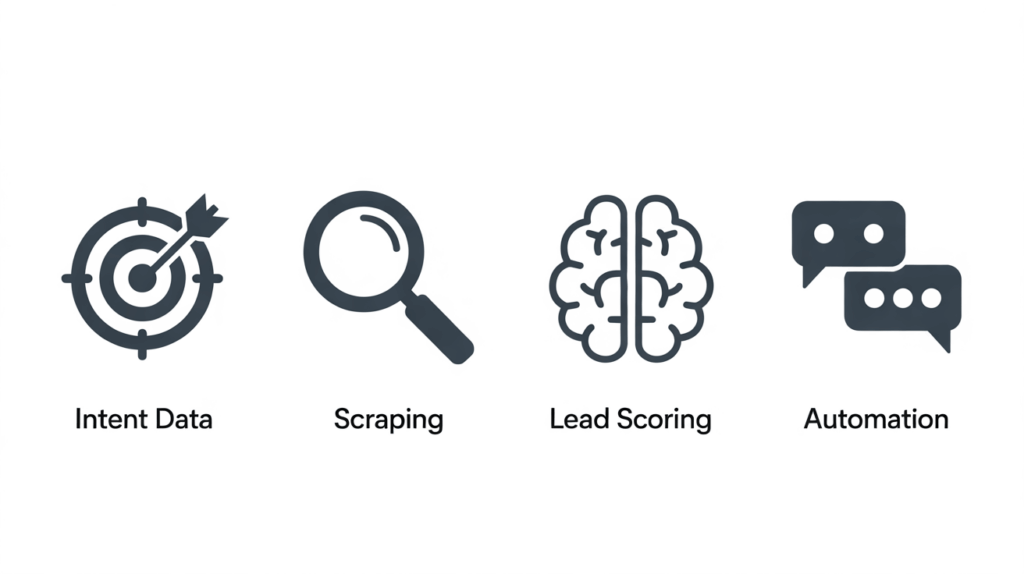
The market for AI sales technology is booming. However, not all tools are created equal. You must understand the landscape to make an informed investment that supports your optimized funnel.
Unified Platforms vs. Point Solutions
This is the most critical distinction in 2025.
Many revenue teams struggle with fragmented tech stacks. They use one tool for data, another for email, and a third for CRM integration. This creates data silos and workflow friction. Fragmented stacks cost revenue teams crucial time and often lead to 20% data decay annually.
Unified AI platforms solve this problem. They consolidate prospecting, engagement, and revenue intelligence into a single architecture. This allows AI agents to work with complete context and eliminate manual data reconciliation.
Why should SMBs prioritize unified platforms?
- Lower Integration Overhead: Less time spent connecting disparate systems.
- Consistent Data Quality: Data is shared instantly across all functions (prospecting, scoring, outreach).
- Faster Time-to-Value: Implementation complexity is significantly reduced, meaning ROI arrives quicker.
For small businesses and SaaS companies operating on tight budgets, choosing a comprehensive platform like Pyrsonalize.com is often more cost-effective and efficient than trying to stitch together four different point solutions.
Data Intelligence and Prospecting Tools
These tools focus heavily on the top-of-funnel activities. Their primary goal is finding accurate contact information and identifying buying signals.
| Tool Type | Primary Function | AI Capability |
|---|---|---|
| Data Enrichment Services | Filling in missing contact and company data. | Validation and real-time data sourcing. |
| Intent Detection Software | Monitoring web behavior and content consumption. | Predictive analytics to flag active buyers. |
| B2B Contact Finders | Scraping professional emails and LinkedIn data. | Automated data hygiene and cleaning. |
Tools in this category are foundational. Without accurate, high-quality data, no amount of AI personalization will succeed. They are the engine that fuels the rest of your sales machine.
Conversational AI and Engagement Tools
Once you have the lead, you need to engage them effectively. This category focuses on real-time interaction and personalized communication across multiple channels.
- AI Chatbots: Deployed on landing pages to qualify inbound leads instantly. They answer FAQs and route high-intent users directly to a sales rep.
- Outreach Sequencers: Automate personalized follow-ups across email and LinkedIn, ensuring consistent engagement over long sales cycles.
- Sentiment Analysis: AI analyzes prospect replies to gauge intent. It tells the rep whether the prospect is interested, hostile, or neutral, helping them pivot their strategy quickly for higher conversion rates.
The goal here is maximizing engagement. It ensures that every touchpoint moves the prospect closer to a conversation.
Strategic Implementation: Integrating AI into Your Sales Process

Buying the tool is only the first step. Successful AI integration requires careful planning and change management. You cannot simply drop a new platform onto your team and expect instant results.
Assessing Needs and Choosing the Right Architecture
Start by evaluating your current bottlenecks. Where exactly do deals stall? Is your average sales cycle 90 days or 180 days? Are your reps spending too much time prospecting or too much time on unqualified calls?
Answering these questions clarifies your AI needs:
- If your primary issue is volume and speed, you need AI agents focused on autonomous prospecting and list building (like Fastest Lead Generation Tools for Quick Campaigns).
- If your primary issue is deal velocity, you need predictive AI for lead scoring and deal acceleration insights.
- If your primary issue is data management, you need a unified platform with robust data enrichment capabilities.
Prioritize platforms that fit naturally into your existing workflow. The best AI tools are designed to work as copilots, augmenting human effort, not replacing it entirely.
Measuring Success Beyond Activity Metrics
Traditional sales tracking focuses on activity: calls made, emails sent, meetings booked. AI demands a different focus. You need to track metrics that reflect true revenue impact and deal acceleration.
Key AI performance indicators (KPIs):
- Lead Quality Score (LQS) Improvement: How much higher is the average conversion rate of AI-scored leads versus manual leads?
- Deal Velocity: Has the average time from initial contact to closed-won shortened by a measurable percentage (e.g., 15%)?
- Multi-Stakeholder Engagement: How effectively is the AI engaging the growing number of decision-makers in complex deals?
- Cost Per Acquisition (CPA) Reduction: Is the automation reducing the overall cost of acquiring a new customer?
Focusing on these results proves the ROI of your AI investment. It shifts the conversation from effort to outcome.
Overcoming Data Quality Challenges
Data quality is the Achilles’ heel of any AI system. Garbage in equals garbage out. Many organizations worry about security and vulnerability. They are equally concerned about the accuracy of their input data.
Ensure your chosen AI platform includes built-in data hygiene features. Look for automatic validation and enrichment services. This eliminates the need for manual data reconciliation across multiple systems.
Furthermore, prioritize platforms that offer AI Lead Gen Tools with Built-in CRM Integration. This ensures seamless data flow, meaning your AI agents are always working with the most current customer context.
Selecting the Right AI Platform for Your Business

You run an SMB or a growing SaaS company. You need powerful tools, but you also need budget predictability and ease of use.
Many enterprise-grade AI platforms are overkill. They require extensive customization and specialized teams to manage them. You need focused efficiency.
What should small to mid-sized teams look for?
The SMB and SaaS AI Imperative
Your platform must offer comprehensive capabilities without complexity. It needs to handle both prospecting and outreach effectively, eliminating the need for multiple subscriptions.
We specifically recommend focusing on tools that:
- Provide multi-channel outreach capabilities (email, LinkedIn).
- Feature intelligent lead scoring based on predictive analytics, not just basic rules.
- Are designed for rapid deployment and intuitive use by non-technical sales reps.
- Offer transparent, scalable pricing models.
This is where Pyrsonalize.com enters the conversation. We built Pyrsonalize specifically to address the scalability and budget constraints faced by growing businesses.
Pyrsonalize.com: AI-Driven Prospecting Made Easy
Pyrsonalize.com is designed as a unified AI solution for lead generation. We eliminate the need for fragmented point solutions.
Our platform uses advanced AI agents to identify ideal customer profiles (ICPs) instantly. It then automates hyper-personalized outreach sequences.
How do we achieve rapid results?
- Instant Lead Identification: Our AI analyzes current market data and your past success metrics to pinpoint high-intent prospects who match your ICP.
- Automated Personalization: We generate unique messaging for every prospect, drastically increasing response rates compared to generic cold outreach.
- Simplified Workflow: The platform manages the entire sequence, from data enrichment to scheduling the follow-up meeting. Your team steps in only when the lead is warm and ready to talk.
We understand that budget matters. That is why we focus on delivering maximum ROI through efficiency, making us one of the Best AI Lead Generation Tools for Small Business 2025.
The competitive advantage in 2025 belongs to those who deploy smart, unified AI. Stop chasing unqualified leads. Start accelerating deals.