


Bad data kills outreach campaigns. This is a simple truth.
Relying on stale or unverified lists in 2025 is a fatal error. High bounce rates destroy your sender reputation immediately. This means your legitimate emails end up in spam folders.
You need speed and precision. You need highly accurate B2B email finder tools. Finding emails is only half the battle, however. Verification is the crucial next step.
This guide analyzes the best tools to verify email addresses in bulk. We look at accuracy, speed, features, and pricing. We show how these essential services integrate with modern AI lead generation strategies.
Are you ready to stop wasting credits on dead leads?
The Imperative of Email Verification in AI Lead Generation

AI tools have revolutionized lead sourcing. They gather massive lists quickly. But quantity never replaces quality.
Your AI system, like Pyrsonalize.com, excels at personalized outreach. It crafts perfect sequences. It identifies ideal prospects. If the underlying data is flawed, the entire effort fails.
Verification is the firewall protecting your investment.
Understanding the Risks: Bounce Rates and Sender Reputation
What happens when you send emails to invalid addresses? You receive a hard bounce.
Hard bounces signal permanent delivery failures. Internet Service Providers (ISPs) track these failures meticulously. They use this data to calculate your sender reputation score.
A high bounce rate flags you as a potential spammer. This immediately impacts deliverability for all future campaigns. This is true even for verified contacts. Most email service providers recommend keeping bounce rates below 2%.
Can you afford to risk your entire domain over a dirty list?
- Risk 1: Financial Waste. You pay for outreach credits and CRM storage. These contacts will never receive your message.
- Risk 2: Domain Blacklisting. Repeated hard bounces can lead to your domain being blacklisted by major ISPs.
- Risk 3: Low Open Rates. A poor reputation pushes your emails into the spam or promotions folder.
- Risk 4: Spam Traps. Unverified lists often contain spam traps. These are old, defunct email addresses used by ISPs to identify spammers. Hitting one is catastrophic.
How Verification Fuels AI Outreach Efficiency
AI lead generation thrives on high-quality input. Clean data allows algorithms to perform better segmentation and personalization.
When you use tools to verify email addresses in bulk, you gain immediate confidence. This confidence translates directly into more aggressive, yet safer, outreach campaigns. You can increase volume knowing your foundation is solid.
Verification is also a critical component of data enrichment tools. Knowing an email is valid is the first step toward scoring and prioritizing that lead. Clean data reduces noise, which directly improves the predictive accuracy of machine learning models.
For example, Pyrsonalize.com integrates seamlessly with verification APIs. This ensures every lead entering your sequence is deliverable.
How does this integration boost efficiency?
- Pre-Campaign Filtering: Invalid emails are removed before they ever hit the sending server. This preserves your domain health.
- Optimized Budgeting: You only spend outreach credits on active, reachable prospects.
- Accurate Reporting: Campaign success metrics (Open Rates, Reply Rates) are based on actual delivered messages. This provides true ROI insight.
Core Functionality: What Quality Bulk Email Verification Tools Must Offer
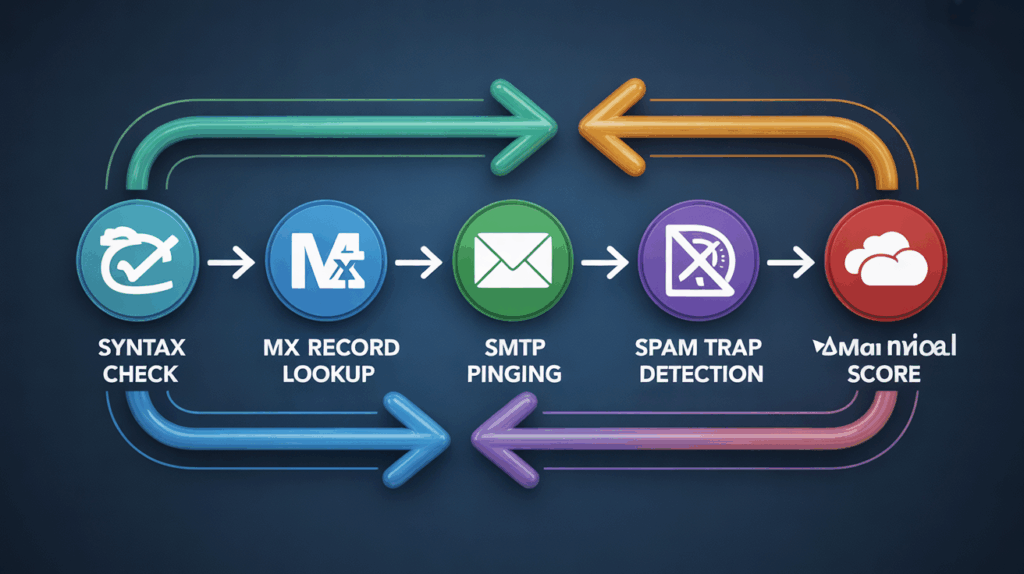
Not all verification tools are created equal. Some perform basic syntax checks. Others perform deep-cleaning SMTP tests.
When evaluating tools to verify email addresses in bulk, look for comprehensive, multi-layered testing procedures. Accuracy is paramount.
What specific technical checks define a premium service?
The Technical Deep Dive: SMTP, DNS, and Syntax Checks
A high-quality verifier performs several checks in sequence. These checks move beyond simple formatting errors. The process starts with basic list cleaning and moves toward complex server interaction.
1. Syntax and Format Validation
This is the simplest step. The tool ensures the email adheres to RFC standards. For example, it must contain an ‘@’ symbol and a domain name. This removes immediate typographical errors. It catches issues like “user@domain..com” or addresses with invalid characters.
2. Domain and DNS Verification
The system checks if the domain name exists. It looks for valid MX (Mail Exchange) records. If the domain is misspelled, such as “gnail.com” instead of “gmail.com,” this step catches it instantly.
3. Deep Cleaning SMTP Test (The Crucial Step)
This is the gold standard for accuracy. The verification tool simulates sending an email without actually delivering it. It connects to the recipient’s mail server via the Simple Mail Transfer Protocol (SMTP).
The server confirms whether the mailbox exists. If the server responds with a “250 OK” message, the email is valid. If it returns a “550 Mailbox not found” error, it is a hard bounce risk.
Tools like ZeroBounce and Bulk Email Checker heavily rely on this deep cleaning test. This guarantees high deliverability rates.
Handling Complex Results: Catch-Alls and Disposable Emails
The verification process rarely results in a simple valid/invalid binary. Modern tools must handle nuanced categories.
Catch-All Domains
A catch-all server accepts all emails sent to a domain. This happens regardless of whether the specific mailbox exists. The server responds with “valid” even if the address is fake.
This is a major challenge for verifiers. Sending to catch-all addresses is risky. You often only know if the address is truly invalid after you send the campaign and receive a hard bounce.
Top-tier verifiers like Bouncer or Emailable use sophisticated algorithms and historical data. They estimate the risk associated with a catch-all address.
Disposable Email Addresses (DEAs)
These are temporary, short-lived email addresses. Examples include 10minutemail or mailinator. They are often used for sign-ups where the user wants to avoid spam.
DEAs are useless for long-term lead generation. Quality verification tools maintain constantly updated lists of hundreds of disposable email providers. They flag these addresses for immediate removal.
Role Accounts
Role accounts are generic addresses like info@, sales@, or support@. While technically valid, they are poor targets for personalized cold outreach. They often trigger lower engagement and higher complaint rates. Good verifiers identify and flag them.
Top Tools to Verify Email Addresses in Bulk (2025 Review)
The market for email verification is competitive. Pricing often correlates directly with accuracy and speed. When selecting tools to verify email addresses in bulk, consider your volume needs and acceptable risk level.
We analyzed current market leaders based on industry reviews and reported accuracy. Choose wisely: high-stakes outreach demands high accuracy.
Premium Accuracy Leaders
These tools boast the highest deliverability guarantees. They often exceed 99% accuracy. They are essential for high-volume cold outreach where domain reputation is non-negotiable.
1. ZeroBounce
ZeroBounce is consistently cited as a market leader. They guarantee 99.6% accuracy in real-time validation. Their robust feature set goes beyond simple validation.
- Key Features: Real-time API, bulk list cleaning, spam trap detection, IP address appending, and mailbox status identification.
- Deliverability Kit: They offer tools to check email server status and monitor deliverability.
- Volume Pricing Note: According to 2025 pricing data, 50,000 verifications cost around $350. They offer 100 free monthly verifications for premium domains.
2. Bouncer
Bouncer has gained significant traction for its user experience and strong accuracy. Users often praise its straightforward interface.
- Key Features: Excellent UX, high accuracy, and a comprehensive Deliverability Kit.
- Free Credits: They offer 100 free credits to test their service.
- Volume Pricing Note: Pricing is competitive in the high-accuracy tier. It is typically around $250 for 50,000 verifications. This positions it slightly below ZeroBounce’s listed price point.
3. Emailable
Emailable is known for being extremely fast and accurate. It is often recommended for businesses dealing with large, frequently updated lists.
- Key Features: Speed, accuracy, and strong API integration for real-time validation on sign-up forms.
- Volume Pricing Note: Pricing for 50,000 verifications stands around $245. This makes it a powerful and cost-effective choice within the premium segment.
Value-Driven Bulk Verification Options
SaaS startups and small businesses often require budget-friendly options. These tools provide solid verification at a fraction of the cost. Note that accuracy may sometimes dip slightly lower, typically closer to 90-95%.
1. Bulk Email Checker
This tool positions itself as a high-value provider for bulk verification. They emphasize their 17+ factor test process. This includes the essential deep cleaning SMTP test.
- Key Features: Extremely low per-email cost (as low as $0.00075 per email for large volumes), Blacklist tracking integration with major senders (Mailchimp, SendGrid), and Google Sheets integration.
- Accuracy Claim: They guarantee 97% deliverability.
- Volume Pricing Note: Highly aggressive pricing. 10,000 verifications cost just $9.95. 100,000 verifications cost $74.95.
2. MillionVerifier
MillionVerifier is known for its aggressive bulk pricing. It is a viable option if you have massive, raw lists that need initial scrubbing.
- Caveat: User feedback indicates verification speed can be slower than premium competitors. Accuracy may also be slightly lower than the guaranteed 99% tiers.
- Volume Pricing Note: Highly affordable, with 50,000 credits costing around $77. This is one of the cheapest options available in 2025.
Key Feature Comparison Table
Choosing the right tool depends on balancing cost, speed, and accuracy. If you are running high-stakes cold outreach, accuracy must win.
| Tool | Reported Accuracy | Price (Approx. 50,000 Verifications) | Primary Strengths | Best For |
|---|---|---|---|---|
| ZeroBounce | 99.6% Guaranteed | ~$350 | Highest accuracy, robust Deliverability Kit, 24/7 support. | Enterprise, high-volume, mission-critical outreach. |
| Bouncer | Very High (99%+) | ~$250 | Excellent UX, reliable catch-all detection, good value for premium accuracy. | SaaS teams needing reliable, user-friendly service. |
| Emailable | Very High (99%+) | ~$245 | Speed, strong API for real-time validation. | Web applications, high-frequency verification needs. |
| Bulk Email Checker | 97% Guaranteed | ~$45 (for 50k) | Lowest cost, high volume capacity, integration features. | Budget-conscious small businesses, large initial list cleaning. |
| MillionVerifier | 90-95% (Reported) | ~$77 | Extreme affordability for high volume. | Initial scrubbing of massive, raw lists where speed is secondary. |
Implementing Bulk Verification into Your Outreach Workflow
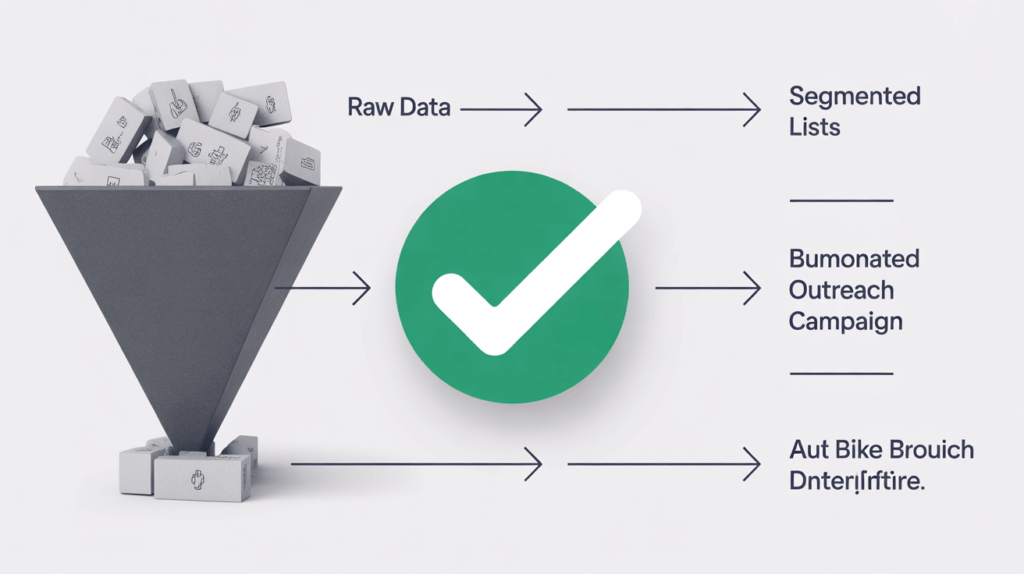
Purchasing verification credits is only the first step. True efficiency comes from integrating these services seamlessly. Integrate them into your lead generation and sales funnel.
How can you maximize the value of these tools?
Real-Time API vs. Batch Uploads
When you acquire lists through B2B data providers or scraping methods, batch uploads are necessary. You upload a CSV file and wait for the results. This is essential for cleaning existing lists.
The future, however, is real-time verification.
Real-time API integration prevents bad data from ever entering your system. This is crucial for web forms, landing pages, and lead capture tools.
- Batch Uploads: Ideal for legacy list cleaning, purchased lists, or exported CRM data. It handles high volumes efficiently but requires manual scheduling.
- Real-Time API: Essential for maximizing conversion rates on lead forms. If a user mistypes “gnail.com,” the API alerts them instantly. This prevents a lost lead due to a simple typo.
Many of the best tools to verify email addresses in bulk offer robust APIs. This includes ZeroBounce, Bulk Email Checker, and Emailable. Integrating this API into your website’s contact forms can instantly decrease confirmation email bounces by over 50%.
Integrating Verification with Your AI Lead Gen Stack
Your AI lead generation stack requires clean, actionable data at every touchpoint. Verification must be a mandatory step. It sits between lead sourcing and cold outreach execution.
Step 1: Source and Find
Use AI-powered tools like Pyrsonalize.com to identify and source ideal prospects. Use firmographics and technographics. This generates the initial bulk list.
Step 2: Verify and Clean
Pass the newly generated list through your chosen bulk email verification tool. This process identifies and segregates invalid, disposable, and spam trap addresses.
What should you do with the results?
- Valid: Immediately push these contacts into your primary outreach sequence.
- Invalid/Spam Traps: Delete permanently. Do not risk your sender reputation.
- Catch-All: Segregate these into a low-priority, highly cautious sequence. Use highly personalized, low-volume outreach to minimize bounce risk.
Step 3: Enrich and Score
Once verified, the leads are ready for further data enrichment. You can now confidently spend resources adding phone numbers, job titles, or social profiles. You know the core email contact is solid.
Step 4: Execute Safe Outreach
A clean list is the bedrock of safe and scalable cold outreach. Whether you are utilizing safe LinkedIn automation or high-volume email campaigns, verification ensures compliance and protects your assets.
Remember, the goal is not just to send emails. The goal is to land in the inbox and start conversations.
The Role of Blacklist Tracking
Some verification tools offer an invaluable feature: Blacklist Tracking. This service integrates with your primary email sending provider (like SendGrid or Mailchimp).
If an email address causes a bounce, a spam complaint, or an unsubscribe during a live campaign, the verification tool instantly adds that address to your internal blacklist.
Why is this critical? It prevents the system from ever attempting to verify or send to that bad address again. This saves verification credits. More importantly, it protects your sender score from repeat offenders.
Bulk Email Checker, for instance, offers this automatic integration. This proactive defense mechanism is mandatory for serious sales teams operating at scale.
Advanced Strategies for Maintaining List Hygiene in 2025

Verification is not a one-time task. Email lists decay rapidly. People change jobs. Domains expire. A clean list today might be 10% invalid six months from now.
You need a continuous hygiene strategy.
1. Implement Verification at the Point of Entry
Use real-time API integrations on all lead capture forms. This ensures you never pay to store or clean a bad email address.
2. Re-Verify Old Lists Quarterly
If you have dormant segments, run them through your bulk verifier. Do this before launching a re-engagement campaign. This prevents sudden spikes in bounce rates that could damage your primary sending domain.
3. Separate Sending Domains
Are you engaging in high-volume cold outreach? Utilize separate secondary domains. Verify your lists rigorously, but if issues arise, your primary corporate domain remains safe.
4. Choose Tools with Clear Reporting
Your verification tool must provide clear, actionable results. You need to know exactly why an email failed. Was it a syntax error? A full mailbox? A non-existent domain? This data helps refine your lead sourcing methods over time.
We are in an era where data quality dictates sales success. Utilizing the right tools to verify email addresses in bulk is no longer optional. It is foundational to efficient, scalable AI lead generation.