

You want scalable lead generation. You need efficiency. Manual outreach is simply not an option in 2025.
LinkedIn is the undisputed champion for B2B prospecting. It holds the key to your ideal clients.
But there is a catch. The moment you try to automate LinkedIn lead generation without getting banned, you hit a wall. Warnings, restrictions, or even permanent account bans loom large.
Are you tired of hearing those horror stories? Many ambitious SaaS founders and sales leaders have been burned by cheap, risky automation tools.
This guide changes that narrative. We are moving past rudimentary scraping and risky extensions. We focus on smart, AI-driven automation that mimics human behavior perfectly.
This is the definitive playbook for generating qualified leads on LinkedIn safely and at scale.
The New LinkedIn Reality: Understanding the Risks in 2025

LinkedIn does not want pure automation. They prioritize genuine professional interactions. Their algorithms are sophisticated and constantly evolving.
They are specifically designed to detect non-human, repetitive actions. Ignoring these detection mechanisms is a recipe for disaster.
What exactly triggers the “LinkedIn Police?” It usually comes down to volume, velocity, and behavioral footprint.
Why Generic Automation Fails
Legacy automation tools rely on easily detectable methods. They often use browser extensions that inject code. LinkedIn identifies these manipulated footprints immediately.
These tools consistently fail the behavioral test. They execute tasks too quickly or too repetitively. They lack human variability.
Consider the hallmarks of unsafe automation:
- Rapid Velocity: Sending 100 connection requests in 15 minutes. No human can sustain this velocity.
- Shared IPs: Logging into your account from rotating, suspicious server locations. This screams “bot” activity.
- Non-Personalized Spam: Sending the exact same message template to thousands of prospects. This generates high “I don’t know this person” reports.
- Lack of Warm-up: Connecting with 3rd-degree contacts without viewing their profile or engaging with content first.
If you received an “unusual activity” warning, you are already on their radar. You need to pivot your strategy immediately.
LinkedIn’s Non-Negotiable Limits
LinkedIn enforces strict, non-publicized limits. These limits vary based on account age, activity level, and whether you use a premium service like Sales Navigator.
Modern tools must respect these digital guardrails. Failing to do so guarantees account restriction.
What are the critical limitations you must adhere to?
- Weekly Invitation Cap: This is the most crucial limit. It hovers between 100-150 invitations per week for most standard accounts. This threshold is designed to force quality over quantity.
- Daily Message Cap: Limits apply to direct messages, especially to 2nd and 3rd-degree connections. High volume here triggers scrutiny.
- Profile Views: Mass viewing thousands of profiles without corresponding connection activity looks suspicious. This signals data scraping.
- Pending Invites: A high volume of pending invites (over 700) signifies poor acceptance rates and spamming behavior. You must regularly withdraw old, ignored invitations to reset this count.
The solution isn’t fighting the limits. The solution is maximizing conversion within the limits.
Strategy Shift: Moving from Bulk Spam to Hyper-Personalization

We understand the risks. Now, we shift focus from avoiding bans to actively building trust. How do we maximize results within LinkedIn’s strict limitations?
Safe automation is not about doing more. It is about doing better. Your goal should be quality conversations, not sheer volume.
How do you achieve high response rates while maintaining a low-volume, safe footprint?
The answer is behavioral intelligence. You need tools that can personalize outreach at scale using AI.
Building Profile Authority (Trust Signals)
LinkedIn success relies on your profile’s authority and trustworthiness. Your profile must be impeccable before you automate outreach.
A professional, complete profile is far less likely to be flagged. It looks legitimate to both the algorithm and the prospect.
Ensure your profile meets this checklist:
- Professional, high-resolution headshot.
- A detailed, engaging headline that clearly states your value proposition.
- A robust ‘About’ section that includes relevant keywords and a soft Call to Action.
- Consistent activity (posting, commenting, engaging) that demonstrates expertise and contribution.
A strong foundation makes your automated outreach credible. It shows you are a real contributor, not a spammer attempting quick connections.
Targeting the Ultra-Specific ICP
Mass outreach guarantees low acceptance rates. Low acceptance rates lead to “I don’t know this person” reports. Those reports lead directly to bans.
The math is simple: better targeting equals higher acceptance. Higher acceptance equals account safety.
Are you targeting the right people?
AI lead generation tools excel at this pre-qualification. They help you define a narrow, highly specific Ideal Customer Profile (ICP).
You must move beyond basic title and industry filters. You need deeper, intent-based insights.
Focus on attributes like:
- Specific technologies used (e.g., uses HubSpot, but not Salesforce).
- Recent company growth or funding announcements (indicating buying intent).
- Shared group membership or past engagement with specific topics.
This level of precision allows for true hyper-personalization. For deeper guidance on refining your target audience, read our guide on Targeted Buyer Persona for AI Lead Gen.
Leveraging Multi-Channel Outreach
Relying solely on LinkedIn messaging is inherently risky. Why put all your eggs in one basket?
The safest, most effective strategy involves multi-channel sequencing. This is where AI lead generation platforms truly shine.
If a connection request is ignored, the sequence shifts channels. Instead of spamming a follow-up message on LinkedIn, the system finds their verified professional email.
This approach bypasses LinkedIn’s strict limits while maintaining a professional contact with the prospect.
A smart sequence might look like this:
- Day 1: Profile View (Automated Warm-up).
- Day 2: Connection Request with a highly personalized note (AI-generated based on profile data).
- Day 5: If accepted, send a non-salesy thank you message. If ignored, the system waits.
- Day 8: If no acceptance, the tool scrapes and verifies their corporate email address.
- Day 10: Send a personalized email outreach referencing the LinkedIn attempt (“Saw you at X company, wanted to connect about Y”).
This mimics the natural behavior of a persistent, yet professional, salesperson. It drastically reduces your risk exposure on the LinkedIn platform.
The Blueprint for Safe Automation Tools (Cloud vs. Extension)
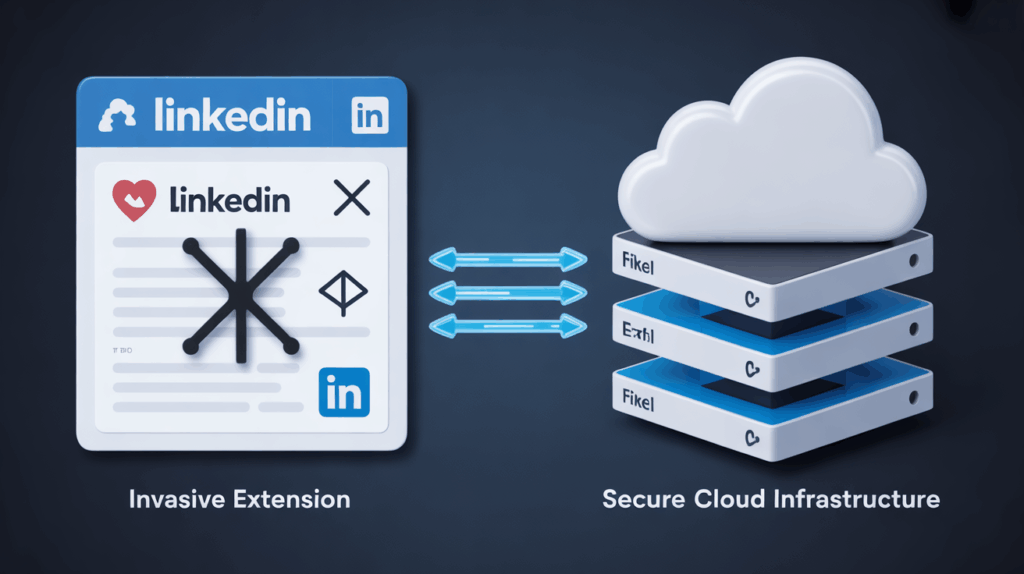
Choosing the right technology is the single biggest factor in successful, ban-proof automation. You must understand the fundamental difference between safe and unsafe tools.
In 2025, the debate is settled: Cloud-based tools are superior for safety and scalability.
Cloud-Based Automation: The Safe Choice
Cloud-based tools run campaigns remotely. They operate 24/7 without requiring your browser to be open. Crucially, they use dedicated IP addresses that are assigned to your account.
This simulates a consistent, stationary login location. LinkedIn’s algorithm sees stable, human-like activity from a single source.
Why are cloud tools safer than browser extensions?
| Feature | Cloud-Based Tools (Safe) | Browser Extensions (Risky) |
|---|---|---|
| Detection Risk | Low. Mimics steady, human activity. | High. Easily detected via code monitoring and DOM manipulation. |
| IP Address | Dedicated, stable IP (mimics home office or corporate VPN). | Often shared, rotating IP (suspicious activity). |
| Warm-up Feature | Standard. Gradually increases daily actions based on account age. | Rarely available or poorly executed. |
| Run Time | 24/7 remote operation, even when you log off. | Only when browser/computer is open and active. |
If your current tool is a Chrome extension, you are running a high-risk operation. It is time to upgrade to a cloud-native platform.
If you are exploring new systems, make sure to check out our analysis of the Best AI Lead Generation Tools for Small Business 2025.
Essential Safety Features Checklist
A truly safe automation platform must include specific features designed to trick the algorithm into thinking a human is operating the account.
Look for these critical safety mechanisms:
- Smart Throttling: The tool must automatically adjust daily limits based on real-time LinkedIn restrictions and your account health metrics.
- Randomized Delays: Actions (clicks, views, connections) should not happen in perfect, mechanical intervals. The system must introduce random human-like delays between actions (e.g., 5 to 12 seconds).
- Timezone Synchronization: The tool should only operate during standard business hours in your defined timezone, avoiding suspicious overnight activity.
- Profile Warm-up Sequences: Before sending a connection request, the tool must perform engagement actions (viewing the profile, liking a recent post).
- Safe Mode/Maximum Limits: A setting that prevents the campaign from ever exceeding pre-defined, ultra-conservative limits, regardless of campaign status.
Simulating Human Behavior (The Warm-up Process)
The warm-up sequence is non-negotiable for safety. You cannot cold-connect with strangers without consequence.
Modern AI tools handle this automatically. They build digital rapport before the outreach even begins.
What does a successful automated warm-up look like?
- Initial Profile View: The system views the prospect’s profile for a realistic duration (e.g., 30-60 seconds). This registers the lead’s attention.
- Content Engagement: The tool identifies the prospect’s most recent post and leaves a relevant, personalized comment or a simple “like.” This establishes initial contact.
- Connection Delay: A mandatory delay (24-48 hours) is enforced after initial engagement.
- Personalized Connection Request: The request is sent, often referencing the content or profile element previously engaged with.
This process reduces the likelihood of the prospect clicking “I don’t know this person” to near zero. It signals to LinkedIn that this is a meaningful interaction.
Execution: Implementing a Ban-Proof LinkedIn Lead Generation Campaign
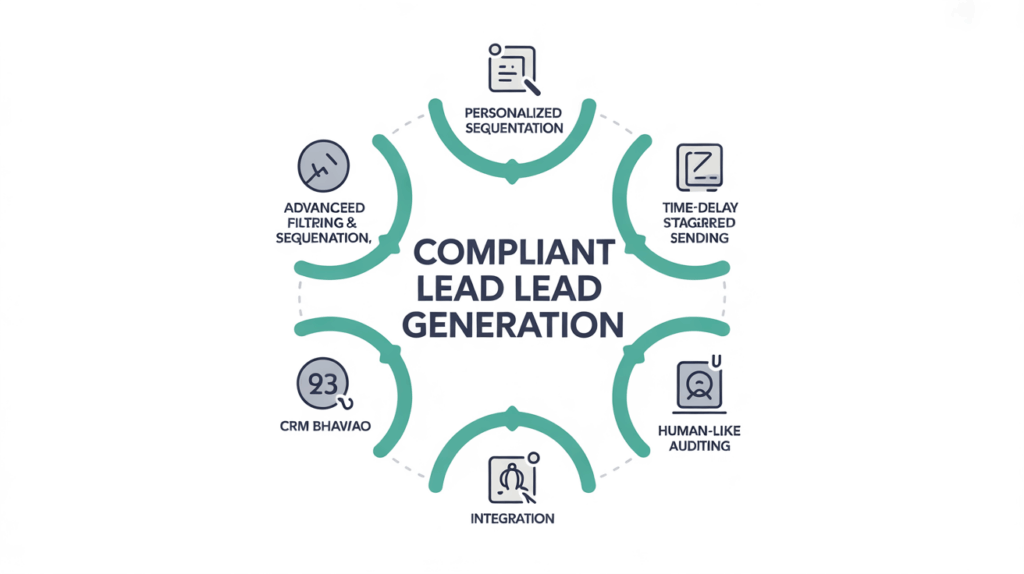
You have the right tool and the right strategy. Now, let’s look at flawless execution. This involves meticulous targeting and creating messaging that converts safely.
Defining the Ultra-Specific ICP
Revisit your target list. Are you segmenting your prospects finely?
The tighter the segment, the easier the personalization. Avoid broad campaigns targeting “all CEOs.”
Instead, focus on granular segmentation:
- “Heads of Marketing at B2B SaaS companies ($1M-$5M ARR) who posted about budget cuts in the last 60 days.”
- “VPs of Sales in the FinTech industry located in the Northeast who recently changed jobs.”
AI tools help streamline this segmentation. Our systems analyze public data points to build highly relevant lists that feed directly into your outreach sequences.
Crafting High-Conversion Message Sequences
Generic messages are dead. They are the fastest route to the spam folder and account restrictions.
Your AI automation tool must generate messages that look and feel human. This requires dynamic personalization tags.
Go beyond [First Name] and [Company Name]. Use variables that reference specific, unique profile data:
[Recent Post Topic]: “I saw your recent post about Q3 staffing challenges…”[Shared Connection]: “I noticed we both know [Shared Connection Name]…”[University/College]: “Fellow [University Name] alum here…”[Skills Endorsed]: “Your endorsement of [Skill Name] caught my eye, as that’s exactly what my platform focuses on.”
This level of detail is impossible to manage manually at scale. AI integration makes it feasible and safe.
When designing your sequence, remember the rule of the soft follow-up. Keep the initial messages short, value-focused, and low-pressure. Never pitch immediately.
For those running multi-channel campaigns, consider how your LinkedIn message flows into your email sequence. We detail similar strategies for maintaining contact across channels in our guide on Best Apollo.io Alternatives for Cold Outreach in 2025.
Monitoring and Scaling Safely
Automation is not “set it and forget it.” Consistent monitoring is essential to automate LinkedIn lead generation without getting banned.
You need to track your core safety metrics weekly:
- Acceptance Rate: This must be high (ideally 25% or higher). Low rates mean your targeting or messaging is poor, signaling spam to LinkedIn. This is the algorithm’s primary trust signal.
- “I Don’t Know This Person” Rate: This should be virtually zero. Any spike requires immediate campaign review and pausing.
- Response Rate: High response rates (even if negative) show LinkedIn that your messages are engaging real users in conversation.
If your acceptance rate dips below 20%, you must pause the campaign immediately. Adjust your targeting or refine your AI-generated message templates.
Scaling requires patience. Increase your daily actions incrementally. If you start with 10 connection requests per day, increase to 15 only after 30 days of clean, successful activity.
Never rush the process. Safety is your priority, and consistency is the key to safety.