
Writing High-Impact Lead Generation Landing Pages
Table of Contents
- Strategic Takeaways: Optimizing Your Lead Generation
- The Strategic Mandate of a Lead Capture Landing Page
- Key Takeaways for Conversion Architects
- Defining the High-Converting Lead Generation Page
- Foundational Elements of a High Converting Lead Generation Landing Page
- Optimizing the Lead Capture Form
- Copywriting Tactics for Lead Generation Success
- Technical and Design Best Practices
- Post-Conversion Strategy: Maximizing the Lead Capture Landing Page Return
- Frequently Asked Questions: Optimizing Your Lead Generation Assets
The digital ecosystem of 2025 demands precision. Your campaigns are optimized, and your traffic sources are refined, yet conversion bottlenecks persist. This usually indicates a failure at the critical point of engagement, the lead generation landing page. This singular asset must function as a high-efficiency machine designed solely to convert qualified traffic into actionable leads.
A successful lead gen landing page is not merely a destination, it is a focused mechanism for securing essential contact information. It requires a strategic alignment of messaging, design, and user psychology to facilitate the necessary value exchange.
You must move beyond basic design principles and focus intensely on conversion architecture. Your goal is to build a high converting lead capture landing page that immediately establishes trust and fulfills the promise made by the preceding advertisement.
Strategic Takeaways: Optimizing Your Lead Generation
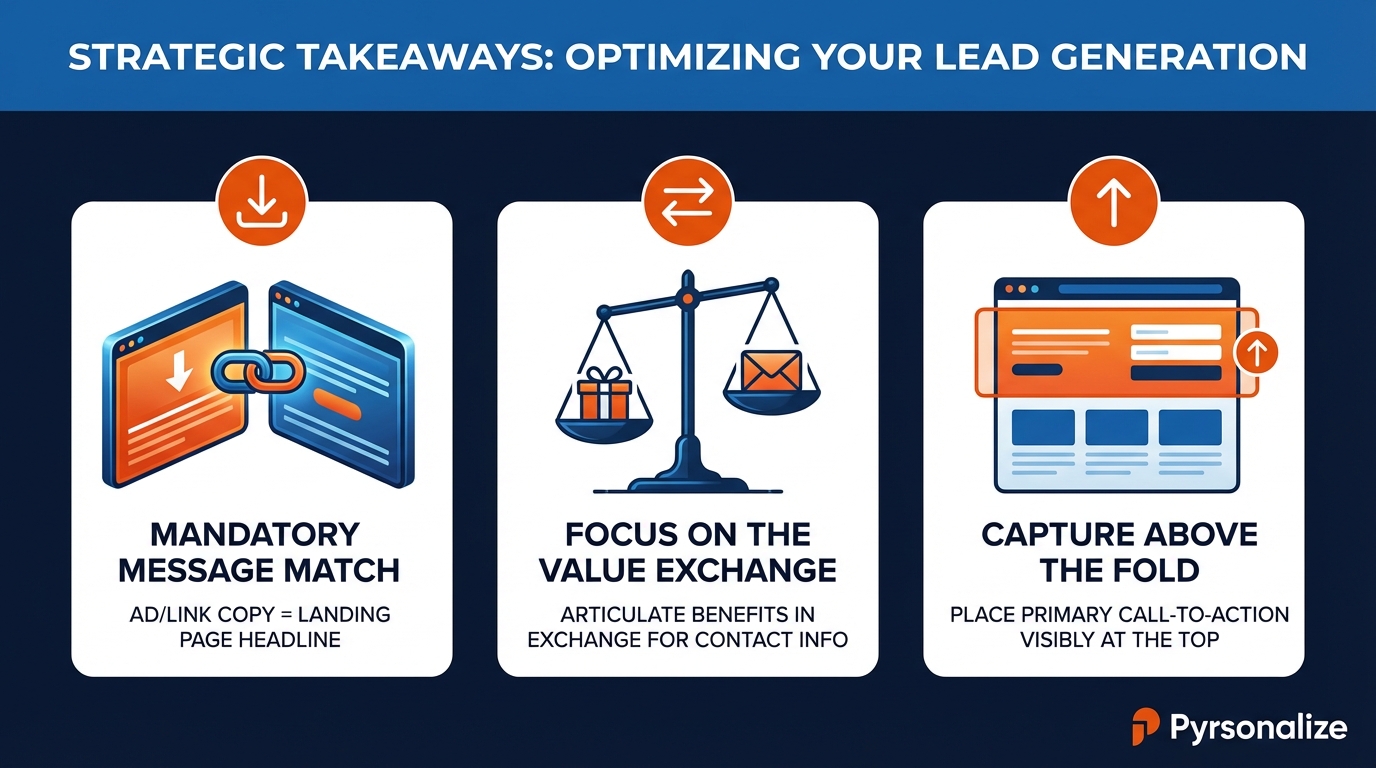
To ensure your lead generation landing page is immediately effective, prioritize the following strategic mandates:
- Mandatory Message Match: Ensure the headline on your landing page perfectly mirrors the copy or offer presented in the referring ad or link.
- Focus on the Value Exchange: Design the page to clearly articulate the benefit the potential customers receive in exchange for their email addresses or contact information.
- Capture Above the Fold: Place the primary lead capture mechanism (the form) and the core offer where it is instantly visible to the user, optimizing the experience Above the Fold.
- Singular Goal: The page must have one purpose only, to collect subscribers. Eliminate all navigational distractions that could lead users away from the conversion goal.
The Strategic Mandate of a Lead Capture Landing Page
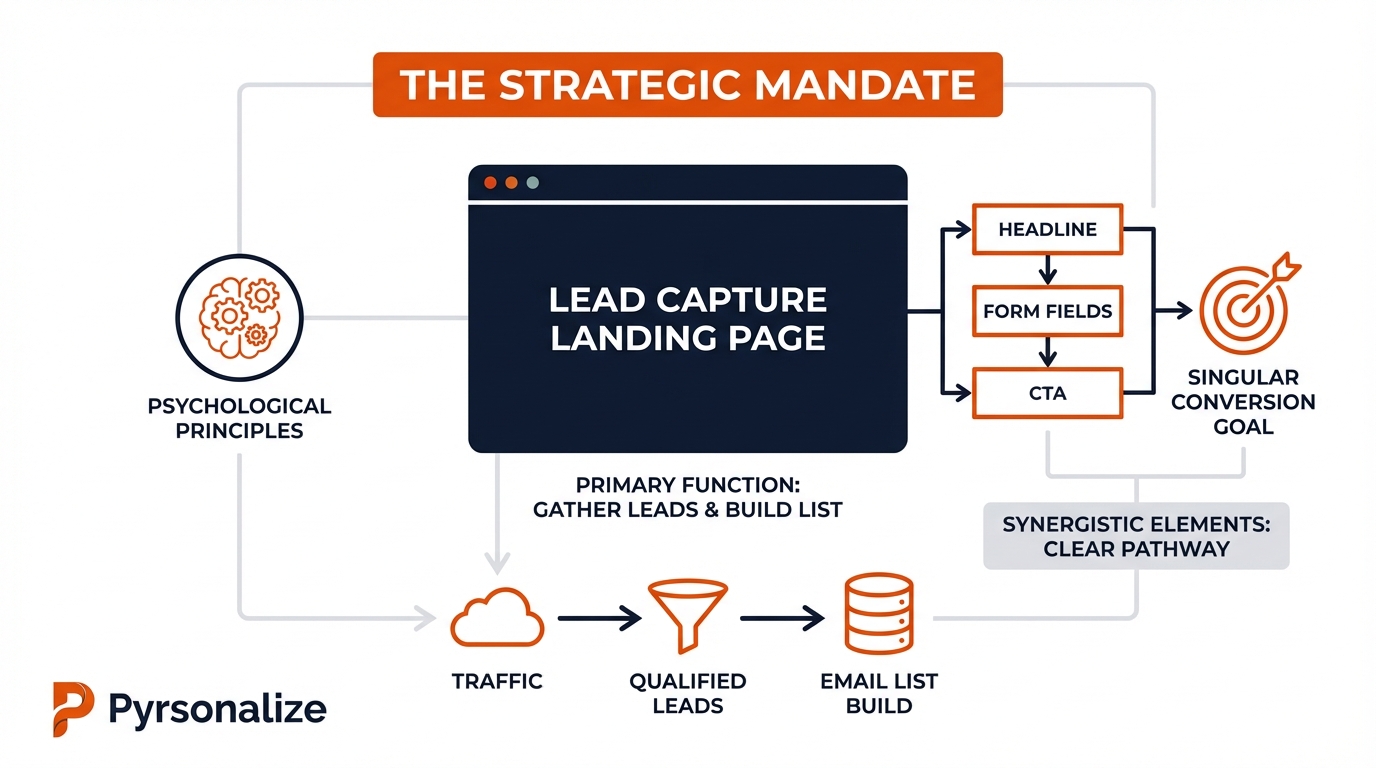
The primary function of this asset is clear: to gather qualified leads and rapidly build an email list. This requires adhering to strict best practices rooted in psychological principles.
Every element on your page, from the headline to the form fields, must work synergistically toward this singular conversion goal. If you fail to establish a clear pathway to conversion, your investment in traffic is wasted.
Understanding the architecture of a high converting landing page allows you to systematically address user hesitation and accelerate trust. We must treat this process as strategic engineering, not merely creative design. For more details, check out our guide on how to embed a lead capture widget on a landing page.
Key Takeaways for Conversion Architects
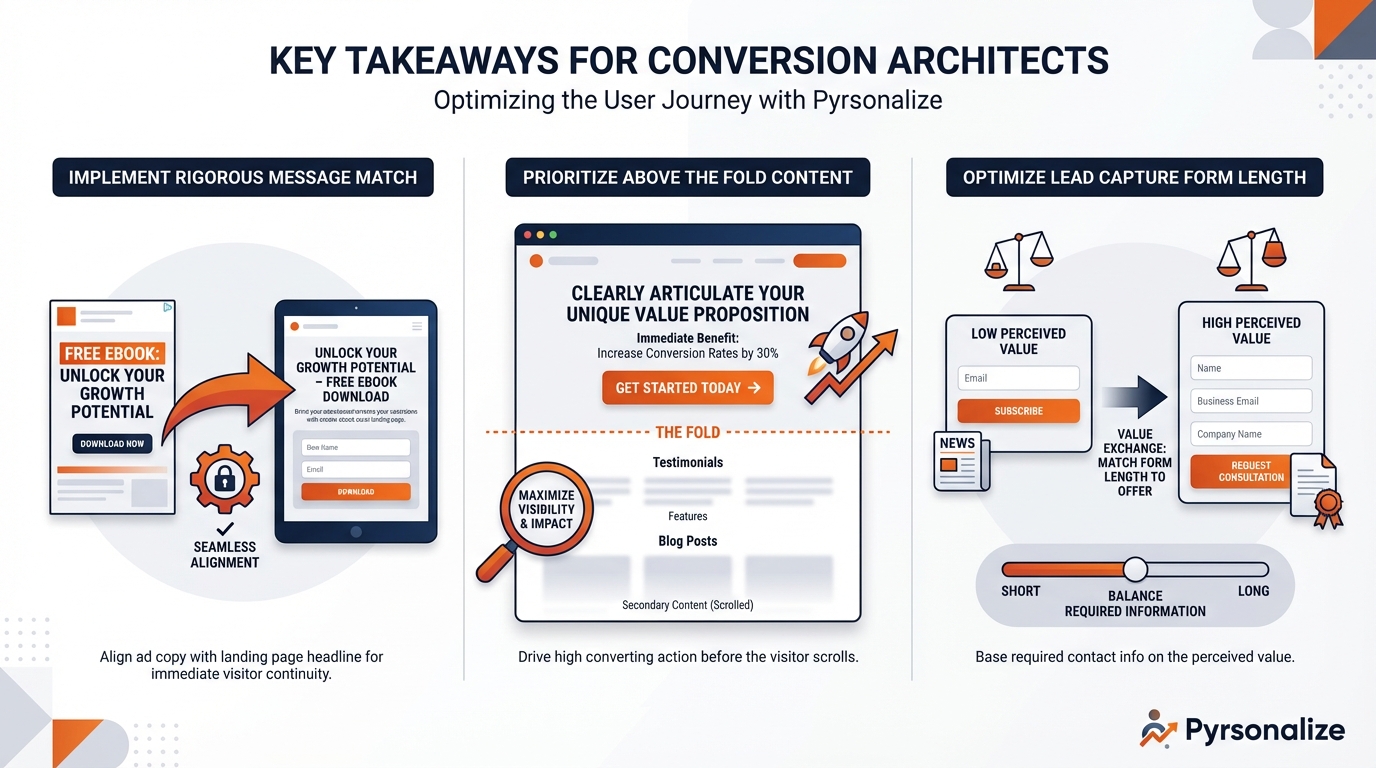
- Implement Rigorous Message Match: Ensure immediate visitor continuity by aligning the advertising copy directly with the headline of your lead generation landing page.
- Prioritize Above the Fold Content: Clearly articulate your Unique Value Proposition (UVP) and the immediate benefit to drive a high converting action before the visitor scrolls.
- Optimize Lead Capture Form Length: Base the required contact information on the perceived value exchange; use shorter forms to collect subscribers for basic email addresses and longer forms for pre-qualifying leads for high-value assets.
- Leverage the Principle of Reciprocity: Offer substantial, immediate value in direct exchange for the visitor’s data to maximize the likelihood of conversion and building an email list.
- Enforce Singular Focus: Eliminate all extraneous navigation, competing internal links, and secondary calls to action to ensure the page drives toward only one primary conversion goal, getting leads.
Defining the High-Converting Lead Generation Page
Your previous focus was on optimizing the immediate user experience, specifically regarding Message Match and Above the Fold content. Now, you must define the environment itself.
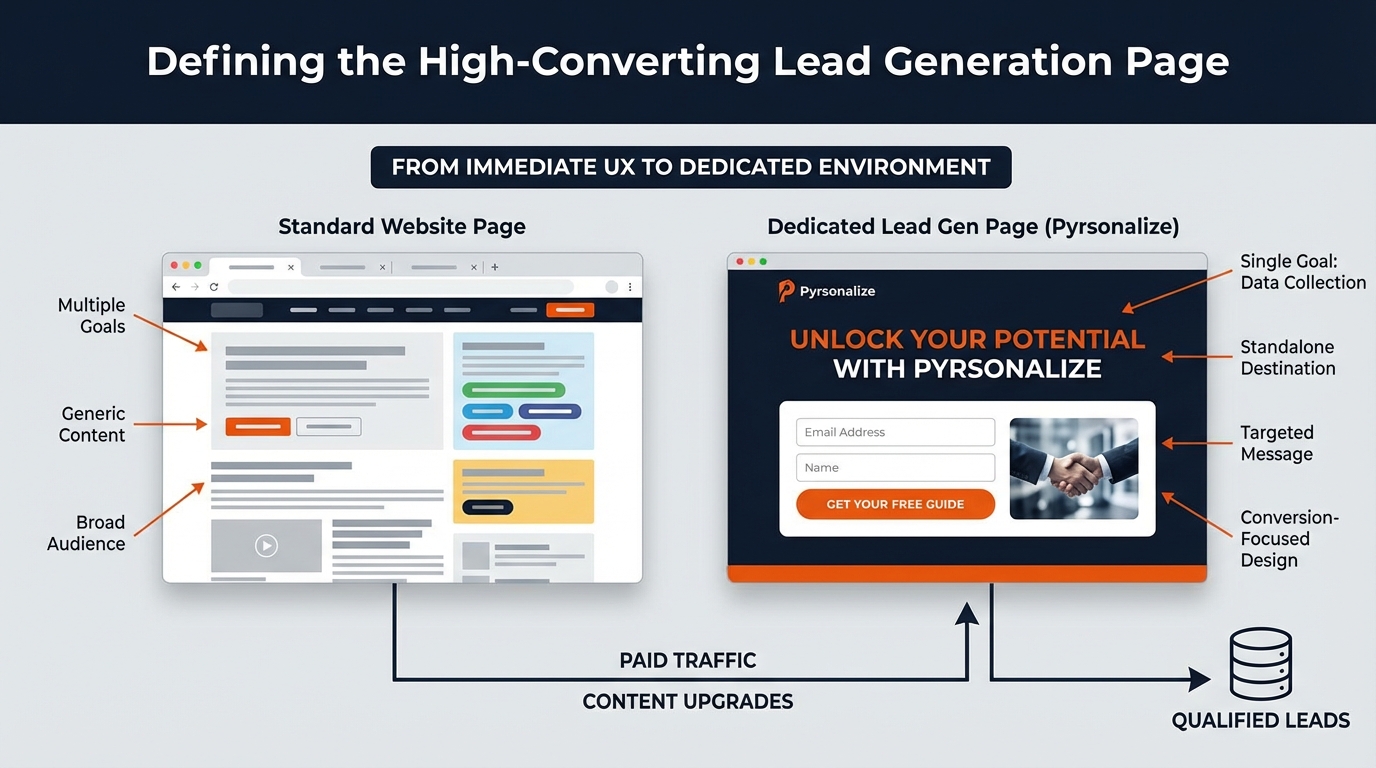
A lead generation landing page is fundamentally different from standard website pages. It is a standalone environment engineered to achieve one goal, to collect necessary data from potential customers.
This page serves as the dedicated destination for traffic originating from paid campaigns or specific content upgrades. Its success is measured exclusively by its conversion rate, defining how effectively it transforms visitors into actionable leads ready for nurturing.
Lead Capture vs. Traditional Web Pages: Eliminating Friction
The primary distinction between a traditional site page and a lead gen landing page lies in focus and friction. Traditional websites feature navigation menus, internal links, and multiple calls to action, all designed for exploration.
Conversely, a dedicated lead capture landing page strips away these distractions. The objective is singular, to guide the user toward form submission.
By removing navigation bars and extraneous links, you eliminate the cognitive load associated with choice. This focused approach dramatically improves the probability of conversion and is a cornerstone of digital best practices for high converting assets.
The Core Transaction: Mastering the Value Exchange
Visitors will only provide their personal data, such as email addresses or detailed contact information, if the perceived reward outweighs the perceived risk. This fundamental transaction is the core mechanism of successful lead generation.
This requirement aligns directly with the Principle of Reciprocity. You must articulate the offer’s value proposition clearly and immediately. To successfully get leads, the user must understand precisely what tangible asset they receive.
The perceived value must always justify the data requested. If you are offering a high-value asset, such as a proprietary tool or a comprehensive guide, you are justified in requesting more extensive information than if you were merely trying to collect subscribers for a weekly digest.
A successful strategy hinges on presenting an offer so compelling that the act of submitting data feels like an essential transaction, not an intrusive request for personal details.
Foundational Elements of a High Converting Lead Generation Landing Page
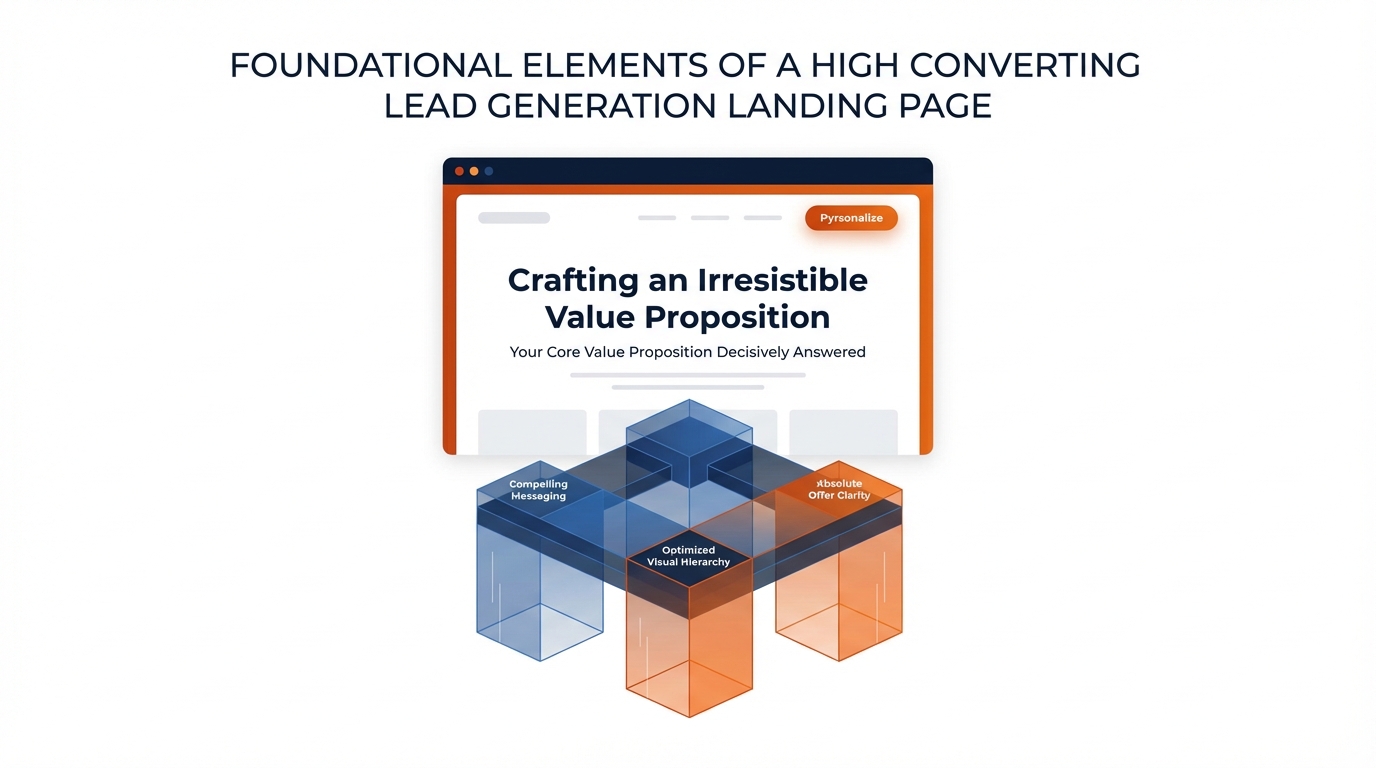
To ensure your page consistently converts, you must establish strategic alignment across three core pillars: compelling messaging, optimized visual hierarchy, and absolute offer clarity.
This alignment is critical for maximizing the efficiency of your traffic and securing high conversion rates from potential customers.
Crafting an Irresistible Value Proposition
Your core value proposition must be immediately communicated in the primary headline. It must decisively answer the visitor’s unspoken question, “What is the immediate value exchange for my contact information?”
The headline must be concise, benefit-driven, and highly specific. Avoid vague statements that confuse potential customers.
If your specific offer is a technical guide on optimizing server load times, the headline must reflect that precise, measurable benefit. This clarity is the first step toward securing trust and encouraging visitors to get leads efficiently.
The Critical Role of Message Match
The principle of Message Match is a non-negotiable requirement for achieving high conversion rates on any lead generation landing page.
This concept demands that the language, imagery, and core offer used in the originating source, whether a paid advertisement or an email campaign, must be perfectly mirrored on the landing page itself.
If an advertisement promises a “Free 2026 Marketing Strategy Checklist,” the headline and subheader of the lead gen landing page must explicitly reference the “Free 2026 Marketing Strategy Checklist.”
Disruption of this continuity, as noted by conversion experts like Hayley Mullen, immediately creates distrust and accelerates high bounce rates. Visitors arriving from an ad expect immediate confirmation they are in the correct location.
Designing for Immediate Impact (Above the Fold)
The content visible without requiring the visitor to scroll, referred to as Above the Fold, represents your most premium digital real estate.
This space must contain the entire conversion argument, allowing the visitor to instantly understand the offer and the necessary action.
This critical area must include the following foundational elements of a successful lead capture landing page:
- The Primary Headline: Articulating the benefit-driven value proposition.
- The Hero Shot: A relevant, high-quality image or video of the asset, product, or solution being offered.
- The Lead Capture Form: Visible and optimized for immediate interaction and collection of email addresses and contact information.
- The Primary CTA Button: Clear, contrasting, action-oriented, and specific to the value exchange.
If a visitor cannot determine the offer and the required action within three seconds of landing, you have effectively lost the opportunity to collect subscribers and generate qualified leads.
Optimizing the Lead Capture Form
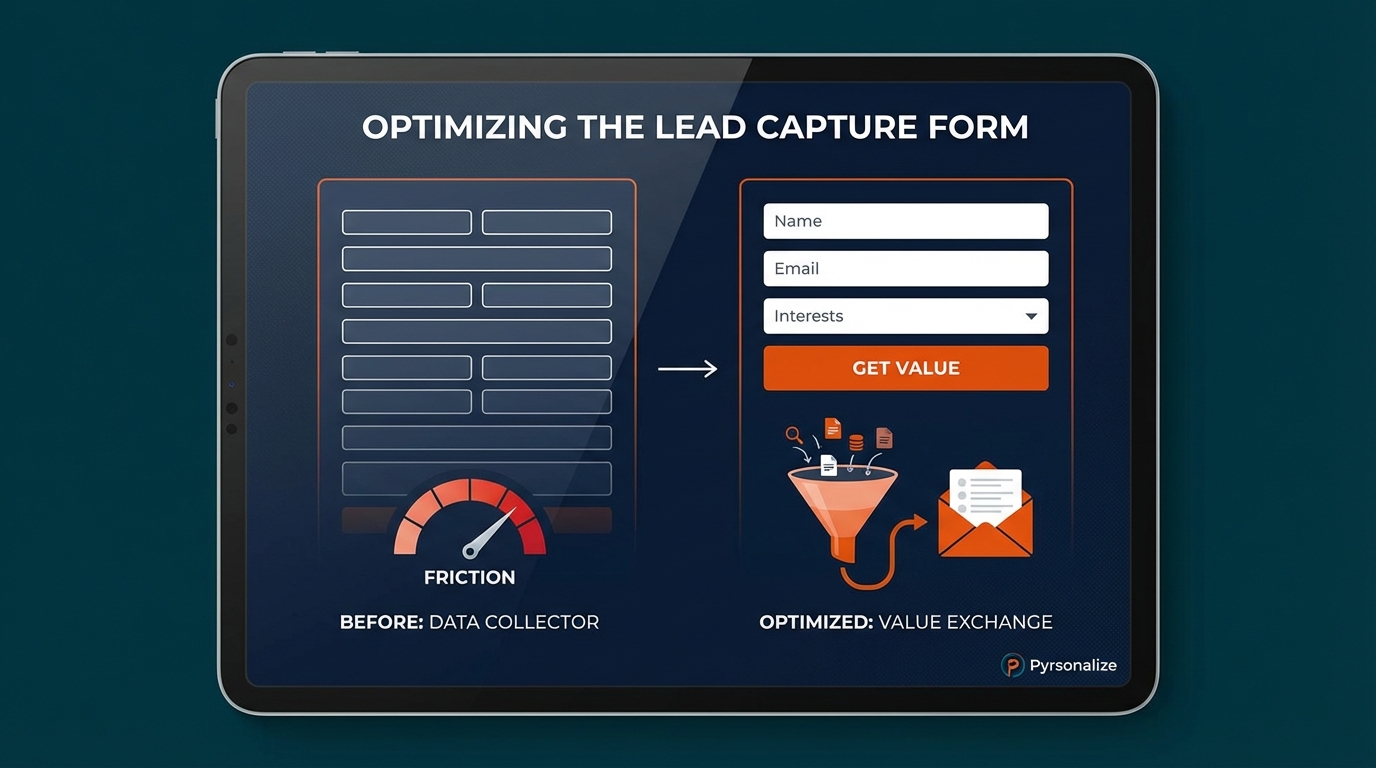
The lead capture form is the final point of execution on your high converting lead generation landing page. This singular component represents the value exchange, and its design dictates whether you successfully get leads and begin building an email list.
Treating the form merely as a data collector is a critical strategic error. It is a tool for minimizing friction while maximizing the acquisition of essential contact information.
Determining Form Length and Friction
Form length introduces friction, which is the primary deterrent to conversion. You must navigate the strategic trade-off between lead quantity and lead quality.
Shorter forms inherently yield a higher volume of email addresses. Conversely, longer forms generate fewer leads but provide richer, pre-qualified data essential for your sales teams.
The optimal choice depends entirely on the value of the offer and the complexity of your sales cycle. A simple lead gen landing page offering an ebook requires minimal data, while a request for a custom consultation justifies greater data collection.
Applying the Principle of Reciprocity
To establish best practices, align the perceived value of your asset with the required effort of the user. This adherence to the Principle of Reciprocity ensures a fair exchange.
You cannot demand extensive contact information if the asset is low-value. The friction must be proportionate to the reward.
| Strategy | Form Length | Conversion Rate Impact | Lead Quality | Best Use Case |
|---|---|---|---|---|
| Minimalist Approach | 1-3 Fields (Name, Email) | High Volume, Low Friction | Lower, Requires Nurturing | Newsletter Signup, Simple Ebook Download, Collect Subscribers |
| Data Enrichment Focus | 5-8 Fields (Role, Company Size, Phone) | Lower Volume, High Friction | Higher, Sales-Ready Leads | Free Trials, Custom Consultations, Demos |
Collecting Critical Contact Information
Every field you add to your lead capture landing page must be validated against a strict business requirement. If the data is not immediately actionable, remove it.
Your focus must be exclusively on collecting the contact information essential for the immediate next step in the buyer journey. Redundant fields introduce unnecessary friction and reduce the number of potential customers you successfully capture.
- Mandatory Fields: These are the minimum data points required to facilitate the value exchange, typically a name and a valid email address.
- Conditional Fields: Data points like company size, phone number, or job title should only be included if the offer is high-value or if the sales team requires immediate contact.
Strategies for Pre-qualifying Leads
Effective lead generation involves filtering out unqualified prospects early in the funnel. This process, known as Pre-qualifying Leads, can be integrated directly into your form structure.
Instead of relying on generic questions, utilize smart fields and conditional logic that segment the audience immediately. This is a crucial best practice for high converting pages.
By asking about industry, company size, or budget range, you instantly score the lead. This allows you to route high-potential prospects directly to your sales team, ensuring marketing efforts attract the right type of potential customers.
This strategic segmentation maximizes the efficiency of your follow-up process and ensures you get leads that are most likely to convert into revenue.
Copywriting Tactics for Lead Generation Success
The performance of your lead capture form relies entirely on the quality of the surrounding messaging. Your copy on the lead generation landing page must be persuasive, concise, and focused entirely on the tangible benefits the user will realize.
This is where strategic copywriting becomes a mandatory best practice for driving high conversion rates.
Leveraging Social Proof and Trust Signals
Trust is the currency of conversion. Visitors, particularly those arriving from paid traffic, are inherently skeptical of new offers. You must leverage social proof immediately to validate your offer.
These signals diminish risk perception and significantly increase the likelihood of form completion, helping you get leads efficiently.
Integrate these essential elements strategically:
- Testimonials: Specific quotes from satisfied clients, ideally including names and company affiliations for maximum credibility.
- Trust Badges: Prominently display logos of major clients or relevant industry certifications and security seals.
- Quantifiable Statistics: Use data showing success, such as “Trusted by 10,000 users” or measured results like “Increased conversion rates by 45%.”
Implementing the Principle of Reciprocity
The Principle of Reciprocity dictates that when you give something of undeniable value first, the recipient feels obligated to return the favor. In modern lead generation, the high-quality asset, the ebook, the template, the free tool, is the initial gift.
Marketing strategist Paul Park often emphasizes that the perceived quality of the free asset must be exceptional to drive this psychological exchange.
Ensure the visual representation of the asset is professional. The description must highlight the depth of knowledge contained within to attract potential customers.
This deliberate strategy reinforces the value exchange, making the act of providing contact information or email addresses a natural response to receiving high-quality content.
The Power of a Singular Call to Action
Every high converting landing page example adheres strictly to the rule of one. There should be only one primary Call to Action (CTA) on the page.
Avoid secondary links that distract potential customers from the primary goal of conversion and minimize the focus on the lead gen landing page.
The CTA button itself must be meticulously crafted to minimize friction and maximize click-through rates. The text must meet three critical criteria:
- Action-Oriented: Use strong verbs that describe the immediate outcome, such as “Get the Guide Now,” or “Start Your Free Trial.”
- Visually Prominent: Use a high-contrast color that immediately draws the eye and ensures visibility, even for visitors skimming the page.
- Benefit-Driven: Avoid generic phrases like “Submit.” Link the action directly to the benefit, reinforcing the final step in the value exchange and ensuring you successfully collect subscribers and begin building an email list.
Technical and Design Best Practices
Successful lead generation landing pages must be technically flawless to support the strategic messaging. Technical friction is often the silent killer of conversions, preventing potential customers from completing the value exchange.
Conversion Rate Optimization Protocols
Effective Conversion Rate Optimization (CRO) is not optional, it is mandatory for scaling your lead generation efforts. You must systematically test variations of your page elements to identify configurations that drive the highest conversion rates.
Focus your A/B testing efforts on high-impact variables that directly influence decision-making:
- Headlines: Strategically test variations focusing on clarity versus urgency to maximize the Message Match with the preceding ad copy.
- Hero Elements: Test product shots against lifestyle imagery or short video loops to determine which visual cue best supports the offer.
- CTA Copy and Color: Test subtle changes in button text and hue. Ensure the CTA button maintains high contrast against the background to focus attention.
- Form Length: Test the difference between minimal fields required to collect subscribers versus additional fields needed for pre-qualifying leads.
Continuous iteration based on quantifiable data is the only path to maintaining a high converting status. Platforms like Unbounce provide the necessary tools for establishing this rigorous testing environment.
Optimizing the Above the Fold Experience
The area visible immediately upon loading, the Above the Fold section, determines whether visitors engage or bounce. This space is premium real estate on any lead capture landing page.
You must ensure the core components of the offer are immediately visible without requiring a scroll. This includes the primary headline, a compelling hero visual, and crucially, the lead capture form or a prominent CTA button leading directly to it.
If potential customers cannot quickly grasp the value proposition and the next step, they will exit. High-performing lead gen landing pages prioritize clarity and action in this critical initial viewport.
Mobile Responsiveness and Load Speed
In 2025, mobile traffic often dominates your marketing funnel. If your lead generation landing page is not perfectly responsive and loads slowly, your ability to get leads will suffer drastically.
Ensure that the form is easy to interact with on a small screen and that all images are optimized for rapid loading. A delay of even one second can increase bounce rates by double digits, wasting budget spent driving traffic to the page.
Technical performance is a foundational element of best practices. Conduct rigorous speed tests on both 4G and Wi-Fi networks to identify and eliminate all rendering friction.
Analyzing High-Converting Landing Page Examples
Study successful landing page examples across various industries. While direct copying is ineffective, understanding the structural choices made by high-performers provides a strong framework for your own strategy.
Look specifically at how industry leaders manage the presentation of complexity. Notice how B2B companies often use longer pages to thoroughly justify a high-value offer, while B2C campaigns leverage shorter, image-heavy designs focusing on immediate emotional appeal.
Adapt these structural insights to your specific audience needs. Analyzing these lead generation examples helps refine how you present the offer and manage the flow of contact information collection.
Post-Conversion Strategy: Maximizing the Lead Capture Landing Page Return
The conversion moment is not the conclusion of the process. It is the critical transition point that validates your entire marketing funnel.
Once you successfully collect subscribers and their contact information, your post-conversion strategy must immediately reinforce the action and initiate robust nurturing.
A mandatory component of every high converting strategy is the optimized Thank You page. This asset must immediately deliver the promised asset or confirm the next steps, fulfilling the crucial Principle of Reciprocity.
This confirmation validates the successful value exchange you facilitated on the lead generation landing page. You must leverage this page to deepen engagement with your newly acquired lead.
Leveraging the Thank You Page for Secondary Conversions
- Suggest Secondary Content: Direct the lead to high-value, related articles or case studies. This pre-qualifies them further and establishes your authority.
- Promote Social Connection: Encourage the lead to follow your company on key social platforms. This expands your communication channels beyond just email addresses.
- Initiate Product Exploration: If appropriate, offer a low-friction opportunity to explore your core product or schedule a demo, moving them closer to becoming paying customers.
- Request Referrals: If the lead capture was highly specific (e.g., a tool or assessment), ask them to share the resource with their peers.
This seamless, strategic transition ensures that the effort invested in creating the perfect lead gen landing page translates directly into accelerated pipeline growth and continued engagement with your potential customers.
Effective post-conversion tactics are a critical component of best practices for building an email list that consistently delivers quality leads.
Frequently Asked Questions: Optimizing Your Lead Generation Assets
What is the difference between a lead capture landing page and a click-through landing page?
The distinction is defined by the objective. A lead capture landing page is engineered specifically to execute a value exchange, gathering contact information via a form in return for an immediate asset (e.g., a high-value checklist or exclusive report).
Conversely, a click-through landing page contains no form. Its sole purpose is to serve as an intermediate step to warm up potential customers, persuading them to click directly through to a subsequent page, typically a checkout or detailed product sales page.
Should I incorporate video on my lead gen landing page?
Yes, strategically implemented video is one of the best practices for increasing conversion rates on a lead generation landing page. Video allows you to communicate complex value propositions quickly or establish trust through a concise testimonial.
However, the execution must be flawless. Ensure the video is highly relevant and optimizes page load times. Never use auto-play functions; this generates friction and detracts from the user experience, negatively impacting your goal to get leads.
How many fields are optimal for forms designed to collect subscribers?
The optimal quantity is determined by the required quality of the lead and the perceived value of the offer. For the goal of efficiently building an email list and maximizing the number of email addresses collected, restrict the form to two or three fields (Name and Email Address).
If the asset is high-value, such as a personalized assessment or consultation, you can justify expanding the form to five or six fields. This enables you to be highly effective at Pre-qualifying Leads for immediate sales follow-up, ensuring the quality of the lead justifies the reduced volume of submissions.
What is the recommended approach for integrating social proof on a high converting landing page?
Social proof is a critical trust signal. It must be positioned strategically near the primary form and the Call to Action (CTA). This placement reinforces the visitor’s decision immediately before they commit to submitting their contact information.
Utilize concise, powerful testimonials or display recognizable client logos. For maximum impact, place these credibility signals prominently in the lower section of the Above the Fold area or directly adjacent to the conversion mechanism.
How often should I update the copy and design of my high converting landing pages?
Even the most high converting pages require proactive maintenance. We mandate a minimum quarterly review cycle where you rigorously analyze key performance indicators (KPIs) and conduct continuous A/B testing on underperforming elements.
Market dynamics, competitor strategies, and user expectations are constantly shifting. Your lead gen landing page must adapt continually to maintain peak conversion efficiency and uphold the highest standards of best practices. For insights on improving your landing pages, check out this guide on How to Embed a Lead Capture Widget on a Landing Page.