


The digital asset market is saturated. You already know this.
Generic stock photos and basic clip art are commoditized. AI generates them instantly, making that revenue stream obsolete,fast.
If you run a serious studio or design operation, your focus must shift. We are not selling hobbyist craft files. We are selling specialized, high-leverage assets: premium fonts, complex 3D models, and unique software add-ons.
The core challenge is maximizing net profit. You need high-traffic platforms that cater specifically to professional buyers, not just mass-market consumers. These buyers pay premium rates.
We analyzed the best-performing platforms for 2026. We focused on three metrics: commission structures, licensing control, and niche audience access. This is the blueprint for scaling your digital asset revenue.
Key Takeaways for Asset Monetization
- Niche Focus Maximizes ROI: General marketplaces yield low returns. Focus on specialized hubs (like TurboSquid for 3D or FontSpring for typography) where commissions are often lower and price points are significantly higher.
- Non-Exclusive Licensing is Mandatory: Platforms offering non-exclusive licensing allow you to sell the same asset across multiple channels. This is how we maximize passive income potential.
- 2026 AI Policy is Non-Negotiable: The current market demands clarity. Understand the strict, constantly evolving policies regarding AI-generated or AI-assisted assets before uploading anything.
- Marketplaces Are Lead Funnels, Not Endpoints: Use self-hosting platforms (Shopify, Gumroad) to capture 90%+ of the revenue. Marketplaces should function primarily as high-volume lead generation funnels for your own ecosystem.
Tier 1: High-Volume, High-Traffic Marketplaces (The Volume Play)

This is where the massive, built-in audiences live. You trade proactive, manual lead generation for immediate, platform-driven traffic. The catch is the cost: You accept high commission rates in exchange for instant discoverability.
Expect lower net profit margins here. Your strategy must focus purely on asset volume and market saturation.
1. Creative Market (Best for Templates & Bundles)
Creative Market sets the standard for high-quality, professional digital assets. Their audience,freelancers, small agencies, and marketers,demands instant, polished solutions.
The core revenue driver here is template-based assets: high-end social media kits, professional presentation themes, and complex mockups.
- Commission Structure: You keep 60%. The platform takes 40%.
- Exclusivity: Non-exclusive. You retain the right to sell your work elsewhere simultaneously.
- Strategy: Bundle aggressively. This is non-negotiable for scaling. A single $15 template is inefficient; a bundle of 50 related templates selling for $49 dramatically shifts your effort-to-revenue ratio in your favor.
2. Envato Market (The Niche Powerhouse)
Envato is not a single marketplace; it’s a network of niche sites (GraphicRiver, ThemeForest, CodeCanyon). This structure allows for hyper-targeting of highly specific, professional buyers.
Be warned: Envato operates on a strict commitment model. Non-exclusive authors take a catastrophic commission hit.
- Commission Structure: Starts at 55% taken by the platform for non-exclusive authors. Exclusive authors can retain up to 87.5%,a massive difference,based on lifetime sales volume.
- AI Policy: Envato is extremely cautious. Clear disclosure of AI usage is mandatory. Unlabeled or misleading AI submissions risk immediate, permanent account suspension. We recommend full transparency here.
- Actionable Insight: If you utilize Envato, you must commit fully. Exclusivity is the only path to achieving high net revenue and scale on this platform. Do not dabble here.
3. Etsy (Best for Market Validation & High-Volume Printables)
Etsy remains relevant for digital assets, but only for specific, low-friction use cases. Focus strictly on instant downloads and high-demand, low-effort assets: digital planners, printable wall art, or simple branding kits.
Etsy’s massive traffic solves your initial discovery problem. The audience is less professional, but the raw volume is unmatched.
- Upfront Cost: $0.20 listing fee per item. Scale your listings carefully; these fees compound quickly at volume.
- Transaction Fees: 6.5% transaction fee plus standard payment processing fees.
- Focus: Use Etsy as a rapid market testing ground. If a simple printable template sells well here (validation), immediately scale up the production and listing for higher-tier platforms like Creative Market. Treat it like low-barrier demand identification.
Tier 2: Specialized Niche Hubs (The Revenue Accelerator)
This is where professional designers earn serious revenue. These platforms attract industry buyers (architects, game developers, large agencies) who are looking for specific, high-fidelity components. They pay accordingly.
4. FontSpring / MyFonts (Typography)
If you design quality, production-ready fonts, general marketplaces are a mistake. Typography requires specialized licensing (desktop, web, app, server).
Platforms like FontSpring or MyFonts handle complex licensing models automatically. They attract buyers ready to pay $100+ for a single font license.
- Royalty Rates: FontSpring offers non-exclusive rates up to 70%. MyFonts (Monotype) is typically lower but offers massive distribution.
- Key Metric: Focus on Perpetual Licensing. This is the foundation of high-ticket font sales.
5. TurboSquid / CGTrader (3D Models and Mockups)
3D assets are a high-value niche. Selling realistic mockups, game-ready models, or VR/AR assets requires platforms built for 3D file formats, rendering previews, and complex usage rights.
TurboSquid and CGTrader dominate this space. They target game studios, architectural firms, and industrial designers.
- Commission Structure (TurboSquid): Standard rate is 50%. Exclusive artists (under their SquidGuild program) can earn up to 80% royalty.
- Why Exclusivity Matters Here: These buyers demand quality assurance. Being exclusive signals a higher level of dedication and quality control to the enterprise buyer.
6. Adobe Creative Cloud Marketplace/Exchange (Software Add-ons)
Integration is the future of digital asset sales. Selling brushes, plugins, actions, or complex templates directly inside the Adobe ecosystem guarantees visibility to a massive, captive audience of paying professionals.
When you integrate your product into their workflow, you eliminate friction. This leads to higher conversion rates.
- Focus: Photoshop actions, Illustrator brushes, Premiere Pro templates, and high-end Lightroom presets.
- Leverage: Adobe actively promotes high-performing assets within the Creative Cloud interface. This is free, high-intent traffic directly to your product.
7. Creative Fabrica (AI and Craft Focus)
Creative Fabrica is designed for the high-volume craft and DIY market. Crucially, they have embraced AI-generated assets, provided they are unique and packaged correctly (e.g., as seamless patterns or unique coloring pages).
This is a critical platform if your strategy involves leveraging AI tools for high-volume, quick-turn asset production. Read our guide on The 2025 Blueprint for AI Passive Income & Tools.
- Commission: 50% cut.
- AI Nuance: They allow AI art, but require you to turn those raw outputs into usable, commercial products (templates, patterns, bundles). Raw prompts are not enough for scale.
Tier 3: Creator Economy & Self-Hosting (Maximum Profit Control)

Marketplaces are for initial exposure. Self-hosting is the only path to maximum profit margin.
If you have an established audience,or, critically, a robust lead generation system like our Strategic B2B Commenting framework,you must transition to full profit control. We mandate this shift for any studio targeting 7-figure asset revenue.
8. Gumroad / Payhip: The Data Retention Funnel
These platforms are designed for simplicity and direct creator-to-consumer sales. They handle processing and delivery. Critically: they allow you to bypass the punitive 40-50% commission structures of Tier 1 platforms.
Gumroad specifically has aggressively optimized its fee structure to reward established creators. This is a necessary profit bridge.
- Gumroad Fees: A flat 10% commission. This is a 30–40 percentage point increase in your immediate profit margin compared to standard marketplaces.
- Payhip Fees: Starts at 5% (free plan); drops to 0% on higher tiers. Zero percent revenue share is the target for any scaling operation.
- The Conversion Advantage: You retain 100% of customer emails and purchase data. Marketplaces steal this data. We use this direct customer list to build long-term retention funnels and maximize customer lifetime value (LTV).
9. Shopify / WooCommerce (Full Ownership)
This is the final frontier: 100% ownership.
Building your own branded storefront eliminates platform dependency entirely. It maximizes profit retention. You control the branding, the user experience (UX), and the licensing terms. For any serious design studio aiming for long-term residual income, this setup is non-negotiable.
- Cost vs. Control: Higher upfront investment (monthly fees, hosting, specialized theme development). Treat this cost as a necessary CAPEX investment in your brand infrastructure.
- Profit Ceiling: You retain 97%–100% of the revenue (after standard payment processing fees). This is precisely how we maximize net income across our digital product lines.
- The Funnel Strategy: Your self-hosted store sells premium, exclusive assets. You use Tier 1 and Tier 2 marketplaces *only* as high-volume traffic feeders, strategically funneling buyers back to your controlled environment for those high-margin products.
Ready to skip the marketplaces and generate your own high-value leads?
Start Your Free Trial of PyrsonalizeMaximizing Net Revenue: Why Commission Rates Kill Profitability
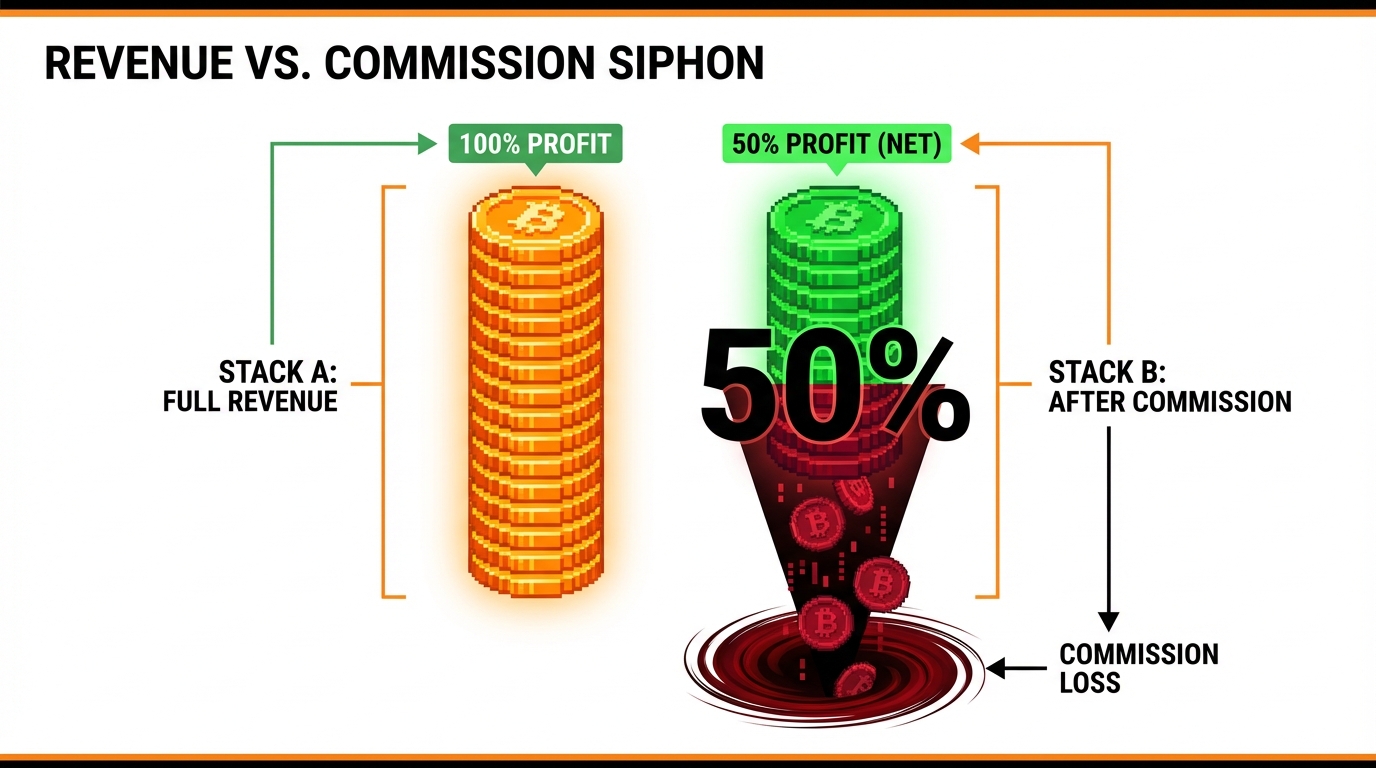
Stop tracking gross sales. They are vanity. We only analyze net revenue,the capital left after every commission, fee, and licensing hurdle is cleared.
If you are scaling (or trying to secure funding), these rates determine your runway. Dependency on high-commission platforms is a slow drain on resources.
Below, we standardize the critical factors showing the true operational cost of marketplace dependency versus the high-control options (Tier 3).
| Platform | Avg. Commission Rate | Exclusivity Policy | Ideal Asset Type |
|---|---|---|---|
| Creative Market | 40% | Non-Exclusive | Template Kits, Fonts (High visibility, high fee) |
| Envato Market (Non-Excl.) | 55% | Optional (High Fee) | High-Volume Niche Graphics (Volume needed to offset fees) |
| Etsy | 6.5% + $0.20 listing fee | Non-Exclusive | Printables, Simple Digital Art (Low barrier entry) |
| Gumroad | 10% | N/A (Self-Hosted Model) | E-books, Templates, Assets (High Net Profit) |
| TurboSquid (Exclusive) | 20% | Mandatory | Professional 3D Models (High-value niche, guaranteed distribution) |
| FontSpring | 30% | Non-Exclusive | Commercial Font Licensing (Specific industry standard) |
The strategic takeaway is clear: 40% to 55% commissions are unsustainable for long-term business growth. You must prioritize platforms,like Gumroad or your own self-hosted solution,that push net revenue above the 80% threshold.
2026 Market Trends: AI, Licensing, and Saturation

We are operating in a post-saturation market. Success is dictated purely by strategic positioning, not by sheer volume metrics.
The AI Policy Divide
The biggest compliance risk right now is AI asset generation. Not all platforms treat AI equally; this is a legal fault line you must navigate.
- Adobe Stock/Envato: They demand detailed metadata and model disclosure. They are actively wary of copyright infringement risks from training data. To submit AI assets, you must prove you own the commercial rights to both the inputs and the outputs. This is high friction.
- Creative Fabrica/Gumroad: They are significantly more permissive. They prioritize commercial viability and the uniqueness of the final product over the method of creation. This low friction is why creators focusing on controlled scaling are leaning here.
“The 2026 reality: The value is no longer in the asset’s generation. AI handles the grunt work. The true monetization system lies in professional packaging, organization, and licensing. The designer is now the strategist.”
The Subscription Saturation Problem
Many major platforms (Envato Elements, Adobe Stock) operate purely on subscription models. Buyers pay a flat monthly fee for unlimited downloads.
This model is excellent for buyers. It is disastrous for creators selling high-value individual items. Your per-download royalty becomes microscopic.
The only viable solution is diversification and intelligent asset placement:
- Use subscription platforms for older, high-volume assets (the “long tail”). Let them generate passive trickle revenue.
- Reserve your newest, highest-quality specialized assets (3D models, premium fonts, complex templates) for individual, high-ticket sales on platforms you control (e.g., TurboSquid, Gumroad, Shopify). Maximize your take-home rate.
Template Economy Shift
Canva and Notion templates are now proven, reliable revenue streams. The demand for highly specialized, functional templates is surging,this is where the margin is.
We see massive, untapped revenue potential in niche template sales:
- Figma component libraries built specifically for high-value industries (FinTech, Health Tech).
- Advanced Notion Templates that automate complex internal processes (project management, content calendars).
- High-fidelity PowerPoint or Keynote templates that directly replace expensive custom agency work.
Focus solely on assets that replace expensive service contracts. That is the only place the real money resides.
Actionable FAQ: What We Are Seeing In Q1 2026
What is the single most profitable type of graphic asset to sell in 2026?
Profit margins correlate directly with replication difficulty. We focus on assets that cannot be easily cloned by an entry-level designer or, critically, by current AI models.
The highest yield comes from two categories of specialized, licensed assets:
- High-Fidelity 3D Models: Specifically engineered for specialized platforms (gaming engines, film VFX pipelines). These assets demand stringent quality control and command $250–$500 per extended license.
- Premium, Expertly Kerned Font Families: Licensing is the key leverage point. Agencies pay top dollar for unique, reliable typography that anchors a major brand identity.
Should I choose platform exclusivity for higher commissions?
Exclusivity is a strategic trade-off. We only recommend it when the platform guarantees two non-negotiable benefits:
- A minimum 25% royalty increase. (20% is often too low to justify the limited reach.)
- Proven, dominant traffic in your specific vertical (e.g., TurboSquid for high-end 3D, not just general templates).
If your assets are general templates, stick to non-exclusivity. Maximize your digital footprint across Etsy, Creative Market, and Gumroad simultaneously. Reach matters more than a fractional increase in commission percentage.
How should I price a digital asset to maximize revenue?
Forget production time. Time spent designing is irrelevant to the market.
You must price based on the value delivered (the immediate ROI for the buyer). If your specialized template saves an agency 10 billable hours, the price must reflect 10–20% of their retained profit.
Actionable structure:
- Implement tiered licensing immediately (Standard, Extended, Enterprise).
- Use Extended/Enterprise tiers to capture maximum value from high-volume corporate clients.
This is high-ticket valuation. To master this negotiation framework, review our guide on securing higher rates: The 5-Figure Copywriter’s Negotiation Playbook for 2025.
Ready to scale your business and find better buyers?
Stop waiting for organic traffic. Use our AI Lead Generation Software to find clients personal emails today.
Start Your Free Trial