

You want to start a B2B consulting service. You want it profitable. You need it fast.
Most guides tell you to spend months perfecting a business plan, registering an LLC, building a complex website, and waiting for organic traffic to materialize.
We reject that model entirely.
That approach guarantees agonizingly slow growth. In 2025, speed is currency. Your first goal is not “launching a business.” Your goal is securing your first high-ticket client. We need immediate validation,cash flow, not complexity.
We call this the 4-Week Velocity Model. It cuts the bureaucracy, rejects the low-value marketplaces (like Upwork or Fiverr), and focuses 100% on immediate, measurable revenue generation.
Key Takeaways: The Velocity Roadmap
- Ignore the Business Plan: Your focus is securing the first paying client, not writing a 50-page document.
- Value Pricing Mandate: Never bill hourly. Price based strictly on the financial outcome you guarantee.
- The Minimum Viable Offer (MVO): Create a fixed-price, 4-week engagement. It must deliver a guaranteed, measurable outcome.
- Rapid, Manual Acquisition: Leverage direct, targeted B2B outreach (Cold Email and LinkedIn). This bypasses slow SEO and expensive, low-yield marketplaces.
I. The Velocity Mindset: Action Over Analysis

The traditional consulting launch model is crippled by one thing: planning paralysis.
Competitors tell you to spend weeks on market research, perfecting your LLC, and optimizing legal setup. We call that procrastination.
Your market research is worthless until money changes hands. Stop polishing the deck. Start dialing the phone.
The only thing that matters in Week 1 is getting a clear, quantifiable offer in front of the right decision-maker.
You already possess the required expertise. The market demands specialists who deliver measurable results now (not six months from now).
Therefore, your roadmap must prioritize client acquisition above all else. This process requires a shift in focus:
- We reject slow-burn organic traffic strategies (initially).
- We prioritize direct, manual lead generation and immediate outreach.
- We ignore vanity metrics and focus solely on cash flow.
We focus on a single, high-leverage metric that dictates our entire strategy: Time to First Revenue (TTFR).
II. Week 1: Hyper-Niche & MVO Design
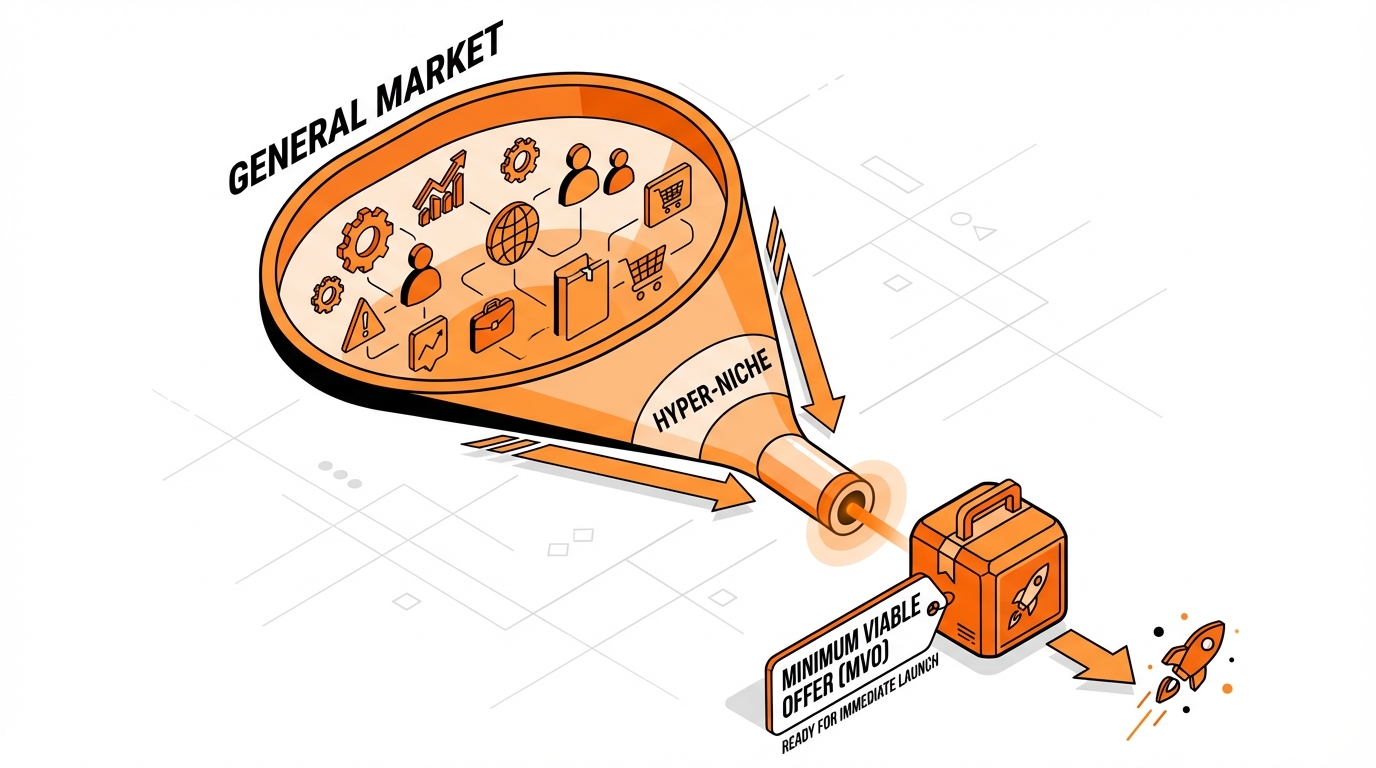
Generalists starve. Specialists thrive. This is the non-negotiable rule of modern B2B consulting.
If your niche is “marketing strategy” or “HR consulting,” you are selling a commodity. Your focus must be surgical: address a specific, high-pain problem for a narrow audience that has the budget to solve it now.
Step #1: Define the Hyper-Niche (The Who)
Extreme clarity on the target client is mandatory. Without it, our manual lead generation system fails.
- Bad Niche: Small businesses needing sales help.
- Better Niche: Mid-market SaaS companies ($5M-$20M ARR) struggling with customer churn.
- Hyper-Niche: Mid-market B2B SaaS companies using HubSpot who consistently see a 15%+ churn rate on 6-month contracts.
The narrower the focus, the easier our manual outreach becomes. This surgical focus allows us to command premium fees. Why? Because you are the only solution speaking directly to their precise, quantifiable problem.
Step #2: Craft the Minimum Viable Offer (MVO)
The MVO is the backbone of our Velocity Model. It is not a lengthy, open-ended engagement. It is engineered for rapid delivery and immediate, quantifiable financial impact.
- Fixed Duration: Four weeks is the maximum ideal timeframe. This minimizes client commitment risk and maximizes our speed to measurable results.
- Fixed Price, High-Ticket: Eliminate hourly billing entirely. Set a clear, high-ticket price range (e.g., $5,000 – $15,000+). We sell outcomes, not hours.
- Guaranteed Outcome (The ROI Hook): The MVO must promise a specific, measurable result. Fixing the outcome is the only way to justify premium pricing.
MVO Example: “We will audit your HubSpot renewal process and implement three key retention workflows guaranteed to reduce your Q4 churn rate by 5% minimum. Delivered in 4 weeks for $10,000.”
This offer is irresistible to the Hyper-Niche target. It is not focused on effort; it is focused strictly on ROI. It is an investment for them, not an expense. This is precisely how we generate high-ticket consultations immediately.
III. Week 2: Value-Based Pricing (High Profit)

Charging by the hour caps your revenue. Period. It also forces clients to micromanage your time and focus on input, not outcome. We fundamentally reject this scarcity mindset.
Value-Based Pricing (VBP) is the only sustainable model for high-ticket B2B consulting. You price the outcome. You do not price the input. This is how you scale fast.
The VBP Calculation
Let’s look at the math. If your Minimum Viable Offer (MVO) helps a SaaS client recover $100,000 in annual churn, charging $10,000 is a no-brainer. That is a 10x ROI for the client (a measurable win).
Our most successful consultants consistently charge 10% to 20% of the measurable financial impact they deliver. This pricing model instantly elevates you. You shift from being a contractor focused on tasks to a strategic partner focused on investment returns.
Stop selling time. Start selling guaranteed revenue increase.
The Danger of Hourly Rates vs. VBP
The decision to adopt VBP is central to profitability and scaling. It’s the difference between building a high-paid job and building a scalable business asset. We use VBP because the alternative is fundamentally broken:
- Hourly rates focus clients on cost, not value.
- They punish efficiency (the faster you solve the problem, the less you earn).
- They limit your earning potential to 24 hours in a day.
Review the breakdown below:
| Metric | Hourly Rate Model | Value-Based Pricing (VBP) |
|---|---|---|
| Client Focus | Cost, Time, and Effort (Input) | ROI, Outcomes, and Impact (Output) |
| Revenue Cap | Capped by hours worked (Low Ceiling). | Capped only by value delivered (Unlimited Ceiling). |
| Incentive Structure | Punishes efficiency (faster work = less money). | Rewards efficiency (faster work = same high fee). |
| Perceived Value | Commodity / Labor | Strategic Partner / Investment |
IV. Week 3: Rapid B2B Client Acquisition Engine
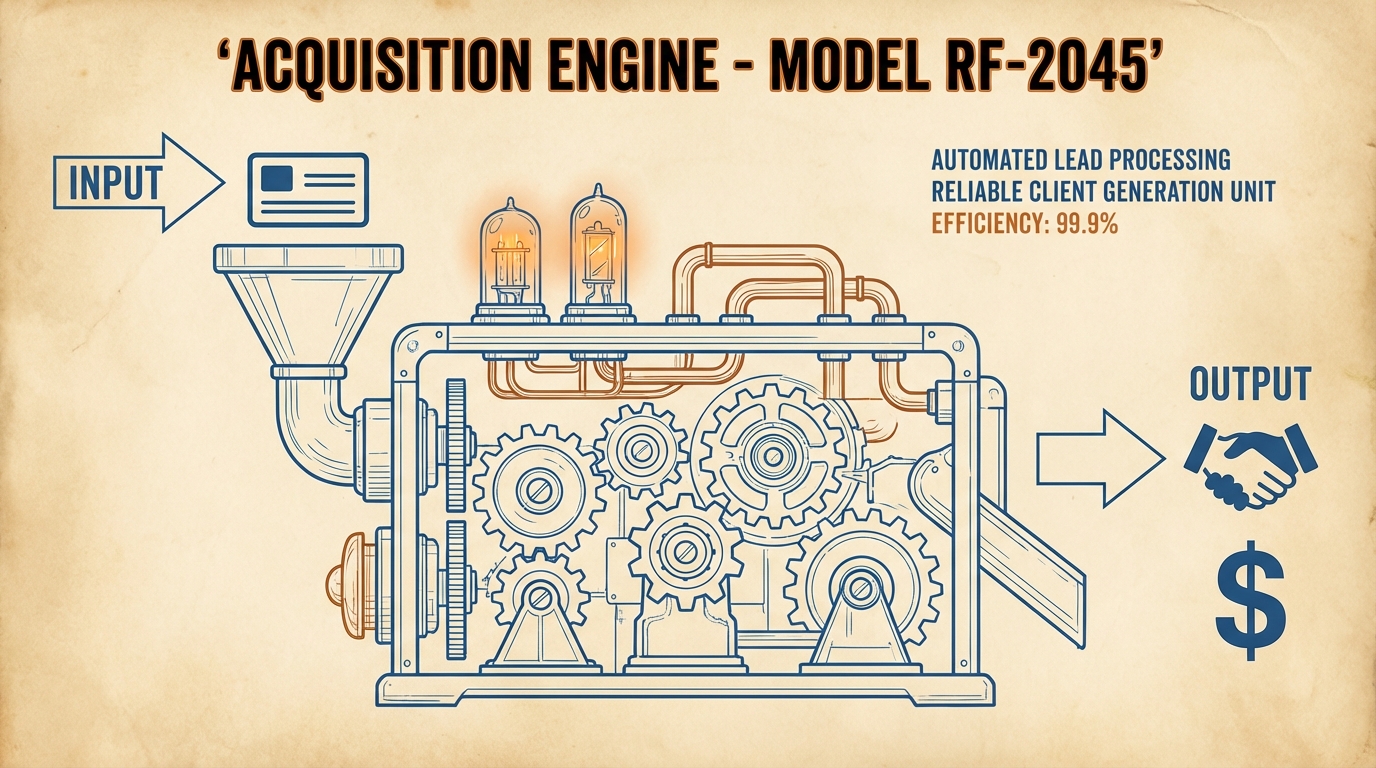
This is the acceleration phase. We are not optimizing for vanity metrics or building a slow-burn content strategy. We are generating qualified appointments now.
The fastest way to land a high-ticket B2B client is direct, targeted outreach.
Avoid the Marketplace Trap
Generic competitor guides push you toward consulting marketplaces (Catalant, TopTal). Reject this advice.
This is a critical mistake for a high-profit B2B service. Marketplaces commoditize your expertise:
- They capture 20–35% of your hard-earned revenue in fees.
- They force price competition, instantly commoditizing your Minimum Viable Offer (MVO).
- They create dangerous revenue dependency. If their algorithm shifts, your pipeline collapses overnight.
We build systems we own. We use AI and data to identify and target decision-makers directly.
Step #1: Identify the Ideal Prospect List
Based on your Hyper-Niche (e.g., SaaS companies focused on Q4 retention), you need a precise list. Target 50–100 specific companies and the names of the decision-makers (VP of Revenue, CEO, Head of Growth).
Your outreach must land in their primary inbox. Generic info@ or sales@ addresses are instantly filtered. You need the verified, personal work email.
This is where we introduce leverage. Tools like Pyrsonalize become critical for scaling this process. We use proprietary AI to scrape public data and verify those hard-to-find client emails.
This ensures your outreach hits the mark. It bypasses gatekeepers and avoids the spam folder entirely.
Ready to validate your list and find those critical emails? Start Your Free Trial and secure your first 100 verified leads today.
Step #2: LinkedIn Outreach (LIO) Framework
LinkedIn is the primary channel for B2B consulting. Your goal is not to sell in the DMs, but to secure a 15-minute diagnostic call.
The LIO Sequence (Max 3 Contacts):
- Connection Request (Hyper-Personalized): Reference a specific, recent event, post, or public metric directly related to your MVO. *Example: “Saw your recent $10M Series A raise. We specialize in reducing post-funding churn for growth-stage SaaS. Quick question about your Q4 retention metrics.”*
- Value-Add DM (Post-Connection): Wait 24 hours. Deliver a specific, non-pitch insight immediately. *Example: “Based on your current tech stack, I spotted a common bottleneck in renewal workflows. We eliminated this exact issue for [Competitor X] last month. Happy to share the 1-page framework,no need to jump on a call.”*
- The Transition: If they engage with the value, propose the 15-minute diagnostic call. If they do not, immediately pivot to the high-leverage cold email channel (Step #3).
Engagement builds trust faster than any long-form content marketing strategy. Our data proves this. Engaging with your target prospects’ existing content is high-leverage activity that shortens the sales cycle dramatically.
Step #3: The High-Ticket Cold Email Framework
Cold email is the fastest path to the decision-maker, provided you follow the rules of high personalization and brevity.
We use the AIDA-P Framework (Attention, Interest, Desire, Action , Proof). This structure ensures maximum conversion velocity:
- Subject Line (Attention): Must be five words or less. Specific and curiosity-driven. *Example: $20k ARR recovery?* or *[Prospect Name]’s Q4 Churn.*
- Opening (Interest): Immediately reference the MVO problem. Be hyper-specific. *Example: “We focus exclusively on helping HubSpot SaaS clients lower churn on contracts under 12 months.”*
- Value Proposition (Desire/Proof): Introduce the quantifiable result. Use measurable proof points. *Example: “We guarantee a minimum 5% churn reduction within 30 days. For companies your size, this consistently recovers $20k+ in ARR per quarter.”*
- Call to Action (Action): Keep friction low. Request 15 minutes,nothing more. *Example: “Worth a quick 15-min diagnostic call next week to review your current retention process?”*
Volume is irrelevant if personalization is absent. You must focus on quality data (Step #1) and quality delivery (Steps #2 and #3). Send 50 highly personalized emails to verified decision-makers, not 5,000 generic blasts.
V. Week 4: Minimum Viable Operations
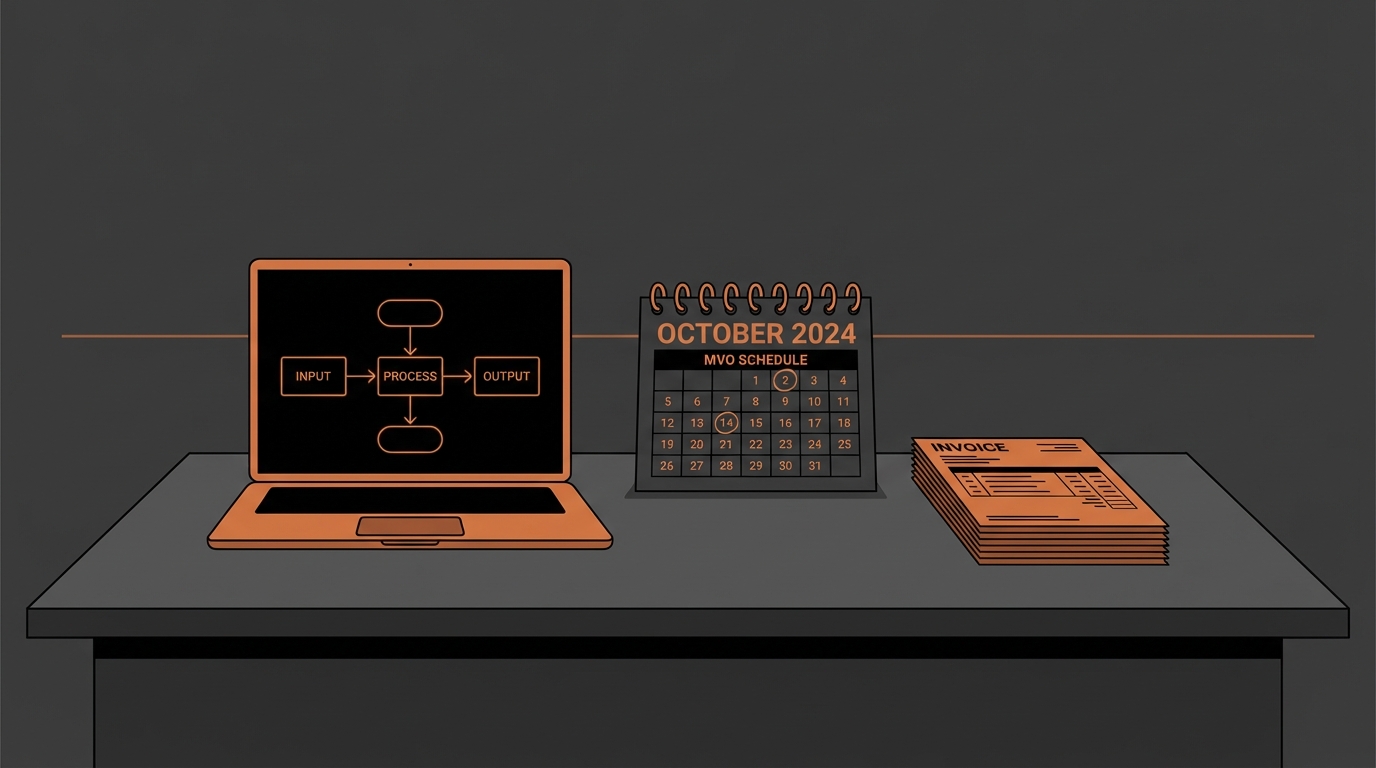
You closed the deal in Week 3. Now, we shift focus from rapid acquisition to foundational infrastructure. This is not about building an empire. It is about building a lean, compliant machine designed to deliver your Minimum Viable Offering (MVO) efficiently. We focus only on what is essential for professional operation.
Step #1: Legal Structure: The Compliance Minimum
Do not waste weeks researching complex corporate structures. Start simple, start fast.
- Sole Proprietorship / Single-Member LLC: This handles your first $100k in revenue. The choice is between separating liability (LLC) or simplifying initial taxes (Sole Prop). Registration takes hours, not weeks.
- Dedicated Business Bank Account: Separate personal and business finances immediately. This is non-negotiable for accounting clarity and legal protection.
- Standardized Contract Template: Never deliver work without a signed agreement. Define the MVO scope, the fixed fee, and the payment schedule clearly. (We recommend 50% upfront to manage cash flow.)
Step #2: The Essential, Lean Tech Stack
Your infrastructure must be lean, strategic, and focused entirely on tracking and client delivery. We reject expensive, bloated software that slows down velocity.
- CRM (Tracking Only): Use Trello, Notion, or even a structured Google Sheet. The sole function is tracking pipeline status: Lead > Contacted > Meeting > Closed/Lost. Keep the system simple.
- Communication Hub: Zoom or Google Meet. Use professional, reliable video conferencing links.
- Payment Processing: Stripe or QuickBooks. You must invoice professionally and accept modern payment methods (ACH, credit card).
- AI Augmentation: This is mandatory for speed. Leverage AI tools (like Pyrsonalize for lead identification, or generic tools for research/drafting). This efficiency gain drives down your time-to-delivery, directly maximizing your value-based pricing returns.
VI. Scale: From MVO to Retainer Model
You secured the initial revenue through the MVO. That was the easy part.
Now, you must convert that transactional success into long-term, predictable income. The objective is simple: move the client from the fixed-scope MVO,usually 4 weeks,into a high-profit, ongoing retainer contract. This is how we build stability.
The Retainer Conversion Strategy
- Step 1: Over-Deliver and Over-Quantify. Complete the MVO scope successfully. Do it early. The client must see undeniable, documented ROI. We focus on results that translate directly to their balance sheet.
- Step 2: Engineer the Case Study. Immediately create a quantifiable case study based on the MVO results. Use hard numbers only. *Example: “We reduced churn by 7% in 28 days. That’s $25,000 in recovered ARR this quarter.”*
- Step 3: Present the Strategic Gap. During the MVO closing meeting, *do not* ask for general feedback. Instead, present the next logical, high-value problem you observed during your work. This positions you as the indispensable strategist. *Example: “The churn workflows are stable, yes. But your competitor acquisition strategy is bleeding leads,that is the $50,000 problem we tackle next.”*
- Step 4: Lock Down the Retainer. Position the retainer as ongoing strategic support. This maintains the MVO gains and expands the scope to solve the new, bigger problem (Step 3). This is priced monthly (e.g., $5,000 – $10,000/month minimum) and guarantees continuous access to your expertise and continual optimization cycles.
This process transforms transactional MVO work into recurring, high-margin revenue streams. This is the only sustainable way we scale a profitable consulting business: without relying on massive internal teams, expensive PPC campaigns, or slow, generic marketing channels. We focus on recurring value delivery.
Ready to find the clients who need this exact transformation? Start Your Free Trial of our AI Lead Generation Software today.
VII. Frequently Asked Questions (FAQ)
Q: Should I build a complex website before launching my consulting service?
A: Absolutely not. A complex website is a distraction in Week 1. It kills velocity.
Your focus must be strictly on direct client acquisition: That is the only metric that matters right now. A simple, optimized LinkedIn profile is sufficient. It must detail your MVO and your hyper-niche clearly.
Only after closing three paying clients should you invest resources into a dedicated site. Use that site to showcase verified case studies and testimonials,not generic fluff.
Q: What is the biggest mistake new B2B consultants make?
A: The biggest mistake is defining yourself as a generalist. This immediately forces you into the commodity trap (the race to the bottom).
To succeed quickly, you must reverse this mentality. Focus on three non-negotiables:
- Hyper-Niche: Be ruthlessly specific about the problem you solve.
- MVO (Guaranteed Outcomes): Offer a measurable result, not just effort.
- Value-Based Pricing: Price based on the client’s expected ROI, not your hourly time. Your time is irrelevant; their outcome is everything.
Q: How can AI help me secure my first client faster?
A: AI is the accelerator for the Velocity Model. It cuts down the two most time-consuming steps: lead generation and hyper-personalization.
Specifically, AI tools like Pyrsonalize deliver measurable speed:
- Bypassing Gatekeepers: We give you the verified personal emails of decision-makers. This skips the SDR layer entirely.
- Pain Point Analysis: AI analyzes targets faster than any human researcher.
- High-Conversion Messaging: Draft highly personalized, high-conversion cold emails and LinkedIn messages in minutes.
Speed is revenue. AI provides the speed.
Ready to take the next step?
Unlock the decision-maker emails you need to implement this strategy today. Start Your Free Trial.
Start Your Free Trial