


Most sales reps and founders treat LinkedIn comments as a secondary engagement tactic. They use generic validation or dropped emojis. This approach is fundamentally flawed in the current B2B landscape.
Comments are not for building superficial engagement. They are a low-friction, high-leverage channel for manual lead generation. When executed strategically, your comment is micro-content designed to qualify the author, attract profile views from their network, and initiate the transition to a private sales conversation.
We analyzed the conversion pathways of top-tier B2B founders using LinkedIn. The consistent finding? Generic comments attract tire-kickers. Strategic comments attract decision-makers who immediately recognize specialized expertise. Stop posting “Great insight.” Start leveraging structured formulas engineered specifically for client acquisition.
Key Takeaways for Strategic Commenting
- Specificity is the Filter: Use precise, industry-specific language (e.g., “utilization rate,” “ARR churn,” “lead-to-opportunity conversion”) to immediately filter for premium clients and repel low-value leads.
- Intent-Based Formulas: Categorize your daily engagement by strategic goal (e.g., Authority Building, Lead Qualification, DM Bridge) rather than relying on spontaneous, low-value reactions.
- Conversion Bridge: Every high-value comment must create a clear, low-friction pathway for the conversation to transition from the public thread into a private message or call.
- Quality Over Volume: Focus your daily engagement on 5-10 posts from high-value Ideal Customer Profiles (ICPs), ensuring each comment adds demonstrable expertise and strategic value.
1. The Language Filter: Attracting Premium Clients

The fundamental requirement for leveraging comments into conversions is recognizing that your language operates as a strategic filter. Generic validation attracts volume; highly specific, calibrated language attracts only the founders and decision-makers operating at your target level.
If you are targeting $10M+ SaaS founders, your comment must immediately reference the specific metrics, operational challenges, or business models they are currently debating internally. This demonstrates visceral recognition of their specific reality, bypassing the need for superficial introduction.
Implementing the Language Filter: Three Strategic Components
- Reference Precise Stage Context: Avoid high-level terminology like “scaling.” Use precise, quantifiable stages that define their current operational friction.
- Low Value: “I agree that scaling is hard.”
- High Value: “We see this exact friction point when clients transition from $5M to $15M ARR. The shift from generalists to specialized leadership is brutal if not timed correctly.”
- Cite Specific Industry Signals (The Secret Handshake): Use specialized terms that only true insiders would understand or care about. This functions as a rapid qualification signal.
- If the author is discussing agency growth, reference “utilization rates,” “scope creep,” or “seat-based pricing models.”
- If the author is discussing product development, reference “PLG adoption curves,” “feature parity,” or “time-to-value metrics.”
- Mirror the Internal Monologue: Use the exact, raw phrasing your Ideal Customer Profile (ICP) uses when describing their pain, not the sanitized, public-facing version.
- If a CEO is worried about team burnout, they aren’t thinking about “better work-life balance.” They are thinking, “I’m paying top dollar for people who are collapsing under the decision load.” Your comment must reflect this raw language to achieve resonance.
2. The 7 High-Value Comment Formulas for Conversion
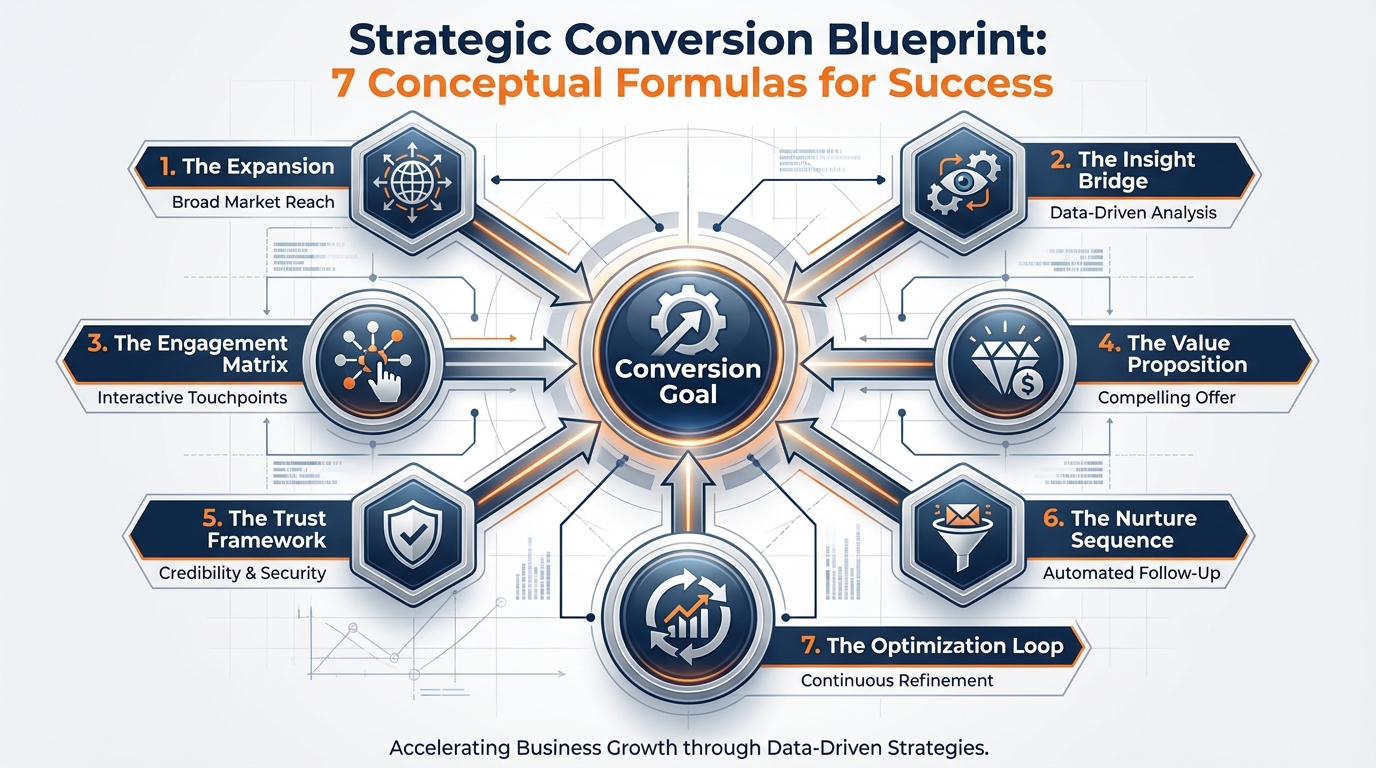
These seven formulas are not suggestions; they are structured, conversion-focused templates. Deploy them by filling the blanks with hyper-specific language that immediately demonstrates your expertise, qualifies the reader, and pushes the interaction toward a private sales opportunity.
Formula 1: The Authority Builder
Goal: Establish yourself as an expert who operates one strategic level deeper than the original post author.
Structure: (Acknowledge Core Point) + (Add Counter-Intuitive Insight/Caveat) + (Provide Concrete Proof/Example).
Template: “You are right that [Original Point]. However, we find that most teams overlook the critical factor of [Counter-Intuitive Insight]. We tracked this across [Specific Number] client deployments in 2025, and the ones that failed to implement [Specific Tactic] saw a [Metric] drop in performance within 90 days.”
Example: “You are right that demand generation requires content consistency. However, we find that most teams overlook the critical factor of intent data integration at the content consumption stage. We tracked this across 14 B2B SaaS deployments in 2025, and the ones that failed to implement predictive prospecting saw a 35% decrease in MQL-to-SQL conversion within 90 days.”
Formula 2: The Pain Point Mirror
Goal: Validate the author’s high-level challenge while subtly positioning your service as the logical, next-stage solution.
Structure: (Validate Feeling/Situation) + (Specific Stage Context) + (Implied Solution or Next Hurdle).
Template: “This feeling of [Specific Negative Emotion/Pain] is completely accurate when you’re at the [Specific Revenue/Team Size] stage. The biggest pivot we see is moving from [Current Problematic Tactic] to [Future Required Tactic]. If you don’t make that shift, your [Key Metric] will flatline, halting scaling.”
Example: “This feeling of pipeline anxiety is completely accurate when you’re at the Series A funding stage. The biggest pivot we see is moving from generic cold outreach to hyper-personalized, AI-driven ABM frameworks. If you don’t make that shift, your cost per acquisition (CPA) will flatline.”
Formula 3: The Qualification Question
Goal: Force the author (or thread readers) to self-qualify their problem, immediately revealing if they are a high-value prospect with a sophisticated challenge.
Structure: (Agree/Acknowledge) + (Ask Hyper-Specific Niche Question that requires advanced knowledge) + (Justify the Question).
Template: “Great post. Since you mentioned [Specific Topic], I’m curious: How are you managing the integration of [Specific Tool/Metric] with your existing [System Name]? We’ve found that bottlenecking this step is where most scaling teams lose 40% of their operational efficiency.”
Example: “Great post. Since you mentioned improving SDR efficiency, I’m curious: How are you managing the integration of AI-generated personal emails with your existing HubSpot CRM automation sequences? We’ve found that bottlenecking this step is where most teams lose 40% of their efficiency.”
Formula 4: The DM Bridge (The Resource Offer)
Goal: Create a natural, low-pressure transition point from the public thread into a private DM conversation, positioning yourself as a tactical resource provider.
Structure: (Validate Post) + (Reference Internal Success/Resource) + (Gentle Invitation to Connect).
Template: “Excellent point on [Specific Insight]. We recently documented the exact 5-step process we used with Client X to solve this exact issue and hit [Specific Result]. I’d be happy to share the framework with anyone tackling this right now. If you’re interested, let me know.”
Example: “Excellent point on the compliance risks of automated LinkedIn outreach. We recently documented the exact 5-step process we used with Client X to implement a compliant AI lead generation stack and hit $100K in new pipeline in Q4. I’d be happy to share the framework with anyone tackling this right now. If you’re interested, let me know.”
Formula 5: The Specific Experience Validation
Goal: Use a real-world client metric or challenge to demonstrate tangible, results-focused experience and immediate credibility.
Structure: (Acknowledge) + (Share Client Story/Metric) + (Key Takeaway for the Reader).
Template: “This is spot on. We had a client, a [Niche] founder, who was struggling with this exact issue. Once we shifted their focus from [Old Metric] to [New Metric], their utilization rate jumped from [Old Percentage] to [New Percentage]. The key takeaway is that strategic metric selection changes everything.”
Example: “This is spot on. We had a client, a mid-market manufacturing CEO, who was struggling with this exact issue. Once we shifted their focus from total connection requests to reply rate from VPs of Operations, their pipeline conversion rate jumped from 8% to 21%. The key takeaway is that the right metric changes everything.”
Formula 6: The Counter-Intuitive Insight
Goal: Challenge the post’s core premise with a strategic alternative, positioning yourself as the contrarian expert who sees the hidden levers.
Structure: (Soft Disagreement/Challenge) + (State the Real Problem) + (Offer the Strategic Solution).
Template: “I agree with the spirit of the post, but I think most teams are focusing on the wrong variable. The issue isn’t [Variable in Post]. The real problem is [Deeper, More Specific Problem]. We solved this by implementing a structured [Your Solution/Framework] that completely bypasses the initial friction.”
Example: “I agree with the spirit of the post, but I think most teams are focusing on the wrong variable. The issue isn’t getting better subject lines. The real problem is the lack of predictive lead scoring on profile activity. We solved this by implementing a structured AI lead scoring model that completely bypasses the initial friction of unqualified prospects.”
Formula 7: The Metric Challenge
Goal: Introduce a high-level, strategic metric that only sophisticated founders and VPs track, raising the bar for the discussion and demonstrating advanced knowledge.
Structure: (Acknowledge) + (Introduce Advanced Metric) + (Ask for Implementation Detail).
Template: “Great thoughts. When you implement [Author’s Tactic], how are you measuring the impact on [Advanced Metric, e.g., Sales Cycle Velocity / Customer Lifetime Value / Renewal Rate]? We found optimizing for that metric requires a completely different approach to [Specific Process].”
Example: “Great thoughts. When you implement automated content distribution, how are you measuring the impact on Sales Cycle Velocity? We found optimizing for that metric requires a completely different approach to initial prospect segmentation and targeting.”
3. Low-Value vs. High-Value Commenting Strategies
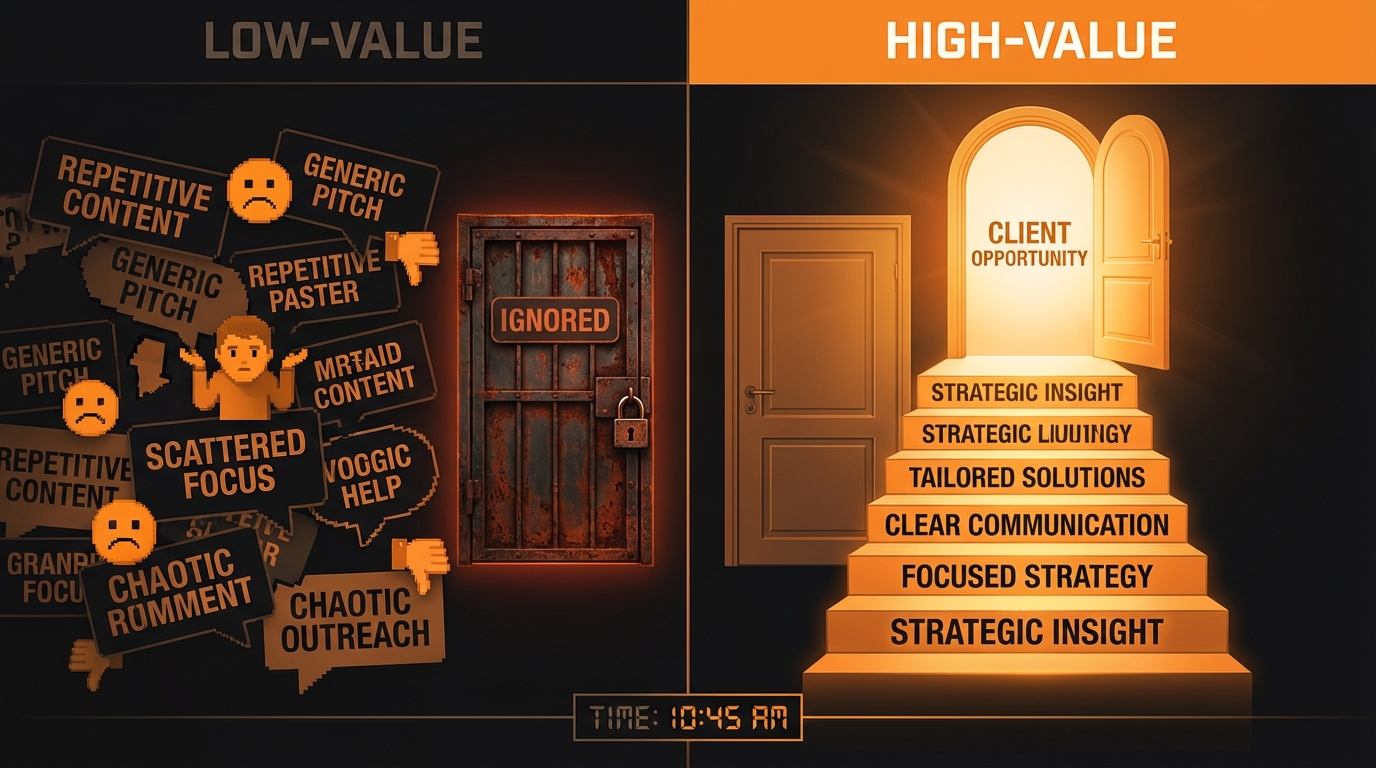
We must establish a clear delineation here. Low-value commenting is a performance trap focused purely on vanity metrics. High-value commenting is a strategic pipeline generator.
Understand this fundamental distinction: the difference between passive engagement and active conversion. If your comment strategy is not designed to pull an Ideal Client Profile (ICP) into a private conversation, you are wasting cycles.
| Strategy Component | Low-Value Commenting (Amateur) | High-Value Commenting (Expert) |
|---|---|---|
| Primary Goal | Increase personal visibility (likes/replies). | Attract profile views from ICPs and initiate a discovery conversation or sales opportunity. |
| Language Used | Generic, positive validation (“Spot on!” “Love this.”). Uses emotional language. | Specific industry signals, technical metrics, and precise pain points. Uses strategic, technical language. |
| Actionable Insight | None; simply agrees with the author or offers surface-level agreement. | Adds a counter-intuitive caveat, cites proprietary data, or outlines a specific process step that challenges the original post. |
| Targeting & Volume | High volume (20+ comments daily) on random, high-traffic posts. | Targeted quality (5-10 comments daily) only on content published by ICPs or ICP influencers. |
4. The Post-Comment Conversion Playbook
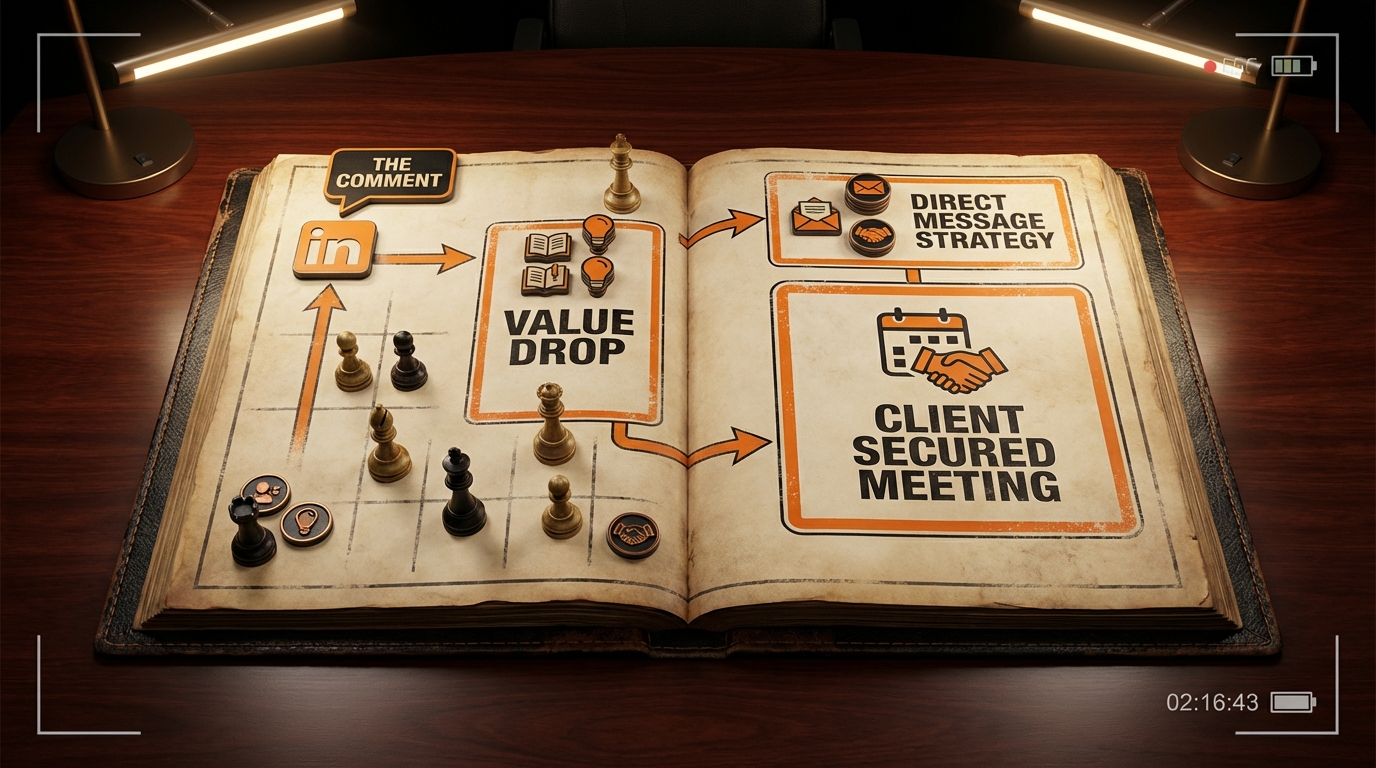
A high-value comment functions as a lead magnet. This is the entry point, not the destination. To maximize ROI, you must implement a defined, repeatable process for converting that public interaction into a private sales opportunity.
Step 1: Identify the Engagement Signal
Do not prematurely transition to the Direct Message. Patience is strategic. Wait for a clear engagement signal that explicitly indicates high intent or interest from your Ideal Client Profile (ICP).
- ICP Author Response: If the original post author (especially if they are an ICP) asks a follow-up question, this is a clear, public invitation to continue the dialogue.
- Immediate Profile View: Track LinkedIn notifications. A profile view immediately following your comment confirms that your insight successfully piqued their interest and validated your authority.
- High-Intent Combination: A simple “Like” is passive recognition. Combine the Like with an Immediate Profile View for the strongest conversion signal.
Step 2: Execute the 24-Hour DM Transition
Timing is critical for leveraging social proof. Do not allow the thread momentum to dissipate. If you receive a strong conversion signal (a reply or an ICP profile view), execute the DM transition within 24 hours.
Your message must immediately reference the public context. This eliminates the need for a cold introduction and leverages the existing, established rapport.
DM Formula: “[Prospect Name], saw your thoughtful reply/view on the thread about [Post Topic]. It sounds like you are actively solving the [Specific Pain Point]. I mentioned [Specific Resource/Insight] in the comments; did you want me to send that over? It might save you 10 hours of research.”
This approach is effective because:
- Non-Aggressive Positioning: This is value delivery, not a cold pitch. You are fulfilling the resource offer implied in your public comment.
- Contextual Relevance: The prospect knows precisely who you are and the specific problem you are addressing.
- Tangible Value: You provide immediate, actionable value (framework, resource, insight) before demanding their time.
Step 3: Offer Value Without Pitching
Once the prospect accepts the resource or responds positively, you initiate the strategic soft pitch. This message is designed to bridge the gap: connecting the public problem you discussed to the proprietary solution your software offers.
Crucially, avoid scheduling a traditional “demo.” Instead, focus on offering a strategic diagnostic review or a quick audit related specifically to the pain point identified in the comment thread.
Soft Pitch Formula: “Glad that framework was helpful. Since you’re dealing with [Specific Pain Point, e.g., low utilization rates], we often run a quick 15-minute diagnostic on [Topic] for founders at your stage. It usually highlights 2-3 immediate bottlenecks. No pitch, just data. If that’s valuable, let me know.”
This approach positions you as a strategic partner who diagnoses issues, not a vendor who immediately sells a tool. We find this utilization of manual lead generation principles consistently outperforms generic, automated cold pitches, establishing the immediate trust required for high-value B2B sales.
Frequently Asked Questions

- How many posts should I comment on daily to see tangible results?
-
Forget generic volume metrics. We operate on a quality-first mandate. Target 5 to 10 high-value comments daily. These must strictly focus on content authored by your Ideal Customer Profile (ICP) or high-leverage industry influencers whose audience directly overlaps with your ICP. Strategic execution compounds faster than generic activity.
- Is it acceptable to drop a link to my service in the comment?
-
Under no circumstances should you drop a link or engage in overt self-promotion within the public comment thread. This instantly signals low value and compromises your expert authority. Leverage the DM Bridge formula (Formula 4) to transition the lead into a private conversation. Resources and links are shared only after genuine public value has been delivered.
- How quickly should I respond to comments on my own posts?
-
Speed is critical for algorithmic visibility. We instruct our teams to respond to every relevant comment on internal posts within 60 minutes. This rapid back-and-forth engagement is heavily rewarded by the LinkedIn algorithm, driving increased post reach.
Furthermore, immediate responses demonstrate active investment, encouraging high-intent prospects to deepen the interaction.
- Should I use emojis in strategic, high-value comments?
-
Exercise extreme caution. High-value comments are designed to establish authority and strategic depth. Excessive or misplaced emojis dilute the professional tone and undermine your expert status.
If you must use them, limit usage to a single, contextual emoji (e.g., a checkmark or arrow) to guide formatting, but prioritize professional, concise language above all else.
Ready to implement this strategy at scale?
Use our AI Lead Generation Software to find the exact client emails you need to convert warm leads.
Start Your Free Trial Today.