

You’ve heard the generic LinkedIn advice: Post consistently. Build ‘thought leadership.’ Wait 18 months for organic inbound leads to trickle in.
That advice is slow. It is unsustainable.
It demands massive, ongoing content production that most sales reps and SDR teams simply cannot maintain at scale.
It’s December 2025. We need results now.
The strategic counter-approach is simple: Stop relying solely on your own stage. Start borrowing authority from people who already have the attention of your ideal clients (the real key to rapid growth).
This is the Comment-to-Client Method.
It treats every comment not as a throwaway reply, but as a piece of micro-content designed to solve a specific problem and drive high-intent profile clicks.
Done correctly, commenting delivers a demonstrably higher ROI than posting your own content. Why? You are constantly placing yourself in front of pre-warmed audiences who already trust the original author. You skip the trust-building phase.
This blueprint details the exact strategy, the specific high-leverage comment templates, and the critical “Conversion Bridge” required to move public visibility into private, paying clients.
The Reality Check:
Most sales reps spend 90% of their time posting low-impact content that generates 0 meetings. This strategy flips that ROI instantly.
We have used the Comment-to-Client Method to consistently generate 5-10 high-intent meetings per week for our clients, often within the first 30 days.
Stop guessing who your ideal client is. Find them, engage them strategically in the comments, and use systems like Pyrsonalize to move them off the platform and into your pipeline.
Start Your Free Trial: Find Client Personal Emails Today.Stop Posting. Start Converting.
![A diagram illustrating a conversion step in a mobile application interface. An orange speech bubble points from the text "New high-value comment thread with [Name]." to a green arrow labeled "Conversion" which points to a circular icon labeled "1-on-1" at the bottom right of the screen.](https://pyrsonalize.com/blog/wp-content/uploads/2025/12/article-section-image-270.jpg "Converting LinkedIn Comments to 1-on-1 Conversations: The Crucial Next Step")
- Profile Conversion Architecture (Step Zero): Your comment is a high-intent traffic generator. If your LinkedIn profile is not meticulously optimized,if it doesn’t clearly articulate the immediate problem you solve and offer a clear next step,you are leaking 90% of your potential revenue. Stop generating vanity traffic. Start generating qualified leads.
- Hyper-Precision Targeting: We move beyond the generic 4 ‘Key Buckets’ of ideal prospects. You must integrate a strict vetting process,what we call The Precision Matrix,to ensure every minute spent commenting maximizes visibility among decision-makers and maintains absolute relevance to your core offering.
- Actionable Typologies (Kill ‘Add Value’): Generic advice is useless. We reject the vague mandate to “just add value.” Instead, you will deploy specific, high-impact formats like The Contrarian Take or The Data-Backed Proof to dominate the comment section, establish authority instantly, and force engagement.
- The Conversion Bridge System: The entire strategy hinges on moving the interaction from public visibility to a private, controlled environment (the DM). This demands a disciplined, proprietary three-step, non-sales sequence designed specifically to pull prospects into your conversion funnel without ever triggering their natural sales defenses.
Step #1: The Conversion Foundation (Profile Optimization)
Profile views are inevitable when you execute a high-volume commenting strategy.
But profile views are the ultimate vanity metric. They mean nothing unless they convert into verified connections, high-intent DMs, or direct traffic to your free trial page.
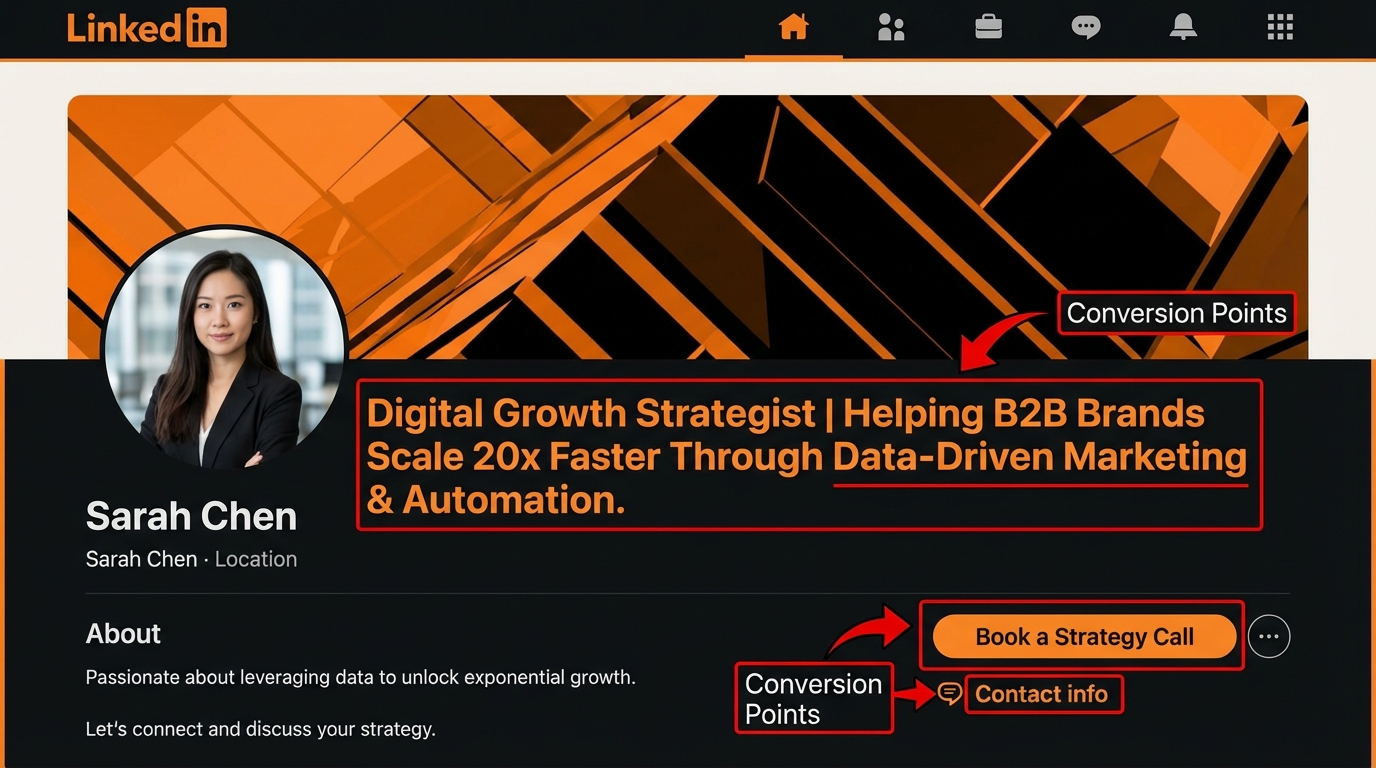
Your entire LinkedIn profile is not a resume,it is a high-conversion landing page. Its sole purpose is to validate the authority you built in the comment section and immediately funnel the visitor into the next, measurable step.
You must optimize these three critical conversion zones:
A. The Headline & Banner (Instant Validation)
Stop using your headline to list your job title. That is amateur hour.
Your headline is your 3-second elevator pitch. It must articulate the specific problem you solve and the quantifiable result you deliver.
- The Generic Approach: SDR at Pyrsonalize. (Weak. Zero value offered.)
- The Conversion Approach: We help B2B Founders and SDR teams boost revenue by 77% using AI-powered personal email discovery. (Authoritative. Quantifiable.)
The banner image must visually reinforce this claim (e.g., a simple graphic showing “Before/After” metrics or a client logo collage). This immediately converts the curiosity generated by your comment into undeniable proof.
B. The Featured Section (The Lead Magnet)
This is where most reps fail to execute. This section is prime digital real estate. Do not clutter it with generic articles, old company news, or irrelevant certifications.
The visitor arriving here is already high-intent. They saw your value in the comments and are looking for proof.
Use this space to host your most powerful lead magnet or case study. Give them a low-friction path to access immediate value:
- A direct link to your free trial sign-up.
- A downloadable PDF: The 2025 Guide to 95% Email Verification Rates.
- A link to a highly specific, high-value blog post (e.g., AI Prospecting: Discovery, Intent, and CPVL Rates (2025)).
C. The About Section (The Credibility Builder)
Your About section is not a resume summary. It is a dedicated sales letter designed to seal the deal.
Use the classic Problem-Agitate-Solve (PAS) framework to establish immediate necessity:
- Problem: Founders are wasting critical time and budget on generic outreach that gets 0% reply rates.
- Agitate: Your team is burning cycles on outdated data, unable to get past gatekeepers. You know your product is good, but your lead flow is stalled.
- Solve: Pyrsonalize uses proprietary AI to find personal, verified emails for 95% of your target accounts, cutting research time by 80% and boosting conversion rates immediately.
Keep the copy tight. Keep it punchy. Close with a clear, non-negotiable Call To Action that tells them exactly what to do next:
Example CTA: Ready to scale your pipeline? Start Your Free Trial Now or DM me directly for a personalized 5-minute audit.
Step #2: Targeting the Precision Matrix (Where to Comment)
You cannot comment everywhere. That is dilution, not strategy.
The goal is focused engagement on high-leverage posts where your ideal clients actively congregate and participate.
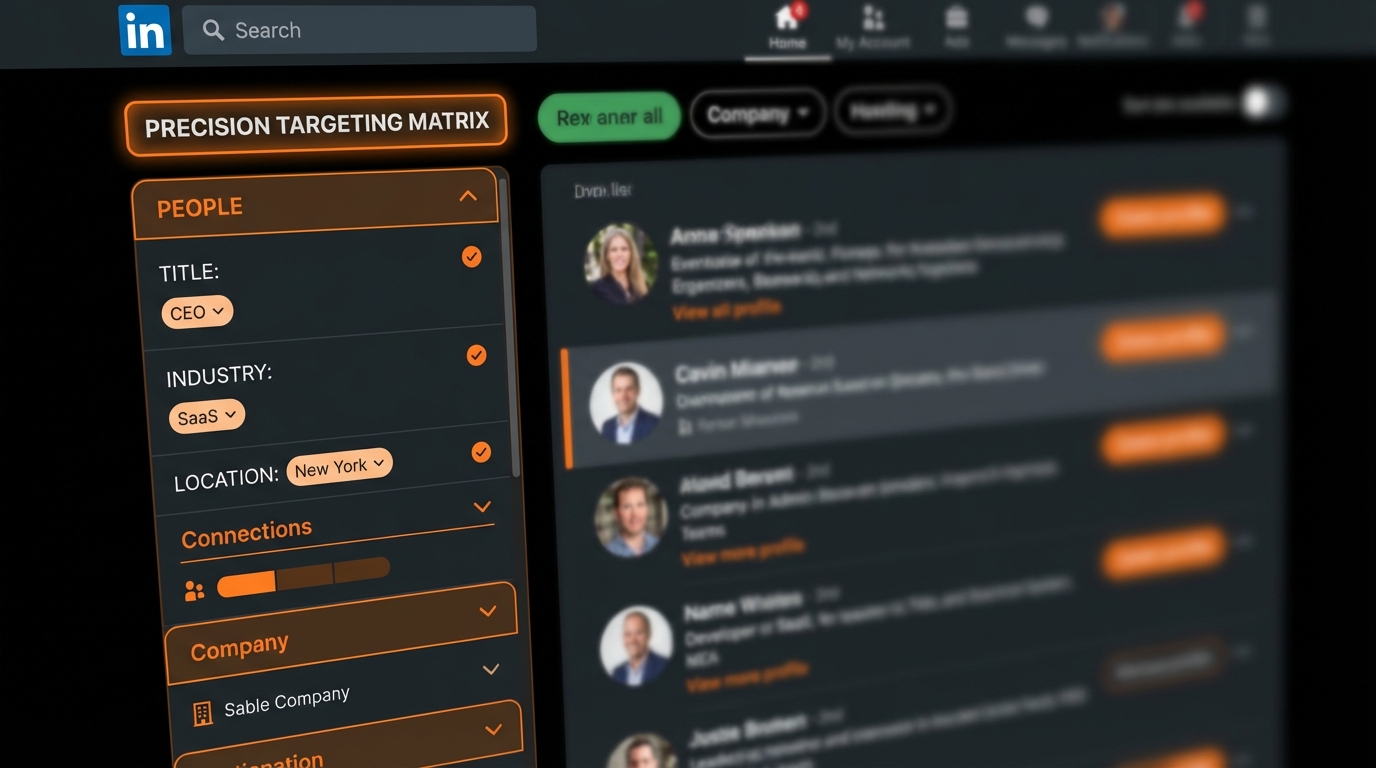
Competitors mention the standard “4 Key Buckets” (Prospects, Peers, Influencers, Clients). That framework is foundational, but it is entirely insufficient for 2025 scale and efficiency.
You need a ruthless Precision Matrix to vet every post before you invest a single minute of your time.
- Prospect Vetting (Highest ROI):
Target your ideal client’s posts directly. This yields the highest immediate return on investment.
The constraint? Volume is inherently low. You must set alerts. When they post, you need to be there,engaging within the first 60 minutes to maximize visibility before the feed algorithm buries the post.
- Influencer Vetting (The Engagement Stage):
Identify 5–10 industry influencers who consistently attract your target audience. This is where you achieve scale.
Crucially, check their engagement rates. Likes are a vanity metric. A post boasting 5,000 likes but only 20 comments is useless noise.
You are hunting for deep conversation. Look specifically for high comment volume (50+ comments) where the debate is rich, competitive, and highly visible. That is where your target audience is actively listening.
- Consistency and Velocity:
The author must maintain frequency. This is non-negotiable.
Commenting on a ghost profile that posts once a month is a direct waste of your time and effort. Focus only on authors who maintain high velocity (posting 3–5 times per week). They own the algorithm; you borrow their stage.
- Topic Relevance (The Solution Filter):
Does the post genuinely address a pain point or strategic challenge that your product solves? If the topic is generic leadership advice, skip it.
If it’s about “The 3 critical flaws in current SDR outbound strategies,” you comment immediately.
Do not comment on motivational fluff unless your service is directly related to executive mindset coaching (and, pragmatically, it probably is not).
“Visibility without relevance is just noise. Your comment must serve the dual purpose of validating the author’s point while subtly positioning your unique expertise as the solution.”
Step #3: Actionable Comment Typology (5 Formats That Convert)
The internet is saturated with generic advice: “Just add value.”
That is useless instruction.
Value is not vague agreement (“Great post, thanks for sharing!”). Value is structured, repeatable authority designed for maximum visibility and immediate profile clicks.
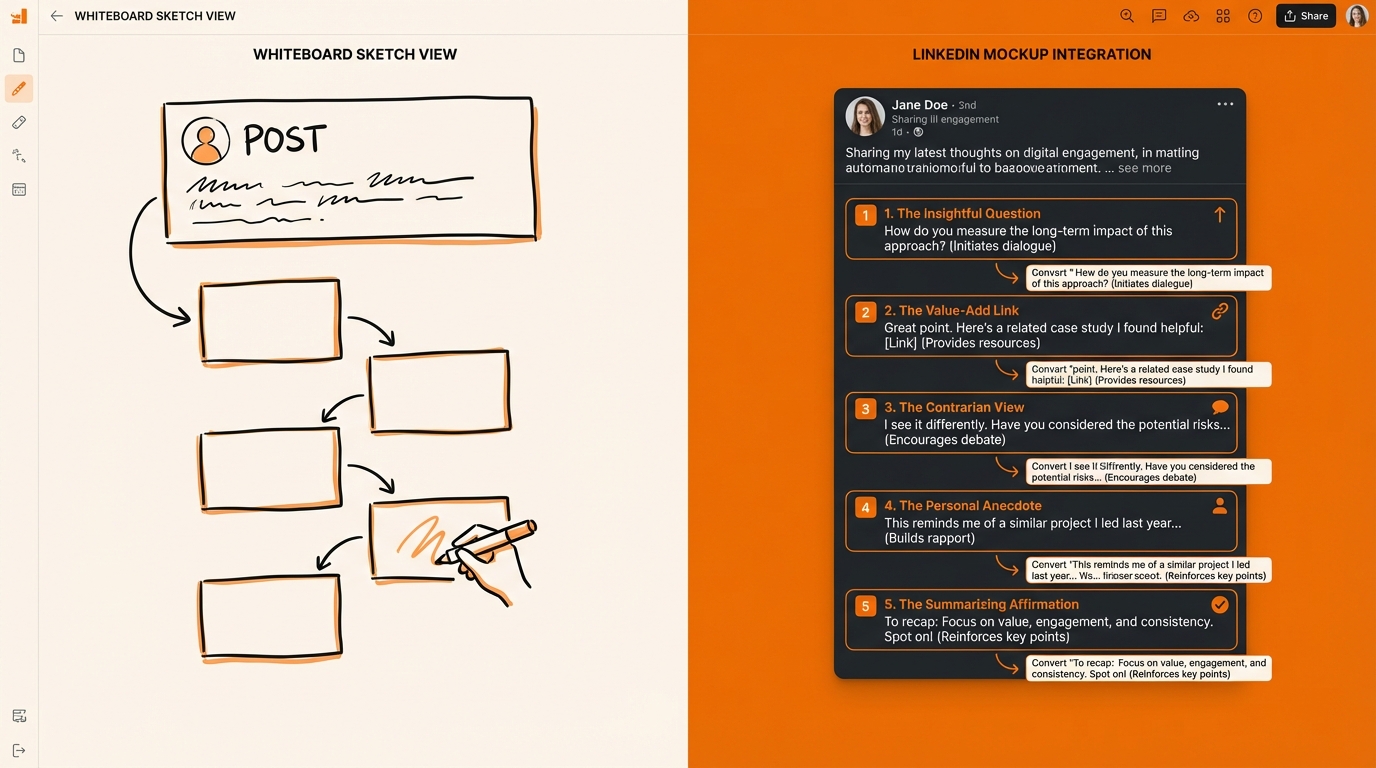
You need a comment typology,a set of five proven structures that guarantee engagement and position you as the definitive expert.
Here are five repeatable comment structures that guarantee profile clicks:
1. The Data-Backed Proof: Establish Non-Negotiable Credibility
When the original author makes a claim, your job is to immediately validate it with proprietary, specific data. This isn’t just agreement; this is proof you are operating at scale (and that you have the internal metrics to back it up).
The Format:
“Totally agree. We saw this exact trend last quarter. Our internal data showed that X specific metric improved by [quantifiable percentage] when we implemented [specific action]. That shift alone validates your point about [Author’s core thesis]. (If you aren’t tracking that metric, you aren’t scaling.)”
2. The Contrarian Take: Drive Fierce Debate
This is a high-risk, high-reward strategy. It generates maximum impressions and replies by creating strategic tension.
Warning: Only use this when you have genuinely insightful counter-data, not just to pick a fight. Your counterpoint must elevate the discussion, not derail it.
The Format:
“I appreciate the insight, but I have to push back hard on [Specific point]. While that works for SMBs, we’ve found that high-growth enterprise teams struggle with [Problem Y] because [Reason Z]. The counter-strategy that consistently delivers 3x better ROI is actually [Your Solution/Pillar].”
3. The Experience Narrative: The Proof-of-Concept Anecdote
Convert your comment into a micro-case study. You are positioning yourself as the expert who has already solved the exact problem the post discusses.
The Format:
“This reminds me of a client we onboarded last month. They were stuck trying to scale outreach with [Pain Point, e.g., low deliverability]. We transitioned them to [Specific Pyrsonalize strategy, e.g., verified personal email acquisition], and within 48 hours, they unlocked [Massive, Quantifiable Result, e.g., a 77% boost in reply rates]. It’s a perfect illustration of why [Author’s point] is non-negotiable in 2025.”
4. The Forward-Looking Extension: Challenge the Status Quo
Take the author’s current analysis and project it 18 months into the future. This demonstrates strategic foresight and intellectual curiosity (which attracts other founders).
Key Rule: Always end with a specific, high-value question. This massively boosts the chance of the author and other high-profile users replying.
The Format:
“Great breakdown. If we accept [Author’s premise] as true today, the next challenge becomes [Future challenge A, e.g., AI-driven personalization at scale]. How do you see that impacting [Industry X] over the next 18 months? Specifically, are you seeing any early signs of [Trend Y]?”
5. The Tool/Resource Drop: The Strategic Efficiency Hook
If the author discusses strategy (like “optimizing lead quality” or “reducing bounce rates”), offer a specific, indispensable resource that solves the bottleneck,ideally, your tool.
This is your soft-sell opportunity. Use it sparingly, but use it to drive traffic to your core offering.
The Format:
“Solid advice on optimizing lead quality. For anyone looking to execute this step immediately, ensuring you have verified personal emails is key. We’ve seen SDR teams using AI tools like Pyrsonalize cut their bounce rate to under 2% by focusing exclusively on [Specific data field verification]. That level of efficiency is non-negotiable for scale in Q1 2026.”
Comment Typology Comparison Matrix
These five formats are your arsenal. Use this comparison matrix to select the right weapon for the right post.
| Typology | Primary Goal | Risk Level |
|---|---|---|
| The Data-Backed Proof | Establish expertise, build proprietary credibility. | Low (Always positive reinforcement). |
| The Contrarian Take | Drive debate, maximize impressions and replies. | Medium (Requires careful, data-driven phrasing). |
| The Experience Narrative | Show results, soft-sell capability, demonstrate ROI. | Low-Medium (Highly engaging, high click-through rate). |
| The Forward-Looking Extension | Engage the author, appear strategically insightful. | Low (Focuses on intellectual curiosity and future trends). |
| The Tool/Resource Drop | Solve immediate bottlenecks, push product trial. | Medium (Must be subtle; avoid aggressive sales language). |
Ready to stop guessing and start acquiring high-quality personal emails for your outreach strategy? Start Your Free Pyrsonalize Trial Today.
Step #4: The Conversion Bridge (Public to Private)
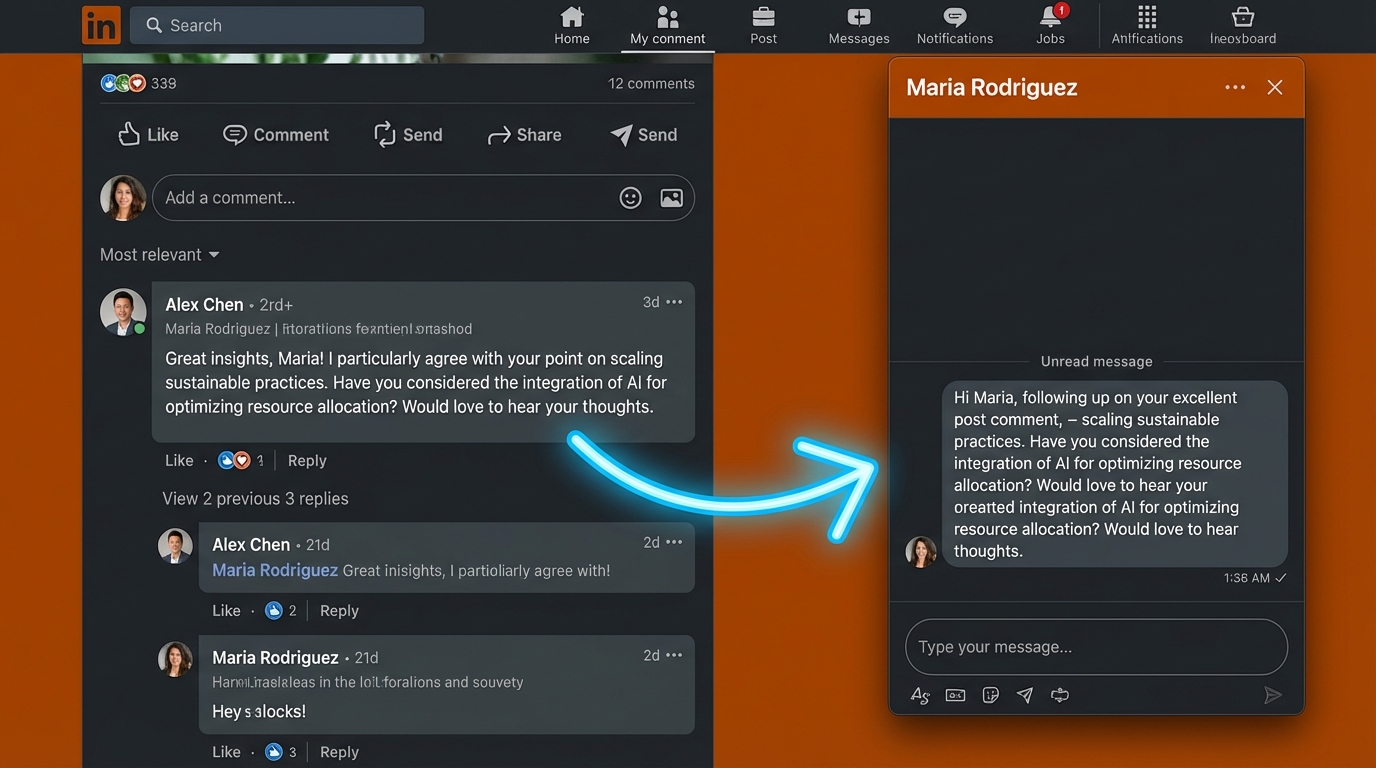
This is the critical failure point for 90% of outreach efforts. The goal is simple: Move the momentum from public validation (the comment) into a private, high-intent conversation.
Skip this sequence, jump straight to a sales DM, and you instantly incinerate the trust you just earned. You need a structured, 3-step Conversion Bridge designed exclusively to leverage that established social proof.
1. Algorithmic Pre-Heat (The 60-Second Warm-Up)
If your comment secured a response,from the prospect or a key peer,you are already on their radar. Do not waste that attention.
Before sending the connection request, execute the Algorithmic Pre-Heat. Spend exactly 60 seconds reviewing their recent activity.
- Like 2-3 of their posts.
- Crucially, these must be posts related to the specific topic you just commented on.
This isn’t random engagement; this signals genuine, focused interest. It also strategically boosts your profile’s algorithmic visibility in their feed, ensuring your name is seen multiple times before the formal contact. It’s a subtle, non-invasive priming mechanism.
2. The Contextual Connection Request (Never Go Generic)
A generic connection request is a death sentence. It screams “mass outreach” and lands you instantly in the ignored pile.
Your request must validate the prospect and explicitly reference the specific insight you shared publicly. This proves you are a strategic thinker, not a bulk spammer.
Use this structure exactly:
“Loved your perspective on [Topic] in [Author’s Name] thread today. Especially your point about the future impact of [Specific Detail]. I’m focused on solving [Related Problem] for founders like you and would appreciate connecting to follow your future insights.”
This structure is brief, specific, and critically, it asks for nothing. You are validating their intelligence and establishing a shared professional gravity.
3. The Value Pivot (24-Hour Rule)
Wait 24 to 48 hours after acceptance. Patience is a strategic asset.
Do not pitch immediately. Your initial Direct Message must extend the public conversation, offering deeper value or posing an insightful, high-level question that confirms you have done your homework.
This is the soft pivot that converts:
“Hey [Name], thanks for connecting. I’ve been thinking about your comment on [Topic], it made me wonder: how are you currently handling the data verification bottleneck internally? We’ve seen a massive surge in founders using AI tools to automate that initial discovery phase, which is cutting SDR research time by half. Curious if that’s a priority for your team this quarter.”
This opener is surgical. It provides immediate context, drops a relevant insight related to your expertise (AI lead generation), and poses a strategic question that requires a thoughtful answer. The moment they mention a bottleneck or a pain point,that is your hard cue to schedule the discovery call.
For founders and SDR teams who need to execute this sequence at scale (and automate the follow-up cadence): You cannot rely on manual effort. We built Pyrsonalize precisely to handle the repetitive, high-volume tasks that make this process scalable.
Start Your Free Trial: Automate Your Discovery PhaseStep #5: Tracking and Refinement: The Feedback Loop That Fuels Scale
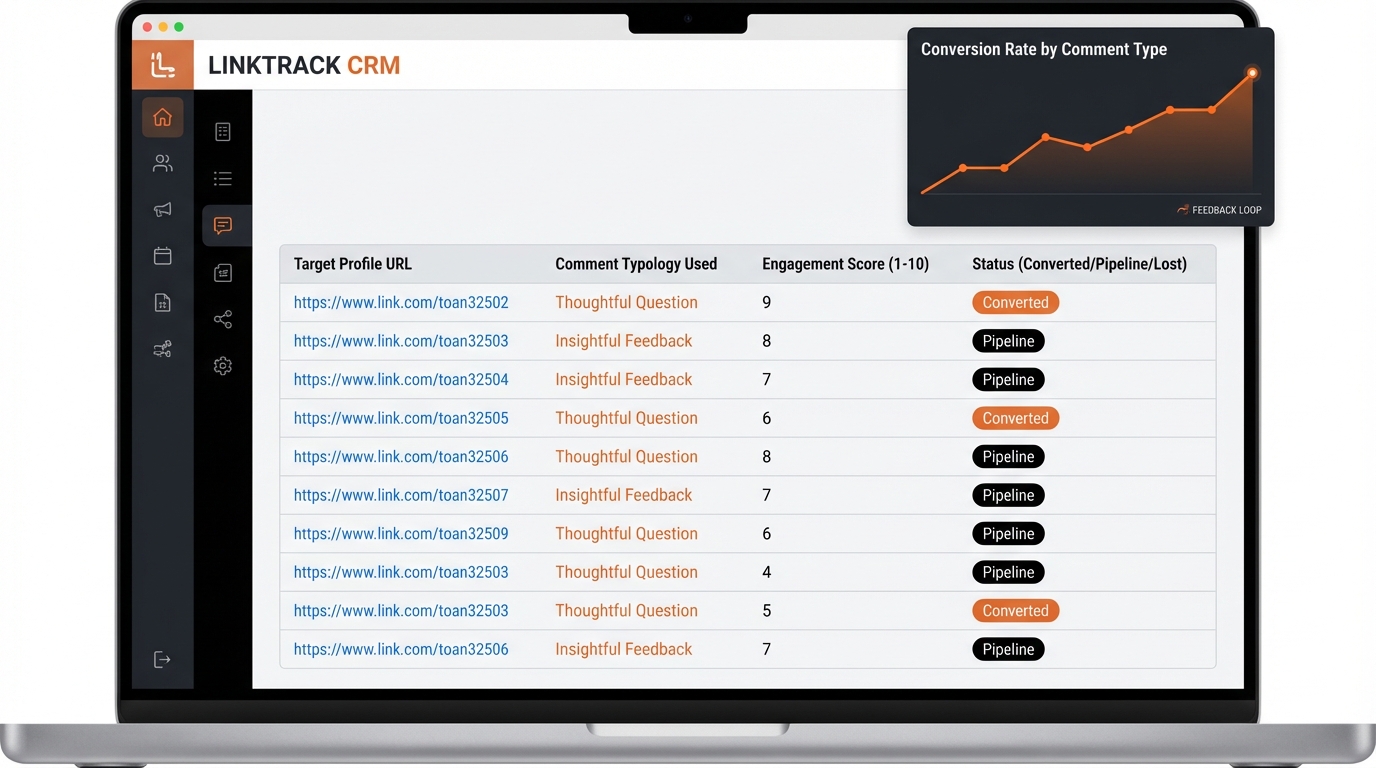
A. Public Authority Metrics (Top of Funnel Levers)
These metrics tell you which types of comments and which target accounts (influencers) are driving the highest quality attention back to your profile. This confirms your public authority is established.
- Comment Engagement Velocity: Track the immediate speed and volume of replies and likes. High velocity indicates resonance and ensures your comment stays visible at the top of the thread.
- Profile View Spike Analysis: Track your daily profile views religiously. A successful, high-value comment should generate an immediate, undeniable spike. This confirms the quality of your content distribution and visibility.
- Connection Acceptance Rate: This is the ultimate measure of your public authority. If prospects accept your request after seeing your comment, your authority bridge is working. *If this rate is below 40%, review your comment framing and profile optimization.*
B. Private Conversion Metrics (The Revenue Pipeline)
This is where the rubber meets the road. These numbers determine if your public effort is translating into tangible, private sales opportunities.
- DM Response Rate (Bridge Success): How many accepted connections replied to your non-sales, value-first opener? If your profile is optimized and your opener is strategic, you should be aiming for a minimum of 30% response rate here.
- Meeting Booked Rate: The percentage of active DM conversations that convert directly into a discovery call or demo. This measures the efficacy of your immediate value proposition (the ‘why now’ trigger).
- Client Acquisition Rate (CAC): The total number of closed clients acquired purely through this method per month. Calculate the ROI. If the ROI isn’t positive, your messaging or qualifying criteria are fundamentally broken.
This systematic tracking eliminates guesswork.
Example: If your Connection Acceptance Rate is high (meaning your comments are authoritative) but your DM Response Rate is low (meaning they aren’t replying to your opener), the failure point is clear: Your profile optimization (Step #1) or your initial private message is failing to bridge the gap effectively.
You don’t need to guess. You have the data.
This systematic tracking allows you to optimize your 2025 AI Lead Funnel based on real-world, actionable data,not hope.
Start measuring today.
The Anti-Generic Rule: Preventing Spam at Scale
![A screenshot comparing two comment moderation panels. The left panel, titled 'SPAM FILTERED (Template)', shows multiple instances of a generic comment, '[GENERIC COMMENT] Great post! Thanks for sharing,' each marked with a large red 'X' and an 'ACTION: BLOCKED' status at the bottom. The right panel, titled 'HIGH VALUE COMMENT (Customized)', displays a specific, insightful comment about a webinar on data privacy, overlaid with a large green checkmark, and marked with a 'STATUS: APPROVED & HIGHLIGHTED' status.](https://pyrsonalize.com/blog/wp-content/uploads/2025/12/article-section-image-276.jpg "Visualizing the Difference: Blocking Generic Spam vs. Approving High-Value, Customized LinkedIn Comments")
The Four Pillars of Spam Avoidance (The “Do NOTs” List)
- NEVER drop a direct product link in the comments. This is not cold outreach; it is social proof farming. Your goal is the conversation, not the conversion link.
- AVOID generic, low-effort compliments (e.g., “Great post!” or “This is fire!”). Your comment must add tangible, specific value or ask a deeply relevant, insightful question that furthers the discussion.
- STAY IN YOUR LANE. Do not comment outside your core domain expertise. Topical consistency is crucial for building perceived authority and reducing the risk profile of your subsequent outreach.
- STOP mass-sending connection requests. Only connect with individuals who have actively engaged with your insightful comment (liked, replied) or visited your profile post-comment. Engagement is your permission slip.
Frequently Asked Questions (FAQ)
Before you scale this system, you need clarity on the mechanics. Here are the most common questions SDRs and Founders ask when implementing this strategy.
How often should I be commenting using this strategy?
The Mandate: 5 to 10 high-quality, high-intent comments per day.
You are optimizing for quality and speed, not sheer volume. If you cannot maintain the quality standard (The Anti-Generic Rule), reduce your volume immediately.
The goal is to be one of the first 10 comments on highly relevant posts (ideally within the first two hours of publishing). Why? Because the organic visibility of your comment drops off a cliff after the initial engagement window closes. Speed is leverage.
Does this work for all B2B industries?
Yes, this strategy is platform-agnostic because it relies on the fundamental psychology of Borrowing Authority (Social Proof).
However, its effectiveness is directly correlated to the activity level of your Ideal Customer Profile (ICP).
This system dominates in sectors where decision-makers *live* on LinkedIn:
- SaaS & Tech
- High-Ticket Consulting
- Finance and FinTech
- Marketing Services
If your target market is rarely on LinkedIn (e.g., certain manufacturing VPs who prefer email), this system is a tactical waste of time. Focus your efforts where your clients are actively engaging.
Should I use AI tools to generate the comments?
Absolutely not. This is the fastest way to fail the Anti-Generic Rule and instantly classify yourself as spam.
A generic, AI-spun comment is instantly recognizable. It erodes the credibility you spent weeks building. AI is a powerful tool for efficiency, not for authenticity.
Here is the strategic split:
- Use AI for finding the leads. (That’s our core competency,we automate the finding of perfect personal emails and contacts for outreach.)
- Use Human Intelligence for the content. The insight, the specific data point, the personal anecdote,that must come from you or your internal data. That human touch is your leverage point.
Ready to scale your organic lead pipeline?
Stop wasting time with ineffective cold outreach. Start finding high-intent clients today.
Start Your Free TrialReferences
- How to get clients from comments, not posts – LinkedIn
- Everyone’s telling you to ‘post on LinkedIn’ to get clients … – Reddit
- How to Get Clients from Comments on LinkedIn | Yagnesh P. posted …
- Can you land clients just by commenting on LinkedIn? – Quora
- How to Land Clients Through Comments on LinkedIn – YouTube