

The traditional B2B funnel is obsolete. It was linear, slow, and relied heavily on human guesswork.
And that guesswork is expensive.
In 2025, if your lead generation system is not augmented by AI, you are conceding ground. You are handing qualified leads directly to competitors who prioritize speed and precision.
Forget the noise about “30-second funnel builders.” A high-converting AI funnel demands strategic implementation, rigorous data preparation, and continuous model training.
This isn’t about slapping a generic chatbot on your landing page.
This is about deploying an intelligent, self-optimizing system that identifies, nurtures, and converts clients, while your SDRs focus only on high-value conversations.
We are breaking down the implementation into seven non-negotiable strategic steps. This is the blueprint for founders and sales leaders who demand measurable ROI,not just software features.
Key Takeaways for SDR Teams
- Data is the Foundation: AI models are useless without clean, unified data. Step 2 is the most critical technical hurdle. Do not skip it.
- Train Your Agents: Generic LLMs fail at complex B2B qualification. Train your AI agents on your specific knowledge base (RAG) to ensure accurate, authoritative qualification (Step 3).
- Measure Precision, Not Volume: Shift your focus from lead volume to the Cost Per Qualified Lead (CPQL) generated by the AI. If the AI is not cheaper and faster than a human, it’s not working.
- Define Handoffs: Clearly establish when the AI stops and the human SDR takes over. This prevents customer confusion and focuses human effort exclusively on high-intent leads.
I. Foundational Strategy: Defining the AI’s Role
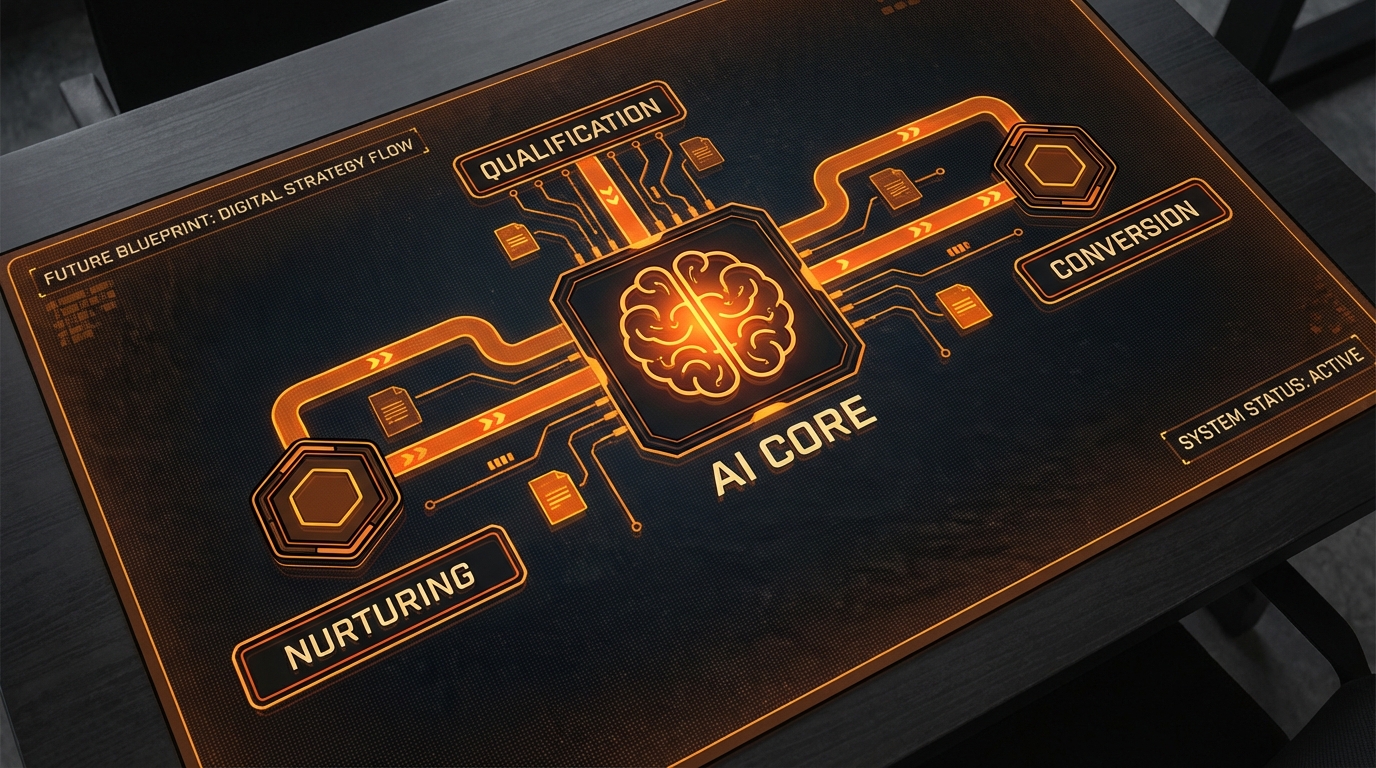
Before you commit budget, integrate an API, or even talk to a vendor, you must define the strategic purpose of the AI within your revenue cycle. This is non-negotiable.
Most companies fail right here. They chase the hype. They implement AI because it’s trendy, not because they have identified a specific, quantifiable problem that requires an AI solution.
If you treat AI as a shiny object, it will deliver shiny results: zero ROI. You must anchor the technology to measurable business outcomes.
- Identify the Bottleneck: Where, specifically, is the friction costing you pipeline? Is it lead qualification (SDR burnout)? Is it personalized follow-up (lack of bandwidth)? Or is it prospect discovery (poor data quality and generic outreach)? Pinpoint the exact failure point.
- Map AI Goals to Revenue Targets: Your goal is not “better personalization.” That’s a vanity metric. Your goal is, for example: “Reduce time-to-qualification by 40% to absorb 2x lead volume, directly resulting in a 15% boost to quarterly pipeline.” Quantifiable results are the only results that matter to the CFO.
- Establish the Human-AI Handoff Points: Define the exact trigger points where the AI agent stops and the human SDR steps in. This is critical for maintaining quality control. The goal is simple: Ensure your human team engages only with highly qualified, intent-rich leads. Eliminate wasted time.
“The strategic advantage of AI isn’t automation; it’s precision. AI should eliminate waste in the funnel, ensuring that every human touchpoint is high-leverage and targeted.”
II. Audit & Data Preparation: Fueling the Engine
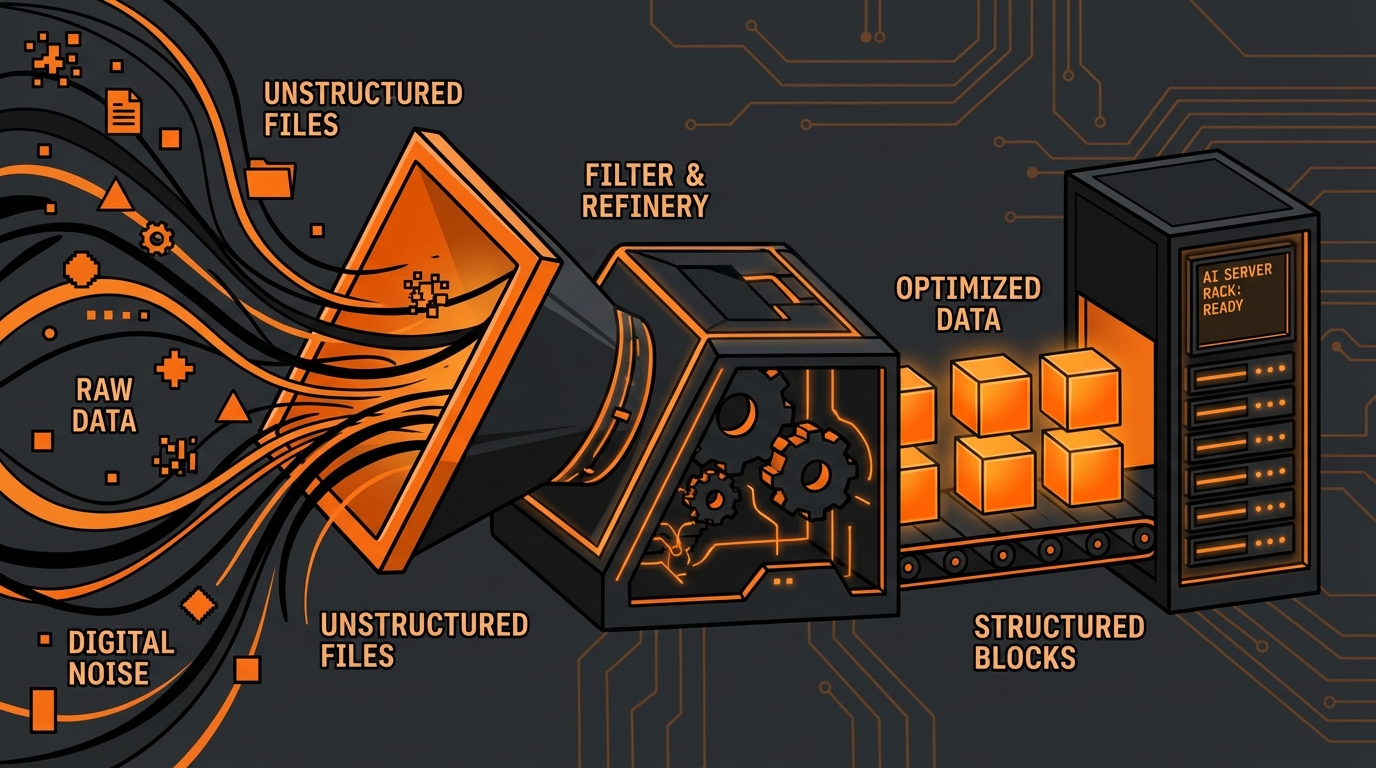
AI is not magic. It is a mirror.
If you feed it dirty, inconsistent data,siloed across five different spreadsheets and three CRMs,it will not only produce unreliable results; it will actively sabotage your conversion rates and waste your SDRs’ time.
This step is tedious. It is also the point where 90% of AI implementations fail. They skip this necessary groundwork, prioritizing API integration over data integrity.
You cannot skip this cleanup. Your AI lead funnel’s success depends entirely on the quality of the historical data you provide it. This is your foundation.
- Unify and Centralize Lead Data: Eliminate data silos immediately. Your lead data cannot live in five different spreadsheets, your CRM, and two separate outreach tools simultaneously. Implement a single source of truth (usually a clean, dedicated CRM or data warehouse). If your data isn’t centralized, your AI is operating blind, pulling fragmented insights that lead to embarrassing outreach.
- Standardize Data Fields: Ambiguity kills predictive performance. Ensure every lead record uses the exact same format for critical fields like Company Size, Industry, and Job Title. “Marketing Director” must be standardized. It cannot be mixed with “Dir. of Mktg.,” “Head of Demand Gen,” or “Mktg. Guru.” Garbage in, measurable garbage out.
- Implement Intent Scoring Metrics: Define what “high intent” looks like in your database before the AI takes over. This must be quantifiable. Track recent website visits, specific high-value content downloads, email opens, and keyword searches monitored by third-party intent tools. The AI needs a baseline definition of “hot” targets to prioritize effectively.
Clean house now. This is not optional pre-work; it is the foundation for scalable, predictable revenue. Do the heavy lifting once, and the AI will reward you with precision.
III. AI Agent & LLM Selection/Training

You just spent critical time cleaning your data foundation. Do not waste that investment.
Using a generic large language model (LLM) for high-stakes B2B qualification is malpractice. It lacks the necessary domain authority and context.
The core of your 2025 funnel must be a specialized AI agent. This agent must be surgically trained on your unique value proposition, product knowledge, and, critically, your specific competitive landscape.
- Choose the Right LLM Base: Function Over Hype.
This is a calculation of speed versus complexity. Do you genuinely require the complex, nuanced reasoning of GPT-4o for every chat? Or will a faster, cheaper, fine-tuned open-source model suffice for high-volume qualification throughput?
Stop chasing benchmarks. Choose function.
- Knowledge Base Ingestion (RAG): The Strategic Differentiator.
Retrieval Augmented Generation (RAG) is the lever that turns a generic chatbot into a 10x SDR. You must train your agent on proprietary intelligence,the stuff only your company knows:
- Product documentation and up-to-date pricing sheets.
- Successful sales call transcripts (focus on anonymized winning patterns).
- Competitor battle cards (to handle common objections precisely and authoritatively).
- The Ideal Customer Profile (ICP) Criteria (e.g., must be $5M+ ARR, using HubSpot, located in North America).
- Iterative Prompt Engineering: Create the Role.
You aren’t chatting with an AI; you are deploying a digital SDR. Design specific, role-playing prompts that force the agent to adopt that persona. This is how you enforce compliance and consistency.
The prompt must be prescriptive: “You are SDR ‘Alex.’ Your goal is to confirm the prospect’s budget and technical stack, then schedule a 15-minute discovery call using this provided link. You are authorized to answer questions only within the bounds of the RAG knowledge base. Do not deviate from the qualification script under any circumstance.”
This rigorous training is non-negotiable. It is the only way to prevent the AI from hallucinating product specs or defaulting to the generic, trust-killing responses that sabotage conversion rates.
IV. Implementation Phase 1: AI at the Top-of-Funnel (TOFU)
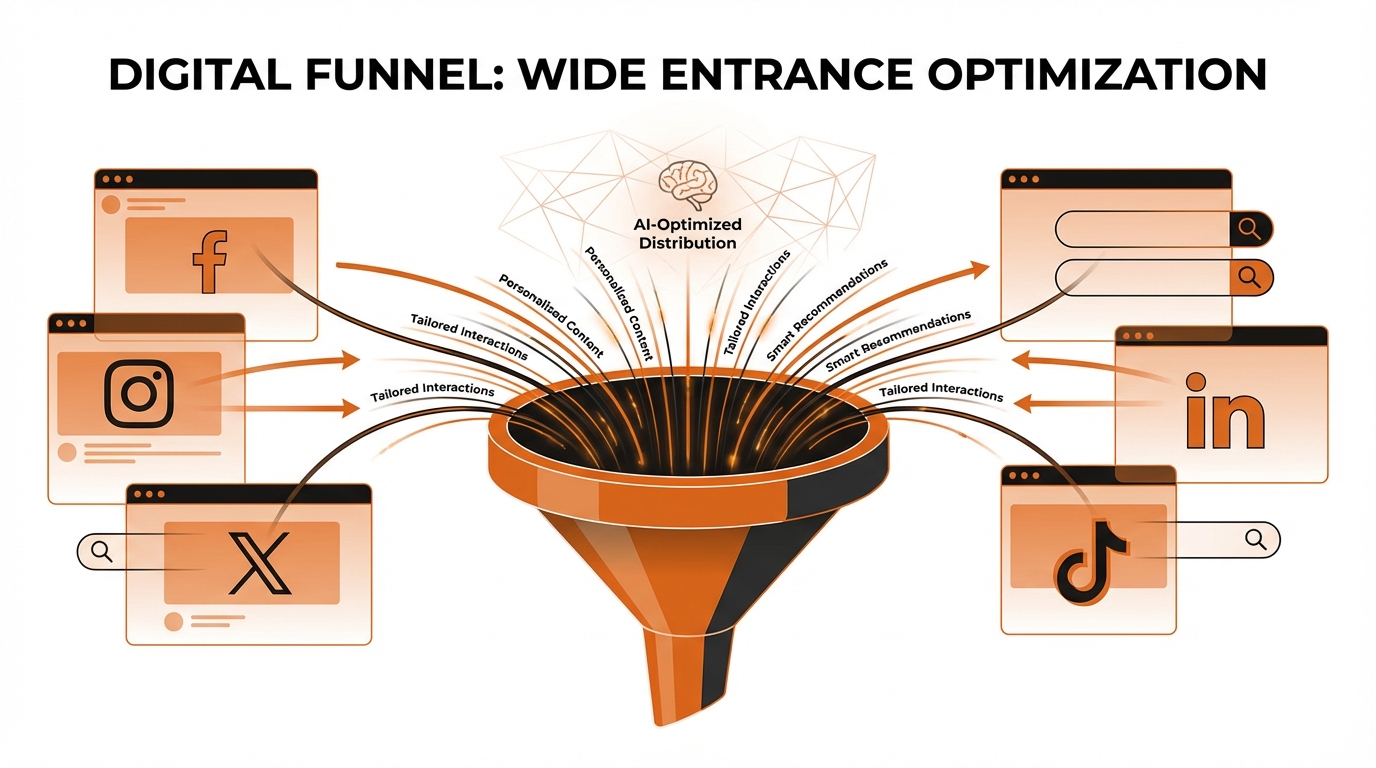
The Top-of-Funnel (TOFU) is where most companies hemorrhage budget on vanity metrics. We fix that.
This phase deploys your specialized AI agent to achieve efficient awareness and surgical capture. The goal is maximum personalization at industrial scale, eliminating the manual heavy lifting that slows down your SDR teams.
- Surgical Audience Segmentation (The Anti-Spray-and-Pray).
Forget generic demographic targeting. That era is dead.
Your AI must move beyond manual analysis. It needs to analyze existing high-value customer profiles (behavioral, intent data, firmographics) and predict, with statistical certainty, which new audiences are most likely to convert within the next 90 days.
This isn’t just matching; this is predictive ROI modeling. Your campaign efficiency instantly skyrockets.
- Hyper-Scaled Content Variation Testing.
Manual A/B testing is a bottleneck. We need A/Z testing.
Deploy generative AI systems,specifically trained on your brand voice,to produce 10x the content volume you previously managed.
This means testing personalized ad creatives, micro-targeted headline variants, and niche-specific landing page copy *simultaneously*. The AI automates the testing loop, identifies the winners, and kills the losers, all in real-time. Speed is leverage here.
- Intelligent, High-Leverage Lead Capture.
Static forms are passive friction. Replace them with conversational AI agents that actively engage, progressively qualify, and enrich the lead data immediately.
But qualification isn’t enough. You need *access*.
This is where we shift from generic capture to direct engagement: Use specialized tools like Pyrsonalize during the capture phase to instantly find the client’s validated personal emails.
Bypassing the bottleneck of generic info@ or shared company inboxes is non-negotiable for high-value B2B outreach. It turns low-friction acquisition into high-leverage outreach.
This phase delivers high-volume acquisition with minimal friction. More importantly, it ensures the captured data,from intent signals to personal contact information,is surgically rich. This is the only way to ensure your MQLs are actually ready for the critical, personalized Middle-of-Funnel engagement.
V. Implementation Phase 2: AI Mid-Funnel (MOFU)
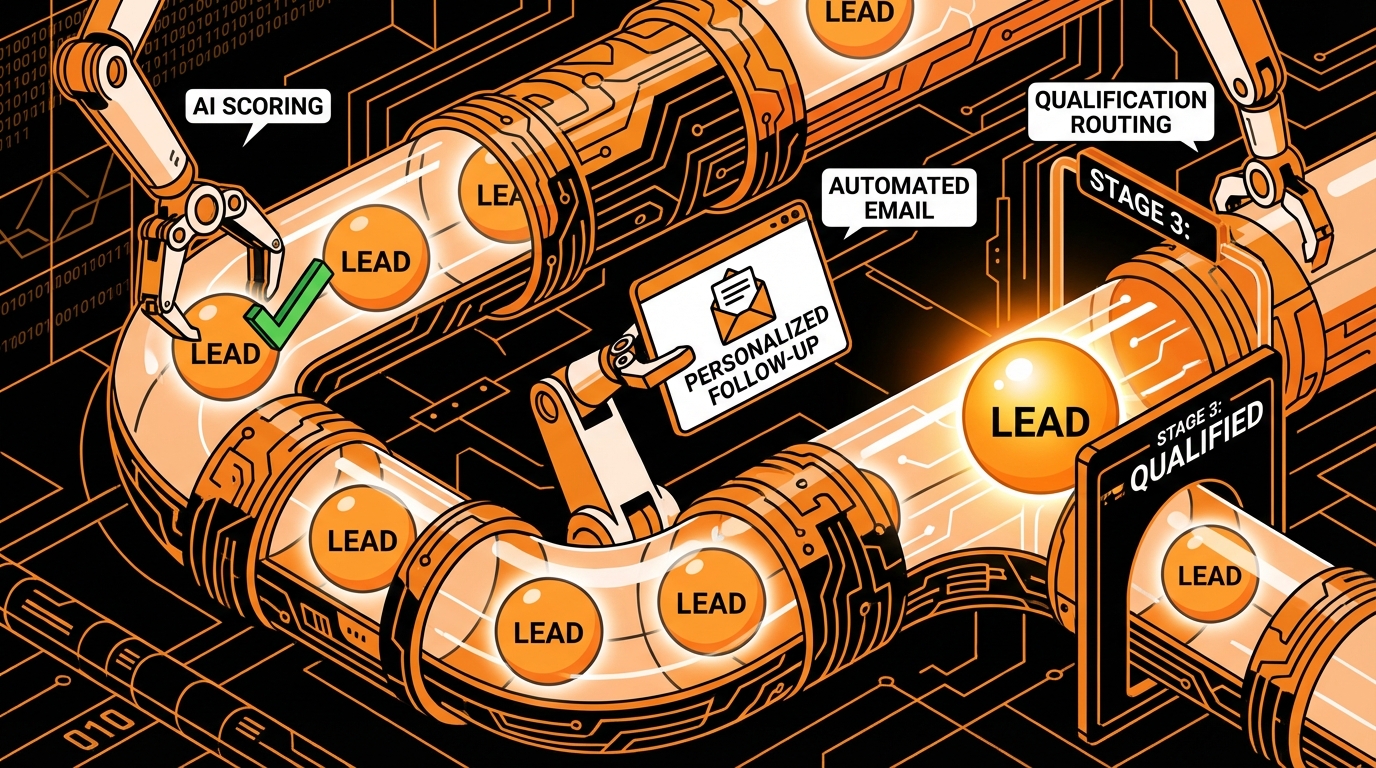
MOFU is the conversion engine. This is where manual nurturing efforts,the relentless, repetitive follow-ups,must be entirely replaced by surgical AI precision.
If TOFU captures the lead, MOFU qualifies it, prioritizes it, and prepares it for the human handover. This stage is the highest leverage point for maximizing your existing pipeline value.
- Dynamic Lead Scoring and Prioritization: The Immediate Handoff
Implement a predictive lead scoring model that adjusts in real-time, eliminating the reliance on static, outdated rules (e.g., “downloaded 3 PDFs = Hot”).
- The Score is a Live Metric: If a lead reads your competitor comparison page twice in 45 minutes, their score doesn’t just increment; it explodes.
- This immediate spike triggers a human alert for the SDR team. No waiting for the weekly report. The system tells your team exactly who to call, right now, based on quantifiable intent.
- Automated, Context-Aware Segmentation
Generic sequences kill pipeline velocity. Your AI must dynamically segment leads based on their last three interactions, not just the initial content download.
- If a prospect downloaded the ‘GDPR Compliance Checklist’ and then viewed the integration API documentation, they are instantly routed into a high-intent sequence focused exclusively on data security features and enterprise integration capacity.
- This personalized routing happens simultaneously across email, chat, and targeted LinkedIn outreach. You meet them where they are, with the message they need.
- Hyper-Personalized Follow-Up Generation
This is where AI saves your SDRs 70% of their research time.
The AI analyzes the prospect’s recent activity (web visits, content consumption, previous chat logs) and generates a unique, context-aware reason for the follow-up.
- Example: “I noticed you spent 4 minutes reviewing the competitor comparison page for Product X vs. Product Y. Is integration complexity the primary roadblock we need to address this week?”
The resulting follow-up is relevant, strategic, and feels entirely hand-written. It drastically improves reply rates.
This level of surgical responsiveness doesn’t just build trust; it shortens sales cycles by 30% and ensures that when a human SDR finally steps in, the conversation is already 80% qualified. You are no longer chasing ghosts.
VI. Implementation Phase 3: AI Bottom-Funnel (BOFU)
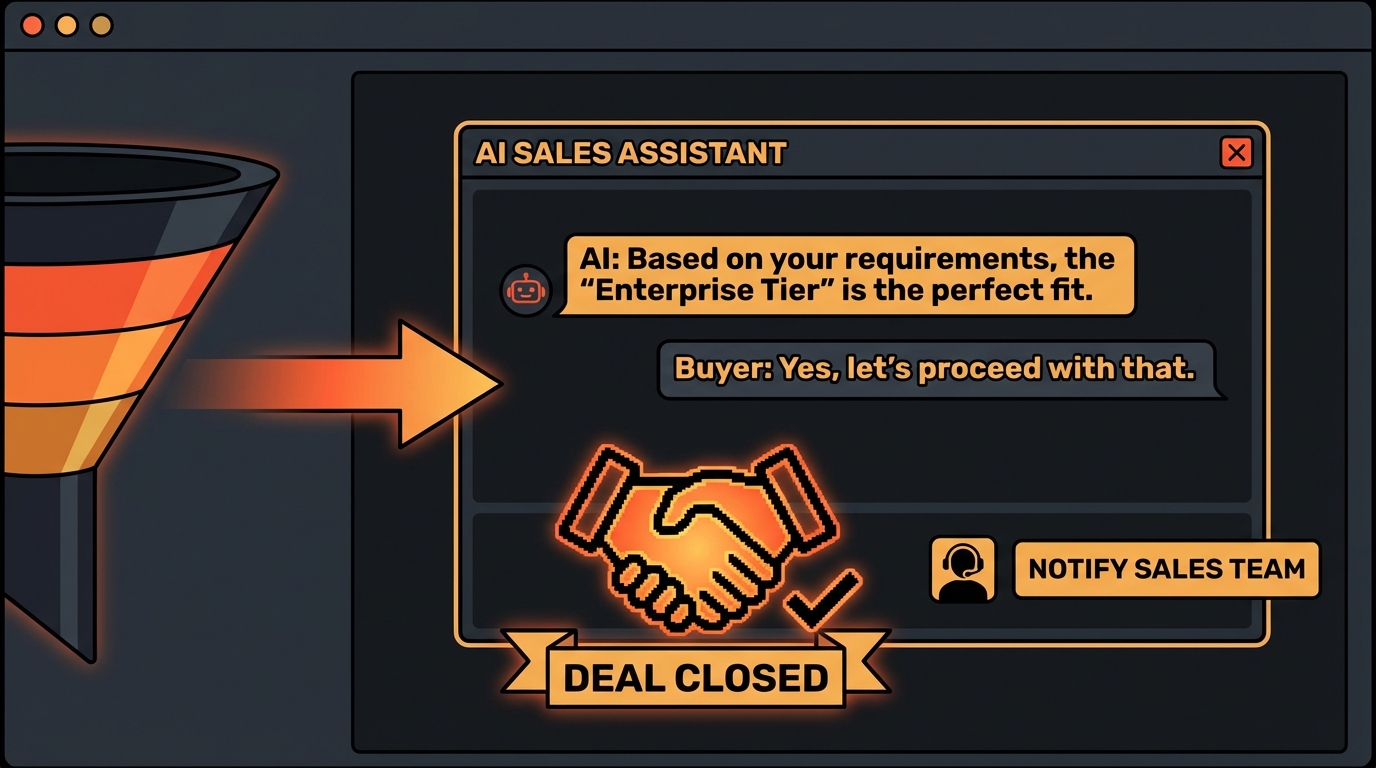
This is the closing mechanism.
At the Bottom-Funnel (BOFU), the AI’s mandate is brutally simple: accelerate deal velocity and eliminate every piece of friction standing between a qualified lead and a signed contract.
- Automated Demo Scheduling and Preparation. Ditch the endless “Are you free Tuesday at 3?” email chains. AI agents assume full ownership of the scheduling back-and-forth.
They confirm intent, check the SDR’s real-time availability, and book the slot,all without human administrative overhead. This isn’t efficiency; it’s conversion leverage. (Teams using this method Book 77% More Meetings, according to our internal data.)
- Instant Proposal Generation and Dynamic Pricing. When a lead is hot, you cannot afford a 48-hour delay waiting for the finance team to approve a custom quote. For standardized SaaS offerings, AI analyzes the lead’s firmographics (size, industry, stated needs) and generates a tailored, dynamic proposal instantly. Speed kills competitive deals. Use it strategically.
- Predictive Revenue Protection (Churn/Upsell). BOFU doesn’t stop at closing new logos. For your existing customer base, AI continuously monitors usage patterns and support metrics. It proactively flags accounts displaying early churn indicators (e.g., feature abandonment, increased help desk volume) or, conversely, accounts ready for a strategic upsell (maxing out current limits). Your Account Managers intervene strategically, preempting problems instead of reacting to loss.
The entire BOFU workflow is designed to surgically remove the final, low-value administrative barriers.
Your SDRs should be negotiating contracts and building relationships,not chasing calendar invites or waiting for proposal approvals.
VII. Measurement, Optimization, and Governance

- A/B Testing AI Models: The Non-Negotiable Iteration.
Stop treating your AI agent like static infrastructure. It is a marketing asset, and assets must be optimized.
Run rigorous A/B tests on specific variables: different LLM training sets, conversational flow structures, and lead handoff criteria. The only metric that matters here: Which version books more qualified calls?
- Calculate True AI ROI (Cost Per Qualified Lead).
This is where the rubber meets the road. Track every dollar spent on the system (API usage, licensing, maintenance) against the only output that matters: the volume of qualified leads generated (CPQL).
If your AI’s CPQL exceeds that of your best human SDR, the model is fundamentally broken. Stop it. Recalibrate immediately.
- Establish Hard Data Governance and Ethics.
We are in 2025. Regulatory compliance is not optional,it’s existential risk management.
Your AI prospecting must adhere strictly to GDPR, CCPA, and any emerging regional standards. Define clear ethical boundaries before deployment, especially concerning hyper-personalization and automated outreach volume. Don’t risk a reputation nuke for a 5% boost in replies.
- Mandate the SDR-to-AI Feedback Loop.
The AI cannot learn in a vacuum. Your human SDRs are the ultimate quality control.
If an AI-qualified lead is junk, the SDR must immediately log the *precise* reason (e.g., “Wrong ICP,” “Budget too low,” “Ghosted after 1st reply”). This structured, actionable data becomes the fuel for weekly, continuous model retraining.
AI vs. Traditional Funnel: A Strategic Comparison
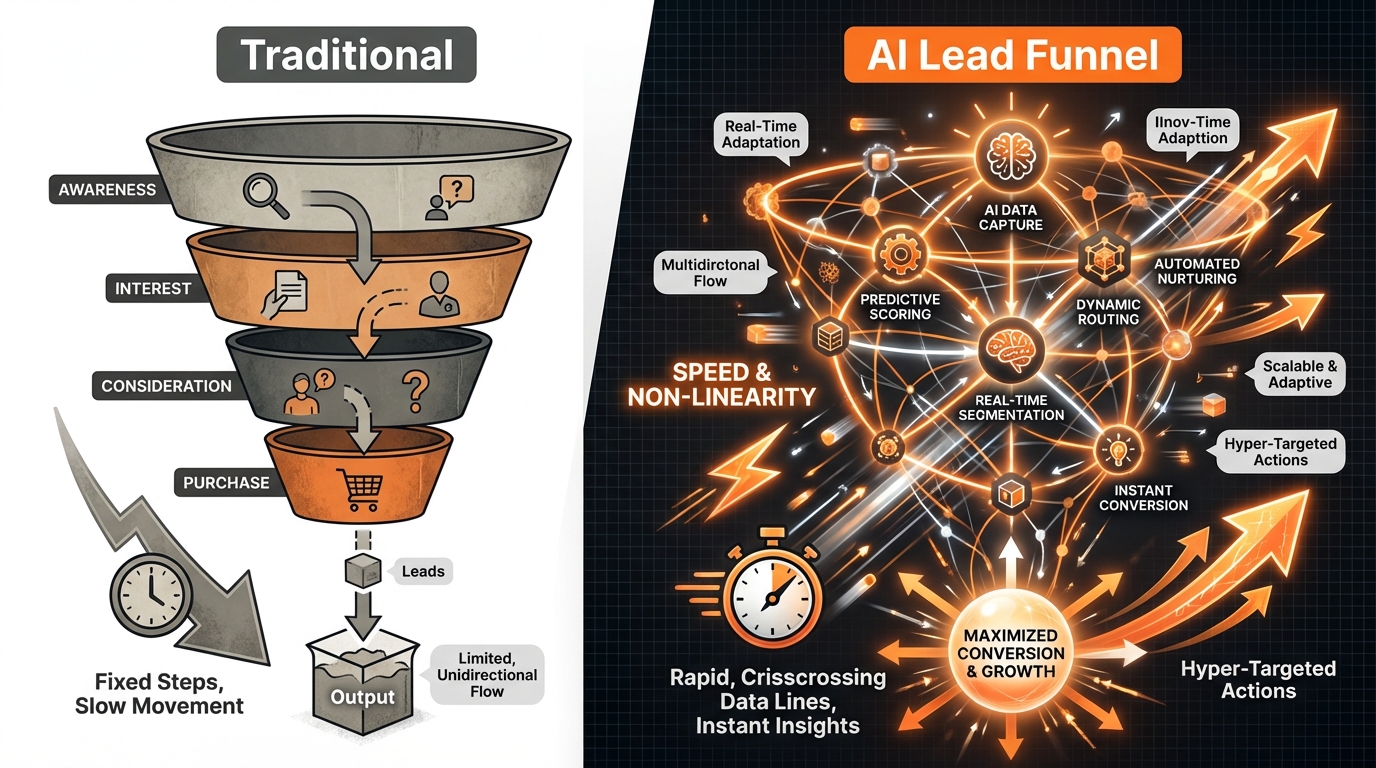
Implementation means nothing if you don’t understand the fundamental paradigm shift you just executed.
Legacy lead generation systems focused on volume. They had to. High-performance AI funnels focus exclusively on value, allowing you to ignore 90% of the noise.
This is the difference between managing activity and managing intent.
Observe the strategic change at every stage when you transition from manual execution to intelligent automation:
| Funnel Stage | Traditional Focus (Pre-2024) | AI-Powered Focus (2025 Strategy) |
|---|---|---|
| TOFU (Awareness) | Volume, Generic Lead Magnets, Manual Segmentation. | Precision Targeting, AI-Generated Creative Variants, Conversational Capture. |
| MOFU (Nurture/Interest) | Static Email Drip Campaigns, Rule-Based Scoring (MQL). | Dynamic Intent Scoring, Real-Time Channel Segmentation, Hyper-Personalized Follow-Up. |
| BOFU (Conversion) | SDR Vetting, Manual Scheduling, Standardized Proposals. | AI Qualification Handoff, Automated Scheduling, Predictive Churn Analysis. |
This isn’t just process optimization. This is a fundamental strategic replacement.
The old system managed activity (sending emails, managing spreadsheets). The new system manages intent and value.
The strategic takeaway is non-negotiable: You must shift your entire operational mindset from maximizing volume to maximizing value.
The Pragmatic Path Forward

Do not attempt to implement all seven steps simultaneously. That is the quickest way to guarantee failure velocity.
Start small.
Focus intensely on the critical foundation: Step 2 (Data Quality) and Step 3 (LLM Training).
If your input data is clean,truly clean,and your AI agent is trained to be intelligent and authoritative, you have built the only foundation that matters for scalable, predictable success.
This is where you gain an insurmountable competitive advantage.
The speed and accuracy of high-performance AI lead generation is unprecedented. Specifically, its ability to identify ideal prospects and instantly find their personal emails for hyper-personalized outreach.
Your competitors are still building basic, generic funnels focused on volume.
You need to build an intelligent, learning system that scales, adapts, and delivers predictable revenue, not just vanity metrics.
Stop wasting time on generic outreach that hits spam traps.
Start building the system that delivers qualified clients directly to your SDR teams, ready to convert.
Frequently Asked Questions
How fast can I see ROI after implementing an AI lead funnel?
If your data foundation is pristine (meaning Step 2 is complete), initial ROI is fast.
You will see immediate results from TOFU automation,specifically, highly personalized cold outreach,within 4 to 6 weeks. That is the low-hanging fruit.
However, full, optimized ROI,including accurate predictive scoring and BOFU efficiency,requires commitment.
Plan for 3 to 6 months. The AI models need significant real conversion data to refine their accuracy. You are training a machine, not flipping a switch.
What is the biggest mistake companies make when adopting AI funnels?
The single biggest, most predictable mistake is neglecting the data preparation phase.
Companies consistently try to bypass Step 2 (Data Quality), piping their AI tools directly into messy, legacy CRMs or disorganized spreadsheets.
The outcome is inevitable: Poor lead quality.
This immediately causes SDRs and sales teams to distrust the system. Systemic abandonment follows quickly.
Remember the core principle, which is exponentially amplified by AI: Garbage In, Garbage Out. Do not skip the foundation.
Should I use a single AI platform or integrate several specialized tools?
For maximum control, accuracy, and performance (especially given the rapid evolution of the 2025 tech stack), the “best-of-breed” approach is superior to any all-in-one suite.
You need specialization. Build your stack strategically:
- Lead Identification: Use specialized tools (like Pyrsonalize) to find high-value targets and proprietary data points (e.g., client personal emails). This is your high-octane fuel.
- Scoring & CRM: A dedicated platform for integration and predictive lead scoring.
- Orchestration: An LLM layer for managing conversational agents and dynamic personalization sequences.
Use flexible integration platforms (Zapier, Make) to tie everything together. Flexibility guarantees maximized performance and avoids vendor lock-in.
Ready to take the next step?
Stop guessing. Start using AI Lead Generation Software To find Clients Personal Emails and initiate outreach that converts.
Start Your Free Trial