

It’s 2025. If your lead generation workflow still treats HubSpot like a glorified spreadsheet,merely a database,you are actively losing money. Period.
Your strategic competitors aren’t just dabbling with AI; they are embedding it directly into their core CRM stack. They are pulling 77% revenue boosts and cutting admin time by 40%.
How?
Not by stacking another shiny, standalone tool. But by forcing their entire lead generation engine to talk seamlessly with HubSpot.
The problem isn’t the software. It’s the strategy.
Most generic guides treat HubSpot integration as simple form mapping,a job for Weavely or Woorise. This approach fails the moment you scale.
It collapses when you try to maintain data integrity across thousands of contacts imported from high-volume external AI prospecting tools (like Clay or Apollo).
What you need is a systematic, three-pillar strategy. This must cover Inbound capture, Outbound data acquisition, and,most critically,the technical governance required to keep your CRM data clean, actionable, and ready for scale.
Key Takeaways for Founders & SDRs
- Stop relying on generic AI tools. Use native HubSpot features (like Breeze Agents) for low-disruption tasks, such as content drafting and basic lead scoring.
- Integration is not mapping fields. True scale requires HubSpot Operations Hub (Webhooks, Custom Workflows) to handle high-volume, external data imports without corrupting your CRM.
- Implement Pre-Sales Validation. Leads generated by external AI must pass an automated quality control sequence (email verification, intent check) before a sales rep is ever notified.
- Choose your Outbound AI stack wisely. Use the Pyrsonalize path for hyper-personalized, verified contact information (personal emails are non-negotiable for high-ROI cold outreach).
The Integration Failure Point: Why Your CRM Data is Still Trash
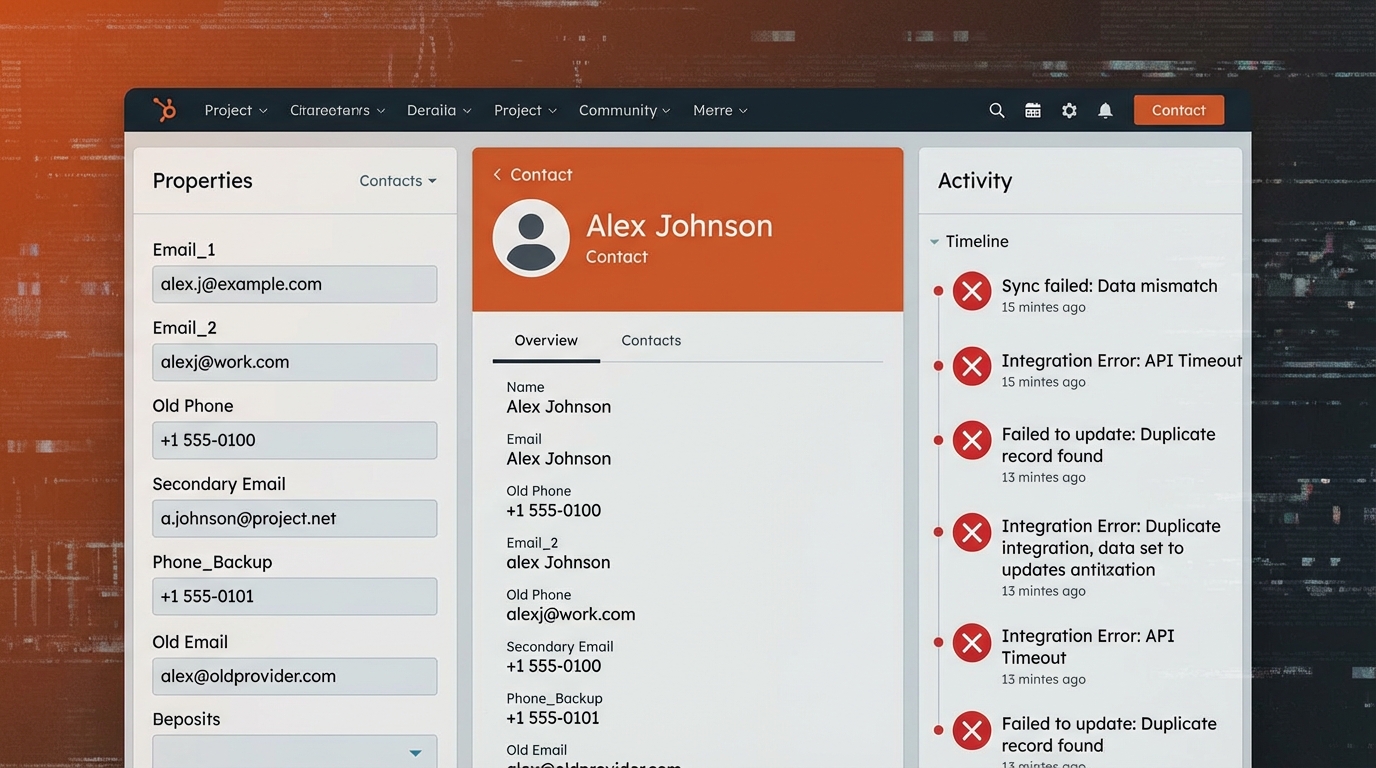
We’ve audited hundreds of SDR teams this year (2025). The single biggest common denominator for stalled pipelines? Garbage data.
Founders invest heavily in best-in-class AI prospecting tools, generate thousands of hyper-targeted leads, and then,critically,dump them straight into HubSpot without a quality check.
The immediate fallout is catastrophic for sales velocity:
- Massive duplication rates (Your CRM instantly turns into a compliance minefield).
- Inconsistent formatting and missing required fields (Killing your ability to segment MQLs vs. SQLs).
- Unverified emails and defunct phone numbers (Wasting SDR time on dead leads that never convert).
The result? Sales reps lose faith in the system. They stop selling. Instead, they spend 30% of their day manually auditing and fixing records,a task that should have been automated (and never necessary in the first place).
Now, let’s be clear: HubSpot’s native AI (like Breeze) is powerful. It excels at internal efficiency,drafting emails, summarizing calls, and surfacing insights via Conversation Intelligence.
But it cannot solve the fundamental problem of external data quality.
Remember this absolute truth:
“AI is only as effective as the data it’s built on. If you feed it garbage, it will help you automate the garbage faster.”
Successful AI integration isn’t about connecting two APIs and hoping for the best outcome. It requires building a strategic, automated buffer zone between your raw data acquisition tools and the sales floor pipeline.
This data hygiene layer is non-negotiable for scale.
Let’s break down the three strategic pillars required to achieve this level of operational excellence.
Pillar 1: Optimizing Inbound AI Capture in HubSpot
Most teams start here: optimizing inbound capture. They throw resources at forms, chatbots, and website experience, hoping volume solves their pipeline issues.
But volume is useless if the data is thin.
Fortunately, HubSpot’s native AI tools,specifically the Breeze suite,have matured significantly, closing critical data gaps previously requiring expensive third-party vendors.
Leveraging Breeze Agents for Qualification
The Customer Agent (part of the Breeze AI suite) is no longer a gimmick. It is now robust enough to manage initial qualification and routing,if you train it ruthlessly on your knowledge base and Ideal Customer Profile (ICP). This is non-negotiable.
- Intent-Based Routing: Configure the Agent to recognize high-intent keywords immediately (“pricing,” “implementation,” “demo”). Use these signals to bypass standard MQL scoring queues and instantly trigger a high-priority alert for the relevant SDR or AE. Speed kills your competitors.
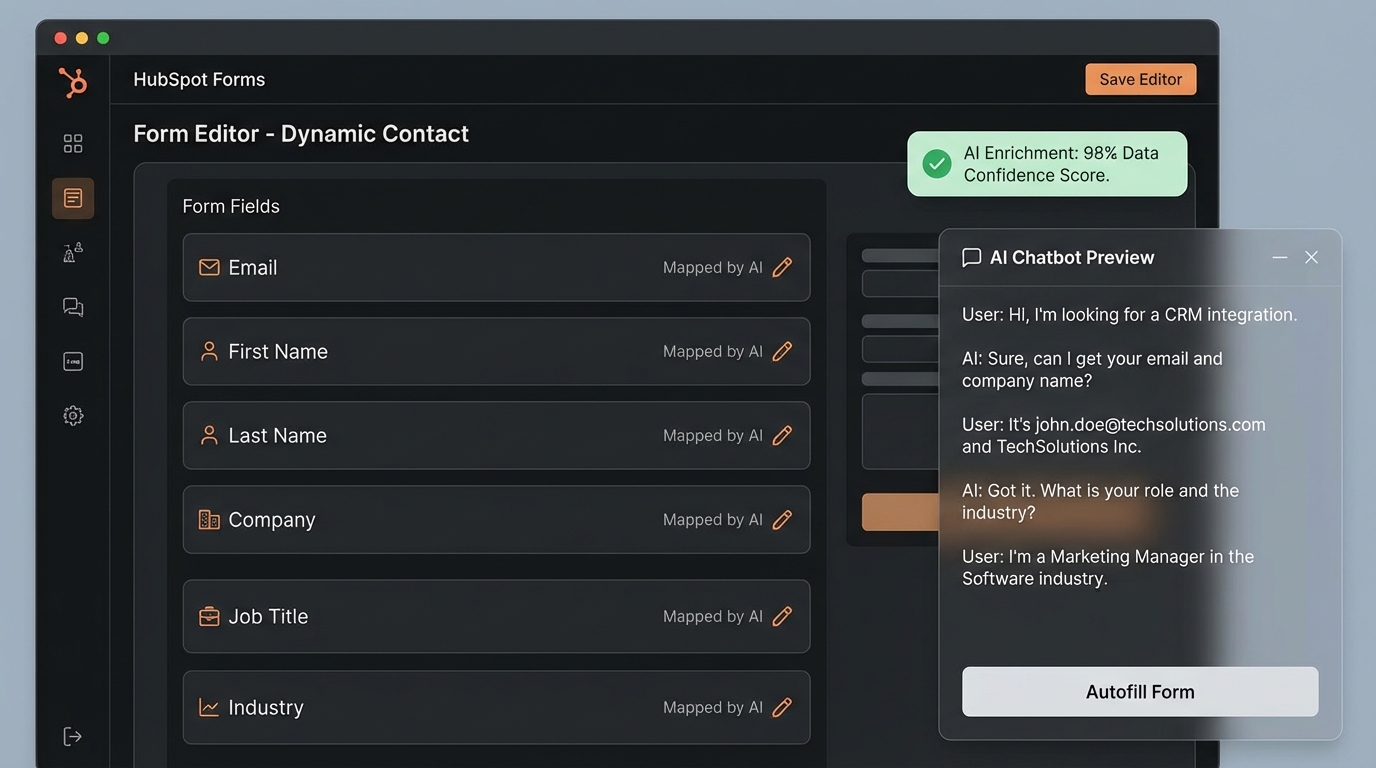
- Automated Data Fill: If a prospect engages, the Agent must automatically prompt for mission-critical missing fields (e.g., Company Size, Industry, Current CRM). Map these directly to custom properties. This is real-time, zero-latency data enrichment,no external API calls required.
- Dynamic Website Personalization: Leverage the Personalization Agent (currently in Beta, but deployable now) to dynamically adjust CTAs and content based on inferred intent or historical behavior. (Example: If a visitor reads three articles on optimizing lead capture, swap the generic “Sign Up” CTA for the specific, high-value conversion point: “Download the Exit Intent Checklist.” Stop wasting traffic.)
This is how you maximize the ROI on your existing traffic. You are using AI to aggressively shorten the conversion path and guarantee the resulting lead record is immediately actionable.
AI-Powered Forms (Weavely & Woorise Context)
HubSpot forms are functional, yes. But they are often too rigid for complex B2B qualification.
Tools like Weavely and Woorise introduce advanced, conditional logic driven by AI prompts,allowing you to gather nuanced data without forcing the user to complete a 17-field monster form.
The Mandate: Advanced Mapping. If you rely on an external form builder (and many advanced teams do), your integration point must be robust. Do not settle for basic name/email mapping.
You must map the AI-driven qualification answers,the nuance (e.g., “Biggest Pain Point,” “Current Tech Stack”),to specific, pre-created HubSpot custom properties. If you skip this step, the data is useless for segmentation and critical AI Predictive Lead Scoring Models. You cannot predict conversion if you don’t know the pain.
Pillar 2: The Outbound AI Decision Matrix (Data Acquisition)
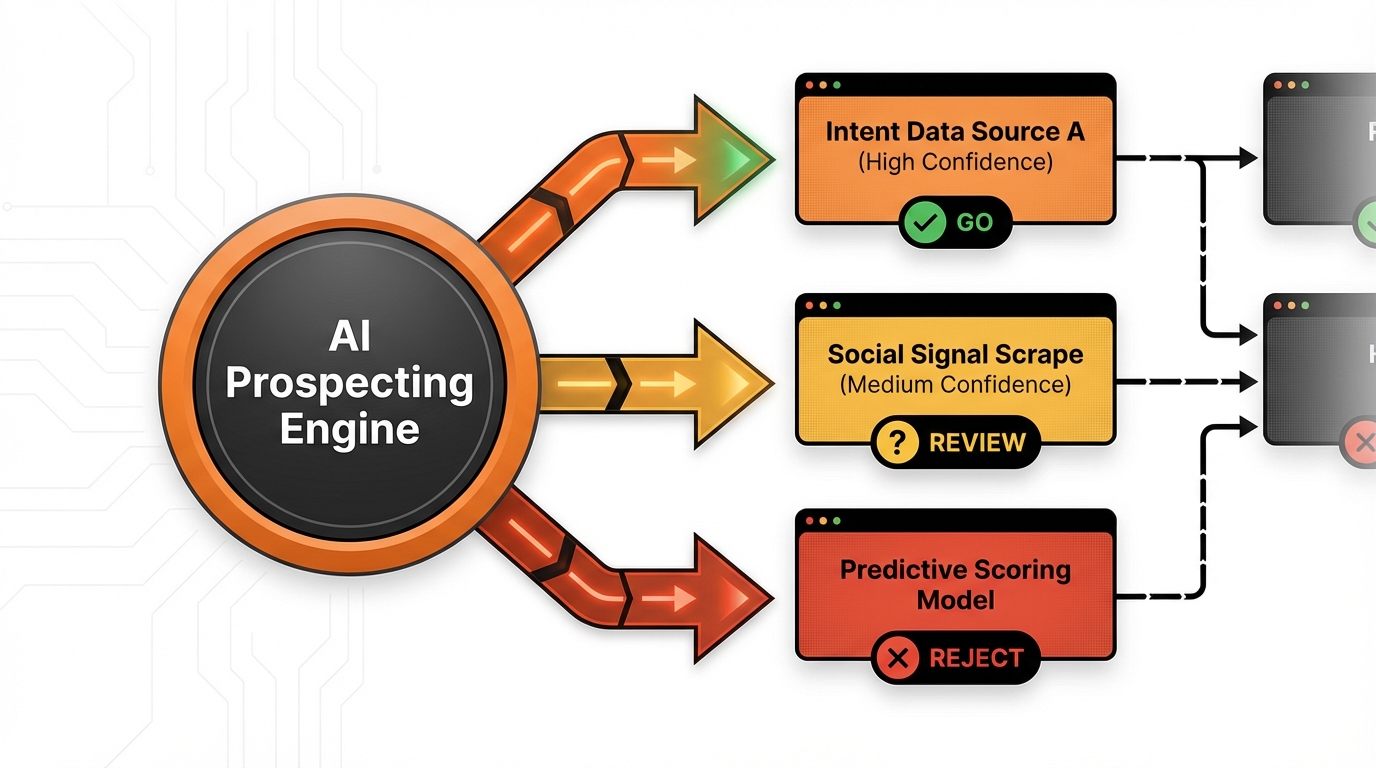
Inbound AI is about optimization. Outbound AI is about expansion.
This is where the real integration headache begins for SDR teams,dealing with massive, raw data exports that instantly clog HubSpot. The decision you make here dictates your future pipeline efficiency.
You face a critical fork in the road: Do you prioritize high-volume scale (Apollo, Zoominfo) or hyper-personalized accuracy (Clay, Pyrsonalize)? Choose incorrectly, and you’ll spend the next quarter cleaning garbage data.
Outbound Lead Generation Tool Comparison
Forget generic info@ addresses. High-ROI outbound requires reaching the prospect’s personal email.
We compare the top data acquisition engines based on their specialization and integration flexibility.
| Feature | Apollo/Zoominfo | Clay (Aggregation Engine) | Pyrsonalize (Hyper-Personalization) |
|---|---|---|---|
| Primary Focus | Bulk data, B2B contact info, Sequencing. | Data waterfall enrichment, Custom AI logic, Verification. | Finding personal emails, Intent data, Hyper-specific lead attributes. |
| HubSpot Integration | Direct native sync (easy setup, limited quality control). | Via Zapier/Make (Webhooks), highly customizable field mapping. | API/Webhooks integration, built-in validation before sync. |
| AI Use Case | Basic email drafting, sequencing automation. | Custom LLM data parsing (e.g., summarizing company news). | Deep research for The 5 Levels of AI Personalization for Cold Email ROI. |
| Best for… | High-volume, generalized outreach. | Complex, multi-step enrichment workflows. | Targeting Founders/Executives where direct, validated communication is essential. |
The Strategic Choice for HubSpot Users
Do not treat these tools as interchangeable. They require entirely different integration architectures. Define the intended outcome before you press ‘Export’.
- If your goal is volume and rapid sequencing: Lean on Apollo or Zoominfo’s native HubSpot sync. This is fast, but you must accept data quality fluctuation (expect 30-40% decay). Use HubSpot’s native deduplication and the Breeze suite’s scoring mechanisms to actively manage the resultant noise.
- If your goal is hyper-personalization and executive outreach (The Pyrsonalize Method): This requires a dedicated, multi-step workflow using Clay combined with a personal email finder like Pyrsonalize. Crucially, the integration cannot be a simple sync. It must be managed via Operations Hub webhooks (Pillar 3). Yes, it’s slower initially, but the ROI per lead is exponentially higher.
Here is the non-negotiable truth: Data from these platforms is never “clean.” It is raw input.
You must process, enrich, and validate it inside HubSpot before it ever touches a sales rep’s pipeline. Skipping this step is how you burn through quality leads and ruin domain reputation.
Pillar 3: Technical Integration & High-Volume Quality Control (The Ops Hub Roadmap)
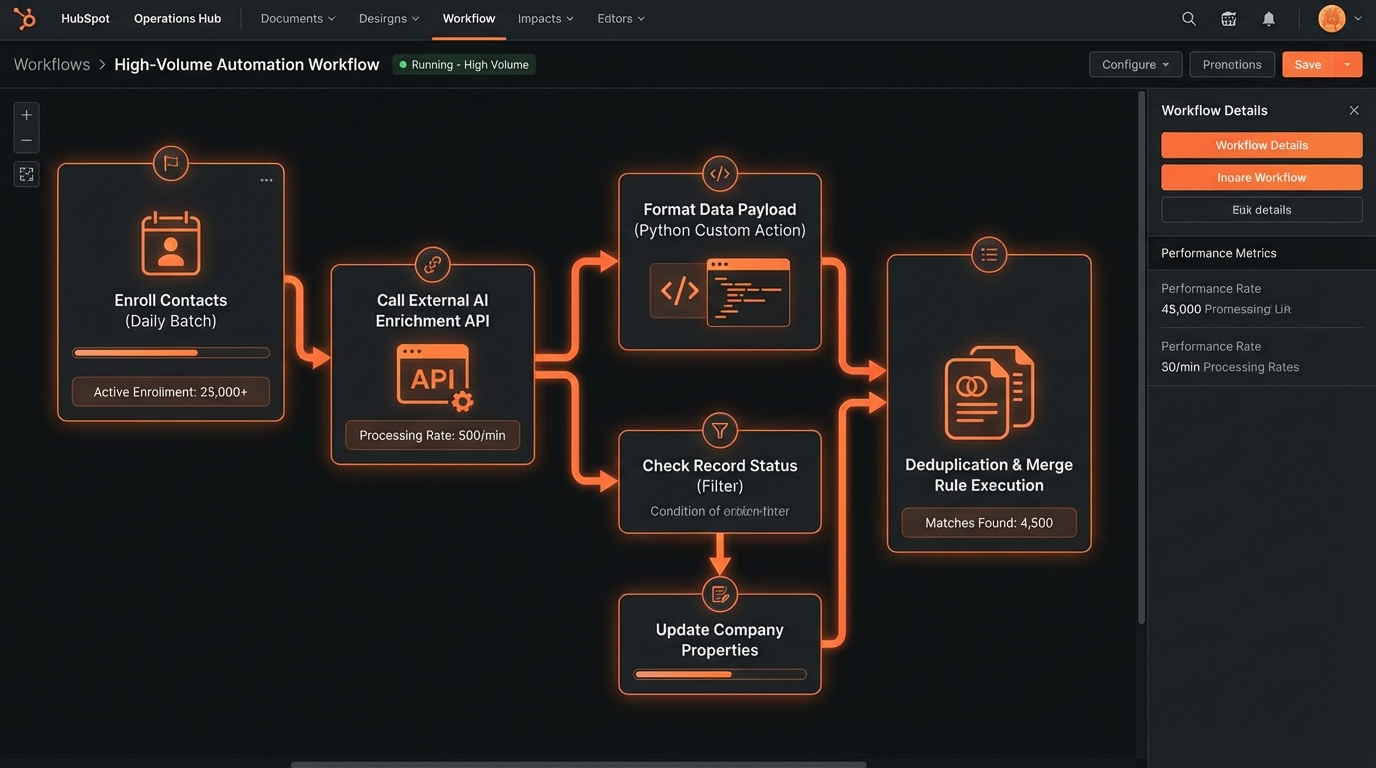
This is the single greatest competitive advantage you can build right now.
You need to stop corrupting your CRM with external data dumps. Immediately.
HubSpot Operations Hub isn’t optional,it is the essential firewall between external AI lead tools and your mission-critical Sales Hub.
Why? Because high-volume data imports (hundreds or thousands of leads, whether from Apollo or a custom Pyrsonalize/Clay workflow) lack the critical steps for validation and formatting when pushed directly via API. That negligence kills pipeline efficiency.
Step 1: Define Custom Properties (The Non-Negotiable Pre-Import Mandate)
Before you import a single contact, you must create dedicated custom properties in HubSpot for external data.
This isn’t just organizational hygiene; this segmentation prevents overwriting or mixing validated, existing data with raw, unverified import data. It protects your historical data integrity.
- Source Tool: (Single line text). Use this to track lineage: “Pyrsonalize Workflow 4,” “Apollo Export Q4.”
- Import Date: (Date selector). Time-stamping is crucial for data decay audits.
- Verification Status: (Dropdown). Options: Verified, Catch-All Risk, Bounce Risk, Scrubbed.
- AI Research Summary: (Multi-line text). Store the personalized snippet or research outcome generated by the AI tool here.
Mapping these fields correctly ensures that when an SDR views a contact record, they immediately know the origin and the quality score of the lead. No more guessing. No wasted time on dead ends.
Step 2: The Operations Hub Workflow Sequence (Building the QC Gauntlet)
Operations Hub is the low-code engine that triggers automated actions based on external data inputs (Webhooks).
This is how you force every external lead through a quality control gauntlet that eliminates 90% of the junk before it hits your reps’ queues.
The High-Volume QC Blueprint:
- Trigger: New Contact Created (Source Tool property is filled).
- Formatting & Standardization: Use Ops Hub actions to automatically standardize common fields. Convert “VP Sales” to “Vice President of Sales.” Standardize phone number formats (Crucial, since AI models rely on consistent data structure).
- Deduplication Check: Run an automated check for duplicates based on Email and Company Domain. If a duplicate is found, the workflow must automatically merge the records or flag the new contact for manual review. This is non-negotiable data pollution prevention.
- Email Verification Webhook: This is the most critical step for outbound success. Send the email address to an external verification service (or use Pyrsonalize’s built-in verification) via a webhook. Wait for the response (Valid, Catch-All, Invalid).
- Update Verification Status: Based on the webhook response, update the HubSpot property “Verification Status.” Only leads marked “Verified” proceed to the next stage.
By implementing this sequence, you ensure that SDRs are spending 100% of their time on viable prospects. This protects your domain reputation and drives immediate efficiency gains.
Step 3: AI Validation: Filtering Intent Before Sales Engagement
Filtering bad emails is step one (Data Quality).
Filtering bad intent is step two (Strategic Fit).
You can leverage low-code platforms (Zapier/Make) to connect HubSpot data to an external Large Language Model (LLM) like OpenAI or Anthropic. This creates a custom, highly accurate AI qualification layer that operates 24/7.
The Custom LLM Qualification Workflow:
- Input: New contact record in HubSpot (must be post-email verification).
- Action: Send the prospect’s LinkedIn bio, company description, and the personalized “AI Research Summary” property to an LLM via a Make/Zapier webhook.
- Prompt (Example): “Analyze this profile against our Ideal Customer Profile (ICP: Enterprise SaaS, 500+ employees, using Salesforce). Assign a score (1-5, where 5 is perfect fit) and provide a one-sentence reason why this lead is a good fit.”
- Output: Map the LLM’s assigned score and summary back to a new HubSpot property: “LLM Fit Score.”
This final AI layer provides instant context and confidence. SDRs don’t chase every lead that happens to have a valid email address; they chase the leads validated by both technical data quality and AI-driven strategic fit.
“The 2026 sales mandate is not just finding leads, but validating their intent and access point. If a contact has a verified personal email (which Pyrsonalize excels at providing) and an LLM Fit Score of 4 or 5, the SDR knows that lead warrants immediate, high-touch outreach. That strategic focus is the only way to drive scalable, predictable revenue.”
Measuring ROI: The AI-Specific KPI Dashboard
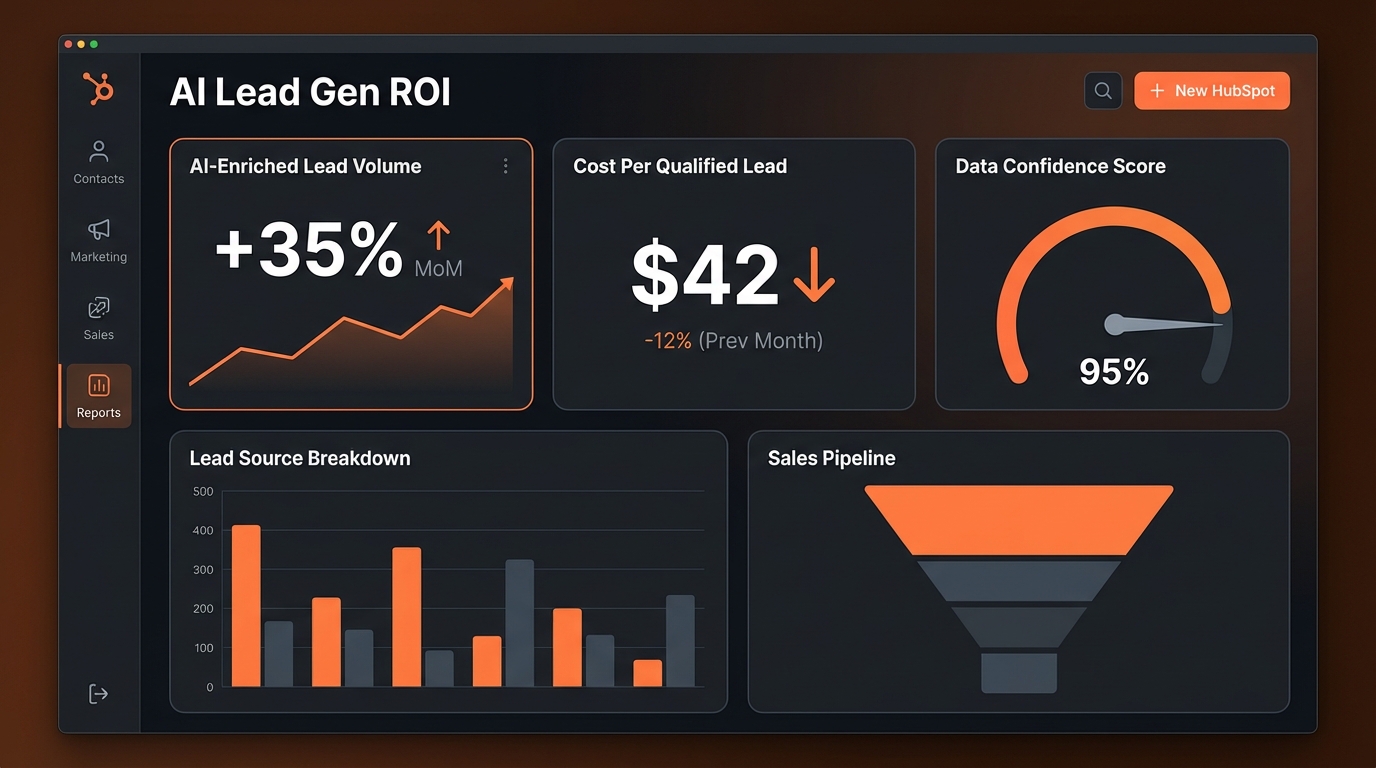
Your traditional Lead-to-Opportunity metrics are irrelevant for measuring AI success.
If you use them, you will fundamentally miss the true ROI of integrating high-volume AI lead generation. Why? Because the goal isn’t just volume,it’s operational efficiency and verifiable data quality.
AI integration is designed to reduce friction and eliminate administrative waste. Your measurement system must reflect this shift, or you are optimizing the wrong variable.
Here are the crucial, non-negotiable metrics for your 2025 AI Lead Generation Dashboard:
- Lead-to-Verified-Lead Rate (LTVL): This measures the percentage of raw imported leads that successfully clear the Operations Hub QC sequence. (Email verified, formatted, and de-duplicated against your existing database.) A low LTVL is a flashing red light. It proves your external prospecting tool selection is poor, and you are wasting valuable sync capacity.
- Time Saved Per Rep (Operational Efficiency): Track the direct reduction in manual data entry, cleanup, and administrative tasks. This is tracked by comparing pre-automation time against post-automation time (leveraging features like Conversation Intelligence or Operations Hub formatting actions). This metric is the true measure of efficiency ROI.
- Data Completeness Score: The percentage of mission-critical fields (Job Title, Company Size, LLM Fit Score) that are fully populated upon contact creation. With AI enrichment and custom property mapping running, this score should be a non-negotiable 95% or higher. If it’s not, your mapping workflows are broken.
- Pipeline Velocity (AI vs. Manual Leads): Directly compare the speed at which AI-sourced and qualified leads move from MQL to SQL versus manually sourced leads. Due to superior initial data quality (see Data Completeness Score), AI-qualified leads must accelerate 20-30% faster through the pipeline. If they don’t, your qualification logic is flawed.
Focusing strictly on these four KPIs forces you to optimize the engine,the technical integration and the quality control system,not just the raw volume.
If your LTVL drops to 60%, you don’t need more leads. You need to immediately adjust your external data acquisition strategy or tighten your Operations Hub workflows. The dashboard tells you exactly where the failure point is.
Frequently Asked Questions (FAQ)

How does HubSpot’s Breeze compare to external AI tools like Clay or Pyrsonalize?
HubSpot Breeze is designed for internal operational efficiency. Its focus is native CRM enhancement: drafting emails, summarizing calls, and basic lead scoring. It excels because it works seamlessly within the HubSpot ecosystem, drastically reducing context switching.
However, Breeze is not a data acquisition engine.
External tools like Clay or Pyrsonalize are specialized in high-volume data acquisition and hyper-personalization. They are mandatory for high-ROI outbound because they find the verifiable contact data,specifically the personal emails,and unique intent signals that Breeze, as an internal CRM tool, cannot access from outside sources.
You need both: Breeze handles internal optimization; Pyrsonalize handles external acquisition.
Is HubSpot Operations Hub necessary for AI integration?
For scalable, high-volume lead generation, Operations Hub is non-negotiable. If you are only importing ten leads a week, manual management works fine. But if you are importing hundreds or thousands of leads from tools like Pyrsonalize, Operations Hub is your necessary data firewall.
Without it, high-volume AI lead generation will corrupt your CRM and fundamentally tank your pipeline integrity.
Operations Hub uses custom workflows and webhooks to force data standardization *at scale* by managing:
- Mandatory deduplication checks upon entry.
- External verification checks (email validation, data enrichment).
- Data standardization before the lead is allowed into the sales pipeline.
It stops administrative waste before it starts.
How do I ensure GDPR compliance when using AI lead generation tools?
Compliance hinges on two factors: data transparency and proactive verification. You must engineer your system to meet these mandates automatically:
- Data Provenance: Ensure your external tools (like Pyrsonalize) provide clear data provenance,where and when the data was found.
- Mandatory Verification: Use the Operations Hub workflow (Pillar 3) to run mandatory verification checks on all emails before outreach is initiated. Never automate outreach to leads that haven’t passed verification.
- Instant Unsubscribe Sync: Ensure your HubSpot contact records are instantly updated with unsubscribe requests, and that status syncs back to your outreach automation tool immediately.
This is not optional. We strongly recommend reviewing the specific GDPR compliance features of every tool you integrate before deployment.
Can I use generic LLMs (ChatGPT/Gemini) with HubSpot?
Yes, but not natively. You must use a low-code intermediary platform like Zapier or Make to bridge the gap. The process is strategic and requires structured input/output.
This allows you to send structured HubSpot data (like a contact’s profile, recent actions, or industry) to the LLM and receive a structured output back into a custom HubSpot property.
Examples of structured output include:
- An LLM Fit Score (based on complex criteria).
- A highly personalized opening line.
- A detailed qualification rationale for the SDR.
While this requires setup time, it enables truly custom AI qualification that the native Breeze features might not yet support for niche, high-value use cases.
Ready to take the next strategic step?
Stop wasting time and budget on unverified, generic data. Pyrsonalize finds the personal emails you need to break through the noise and guarantees data integrity before you hit ‘Send’.
Start Your Free Trial
Start Your Free TrialReferences
- AI Lead Generation Forms in HubSpot – YouTube
- How to add AI to your existing CRM without disrupting sales workflows
- Meet Breeze , HubSpot’s AI tools that make impossible growth …
- What’s the best lead generation tool you’ve used with HubSpot?
- AgentX Tutorials: How to generate lead and send to HubSpot CRM