

#1: The Fundamental Shift,Why ChatGPT Fails at Cold Outreach (The Data Gap)
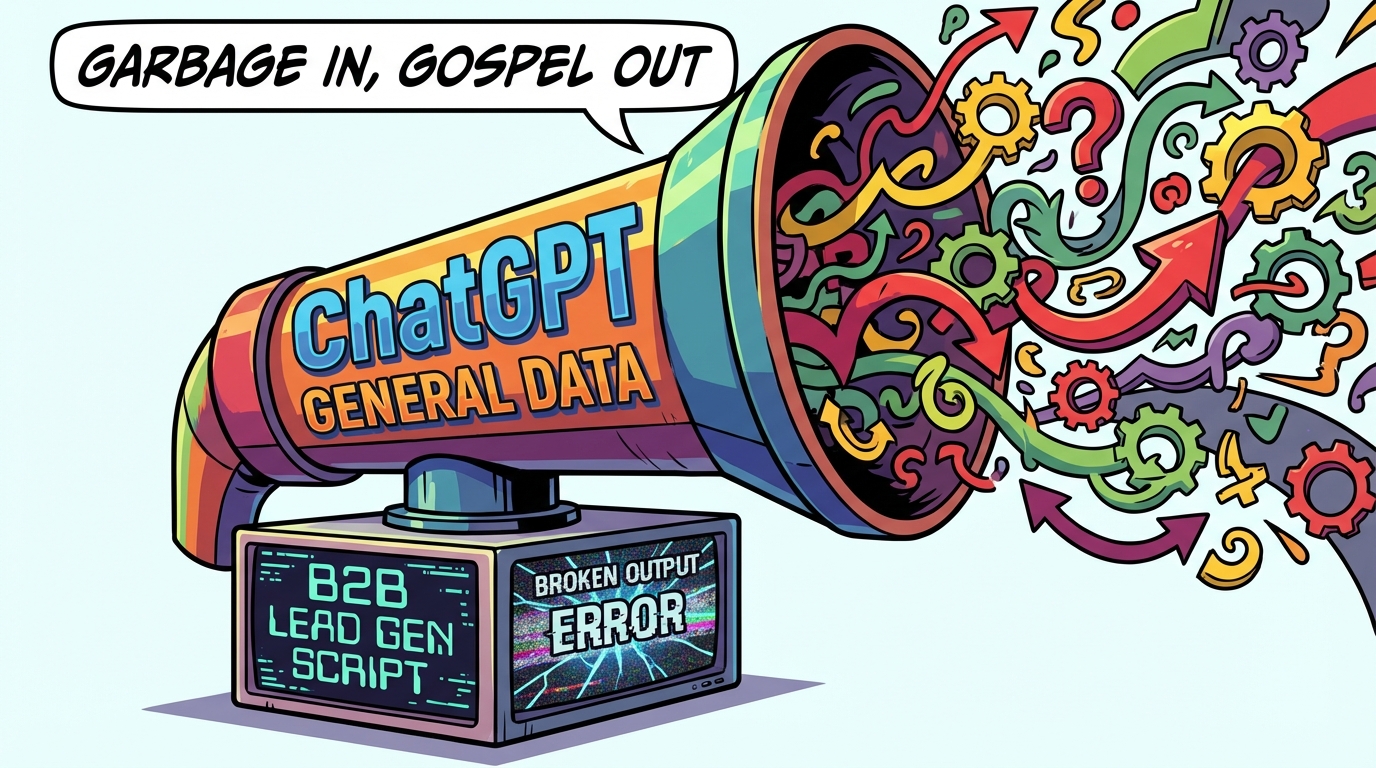
You need to understand the core constraint: Garbage In, Gospel Out.
If you feed ChatGPT generic inputs, it generates believable, high-quality boilerplate text. This is why 90% of AI-generated cold outreach fails.
Standard users treat ChatGPT like a search engine, asking:
- “Write a cold email for my SaaS product.”
- “Give me LinkedIn connection message ideas.”
This is a fundamental strategic error. ChatGPT is a language model; it excels at synthesizing existing data. It cannot invent a unique, high-leverage sales strategy for your specific business.
We leverage ChatGPT as an optimization engine, not a creation engine. This means the strategic heavy lifting must be done by you.
Bridging the AI Input Gap: The Three Non-Negotiables
To move from generating generic noise to generating revenue-driving scripts, we must bridge the AI Input Gap.
This requires supplying three non-negotiable data sets *before* asking for a single line of copy. These inputs provide the necessary context for the AI to sound strategic, empathetic, and relevant.
Here are the three core data inputs we use to anchor all B2B script generation:
-
The Ideal Customer Profile (ICP) Matrix:
This goes beyond job title. We feed the AI specific pain points, common industry jargon, current market headwinds, and the specific technology stack used by the prospect. The more granular the data, the more personalized the output.
-
The Measurable Value Proposition (MVP):
ChatGPT needs to know exactly what success looks like. Instead of “we save time,” we use “we reduce manual data entry by 40%, saving the average SDR 8 hours per week.” The MVP must be quantitative and directly relevant to the ICP’s primary KPI.
-
The Channel and Tone Constraint:
Every channel (email, LinkedIn, cold call) requires a specific tone, length, and call-to-action (CTA). We explicitly define these constraints. For instance: “Generate a 50-word LinkedIn message. Tone: Direct and respectful. CTA: Request a 15-minute discovery call, citing the 40% efficiency gain.”
You are about to see the exact prompt methodology we use to combine these three elements into a single, high-converting instruction set.
🔥 Strategic Insight: Do not let ChatGPT create your strategy. Use it to optimize your existing, proven strategy. If your MVP is weak, ChatGPT will only make the message sound polished, not persuasive.
Key Takeaways: The Strategic Edge
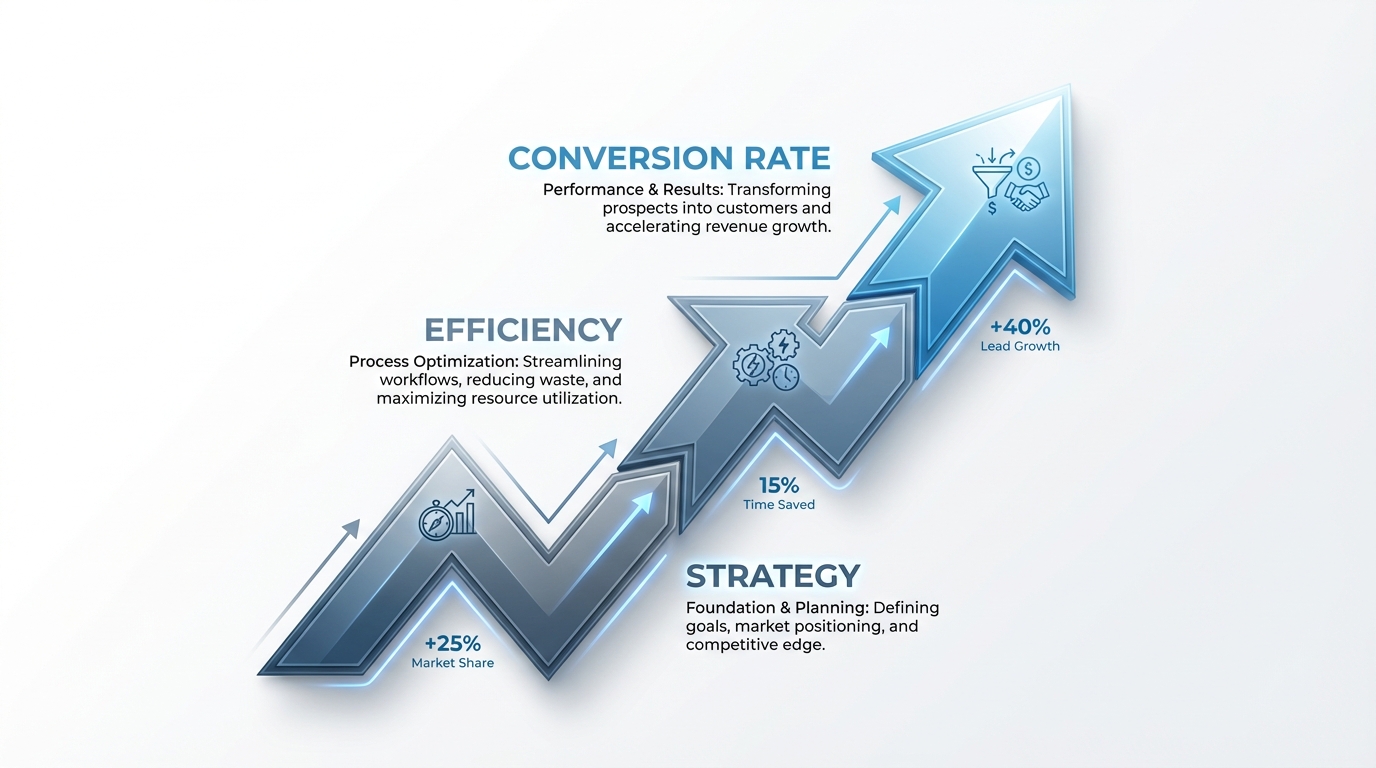
We already established that generic inputs yield generic failure. To move past the boilerplate text that stalls 90% of outreach campaigns, we need a strategic framework,not just a tool.
This is precisely how we structure our high-conversion scripts:
- Prompting Methodology is Non-Negotiable: Success requires the simultaneous deployment of Role-Prompting (establishing the expert persona, e.g., ‘Sales Director’) and Contextual-Prompting (grounding the output in specific prospect data). This combination eliminates generic fluff and maximizes relevance.
- Closing the Multi-Channel Gap: Your competitors are still sending siloed emails. Our focus is on comprehensive, linked sequences that bridge Cold Email, LinkedIn DMs, and Cold Call voicemails. Maximum contact efficiency is mandatory for scaling B2B outreach.
- Pre-emptive Objection Training: The AI cannot just write the opening script. It must be explicitly trained to anticipate and draft high-conversion responses for specific B2B objections (e.g., “We already use [Competitor X]” or “I’m too busy right now”).
- The 80/20 Rule of Refinement: ChatGPT handles the structural 80% (speed and structure). Your team must own the final 20%,the hyper-personalization, compliance checks, and brand voice integrity. AI provides the draft; the human closes the deal and protects the brand.
Mastering Advanced Prompting for B2B Scripts
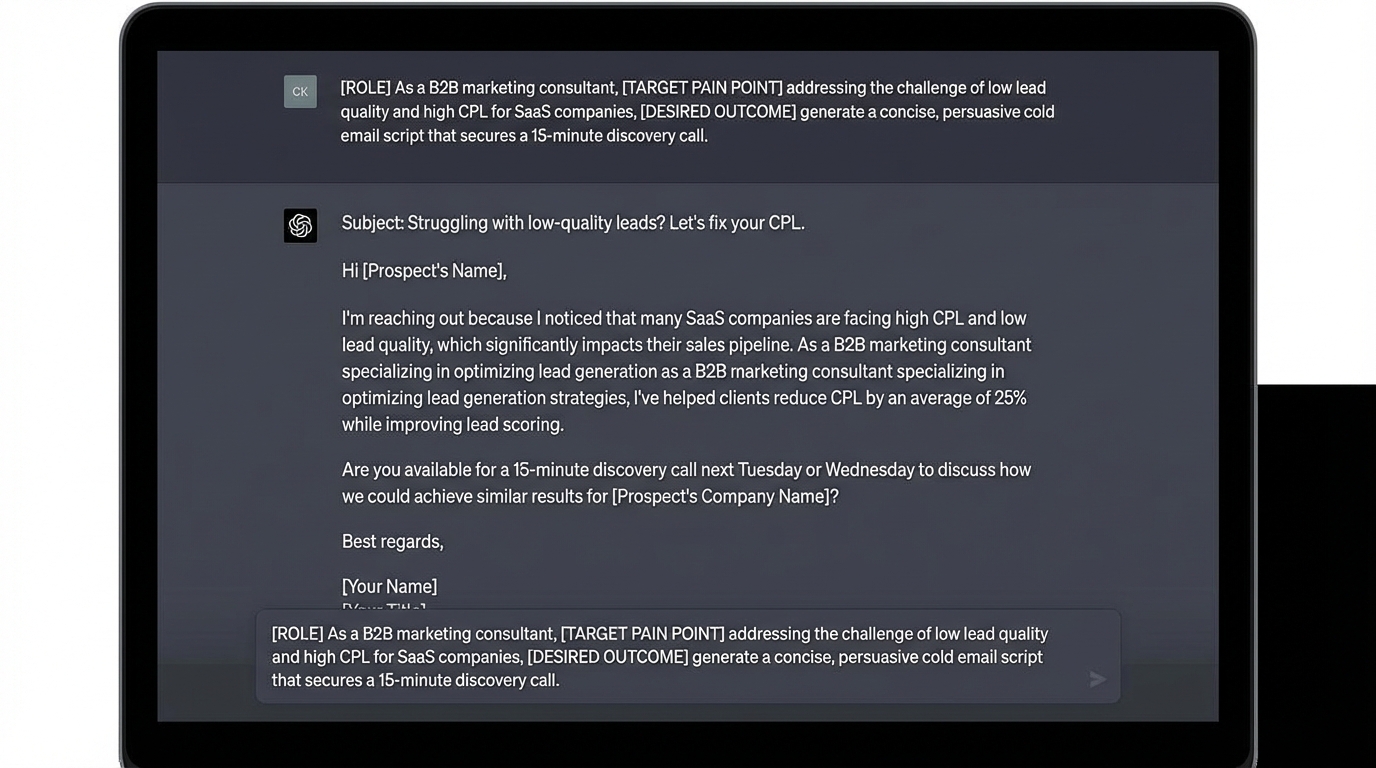
The difference between a generic, deleted email and a highly converting script is simple: Input quality.
Stop treating ChatGPT as a typing assistant.
Treat it as a highly paid, experienced copywriter who requires precise direction and context. We mandate two prompt layers for every high-performing script.
Step #1: Implement Role-Prompting (The Voice of Authority)
Your script must sound like it came from an experienced professional. Not a generalist AI.
Role-Prompting is how we force the Large Language Model (LLM) to adopt a specific persona. This includes industry jargon, strategic focus, and an appropriate B2B tone. This step is non-negotiable.
We use a rigid structure for the Role Prompt. This eliminates 90% of the generic fluff immediately.
The Mandatory Role Prompt Structure:
Act as a Senior Sales Director specializing in B2B SaaS solutions for the Fintech sector. Your goal is to secure a 15-minute discovery call with a VP of Operations at a company between 500-1,000 employees. Your tone must be authoritative, strategic, and respectful of their time.
We specify five core variables in this structure:
- Role: Defines expert status and required vocabulary.
- Industry: Provides contextual market knowledge.
- Target Title: Sets the authority level and strategic focus of the message.
- Company Size: Ensures relevance (a key filter).
- Desired Tone: Guarantees professionalism and respect.
Step #2: Ground the Script with Contextual-Prompting (The Data Layer)
A great script addresses a specific, measurable pain point. This requires hard data.
Contextual Prompting feeds the AI the necessary intelligence about your Ideal Customer Profile (ICP) and their current challenges. We are personalizing pain points,not just names. (Need help defining these inputs? Review our guide on Targeted Buyer Persona for AI Lead Gen.)
We require three mandatory data points to ground the script in reality:
- The Product Value: Our AI lead generation software finds personal client emails with 98% accuracy. This reduces list decay by 40%.
- The Prospect’s Pain Point: VPs of Operations in Fintech struggle specifically with GDPR compliance risk and high SDR churn due to poor lead quality.
- The Competitor Angle: They are currently using a competitor (ZoomInfo or Apollo) known for high bounce rates and low compliance scores.
Combining the Role and the Contextual layers transforms your final prompt. It moves from being a simple suggestion to a powerful, executable instruction set.
The B2B Script Arsenal: Ready-to-Deploy Frameworks
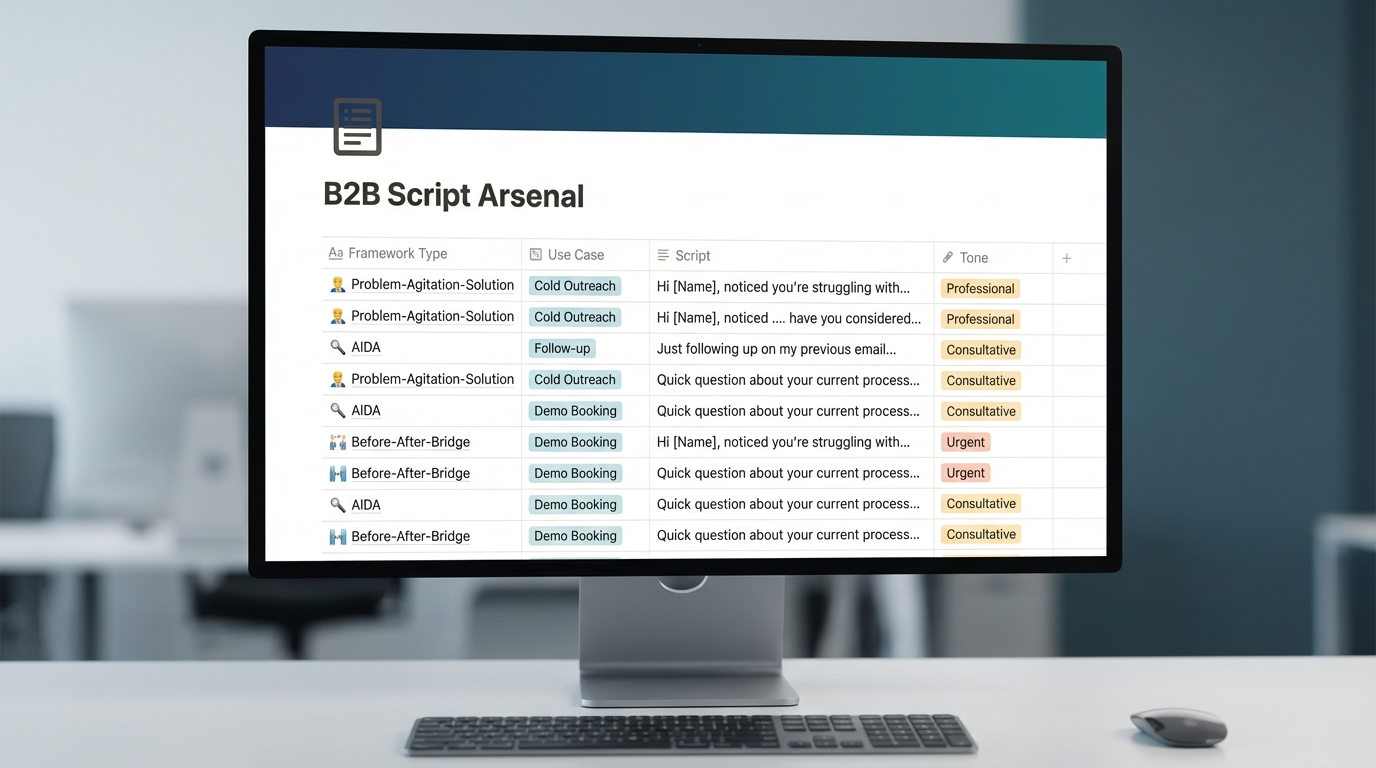
We do not use a single, monolithic script. We segment our scripts by channel. Each platform,email, LinkedIn, phone,requires a distinct approach, even if the core value proposition remains identical.
Cold Email Sequences (3-Part System)
Email remains the primary engine of predictable outbound revenue. However, a single email is insufficient; it relies on luck. We mandate a short, high-value sequence (minimum three parts) to maximize conversion probability.
Prompt Framework: Cold Email Sequence Generation
[USE ROLE/CONTEXT PROMPT FIRST]

Generate a 3-part cold email sequence. Keep all emails under 100 words.

Email 1 (The Pain Hook): Focus strictly on the prospect's primary pain point (GDPR risk/SDR churn). Use a compelling data point if possible. CTA: Simple question to solicit a response.
Email 2 (The Value Proposition): Sent 3 days later. Introduce our solution (Pyrsonalize) as the direct solution to that pain, emphasizing accuracy and compliance. CTA: Offer a specific resource or case study link.
Email 3 (The Breakup): Sent 5 days later. Assume the prospect is busy, not uninterested. Offer one final, clear value statement and close the thread permanently.
Example Output (Email 1 – The Pain Hook):
Subject: SDR churn or compliance risk, [First Name]?

[First Name],

We track the operational efficiency of Fintech sales teams. We frequently see SDR churn rates hit 30% when lead quality is low.

Your current provider (likely ZoomInfo or Apollo) often provides data with high bounce rates. That translates directly to wasted SDR time and increased corporate risk exposure.

Are you confident in the compliance score of your current lead lists for 2025?

Best,
[Your Name]
LinkedIn Outreach (The Personal & Direct Approach)
LinkedIn outreach demands extreme brevity and strategic patience. If your connection request contains a pitch, you lose the prospect immediately. Our strategy uses two distinct, decoupled stages to bypass this common mistake.
Prompt Framework: LinkedIn Connection Request & DM
[USE ROLE/CONTEXT PROMPT FIRST]

Generate two distinct LinkedIn messages based on the following rules:

Message 1 (Connection Request): Max 300 characters. Reference a recent company event or public trend related to their pain point (e.g., APAC expansion, budget cuts). Do NOT pitch. Goal: Acceptance.
Message 2 (Follow-up DM): If Message 1 is accepted, send this concise message 1 day later. Use a specific, measurable result (e.g., 40% reduction in decay) and ask for a 5-minute exploratory chat.
Example Output (Message 1 – Connection Request):
[First Name], noticed your team’s recent expansion into the APAC market. That introduces significant new compliance hurdles regarding data acquisition. Focused on how our teams manage that lead quality risk. Would be valuable to connect.
The fundamental rule of high-converting LinkedIn outreach is separation: Decouple the connection request from the pitch. The request establishes common ground and relevance. The DM delivers the surgical, measurable value proposition.
Cold Calling Scripts (Hook, Discovery, Voicemail)
Cold calling remains the fastest path to a booked meeting,if your SDRs are properly equipped. We reject generic, robotic scripts. Reps require frameworks that anticipate objections and sound inherently natural (not read).
Prompt Framework: Cold Call Script Generation
[USE ROLE/CONTEXT PROMPT FIRST]

Generate a Cold Call Script for the VP of Operations. Include these three essential components:
1. A direct, low-friction opening hook (must include an opt-out question).
2. Two highly specific discovery questions related to GDPR risk and SDR efficiency metrics.
3. A compelling, concise voicemail script (maximum 25 seconds).
Example Output (Opening Hook & Discovery):
Opening Hook:
"Hi [First Name], this is [My Name] over at Pyrsonalize. I know I'm calling out of the blue, but I'm calling specifically because we help Fintech VPs reduce their lead list decay from 40% to under 2%. Do you have 27 seconds for me to explain why?"

Discovery Questions:
1. "When you audit your current lead data sources, what percentage of emails are currently bouncing, and how is that specifically impacting your SDR team's daily activity rate?"
2. "How concerned are you about the upcoming changes to international data transfer rules, especially regarding the contact data your team is currently using for outbound prospecting?"
Scaling Your Sequences: Follow-Ups and Objection Handling
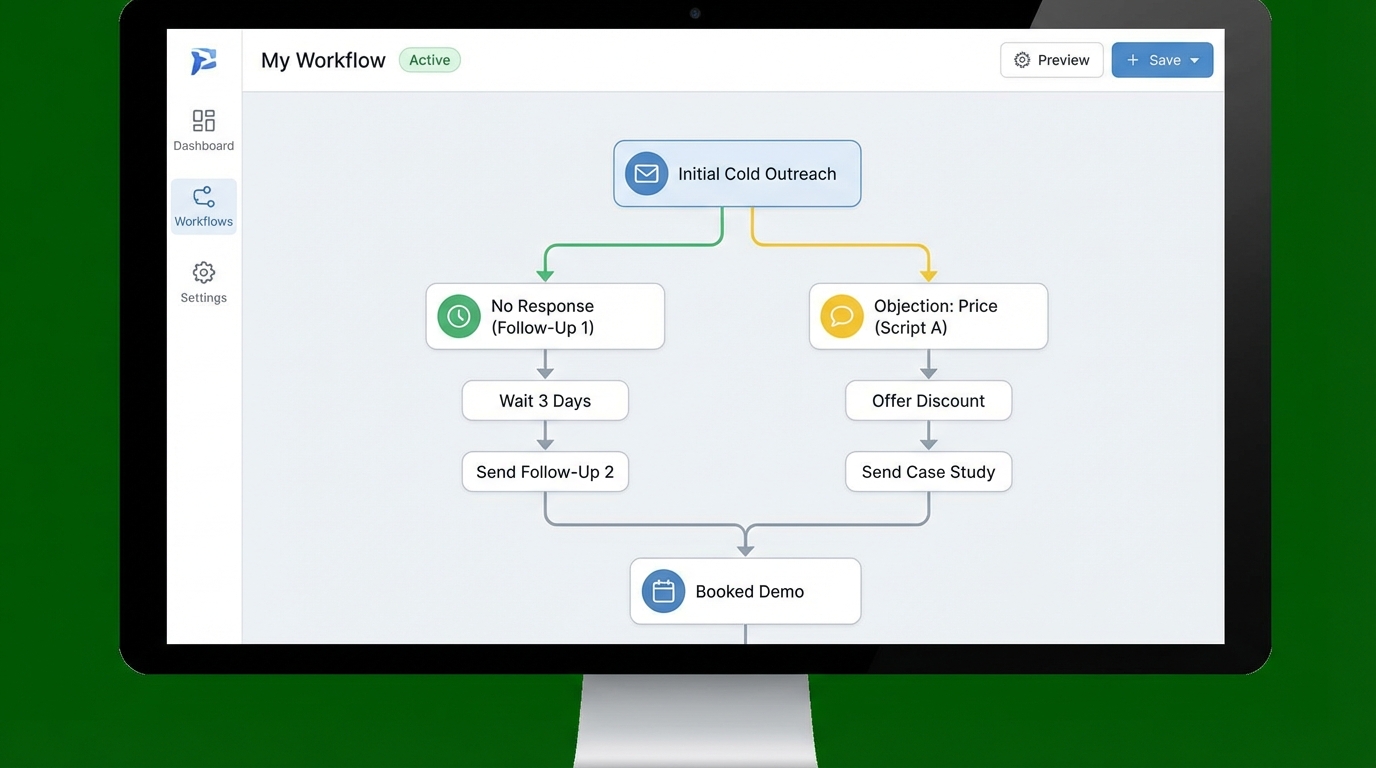
The first touch is easy. The real work,the pipeline generation,happens in the subsequent 6 to 8 touches. We leverage AI not just for drafting, but to strategically map out full sequences and preemptively handle every predictable roadblock.
Step #1: Generating the Full Sequence Blueprint
We never ask ChatGPT to write 10 individual emails. That’s inefficient. We ask it to design the sequence architecture.
This strategic approach guarantees maximum efficiency and ensures the sequence flows logically and maintains channel variety. (This is essential for effective Outbound Sequence Setup: The 2025 Strategic Blueprint.)
We demand structure from the AI. The output must be a blueprint, not just raw copy.
Prompt Framework: Full Multi-Channel Sequence
[USE ROLE/CONTEXT PROMPT FIRST]

Design a 7-touch, 14-day multi-channel sequence targeting a VP of Operations in the Fintech space. Output the sequence in a table format showing: Day, Channel, Goal, and Value Proposition Angle.

Ensure the sequence utilizes Email, LinkedIn (Connection and DM), and Phone. The core value proposition is cutting regulatory compliance risk via 98% data accuracy.
Strategic Sequence Example: The 14-Day Blueprint
| Day | Channel | Goal | Value Angle Focus |
|---|---|---|---|
| Day 1 | Email (Cold 1) | Get a reply/Interest indicator | The Cost of Poor Data (SDR Churn/Wasted Time) |
| Day 2 | LinkedIn (Connect) | Acceptance/Visibility | Industry Trend & Strategic Alignment (e.g., Q3 Regulatory Changes) |
| Day 4 | Phone (Call 1) | Live conversation or Voicemail drop | Efficiency & Time Savings (Reference Day 1 email) |
| Day 6 | Email (Cold 2) | Educate/Share Proof | Hard Data: 98% Accuracy vs. Competitor Bounce Rates (Compliance Focus) |
| Day 9 | LinkedIn (DM) | Book the meeting | Direct CTA: “30-minute compliance review” |
| Day 12 | Phone (Call 2) | Final attempt/Leave message referencing email 2 | Urgency (Compliance Deadlines/Audit Risk) |
| Day 14 | Email (Breakup) | Close the loop/Maintain goodwill | Respecting their priorities (“I’ll assume this isn’t a priority for Q4.”) |
Step #2: Handling Common B2B Objections
Every SDR team faces the same five objections, every day. This repetitive struggle kills efficiency and drains morale.
We use ChatGPT to generate a standardized, high-quality response matrix for our entire team. This ensures consistency and maximizes conversion rates.
The goal is not to eliminate the objection (that’s impossible). The goal is to provide a concise, strategic pivot that immediately redirects the conversation back to our unique value proposition.
Prompt Framework: Objection Response Generation
[USE ROLE/CONTEXT PROMPT FIRST]

I need a three-sentence response for the following objection: "We already use [Competitor X] and are happy."

The response must:
1. Acknowledge the current tool.
2. Pivot the conversation to the specific, measurable gap (high bounce rate/compliance risk) that [Competitor X] fails to address.
3. Ask one strategic follow-up question to re-engage the prospect.
Example Output (The Competitor Objection):
"That's understandable. [Competitor X] is great for general data volume, but VPs often tell us they struggle with its 30%+ bounce rate in highly regulated markets like Fintech. We specifically focus on data verification to ensure compliance and cut SDR wasted time by half. If you could cut your bounce rate to 2% tomorrow, what would that do for your Q1 pipeline targets?"Start Your Free Trial of Pyrsonalize Today
Step #2: The Critical Compliance Check (Why AI Needs Human Oversight)
![A stylized illustration showing a hand holding a magnifying glass over a computer screen displaying lines of code or script text, with the phrase "AI GENERATED SCRIPT: [COMPLIANCE REVIEW PENDING]" highlighted. In the background, there are icons representing legal compliance, including the scales of justice, a checklist with a checkmark, and speech bubbles labeled "GDPR" and "CCPA".](https://pyrsonalize.com/blog/wp-content/uploads/2025/12/article-section-image-210.jpg "Human Oversight: Reviewing AI-Generated Scripts for GDPR and CCPA Compliance")
AI is a drafting engine. It is not a compliance officer or a brand voice guardian.
We treat ChatGPT as a powerful co-pilot, not the pilot. The final step before deployment is always the human review. This process ensures the 80% draft generated by AI is polished into a 100% compliant, high-converting asset.
Our 5-Point Script Refinement Checklist
- Tone Verification: Does the script truly sound authoritative and strategic? Or did the AI revert to generic, low-converting language (“we are excited to help”)? We reject anything that sounds like canned outreach.
- Variable Insertion: Have you replaced all placeholders ([Company Name], [Recent Event], [Prospect Pain Point]) with accurate, verified data? Deploying a script with a visible
[Variable]placeholder is a critical failure that destroys trust. - Legal & Compliance Check (Non-Negotiable): Does the script include necessary opt-out language? Does the content comply with regional data privacy laws (GDPR, CCPA)? Failure here risks deliverability and major fines.
- Single CTA Enforcement: Does the script contain one, and only one, clear Call to Action? Ambiguous CTAs kill conversion rates. We demand clarity.
- Pain Specificity Check: Is the script personalizing the pain point, not just the person? We preach this constantly: focus the message on results, not flattery. Personalize Pain, Not People.
If the script fails any of these five checks, it goes immediately back to the drawing board. This is non-negotiable.
Remember this key principle: AI accelerates the drafting process. It frees your team to focus 100% on the strategic refinement,the critical step that drives actual bookings and revenue increase.
Frequently Asked Questions: Tactical Implementation
- How do I ensure ChatGPT’s scripts are compliant with GDPR?
-
We cannot stress this enough: AI is not a compliance officer. We use ChatGPT solely for drafting the persuasive core message. Compliance is non-negotiable and requires human oversight.
Your mandated policy must ensure every script includes pre-approved, legally verified clauses. This includes data source transparency and explicit opt-out mechanisms. Treat the AI output as 80% complete; the final 20% is the human compliance filter.
- Is using ChatGPT for cold calling scripts ethical?
-
Yes, using AI for foundational scripts is highly ethical,it is strategic. The risk lies in treating the script as a word-for-word, automated monologue. This is the failure point.
We leverage AI for consistency and to build robust objection handling frameworks. The SDR provides the critical human element: dynamic conversation, empathy, and timing. If you treat it as a high-efficiency framework, your team wins.
- What is the best way to train ChatGPT on my specific product?
-
We strictly use the Contextual-Prompting method. Never rely on ChatGPT’s general knowledge base; it is too slow and generic for B2B precision.
You must feed the AI precise, measurable data points *within the prompt structure* itself. For example:
- “Our software reduces setup time by 70% compared to [Competitor X].”
- “Our ICP is VPs of Marketing at $10M-$50M B2B firms who prioritize speed and measurable ROI.”
Draft a script focusing *only* on those specific metrics. Specificity drives conversion.
- How often should I refresh my AI-generated scripts?
-
We mandate a minimum quarterly review. However, performance dictates the true refresh rate. Market dynamics, competitor messaging, and regulatory requirements shift too fast for annual checks.
If your core KPIs (Reply Rate, Conversion Rate) drop below benchmark, refresh immediately. Continuous context feeding is mandatory to prevent script decay and maintain market relevance.
Ready to take the next step?
Stop wasting SDR time on bad data. Start finding personal client emails immediately.
Start Your Free Trial