

The real estate market is accelerating. Your traditional lead generation tactics,cold calling expired listings, running generic Facebook ads,are now baseline requirements.
They are not differentiators.
To scale past the $500k GCI ceiling, you need a system. Not just a tool. You need a complete, integrated AI workflow that finds, qualifies, and nurtures high-intent leads while you sleep.
This is not about replacing the human agent. It is about automating low-leverage tasks so your human expertise is applied only to high-leverage conversations.
We implemented targeted AI research systems across our own sales teams. The result was clear: A 30% reduction in Cost Per Qualified Lead (CPQL) and a massive increase in deal velocity.
You can achieve the same results.
This guide breaks down the definitive AI lead generation system for high-ticket sales professionals in 2025. It is strategic, actionable, and entirely focused on revenue.
Key Takeaways: The 2025 AI Mandate
- AI is not for content creation first: It is primarily a research and qualification engine designed to identify motivated sellers before they list.
- Segmentation is critical: Use predictive AI for high-value seller leads and generative AI for buyer lead magnets and nurturing.
- Focus on the 60-Minute Workflow: Integrate your AI research tool (like Pyrsonalize), CRM, and chatbot for seamless, non-manual lead handoff.
- Compliance is non-negotiable: Future-proof your operation by adhering strictly to Fair Housing and data privacy regulations.
The Strategic AI Lead Generation Framework
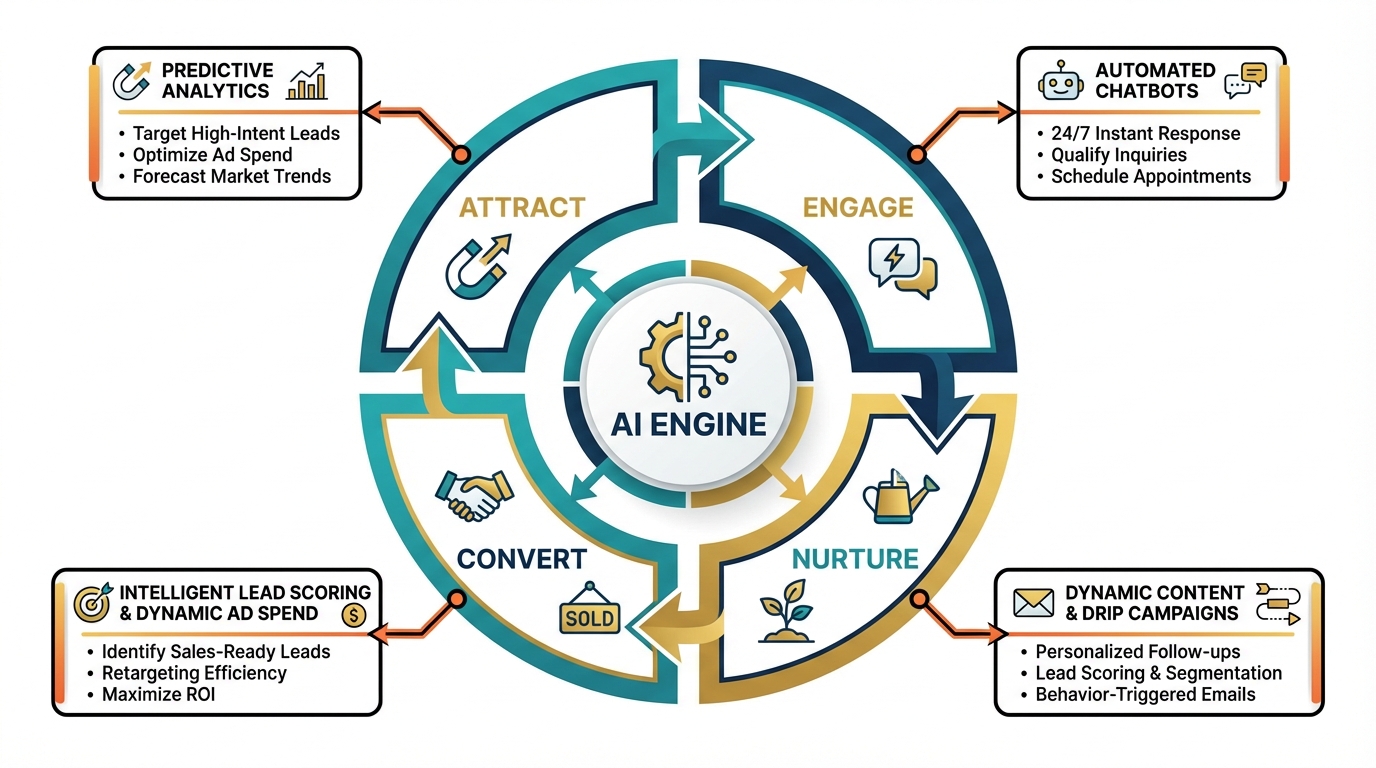
Most agents use AI backward. They start with content generation: generic blog posts or social media captions. We start with identification.
Your AI strategy must be segmented. Seller leads demand predictive intelligence and deep database reactivation. Buyer leads thrive on instant value delivery and automated nurturing systems.
1. AI for High-Value Seller Leads (Predictive Focus)
Seller leads are the highest leverage opportunity in real estate. Period.
AI unlocks these opportunities early. We are not waiting for the MLS listing to hit. We use proprietary data and predictive modeling to identify intent before the competition does.
Predictive Analytics for Listing Acquisition
Predictive AI tools analyze vast datasets: tax records, demographic shifts, permit applications, and behavioral signals (e.g., specific website traffic, loan inquiry changes).
The strategic goal is simple: Assign a “Propensity to Sell” score to every homeowner in your farm area.
Actionable Steps:
- Identify Micro-Markets: Use proprietary tools to analyze zip codes showing high turnover or demographic shifts (e.g., aging populations, high corporate relocation rates). Find where the money is moving.
- Score the Database: Feed your existing CRM contacts into a predictive engine. It flags which past clients or cold contacts are statistically most likely to list in the next 6-12 months. This is non-negotiable data.
- Hyper-Targeted Outreach: Use the AI-generated insight (e.g., “Owner has lived in the home 12+ years and recently searched for local retirement communities”) to craft a high-conversion, non-generic message. Stop relying on mass mailers.
This approach moves you from mass marketing to precise, surgical outreach. This is how we reduce wasted spend by 40%.
Database Reactivation and Engagement
You have thousands of dormant assets sitting in your CRM. AI makes them warm again instantly.
A simple, targeted sequence can revive 5–10% of that database. That’s pure profit.
The Reactivation Blueprint:
- AI Sentiment Analysis: Run old email threads through a large language model (LLM) to summarize the last known interaction and sentiment. This bypasses hours of manual review.
- Automated Value Drop: Deploy an automated email sequence offering an AI-generated, hyper-local market update (e.g., “What the new school bond means for your specific property value in Sector 7”).
- Intent Triggering: Set up click triggers. If a contact clicks the market report link, they immediately receive a personalized SMS from an AI chatbot asking if the data was useful. This is instant, high-speed qualification.
We use AI to quickly personalize the reason for contact,not just the name. This increases our response rates dramatically. For a detailed strategy on deployment, review our guide on Outbound Sequence Setup: The 2025 Strategic Blueprint.
2. AI for Scalable Buyer Leads (Generative Focus)
Buyer leads need speed, volume, and instant gratification. Generative AI excels at this specific requirement.
Rapid Content Generation and Lead Magnets
Generative AI eliminates the creative bottleneck. Tools allow you to create high-value, hyper-specific assets in minutes.
High-Converting Assets:
- Relocation Guides: Generate 10-page, comprehensive PDFs titled, “The 2025 Guide to Moving to [City]: Schools, Commutes, and Hidden Neighborhood Costs.”
- First-Time Buyer Checklists: Create detailed, actionable checklists that address common anxieties and pre-approval steps.
- Hyper-Local Video Scripts: Use AI to analyze current interest rates and local inventory data. Output short, 60-second video scripts optimized for TikTok/Reels that address market fears directly.
These assets serve as powerful lead magnets. They capture contact information immediately and qualify intent based on the downloaded material.
Next-Gen AI Chatbots for Instant Engagement
Speed kills competition. The modern consumer expects a response in seconds. If you wait 10 minutes, the lead is gone.
AI chatbots handle the initial 80% of the conversation volume. They are not just FAQ machines; they are dedicated qualification engines.
“Conversational Lead Generation employs human-like chat (rather than forms) to gather information and assess leads, boosting your collection rate by as much as 5 times.”
The Chatbot Qualification Workflow:
- The bot asks key qualifying questions: timeframe, budget range, pre-approval status.
- It assigns a dynamic lead score based on these inputs.
- When the lead hits a pre-defined threshold (e.g., “Ready to view homes in 30 days and pre-approved”), the human agent receives an immediate notification.
- The notification includes a full conversation transcript.
The human agent engages only when conversion is imminent. This is how you achieve true leverage: The AI does the heavy lifting; you close the deal.
The Essential AI Toolkit: ROI Comparison
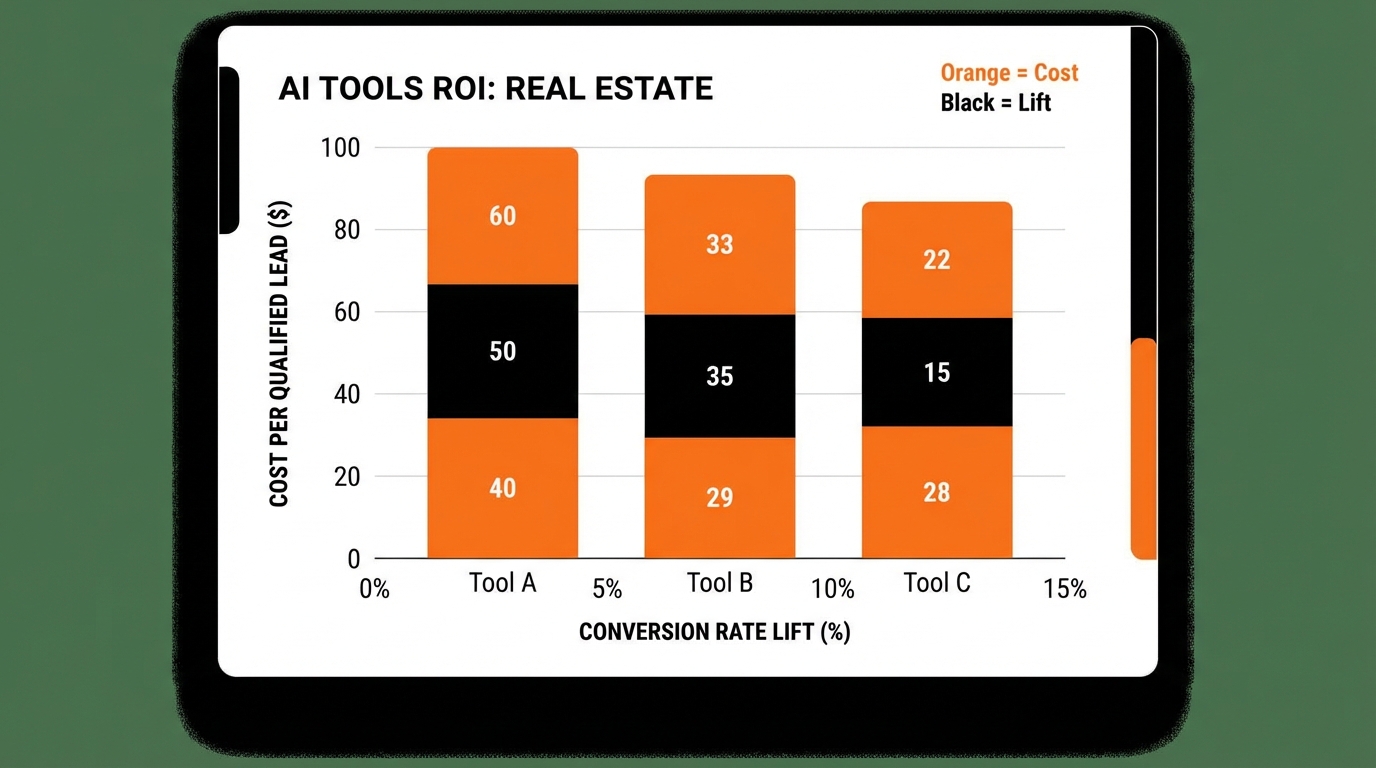
Do not invest in tools based on hype. Invest based on measurable ROI: specifically, reduction in Cost Per Lead (CPL) and Cost Per Qualified Lead (CPQL).
Here is a strategic breakdown of the tools that deliver tangible results in 2025.
| Tool Category | Key Function | Primary Tool Examples | Est. CPL Reduction (Targeted Use) |
|---|---|---|---|
| Predictive Analytics | Identifies homeowners with high propensity to sell before listing. | Smartzip, Catalyze AI, Offrs | 35% – 50% (Focuses budget on high-intent targets) |
| Conversational AI/Chatbot | 24/7 lead qualification, instant response, nurturing via SMS/Web. | Roof AI, CINC (Alex), Gupshup | 20% – 30% (Reduces abandoned leads due to slow response) |
| Content Generation/Design | Rapid creation of lead magnets, social media copy, and ad creatives. | ChatGPT, Claude, Gamma.app, Canva Magic Studio | 10% – 15% (Increases ad CTR with better creative) |
| CRM Integration & Nurture | Automated follow-up sequences, email personalization, task management. | Top Producer, Lone Wolf (Relationships), Follow Up Boss | N/A (Focus is on CPQL reduction through better conversion) |
The 60-Minute AI Workflow: Integration is Key
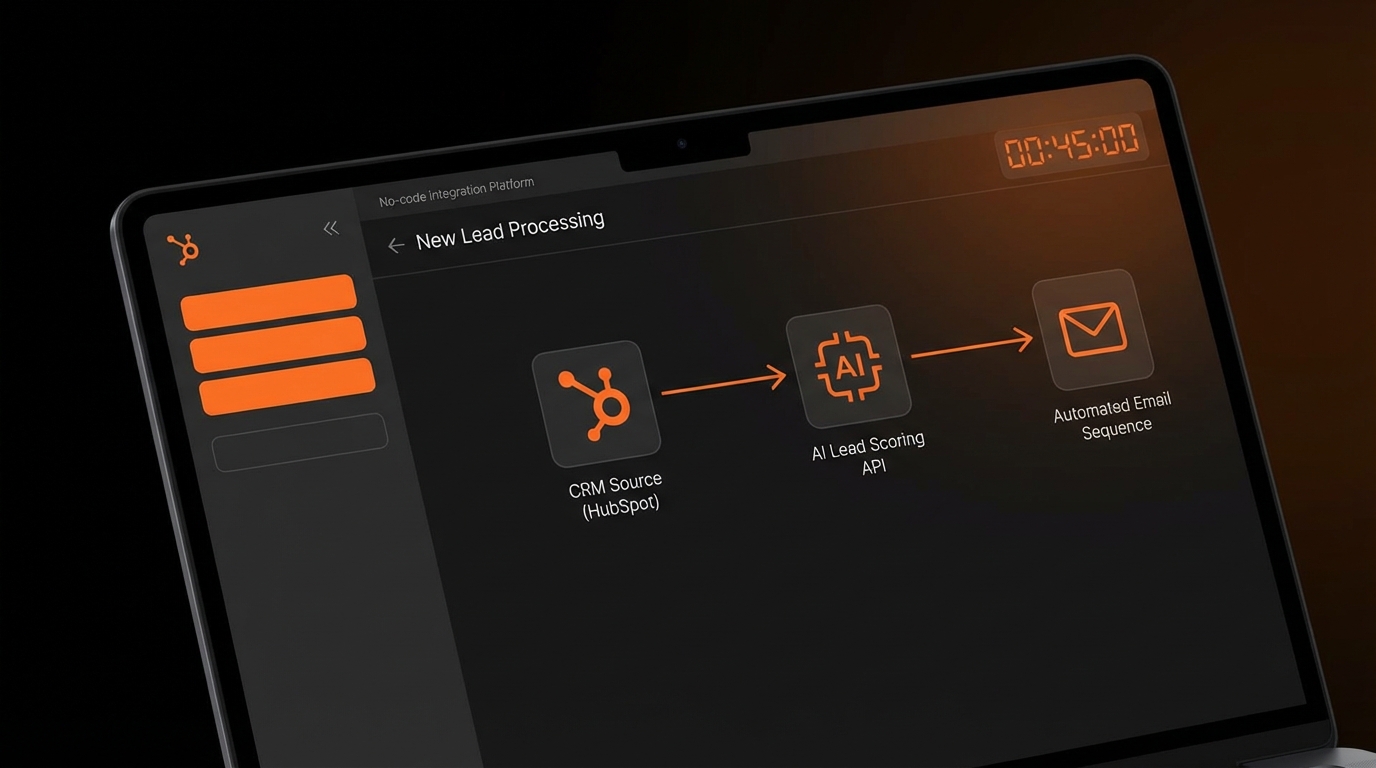
Tools are useless in isolation. Your competitive advantage is derived solely from linked, efficient systems.
We designed this 60-minute workflow to show real estate professionals how to process high-intent seller leads,with absolute efficiency,in one focused hour daily.
Step #1: Data Ingestion (0 – 15 Minutes)
Start with the source of truth: your predictive analytics tool (e.g., Smartzip). This step ensures you are pursuing the right people with validated contact details.
- Review the Daily Hot List: Log in and identify the top 5-10 homeowners in your target area whose “Propensity to Sell” score increased overnight. Focus on velocity, not volume.
- Cross-Reference CRM: Ensure these high-score targets are tagged correctly in your CRM (Tag:
AI_Hot_Seller). This prevents pipeline leakage. - Enrichment Check: Use an AI research tool (like Pyrsonalize) to verify the owner’s *personal* contact information: accurate email and mobile number. This bypasses outdated public records entirely, guaranteeing deliverability for immediate outreach.
Step #2: Personalized Outreach Draft (15 – 35 Minutes)
Stop writing generic emails. Leverage AI to generate hyper-personalized drafts based *only* on validated lead insights.
- Prompt the AI: Input the predictive insight (e.g., “15-year ownership, recent zoning change in the area, property is 20% undervalued based on local comps”). Be specific.
- Generate the Hook: Ask the AI to generate three subject lines and three opening paragraphs. Focus the language strictly on the specific pain point (e.g., “Your property value jump post-rezoning”).
- Review and Refine: Select the most authoritative draft. Use the AI output as a strategic starting point,never the final word. Keep the tone brief and expert-level.
This process cuts 90% of the manual writing time while maintaining elite personalization quality. It sets the stage for immediate, trust-based outbound sequencing.
Step #3: Automated Nurture Deployment (35 – 45 Minutes)
Enroll the high-intent targets identified in Step #1 into a short, focused sequence immediately.
- Initial Contact: Deploy the personalized email/SMS drafted in Step #2.
- Sequence Setup: Enroll the lead in a concise 7-day outbound sequence. This must include two soft follow-up emails and one personalized voicemail drop (if using advanced systems like Salesloft or Outreach).
- Activity Monitoring (The Critical Step): Set up real-time alerts. If the lead hits a trigger (e.g., opens the email three times in one hour, clicks a link), the sequence must stop immediately. High engagement signals readiness for human intervention.
Step #4: Lead Handoff and Qualification (45 – 60 Minutes)
The AI handled the heavy lifting,data validation, personalization, and intent signaling. The human agent now steps in to close.
- Chatbot Review: Review the daily summary report from your dedicated AI chatbot (for inbound buyer leads). Focus only on conversations where the lead qualification score exceeded your threshold (e.g., 8/10).
- First Human Touch: Call the highest-scoring leads immediately. Your opening line must be informed by the AI transcript: “I see you downloaded our Relocation Guide and mentioned a budget of $750k. Is that still accurate?”
- Qualification Protocol: Use a structured framework,we recommend BANT (Budget, Authority, Need, Timeline). AI provides the initial data; the human agent verifies motivation, emotional readiness, and timeline accuracy. For a deeper understanding of this strategic qualification process, read our guide on BANT implementation.
Step #2: Qualification Mastery (Moving Beyond the Form Fill)
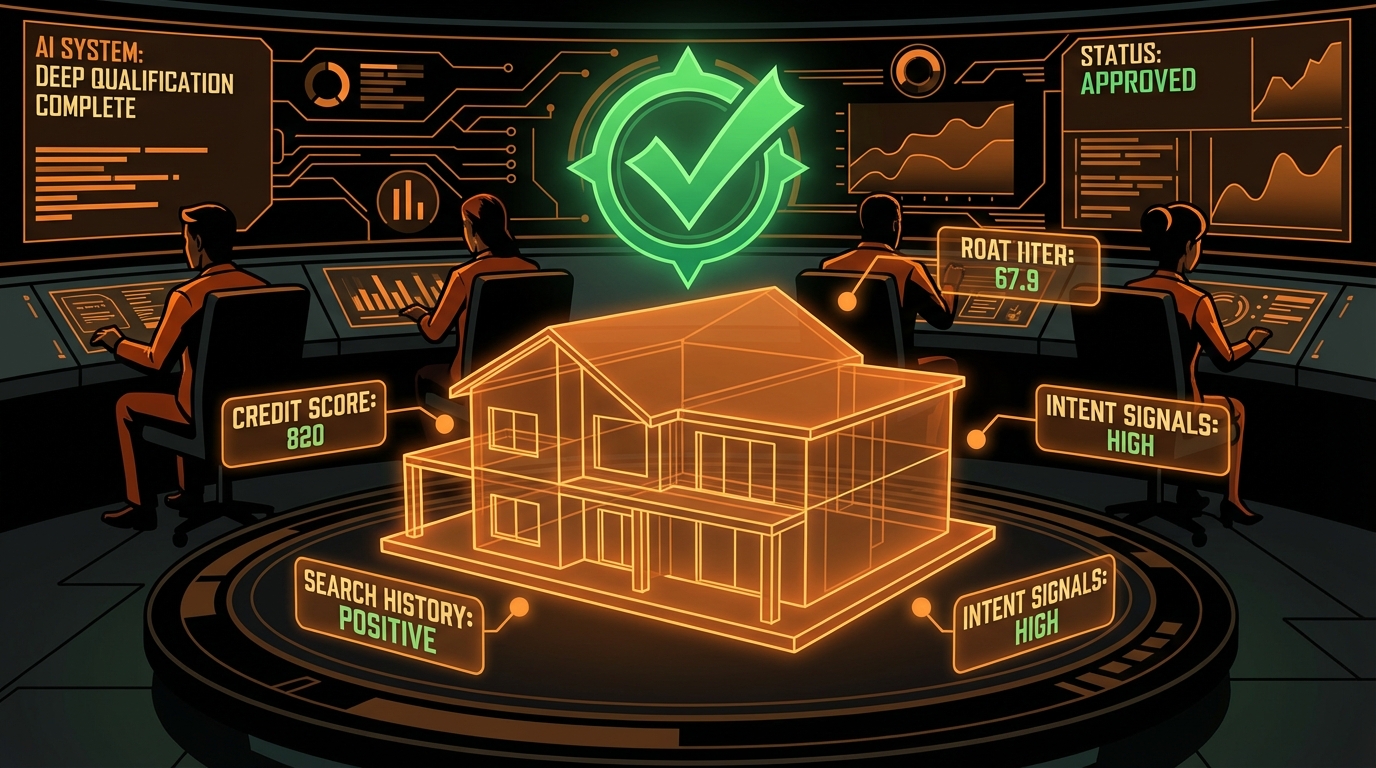
AI delivers volume. But volume without quality is just noise,a liability, not an asset.
Mastering qualification means leveraging AI for scoring (speed) and human agents for empathy (conversion).
The Predictive Scoring Model
Your CRM’s native scoring is too basic for high-ticket sales. We bypass it.
We integrate behavioral and predictive data to create a true intent profile. This is how we prioritize follow-up time.
Three Critical Scoring Metrics We Prioritize:
- Behavioral Velocity: Did the lead view the same listing category five times in one week? Did they open three emails in 24 hours? High velocity equals high intent.
- Intent Keywords: Review chatbot transcripts and search logs. Did the conversation include terms like “pre-approved,” “closing timeline,” or “urgent relocation”? These are immediate buying signals.
- Predictive Overlap: Does the lead’s address overlap with our high-propensity-to-sell data models? (This is crucial for targeted seller outreach.)
The AI system aggregates these inputs instantly. The resulting score dictates the urgency of your human follow-up. Rule of thumb: Anything scoring above 7/10 must trigger an immediate call,within five minutes.
Metrics That Drive Revenue (Not Vanity)
Stop tracking vanity metrics like total leads captured. That metric is meaningless.
We focus strictly on conversion ratios and Cost Per Qualified Lead (CPQL). These metrics tie directly to scalability.
Critical KPIs for High-Ticket AI Lead Generation:
- Lead-to-Appointment Rate (LTA): The percentage of raw leads that successfully book an initial consultation. This measures the efficacy of your AI nurturing sequence.
- Cost Per Qualified Lead (CPQL): Total marketing spend divided by the number of leads hitting your 7/10 qualification score. This measures true system efficiency.
- Time to Conversion (TTC): The number of days from initial capture to contract signing. AI’s primary job is to drastically reduce this cycle time.
These metrics tie directly to your bottom line. They allow us to scale based on predictable outcomes, not hope. Understanding these high-ticket metrics is essential for predictable revenue growth. Review our blueprint on SDR Agent KPIs: Blueprint for High-Ticket Lead Quality.
Step #3: Future-Proofing and Ethics (The Liability Check)

AI adoption is accelerating. So is regulatory risk.
High-ticket sales professionals must operate ethically. Legal compliance is not optional; it is the baseline for scalability.
Regulatory Compliance: Protecting Your Scale
AI is powerful. It is also a massive liability if unchecked.
Non-compliance is not just expensive,it is catastrophic to your brand equity. We enforce mandatory compliance checks on all lead generation systems:
- Fair Housing Act (FHA): AI learns from historical data. This means algorithms naturally perpetuate bias (redlining, discriminatory targeting). You must audit your predictive models and ad targeting criteria constantly. Ensure zero exclusion of protected classes based on geography, ethnicity, or familial status.
- Data Privacy (CCPA/GDPR): If your AI tool scrapes public data,which our software does to find personal emails,you carry the risk. Ensure the system provides clear opt-out mechanisms. Adherence to local privacy laws regarding personal contact information is mandatory.
- TCPA (Telemarketing): Automated SMS or voice outreach requires strict, verifiable consent. AI chatbots must clearly identify themselves and offer opt-out options immediately upon initial engagement.
Do not rely on your tool vendor for liability coverage. Your brokerage,and your license,carries the full risk.
The Immediate Future: Hyper-Specificity and Capacity Multiplication
The next frontier of AI is not just speed; it is hyper-specificity. Preparation starts today.
What to Prepare For:
- Hyper-Local Market Intelligence: AI will move past zip codes. It will generate reports for specific neighborhood blocks, detailing recent sales, school ratings, and micro-economic forecasts in real-time. Instant, deep expertise is the new standard for listing presentations.
- Generative Listing Creation: Agents input raw property data. AI instantly generates fully optimized listing descriptions, virtual staging images (aligned with current design trends), and all required social media assets simultaneously.
- AI Agent Assistants (Capacity Multipliers): These assistants move beyond simple qualification. They will manage scheduling, draft CMA requests, and handle preliminary disclosure questions. They become a true extension of the human agent, multiplying individual capacity by 5x.
The role of the high-level agent is shifting entirely: from information gatekeeper to strategic advisor and emotional anchor. AI handles the information complexity; you handle the transaction complexity and trust.
Ready to take the next step?
Try AI Lead Generation Today
Click HereFrequently Asked Questions

Is AI going to replace real estate agents?
No. AI replaces the repetitive tasks that burn out agents: manual prospecting, initial qualification, and content drafting. It multiplies the efficiency of the human agent. AI handles data and logistics; the agent handles negotiation, complex problem-solving, and the emotional aspects of a major transaction. The agents who refuse to adopt AI will be replaced by agents who use it.
What is the most effective AI tool for finding motivated sellers?
The most effective tools are those focused on predictive analytics (like Smartzip or Offrs). These systems analyze non-traditional data points to assign a “propensity to sell” score. This allows you to target homeowners who have not yet signaled intent publicly, giving you a massive advantage over agents relying on expired listings or FSBO data.
How do I ensure my AI chatbot sounds natural and not robotic?
Modern chatbots are trained on vast real estate dialogue datasets. To ensure a natural tone, you must provide detailed context during the setup phase: define your specific local market jargon, provide successful qualification scripts, and instruct the AI to maintain a specific, empathetic persona (e.g., “Act as a friendly, confident, and knowledgeable local expert”). Continuous monitoring and human feedback loops are also essential for refinement.
References
- Anyone Using AI for lead gen in real estate? : r/RealEstateTechnology
- How Realtors Are Using A.I. to Get Daily Inbound Leads – YouTube
- 5 AI-Powered Ways to Generate Real Estate Leads in 2025
- The Best 9 Real Estate AI Tools for 2025 – The Close
- AI Tools for Real Estate Lead Qualification: Guide – Dialzara