

Most organizations get this wrong.
They treat the Sales Development Representative (SDR) and Business Development Representative (BDR) titles as completely interchangeable.
We see the confusion everywhere: job descriptions are mixed, responsibilities overlap, and the results are predictable: wasted Account Executive (AE) time and pipeline bottlenecks.
In 2025, if you are serious about scalable, non-automated lead generation, you must enforce a strict delineation.
This is not about semantics.
It is about defining two fundamentally different revenue generation strategies.
This distinction dictates everything: reporting structure, core metrics, and ultimate career trajectory.
You are about to learn the strategic framework we use to maximize output from both roles. We focus on results: high-quality appointments and measurable revenue impact.
Key Takeaways: The BDR/SDR Strategic Delineation
- SDR Focus: Inbound Lead Qualification. They react to marketing intent (form fills, content downloads) and qualify warm leads. Speed and efficiency are paramount.
- BDR Focus: Outbound Prospecting. They proactively hunt for accounts that fit the Ideal Customer Profile (ICP) where no prior relationship exists. They need persistence and creative messaging.
- Reporting Structure: SDRs often report to Marketing (focused on lead volume and velocity). BDRs report to Sales (focused on target account penetration and pipeline value).
- Skillset: SDRs need strong qualification frameworks (e.g., BANT/MEDDIC). BDRs require deep research skills and personalized, manual outreach expertise.
Step #1: Defining the Core Function: Inbound vs. Outbound
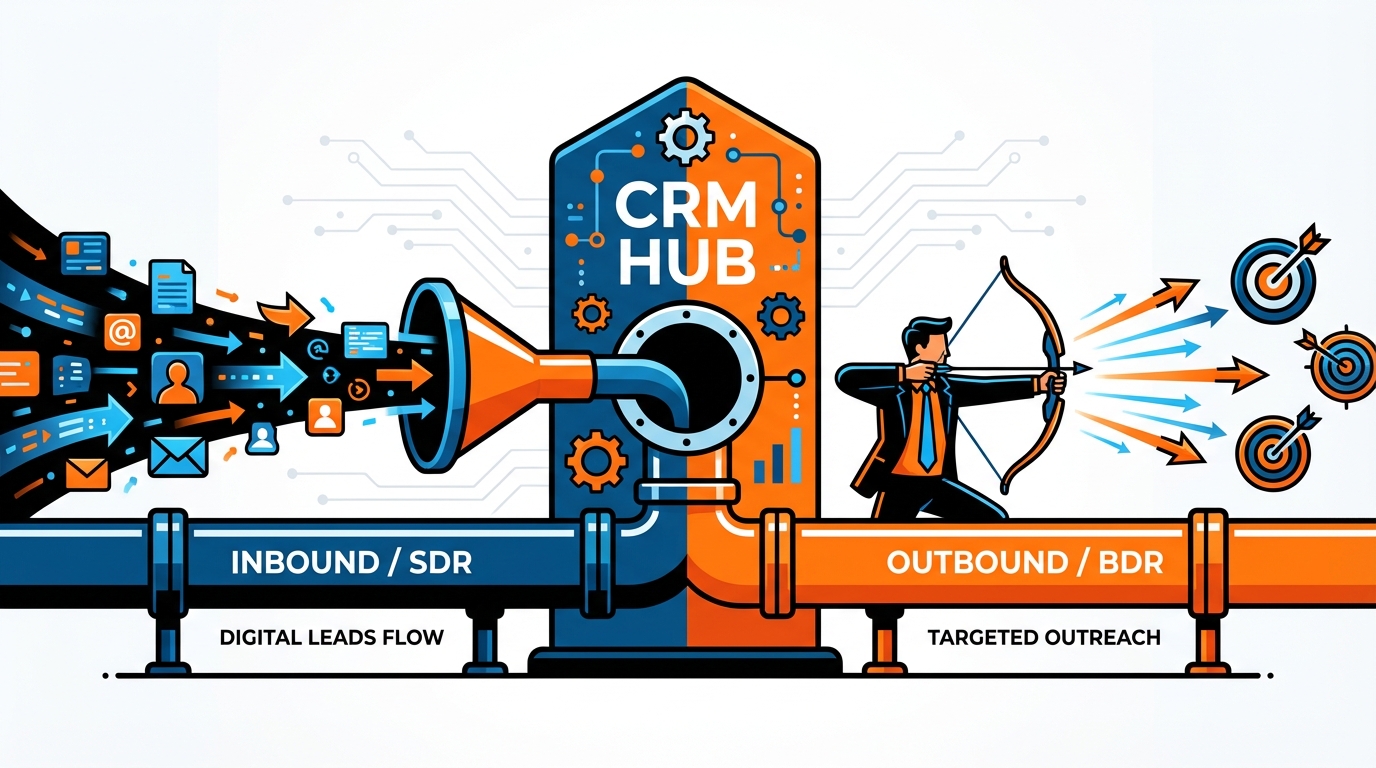
Stop using vague titles. The only strategic differentiator between BDRs and SDRs is the lead source.
If you miss this distinction, your pipeline will leak. We define the roles strictly by one metric: Inbound vs. Outbound.
The Sales Development Representative (SDR): The Qualifier
The SDR is your frontline defense. Their purpose is qualification, not hunting.
They take the volume of warm traffic generated by marketing (Marketing Qualified Leads, or MQLs) and triage it ruthlessly. Their primary mission: Prevent your high-value Account Executives (AEs) from wasting time on unqualified leads.
They are rapid responders and rigorous gatekeepers.
SDR Responsibilities:
- Inbound Response: Reacting immediately to MQLs,website forms, sign-ups, and content downloads. Speed dictates conversion here.
- Rigorous Qualification: Applying frameworks (like BANT or MEDDIC) to assess genuine fit, budget, and intent.
- Hand-off/Appointment Setting: Scheduling the initial discovery call or demo for the AE.
- Warm Nurturing: Maintaining engagement with prospects who expressed interest but lack immediate readiness (intent signals are present).
If the prospect raised their hand first, it is an SDR job.
The Business Development Representative (BDR): The Hunter
The BDR is the strategic hunter. Full stop.
They generate net-new opportunities where zero intent previously existed. This demands deep strategic research, extreme resilience, and the ability to craft personalized outreach that cuts through noise (i.e., anti-generic messaging).
This is pure cold effort. It is significantly harder,and often more lucrative,work than managing warm inbound flow.
BDR Responsibilities:
- Target Account Mapping: Identifying and researching companies that perfectly fit the Ideal Customer Profile (ICP). This is strategic, manual work.
- Data Acquisition: Utilizing AI lead generation software to find verified personal emails and direct contact details. This requires a strategic sales tech stack solution.
- Outbound Prospecting: Initiating contact via highly personalized cold emails, strategic cold calls, and targeted LinkedIn messaging. They create the conversation from scratch.
- Opportunity Creation: Booking the initial meeting based purely on proactive, expert-level outreach.
- Market Expansion: Focusing specifically on new verticals, geographies, or strategic accounts the company must penetrate.
If the BDR reached out first, it is a BDR job.
Step #2: Strategic Reporting and Alignment
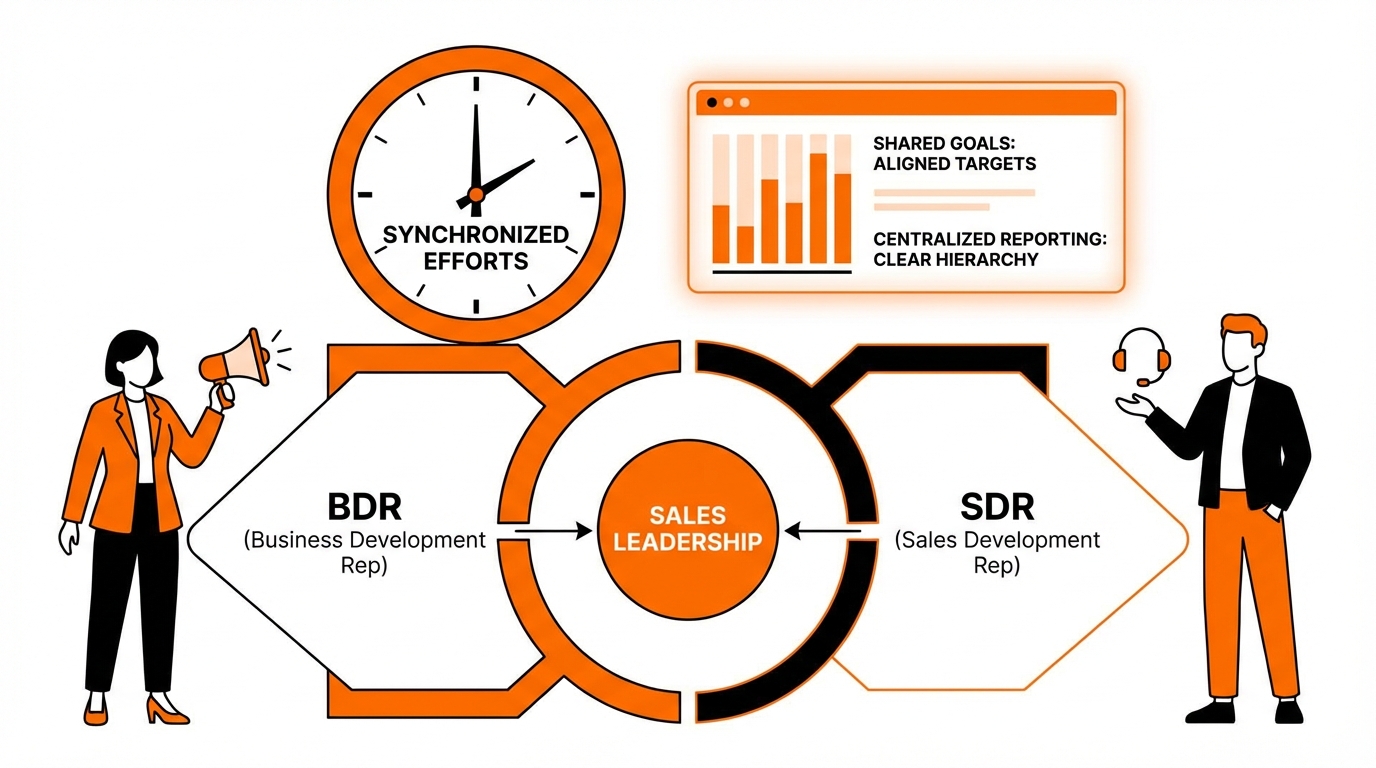
Organizational structure dictates success,or failure.
If you place these roles incorrectly, you kill accountability and pipeline flow. Misalignment guarantees confusion and poor results.
SDRs Must Report to Marketing
The SDR function optimizes Marketing’s direct output. This alignment is non-negotiable for maximizing inbound ROI.
Marketing owns MQL volume and quality. Therefore, the SDR’s single goal is maximizing the conversion rate from MQL (Marketing Qualified Lead) to SQL (Sales Qualified Lead).
This structure forces rapid, critical feedback loops:
- If SDRs reject MQLs quickly, Marketing immediately knows their targeting is flawed or their content is attracting the wrong profile.
- If MQL volume dips, SDRs are the first to raise the alarm about campaign performance.
This alignment ensures maximum flow and efficiency across the top of the funnel.
BDRs Must Report to Sales
BDRs are hunters. Their mandate is pipeline health within specific, named accounts.
Their focus is never volume; it is strategic penetration and revenue generation.
For this reason, BDRs must integrate fully with the Account Executives (AEs) they support. The AE owns the target list; the BDR is the dedicated resource assigned to break into those accounts.
We tested this alignment internally. Aligning BDRs directly with specific AE territories increased our conversion rates by 18%. This shared ownership model drives greater accountability and deeper market knowledge, directly impacting revenue.
BDR performance is measured against opportunity creation,a metric strictly owned by Sales.
Step #3: Performance Metrics, KPIs, and Compensation
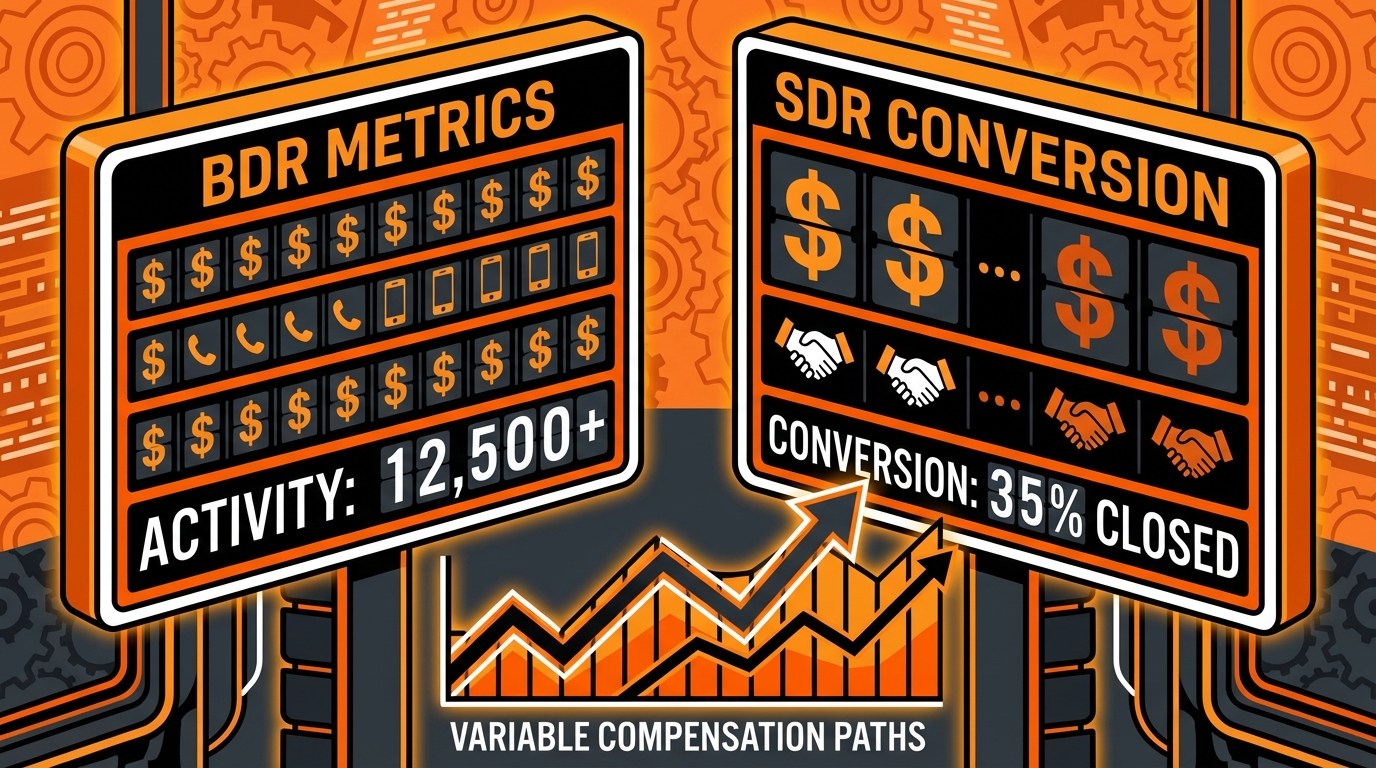
If alignment (Step #2) is the engine, metrics are the fuel gauge.
You cannot measure a hunter (BDR) and a qualifier (SDR) using the same yardstick. This mistake kills morale and guarantees poor pipeline performance.
Their compensation structures must directly mirror their operational goals: volume versus value.
SDR KPIs: Focused on Speed and Volume
SDRs are your rapid-response unit. Their compensation must be tied directly to high-volume outputs and immediate speed metrics.
We optimize our inbound pipeline by prioritizing velocity above all else (since inbound leads decay rapidly).
- Response Time (The Critical Metric): The time taken to contact an MQL. This MUST be under five minutes for competitive advantage.
- MQL-to-SQL Conversion Rate: The percentage of inbound leads they successfully qualify and route to an Account Executive (AE).
- Appointments Set: The raw number of qualified meetings booked.
- Activity Volume: Calls made, emails sent, and connection attempts. (While quality is non-negotiable, high volume ensures adequate coverage of the inbound flow.)
Want to structure your inbound team for predictable revenue? Review our guide on SDR Agent KPIs: The 2025 Blueprint for Predictable Revenue.
BDR KPIs: Focused on Quality and Pipeline Value
BDRs operate in a strategic vacuum; they are building something from nothing. Therefore, their success hinges entirely on quality over quantity.
BDR compensation must heavily incentivize high-value appointments that actually progress,moving past the discovery call and into the sales cycle (opportunity creation).
- Pipeline Value Generated: The dollar value of the opportunities they source. This is the primary metric for BDR success.
- Target Account Penetration: Percentage of named accounts contacted or engaged successfully. (Proof that they are executing the strategic account plan, not just spraying and praying.)
- SQL-to-Opportunity Conversion Rate: How many of their booked meetings actually progress into a qualified pipeline stage (Stage 2 or 3).
- Customization Rate: Tracking the level of personalization in outreach. (This enforces our manual, trust-based lead generation philosophy, preventing mass-blasting and low-quality interactions.)
Step #4: The Skill Gap: What Each Role Demands
If metrics (Step #3) define success, hiring defines potential.
Putting the wrong personality in the wrong seat guarantees failure,and pipeline stagnation. We know this from experience: Hiring the wrong fit destroys team morale faster than any market downturn.
The required skill sets are not overlapping; they are distinct operational mandates.
SDR Success Traits: The Efficient Qualifier
SDRs operate in high-speed environments. They require operational precision and emotional stability.
- Volume Velocity: The capacity to rapidly process and triage high-volume inbound leads. Speed is the primary currency here.
- Operational Efficiency: Not just using the CRM, but mastering it. They must minimize manual friction points to maximize qualification time.
- Surgical Qualification: Active listening focused entirely on identifying critical pain points and swiftly running the lead through your established qualification framework (BANT, MEDDIC, etc.).
- Nurturing Touch: Since these prospects are often warm, the SDR needs high emotional intelligence (EQ) to guide, not push, them toward the meeting.
BDR Success Traits: The Strategic Hunter
BDRs are outbound warriors. They require grit, intellectual curiosity, and extreme creative capability.
- Deep Research Proficiency: They must execute deep dives into trigger events, company news, and executive pain points. Generic outreach is dead; personalization is non-negotiable.
- Extreme Resilience: This role is defined by constant cold rejection. BDRs must be intrinsically motivated,they must thrive on the ‘no’ that leads to the eventual ‘yes.’
- Creative Warfare: The ability to craft compelling cold email subject lines and value propositions that immediately cut through the noise. (This is where leveraging AI tools for personalized messaging becomes critical.)
- Strategic Alignment: Understanding the Account Executive’s larger account strategy. Their outreach must be targeted, aligning specific high-value accounts with long-term revenue goals.
Step #5: Comparing Operational Differences (BDR vs. SDR Table)
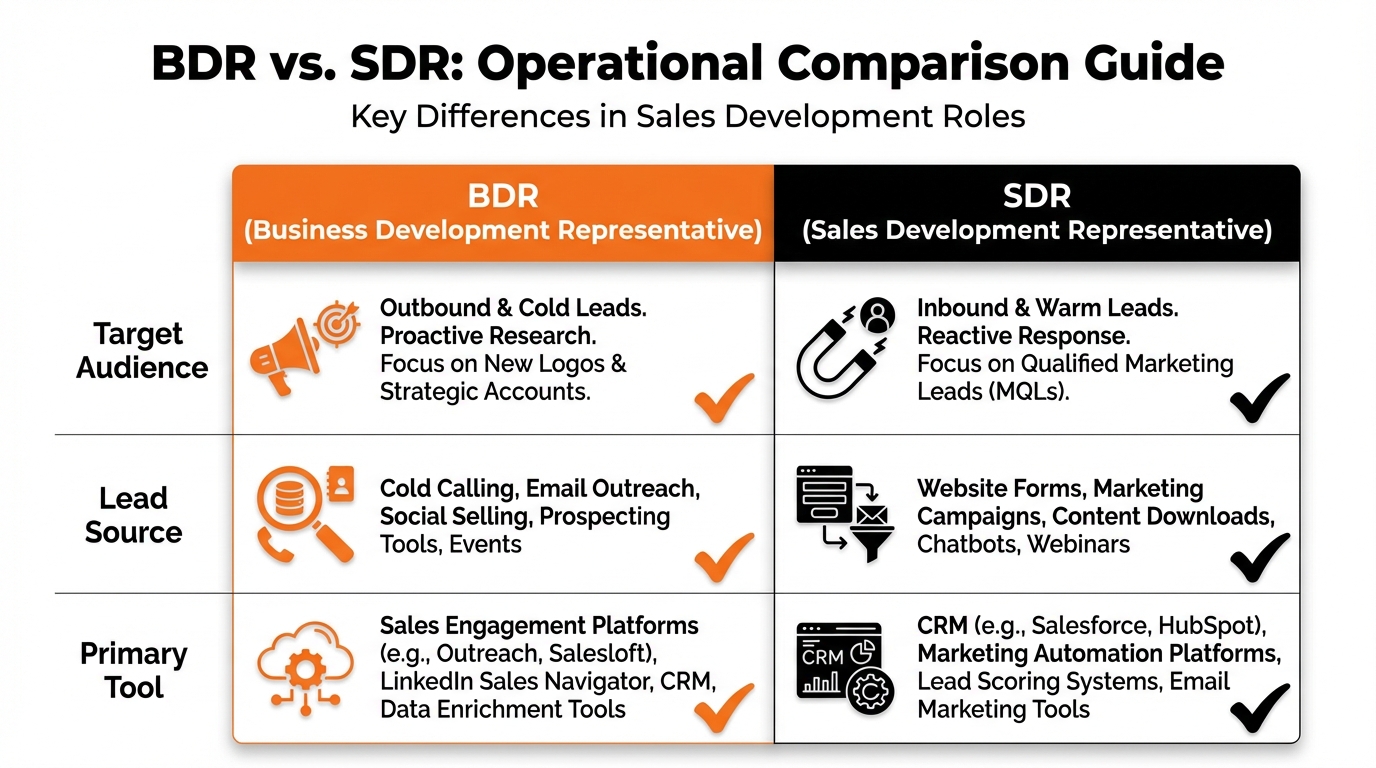
We have established the critical skill differences (Step #4). Now, we translate those traits into operational mandates.
This table is your internal blueprint: use it to define roles, allocate resources, and deploy talent strategically. Misalignment here guarantees wasted budget and stalled pipeline growth.
| Feature | Sales Development Representative (SDR) | Business Development Representative (BDR) |
|---|---|---|
| Primary Lead Source | Inbound (Marketing Qualified Leads, Website Forms, Content Downloads) | Outbound (Cold Prospecting, Strategic Account Mapping, Targeted Outreach) |
| Prospect Awareness Level | Warm (They know the company, actively showed interest, qualification is key) | Cold (Unaware of the company; requires intense trust-building and education) |
| Reporting Structure | Marketing or Sales Development Manager (Focusing on volume and efficiency metrics) | Sales (Often aligned directly with Account Executives and pipeline value) |
| Primary KPI Focus | MQL to SQL Conversion Rate, Response Time, Call/Email Volume, Speed | Pipeline Value Created, Target Account Coverage (Penetration), SQL Quality, Deal Size |
| Required Skill Focus | Efficiency, High-Volume Qualification, Process Adherence, Speed | Deep Research, Persistence, Hyper-Personalized Messaging, Strategic Account Planning |
| Typical Career Path Next Step | Account Manager (AM), Inbound Account Executive, or Sales Operations | Account Executive (AE), Senior BDR, or Strategic Sales Consultant |
Step #6: The Career Trajectory: Why the Distinction Matters for Growth

These roles are the sales entry point. But the track you choose now defines your Account Executive (AE) future,or lack thereof.
The BDR (Outbound Hunter) role is the direct, proven pipeline to the high-ticket Account Executive position. This is non-negotiable for scaling teams.
Why is the BDR track the fast lane?
- AEs Are Pure Hunters: The core AE mandate is pipeline generation. BDRs already master the hardest skill required: generating opportunities from a cold start.
- Resilience is Forged: Outbound work builds the mental fortitude necessary to navigate multi-month sales cycles and constant rejection. This is mandatory for closing high-ticket deals.
The SDR path is crucial for efficiency, but it typically funnels talent toward Account Management (AM) or specialized Inbound AE positions.
If your goal is closing complex, high-ticket deals and managing a large book of business, you must prioritize and master BDR-level outbound skills. Inbound qualification is a necessary tactical skill, but it does not prepare anyone for the AE hunting quota.
The Hybrid Model Trap (Warning)
Small startups often combine BDR and SDR into a “Hybrid” role. This is a necessary evil when capital is scarce.
But we advise immediate specialization once you cross $3M ARR. Delaying this decision guarantees pipeline stagnation.
- Hybrid reps always prioritize the path of least resistance: the warmer, easier inbound leads.
- Outbound prospecting (true BDR work) requires dedicated, uninterrupted time blocks.
- When one rep manages both, your crucial, high-value outbound pipeline dies first.
If you absolutely must operate in a hybrid model (and we strongly advise against it), enforce strict time allocation:
- 8:00 AM – 11:00 AM: Dedicated Outbound (BDR work).
- 11:00 AM – 5:00 PM: Inbound Response and Qualification (SDR work).
Protect that morning hunting block fiercely. It is the lifeline of your future pipeline.
Frequently Asked Questions
Is BDR higher than SDR in the sales hierarchy?
Hierarchy is irrelevant; strategy is everything. The BDR role is strategically superior for aspiring closers. Why? Outbound hunting requires genuine initiative, deep research, and high resilience,skills mandatory for the Account Executive (AE) role. SDR work, handling warm inbound leads, does not build this core muscle. If your goal is to close high-ticket deals, choose the BDR track.
Do SDRs or BDRs earn more money?
BDRs generally earn more money overall. Their compensation is heavily skewed toward pipeline quality and the value of the deals sourced. SDRs are compensated for volume and speed (appointments set). Because outbound hunting is strategically difficult, BDRs possess higher overall earning potential, especially in high-ticket SaaS and complex enterprise sales. This is a reflection of risk versus reward.
What is an ADR, and how does it compare to SDR and BDR?
ADR means Account Development Representative. For many organizations, this term is simply interchangeable with BDR (Business Development Representative). When separated, the ADR usually focuses on strategic expansion: developing existing, lower-tier accounts or penetrating new divisions within current client organizations. It is strategic development focused on growth within the existing customer base, not net-new logo acquisition.
Ready to take the next step?
Use AI to find the personal emails of your BDR target accounts today.
Try AI Lead Generation Today