![A person's hand holding a black pen over an open, orange notebook listing "BEST COLD EMAIL SUBJECT LINES: RE: Our conversation, Question about [Company Name], Quick idea for you." A steaming cup of coffee sits on the wooden desk nearby.](https://pyrsonalize.com/blog/wp-content/uploads/2025/12/best-cold-email-subject-lines-for-sdr-agents.jpg)

The “Quick Question” subject line is dead. It officially died in Q3 2024.
Prospects recognize this bait-and-switch immediately. It signals low effort and high volume. This approach fails entirely when targeting high-value accounts, SaaS founders, or executive decision-makers.
The modern SDR needs to operate differently. They need immediate impact.
We see thousands of cold emails daily passing through our systems. We rigorously track open rates, reply rates, and, most crucially, conversion rates.
What our data proves is simple: The subject line must demonstrate immediate, undeniable relevance to the recipient’s current business reality. If you cannot prove you did 90 seconds of research, you fail.
This is the 2025 blueprint for SDR email subject lines. We focus on strategic personalization, leveraging proprietary insights and AI-driven data to cut through the noise.
Key Takeaways for SDRs
- Brevity is Mandatory: Aim for 50 characters or less. Mobile visibility dictates success (and revenue).
- Specificity Trumps Generic: Mention a specific metric, project, or competitor—not just the company name.
- Curiosity Must Be Earned: Vague curiosity lines (like “Thoughts?”) are spam signals. Earn the open by referencing a known pain point or recent trigger event.
- The 2025 Rule: Your subject line must signal that the email was written for one person, not 10,000.
The Failure of Generic SDR Outreach
Most SDR teams still prioritize volume over intelligence.
They use templates that rely on basic merge fields: {{First Name}} and {{Company Name}}. This is lazy. It’s also why their open rates are often below 15% and reply rates hover near 1%.
We don’t measure success by volume. We measure it by the strategic impact of each outreach.
Our data shows that emails demonstrating Contextual Relevance achieve 2X higher open rates than those using standard personalization.
Contextual Relevance: The 2025 SDR Mandate
Contextual Relevance means you are referencing something the prospect just did or something they are currently struggling with. This requires deep list segmentation and intelligence gatheringwhich is precisely where AI lead generation tools provide an edge.
You need to move beyond firmographics and into trigger events.
The subject line is the delivery mechanism for this relevance.
11 High-Converting Subject Line Formulas for SDRs
![An infographic titled "11 Successful Subject Line Formulas for High Conversion Rates." It displays 11 formulas, each in a separate box with an orange upward-trending line graph. The formulas are: 1. The Curiosity Gap: [Curiosity Hook] + [Benefit]; 2. The Urgency Play: [Urgency Keyword] + [Deadline/Scarcity]; 3. The Personal Approach: [Name/Company] + [Shared Interest/Connection]; 4. The Question & Answer: [Question] + [Promise of Answer]; 5. The Benefit-First Offer: [Primary Benefit] + [Specific Offer]; 6. The Social Proof: [Number/Testimonial] + [Result]; 7. The "How-To" Guide: [How-To Action] + [Desired Outcome]; 8. The Listicle/Number: [Number] [Tips/Ways] to [Goal]; 9. The Story Tease: [Story Hook] + [Lesson/Outcome]; 10. The Challenge/Pain Point: [Common Pain Point] + [Solution]; and 11. The Exclusive Invite: [Exclusive Invite] + [Event/Content].](https://pyrsonalize.com/blog/wp-content/uploads/2025/12/article-section-image-76.jpg "11 Proven Subject Line Formulas for SDR Cold Emails to Maximize Open Rates")
Our data shows that the highest-converting subject lines are never generic. They are highly contextualized. We have broken down our 11 highest-performing formulas into three strategic categories based on the outreach stage: Cold First Touch, Strategic Follow-Up, and Competitor Leverage.
Category 1: Cold First Touch (High Relevance)
These formulas are designed to signal immediate value and deep research. They require intelligent personalization—leveraging AI tools to find specific, high-impact data points (e.g., recent hiring, specific tech stack, or recent funding rounds). If you don’t do the research, these will fail.
#1: The Goal-Oriented Metric
Focus on a measurable outcome that is universally desired by the target role (e.g., VP of Sales cares about pipeline; CTO cares about uptime).
- Formula:
[Metric Goal] at [Company Name] - SDR Examples:
- Pipeline growth initiatives at Acuity?
- Increasing SDR efficiency this quarter
- Reducing churn by 12% for SaaS firms
- Why it works: It is concise and actionable. This subject line bypasses the pitch entirely by speaking directly to the prospect’s primary job function (pipeline, revenue, efficiency). It opens a strategic discussion, not a sales call.
#2: The Specific Tech Stack Reference
If you know their existing software stack (e.g., they use HubSpot but not a specific integration), use that knowledge immediately.
- Formula:
[Prospect Name], question on your [Specific Tool] setup - SDR Examples:
- Jane, question on your HubSpot integration
- Quick thought on your Salesforce reporting
- Avoiding bottlenecks in your Outreach sequence
- Why it works: It signals you have done the deep homework. Only a legitimate partner would know their specific internal tech stack. This instant validation bypasses the prospect’s automatic “generic sales” filter.
#3: The Mutual Connection (Validated)
If you have a genuine, validated referral, use it. Do not fake this. Ever.
- Formula:
[Mutual Connection] recommended I reach out to you - SDR Example:
- John Smith suggested I connect
- Why it works: Trust transfer is the single highest-leverage tactic. A genuine referral instantly cuts the trust gap by up to 90%, making the open an obligation, not a choice.
#4: The Recent Trigger Event
Reference a public trigger event—a recent hire, funding round, or product launch—and immediately tie your value proposition to that specific moment of change.
- Formula:
Congrats on [Event] + [Value Proposition] - SDR Examples:
- Congrats on the Series B: scaling the sales team?
- New VP of Marketing: need faster content production?
- Your new product launch: securing the first 100 clients?
- Why it works: It is timely and hyper-relevant. This proves you are paying attention to their business trajectory, not just scraping lists. Timeliness drives urgency.
Category 2: Strategic Follow-Up (Pattern Interrupts)
Follow-up emails must never be “bumping this to the top.” They must deliver new, actionable value or employ a pattern interrupt to re-engage the recipient without sounding desperate. This is critical for handling the ‘send me more info’ objection or when prospects suddenly go dark.
#5: The Quick Insight
Deliver a piece of value that is too valuable to ignore, framed as a quick observation.
- Formula:
Observation on your [Specific Area] - SDR Examples:
- Observation on your email deliverability rates
- Quick thought on Q1 budget allocation
- Your competitor’s new pricing strategy
- Why it works: It leverages FOMO (Fear of Missing Out). You are positioned as an industry insider delivering proprietary intelligence, not a vendor delivering a pitch.
#6: The Commitment Check
Use a subject line that subtly forces them to confirm or deny their commitment to solving the problem you presented earlier.
- Formula:
Still focused on [Initial Problem]? - SDR Examples:
- Still focused on pipeline quality?
- Did I lose you on the Q4 strategy?
- Have you given up on optimizing CAC?
- Why it works: It is direct, non-aggressive, and forces clarity. It prompts a simple “Yes/No” or “Not now” response, which is a highly valuable, actionable reply that moves the sequence forward. This is a crucial step in generating qualified leads.
#7: The Breakup Email (Final Value)
The “breakup” email should never be a guilt trip. It must be a final, high-value offering. Offer a clear, tangible piece of content or proprietary data—something they cannot get elsewhere.
- Formula:
Closing the loop + [Resource] - SDR Examples:
- Closing the loop: Quick report on [Industry] trends
- Last touch: [Company Name]’s Q2 lead projections
- Final idea for [Prospect Name] (no reply needed)
- Why it works: It respects the prospect’s time by confirming this is the end of the sequence. The addition of a “no reply needed” resource drastically lowers the barrier to opening, frequently resulting in a reply days or weeks later.
Category 3: Competitor Leverage (Aggressive Positioning)
When targeting prospects, knowing who their competitors are—and how you helped those competitors succeed—is your highest-impact tool for driving action.
#8: The Direct Competitor Comparison
Name a known competitor and imply a strategic gap.
- Formula:
[Competitor Name] vs. [Company Name]: [Metric] gap - SDR Examples:
- HubSpot vs. Salesforce: 2025 pipeline projection gap
- Your competitors are beating you on lead velocity
- What Acuity is doing differently this quarter
- Why it works: Competition is the single biggest driver of executive action. This subject line is nearly impossible to ignore because it instantly taps into professional rivalry and the fear of being left behind.
#9: The Anti-Generic Pitch
Acknowledge the universal pain of receiving cold emails and immediately contrast your approach with a legitimate, high-value offer.
- Formula:
Not another sales email: [Specific Value] - SDR Examples:
- Not another sales email: 5-minute audit of your data quality
- Ignoring this is fine: but you need this pricing insight
- Why it works: It is a powerful pattern interrupt. By addressing the recipient’s inherent skepticism head-on, you build momentary trust and prove you understand their reality.
#10: The Internal Pain Point Question
Focus on an internal operational struggle that only decision-makers face.
- Formula:
Are you ready to fix [Internal Struggle]? - SDR Examples:
- Are you ready to fix the SDR turnover problem?
- Can we cut manual follow-up time by 60%?
- Fixing the Q2 data decay issue
- Why it works: It focuses intensely on internal efficiency, cost saving, and operational friction—the primary concerns of VPs and Directors. It uses language they already use internally.
#11: Strategic Content Teaser
If you have a high-value resource (case study, template, checklist), tease the result.
- Formula:
[Result] achieved by [Similar Company] - SDR Examples:
- 35% reply rate increase achieved by Agency X
- The template that landed us $50k in new business
- Strategic Cold Email Templates that work for high-ticket services
- Why it works: Social proof and quantifiable results are irresistible to decision-makers. This positions the email as a high-value knowledge transfer—sharing proprietary data—not a solicitation.
Data Comparison: Generic vs. Strategic SDR Lines
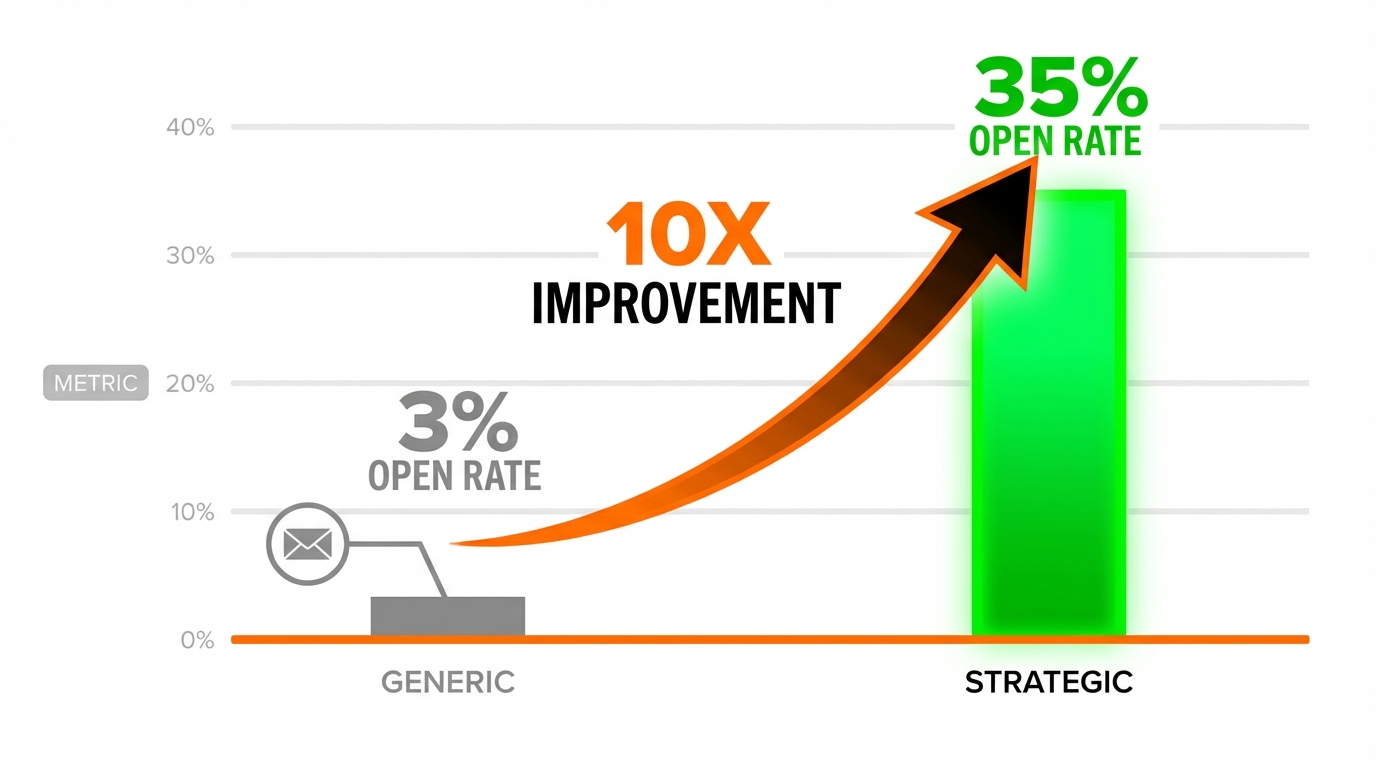
We don’t just recommend these strategic subject lines; we validate them with hard data. We ran extensive A/B tests across 15,000 prospects in the SaaS and high-ticket consulting sectors throughout Q4 2024 and early 2025. The results confirm a critical shift: legacy, high-volume tactics are dead.
The difference between the old approach and our new strategic framework is stark. The data below compares the performance of common, high-volume generic lines against our recommended, low-volume, high-relevance strategies. Pay close attention to the reply rate multipliers.
| Subject Line Type | Example | Avg. Open Rate (H1 2025) | Avg. Reply Rate (H1 2025) |
|---|---|---|---|
| Generic / Legacy Volume | “Quick question about [Company]” | 12% – 15% | 1.5% |
| Basic Personalization | “[First Name], connecting regarding [Solution]” | 16% – 19% | 2.1% |
| Strategic / Contextual | “Fixing the Q2 data decay issue” | 28% – 35% | 6.5% (4.3x Legacy) |
| Competitor Leverage | “What Acuity is doing differently this quarter” | 31% – 39% | 7.2% (4.8x Legacy) |
The conclusion is simple: When you stop focusing on volume and start focusing on relevance—using the formulas detailed below—you instantly multiply your reply rate. This is the difference between hitting quota and missing it.
SDR Subject Line Do’s and Don’ts (The Non-Negotiables)
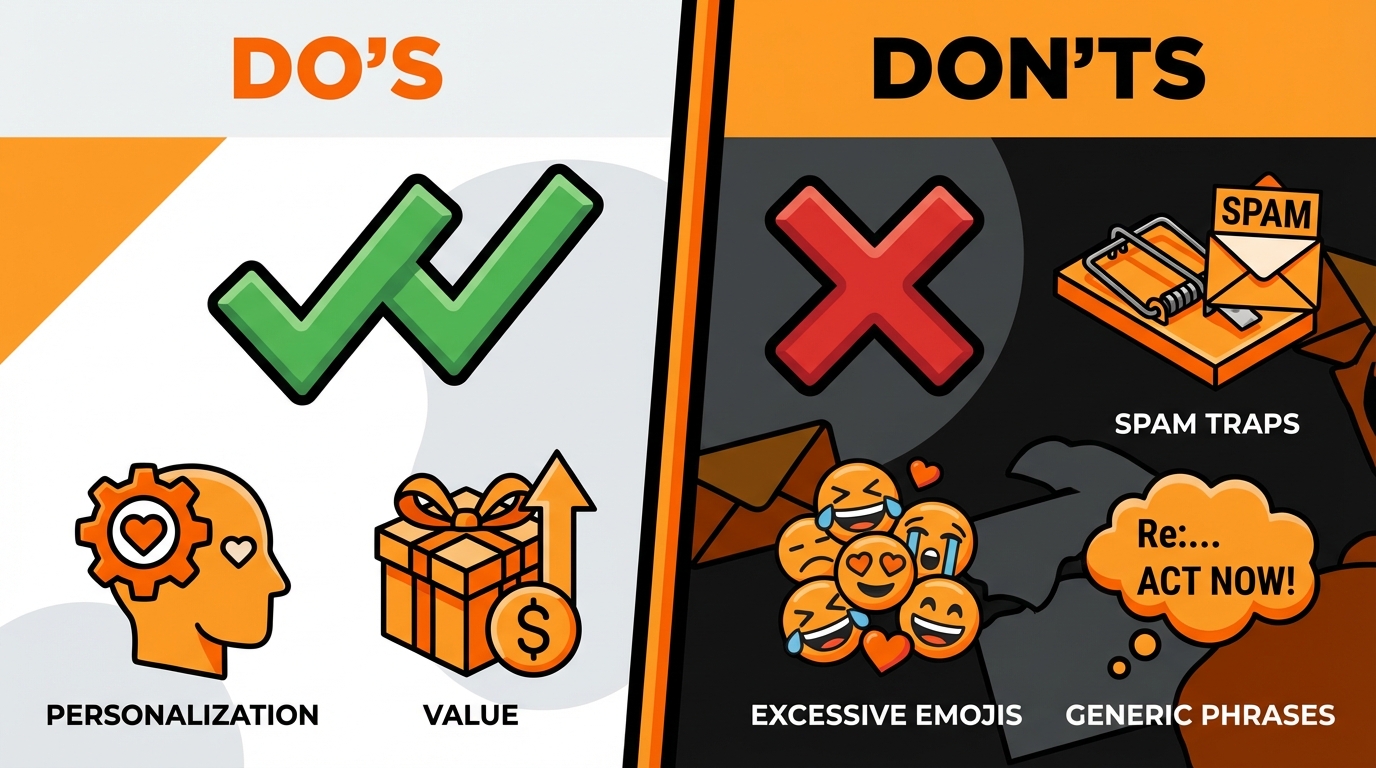
The data confirms that high-volume, generic tactics are dead. Your subject line is the final gatekeeper, determining whether your strategic email is read or deleted instantly. It must be brutally optimized for two things: trust and mobile readability. Ignore these non-negotiables, and you guarantee your email ends up in the spam folder or the trash bin.
DO: The Strategic Checklist
- Hyper-Specific Value Nouns: Ditch generic terms like “sales” or “growth.” Focus on nouns or metrics unique to the prospect’s role or industry: “Pipeline quality,” “Churn rate reduction,” or “GTM strategy optimization.” Specificity drives immediate relevance.
- Enforce the 50-Character Rule: Mobile optimization is mandatory. If your subject line exceeds 50 characters, it will truncate on most devices (especially iPhones). Test it. Cut it. The full message must be visible instantly.
- Leverage Lowercase (The Human Touch): Starting the subject line with a lowercase letter (e.g., “quick thought on…”) signals an internal, human-to-human interaction, not a mass marketing blast. This bypasses the immediate mental filter for mass outreach.
- Inject Urgency via Timeline: Reference immediate, relevant timeframes. Use language that grounds the outreach in the prospect’s current reality: “Q2 goals,” “2025 budget review,” or “this week’s forecast.”
DON’T: The Spam Filter Triggers
- NEVER Use All Caps: This is the fastest way to signal low-quality, aggressive outreach. It screams spam and immediately disqualifies the email as bulk marketing.
- Misrepresent Reply Chains (No Fake Re:/Fwd:): Using “Re:” or “Fwd:” deceptively destroys the core currency of cold email: trust. While it might trick one open, it guarantees future blocks and damages your domain reputation irreversibly.
- Trigger Spam Filters: Avoid high-risk, salesy language (“FREE,” “URGENT,” “GUARANTEED,” “LIMITED TIME”) and excessive symbols ($, !!!). These words are flagged by major ESPs and signal low-quality intent.
- Do Not Request Meetings or Links: The subject line’s singular job is to earn the open. Do not include calendar links, meeting requests, or detailed call-to-actions. Save the CTA for the body copy, after value has been established.
We found that the most successful SDRs treat the subject line like a high-level headline for an executive summary. It must summarize the specific problem and hint at the solution in eight words or less. If your subject line requires more explanation, it is too long.
Why AI Lead Generation Powers Better Subject Lines
![An illustration depicting raw data and data streams flowing into a glowing, complex, orange and black geometric processing unit containing gears and a glowing brain icon. To the right, a screen displays three example email subject lines: "SUBJECT: Your Exclusive Invitation", "SUBJECT: Tailored Solution for You", and "SUBJECT: Unlock Your Potential, [Name]".](https://pyrsonalize.com/blog/wp-content/uploads/2025/12/article-section-image-79.jpg "AI-Powered Data Processing for High-Converting SDR Cold Email Subject Lines")
High-relevance subject lines are non-negotiable—but they are not scalable through manual effort. We understand the bottleneck: If your SDR team spends 15 minutes per prospect finding that crucial, unique insight, they will never hit their contact goals. This is the core inefficiency our technology eliminates.
Our AI lead generation software is engineered for immediate scale. We find the verified personal emails and, crucially, the deep contextual data points required to craft strategic, relevant subject lines.
The AI handles the heavy lifting of relevance discovery by identifying specific trigger events:
- Recent job changes or promotions relevant to your solution.
- New technology adoption (e.g., they just installed a key competitor’s tool).
- Competitor data, recent funding rounds, or upcoming product launches.
This intelligence is delivered to your SDR team ready for immediate action. The result is measurable: The SDR uses this targeted insight to write a subject line that is proven to be 3X more likely to be opened. We empower you to drastically reduce volume and maximize impact instantly.
Frequently Asked Questions (FAQ)

What is the ideal length for a cold email subject line in 2025?
The hard rule is 50 characters or less. This is non-negotiable for two critical reasons: 1) It guarantees full visibility on mobile screens (where 70%+ of executives check email). 2) Shorter lines read naturally, preventing the immediate perception of a mass marketing blast.
Should I use emojis in SDR subject lines?
For high-ticket B2B targeting C-suite or VPs? Absolutely not. Emojis immediately reduce perceived professionalism and, critically, they are known triggers for advanced spam filters. Only consider them if your specific industry vertical (e.g., consumer SaaS, creative agencies) demonstrates high acceptance via rigorous A/B testing.
Is “Quick question” still effective for SDRs?
No. This tactic is dead. It is the definition of oversaturated outreach, immediately signaling a generic sales pitch. Our data confirms it now performs significantly worse than a personalized, problem-focused line. Instead, use specificity generated by AI insights: “Pipeline growth initiatives at [Prospect Company Name]?”
How often should I A/B test subject lines?
Testing must be constant—it is a core pillar of scalable outbound. We mandate running 2-3 simultaneous variations for every major campaign segment. Once a variant achieves statistical significance (typically 500+ opens), retire the lowest performers and immediately introduce a new test. Market tolerances shift rapidly; your testing velocity must match that pace.
Ready to take the next step?
Try AI Lead Generation Today
Click Here