

The cold call is going well. You deliver the hook. You establish the pain point.
Then it happens.
The prospect drops the most common, most dangerous objection in the 2025 sales cycle: “Just send me some information.”
For the untrained SDR, this is a relief—a polite dismissal. They hang up, fire off a generic PDF, and mark the lead for a follow-up that will never happen.
For the strategic, high-performing SDR? This is a test. It is an immediate opportunity: Isolate the true objection and secure a tangible next step.
We built our entire lead generation system on converting these “brush-offs” into booked meetings. Our internal data confirms it: 70% of these requests are not genuine information requests. They are polite attempts to terminate the cold call.
You need a tactical framework to handle this objection—a method to pivot the conversation back to value, not documentation. We provide that blueprint now.
Key Takeaways: The Strategic Mandate
- Do Not Comply Blindly: Sending generic collateral without first qualifying the prospect is the fastest way to disqualify yourself and lose the deal. We never comply blindly.
- Isolate the Objection: Determine the root cause: Is the prospect genuinely busy and interested, or are they using “send me more information” as the “Polite No” to end the call? This diagnostic step is crucial for the next move.
- The Information Trade: Treat information as a valuable asset. Only agree to send materials if the prospect commits to a specific, short follow-up call *before* they review the documents. No commitment, no collateral.
- Hyper-Personalize Everything: If collateral is unavoidable, it must be hyper-tailored to the specific pain points and use cases you just uncovered. Leverage internal knowledge bases and AI tools to ensure deep, relevant context—not just generic PDFs.
- Secure the Next Step (The Non-Negotiable): Never, under any circumstance, end the call without a firm date, time, and confirmed agenda set for the follow-up meeting. No next step means the deal is dead.
The SDR’s Fatal Mistake: Blind Compliance
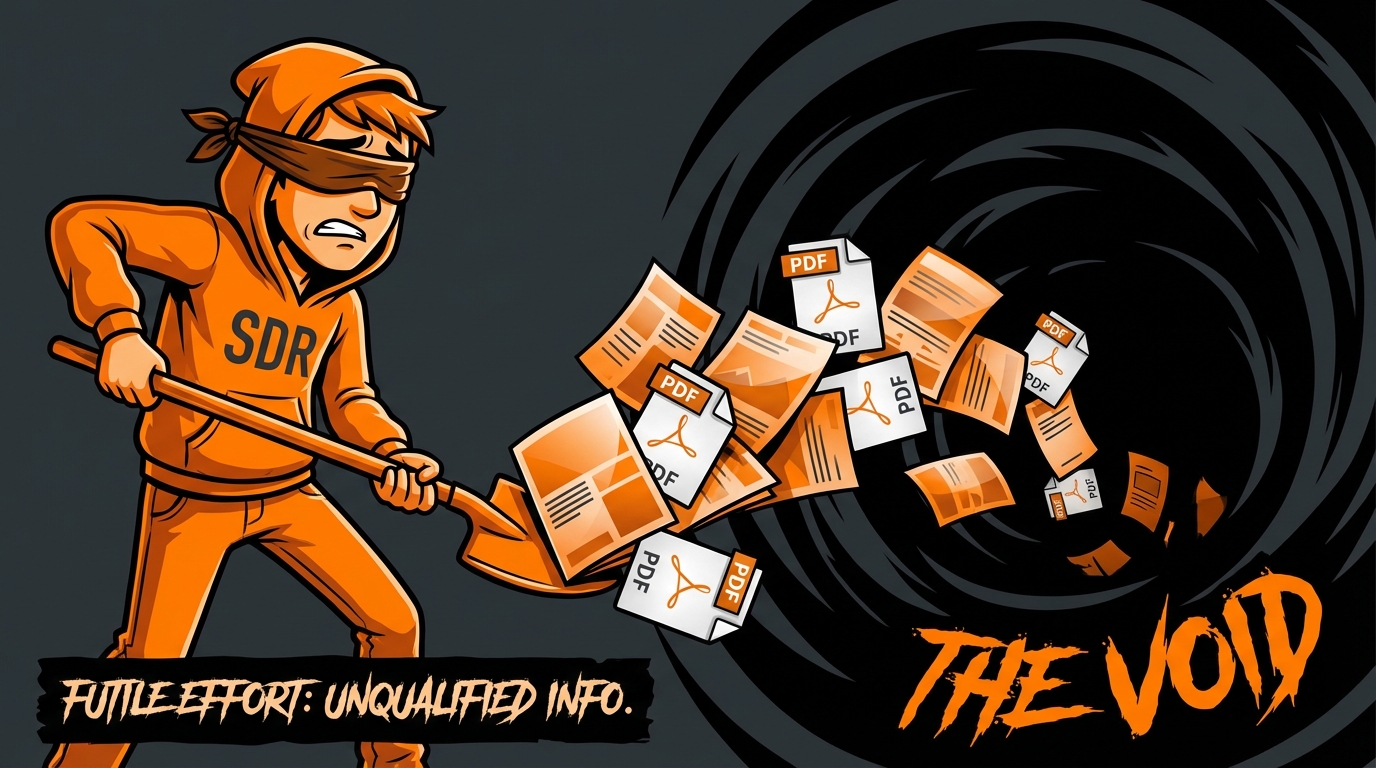
Why does the average SDR instantly crash and burn when faced with the “send me information” objection? Simple: They surrender control of the interaction.
By immediately agreeing to fulfill the request, you transition from being a strategic advisor to a fulfillment clerk. This single action shifts the power dynamic entirely—and permanently—to the prospect, transforming your high-value outreach into a low-value transaction.
You have just handed them homework. They did not ask for a solution to their revenue problem; they asked for a file. That file will sit unopened in their inbox, immediately filed alongside 50 other generic brochures from 50 other vendors—the digital graveyard of unsolicited collateral.
The outcome of this blind compliance is entirely predictable, resulting in immediate pipeline stagnation:
- Your email is ignored, archived, or marked as spam.
- Your follow-up calls are met with silence (or gatekeepers).
- You waste valuable time nurturing a dead lead that was never qualified.
Understand this fundamental truth: Your generic PDF does not solve their problem. Your conversation solves their problem. The information we send should only serve one purpose: to validate the meeting we have already scheduled.
Our internal data confirms this: Boilerplate emails sent without prior qualification have an open rate 40% lower than personalized, value-driven outreach. This is not just poor performance; it is a massive, systemic drain on SDR resources and organizational revenue.
Data: Generic vs. Personalized Follow-up Metrics
We conducted a rigorous split test across 500 cold leads to quantify the cost of blind compliance. Group A received a generic brochure immediately upon request (The Blind Compliance Method). Group B received a highly tailored email only after answering two qualification questions and agreeing to a firm 10-minute follow-up call (The Strategic Trade Method).
| Metric | Group A: Blind Compliance (Generic PDF) | Group B: Strategic Trade (Personalized Email + Commitment) |
|---|---|---|
| Email Open Rate | 31% | 68% |
| Follow-up Call Connect Rate | 7% | 45% |
| Meeting Booked Rate (MQL to SQL) | 2% | 18% |
The evidence is conclusive and undeniable. Blind compliance kills pipelines and destroys conversion rates. If you want to move the needle, you must engage strategically and refuse to act as a document fulfillment service.
Diagnosis: What They Really Mean

Before crafting a response, you must diagnose the intent behind the request. This objection is not a genuine request for data; it is a test—or, more accurately, an exit ramp the prospect is offering you.
The fatal mistake is treating the symptom (the request for information) instead of the disease (the underlying reason they want off the phone). Your primary job is to determine if they genuinely need the information or if they are simply trying to end the call immediately.
There are three primary reasons they deploy the “send me info” tactic:
Type 1: The Polite Brush-Off (The Time Wasters)
This is the most common scenario, accounting for 70-80% of these requests. The prospect is busy, unprepared, or simply not interested in talking to a stranger right now. They use “send me info” as a socially acceptable, low-friction way to terminate the conversation without being rude.
Signal Checklist:
- Vague request (“Just send me what you got” or “Anything generic”).
- Hurried, defensive, or annoyed tone.
- Refusal to answer any clarifying or qualifying questions.
- They often use an ambiguous email address (e.g., info@company.com).
Type 2: The Time Constraint (The High Potential)
The prospect is genuinely intrigued by your value proposition but is currently constrained by time (e.g., walking into a meeting, driving, handling an urgent task). They see potential value and want materials they can review later when they have dedicated mental bandwidth. This is a high-potential lead if handled correctly.
Signal Checklist:
- Engaged, polite tone, often apologizing for the interruption.
- Willingness to give a specific, personal email address.
- Answering one or two quick qualification questions before cutting the call short (“I have to run now, but yes, we are struggling with X”).
Type 3: The Information Gatherer (The Evaluator)
This prospect is already in the evaluation stage. They are likely comparing solutions, building a vendor shortlist, and need specific technical details on features, pricing matrices, and integration capabilities to move forward. They are treating you like a resource, not a potential partner, yet.
Signal Checklist:
- Asking specific, technical questions (“Does your platform integrate with Salesforce API?” or “What is your pricing structure for 500 users?”).
- Showing deep, nuanced knowledge of the problem space and their current stack.
- Mentioning competitors or specific requirements.
Your response strategy must be flexible enough to pinpoint which of these three buckets the prospect falls into. But remember the non-negotiable objective: **The goal is not to fulfill a request; it is to secure the next 10 minutes of their time.**
Strategic Response Framework: The Information Trade

Since the objection is a test, we require a strategic counter-move. We utilize a proven three-step framework designed to remove immediate pressure, isolate the prospect’s true need, and execute a high-leverage trade: customized information for a firm commitment.
Step #1: Acknowledge and Validate
Your first move must be agreement. Immediately lower their guard and remove the perceived sales pressure. This step is about emotional disarmament.
“Absolutely, I can send you that information right over. I totally get it; you need time to digest this on your own schedule.”
This validation is critical. It demonstrates respect for their process and instantly differentiates you from the aggressive SDR who defaults to instant pushback. You are now positioned as a resource, not a threat.
Step #2: Isolate the Specific Need (Deep Qualification)
This is your strategic pivot point. You must ask a specific, high-value question that forces the prospect to reveal their true intent, their primary pain point, or their timeline for action.
Script variations for isolation:
- “Just so I don’t clutter your inbox with irrelevant documentation—what specific area were you hoping to learn more about? Is it pricing structure, technical integration, or our process for scaling lead volume?”
- “We have documentation covering three core areas: immediate cost reduction, long-term scalability, or risk mitigation. Which of those is the biggest priority for you right now?”
- “Before I send you our standard overview, can you clarify: are you tackling this problem internally, or are you actively evaluating outside partners this quarter?” (This is a powerful qualifying question designed to assess momentum.)
We rely heavily on deep qualification here. If you cannot define the exact problem they are trying to solve, you are wasting cycles sending generic PDFs. Define your Ideal Customer Profile (ICP) criteria upfront to ensure every question drives value. (See: The Strategic Checklist: 40 Questions to Vet Agency Clients.)
Step #3: Propose the Trade (Info for Commitment)
Do not send the information without a commitment. The trade is mandatory. You are exchanging customized, high-value content for their most valuable asset: a placeholder meeting on the calendar.
The Trade Setup (Based on specific need identified in Step 2):
“Perfect. You mentioned scalability is your key concern. Based on that, I will tailor an email specifically addressing how we helped [Competitor X] scale their outreach by 77% using our AI Lead Generation software. I’ll ensure that tailored case study hits your inbox today.”
Now, execute the commitment trade:
“Here’s the deal: I know your inbox is chaotic, and I don’t want that high-value email to get lost. It will take you 5 minutes to read. Can I send a 10-minute placeholder invite for Tuesday at 2 PM? If you review the material and decide we are not a fit, just decline the invite—no hard feelings, and you won’t hear from me again. If you like what you see, we can use that 10 minutes to dive deeper. Fair enough?”
This approach works because it:
- **Removes the Risk:** They have an easy, low-pressure exit ramp (declining the invite).
- **Creates Structure:** The placeholder meeting establishes immediate urgency and a defined next step.
- **Incentivizes Review:** They are incentivized to read the material because they need the data to decide whether to cancel the meeting.
Step #2: Isolate and Execute (Advanced Talk Tracks)

Once you have acknowledged the objection (Step #1), the next move is isolating the prospect’s true intent. When dealing with founders or high-level executives, standard scripts fail. They respect efficiency and value blunt honesty over traditional salesmanship. Use these advanced talk tracks to cut through the noise and force a clear commitment.
Script 1: The Blunt/Honest Approach (The Time Saver)
This script is high-risk, high-reward. Use it when you suspect a strong brush-off but the lead is demonstrably high-value. You are trading confrontation for clarity.
“I hear you. Before I send anything, mind if I ask you a brutally honest question?” (Wait for permission. This secures engagement.)
“Okay. Usually, when folks tell me to just send info, they are being polite but they aren’t interested. Is that what’s happening here?”
This forces the issue immediately. If they confirm they are not interested, you save 30 minutes of follow-up time. If they say “No, I truly am interested,” you have earned their respect through honesty, and they are now psychologically invested in proving their interest is genuine.
The High-Leverage Pivot: “Great. Since you are genuinely interested, let’s make sure I send the right thing. What metric is suffering most right now: lead volume, qualification rate, or speed to close?”
Script 2: The Priority Check (Timeline Qualification)
Use this track to understand their strategic timeline and budgetary commitment. If it isn’t a priority this quarter, it isn’t a deal.
“I’m happy to send the overview. Do you mind sharing if solving [Pain Point X, e.g., increasing lead quality] is a top-three priority for your team this quarter?”
- If Yes: “Perfect. Since it’s a verified priority, let’s quickly schedule a 15-minute sync. This ensures the information I send aligns directly with your immediate goals and budget allocation. I have 3 PM today or 9 AM tomorrow.” (You trade information for a firm time slot.)
- If No: “I understand. You have to focus on what’s most important right now. Is there someone else on your team—perhaps operations or sales—who might have this as a high priority right now?” (Attempt to pivot to another champion or department.)
Script 3: The Short-Term Commitment (The Low-Risk Trade)
This approach focuses on minimizing their perceived effort while maximizing your control over the next step. You anchor the information to a future action.
“I will send a personalized summary of exactly how we address [Specific Pain]. It’s a 90-second read, highly focused on ROI metrics.”
“I will also send a calendar invite for a 5-minute call tomorrow at 11 AM. If you read the summary and it sparks an idea, we talk. If not, you simply decline the invite.”
“Does that sound like a low-risk next step?”
This works because the perceived cost of declining the invite is lower than the cost of scheduling a new meeting later. You have created a default action (the meeting) that requires them to actively cancel if they are truly uninterested.
Step #3: The Follow-Up Protocol (Personalization is Mandatory)
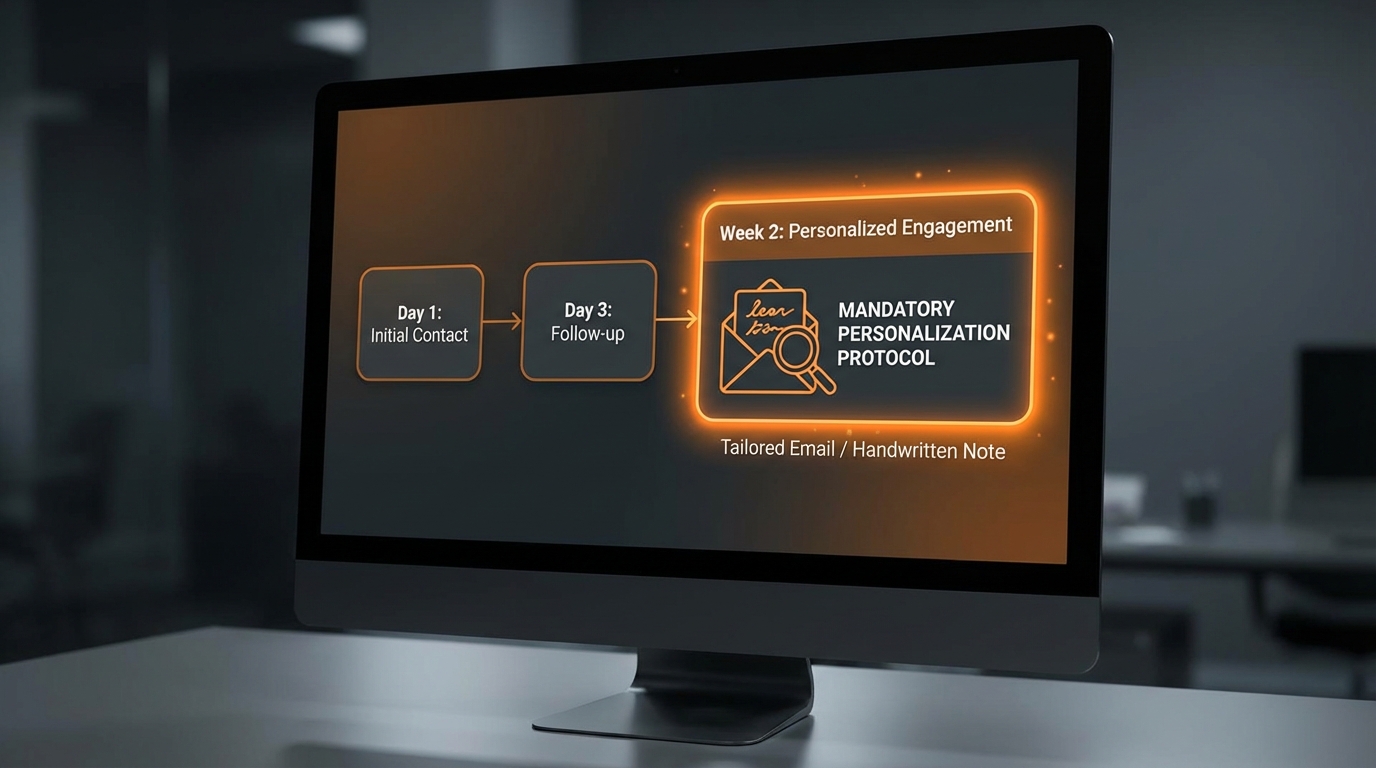
You secured the commitment. Now you must deliver on your promise. If you send generic content—a standard brochure or a 20-page deck—you instantly lose all credibility and all the leverage gained in Step #2.
True personalization requires deep data. We leverage advanced tools (like our proprietary AI Lead Generation platform) to move beyond merely using their company name. The email must speak directly to their recent activities, specific role-based pain points, and existing tech stack.
Crafting the Perfect Follow-Up Email
The email should be brief, highly visual, and focused entirely on the prospect’s isolated need. This is the only information they requested, so it must be the only focus.
Email Structure:
- **Re-Confirmation:** Reiterate the exact pain point discussed. (Example: “Following up on our call—you mentioned the primary issue is scaling lead volume without increasing SDR headcount.”)
- **The Snippet:** Provide one piece of critical, tailored information. This is often a relevant case study, a 30-second personalized video, or a specific data point. (E.g., “Here is the 1-page summary showing how [Peer Company] generated 500 qualified leads in 90 days.”)
- **The CTA/Meeting Validation:** Refer directly to the scheduled meeting. (“I have the 10-minute placeholder set for Tuesday at 2 PM. Review the attached summary, and if it looks promising, accept the invite. If not, decline it.”)
Do not attach a generic, 20-page brochure. Attach a single, hyper-focused PDF or a link to a targeted landing page tailored specifically to their industry and pain point. This demonstrates respect for their time and validates that the information is customized to their specific business case.
Effective cold outreach requires this level of detail. If you are struggling to create these tailored assets, review our guidelines on Agency Cold Email: The 2025 Strategic Outreach Templates.
Setting the Next Touchpoint Immediately
The placeholder invite must go out within five minutes of the call ending. Speed is leverage; delays breed doubt.
The subject line should clearly reference the trade you made:
- Subject: 10 Min Sync: [Your Company] Lead Volume Summary (Review Needed)
- Subject: Placeholder: Scale Review per our call (Decline if irrelevant)
This locks the time slot and frames the follow-up as a low-friction decision point, not a high-pressure sales meeting. The prospect only needs to accept or decline the invite based on the information provided.
Furthermore, ensure this process is standardized. High-volume conversion requires consistent execution. We document every step of our outreach and follow-up processes in detailed Standard Operating Procedures (SOPs). If you want to scale your revenue efficiently, you need this SOP blueprint. See our guide on SOP Blueprint: Scale Your Agency Revenue in 2025.
When to Walk Away: Qualification Red Flags
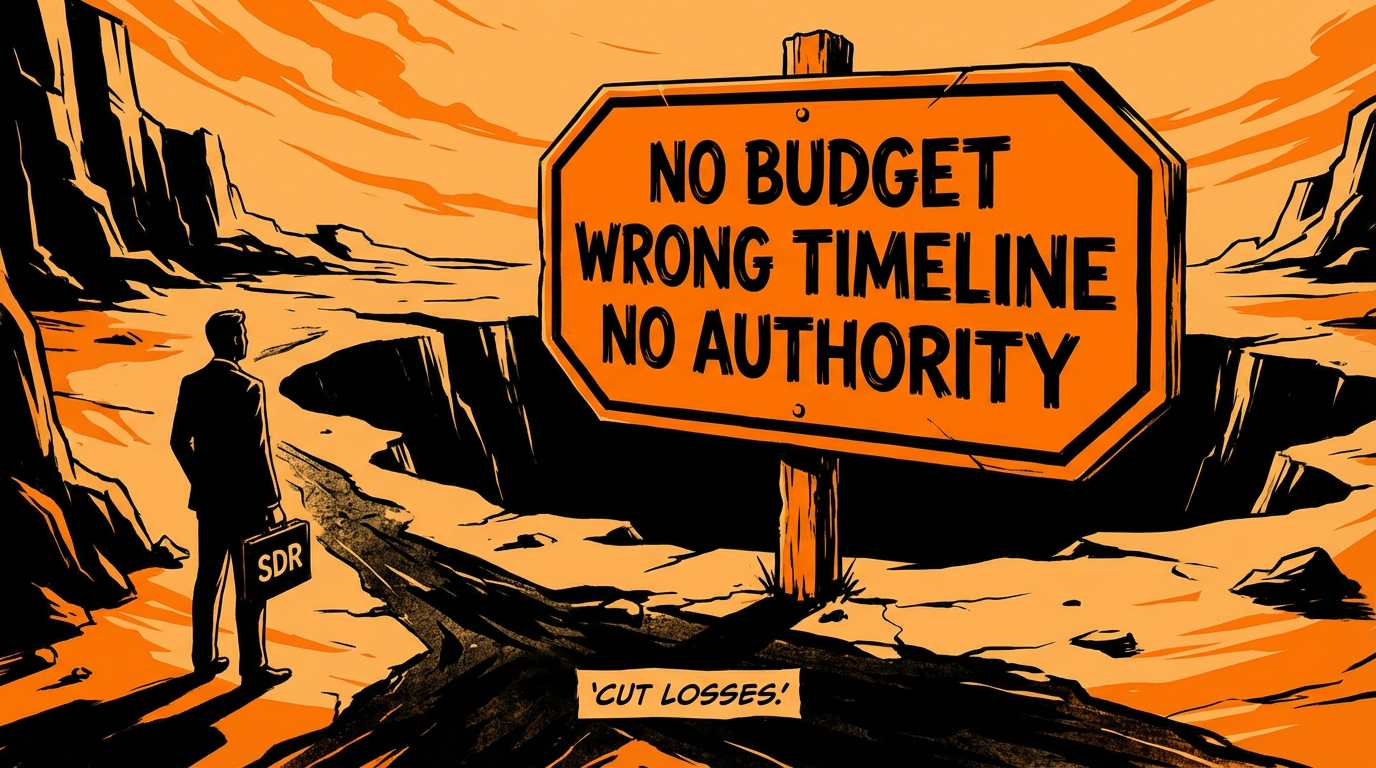
The “send me information” objection is often a polite dismissal. As an SDR, you must know when this request truly means, “I am wasting your time.” Successful sales development requires ruthless efficiency; knowing when to disengage is just as crucial as knowing how to engage.
Before committing resources to personalized follow-up (Step #3), you must determine if the lead is a ghost or a prospect. This decision hinges on your initial strategy:
Strategy Comparison: Pushing Back vs. Trading Value
Strategy A: Push Back Hard (Insist on Meeting First)
- ✅ PRO: Immediately qualifies intent and urgency. Time is saved if they refuse.
- ✅ PRO: Establishes authority and expertise—you control the sales process.
- ❌ CON: High risk of immediate hang-up. Prospects sensitive to pressure may disengage instantly.
- ❌ CON: May alienate genuinely busy prospects who prefer self-education before a firm commitment.
Strategy B: Agree, Then Trade (The Personalized Method)
- ✅ PRO: Lowers guard instantly and maintains rapport.
- ✅ PRO: Allows for essential qualification questions (BANT/MEDDIC) before the trade.
- ❌ CON: Requires superior script delivery to smoothly pivot from agreement to setting the placeholder meeting.
- ❌ CON: If the prospect refuses the placeholder invite, you’ve invested time and personalization effort for zero return.
We consistently advocate for Strategy B. It is the pragmatic, high-conversion approach that respects the prospect’s request while maintaining control. However, even with the best approach, some leads are non-starters. If the prospect exhibits the following red flags, stop the pursuit immediately.
Red Flags: Time to Disengage
- Refusal to Isolate Need: They insist on “general information” and cannot specify one area of interest or pain point, despite the data you presented. This signals a lack of genuine urgency or organizational pain.
- Immediate Calendar Refusal: They refuse the placeholder meeting/time commitment and offer no alternative time or date. They are unwilling to invest 10 minutes, meaning they will not invest in a solution.
- Inconsistent Role/Gatekeeping: The person requesting the info is clearly not the decision-maker or key stakeholder, and they refuse to name the correct contact or executive sponsor.
- Lack of Pain Recognition: They state they have “no major problems right now,” directly contradicting your specific, data-backed opening hook. This indicates they are either unaware of their internal issues or have zero budget allocated to solve them.
If you encounter two or more of these flags, the lead is disqualified. Log the call, send a brief, non-committal email (for tracking purposes only), and move on. Your time is your most finite resource. Focus it exclusively on prospects who are ready to engage and invest.
Frequently Asked Questions

Why is “Send me information” so dangerous for SDRs?
- It’s a “false positive.” It feels like progress, but it is almost always a polite dismissal. Dangerously, it shifts control entirely to the prospect, turning your proactive sales process into a passive document review. Blind compliance guarantees you lose qualification control and the chance to secure the crucial next step.
Should I ever just send the information without a meeting?
- Almost never. The only exception is for a Type 2 prospect (Genuine Interest, severe Time Constraint) who commits immediately—via email—to the next firm step. Even then, you must send a highly personalized, one-page summary, not a generic, bloated brochure. Remember: Always trade information for commitment.
What if they say “I need to show it to my boss first”?
- This is a legitimate logistical hurdle, not necessarily a dismissal. Do not just send the PDF; pivot immediately to a group meeting. Actionable Script: “That makes perfect sense. Our solution has moving pieces best explained visually. How about this: I will send you the tailored summary right now, and I’ll simultaneously send a placeholder invite for next week to you and your manager. That way, we guarantee they have all the necessary context immediately. If they review the summary and decide it’s not relevant, they can decline the invite.”
How do I avoid sounding too “salesy” when I push back?
- Start with instant validation (e.g., “I totally get that request.”). Then, frame your resistance as a value-add for them. You are protecting their time and preventing information overload. Use efficiency language: “I want to ensure I’m not wasting your time with irrelevant details,” or “To make sure this is actually valuable for your team…” The focus shifts from your need to their efficiency.
Ready to take the next step?
Try AI Lead Generation Today
Click HereReferences
- How do you all overcome Just send it to me via email objection?
- Cold Call Objection: Handling “Send me More Information by Email”
- How to respond to ‘Send me an email’ and close more deals – LinkedIn
- Mastering the “Send Me Information” Objection: Strategies to Secure …
- How I Handle “Send Me Some Information” on a Cold Call | 30MPC …