


Most agencies treat client onboarding as a necessary administrative chore—a simple checklist of contracts and logins. This approach is a fundamental failure of strategic vision and a direct drain on profit margins.
The truth is, in 2025, onboarding is not administrative. It is your most critical business system. It functions as your primary defense against scope creep, the engine of client retention, and the foundation for predictable revenue growth.
A disorganized process doesn’t just annoy clients; it costs you margin. It erodes client trust immediately. Worse, it forces high-value team members—your strategists and executors—to waste hours chasing credentials instead of delivering the results you promised.
We designed our internal client systems to be zero-friction and entirely process-driven. This blueprint outlines the five non-negotiable phases required to transform your current onboarding liability into a scalable, profit-generating asset.
Key Takeaways: Onboarding as a Revenue System
- Onboarding is Revenue Protection: The process must be designed to prevent scope creep and align financial expectations, directly protecting your agency’s profit margins.
- Phase Zero: Mandatory Vetting: Do not onboard a client who is not properly qualified. Use strategic discovery questions to identify misalignment and red flags before the kickoff call.
- SOPs are Mandatory: Every single step, from credential collection to kickoff presentation, must be documented as a Standard Operating Procedure (SOP) to ensure replicability and high quality, regardless of which team member executes it.
- Consolidate Technology: Leverage AI-driven tools (where efficient) to streamline initial data collection, but immediately centralize all client communication and assets into one dedicated portal or PM system.
- Metrics Define Success: Mutual success criteria (KPIs) must be established, agreed upon, and tracked via a shared dashboard within the first week of engagement.
Phase 1: Pre-Onboarding Vetting (The Trust Foundation)
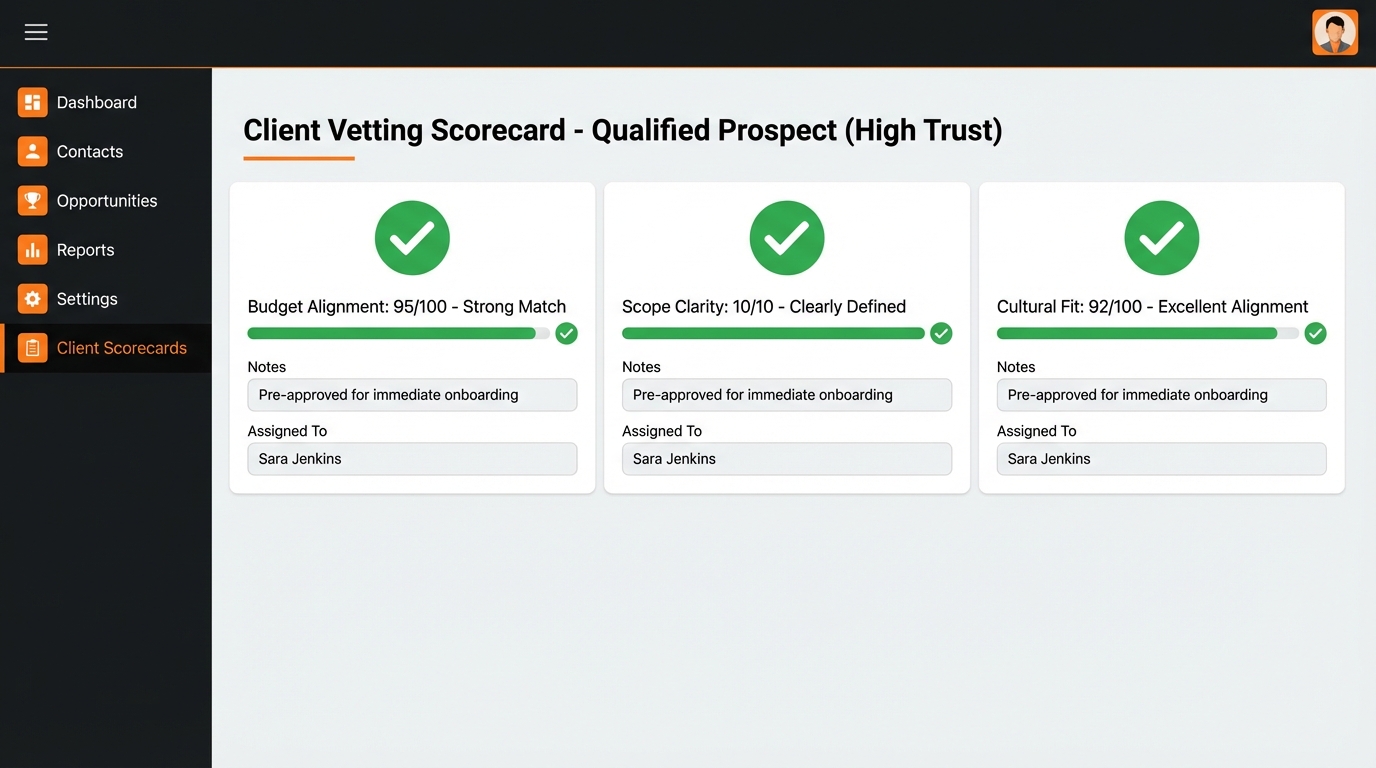
Your onboarding process does not start the moment the contract is signed. It begins the moment the prospect first engages with your sales team.
The transition from sales to operations—the “handoff”—is the most volatile part of the relationship. A poor handoff guarantees client confusion and immediate friction. We eliminate this risk by requiring deep qualification before the client ever enters the official onboarding flow.
Step #1: Implement a Post-Sale Discovery Checklist
We mandate that the sales team gather specific, non-negotiable data points before the deal is ever marked “Closed Won.” If they skip this list, the deal is automatically flagged for operational review.
This data must move beyond simple budget and timeline checks. It must establish the client’s internal operational maturity and infrastructure.
- Existing Tech Stack: Document every tool they use (CRMs, analytics, marketing automation). This validates integration needs.
- Internal Stakeholders: Identify the final sign-off authority vs. the daily point of contact (POC). These roles are rarely the same—clarity here prevents bottlenecks.
- Access Dependency: Compile the definitive list of credentials and platform permissions needed. This list must be documented before the kickoff call.
- Definition of Failure: Ask the client directly: “If this partnership fails in 90 days, what specifically went wrong?” This question forces them to articulate hidden expectations and deepest fears.
This rigorous pre-work allows the onboarding specialist to customize the kickoff presentation immediately, proving that their specific needs were transferred seamlessly from the sales process.
Our internal data shows that 80% of client friction in the first 30 days stemmed from misaligned expectations, not poor delivery. The solution is rigorous, preemptive questioning, every time.
If you need a proven framework for this vetting, use The Strategic Checklist: 40 Questions to Vet Agency Clients. Only move forward with high-fit partners.
Step #2: Send the Automated Welcome Sequence
The instant the contract is signed, the client receives a structured, automated welcome sequence. This sequence is designed to achieve three immediate goals: building excitement, managing critical logistics, and directing client attention.
- The Welcome Email (Immediate): Confirmation, a thank you, and the official introduction to the Onboarding Specialist (OS). Establish the OS as the single point of contact for the next 14 days.
- The Logistics Email (Day 1): This email contains the link to the secure Credential Vault. (Use a secure, encrypted tool like 1Password or LastPass; never email passwords.) It also includes the link to the mandatory Client Onboarding Questionnaire.
- The Kickoff Prep Email (Day 2): The comprehensive agenda for the mandatory kickoff call is shared. This agenda must list every topic to be covered and the required client attendees from their side.
This structured sequence ensures the client feels supported while immediately establishing that operational efficiency and organization are core values of your agency.
Phase 2: Legal and Financial Alignment (Protecting the Margin)
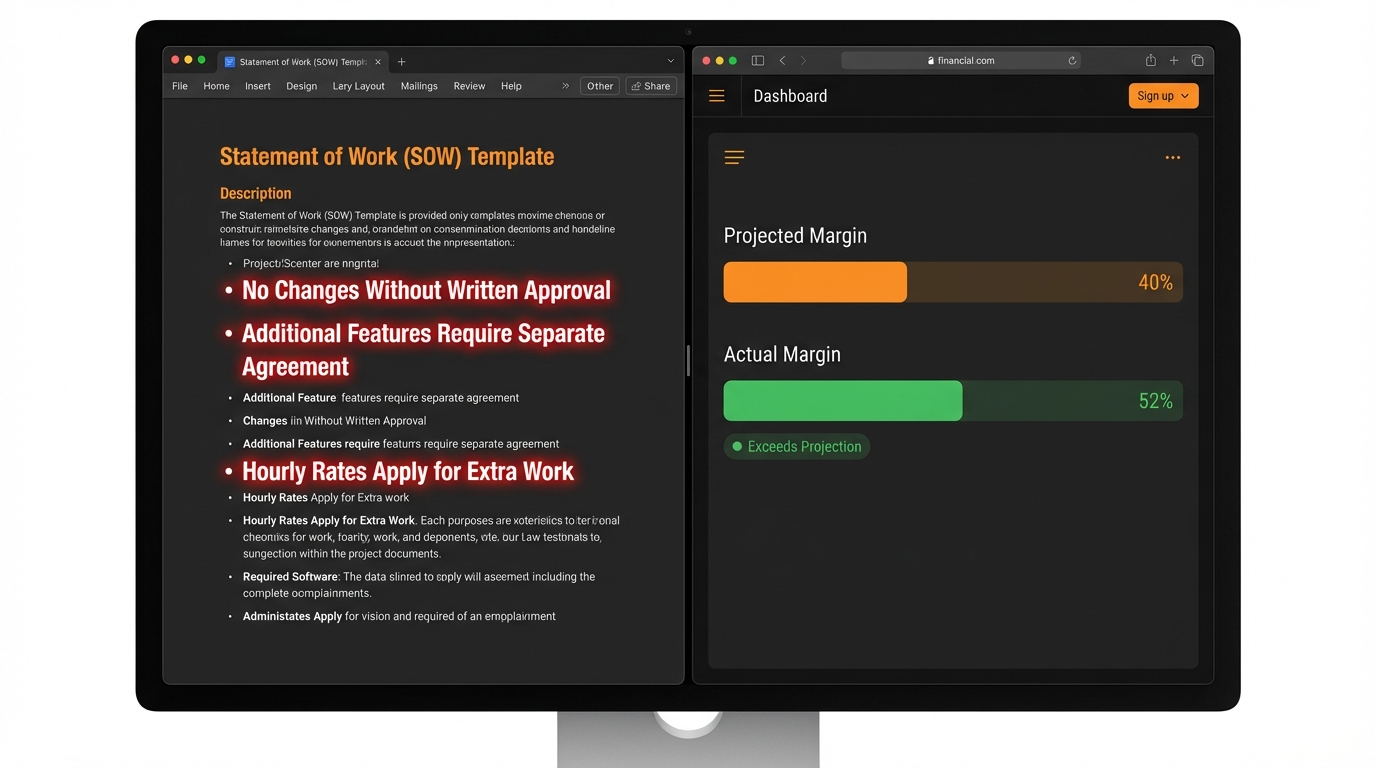
Scope creep is typically born from financial ambiguity. If the boundaries are soft, the client will push them. Period.
The onboarding phase must definitively lock down what is in scope and, more importantly, what is explicitly out of scope. This protects your team’s time and your agency’s margin.
Step #3: Finalize and Re-Sign the Statement of Work (SOW)
The SOW is your operational contract. It must be reviewed and signed off on again during onboarding, even if the client signed a version during the sales cycle.
Why re-sign? The client’s perception of service often shifts between the sales pitch and the operational reality. Re-signing ensures alignment and confirms they understand the deliverables.
Your SOW must include:
- Explicit Exclusions: List 3–5 things your agency will absolutely not be doing (e.g., “We will not manage your internal IT infrastructure,” or “We will not provide copywriting for product pages outside the defined campaign scope”).
- Defined Deliverables: Quantify every output. Instead of “monthly reports,” specify “one 15-slide PDF report delivered on the 5th business day of the month via the Client Portal.”
- Revision Limits: State the maximum number of revisions allowed for key deliverables (e.g., 2 rounds of creative revisions for ads; subsequent revisions are billed at $X rate).
Step #4: Establish Clear Billing and Pricing Protocols
The financial relationship must be transparent from day one. Any confusion about invoicing dates, payment methods, or the retainer structure guarantees collection issues and client resentment later on.
A Note on Hourly Billing: If you are still using hourly billing, you are sacrificing margin and client trust. We moved away from that model years ago because it fundamentally misaligns incentives. Our focus is on value, not time spent.
During this step, the Onboarding Specialist reviews the pricing model with the client. Confirm the fixed monthly retainer date, the accepted payment methods, and the exact protocol for handling variable costs like ad spend or third-party tool licenses.
If you need to transition to a more strategic model, read our guide on Stop Hourly Billing: The 2025 Agency Pricing Blueprint.
Step #5: Secure All Technical Access and Credentials
This step is purely logistical, but friction here kills initial momentum and delays results.
The Onboarding Specialist must verify all critical access points are granted, tested, and functional before the kickoff call. This prevents the first client meeting from turning into a troubleshooting session.
Mandatory Access Checklist:
- Website/CMS Access: Admin rights to WordPress, Shopify, or other relevant platforms.
- Analytics Access: Read/Write access to Google Analytics 4 (GA4) or relevant Business Intelligence (BI) tools.
- Ad Platform Access: Editor/Admin access to Meta Ads Manager, Google Ads, LinkedIn Campaign Manager, etc.
- Communication Hub: Invitation to the dedicated Slack channel or Project Management (PM) workspace.
- Email/Outreach Access: If applicable, access to specific client email accounts or required lead generation software licenses.
Set Boundaries: If the client fails to provide verified access within 48 hours of the request, the kickoff call should be immediately rescheduled. This establishes an immediate boundary: your time is valuable, and delays in providing access directly impact their results.
Phase 3: The Zero-Friction Kickoff (Operationalizing the Win)
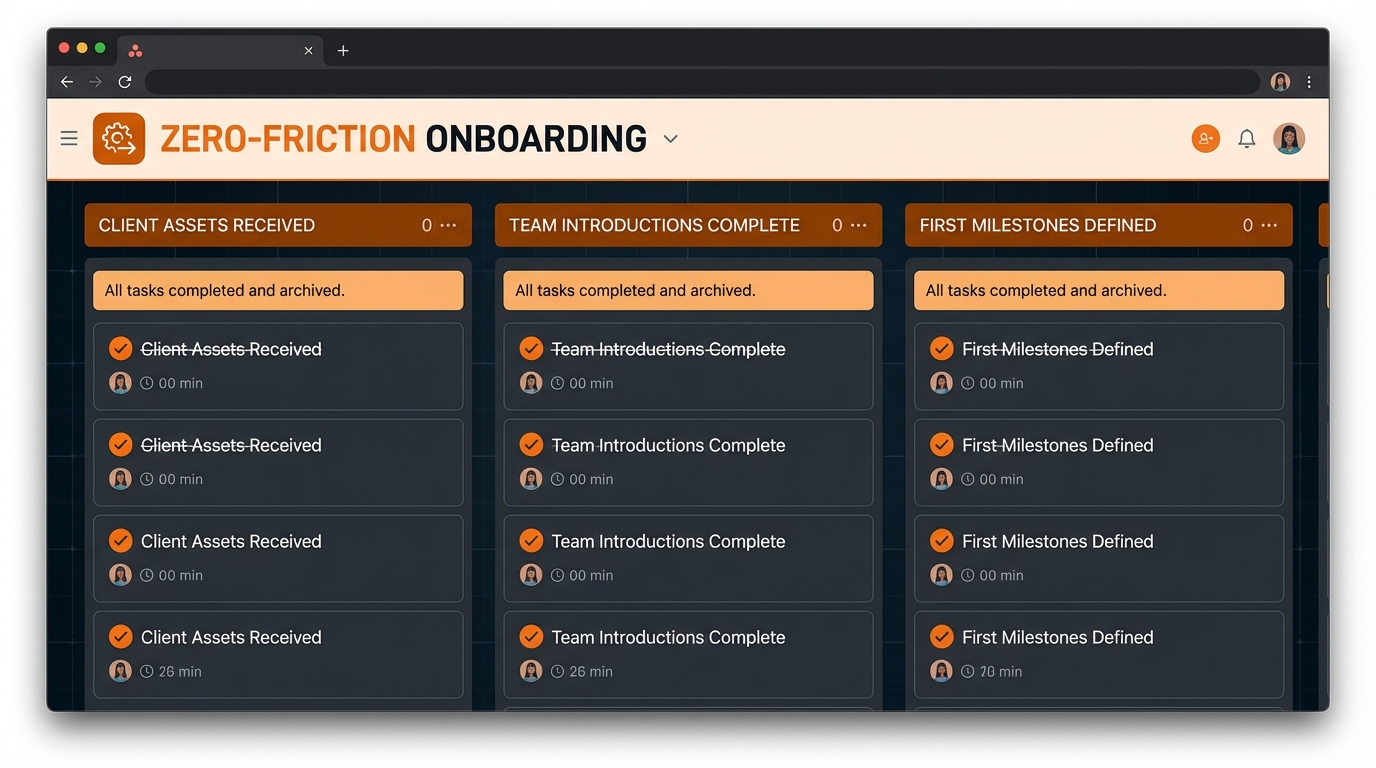
The Kickoff Call is not just a formality—it is your agency’s most important performance. This phase marks the critical transition from seller (securing the contract) to trusted operator (delivering the results). Discipline and structure are non-negotiable here.
Step #6: Execute the Structured Kickoff Workshop
A kickoff is not a celebratory meeting. It is a structured, working workshop with a strict, timed agenda designed to achieve operational alignment immediately.
Kickoff Agenda Blueprint (90 Minutes Max):
- Introductions (5 min): Account Manager (AM), Onboarding Specialist (OS), and key delivery personnel. Limit agency attendees strictly to those who will be actively contributing to the delivery.
- Sales-to-Ops Recap (10 min): The OS confirms the goals, challenges, and context gathered during pre-onboarding. This validates the client’s input and ensures the handoff was clean and accurate.
- Mutual Success Criteria Definition (30 min): This is the most crucial segment. You must finalize 3–5 high-impact SMART goals and the specific KPIs (Key Performance Indicators) used to measure them. Agreement here prevents future disputes.
- Process and Communication Protocol (20 min): Review the SOW exclusions, the reporting schedule, and preferred communication channels. Explicitly define response times (e.g., “We guarantee a response to critical issues within 4 hours during business days”).
- First 14-Day Action Plan (15 min): Present the immediate next steps your team is taking to demonstrate momentum. This plan must include a visible quick win (see Step #10 in the subsequent section).
- Q&A / Next Steps (10 min): Address final questions and schedule the next mandatory check-in (often the first status meeting).
The meeting ends precisely on time. Authority is built through discipline.
Step #7: Standardize Your Project Management Handoff
How you manage the project internally dictates the client experience externally—and this is where most agencies fail. We mandate that all client work tasks, communication, feedback, and deliverables must be centralized in a single Project Management (PM) tool.
This centralization prevents critical information from dying in sprawling email threads or siloed chat tools. Crucially, your choice of PM software directly impacts the client’s ability to engage and provide feedback efficiently.
| Feature | Asana/Monday | ClickUp/Jira | Dedicated Client Portal |
|---|---|---|---|
| Client Friction Level | Medium (Requires client training) | High (Overly complex UI/UX) | Low (Simplified, branded interface) |
| Visibility & Transparency | Good, but often too detailed | High, but difficult for non-technical users | Excellent (Curated view of progress) |
| Branding Capabilities | Limited | None | Full White-Labeling (Recommended for high-ticket clients) |
Step #8: Document the Decision Log
Immediately after the kickoff, the Onboarding Specialist compiles the “Decision Log.” This is a crucial artifact—a single source of truth summarizing the operational outcome of the workshop:
- Finalized KPIs and success metrics, linked directly to contract goals.
- Agreed-upon communication channels and designated contact roles for both teams.
- Confirmed scope boundaries and known exclusions (re-emphasizing Phase 2 alignment).
- The First 14-Day Action Plan and scheduled next check-in.
The Decision Log is immediately sent to the client and requires a formal sign-off (a digital signature or explicit email confirmation stating: “I approve the Decision Log and confirmed goals”). This documentation is your primary defense against future scope creep and the inevitable ‘I don’t remember agreeing to that’ conversations. Do not proceed with execution until you have this confirmation.
Phase 4: Establishing the Reporting Cadence (Retention Engineering)
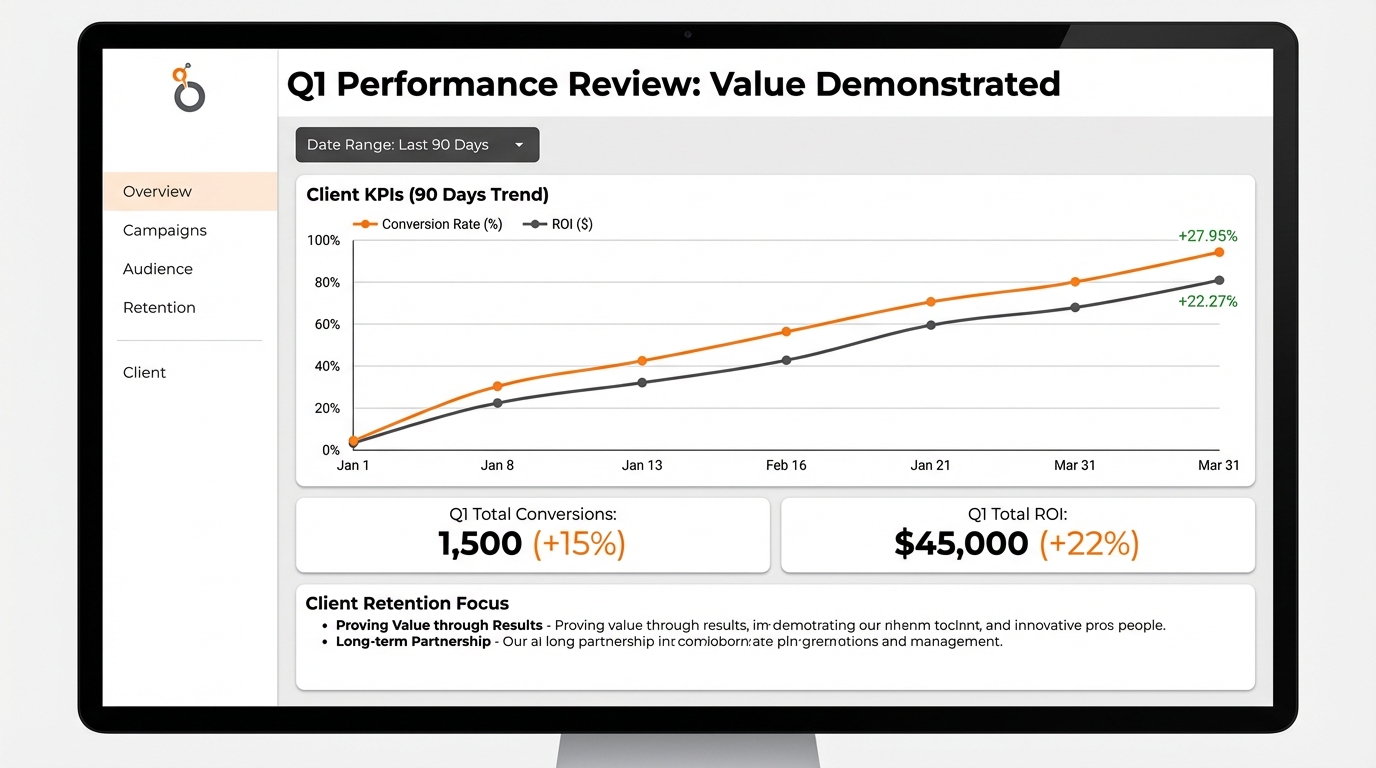
Retention is won or lost in the first 60 days.
Clients leave because they feel disconnected, not necessarily because results are slow. Your reporting structure is the mechanism for maintaining connection and demonstrating continuous value.
Step #9: Build the Shared KPI Dashboard
Waiting until the end of the month to show progress is a failure of communication. Within 72 hours of the kickoff, the client must have access to a shared, real-time dashboard. This dashboard tracks the KPIs agreed upon during the Kickoff Workshop (Step #6).
Whether you use Looker Studio, Databox, or your project management tool’s native reporting, the dashboard must be simple. It must focus only on the metrics that define success for that specific client.
The Dashboard Rule: If a metric does not directly map to a client goal—such as revenue, lead quality, or cost reduction—it does not belong on the client-facing dashboard. Internal data complexity must be hidden from the client.
Step #10: Deliver the Quick Win
The first 14 days are critical. Your objective is not long-term strategy yet; it is to deliver a quick, tangible win. This is the essence of retention engineering.
A quick win is not necessarily a massive revenue spike, but a visible demonstration of competence and momentum. It proves that your team is already working and that the client made the right decision hiring you.
Here are three examples of effective quick wins:
- Example 1 (SEO Agency): Complete a full technical audit and fix 3 critical site errors that immediately boost core web vital scores or page speed.
- Example 2 (Lead Gen Agency): Identify and verify 50 high-value target accounts and present the list, along with personalized email drafts, within one week. (Use our AI Lead Generation Software to accelerate this process.)
- Example 3 (PPC Agency): Optimize 5 underperforming ad headlines and descriptions to immediately increase the average Quality Score by 10%.
The quick win validates their decision to hire you and builds the necessary trust capital required for the heavier, slower strategic work that follows.
For detailed guidance on structuring your monthly value demonstration, review our guide on Strategic Monthly Reporting: Agency Client Retention.
Phase 5: SOP Integration and Handoff (Scaling the System)
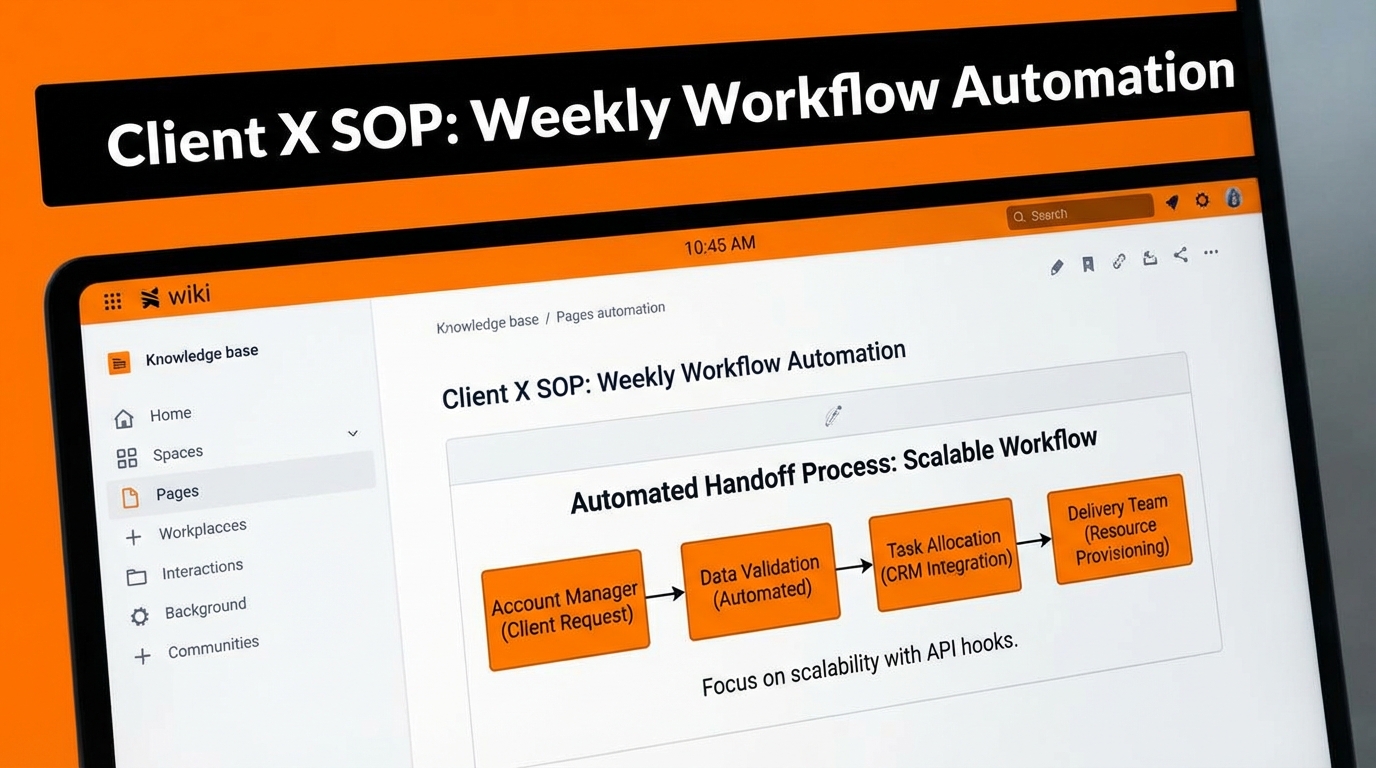
The goal of a high-efficiency onboarding system is repeatability. If every new client requires senior management intervention or custom setup, you have built a bottleneck—not a scalable process.
Phase 5 is the crucial transition: integrating the new client into your existing Standard Operating Procedures (SOPs) and formalizing the internal handoff structure. This is how we engineer scale and protect long-term delivery.
Step #11: Formalize the Internal Handoff
The Onboarding Specialist (OS) is responsible for the rapid setup and initial quick win delivery (typically concluding around the 14-day mark). Their job is now complete.
The OS must formally transfer ownership to the long-term Account Manager (AM) and the Project Lead (PL). This is non-negotiable.
We mandate an internal Handoff Meeting specifically designed for context transfer. The OS transfers all critical context, including:
- Client personality profiles (e.g., “POC prefers asynchronous updates,” “CEO is highly results-focused and requires data first”).
- Known risks and friction points (e.g., “Client is slow to provide feedback,” “Internal marketing team is resistant to Scope creep”).
- Detailed access log and technical setup confirmation (the “keys to the kingdom”).
- Review of the signed Decision Log, highlighting non-standard choices.
The goal is zero friction: the AM should never have to restart the relationship or re-ask questions already answered during the discovery phase. This protects the client experience.
Step #12: Build the Client-Specific Knowledge Base
Institutional knowledge is your agency’s highest-value non-human asset. Every client must have a dedicated, internal Knowledge Base (KB) located within your Project Management (PM) system.
This KB is the single source of truth for all client-specific SOPs, brand guides, technical notes, and historical decisions. This system mitigates catastrophic risk: if the Account Manager leaves, the client relationship does not suffer a complete loss of institutional knowledge.
This documentation should include:
- The Client’s Brand Voice, Tone, and Style Guide (essential for content teams).
- Specific SOPs for data retrieval (e.g., “How to pull conversion data from Client X’s specific CRM integration”).
- Historical audit results, major project decisions, and approved exceptions to standard policy.
- A comprehensive contact list and defined roles for all client stakeholders.
Treat this documentation as a high-value operational asset. It is the core engine of operational efficiency and directly protects future revenue streams.
Frequently Asked Questions
How long should a structured agency client onboarding process take?
The core logistical setup (contract finalization, access provisioning, kickoff meeting) must be completed within 7 business days of contract signing. Strategic integration—which includes delivering the first quick win and establishing the reporting dashboard—should wrap up within 14 calendar days. We define the full onboarding phase as the first 30 days, concluding with a mandatory 30-day review call to formalize the transition to account management.
Who should own the client onboarding process in a scaling agency?
Onboarding must be owned by a dedicated Onboarding Specialist (OS) or a specialized Implementation Manager. This is a non-negotiable step for scaling. This role must be distinct from the long-term Account Manager (AM). This separation ensures the AM can focus exclusively on retention and strategic growth, while the OS handles the high-friction setup logistics and immediate tactical execution. Consistency demands specialization.
How do we prevent scope creep during the onboarding phase?
Scope creep is a profitability killer. We prevent it via three mandatory controls:
- Explicitly listing service exclusions (the ‘will not do’ list) in the Statement of Work (SOW).
- Requiring the client to sign off on the finalized Decision Log and Scope Definition immediately after the kickoff call.
- Establishing a formal, documented Change Order process. All out-of-scope (OOS) requests must be formally priced and approved via a Change Order document before any work begins.
Ready to take the next step?
Try AI Lead Generation Today
Click HereReferences
- Agency Client Onboarding: An Easy 5-Step Checklist [2025]
- Agency Client Onboarding: 17-Step Checklist for a Smooth Start
- 8 Client Onboarding Best Practices for Agencies to Boost Retention
- How have you improved your client onboarding experience? – Reddit
- Here’s how your agency can build a seamless client onboarding …