

Your agency runs on trust, talent, and repeatable processes. Yet, most digital marketing agencies fail the scalability test: they rely on generic project management (PM) tools that simply cannot track core financials or resource allocation effectively.
We see this constantly. Teams managing $500k retainers are still using tools designed only for internal task lists. This is not a minor inconvenience; it is a severe operational failure that bleeds margin.
A marketing agency is not a marketing department; you are a professional services organization. Therefore, your PM platform must function as a **Professional Services Automation (PSA) system** first. It is the only way to directly measure and maximize utilization rates and profit margins.
If your PM software cannot tell you the real-time profitability of Client X versus Client Y, you are operating blind. You are not just leaving money on the table—you are actively subsidizing low-value clients.
This guide cuts through the noise of feature lists and focuses strictly on the strategic requirements for scale. We are defining the PM stack that scales revenue and operational efficiency in 2025.
Key Strategic Takeaways
- Generic PM Tools Fail Agencies: Platforms like Trello or basic Asana are insufficient for client-facing, high-ticket work. They lack profitability tracking and resource forecasting crucial for agency margins.
- PSA is Non-Negotiable: Your PM solution must function as a Professional Services Automation (PSA) platform. This means integrating time tracking, invoicing, resource planning, and real-time profitability reports.
- Focus on Utilization: The primary metric for agency scale is utilization rate. The best software provides real-time visibility into team capacity to maximize billable hours and prevent burnout.
- Integrate Intake: Project management must start at the lead stage. Use the platform to standardize client vetting and scope definition to prevent margin-killing scope creep.
Why Your Current PM System Is Leaking Cash
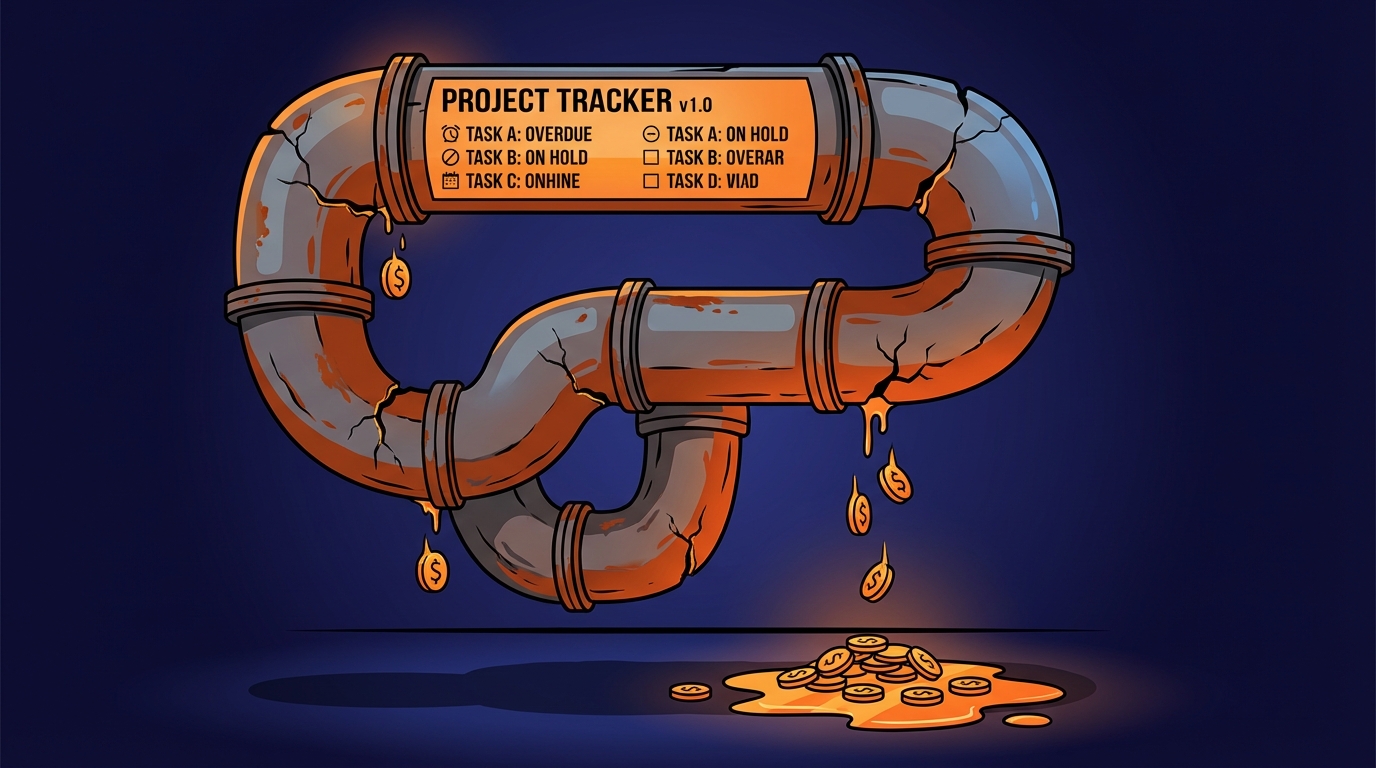
Every agency starts lean—usually on Trello, Notion, or the basic tier of ClickUp. This setup is manageable when you have one founder and two clients. But the system fails instantly when you hit scale: onboarding your fourth retainer and hiring your first full-time employee.
The core issue is not a lack of tools; it is fragmentation. When critical operational data lives in silos, your profitability vanishes. This fragmentation creates three major profit leaks:
- Time Tracking is Disconnected: Hours logged in external tools (like Harvest or Toggl) require manual transfer to spreadsheets for invoicing and P&L analysis. This process is slow, inaccurate, and creates easy opportunities for revenue leakage.
- Resource Planning is Pure Guesswork: You assign tasks based on gut instinct, not actual capacity data. This prevents accurate forecasting for new leads, leading directly to bottlenecks, burnout, and poor client delivery.
- Scope Creep is Untracked: New client requests are added to a task board without an immediate financial impact assessment. Your team delivers work that was never billed—you are giving away services for free.
Based on our analysis, agencies running disconnected systems lose a staggering 15% to 25% of potential profit margin annually. This is the direct cost of inefficient workflows and untracked billable time.
“If the tool doesn’t link time logged directly to client profitability reports, it’s a glorified to-do list. Agencies need financial visibility, not just task visibility.”
The 5 Non-Negotiable Requirements for Agency PM Software
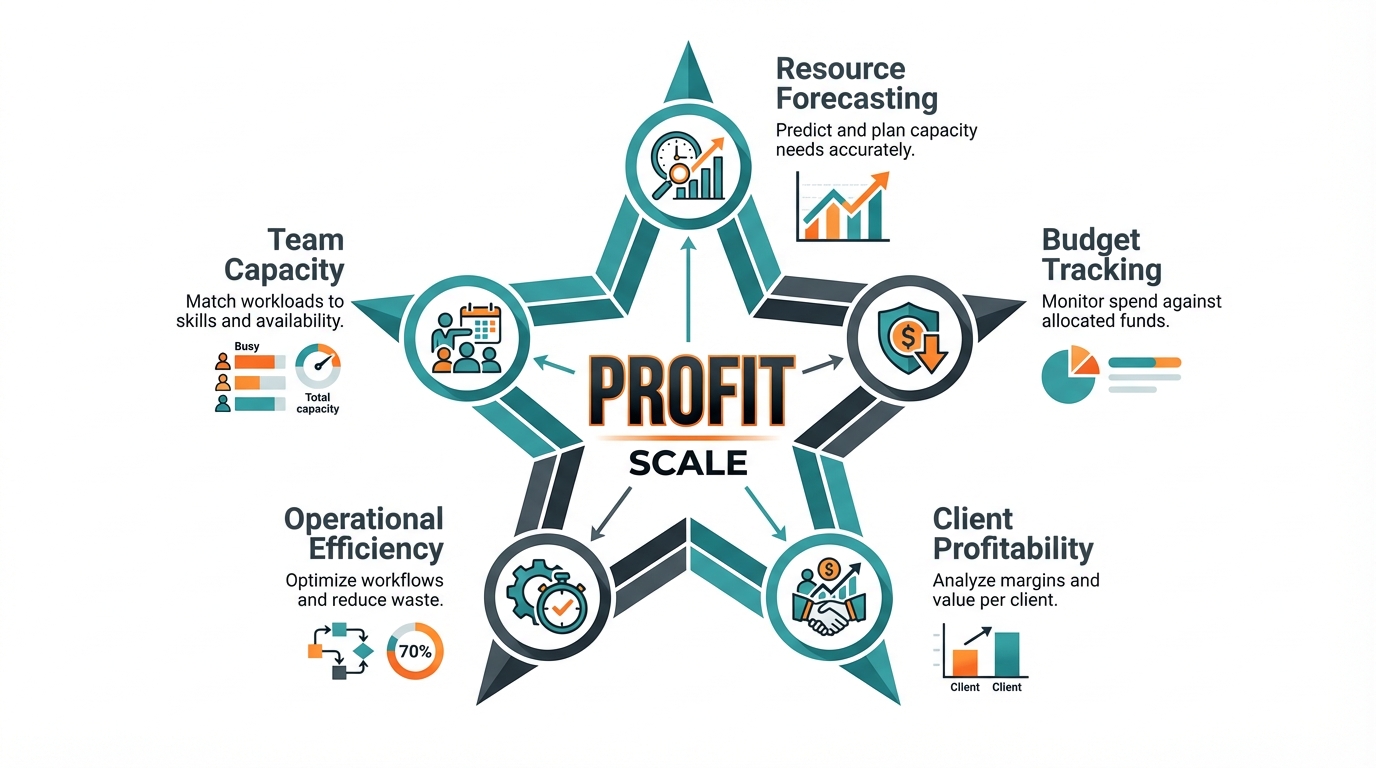
When selecting a platform in 2025, bypass the generic lists designed for startups or internal teams. We only focus on systems that directly drive measurable revenue increases and margin protection. If the software lacks any of these five capabilities, it is not built for agency scale.
#1: Real-Time Profitability Tracking
This is the absolute foundation. If your software cannot tell you the profit margin of a project right now, it is a liability. Every task, every hour, and every resource must be tied directly to a specific client budget.
- The platform must calculate the actual margin remaining on a retainer immediately after time is logged. This prevents over-servicing.
- It must allow you to track internal costs (e.g., staff loaded salary rate) against the billable revenue generated.
- You need instant reports that isolate high-margin clients versus low-margin clients. This data dictates which services you scale and which you sunset.
#2: Utilization and Resource Forecasting
Utilization measures how many of your team’s available hours are spent on billable work. Maximizing utilization is the fastest route to high revenue.
- The software must provide a visual, cross-project workload overview—a single source of truth for who is working on what.
- You must be able to forecast resource needs 4–8 weeks out. This requires integrating current project timelines with incoming sales pipeline data.
- Capacity Management: The system must automatically flag when a team member is over-allocated (or under-allocated), preventing burnout, scope creep, and quality degradation.
#3: Standardized Client Intake & Scope Management
Scope creep is the single biggest profitability killer in agencies. Your PM tool must enforce strict boundaries and defined workflows from the moment a new client is onboarded.
- Use built-in forms and mandatory templates to standardize the client briefing, request, and approval process.
- All new requests must route through a defined approval workflow before they can generate billable tasks. No exceptions.
- The system should facilitate the documentation needed for successful client vetting and project sign-off. Read our guide on The Strategic Checklist: 40 Questions to Vet Agency Clients for the full framework.
#4: Integrated Time Tracking Discipline
If time tracking is optional, your profitability reports are fiction. Discipline in time logging is non-negotiable for accurate financial metrics.
- The time tracker must be native, mandatory, and integrated directly within the task environment. External apps introduce friction and inaccuracy.
- It must clearly distinguish between billable and non-billable (internal) hours. This separation is crucial for accurate utilization metrics and cost accounting.
- Detailed audit logs are required: We need to see who logged the time, precisely when, and against which specific budget line item. Discipline drives financial accuracy.
#5: Scaling SOPs and Templatization
Scaling stops when every project requires custom setup. Agencies thrive on standardized, repeatable processes (SOPs). You cannot customize every project from scratch and maintain margin.
- The platform must allow you to create complex, multi-step project templates (e.g., “Standard Monthly Retainer 2025” or “Advanced SEO Audit”).
- When a new client signs, the template must deploy instantly, automatically assigning roles, dependencies, and deadlines based on the service package selected.
- This ensures consistency in delivery, maintains quality control, and drastically reduces setup time, allowing your team to focus on execution, not administration. Learn how to codify these processes in our detailed SOP Blueprint: Scale Your Agency Revenue in 2025.
Deep Dive: The Top 5 Project Management Platforms for Agency Scale

These five platforms are the industry benchmark. They explicitly meet the PSA requirements we defined above—they are built to manage high-volume client delivery while maximizing profitability and margin protection. If you are scaling beyond $5M in annual revenue, these are the systems that drive that growth.
#1: Productive
Productive is purpose-built for agencies and professional services firms. It is not a generalized task manager adapted for marketing; it is a dedicated Professional Services Automation (PSA) system designed to optimize agency performance.
Strategic Advantages:
- Unified System (True PSA): Productive integrates the sales pipeline, resource planning, project delivery, invoicing, and reporting. This eliminates system fragmentation and the data silos that kill agency margins.
- Real-Time Profitability: Provides live, granular insights into project margins. You know the exact profitability of a retainer before the invoice goes out—allowing for immediate corrective action.
- Utilization Focus: Excellent resource planning tools allow managers to forecast capacity based on individual skill sets and booked time, ensuring maximum billable utilization.
The Trade-Off:
This is a dedicated PSA system, not a simple task list. It has a steeper learning curve than Trello or Asana, requiring significant commitment during the initial setup to define and enforce core internal processes.
#2: Scoro
Scoro is often cited as a true all-in-one solution for agency operations. It handles the entire workflow: from initial quote and resource allocation through final billing and comprehensive financial reporting.
Strategic Advantages:
- Financial Core & Automation: Scoro places a massive emphasis on financial performance, budgeting, and automated invoicing. This is ideal for agencies transitioning away from manual spreadsheet processes or “QuickBooks chaos.”
- End-to-End Workflow: Built-in CRM capabilities allow you to track client accounts and sales pipelines alongside project delivery, providing a single view of the client lifecycle.
- Actionable Reporting Depth: Delivers granular profitability reports segmented by client, service line, and employee. This data is essential for strategic decision-making and optimizing service pricing.
The Trade-Off:
The comprehensive feature set can be overwhelming for smaller teams (under 10 people). Pricing scales quickly, demanding that agencies fully utilize the advanced financial features to justify the investment.
#3: Teamwork.com
Teamwork.com has established itself as a leader in client-focused project delivery. Founded by agency professionals, it possesses a native understanding of the complexities of client workflows and external collaboration.
Strategic Advantages:
- Client Collaboration Focus: Industry-leading features for external client access and approvals. Allows seamless communication and delivery without exposing sensitive internal resource data or project costs.
- Resource Management: Robust workload management tools ensure team capacity is optimized, helping managers instantly visualize bottlenecks before they impact delivery timelines.
- Budget Control: Strong native time tracking and budgeting features are critical for effectively managing both complex fixed-price projects and hourly retainers.
The Trade-Off:
While Teamwork excels at project execution, the deepest P&L analysis may require integration with a dedicated accounting solution. Unlike Productive or Scoro, it does not aim to handle the full breadth of internal financial records.
#4: monday.com
monday.com functions as a highly customizable Work OS. Its strength lies in extreme flexibility and a visual interface, allowing agencies to mold the platform to fit unique client workflows and service offerings.
Strategic Advantages:
- Extreme Flexibility: Easily customize boards, views (Kanban, Gantt, Calendar), and dashboards for radically different client needs or service models (e.g., SEO vs. Paid Media).
- Powerful Automation: Low-code automation capabilities drastically streamline repetitive tasks. This saves hundreds of non-billable hours by automating status changes, notifications, and client reporting.
- Integration Ecosystem: Excellent connectivity with core marketing and sales tools (HubSpot, Salesforce, etc.), which is crucial for lead flow visibility and handoffs.
The Trade-Off:
Flexibility is a double-edged sword. Agencies must invest significant time in building and enforcing strict financial and resource management structures. Without enforced rules, monday.com can quickly become a disorganized collection of siloed boards.
#5: ClickUp
ClickUp offers arguably the most robust feature set in the market, positioning itself as an “all-in-one” solution that attempts to replace several specialized tools used for task, document, and resource management.
Strategic Advantages:
- Maximum Consolidation: ClickUp’s feature density is unmatched (Docs, Goals, Whiteboards, native CRM). This allows agencies to consolidate several expensive tool subscriptions into a single platform.
- Free Tier Strength: Provides a very robust free plan, making it an excellent option for startups or agencies testing the waters before committing to enterprise-level PSA systems.
- Custom Workflow Mapping: Highly customizable statuses, fields, and workflows allow for deep integration of complex agency standard operating procedures (SOPs).
The Trade-Off:
The sheer volume of features creates a steep learning curve. New users often feel overwhelmed, which can significantly slow agency-wide adoption. Achieving true PSA-level profitability tracking requires extensive, specific setup and configuration compared to natively built solutions like Productive.
Comparison Table: Agency PM Software Profitability Metrics
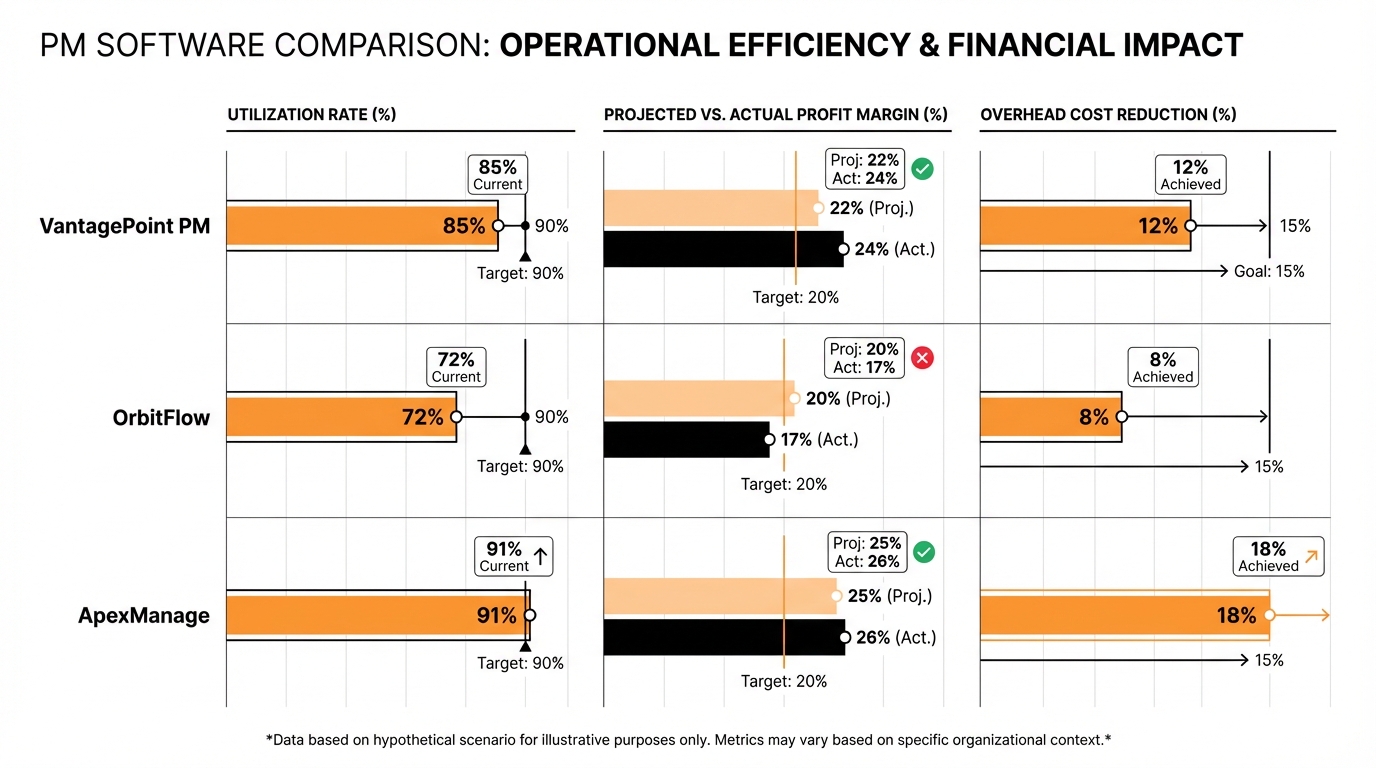
To emphasize the clear difference between simple task managers and true Professional Services Automation (PSA) tools, we created this comparison. We evaluated these five systems strictly based on features essential for agency margin protection, real-time profitability tracking, and sustainable scale—not just basic task completion.
| Platform | Primary Focus | Native Real-Time Profit Tracking | Dedicated Resource Utilization (Forecasting) | Integrated CRM/Sales Pipeline | Complexity for Small Teams (1-10 staff) |
|---|---|---|---|---|---|
| Productive | Professional Services Automation (PSA) | Yes (Core Feature) | High (Advanced Forecasting) | Yes | Medium-High |
| Scoro | All-in-One Financial/Work Management | Yes (Core Feature) | High (Capacity Planning) | Yes | High |
| Teamwork.com | Client Project Delivery | Strong (Budget vs. Actual) | High (Workload Management) | Via Integrations (HubSpot) | Medium |
| monday.com | Highly Flexible Work OS | Requires Custom Build | Medium-High (Resource Views) | Requires Custom Build | Medium |
| ClickUp | Feature-Rich Task Management | Requires Custom Build | Medium (Workload View) | Basic Native CRM | Medium-High (Due to feature density) |
Implementing the PM System: A 4-Step Strategic Rollout
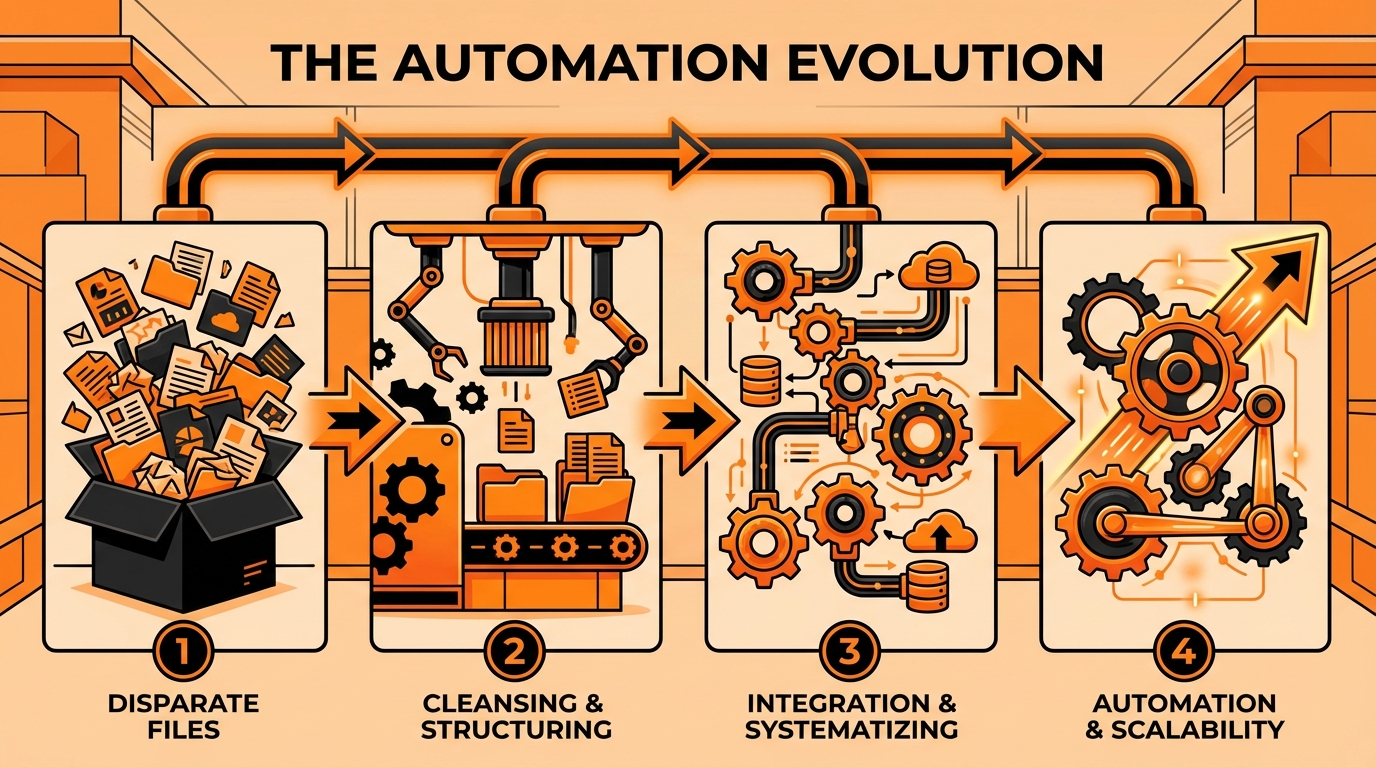
Migrating PM systems is disruptive. Do not treat this transition as a simple software install. Treat it as a critical business process overhaul designed to safeguard margins. Follow this strategic, four-step sequence to ensure adoption and profitability.
Step #1: Define the Profitability Metrics (Before Login)
Before you ever create a project board or assign a task, define what measurable success looks like in the new system. If you cannot measure it, you cannot manage it.
- Target Utilization: What is the target billable utilization rate for your delivery team (e.g., 85% for specialists, 60% for leadership)?
- Minimum Margin: What is the minimum acceptable profit margin per project type (e.g., 40% for retainer work, 30% for fixed-scope projects)?
- Cost Input: You must calculate the internal, fully-loaded cost of every employee (salary + benefits + overhead). Input this cost data first. The system requires accurate cost inputs to calculate real-time margin accurately.
Step #2: Standardize Client Intake and Vetting
Your PM system must act as the gatekeeper, integrating directly with your lead acquisition efforts. This prevents poorly scoped or low-margin clients from entering the fulfillment pipeline and damaging agency profitability.
Use the PM platform’s intake forms or project templates to enforce the initial scope definition and budget allocation. Every new project must pass through this standardized gate before work begins.
The moment a prospect converts, the PM system should automatically generate the standard project structure, complete with phase definitions and allocated hours. This action links the sales process directly to fulfillment, ensuring that initiatives like Strategic Lead Generation for Small Agencies: The 2025 Blueprint result in reliably profitable projects.
Step #3: Enforce Time Tracking Discipline (Mandatory)
Staff resistance to time tracking is the number one killer of PSA implementation and profitability tracking. You need a zero-tolerance policy enforced by leadership.
- Training and Justification: Show the team why they are tracking time—it is not about micromanagement. It proves their billable value, justifies resource allocation, and protects the agency’s ability to pay salaries and grow.
- Weekly Audits: Run weekly compliance reports. If time is not logged accurately or completely by Monday morning, it must be corrected immediately. Non-compliance must impact performance reviews.
- Integration: Ensure the time tracker is integrated directly into the workflow. Staff should be able to start the timer automatically when the task status changes to “In Progress” or “Review.”
Step #4: Automate Reporting and Review
The ultimate goal of a PSA system is to eliminate manual spreadsheet reporting. Configure the dashboards to display the critical P&L metrics for leadership review:
- Top Performers: The Top 3 highest margin projects and clients.
- Intervention Required: The Lowest 3 utilized team members or projects currently exceeding 80% of their allocated budget.
- Agency Health: Real-time variance between budgeted revenue and actual costs across the portfolio.
These reports must be automatically generated and delivered to leadership daily or weekly. If you cannot extract actionable financial insights and identify margin risks within 60 seconds of logging in, the implementation has failed its primary objective.
Frequently Asked Questions

What is the difference between Marketing PM Software and Professional Services Automation (PSA)?
Marketing PM tools (like basic Trello or Asana) focus solely on organizing tasks, deadlines, and internal collaboration. They are task managers, not financial systems. Professional Services Automation (PSA) tools (such as Productive or Scoro) are built specifically for client-facing, billable agencies.
PSA is the crucial upgrade: it integrates resource forecasting, detailed time tracking, expense management, invoicing, and real-time profitability analysis. Agencies cannot protect margins with basic task management; they require the financial oversight capabilities inherent in a PSA system.
Can I use a highly flexible tool like Notion or ClickUp to manage agency finances?
Yes, this is technically possible, but it demands significant operational overhead. Flexible tools require extensive custom setup, complex database linking, and near-perfect adherence to Standard Operating Procedures (SOPs) to mimic a PSA environment. The critical risk lies in manual data entry and linking, especially for calculating utilization and profitability.
This human error factor is high and introduces significant financial risk. Dedicated PSA tools handle these complex calculations natively and automatically, drastically reducing operational risk and safeguarding our financial data integrity.
How often should we review our PM software’s utilization reports?
Utilization reports are leading indicators of future revenue problems and team burnout. Monitoring must be mandatory and frequent:
- Agency Leadership: Review high-level utilization and profitability dashboards daily. This allows for immediate strategic adjustments to capacity and sales focus.
- Project Managers (PMs): Review resource allocation, capacity forecasts, and individual project budgets at least twice weekly.
Daily monitoring is non-negotiable. We must identify under- or over-utilization risks immediately to adjust workloads before they cause project delays or margin erosion.
How do we handle client requests that fall outside the initial scope?
Our PM system must enforce a rigid, formal change request process. This is the only way to protect our margins from scope creep. The procedure must be non-negotiable:
- The client submits the request via a standardized, system-generated form.
- The platform automatically generates an estimated time and cost impact based on our rates.
- This financial estimate must be formally approved by both the client and the agency manager before any tasks are created, assigned, or executed.
If the system does not enforce this structured workflow, the process will fail, and scope creep will erode profitability.
Ready to take the next step?
Try AI Lead Generation Today
Click Here