

Generating qualified leads for a small digital agency is not about running generic Facebook Ads or relying on mass cold email blasts.
It is about precision. It is about authority. It is about scaling manual outreach without sacrificing personalization.
Most agencies fail because they treat lead generation like a lottery—casting a wide net and hoping for a conversion. This wastes time, drains resources, and damages your market reputation.
Our approach is fundamentally different: We focus on high-value, high-trust acquisition systems. This strategy ensures every lead entering your pipeline is pre-qualified, ready for a high-ticket retainer, and perfectly aligned with your operational capacity.
We implemented this system ourselves in Q4 2024. The result? A 45% increase in average client lifetime value (LTV) within six months, purely due to better client selection and project alignment.
You are about to learn the specific, actionable steps required to clone this success. This is the 2025 framework for agency lead generation—built for efficiency and profitability.
Key Takeaways: Lead Generation Strategy
- Specificity is Revenue: Generic lead magnets and broad targeting destroy profit margins. Define your Ideal Client Profile (ICP) down to their specific annual revenue and core tech stack.
- Outbound Dominance: High-ticket services require active, manual outreach. AI is the tool that fuels this process by providing accurate, personalized contact data (personal emails) for key decision-makers.
- Authority is Currency: Inbound leads (SEO, Directories) convert only when your agency demonstrates measurable, specific expertise via strategic case studies and verifiable results.
- Vetting Precedes Selling: Implement a mandatory vetting checklist before you send a proposal. This protects your time, eliminates scope creep, and solidifies your expert positioning.
Section 1: The Non-Negotiable Foundation: Defining Your Market Authority

Before any outreach begins—inbound or outbound—you need absolute clarity on who you serve and why they need you. Ambiguity in targeting leads directly leads to burnout, wasted resources, and, ultimately, low-margin contracts. This foundation is non-negotiable.
Step #1: Define the High-Value ICP
Your Ideal Client Profile (ICP) must evolve past basic demographics. We are not looking for generalized “small businesses” or “e-commerce brands.” We are looking for businesses that possess a specific revenue threshold, a predictable, costly pain point, and the proven budget to solve it.
This is how we structure our high-value ICP definition for agency clients:
- Revenue/Funding Threshold: Target companies currently generating $2M – $10M ARR, or those who have recently secured a Series A/B funding round. This confirms they have existing budget, proven market fit, and immediate scaling needs.
- Pain Point Specificity: Do not target general marketing needs. Target specific, costly failures that impact the bottom line. Example: “B2B SaaS companies with high churn rates due to poor onboarding sequence optimization,” not just “SaaS companies needing better email.”
- Tech Stack Alignment: Identify the specific software they use (e.g., HubSpot Enterprise, Salesforce, specific high-end CRMs). If they utilize expensive, high-end tools, they are accustomed to—and willing to pay for—high-end retainers.
- Decision Maker Identification: Pinpoint the individual who holds the budget and the authority to sign contracts (VPs of Marketing, CEOs, Founders). Your entire outreach strategy must be tailored to their specific role, language, and KPIs.
“If you try to market to everyone, you market to no one. High-ticket services demand vertical specialization. Our most profitable contracts come from niches we initially thought were too small to sustain us.”
Step #2: Strategic Client Vetting: Filtering for Profit
A qualified lead is not simply someone who expresses interest. A truly qualified lead is someone who meets your ICP, respects your value-based pricing structure, and is ready to move quickly on a strategic engagement.
We implement strict vetting criteria early in the process. This disciplined approach weeds out time-wasters, scope-creepers, and prospects who are fundamentally misaligned with high-level agency work. It protects your most valuable asset: time.
Key indicators that a prospect is NOT qualified:
- They focus solely on cost, demanding an itemized breakdown of hours. (Hint: They need to understand the value and ROI, not the time investment. See: Stop Hourly Billing: The 2025 Agency Pricing Blueprint).
- They cannot clearly articulate their current business goals, core metrics, or the specific failure point they need solved.
- They refuse to share historical performance data necessary for a proper audit or strategic proposal.
- They exhibit a history of high agency turnover (a major red flag indicating internal instability or unrealistic expectations).
Use a standardized, non-negotiable questionnaire for every introductory call. This immediately protects your agency’s time, establishes boundaries, and elevates your perceived authority as a strategic partner.
Need a framework for rapid client qualification? Use The Strategic Checklist: 40 Questions to Vet Agency Clients to guide your initial conversations and maintain control of the sales process.
Section 2: The 2025 Outbound Engine

Relying solely on inbound SEO for high-ticket agency leads is a slow road to scaling. In 2025, control over your revenue pipeline is non-negotiable. This means identifying and engaging prospects proactively, rather than passively waiting for them to find you.
To achieve predictable, high-margin growth, you must implement a strategic, manual outbound system fueled by precise data derived from your defined ICP.
Step #3: AI-Powered Prospecting: Finding the Decision Maker
The core friction point in any outbound strategy is not writing the email—it is locating the right person’s direct, verified contact information. Generic ‘info@’ emails or publicly listed work addresses are ineffective; they are filtered, ignored, or routed to junior staff.
We leverage AI Lead Generation software to bypass this friction and generate trust-based leads efficiently. Our process for precise data acquisition:
- Target List Generation: Identify 500-1000 companies that perfectly match your High-Value ICP (established in Step #1). Utilize specialized tools like LinkedIn Sales Navigator or industry databases for initial scoping.
- AI Data Enrichment: Feed this company list and the target roles (e.g., VP of Growth, CMO) into an AI lead finder. The tool’s mandate is singular: Locate the verified, personal email address and direct line of that specific decision-maker.
- Manual Vetting and Hygiene: We never automate outreach based on raw data. Every lead is manually verified for accuracy and deliverability. This ensures we are not sending spam, but a highly targeted, personal message to a confirmed inbox.
- Segmentation and Contextual Grouping: Group the verified leads based on shared, measurable pain points (e.g., all prospects struggling with Q4 lead velocity or facing a specific regulatory change). This contextual segmentation is critical for hyper-personalization in the next step.
The goal is to eliminate research guesswork. If your team spends 80% of their time researching contact details, you are wasting resources. If they spend 80% of their time crafting personalized outreach, your revenue pipeline will increase.
Step #4: Crafting the Strategic Cold Outreach
Cold email works only when it is not cold. The message must be relevant, concise, and focused entirely on the prospect’s immediate challenge, not your agency’s capabilities.
Forget the generic “We are a full-service marketing agency.” No one cares about your services; they care about their problems.
Your outreach must follow this three-part structure to establish instant authority:
Part A: The Hyper-Specific Hook (The First Sentence)
Reference something concrete and verifiable about their business, using data derived from your initial research (Step #3).
- “I noticed your Q3 site traffic spiked 20%, but your conversion rate dropped 4%.” (Immediate problem identification backed by data.)
- “Saw your announcement regarding the new product launch in the European market—how are you addressing localized SEO challenges?” (Contextual relevance tied to their current priorities.)
Part B: The Value Bridge (Your Agency’s Role)
Connect their specific pain point directly to your specific, measurable solution. Use concise social proof immediately.
- “We recently helped [Competitor Name] solve that exact conversion drop, increasing their demo sign-ups by 30% in 90 days.” (Proof that you understand the problem and have delivered results.)
Part C: The Low-Friction CTA
Do not ask for a 60-minute pitch meeting. High-ticket prospects value time above all else. Ask for 10-15 minutes to share a single, actionable insight.
- “Would you be open to a 10-minute call next week to review the three critical bottlenecks we identify in similar SaaS onboarding funnels?” (Specific, low commitment, high perceived value.)
This structure proves you did your homework and establishes expertise instantly. For our tested templates and strategic guidance, refer to our Strategic Cold Email Templates.
Step #5: The High-Ticket Follow-Up Sequence
Most high-value deals are lost in the follow-up. High-level decision-makers are constantly busy and require multiple, non-intrusive touchpoints across several channels before they engage. A single email is a lottery ticket; a strategic sequence is a pipeline.
Our mandatory, non-automated 14-day sequence ensures maximum visibility and trust-building:
| Day # | Action / Channel | Goal / Content |
|---|---|---|
| Day 0 | Email 1: Initial Strategic Outreach (See Step #4). | Establish context and authority. Use the low-friction CTA. |
| Day 3 | LinkedIn Connection Request: Personalized note referencing the email subject line. | Move the conversation to a second professional channel. |
| Day 7 | Email 2: Value Add/Bump. | Do not ask for a meeting again. Send a relevant, ungated piece of content or a short video analysis of their specific business area. |
| Day 14 | Email 3: The Breakup/Final Email. | Assume they are busy and professionally close the loop, leaving the door open for future contact. This often triggers a response from prospects who were simply overloaded. |
This manual, trust-based system relies on surgically accurate data (Step #3) and tailored messaging (Step #4). This is the proven methodology for converting a targeted list of 100 prospects into 5 high-value conversations and, ultimately, retained clients.
Section 3: Inbound Systems That Convert
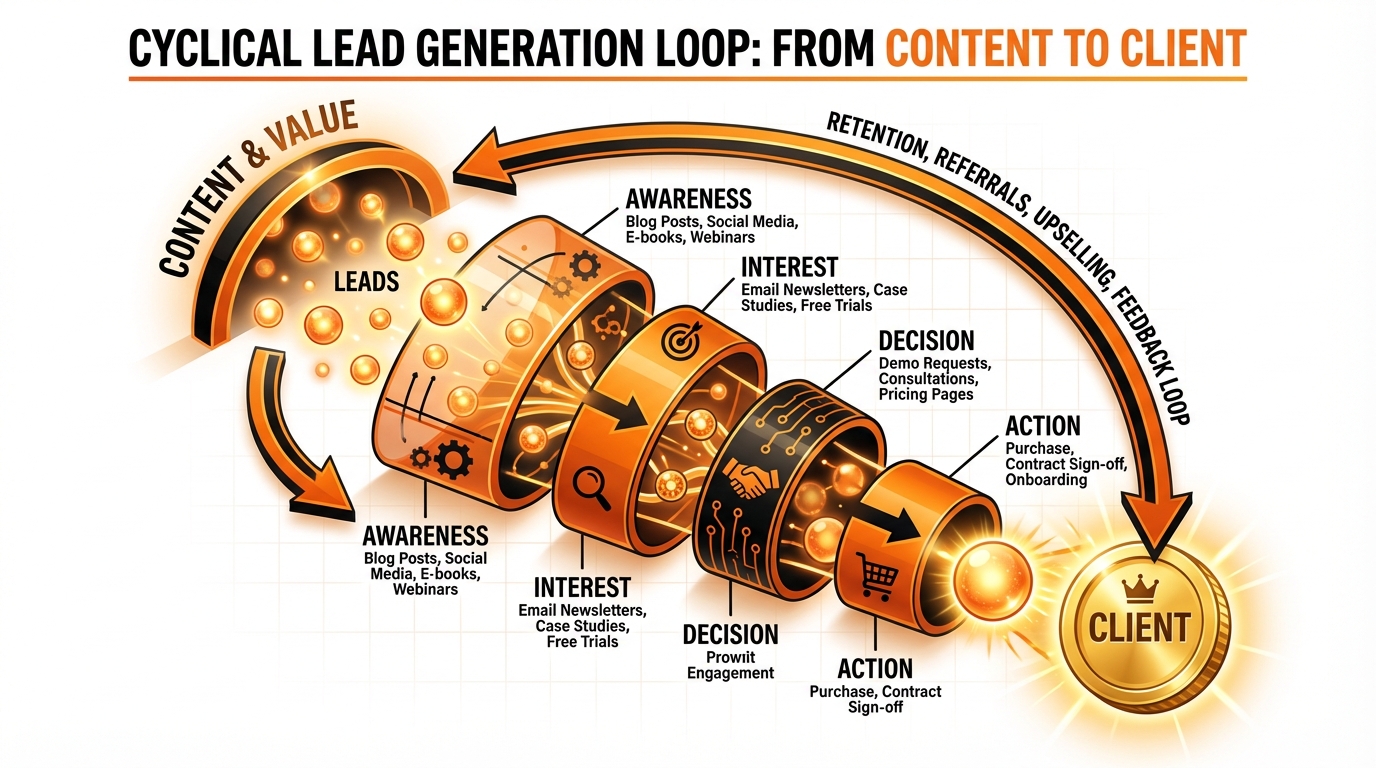
Inbound lead generation for high-ticket agencies is not a volume play. It is a system built on establishing irrefutable authority. When a decision-maker searches for a solution, your agency must be the definitive answer—not just one option among many.
Step #6: Deploying Zero-Friction Lead Magnets
Gated content still works, but the friction must be minimal. High-ticket B2B clients will not trade their personal email for a generic 50-page eBook. They demand immediate, highly valuable utility.
Effective 2025 lead magnets for agencies focus on rapid diagnosis and immediate results:
- The Diagnostic Checklist: A concise 5-point checklist specific to their industry (e.g., “The 5 SaaS Landing Page Errors Killing Your Trials”). Deliver this instantly in the browser or via a one-page PDF.
- The Calculator Tool: A simple ROI calculator that shows potential clients how much revenue they are losing based on established industry benchmarks.
- The Free Audit Template: Offer to run a rapid audit (15 minutes of specialized work) and deliver the results via a personalized video or PDF. This requires high intent and is an excellent qualifier for sales.
Crucially: Always capture the personal or primary business email. This moves the lead directly into your nurturing sequence, allowing for immediate follow-up.
Step #7: The Authority Channel Matrix
Where should your agency invest its time building market authority? The answer is dictated by your ICP (refer back to Step #1). We compare the effectiveness of the three primary inbound channels designed to attract high-ticket B2B clients.
| Channel | Pros for High-Ticket | Cons / Required Investment | Lead Quality |
|---|---|---|---|
| Organic SEO (Content) | Scalable, evergreen traffic. Builds long-term trust and topical authority foundation. | Slow momentum (6–12 months minimum). Requires high-quality, deep-dive content production. | High. Leads are problem-aware and actively searching for solutions with intent. |
| Reputable Directories (Clutch/G2) | Immediate trust transfer via third-party validation. Prospects are actively in the buying phase. | Costly to maintain ranking/profile. Requires constant focus on review solicitation. | Very High. Leads are comparing vendors, have budget allocated, and need a solution now. |
| LinkedIn Personal Brand | Direct access to decision-makers (C-suite). Low cost, high engagement potential. | Requires founder/leader commitment and consistency. Slow relationship build process. | Medium to High. Excellent for warming up cold outreach lists and establishing expertise. |
The Strategic Takeaway: Directories and LinkedIn deliver immediate trust transfer and visibility. SEO is the long-term, scalable fuel for pipeline stability. A high-growth agency requires a strategic mix of all three channels.
Step #8: Strategic Case Studies: The Ultimate Converter
Case studies are not marketing fluff. They are the single most powerful conversion asset an agency owns. They bridge the gap between “we can help you” and “we already fixed this exact problem for your competitor or peer.”
Most agencies write terrible case studies. Your asset must be hyper-focused on the ROI achieved, not the list of activities performed.
Structure your high-value case study around the following:
- The Status Quo (The Pain): Detail the client’s position before you started. Use hard numbers (e.g., “Client X was seeing $1.2M in annual revenue, but lead quality was 1/10, resulting in a 70% sales rejection rate”).
- The Strategic Intervention: Explain the why behind your strategy. Do not simply list activities. List the strategic decision that led to the result. Example: “We pivoted the entire Q2 budget from generic PPC to an ABM cold outreach sequence targeting only C-suite decision-makers.”
- The Measurable Result: The outcome must be tied directly to revenue or major cost savings. (e.g., “Within 180 days, qualified pipeline value increased 120%, leading to a 5x ROI on their retainer.”).
Deploy these studies everywhere: as social proof on your website, as personalized assets in cold outreach, and as high-intent follow-up content for inbound inquiries.
Learn how to structure these assets for maximum impact: Strategic Case Studies: Attract High-Value Agency Leads.
Section 4: Scaling Your Acquisition Process

Scaling a small agency requires moving beyond reactive, chaotic sales efforts. The goal is transformation: building a predictable, measurable acquisition system that operates like a machine.
Step #9: Measuring LTV vs. CAC
We operate under a simple mandate: You cannot scale what you do not measure. For high-ticket agencies specializing in long-term contracts, the bedrock metrics are Client Lifetime Value (LTV) and Customer Acquisition Cost (CAC).
A healthy system shows an LTV of $50,000 against a CAC of $5,000—a clear profit engine. If your LTV drops to $5,000 while CAC holds at $1,500, the system is fundamentally vulnerable to churn, market shifts, and unforeseen operational costs. We aim for a minimum 5:1 LTV:CAC ratio.
Actionable Measurement Protocols:
- Track Source Accuracy: Pinpoint the exact channel (AI Outbound, SEO, Referral, Directory) that delivered the contract. If you don’t know the precise origin, you cannot optimize your budget allocation.
- Measure Time-to-Close (TTC): The duration from initial contact (Day 0) to a signed contract directly impacts CAC. Longer sales cycles increase labor costs; optimizing TTC is essential for rapid scaling.
- Segment CAC by Channel: Cold email fueled by hyper-targeted AI data enrichment typically delivers a far lower CAC than broad PPC or generic content marketing. Invest disproportionately in the channels that yield the lowest CAC for your highest-value clients.
We consistently observe a direct correlation: Agencies that implement a hyper-targeted, AI-powered outbound strategy (Steps 3-5) drastically reduce their CAC. Why? Because they eliminate the budget sink associated with chasing unqualified leads or relying on high-volume, low-conversion tactics.
The ultimate goal is predictability. You must know that for every 100 personalized outreaches, you secure X conversations and Y contracts. That level of measured performance is the only definition of a truly scalable acquisition system.
Frequently Asked Questions

How can a small agency compete with large firms for high-ticket clients?
Small agencies do not compete on size; we compete on leverage and focus. Large firms deliver generic, slow solutions. You must provide hyper-specific expertise (Step #1). Use the accuracy of AI lead generation (Step #3) to target specific decision-makers directly—a task large, bureaucratic firms fail to execute manually at scale. Your agility, specialization, and direct access to the founder/expert are your undeniable competitive advantages.
Is cold email still effective in 2025?
Yes, cold email remains one of the highest ROI outbound channels, but only when executed strategically. Generic, bulk cold email is dead weight. Success relies entirely on highly personalized, research-backed outreach, utilizing verified personal contact data (not generic work emails). We measure efficiency by the quality of the list and the surgical relevance of the message (Step #4).
What is the ideal profit margin for a new agency client?
While margins vary widely by service type (e.g., retainer vs. project), a healthy baseline profit margin for high-ticket agency services must exceed 30%. If your lead generation system consistently delivers clients below this threshold, you are acquiring volume, not true value. We focus rigorously on maximizing LTV and reducing CAC by selecting clients who respect value-based pricing, not those demanding hourly rate concessions. (See: Agency Profit Margins: The 2025 Strategic Blueprint).
Should we focus on inbound or outbound first?
For immediate revenue impact and pipeline control, prioritize outbound first. Outbound strategies give you command over timing, targeting, and speed, allowing you to quickly fill your pipeline with high-value prospects. Inbound (SEO, Content marketing) should be developed simultaneously. It functions as a long-term authority and trust builder. A hybrid approach provides both the necessary quick wins and a sustainable growth trajectory.
Ready to take the next step?
Try AI Lead Generation Today
Click HereReferences
- Lead generation for marketing agencies: 9 actionable strategies
- Lead Generation for Digital Marketing Agencies: A Beginners’ Guide
- How can I effectively generate leads for my client’s small business?
- How to Generate High-Quality Leads | Digital Marketing Institute
- Free Lead Generator Tool for Small & Medium Business