

Most agencies waste critical time onboarding the wrong clients.
They default to surface-level questions: What is your budget? What is your mission statement?
This is a critical error. These questions confirm basic fit, but they fail to vet for **scale** or true **profit alignment**.
If you run a high-ticket service business, your intake process must function as a rigorous filter. It must immediately identify clients who understand value, possess the necessary infrastructure, and are ready to execute at speed.
We use this exact 40-point framework to vet every prospect we engage. It ensures every new client engagement drives measurable, mutual revenue growth—for them and for us.
Key Takeaways: Vetting for Scale
- Prioritize Financial Metrics: Move beyond basic budget discussions. Ask directly about Lifetime Value (LTV), Customer Acquisition Cost (CAC), and current profit margins.
- Demand Technical Transparency: Require explicit answers on data ownership, API access, and the existing tool stack.
- Assess Risk Alignment: Use situational questions to gauge how the client handles disagreement, unexpected failures, and necessary pivots.
- Define the ‘Why Now’: Understand the precise catalyst for hiring your agency right now, ensuring urgency and commitment are high.
Why Your Intake Questions Define Your Agency’s Value

A high-level intake questionnaire is not an administrative chore. It is a strategic tool—in fact, it is the most critical tool in your sales process.
It immediately signals your expertise. This process positions us as the authority, not merely a vendor simply waiting for instructions.
When we ask deep, pragmatic questions (e.g., about their P&L or existing technical debt), we immediately elevate the conversation. We shift the focus from cheap tasks to high-value outcomes.
This methodology is non-negotiable. It ensures we only engage in projects that have a high probability of success and high profitability for our agency.
Step #1: Financial and Profit Alignment Questions (The Non-Negotiables)

A true high-ticket partnership begins not with tactics, but with the balance sheet. If your client cannot articulate their core financial metrics, they are not ready for aggressive, scalable growth.
Never start with the project budget. Start with the client’s financial reality.
We must confirm the client has the underlying financial structure to support the aggressive growth we plan to deliver. If their Customer Acquisition Cost (CAC) is unsustainable, no marketing tactic—or agency—will save them.
- What is your current Customer Lifetime Value (LTV)? (If they cannot answer this immediately, that is a critical red flag signaling a lack of financial maturity.)
- What is your target Customer Acquisition Cost (CAC) for this specific initiative? (We require a strict ceiling to define the scope and realistic traffic strategy.)
- What is the maximum acceptable payback period for a new client acquisition? (30 days? 90 days? This metric fundamentally dictates our strategy pacing and budget allocation.)
- What is your net profit margin on your core offering? (This dictates resource allocation, risk tolerance, and the scale of potential investment.)
- What percentage of current revenue is generated by repeat business versus new acquisition? (This assesses product-market fit longevity and determines the necessary intensity of new lead generation efforts.)
- What internal costs (salary, tech stack) are currently allocated to the area we will be managing? (Establishes a clear, auditable baseline for calculating immediate ROI and quantifying efficiency gains.)
- If we achieve X result (e.g., 20% increase in leads), what is the conservative, quantifiable financial impact over 12 months? (Forces them to quantify value in dollars, not abstract activity.)
- How do you currently define a successful, profitable agency relationship? (Crucial for defining agency profit margins and ensuring the partnership is mutually sustainable and ambitious.)
We are not selling marketing activity. We are selling scalable, quantifiable revenue increase. If the client cannot quantify the financial impact of our potential work, they are not ready for a high-ticket partnership.
Step #2: Strategic Vision and Goal Setting (Beyond the Mission Statement)

Standard agency qualification starts and ends with vague inquiries about “short-term goals.” We move past that. A high-value partnership requires understanding the structural necessity driving the search.
We are not interested in generic mission statements. We are vetting the client’s urgency and their commitment to necessary structural change. We need to identify the catalyst—the critical pain point *right now*—and quantify the consequences of failure.
If the stakes are low, the commitment (and the necessary budget) will inevitably be low.
- What is the single, most critical bottleneck in your current sales funnel? (Be specific: conversion rate, lead quality, follow-up speed. We need precision, not general complaints.)
- If you achieve your Q1 goal, what strategic decision does that success unlock for the business? (Hiring a new VP, expansion into a new market, securing the next round of funding. This links our work directly to enterprise growth.)
- Describe the primary risk of inaction for the next six months. (Force them to quantify the real cost of delay—lost market share, declining retention rates, competitor dominance.)
- Who, internally, is the ultimate decision-maker, and how quickly can they approve strategic shifts or budget changes? (We vet for implementation speed. Bureaucracy kills results.)
- Who are the three competitors you fear the most, and specifically, what is their competitive advantage over you? (This forces a realistic, non-biased competitive analysis and highlights where we must focus our differentiation strategy.)
- How do you currently define a “qualified lead”? Be precise with required titles, company size, and intent signals. (Immediate alignment of our lead generation metrics with their sales criteria.)
- What is the biggest misconception clients have about your product or service? (Identifies immediate messaging gaps and points us toward necessary positioning fixes.)
- What is the average tenure and size of your current sales team? (Assesses internal stability and capacity to handle the increased lead volume we will deliver.)
- What is the “Why Now” moment that triggered this agency search? (Was it a failed internal project, a sudden competitor surge, or a recent funding round? This determines the true level of urgency.)
Step #3: Technical Infrastructure and Data Ownership
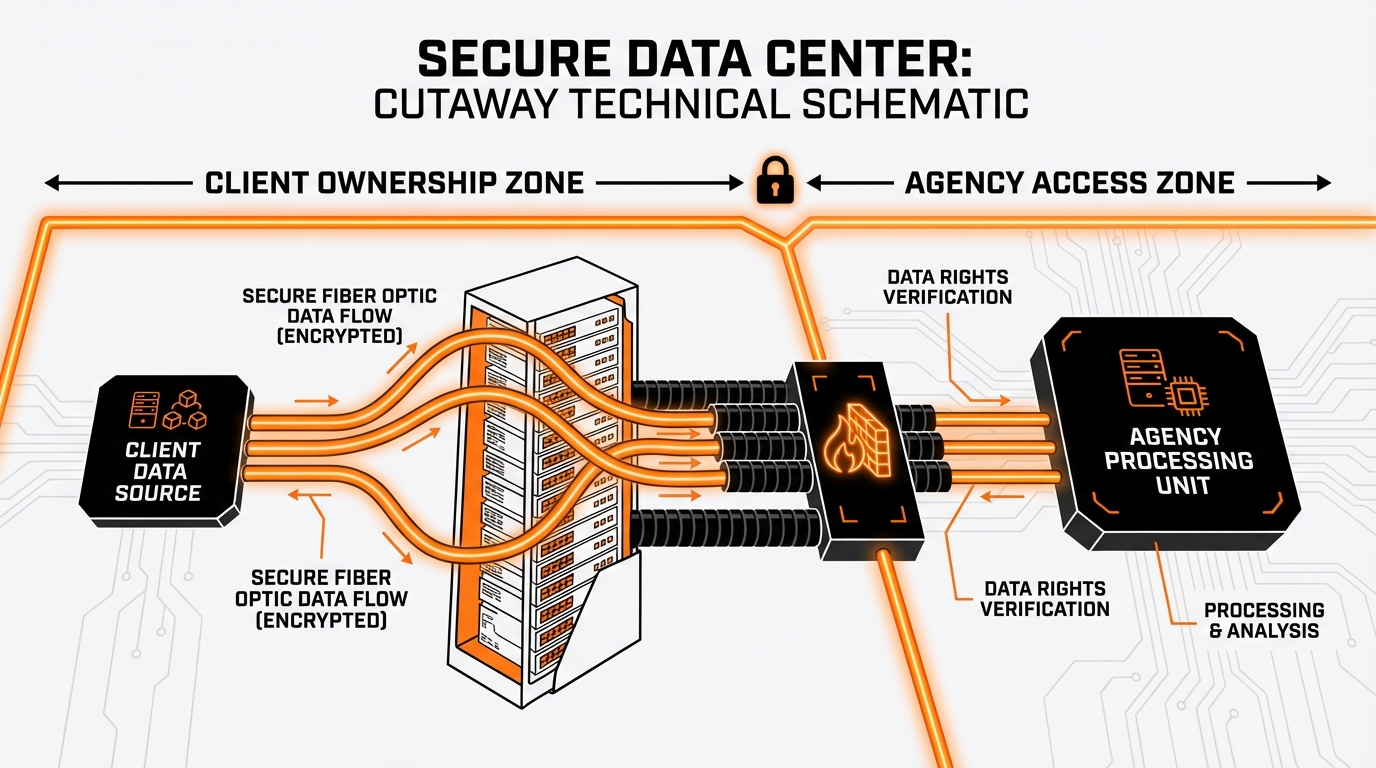
Strategy is theoretical. Execution is defined by access. If the technical foundation is shaky, the campaign is dead on arrival. Most agencies fail to vet this properly, leading to devastating delays and stalled momentum.
High-ticket lead generation requires immediate, deep integration with existing client infrastructure—CRM, analytics, and lead capture tools. We secure unimpeded access and establish clear data ownership *before* signing the contract. This section vets their operational maturity and technical preparedness.
- Which CRM/Sales tool are you currently using (e.g., HubSpot, Salesforce) and who holds admin access? (Required for real-time tracking, accurate attribution, and rapid integration.)
- Will we retain 100% ownership of all campaign data, audience lists, and ad account history upon termination? (This is a non-negotiable prerequisite for high-value partnerships. The client must own the assets we create.)
- What is your current process for integrating new lead data into your CRM? Is it manual or automated? (We are vetting for scalability. Manual processes introduce friction and kill velocity.)
- Do you have Google Analytics 4 (GA4) properly installed, and are conversion events accurately tracked? (This is a fundamental technical prerequisite. If not, the setup must be factored into the onboarding timeline.)
- What third-party data enrichment tools (e.g., Clearbit, ZoomInfo) are currently integrated with your stack? (Identifies existing data assets we can immediately leverage to improve lead quality.)
- Who is the dedicated internal technical liaison for immediate access issues? (We must bypass the IT department bottleneck. Avoid waiting three days for a simple password reset.)
- Describe your current lead scoring methodology. (We need to understand how Sales qualifies leads. If no methodology exists, we must build a defined scoring system for alignment.)
- What is the current speed (load time) and conversion rate of the primary landing page we will be driving traffic to? (We are vetting the existing asset quality. Poor landing pages negate effective traffic generation.)
Step #4: Operational Cadence and Risk Assessment
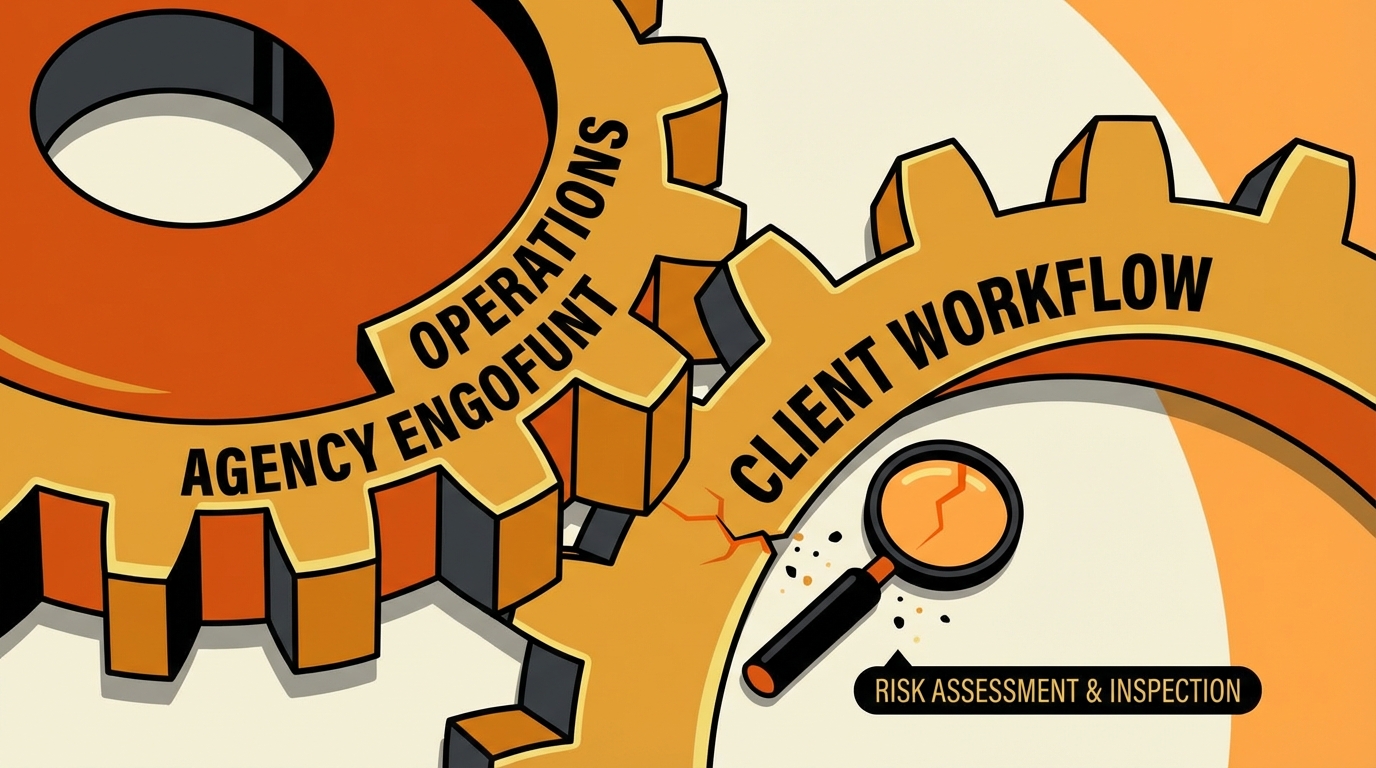
Technical integration is useless without operational alignment. The long-term success of any high-ticket engagement is defined entirely by communication, operational cadence, and conflict resolution maturity.
We leverage situational questions here to pressure-test the client’s understanding of true partnership dynamics. This is how we proactively identify and lock down scope creep, manage unrealistic expectations, and prevent expensive friction points before the contract is signed.
- How frequently do you require formal reporting, and what KPIs are non-negotiable for inclusion? (Defines reporting cadence and hard metrics. This prevents scope creep via ‘ad hoc’ report demands.)
- If we recommend a strategy that directly contradicts your existing internal belief structure, how do you prefer to handle the disagreement? (Tests trust. We must establish authority; we cannot execute strategies based on internal dogma.)
- What does success look like in the first 30 days? Be realistic. (Pressure-tests for unrealistic expectations. We need actionable, achievable short-term wins, not revenue targets.)
- What is your internal process for providing feedback and creative approvals? (This vets the approval chain. Slow approvals are the number one killer of campaign momentum.)
- Have you worked with an agency before? If yes, what was the primary reason the relationship ended? (Critical insight. The client often describes their own operational deficiencies disguised as the previous agency’s failure.)
- If we hit a major operational roadblock (e.g., ad account suspension or payment failure), what level of involvement do you expect from your team to resolve it? (Tests accountability and willingness to handle client-side infrastructure issues immediately.)
- What is the maximum response time you expect from our team during standard business hours? (Sets clear communication SLAs. Prevents constant, distracting ‘check-in’ requests.)
- If the project requires a significant, unexpected shift in budget (e.g., scaling ad spend by 50% or pausing a channel), who is authorized to make that decision immediately? (Vetting for agility. Delays on budget changes cost revenue.)
Step #5: Customer and Market Perception Deep Dive

Before launching any campaign, we must assess the existing reputation and authority of the client. We cannot build high-performance, trust-based lead generation strategies in a vacuum.
This deep dive focuses on crucial client assets—case studies, testimonials, and current industry standing. We are vetting the raw material we will use to generate authority and drive high-ticket sales.
- Can you provide 3-5 high-quality, measurable case studies detailing recent client wins? (If they lack demonstrable, measurable success stories, the foundational content build will be significantly slower and more expensive.)
- What are the 3-5 keywords or phrases your target customers use when searching for a solution to their problem? (This pressure-tests their market awareness and is critical for immediate organic and paid strategy alignment.)
- What is the single most common objection your sales team hears on discovery calls? (This directly informs the necessary counter-messaging, content strategy pillars, and required sales enablement assets.)
- If your customers had to describe your brand in three words, what would they be? (Assesses the gap between current brand perception and desired brand aspiration.)
- Where do your ideal clients currently consume industry content (e.g., specific newsletters, podcasts, forums)? (This data is essential for directing our targeted distribution, outreach, and paid media spend.)
- What recent industry changes (regulatory, technological, competitive) are currently impacting your business model? (Vets the client’s strategic awareness and resilience to immediate market volatility.)
- What is the most successful piece of content or sales material your company has produced in the last year? Why did it succeed? (Identifies the existing winning formats, themes, and proof points we need to scale immediately.)
Strategic vs. Tactical Intake: A Comparison
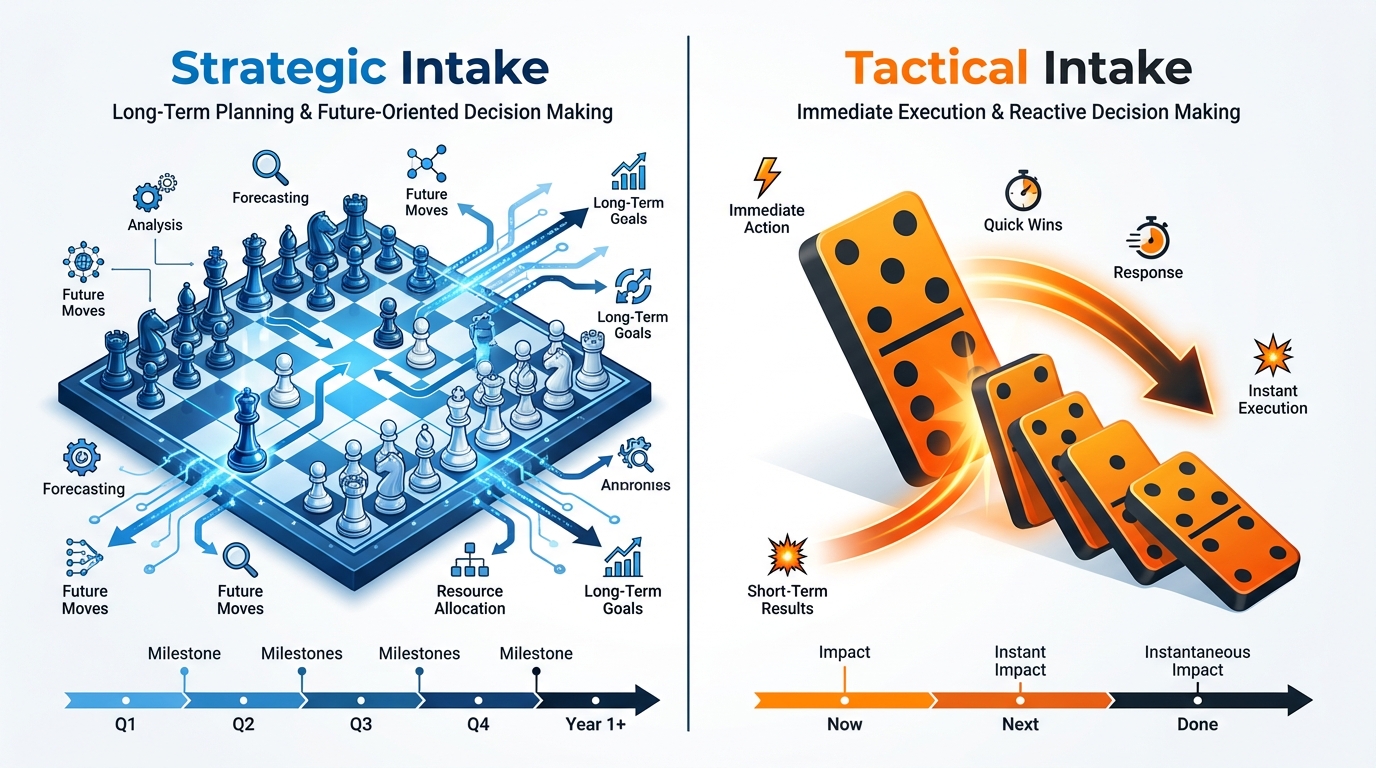
The difference between a high-value agency and a commodity vendor is stark. It is defined entirely by the quality of the questions asked during the intake process.
Commodity vendors ask what to do (tactics). Strategic partners ask why we are doing it, and what success truly means for the client’s overall P&L. We do not accept surface-level answers; we push for the context that unlocks true revenue growth.
Use the comparison below to audit your current qualification process. Are you gathering low-leverage tactical data, or are you extracting the high-leverage strategic drivers necessary for partnership success?
| Low-Leverage (Tactical Focus) | High-Leverage (Strategic Drivers) |
|---|---|
| What is your current marketing budget? | What is your target Customer Acquisition Cost (CAC) and Lifetime Value (LTV)? |
| What social media platforms do you use? | Where do your ideal clients consume industry content, and which sources do they trust implicitly? |
| Who are your top competitors? | What is the specific competitive advantage you fear most, and why are you currently unable to neutralize it? |
| What are your goals for the project? | What strategic decision does achieving this goal unlock for your business (e.g., funding, hiring, market expansion)? |
| How often should we communicate? | How do you handle strategy disagreement or unexpected failure? (This gauges partnership maturity.) |
The Strategic Onboarding Mandate: Vetting for Profitability

Our mandate is clear: We do not sign every client. We only sign profitable partners—those structured for mutual success from Day One.
This rigorous questionnaire is, fundamentally, a self-selection mechanism. It is designed to expose operational weaknesses and financial misalignment early in the process.
Clients who recoil from detailed, high-level questions demonstrate they are not ready for a strategic partnership. They are seeking commodity labor and quick fixes. We, however, are filtering for scalable, long-term revenue partners.
Implement this vetting checklist immediately. Filter the noise. Dedicate your agency’s finite resources only to businesses possessing the financial muscle and operational maturity required for true scale.
This commitment to rigorous vetting is the difference between a struggling commodity vendor and a high-value, sustainable agency.
Ready to take the next step?
Try AI Lead Generation Today
Click HereFrequently Asked Questions
- When is the optimal time to send the client questionnaire?
- The optimal time is immediately following the initial discovery call, but critically, before the proposal is finalized. The data gathered dictates the scope, defines the strategy, and justifies the value-based pricing. Never treat this as a post-contract formality. It is a core vetting tool used to confirm mutual readiness.
- Should I make the questionnaire mandatory for proposal creation?
- Mandatory. This is a non-negotiable requirement for high-ticket services. We frame it as the necessary input for crafting a hyper-personalized, value-based proposal. Refusal to provide essential data—especially core financial metrics—is an immediate red flag; it signals a lack of readiness for a data-driven partnership. Use this step as a critical quality filter to protect your agency’s most valuable resource: time. This due diligence supports the value-based pricing strategy.
- How do I handle clients who don’t know their LTV or CAC?
- This reveals a fundamental operational deficiency. We never begin a scaling engagement without established Customer Lifetime Value (LTV) and Customer Acquisition Cost (CAC). You have two strategic options:
- Option 1: Immediately decline the engagement. They are not ready for growth investment.
- Option 2: Propose a high-ticket, fixed-price “Discovery & Audit Phase.” This phase is exclusively dedicated to establishing tracking infrastructure and defining these core metrics.
- How long should the questionnaire be?
- Quality outweighs quantity. Our standard recommendation is 25 to 40 strategic questions. If using a digital platform, employ conditional logic to streamline the experience and hide irrelevant sections. The length is justified. It ensures the necessary depth of understanding, serving as an investment that saves both parties months of operational misalignment later.
References
- Marketing Agency Client Questionnaire: 27 Questions to Ask New …
- Marketing client questionnaire: 30 questions to ask – Content Snare
- If you were a client what questions would you ask a potential social …
- 27+ Questions to ask in your Agency Client Onboarding … – Leadsie
- 10 Questions Companies Should Ask All Prospective Agency Partners