


.ak-article-table { width: 100%; border-collapse: collapse; margin: 20px 0; border: 1px solid #2563eb; } .ak-article-table th { background-color: #1e40af; color: white; padding: 10px; text-align: left; } .ak-article-table td { border: 1px solid #ddd; padding: 8px; } .ak-cta-button { display: inline-block; background-color: #16a34a; color: white !important; padding: 12px 24px; text-decoration: none; border-radius: 5px; font-weight: bold; margin: 20px 0; text-align: center; } .ak-cta-button:hover { opacity: 0.9; }
You launched your digital marketing agency. Now you need revenue.
The market is saturated with generic, low-value offers. Prospects are tired of automated LinkedIn spam and templated cold emails. They ignore the noise.
Securing your first high-value client is not about volume. It is about precision. It is about demonstrating unique expertise—long before the contract is signed.
We built our lead generation systems (and the systems for our high-ticket clients) on a bedrock of non-automated trust. We ignore the shortcuts that lead directly to churn.
This guide outlines the precise, strategic framework we use to land foundational clients fast. This is not theory. This is the blueprint for immediate revenue generation.
Immediate Focus: The Three Pillars of Client Acquisition
The framework detailed below is built on three core, actionable pillars designed to bypass market saturation and establish authority immediately:
- Hyper-Niche Targeting: Identifying the exact, profitable segment you can serve better than anyone else.
- Irresistible Offer Design: Crafting a service agreement where the perceived value drastically outweighs the cost, minimizing sales friction.
- Non-Automated Value Delivery: Providing actionable insights and demonstrating expertise before the pitch.
Key Takeaways: Landing Your First Client

- Niche Down Hard: Generalist agencies do not scale; they die slow deaths. Our success hinges on focusing on a specific, high-value vertical (e.g., B2B SaaS, specialized e-commerce, or high-end legal services).
- Create Zero-Client Case Studies: We must demonstrate measurable ROI before securing a contract. Perform high-value audits, competitive gap analyses, and hypothetical “Day 90” campaign forecasts for target clients.
- Master Precision Outreach: Bypass the ‘info@’ black hole. Leverage modern data and AI tools to acquire direct, personal contact information for decision-makers. Our outreach must be hyper-personalized, not bulk-sent.
- Systematize Immediately: Your first client is not a fluke; it must be the foundation of a repeatable, scalable model. Document every step of the acquisition process from Day One—this is your future sales playbook.
- Price for Authority and Confidence: Never undervalue the measurable outcomes you deliver just to win a low bid. Charge a premium, high-value retainer that reflects the confidence we have in guaranteeing a significant return on investment (ROI).
Stop Chasing Leads: Start Defining Your ICP
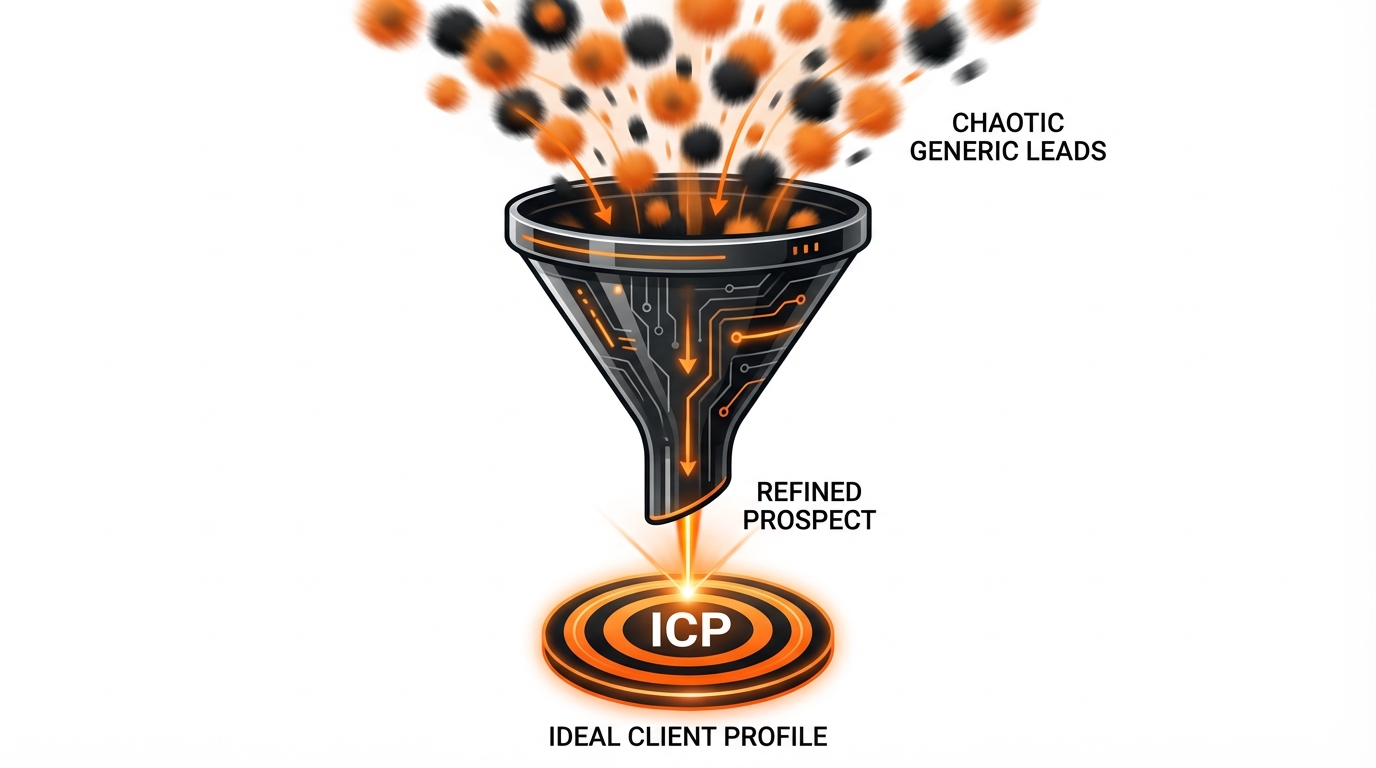
The vast majority of new agencies stall—or fail outright—by committing one critical error: treating the entire market as their prospect pool. This generalist mindset kills growth.
Download the Visual Guide
Get the slide-by-slide visual summary of this article (PDF) for free.
Our data shows that 80% of client acquisition struggles stem directly from the lack of a defined Ideal Client Profile (ICP). If your messaging attempts to speak to everyone, it will resonate with absolutely no one. Defining your ICP is non-negotiable for scaling.
Step #1: Niche Selection is Non-Negotiable
Your niche must satisfy two opposing criteria simultaneously: it must be specific enough to establish you as the obvious, dominant expert, yet large enough to sustain aggressive scaling.
We mandate avoiding broad categories like “general small business marketing.” Instead, target highly specific verticals: “Series A FinTech startups seeking PQL acceleration” or “Multifamily residential brokers operating exclusively in high-growth metro areas (e.g., Austin, Miami).”
Use these three criteria to vet the profitability of any potential niche:
- Budget Capacity (Can they pay?): Can the business comfortably afford a $5k+ monthly retainer? If their average customer value (ACV) is low—or their sales cycles are excessively long—they cannot generate the necessary ROI to justify your fees.
- Measurable Pain (Is the problem expensive?): Is their core business problem visible, quantifiable, and currently costing them revenue? We need to fix a problem that keeps the CEO awake, such as low organic traffic or poor lead conversion rates, not just aesthetic issues.
- Accessibility (Can we reach them?): Can you easily identify and acquire the personal contact information for decision-makers (VPs, Directors, Founders)? If your target audience hides behind layers of corporate gatekeepers, move on.
Step #2: Identify the Real Problem (Not Just the Symptom)
A novice agency takes the client’s request at face value. A sophisticated agency understands that the client is usually diagnosing themselves incorrectly.
A client who says, “I need more Facebook likes,” is describing a symptom. The underlying ailment is likely poor branding, a flawed funnel, or a fundamental misunderstanding of their audience’s intent.
Your role is that of a specialist consultant: diagnose the underlying ailment using deep industry knowledge and intensive pre-sale research. We never pitch a service (e.g., “we do SEO”). We pitch a quantifiable solution to an expensive, specific problem we have already identified.
Symptom vs. Diagnosis:
- Symptom: Low lead volume.
- Diagnosis: The existing lead magnet targets the wrong stage of the buyer journey, resulting in high MQL volume but near-zero SQL conversion.
- Solution Pitch: “We will restructure your top-of-funnel content to increase SQL conversion rates by 40% in 90 days.”
When you approach a prospect, never sell hours or deliverables. Sell the measurable outcome of solving their most expensive current problem.
Phase I: Building Irresistible Leverage (No Experience Required)

If you defined your Ideal Client Profile (ICP) correctly, you know exactly who you need to impress. The biggest hurdle for new agencies is the lack of a portfolio. We eliminate this objection entirely by creating pre-sale proof—proof tailored specifically to their assets.
Step #3: The Zero-Client Case Study Strategy
Waiting for results is a rookie mistake. You must manufacture the confidence—and the projected ROI—before the contract is signed. We bypass the “do you have experience?” question by delivering value upfront.
This is executed through the High-Value Audit & Prediction Model:
- Select 5 High-Value ICP Targets: Choose companies you genuinely want to work with and who have the budget to service your retainer fees.
- Deep Audit & Flaw Identification: Use industry tools (SEMrush, Ahrefs, GA4) to analyze their current performance. Identify 3 critical, measurable flaws that are actively costing them money or market share.
- Develop the Irresistible “What If” Scenario: Create a short, high-impact 5-slide deck detailing the flaw, your precise fix, and the guaranteed projected ROI. Example: “If we implemented Schema markup on your top 10 pages, we project a 15% CTR increase within 90 days, netting $12,000 in additional revenue.”
- Package and Name It: Do not call it a “free audit.” Call it a “2025 Growth Opportunity Assessment” or the “Q4 Revenue Acceleration Blueprint.” This signals a strategic partnership, not a free giveaway.
Our internal data shows that presenting a customized, data-backed projection is 10x more effective than showing generic past work. You are proving your value on their assets, immediately establishing yourself as an insider and a necessary solution.
Step #4: Pricing for Momentum
Hourly pricing is a trap. It signals you sell time, not transformative results, and instantly caps your earning potential. Your pricing structure must reflect the value you deliver, not the hours you spend.
Your first client contract must be a monthly retainer. This is non-negotiable. A retainer ensures predictable revenue and forces your agency to focus on consistent, recurring value delivery.
We advocate for a hybrid model: A small, non-negotiable setup fee followed by the monthly retainer. The setup fee covers the intensive initial strategic work (like the audit and implementation planning) and separates serious clients from time-wasters. Understanding how to structure this is critical; Value-Based Pricing: The Small Agency Growth Blueprint is essential reading for this step.
Compare the common models and why retainers drive momentum:
| Pricing Model | Best For | Pros for New Agencies | Cons for New Agencies |
|---|---|---|---|
| Hourly Rate | One-off tasks, quick consulting | Easy to calculate initial cost. | Low perceived value; revenue capped; client friction over hours. |
| Project-Based | Website builds, defined 60-day campaigns | High initial payment; clear scope. | No recurring revenue; forces a constant, exhausting sales cycle. |
| Monthly Retainer | Ongoing SEO, content, PPC management | Predictable cash flow; high retention potential; scales easily. | Requires consistent delivery, detailed reporting, and proactive communication. |
| Performance-Based | Highly specialized lead generation (CPA/CPL) | High ROI alignment; attracts confident clients. | Risky if initial results are slow; requires deep confidence in execution and significant cash reserves. |
Phase II: Precision Lead Acquisition in 2025
The game has fundamentally changed. Mass automation is failing, and prospects are immediately deleting generic outreach. If your message isn’t hyper-personalized, it’s spam.
Our strategy focuses exclusively on identifying the specific decision-maker—the person who signs the checks—and reaching them personally, effectively bypassing gatekeepers and noise.
Step #5: Ditch Generic Outreach: Find Personal Contact Data
Stop sending pitches to info@company.com. Stop relying on generic LinkedIn connection requests. That approach is dead, and it wastes your most valuable resource: time.
We require the direct, personal contact data of the decision-maker: the CEO, the CMO, or the VP of Sales. Gaining this access makes modern, AI-driven lead generation software mandatory.
The Strategic Data Flow:
- Define the Persona: Identify the exact title that holds budgetary power (e.g., VP of Growth, not just “Marketing Manager”).
- Build the List: Use specialized AI tools to scrape public data and verify personal email addresses for those specific titles within your ICP companies.
- Filter Ruthlessly: Remove all generic, role-based, or catch-all emails. We only target verified, personal addresses to ensure inbox delivery.
- Personalize the Hook: Integrate the audit data from Step #3 to craft an opening line that demonstrates you already understand their business better than their internal team.
This stringent process ensures your message lands in the primary inbox of the person who can authorize the contract.
Step #6: The High-Value Micro-Pitch
Your first contact must be brief, strategic, and focused entirely on the prospect’s current pain points. This is not about you; it’s about the revenue you can generate for them.
The goal of the micro-pitch is not to sell your service. The goal is to book a low-friction, 15-minute discovery call.
Micro-Pitch Structure (Cold Email/LinkedIn Message):
- Subject Line (The Hook): Mention the specific problem you identified in the audit. (e.g., “Organic Traffic Flaw at [Company Name]” or “Fixing [Company Name]’s Q3 Lead Drop”).
- Opening (The Proof): State clearly that you analyzed their business. Reference a specific, measurable metric they care about. (e.g., “I noticed your Q3 lead conversion rate dropped 18% on your primary landing page—a $15k monthly loss.”).
- The Value Proposition (The Fix): Briefly mention the fix and the projected outcome (derived from Step #3). (e.g., “We have a strategic fix that typically restores 90% of that lost revenue within the first 60 days.”).
- The Low-Friction CTA: Ask for minimal commitment. Do not request a 60-minute meeting. (e.g., “Are you open to a quick 15-minute sync next week to review the full assessment and potential revenue lift?”).
We detail the full outreach methodology in our guide on Strategic Lead Generation for Small Agencies: The 2025 Blueprint. Consistency is non-negotiable here. You must execute this personalized outreach daily until you secure that first client.
Phase III: Conversion and Scaling Systems

Acquisition is only half the battle. Phase III focuses on closing the deal and immediately building the repeatable systems necessary for predictable agency scaling.
Step #7: Master the Discovery Call Framework
This is the critical juncture where most new agencies fail. They talk too much about features and services; they try to sell before diagnosing the problem.
The discovery call must be an interrogation disguised as a conversation. Your goal is to uncover deep pain points, not showcase your skills.
The 80/20 Rule: The prospect talks 80% of the time. You talk 20% of the time, primarily asking strategic, open-ended questions designed to expose their operational gaps.
Key areas we confirm on every successful call:
- Current State: “What is the single biggest bottleneck preventing you from hitting your Q1 revenue target?” (Focus on measurable blockers.)
- Desired State: “If we were successful, what measurable change would you see in your business 6 months from now?” (Tie this directly to revenue, pipeline growth, or profit—never vanity metrics.)
- Consequences: “What happens if you do nothing? What is the cost of inaction?” (This builds critical urgency and frames your service as a necessary investment, not an expense.)
Only after you fully understand their pain and desired outcome do you present your solution—which must directly bridge the gap between their current reality and their desired state.
Step #8: Immediate Systematization
Your first client is more than a revenue stream; it is the foundational template for your entire agency model. You must immediately convert the process of servicing them into a documented, repeatable system.
Every single task—from client onboarding to monthly reporting and service delivery—must be logged, templated, and repeatable.
This is the only way to move from a solo freelancer trading time for money to an agency that scales predictably. If you cannot document it, you cannot hire, delegate, or scale it.
We recommend building out your Standard Operating Procedure (SOP) Blueprint immediately after signing Client #1.
Final Strategic Move: The Retention Engine
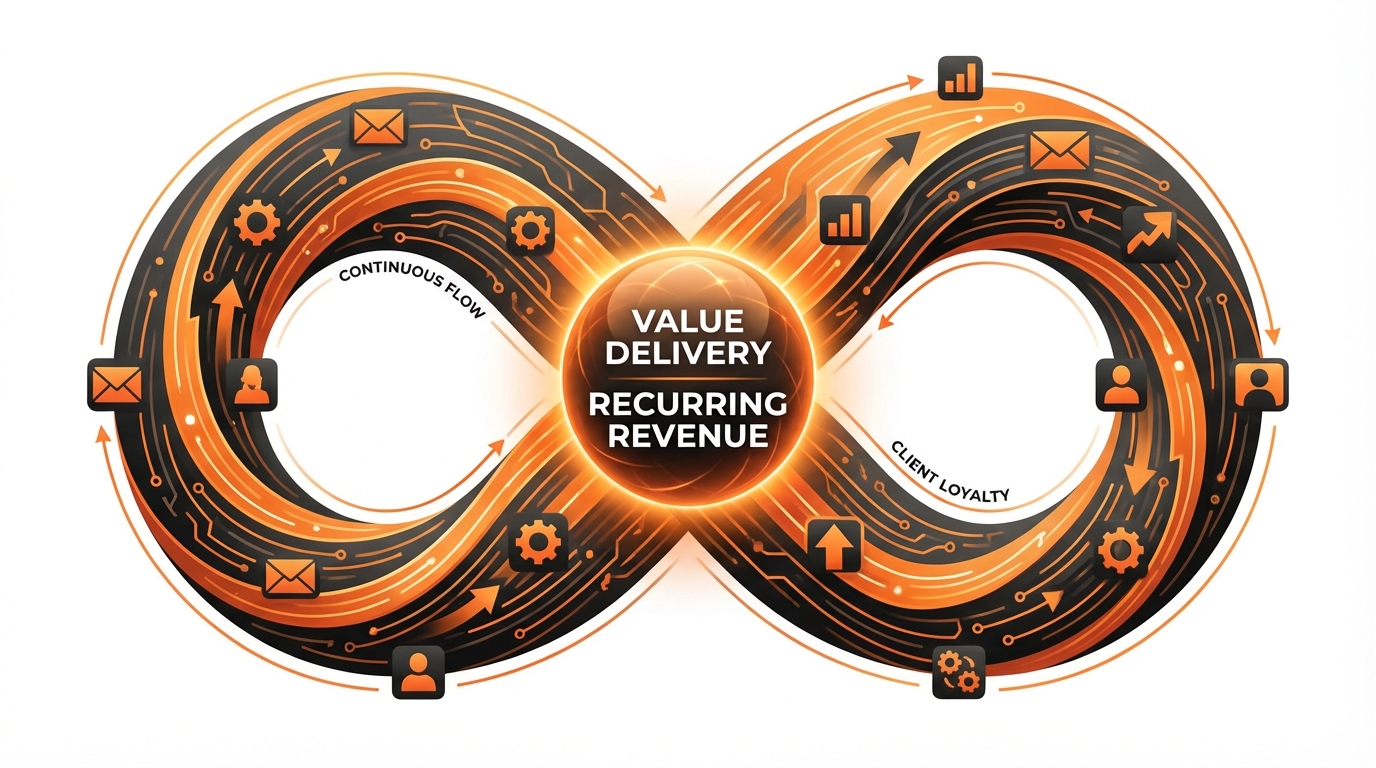
The deal is closed. Now, the real work begins. Your first client is the foundation of your agency. They provide the critical first testimonial, the essential case study, and your initial referral source.
Our goal is non-negotiable: 100% retention for the first 12 months.
The Power of Over-Delivering (The 90-Day Trust Accelerator)
Do not just meet the contract requirements. Exceed them. In the first 90 days, your focus must be on generating immediate trust and measurable results.
We leverage quick wins to secure the relationship instantly. This buys you the necessary runway to execute the long-term, complex strategy.
Reporting is Retention: Communicating ROI
Clients do not cancel when they *see* the value. Value is not inherent; it must be communicated clearly, consistently, and tied directly to their bottom line—revenue.
Stop sending overwhelming vanity metrics. Your client, likely a CEO or business owner, does not have time for a 50-page Google Analytics report. They need the answer to one question: Investment vs. Return.
Implement the 1-Page Executive Summary Framework:
- **Discard:** Long, dense reports filled with impressions, clicks, and non-revenue-driving KPIs.
- **Focus On:** Revenue generated, Customer Acquisition Cost (CAC), and Lifetime Value (LTV). These are the metrics that drive CEO decisions.
- **Delivery:** A concise, 1-page executive summary that explicitly contrasts Investment vs. Net Return.
We utilize strategic monthly reporting to ensure clients understand the ROI, turning a satisfied client into a loyal partner. Mastering this framework is non-negotiable for scaling. Review our guide on Strategic Monthly Reporting: Agency Client Retention to implement this system immediately.
Frequently Asked Questions

How do I handle the ‘No Experience’ objection?
We pivot the conversation immediately, focusing on strategic insight over historical volume. When faced with this objection, state clearly:
- “I haven’t worked with 50 clients—which is precisely why I can dedicate 100% of my focus to your results.”
- “I already conducted a deep audit on your business, identifying a $15,000 revenue opportunity.”
- “My experience doesn’t matter; the strategic insight I bring today does.”
Ensure you leverage the Zero-Client Case Study (Step #3) to prove competence instantly. This shifts the focus from your past to their future results.
Should I work for free to get my first client?
Absolutely not. Working for free fundamentally devalues your service and sets a poor precedent. We distinguish between strategic assessment and implementation:
- **The Strategy:** Offer the high-value, unpaid strategic assessment (the initial audit and growth projection from Step #3). This proves capability and builds instant trust.
- **The Implementation:** If they want you to execute the strategy, they must pay the full setup fee and retainer.
Strategic assessment is a marketing tool; free implementation is a business killer.
What is the ideal price point for a first client retainer?
Your price point must be high enough to sustain exceptional quality delivery. For specialized B2B services, a retainer below $2,500 signals low value and compromises the results you can deliver.
- **Target Range:** Aim for $3,000 to $5,000 per month.
- **Required Fee:** Always include a setup fee ($1,000 to $2,000).
If a client cannot afford this, they are outside your Ideal Client Profile (ICP). They will inevitably become a high-maintenance, low-profit liability.
How long should my first contract be?
We mandate a minimum 90-day contract, transitioning to month-to-month thereafter. Digital marketing results—especially in SEO and content strategy—require time to materialize and compound.
The 90-day minimum provides the necessary runway to prove the Return on Investment (ROI), securing the long-term relationship. Always include a clear, 30-day cancellation clause. This demonstrates transparency and immediately builds trust.
Ready to take the next step?
Try AI Lead Generation Today
Click HereReferences
- To Digital Marketing Agency Owners: How Did You Get Your First …
- How to Get Your First Digital Marketing Client: A Complete Guide
- 5 Key Strategies to Land Clients for Your Digital Marketing Agency
- Get Your First Digital Marketing Agency Clients | SMMA Clients 2025
- Getting first client for marketing agency? – Facebook